Oct 20, 2010

Cost, price, wind & value of wind as wind drops

DailyKOS  ...There was a conference on the subject last week in Atlantic City which I attended, and which generated a lot of attention (with over 1,500 attendees) and during which the federal lease for Cape Wind was signed.

While no turbine has been built in the US yet*, there are high hopes that there will be some in the near future, and one of the ways to make that happen faster is to absorb the lessons from the European experience, where close to 2,500 MW have been built already. So here's my take on what can be usefully learnt.

Part of my series on Wind Power with the usual disclosure that my work (as an independent consultant) is to advise offshore wind projects find debt financing.

....support to be economically attractive to private investors,  offshore wind requires an unusual level of regulatory effort to work:

  • first, the economics need to make sense.

    While offshore is more expensive than onshore,   see my article on the cost of wind, the price of wind, the value of wind).

  • the biggest obstacle in the US: the instability created by the PTC mechanism, which needs to be extended every year or couple of years, is well documented and has led to under-investment in US factories by manufacturers, who fear that the market will disappear on them every now on them (as is happening - again - this year);


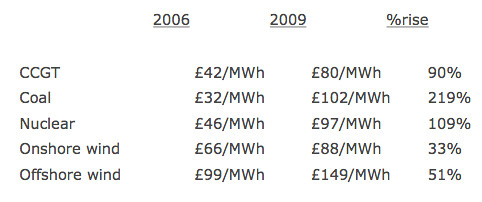
...While many have expressed worries about the fact that the cost of offshore wind has pretty much doubled over the past 5 years, this can be discounted for several reasons:

  • prices were driven up by the cost of commodities (steel, in particular, for offshore wind); this applied equally to other technologies, which have seen their prices move in the same direction even more for the same reason;

    Source: UKER

Please read full at DailyKOS


PFI - Offshore deals tests banks as wind drops
UK wind speeds have been at 180 year record lows this year - raising concerns about the reliability of wind as an energy source.
With UK wind speeds at 180 year low... Two projects in the embryonic but fast growing offshore wind sector are currently seeking debt finance. The sponsors, large European utilities, want to transfer construction risk on the deals to the banks to keep the financings off their balance sheets. A further test for the financiers is the fact.
Despite the risks, neither scheme has a construction guarantee from the sponsors. And there is plenty of risk on offshore deals...

It's not windy
The deals are being launched as it has become clear 2010 has been a bad year for UK wind speeds, perhaps the worse since 1821. Wind speeds clearly have a direct impact on energy MW yields from wind.

A recent report from wind consultancy Garrad Hassan said UK wind yields have dropped this year to perhaps a 1 in 15 year event due to stable high pressure. Energy levels from wind dropped 27.8% in the first quarter compared with the average and 18.3% in the second quarter... The much bigger question, however, is for energy planners. Relying on a variable source of energy creates problems in terms of day-to-day security of power supply, particularly if wind accounts a quarter of the country's power generation by 2030 as planned in the UK.


Read more at Reuters

Owners & Reality Weigh in on Environmental Business Costs

A new report highlighting the economic benefits of the Clean Air Act.


Or did it?

HAASE - I am curious how this report correlates to the  "Impact of Regulatory Costs on Small Firms Report" by the U.S. Small Business Administration stating that the annual cost of federal regulations in the United States increased to more than $1.75 trillion in 2008. Had every U.S. household paid an equal share of the federal regulatory burden, each would have owed $15,586 in 2008?

They put the cost of environmental regulations in a range between between $175 billion and $280 billion when converted into 2009 dollars. This report uses the high end of the cost range provided in the OMB reports and Hahn and Hird (1991). This reflects a judgment that cost estimates are absent for important environmental regulations and that government agencies tend to be conservative in estimating regulatory costs????


Medieval Italian Town Powered By & Selling WindPower

With renewable power, Tocco da Casauria, in central Italy, produces more electricity than it uses, making money off the surplus.

HTML clipboard

It's a remarkable story.  In central Italy, where ancient towns and villages are tucked into the mountainous landscape, suddenly giant wind turbines can be seen on the horizon. 

Faced with sky-high electricity rates, small communities across a country known more for garbage than environmental citizenship are finding economic salvation in making renewable energy. More than 800 Italian communities now make more energy than they use because of the recent addition of renewable energy plants.

A quintessential Italian town of 2,700 people in Italy's poor mountainous center, with its well-maintained church and ruined castle, Tocco is in most ways stuck in yesteryear. Old men talking politics fill gritty bars, and old women wander through the market. The olive harvest is the most important event on the calendar.

Yet, from an energy perspective, Tocco is very much tomorrow. In addition to the town's wind turbines, solar panels generate electricity at its ancient cemetery and sports complex, as well as at a growing number of private residences.

read more at NY Times… (Via Amherst Times)

Pollution Bill directly targeted at the consumers wallet

New Tactic in California for Paying Pollution ...Faced with a fine of at least $29 million for exceeding federal ozone limits, the San Joaquin Valley's air quality regulators are proposing an annual surcharge of $10 to $24 on registration fees for the region's 2.7 million cars and trucks beginning next year. A decision is expected when the governing board meets on Thursday.

"We, the people, are the ones whom we need to point the finger at," said Seyed Sadredin, executive director of the San Joaquin Valley Air Pollution Control District, which administers federal and state pollution laws here.

"I think it's fair to say that this is the first time that a strategy has been directly targeted at the consumer, not at the manufacturer of the car or the manufacturer of the engine or of all the other pieces," said Susana M. Hildebrand, the chief engineer for the Texas Commission on Environmental Quality.

A provision of the Clean Air Act that sets fines for exceeding pollution limits originally required industrial companies to pay them; in fact, the provision, which was added to the law in 1990, was specifically devised "as a hammer to get them to do more," as Mr. Sadredin put it.

This year, regulators here and around the country got the Environmental Protection Agency's approval to try alternative approaches like the surcharge. The California Legislature had already given the San Joaquin district the authority to impose fees up to $24 after regulators argued that local industries had done everything technologically feasible to control their emissions.

"We're saying that for the privilege of driving in the valley, paying an extra $1 a month is preferable to charging industry $29 million," Mr. Sadredin said.

Please read on at NY Times

Chavez in Russian & Iran for talks on boosting oil, gas and Nuke Deals

HI, We are in control of your oil... and hate you.

UPI POY 2009 - News and Features.Chavez in Iran for talks on boosting oil, gas ties ... nothing is going to stop us, we are free, sovereign and independent."

AP/FoxNews- Venezuelan President Hugo Chavez was holding talks Tuesday with Iranian leaders expected to focus on boosting cooperation between the countries' oil, gas and petrochemical industries.

Chavez, who is on his ninth visit to Iran as president, praised Caracas' ties with its close Mideast ally, saying they "are solid and very, very deep." In remarks carried on Venezuelan state television, Chavez said relations with Tehran are based both on "shared interests" and a mutual belief in the importance of Iranian sovereignty.

The Venezuelan leader, who has backed Iran in its confrontation with Western powers over Tehran's disputed nuclear program, said he and Ahmadinejad would discuss "the tensions that (U.S.) imperialism is generating" in the Middle East and "the unfair sanctions imposed on the people of Iran," referring to the U.N. sanctions imposed on Iran over its refusal to halt uranium enrichment.

HTML clipboard
Total Imports of Petroleum (EIA)
(Thousand Barrels per Day)
Country Jul-10

CANADA
MEXICO
NIGERIA
VENEZUELA

HTML clipboard
UPI - Venezuela-Russia nuke deal a new headache for U.S., IAEA
U.S. State Department spokesman Philip Crowley said in Washington the United States hoped both Russia and Venezuela would act responsibly and adhere to IAEA rules. Comparisons with the Iran nuclear row figured in Crowley's briefing with reporters.
OPEC Crude Oil Production 2009
Any criticism of Chavez is readily equated in Caracas with ill intentions toward Chavez but oil-rich Venezuela this year won dubious distinction as the only major Latin American economy to shrink despite steady income from crude oil exports.

Prolonged outages of power and water supplies in 2009 and this year, which exacerbated popular discontent, were partly the result of severe drought but expert evidence cited in the government's own performance reports cited inefficiencies and waste.

Poor investment in the energy sector was also blamed for the energy crisis. A stopgap investment program to upgrade the infrastructure at a cost of $192 million was seen by opposition critics as too little too late.

The 500 megawatt Russian-built power station could take several years to be ready but Chavez faces elections next year and has seen his congressional majority halved in recent polls.

After a deal signed during his ninth visit to Moscow since coming to power in 1999, Chavez announced: "Venezuela is on its way to getting nuclear power. I hardly need to say so but I'll say it anyway: for peaceful purposes, of course." ....the deal follows more than $4 billion of Russian military sales, at least $2.2 billion on flexible credit terms. The deal enabled Russia to transfer Soviet-era military hardware to Venezuela as part of its strategy to stimulate Russian arms industries. Included in the deal are about 100 T-72 tanks, fighter jets and helicopters, short-range missiles and 100,000 Kalashnikov rifles of an earlier make.

Opposition critics of Chavez say the arms buying is superfluous to Venezuela's needs.

Chavez says Venezuela needs the weapons to defend itself against foreign adversaries among which names Colombia and the United States.

PeakChina - The Three Chinas

Watts Up With That-  The choices we make about energy, the environment and climate will be limited by The Three Chinas.
  1. The Real China - One of the Chinas is very real and familiar. It has a population of 1.4 billion.HTML clipboard

    China is developing quickly, trying to do in 50 years what America did in 100. As a result, they have doubled their energy use since 2000, becoming the largest energy user in the world.

    China's energy use may well double again by 2020. (The figures in the report did not match reality, but their estimate of 7.5% annual growth looks fairly okay).

    Coal currently provides 70% of China's energy. That may drop to 65% by 2020. It may not.

    If China doubles its energy use (to 200 quads) and 65% of it comes from coal, that will be 130 quadrillion BTUs generated from burning coal, in China, in 2020.

     China's coal plants are much dirtier than those used in the developed world.

  2. The Second China - This very real China will be replicated by the natural growth of the human population to 8.5 billion by 2035, and 9.1 billion at its peak later this century. That's more than the entire population of China. As many of them will actually be born in China, and many more will form part of our third 'imaginary' China, it is appropriate to limit the Second China to the size of the real one.
  3. The Third China - While China is developing quickly, so is the rest of the developing world. As countries develop, the people living in them get richer. They buy cars, appliances, computers, and begin to use more energy.

Can effort & fitness add 8 years?

The Associated Press reports it's the latest evidence for an apparent Hispanic paradox.

NPR - it turns out, Hispanics born recently can expect to live longer.
How much longer? Well, a Hispanic person born in 2006 can expect to live to the ripe old age of about 80 years. For non-Hispanic the expected lifespan can be up to 8 years shorter.

...about 39 percent of the 45 million Hispanics — are immigrants.
Moving from one country to another takes some effort and fitness. So the United States may be attracting relatively healthier people from Mexico, the largest source of Hispanic immigrants, and other countries, according to the AP.

China Halting Shipments of Rare Earth Minerals To US

China, after putting at least a temporary stop to rare earth exports to Japan, is now doing the same with exports to the US; according to the linked article, this is in response to recent US promises to investigate certain Chinese trade practices. - SlashDot

Disposable life...Life Expectency a Home's Technology

HTML clipboard

A HipHugger - ...the National Association of Home Builders has released a new study detailing the lifespans of many of our home's electronics. So...about how long can you expect to have that new fridge?appliances for sale photo

The Study of Life Expectancy of Home Components lists everything from building materials to technology...Many of our major household appliances and gadgets will last over a decade, which is excellent when it comes to keeping what we have for as long as possible. It notes items such as:

Appliances:
* Dishwasher: 9 years
* Food Waste ("Garbage") Disposer: 12 years
* Microwave Oven: 9 years
* Gas Range:15 years
* Standard Refrigerator: 13 years
* Freezer: 11 years
* Washer: 10 years
* Gas Dryer: 10 years
* Furnaces: 15 to 20 years
* Tankless Water Heater: 20+ years
* Gas Water Heater: 10 years
* Heat/Smoke Detectors: 5 to 10 years
* Wireless Home Networks: 50+ years

See more at A HipHugger

Oct 19, 2010

Upper Mississippi River now a "Wetland of International Importance"

WI -DNR: The floodplain forests along the Upper Mississippi River, including more than 130,000 acres in Wisconsin, are now officially recognized as a global treasure.
HTML clipboard
"The designation is a recognition of just how critically important this is for a multitude of species," says Jeff Janvrin, a Department of Natural Resources fisheries biologist who has worked on habitat restoration projects along the river for more than 20 years. "It's also recognition of the hard work people have been putting in to protect the river over the many generations."

The complex series of forested backwater channels, marshes and islands in Wisconsin, Minnesota, Illinois and Iowa are home to more than 100 fish species and 42 mussels species. Mississippi River wetlands provide habitat to more than 300 birds and a flyway for 40 percent of the waterfowl in America. A slideshow featuring a sampling of these natural resources is found on the Wisconsin Wetlands page of the DNR website.

BPA Declared Toxic In Canada

NY Times — The government of Canada formally declared bisphenol A, a chemical widely used to create clear, hard plastics, as well as food can liners, to be a toxic substance on Wednesday.

The compound, commonly known as BPA, has been shown to disrupt the hormone systems of animals and is under review in the United States and Europe.

Canada's move, which was strenuously fought by the chemical industry, followed an announcement by the government two years ago that it would eliminate the compound's use in polycarbonate bottles used by infants and children.

The compound was formally listed as being toxic to both the environment and human health in an official notice published online by the government without fanfare, a noticeable contrast to the earlier baby bottle announcement, which was made by two cabinet ministers.

"Environment Canada's announcement is contrary to the weight of worldwide scientific evidence, unwarranted and will unnecessarily confuse and alarm the public," Steven G. Hentges, who leads the polycarbonate and BPA group at the council, said in a statement.

Rick Smith, the executive director of Environmental Defence, a group that lobbied for the designation, said he hoped that the government would ban BPA from infant formula can linings.

"This toxic designation is a very strong regulatory power that gives them firm legal footing on any number of things," Dr. Smith said.

Read more at NY Times & Qfficial notice at Gazette


Haase - Didn't I report this back in 2006?

'Humans will need two Earths by 2030'

USA Today "The over-use and pollution of Earth's natural resources have become so extreme that, at current rates, a second planet will be needed by 2030 to meet the world's needs, a new report warns. The Living Planet Report tells that the demands on natural res HTML clipboardources have doubled in the past 50 years and are now outstripping what the Earth can provide by more than half."

The planet's 6.8 billion people were living 50% beyond Earth's sustainable means in 2007, the latest year for which figures are available, according to the biannual "Living Planet" report by WWF.

"Even with modest U.N. projections for population growth, consumption and climate change, by 2030 humanity will need the capacity of two Earths to absorb CO2 waste and keep up with natural resource consumption," the report says, adding that four and a half planets would be needed if everyone used as many resources as the average American.

Its index of biodiversity health showed a loss of almost 30% worldwide and an even loss of 60% in the tropics between 1970 and 2007.

Please read full at USA Todaya


MIT solar-powered water desalination system

Slash..." HTML clipboard team from the Massachusetts Institute of Technology's Field and Space Robotic Laboratory has designed a new solar-powered water desalination system to provide drinking water to disaster zones and disadvantaged parts of the planet. Desalination systems often require a lot of energy and a large infrastructure to support them, but MIT's compact system is able to cope due to its ingenious design. The system's photovoltaic panel is able to generate power for the pump, which in turn pushes undrinkable seawater through a permeable membrane. MIT's prototype can reportedly produce 80 gallons of drinking water per day, depending on weather conditions."

First National Geothermal Student Competition - DOE

The U.S. Department of Energy (DOE) today announced the launch of its inaugural National Geothermal Student Competition.
Logo: U.S. Department of  Energy Blog
 DOE, through its Geothermal Technologies Program (GTP), will provide up to $100,000 to fund as many as 10 collegiate teams that will participate in this competition. In this intercollegiate competition—the first ever to address geothermal education—student teams will be challenged to advance their understanding of geothermal energy's potential as a significant contributor to our nation's energy portfolio. Geothermal technology allows for consistently produced energy by tapping into the heat of the earth and emits minimal greenhouse gases. Expanding the use of geothermal resources as a domestic energy source will play an important role in increasing America's energy independence.

The National Geothermal Student Competition is open to all colleges, universities and other post-secondary institutions in the United States. To participate in the competition, teams should submit proposals through DOE's National Renewable Energy Laboratory Request for Proposals link on its Business Opportunities Web page. Up to 10 teams will be selected to participate based on a competitive review of the proposals. Proposals are due November 12, 2010.

Read the full DOE Announcement here

DOE Cut Energy Use by 50% in Commercial Buildings

Find out how to save Billion$ of our nations energy loss from this free DOE Webinar October 28, 2010
LINK: Strategies to Cut Energy Use by 50 Percent in Commercial Buildings

Boycott BP is community Boycott?

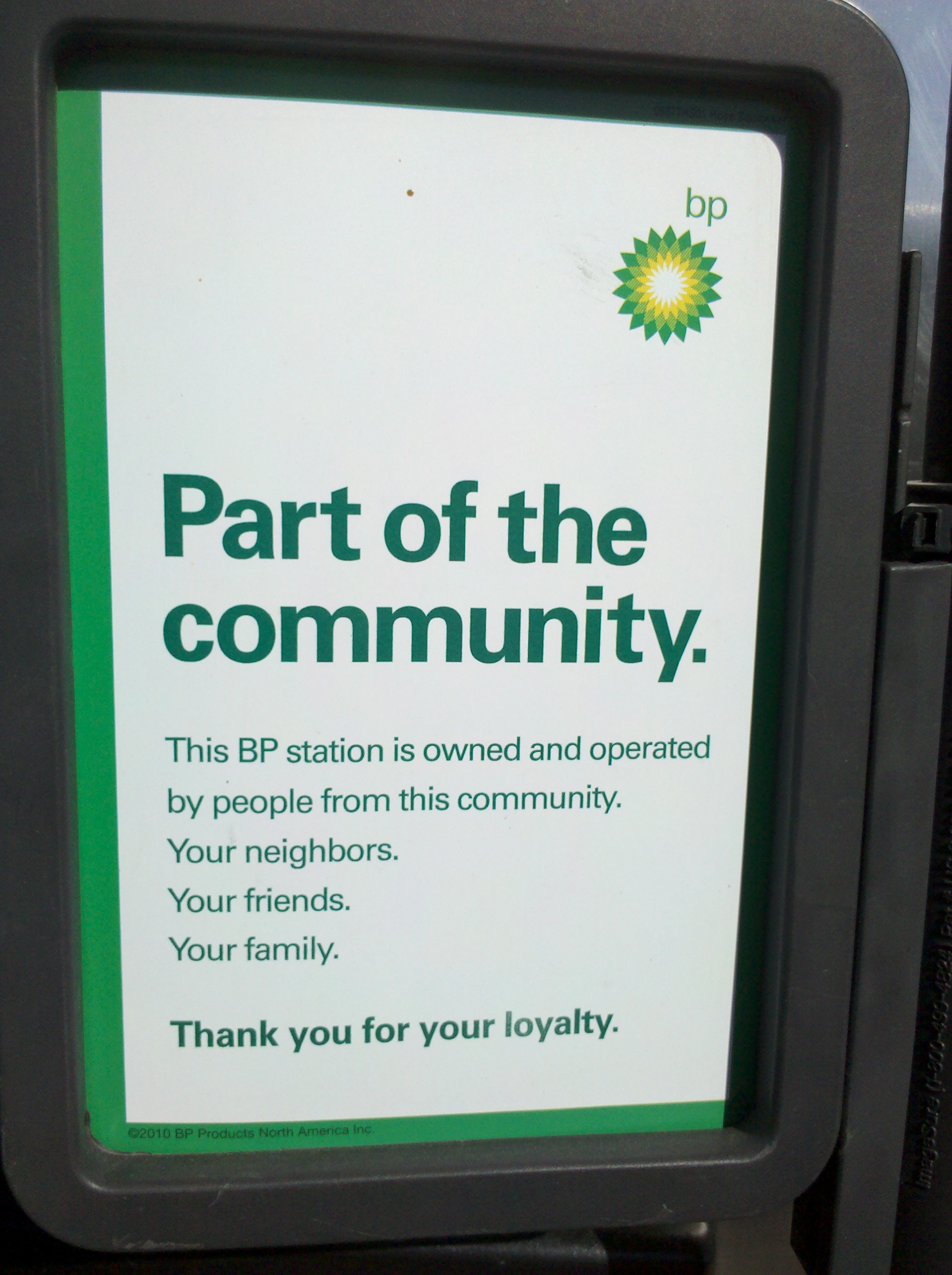
Socimages: a photograph of a public relations notice at a BP gas station explains that the owner of the BP gas station is a member of the community...HTML clipboard 

The notice is clearly an effort to smooth over the negative publicity BP has recieved as a result of the oil spill in the gulf.  On the one hand, it seems obvious that it's disingenuous for BP to claim that they are "part of the community." 

And, if one wants to boycott BP, one would not want to buy at a BP station. But, According to the National Association for Convenience Stores, 80% of the gas in the U.S. is bought at convenience stores and in only 2% of cases are these owned by major oil companies (the remainder is largely sold through superstores like Costco and Sam's Club).  57% of the time, these stores are owned by a person for whom it is a small business and it is the only convenience store they own.

So it is true that, in almost all cases, attempting to police or punish BP by refusing to buy their gas is also hurting a small business owner who has zero control over BP and its policies.

View original at socimages

First Aid - Do Something Get Trained!

Oct 18, 2010

In France the Oil War is On!

Independent -  France's oil industry association, said that if strikes continued at all 12 of France's refineries, then national shortages would follow... the French oil company, said 350 to 400 petrol stations were suffering disrupted supplies. Shortages looked set to worsen as lorry drivers pledged to halt road transport of fuel to filling stations from last night. The government has authorised oil companies to use emergency stocks, but has not yet touched its three-week strategic reserves. -Independent

Who Got Green Stimulus?

HTML clipboard HTML clipboard https://blogger.googleusercontent.com/img/b/R29vZ2xl/AVvXsEhPqzuFj9diQHVQNuBd6MQhR-16uLJppVfKKFBRW9iRE84BvXoCav-YmSX3x2t1XZgrtR5nF7XNSFJVswQreO5iUiSy4bRPwq53JWm-vXwB3Z4o9tIa-BaWaeH2fZDy-fXetdj_AA/s1600/FederalEmployment.bmpOf the Million$/Billion$ spent on "job and business creation" where did the "GreenBacks" go???
The $92million of stimulus funding was targeted at green jobs, only about $20million has been spent... of which 80% of funding for green programs, including $2.3billion in manufacturing tax credits, went to companies who employ their primary workforce in China, South Korea and Spain. - thehayride

It seems that grants for wind turbines and solar panels created manufacturing jobs overseas rather than domestically as the administration presumably envisioned.
HTML clipboard
For example, a report issued last fall by American University's Investigative Reporting Workshop that proved highly embarrassing to the administration indicated that eleven US wind farms used their stimulus grants to purchase over 70% of their turbines from overseas manufacturers...while most are livid, but little can be done to force domestic purchasing without creating a trade war. And the United Steelworkers union has filed a lawsuit against China accusing them of subsidizing their manufacturers of such products so as to own the market.
HTML clipboard
Quote of the week?
 "A generation which ignores history has no past and no future" - PragmaticAmerican

Oct 17, 2010

Wisconsin's Unsustainable education...kids to inherit our debt.

JS Online: West Bend, WI — After living beyond its means for decades and shifting its debt onto future generations, an entire society is seeing the bills come due earlier than expected.

"This is definitely the worst economic situation that school districts have faced since the Depression,"  The consequences are upon us. Three years ago, six librarians served West Bend's six elementary schools; this year, one librarian remains.
Next year, there likely will be none.

HTML clipboard

In Wisconsin alone...An unprecedented three of every four school districts cut teachers this year, with an estimated 1,000 educators terminated and at least as many phased out through attrition or reduced to part time, according to the Wisconsin Education Association Council.

But nowhere is the squeeze more evident than in West Bend, home to the state's 20th-largest school district as well as one of its highest unemployment rates and a fervent anti-tax sentiment that makes budget-cutting the only apparent option.

"Parents ask, 'What should we do with our children as the West Bend School District continues to cut and cut and cut programs,' " said Egan, a 20-year veteran who is likely to be reassigned to teach the regular curriculum.

For the first time since the Depression, virtually every strata of American government is caught in the same viselike squeeze: Cities, counties and states find themselves deep in debt and lacking rainy day reserves to tide them over in hard times. Even with federal stimulus funds, local governments are laying off police officers and teachers, closing firehouses and selling public assets. During the past two years, state and local governments nationwide have cut 242,000 jobs, and public schools have shed an additional 200,700, according to the U.S. Bureau of Labor Statistics.

"These kids are going to inherit our debt while we're cutting their programming," Herdrich said. "Meanwhile, overseas, Singapore, China and India are prioritizing education as their economic driver."

"In the past we just borrowed more and went on our merry way,"

Please read full at JS Online

Quote from "Keeping the Poor in Poverty"

"No one ever got a job from a poor man." - Phil GrammHTML clipboard http://verydemotivational.files.wordpress.com/2010/04/129169053672915750.jpg
...We can't expect to create more jobs if we punish the type of activity that creates jobs... if we wish to fight poverty, we must end those government policies — high taxes and regulatory excess — that inhibit growth and job creation. We must give people the opportunity to start new businesses and enable low-income Americans to save and accumulate wealth.

Believers in the free market often seem defensive when the topic is poverty. They shouldn't be.

Nothing has done as much to lift people out of poverty as capitalism and free markets. All one has to do is look around the world to realize that those countries that provide the most economic freedom have less poverty than those that are still mired in socialism and government control.

Compassion is more than talking about the plight of the poor or giving them just enough money to make poverty a bit more comfortable. Real compassion is about creating the conditions that will enable the poor to get out of poverty.


Hear a little gem from Milton Friedman - Greed:

"Capitalism and Freedom" (1962) advocated minimizing the role of government in a free market as a means of creating political and social freedom.

Haase - "History, learn from it or become it".

Mission is to empower public with health-care knowledge

WashingtonPost  Patient Centered Outcomes Research Institute's board. Leadership_img
If you're not familiar with the PCORI board, you're not alone. Created by the health-care overhaul law, it's one of the newest and least known panels in government. But the work of its 21 members, if successful, could increase the public's knowledge of medical treatments for everything from attention deficit and hyperactivity disorder to cancer. And it could dramatically change how you discuss treatments with your doctor when the law is fully implemented in 2014. "I was very excited," said Lipstein, president and chief executive of BJC HealthCare in St. Louis, which operates 13 hospitals with more than 26,000 employees.

HTML clipboard According to the legislation, the PCORI will act as a non-profit organization to assist patients, clinicians, purchasers, and policy-makers in making informed health decisions by carrying out research projects that provide quality, relevant evidence on how diseases, disorders, and other health conditions can effectively and appropriately be prevented, diagnosed, treated, monitored, and managed.

Learn more:

Marketing & Branding disease to sell cures

Carl Elliott, CNN - If you want to understand the way prescription drugs are marketed today, have a look at the 1928 book, "Propaganda," by Edward Bernays, the father of public relations in America. For Bernays, the public relations business was less about selling things than about creating the conditions for things to sell themselves. . . . HTML clipboard

To brand a disease is to shape its public perception in order to make it more palatable to potential patients. Panic disorder, reflux disease, erectile dysfunction, restless legs syndrome, bipolar disorder, overactive bladder, ADHD, premenstrual dysphoric disorder, even clinical depression: All these conditions were once regarded as rare until a marketing campaign transformed the brand.

Once a branded disease has achieved a degree of cultural legitimacy, there is no need to convince anyone that a drug to treat it is necessary. It will come to him as his own idea.

Disease branding works especially well for two kinds of conditions. The first is the shameful condition that can be destigmatized. For instance, when Pharmacia launched Detrol in the late 1990s, the condition the drug treated was known to doctors as "urge incontinence." Patients called it "accidentally peeing in my pants" and were embarrassed to bring it up with their physicians.

Pharmacia fixed the problem by rebranding the condition as "overactive bladder." Whereas "incontinence" suggested weakness and was associated mainly with elderly women, the phrase "overactive bladder" evoked a supercharged organ frantically working overtime. To qualify for a diagnosis of "overactive bladder," patients did not actually have to lose bladder control." They simply needed to go to the bathroom a lot. Please read full by Carl Elliott at CNN

...There Is No "Plan B"?

The hard news is that there is no "Plan B." (cMartenson's Blog)
The future is likely to be more chaotic than you probably think...The impact of Peak Oil on markets, lifestyles, and even national solvency deserves our very highest attention - but, it turns out, some important players seem to be paying no attention at all.

But there were two reports that really stood out for me.
The first was given by Rear Admiral Lawrence Rice, who presented the findings of the 2010 Joint Operating Environment (a forward-looking document examining the trends, contexts, and implications for future joint force commanders in the US military), which spends 76 pages summarizing the key trends and threats of the world. "Energy" occupies six of those pages, and Peak Oil dominates the discussion. Among the conclusions (on page 29), we find this hidden gem, which uses numbers and timing that are eerily similar to those that I put forth in my April 2009 report, Oil - The Coming Supply Crunch:
By 2012, surplus oil production capacity could entirely disappear, and as early as 2015, the shortfall in output could reach nearly 10 MBD.
While there are two "coulds" in that statement, the mere possibility that such an imminent arrival and massive shortfall could be true should give every prudent adult a few second thoughts about what the future may hold. If surplus production capacity disappears in just a couple of years, there is an entire world of planning that should take place beforehand at the international, national, community, and personal levels.

A severe energy crunch is inevitable without a massive expansion of production and refining capacity. While it is difficult to predict precisely what economic, political, and strategic effects such a shortfall might produce, it surely would reduce the prospects for growth in both the developing and developed worlds. (p. 28)

Well, the amounts needed from OPEC are quite, shall we say, 'ambitious,' as they amount to an additional two Saudia Arabias coming on line in order to make up the shortfall. A massive crunch is not otherwise avoidable. Let's be honest; there are no more Saudia Arabias to be found.

No plans = unnecessary chaos.
HTML clipboard
While we can expect that such plans will be tossed together when necessary, I would hope that Katrina taught us a few lessons about developing plans on the fly after the disaster has already arrived. Sure, things got done, but they were certainly suboptimal and led to more confusion and more chaos than if they had been carefully developed, practiced, and debugged.

The way that I understand the lack of planning on the part of the civilian side is that Peak Oil does not present any easy political wins, if any at all. Given the two-year planning cycle in DC, it's never a good time to bring up such an unpleasant subject. Politics trump necessity.

...That's the source of my discomfort. It's not necessarily that large organizations are beginning to share my sense of timing and impact of Peak Oil, although that will hasten the tipping point of awareness. It's that somehow I always thought that because Admiral Hyman Rickover knew well that this day would come (in the 1950's!), 60 years would have been sufficient lead time to assemble some credible plans.


The lack of planning also betrays a very common attitude, which might be summarized as, "We'll deal with that when we get there."

 I detect this attitude in a wide range of individuals and market participants, so it's not at all uncommon. However, I think it's a mistake to hold this view. When (not if, but when) full awareness of Peak Oil arrives on the international stock, bond, and commodity markets we will discover just how narrow the doorways really are. Only a few will manage to preserve their wealth by squeezing through the doorway early; most will not make it through. As mentioned frequently on this site, our
What Should I Do? guide for developing personal resiliency against a Post-Peak future offers a valuable resource for those just getting started in their preparations.

Oct 16, 2010

The next oil shock?

VIA the BigGav - HTML clipboard Oil is "the lifeblood of modern civilisation". This paper provides an overview of the global oil market. In particular, it examines the outlook for oil supply and demand over the next five years, and the economic consequences.
  • Low-cost reserves of oil are being rapidly exhausted, forcing oil companies to turn to more expensive sources of oil. This replacement of low-cost sources of oil with higher-costs sources is driving the price of oil higher. 
  • While the world will not run out of oil reserves for decades to come, it cannot indefinitely continue to produce oil at an increasing rate from the remaining reserves. Forecasts indicate that world oil production capacity will not grow or fall in the next five years while demand will continue to rise.
  • If oil production capacity does not rise as fast as demand, the buffer of spare production capacity disappears. In such a 'supply crunch' the price of oil 'spikes' to high levels. High oil prices can induce global recessions.
  • Organisations including the International Energy Agency and the US military have warned that another supply crunch is likely to occur soon after 2012 due to rising demand and insufficient production capacity
  • There is a risk that the world economy may be at the start of a cycle of supply crunches leading to price spikes and recessions, followed by recoveries leading to supply crunches

Oil market basics

Not all oil is the same. The source and the quality vary. The graph below shows approximate oil reserves divided by type of reserve and production cost.

Estimates of the total amount of oil are hotly debated. The typical estimate is that there were originally between two and three and a half trillion recoverable barrels of conventional oil. [6]  

So far, about 1.3 trillion barrels of oil – mostly the cheapest, most easily accessible, highest quality oil – have been produced, leaving about 1.7 trillion more barrels of conventional oil in the ground. It is estimated that a further six trillion barrels of non-conventional oil could be produced from sources such as tar sands, bitumen, and gas or coal-to-liquids. [7]  

Not all the oil that is thought to be in the ground has been found. The key measure of discovered oil is "proven reserves" (also called "proved reserves"), which is the amount of oil in a given field that the owner is 90 percent confident is present and can be extracted with existing technology. [8]   As of 2009, the official total of proven reserves worldwide, including non-conventional reserves, stood at 1.25 trillion barrels of conventional oil and 150 billion barrels of Canadian oil sands. [9]   At the rate of production forecast by the United States Energy Information Agency, [10]   proven reserves would be sufficient to meet world demand for another 25-32 years, providing that oil production capacity can continue to expand.

Few big oil reserves have been found in recent decades. Oil companies must drill more wells in increasingly difficult and expensive locations to find the remaining undiscovered reserves. Oil discovered per new well is declining. In 17 years between 1963 and 1980, 15,000 wells found nearly 1.5 trillion barrels of oil. In 22 years between 1980 and 2002, 60,000 more wells found half as much new oil. It now takes approximately 10 wildcat wells on average to discover the same quantity of reserves as a single wildcat well would discover 50 years ago. [11]  

The diagram below illustrates the world's oil reserves, along with the average daily additions to and the consumption of those reserves.

Read full at parliament

Transport Policy at Its Worst

BigGav - New York Times has a column on the inability of the United States to build new transport infrastructure

"The Chinese could build it. The Turks could build it. We can't build it. "
We are the mightiest nation mankind has ever seen. But we can't seem to build a railroad tunnel to carry commuters between New Jersey and New York.
...The project had been in the works for 20 years, and ground had already been broken when the governor of New Jersey, Chris Christie, rejected the project on Thursday, saying that his state could not afford its share of the costs.

This is a railroad tunnel we're talking about. We're not trying to go to the Moon. This is not the Manhattan Project. It's a railroad tunnel that's needed to take people back and forth to work and to ease the pressure on the existing tunnel, a wilting two-track facility that's about 100 years old. What is the matter with us?


More NY Rail FAIL...
 
UPDATE:
When New Jersey Governor Chris Christie recently pulled out of the proposed Hudson River rail tunnel, angst gripped the editorial pages of the New York Times and elsewhere...they fail to mention that Christie vetoed the project because huge cost overruns would have imposed a crushing burden on New Jersey taxpayers. Paul Krugman (not surprisingly) counters that getting rid of what economists call “externalities” (such as traffic congestion) would magically transform the multibillion-dollar expenditures from red to black ink. Therefore, a costly boondoggle always can be justified as a net plus for taxpayers. Krugman writes:
It was a destructive and incredibly foolish decision on multiple levels. But it shouldn’t have been all that surprising. We are no longer the nation that used to amaze the world with its visionary projects. We have become, instead, a nation whose politicians seem to compete over who can show the least vision, the least concern about the future and the greatest willingness to pander to short-term, narrow-minded selfishness.
I hate to interrupt this self-righteous pity party, but if there ever were a “Not So Fast” moment, this is it. A public-works project such as the proposed tunnel makes sense if over time the marginal benefits outweigh the marginal costs. If they do not, then it provides a benefit to some at the expense of others,

Today, we see economic analysis turned on its head. Projected cost overruns suddenly are justified because “they provide jobs,” as though higher costs mean more wealth created...this was a multibillion-dollar project to aid a subsidized industry, which means that in the end, it would have enabled the consumption of more wealth than it allegedly would create. 
 
In contrast, the existing rail tunnel under the Hudson was built by the Pennsylvania Railroad a century ago, and despite the modern declarations that government must provide such things, the company did it because it was good business. There was none of the convoluted “this lowers externalities” arguments we hear from people like Krugman as justification for the rail tunnel. The old tunnel was governed in large part by market prices so there was a market-driven return on investment.

China 150 to 253 gigawatts of wind power by 2020

physorg - China's wind power capacity will increase more than five-fold over the next decade from 2009,
, as the country steps up its drive to
develop clean energy.

"It can choose between the dirty, dangerous world of coal and fossil fuels, or the new, clean future promised by wind. The answer is obvious."

Total installed capacity will reach at least 150 gigawatts by 2020 compared with 25.8 gigawatts at the end of 2009, according to the China Wind Power Outlook 2010 report.

A more ambitious forecast by the publishers of the report -- Greenpeace, the Chinese Renewable Energy Industries Association (CREIA) and the Global Wind Energy Council (GWEC) -- is 230 gigawatts over the next 10 years.

That would be equal to 13 times the capacity of the Three Gorges Dam and could cut 150 million tonnes of coal consumption - physorg

Is the US Already Past the Point of Peak Water?


Hugger - Peak water has been a concern for several years now, with many nations already experiencing extreme water shortages, even to the point of violence. But here in the US, it seems that water will continue to flow from faucets indefinitely. If only that were the case... In the southwest where it is arid in the first place, water crunches after years of drought are already serious, and water supplies even in more precipitous areas need to be tightly regulated. When it comes to peak water, the US is certainly not immune.


Nearly a billion people in the world don't have access to clean water right now,
In an article on Huffington Post, Gleick writes of three types of peak water: renewable, where water flows are constrained over time; nonrenewable, such as groundwater sources, where we pull more than can be naturally replenished; and ecological, which is the point beyond which the cost to the local ecology of using the water is higher than the value of using it for human consumption. According to Gleick, we seem to have hit the limits of all three.

There is strong evidence that the United States may have already passed the points of peak water, including peak renewable, nonrenewable, and ecological water, in many watersheds, especially (but not exclusively) in the more arid west. Indeed, when we look at data on total water withdrawals and use in the US... it shows that maximum water use occurred more than 30 years ago, and that we are now using less water overall, and much less water per person, than in 1980.
The bad news is that this suggests we have reached, or passed the point of peak water -- as is increasingly obvious in the regions I've mentioned above.
The good news, however, is that we have been able to continue to grow our economy and meet the demands of growing populations, with less and less water, through smart technology, regulations, education, and water conservation and efficiency programs. I think we're in a transition to a new way of thinking about and managing our water. And the sooner the better.


World water statistics from the world water week
HTML clipboard
  • Of all water on earth, 97 % is salt water, and of the remaining 3 % fresh water, some 70% is frozen in the polar icecaps. The other 30% is mostly present as soil moisture or lies in underground aquifers.

  • Less than 1% of the world's fresh water is readily accessible for direct human uses.

  • Global water use: Agriculture 70 %, Industry 20 %, Domestic use 10 %.

  • A child born in the developed world consumes 30 to 50 times as much water as one in the developing world.

  • With rapid population growth, water withdrawals have tripled over the last 50 years.

  • An estimated 90% of the 3 billion people who are expected to be added to the population by 2050 will be in developing countries, many in regions already in water stress where the current population does not have sustainable access to safe drinking water and adequate sanitation.

  • The 10 largest water users (in volume) are India, China, the United States, Pakistan, Japan, Thailand, Indonesia, Bangladesh, Mexico and the Russian Federation.

  • Water withdrawals are predicted to increase by 50 percent by 2025 in developing countries, and 18 per cent in developed countries.

  • In 2030, 47% of world population will be living in areas of high water stress.

  • By 2030 the number of urban dwellers is expected to be about 1.8 billion more than in 2005 and to constitute about 60% of the world’s population. As the urban population increases, many major cities have had to draw freshwater from increasingly distant watersheds, as local surface and groundwater sources no longer meet the demand for water, or as they become depleted or polluted

  • To ensure our basic needs, we all need 20 to 50 litres of water free from harmful contaminants each and every day.

  • Almost one-tenth of the global disease burden could be prevented by improving water supply, sanitation, hygiene and management of water resources. Such improvements reduce child mortality and improve health and nutritional status in a sustainable way.

  • Up to 50% of malnutrition is related to repeated diarrhoea or intestinal nematode infections as a result of unclean water, inadequate sanitation or poor hygiene.

  • 87 per cent of the world’s population - 5.7 billion people - uses drinking water from improved sources. 54 per cent uses a piped connection in their dwelling, plot or yard, and 33 per cent uses other improved drinking water sources such as public taps, standpipes, tube wells or boreholes, protected dug wells, protected springs and rainwater collection.

  • Current trends suggest that more than 90% of the global population will use improved drinking water sources by 2015.

  • 884 million people – about half of whom live in Asia – still rely on drinking water from unimproved sources such as ponds, streams, irrigation canals and unprotected dug wells.

  • 30 to 40% of water or more goes unaccounted for due to water leakages in pipes and canals and illegal tapping.

  • Some African countries have been making rapid progress in drinking water coverage. For example, Tanzania was only 38% covered in 1990, and in 2002 was 73% covered; Namibia was 58% covered in 1990, and in 2002 was 80% covered.

  • Improved water supply reduces diarrhoea morbidity by 21%.

  • Improved sanitation reduces diarrhoea morbidity by 37.5%.

  • Hygiene interventions including hygiene education and promotion of hand washing can lead to a reduction of diarrhoeal cases by up to 45%.

  • the total annual economic benefits of meeting the MDG target on water supply and sanitation accrue to USD 84 billion.

  • Economic losses, due to the lack of water and sanitation in Africa as a result of the mortality and morbidity impacts, are estimated at $28.4 billion or about 5% of GDP.

  • Poor countries with access to clean water and sanitation services experience faster economic growth than those without: one study found that the annual economic growth rate was 3.7 % among poor countries with better access to improved water and sanitation services, while similarly poor countries without access had an annual growth of just 0.1 %

  • Today, irrigated agriculture covers 275 million hectares – about 20% of cultivated land – and accounts for 40% of global food production.

  • Feeding everyone in 2050 – including the undernourished and additional 3 billion people expected – could require 50 % more water than is needed now.

  • Industry and energy together account for 20% of water demand