 The Congressional Budget Office (CBO) developed a hypothetical future fleet, based on the Navy's shipbuilding plan, of new destroyers and amphibious warfare ships that are candidates for nuclear propulsion systems. Specifically, CBO chose for its analysis the Navy's planned new version of the DDG-51 destroyer and its replacement, the DDG(X); the LH(X) amphibious assault ship; and the LSD(X) amphibious dock landing ship. CBO then estimated the life-cycle costs for each ship in that fleet—that is, the costs over the ship's entire 40-year service life, beginning with its acquisition and progressing through the annual expenditures over 40 years for its fuel, personnel, and other operations and support and, finally, its disposal. CBO compared lifecycle costs under two alternative versions of the fleet: Each version comprised the same number of ships of each class but differed in whether the ships were powered by conventional systems that used petroleum-based fuels or by nuclear reactors. Read full PDF report at CBO
 May 20, 2011
CBO Look at Nuclear Power for Navy Surface Ships
The Congressional Budget Office (CBO) developed a hypothetical future fleet, based on the Navy's shipbuilding plan, of new destroyers and amphibious warfare ships that are candidates for nuclear propulsion systems. Specifically, CBO chose for its analysis the Navy's planned new version of the DDG-51 destroyer and its replacement, the DDG(X); the LH(X) amphibious assault ship; and the LSD(X) amphibious dock landing ship. CBO then estimated the life-cycle costs for each ship in that fleet—that is, the costs over the ship's entire 40-year service life, beginning with its acquisition and progressing through the annual expenditures over 40 years for its fuel, personnel, and other operations and support and, finally, its disposal. CBO compared lifecycle costs under two alternative versions of the fleet: Each version comprised the same number of ships of each class but differed in whether the ships were powered by conventional systems that used petroleum-based fuels or by nuclear reactors. Read full PDF report at CBO 
Department of Energy Releases 2011 Strategic Plan
The Department of Energy today released its 2011Strategic Plan (pdf – 3.46MB), a comprehensive blueprint to guide the agency’s core mission of ensuring America’s security and prosperity by addressing its energy, environmental, and nuclear challenges through transformative science and technology solutions.

The DOE Strategic Plan is organized into four distinct categories, representing the broad cross-cutting and collaborative efforts taking place across the Department’s headquarters, site offices and national laboratories. Those include:
- Catalyzing the timely, material, and efficient transformation of the nation’s energy system and securing U.S. leadership in clean energy technologies
- Maintaining a vibrant U.S. effort in science and engineering as a cornerstone of our economic prosperity with clear leadership in strategic areas
- Enhancing nuclear security through defense, nonproliferation, and environmental efforts
- Establishing an operational and adaptable framework that combines the best wisdom of all Department stakeholders to maximize mission success.
CBO affecting Nuclear Safety, Hazardous Waste and the Budget Deficit
The following CBO's documents were added this month to their Website:
- S. 710, Hazardous Waste Electronic Manifest Establishment Act
Cost estimate for the bill as ordered reported by the Senate Committee on Environment and Public Works - H.R. 1326, Furthering International Nuclear Safety Act of 2011
Cost estimate for the bill as amended by the House Committee on Foreign Affairs - Monthly Treasury Statement for March and the Daily Treasury Statements for April -The federal government incurred a budget deficit of $871 billion in the first seven months of fiscal year 2011, CBO estimates. That year-to-date total is roughly $70 billion more than the deficit incurred in the same period in 2010. Both outlays and revenues are about 9 percent higher they were last year at this time. With the completion of the spring tax-filing season, receipts of individual income taxes have been significantly greater than CBO anticipated.
Research shows that honeybees are being killed by cell phones from I Hate the Media Article Feed by editor


May 19, 2011
FDA: Don’t buy drugs marketed as antimicrobial dietary supplements
The FDA is warning consumers not to use products marketed as dietary supplements that also claim to be antimicrobial (antibiotic, antifungal or antiviral) drugs. These illegal products are falsely promoted with claims to treat illnesses such as upper respiratory infections, sinusitis, pneumonia, bronchitis and the common cold.
Source: U.S. Good and Drug Administration
- The FDA has learned that several companies are distributing and promoting products labeled as dietary supplements for antimicrobial uses. These products may or may not contain antimicrobials, and their use could delay treatment for serious illnesses.
- The FDA has determined that many of these products mimic the labeling of drugs available in Mexico, and that they are marketed specifically to the Hispanic community.
- Consumers should stop using these products immediately and contact their health care providers.
May 18, 2011
Wooohooo! Coffee Wards Off Cancer
 "A new study indicates that heavy coffee drinking staves off deadly prostate cancer in men. Some 47,911 US men were surveyed over the period 1986 to 2008 for the research. During this time some 5,035 of them developed prostate cancer with 642 dying of it. According to analysis by investigating scientists, men who drank the most coffee (a fairly normal six-plus cups per day) had a 20 per cent lower risk of developing any kind of prostate cancer. If they did get prostate cancer, the java-swillers were much less likely to die from it than others: their risk of deadly prostate cancer was no less than 60 per cent lower than normal. Even less thirsty coffee drinkers who only put away one to three cups daily saw their chance of deadly prostate cancer fall by a useful 30 per cent." - Via SlashDot
New mystery energy catalyzer gets U.S. partner
Nyteknik - Andrea Rossi, the energy catalyzer inventor, has reached an agreement with a new company in the United States. The agreement builds on several years of contacts with people linked to the U.S. Department of Energy. The fresh agreement outlines commercial plans in North- and South America for the energy catalyzer (PDF) – the device that seems to produce large amounts of energy via a hitherto unknown and not fully understood nuclear reaction. Under the agreement, a newly formed company, Ampenergo, will receive part of the royalties on all sales of licenses and products built on the energy catalyzer in the Americas. Read full here See Energy Catalyzer (E-Cat) by Andrea Rossi will spark a new energy revolution.
This may be the first commercially available cold fusion device
January 14, 2011, Andrea Rossi submitted his “Energy Catalyzer” reactor, which burns hydrogen in a nickel catalyst, for examination by scientists at the University of Bologna and The INFN (Italian National Institute of Nuclear Physics). The test was organized by Dr. Giuseppe Levi of INFN and the University of Bologna and was assisted by other members of the physics and chemistry faculties. This result was achieved without the production of any measurable nuclear radiation. The magnitude of this result suggests that there is a viable energy technology that uses commonly available materials, that does not produce carbon dioxide, and that does not produce radioactive waste and will be economical to build. The reactor used less than 1 gram of hydrogen, less than 1,000 W of electricity to convert 292 grams of water per minute at ~20°C into dry steam at ~101°C. The unit was turned ON and began producing some steam in a few minutes, and once it reached steady state continued producing steam until it was turned OFF. The amount of power required to heat water 80°C and convert it to steam is approximately 12,000 watts. Dr. Levi and his team will be producing a technical report detailing the design and execution of their evaluation here (PDF)
This may be the first commercially available cold fusion device
January 14, 2011, Andrea Rossi submitted his “Energy Catalyzer” reactor, which burns hydrogen in a nickel catalyst, for examination by scientists at the University of Bologna and The INFN (Italian National Institute of Nuclear Physics). The test was organized by Dr. Giuseppe Levi of INFN and the University of Bologna and was assisted by other members of the physics and chemistry faculties. This result was achieved without the production of any measurable nuclear radiation. The magnitude of this result suggests that there is a viable energy technology that uses commonly available materials, that does not produce carbon dioxide, and that does not produce radioactive waste and will be economical to build. The reactor used less than 1 gram of hydrogen, less than 1,000 W of electricity to convert 292 grams of water per minute at ~20°C into dry steam at ~101°C. The unit was turned ON and began producing some steam in a few minutes, and once it reached steady state continued producing steam until it was turned OFF. The amount of power required to heat water 80°C and convert it to steam is approximately 12,000 watts. Dr. Levi and his team will be producing a technical report detailing the design and execution of their evaluation here (PDF)
May 17, 2011
ESL Light Bulb .... move over LED & CFL, there is a new salvation
 Electron Stimulated Luminescence™ (ESL) Lighting Technology is an entirely new, energy efficient lighting technology. It uses accelerated electrons to stimulate phosphor to create light, making the surface of the bulb “glow”. ESL technology creates the same light quality as an incandescent but is up to 70% more energy efficient, lasting up to 5 times longer than incandescent and contributing to the reduction of greenhouse gas emissions. There is no use of the neurotoxin Mercury (Hg) in the lighting process. With this technology, Vu1 has developed its first light bulb that received UL certification in October 2010: the R30 ESL bulb is specifically designed to replace the 65W incandescent R30 flood bulb is recessed light fixtures and the light quality is virtually indistinguishable from this traditional lamp it replaces and, unlike CFLs, is mercury-free.
- Energy Efficient– Vu1 bulbs are up to 70% more efficient than the incandescent bulb
- Superior Light Quality – Unlike CFL or LED bulbs, ESL technology features qualities consumers enjoy now – a perfect light quality that turns on instantly and is fully dimmable
- Mercury Free – Vu1 bulbs contain no mercury, allowing them to be household disposable and safe to recycle
- Affordable – ESL technology adapts to existing light bulb shape, reducing production costs and providing consumers and businesses with a competitive and cost-effective solution
- All of Vu1’s bulbs will be UL approved and in the future ENERGY STAR® compliant.
- Smaller Carbon Footprint – Bulbs generated by ESL technology have a smaller carbon footprint throughout their lifecycles than those generated by LED and CFL technology
- Lower Production Costs – ESL bulbs have lower manufacturing and disposal costs compared to LED and CFL bulbs
U.S. government has maxed out its credit card...Halts Pension Investments
"In the economic area, this is the equivalent of nuclear war," - AP
The United States reached its $14.3 trillion limit on federal borrowing Monday, leaving Congress 11 weeks to raise the threshold or risk a financial panic or another recession. Geithner said the government could get by with bookkeeping maneuvers like that through Aug. 2. After that, the government could default on its debt for the first time, threatening the national credit rating and the dollar. Geithner sent Congress a letter saying he would be unable to make the pension investments in full. He urged Congress to raise the debt limit "in order to protect the full faith and credit of the United States and avoid catastrophic economic consequences for citizens." "We need to have a vote to lift the debt ceiling because the consequences of not doing so would be quite serious," White House spokesman Jay Carney told reporters. "And those who suggest otherwise are whistling past the graveyard." If it doesn't raise the limit, Congress would have to come up with $738 billion to make up for what it planned to borrow through the end of the fiscal year on Sept. 30...Read full from Associated Press
The United States reached its $14.3 trillion limit on federal borrowing Monday, leaving Congress 11 weeks to raise the threshold or risk a financial panic or another recession. Geithner said the government could get by with bookkeeping maneuvers like that through Aug. 2. After that, the government could default on its debt for the first time, threatening the national credit rating and the dollar.
Geithner sent Congress a letter saying he would be unable to make the pension investments in full. He urged Congress to raise the debt limit "in order to protect the full faith and credit of the United States and avoid catastrophic economic consequences for citizens." "We need to have a vote to lift the debt ceiling because the consequences of not doing so would be quite serious," White House spokesman Jay Carney told reporters. "And those who suggest otherwise are whistling past the graveyard." If it doesn't raise the limit, Congress would have to come up with $738 billion to make up for what it planned to borrow through the end of the fiscal year on Sept. 30...Read full from Associated Press
May 16, 2011
Dollar will continue to devalue... FED Never Ending Money Printing
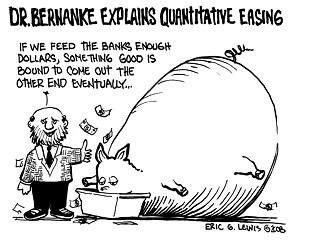 USAWatchdog - ....a few specific points brought up in the Press conference hosted by Fed chief Ben Bernanke are: high oil prices are not the fault of the Fed; neither is the weak dollar, that is the Treasury Department’s problem even though U.S. dollars say “Federal Reserve Note” across the top of every single one of them; and finally (and this is my favorite), the second round of Quantitative Easing (QE2) will end by June 30th. (Fed press conference from Reuters.)
 The overt fed money printing of $75 billion a month is going to end, but the covert money printing will not. It can’t because who will step in and buy all that debt at discount rates? Jim Rickards, Senior Managing Director for Market Intelligence at Omnis, Inc., thinks the Fed will still be printing “$750 billion” a year. Rickards wrote a piece about 5 weeks ago spelling out why he thinks QE will be “perpetual.” Rickards is a big thinker, and he is the insider’s insider.
He says, “The Fed is now like a 400-pound man who can eat 5,000 calories per day without gaining weight because his morbidly obese metabolism requires it to function. The discussion of QE, QE2 and QE3 has become irrelevant. What we have is permanent QE until such time as the Fed decides to tighten financial conditions. This is unlikely to happen until mid-2012 at the earliest, perhaps later in view of the housing double-dip and increasing oil prices. In any case, QE will be with us for an “extended period” no matter what the Fed announces.”
The continuing fed money printing to prop up an insolvent system is flashing a long-term green light to gold and silver. Jim Willie says, the green light is stuck on and will not turn red until there is resolution and reform.
Stating “Have they liquidated any big US banks?? Has any reform come for encouraging the return of US industry?? Has any regulatory reform been pursued for expanding business?? Have they stopped printing money to cover debt?? Has any reduction in USGovt deficits been realized?? The answer is a loud NO on all counts of the basic test, which signals a continued bull market in precious metals.”
 Economist John Williams, says the inflation in food and energy is coming from a weakening U.S. dollar. Inflation will increase as the value of the dollar decreases. In his latest report, Williams says, “U.S. inflation is on the rise, due primarily to the Fed’s successful efforts at starting to debase the U.S. dollar. It is the dollar’s weakness that primarily has driven oil prices higher, more so than political tensions in the Middle East and North Africa, or Mr. Bernanke’s suggestions of surging global oil demand. As a result of Fed activity, the U.S. dollar has lost its safe-haven status and is hitting all-time lows against a number of major currencies. . . . even the Fed’s Vice-Chairman has acknowledged current Fed policy is weakening the U.S. dollar.”
Williams says the U.S. is sliding towards “systemic solvency crises,” and the dollar continues to fall “unabated.” He is predicting hyperinflation within a few years, at the latest. So, no matter what the Fed says it’s doing, the evidence shows a trail of never ending money printing. This will only enrich the few, while robbing the masses of their money’s buying power. - USAWatchdog
U.S. becomes net fuel exporter
UPI - The United States for the first time in nearly 20 years exported more gas than it purchased from the global market for the first time in years... as domestic consumers face with high gasoline prices, data indicate.
Joe Gorder, executive vice president at U.S. refiner Valero Energy, said the trend in exports is driven by rising demand in Latin America. "I do believe that we are seeing just a long-term trend here that's going to allow Gulf Coast refiners to continue to export barrels," he told the Financial Times.Gasoline is cheaper along the coast of the Gulf of Mexico where many of the country's refiners are located. Conflict in the Middle East, however, helped push oil prices to post-recession highs, meaning its more profitable to sell oil products overseas than to the domestic market. Russia last week said it was increasing tariffs on oil products to cope with record prices and gasoline shortages at home. With gasoline topping $4 per gallon in most U.S. markets, U.S. President Barack Obama said he would probe the effects that market speculators have on oil and gasoline prices.
Joe Gorder, executive vice president at U.S. refiner Valero Energy, said the trend in exports is driven by rising demand in Latin America. "I do believe that we are seeing just a long-term trend here that's going to allow Gulf Coast refiners to continue to export barrels," he told the Financial Times.Gasoline is cheaper along the coast of the Gulf of Mexico where many of the country's refiners are located. Conflict in the Middle East, however, helped push oil prices to post-recession highs, meaning its more profitable to sell oil products overseas than to the domestic market. Russia last week said it was increasing tariffs on oil products to cope with record prices and gasoline shortages at home. With gasoline topping $4 per gallon in most U.S. markets, U.S. President Barack Obama said he would probe the effects that market speculators have on oil and gasoline prices.
The great American government fire sale is on
Towns and cities with ravaged revenues are selling municipal treasures to pay the bills
(AP YahooNews) - As 2010 drew to a close, the mayor of Newark, N.J., was staring into a budget abyss so deep that he sold 16 city buildings to pay the bills. They included the architecturally significant Newark Symphony Hall and the police and fire headquarters.

And soon, if state legislators have their way, private investors will be able to buy plenty of other municipal treasures: power plants in Wisconsin, prisons in Louisiana and Ohio and municipal buildings in Boston. The Great Government Tag Sale is on.
As states and cities struggle with billions of dollars in shortfalls, elected officials are increasingly selling public assets to cover their costs. Sometimes municipalities sell the buildings to pocket a one-time pile of cash and then lease them back so they can continue to use them. To proponents, selling government property is an efficient way to plug budget holes. That's one reason the Obama administration has looked at unloading office towers, courthouses, warehouses and shacks. Private owners who develop the properties can inject vibrancy into municipal dead zones, the thinking goes. Buildings that were once exempt from property taxes are put back on the rolls. But to critics, these sales are as misguided as pulling money out of your house to pay your bills. They point out that the government is letting go of a long-term, valuable asset in exchange for a one-time payment. When the asset is a building, a municipality then has to spend more money on leasing it back or renting another facility.
"This is tantamount to selling the family china only to have to rent it back in order to eat dinner," says economist Yves Smith, Often, the public balks at these deals. In Britain last year, people practically took up pitchforks when the government, as a part of its austerity cure, announced plans to sell Sherwood Forest. The environment secretary backed off. "This is the second worst thing a government can do," says Jay Powell, a fellow at the Bipartisan Policy Institute. "The worst thing they can do is run out of money." Read more by Associated Press writer David Porter at YahooNews
(AP YahooNews) - As 2010 drew to a close, the mayor of Newark, N.J., was staring into a budget abyss so deep that he sold 16 city buildings to pay the bills. They included the architecturally significant Newark Symphony Hall and the police and fire headquarters.
And soon, if state legislators have their way, private investors will be able to buy plenty of other municipal treasures: power plants in Wisconsin, prisons in Louisiana and Ohio and municipal buildings in Boston. The Great Government Tag Sale is on.
As states and cities struggle with billions of dollars in shortfalls, elected officials are increasingly selling public assets to cover their costs. Sometimes municipalities sell the buildings to pocket a one-time pile of cash and then lease them back so they can continue to use them. To proponents, selling government property is an efficient way to plug budget holes. That's one reason the Obama administration has looked at unloading office towers, courthouses, warehouses and shacks. Private owners who develop the properties can inject vibrancy into municipal dead zones, the thinking goes. Buildings that were once exempt from property taxes are put back on the rolls. But to critics, these sales are as misguided as pulling money out of your house to pay your bills. They point out that the government is letting go of a long-term, valuable asset in exchange for a one-time payment. When the asset is a building, a municipality then has to spend more money on leasing it back or renting another facility.
"This is tantamount to selling the family china only to have to rent it back in order to eat dinner," says economist Yves Smith, Often, the public balks at these deals. In Britain last year, people practically took up pitchforks when the government, as a part of its austerity cure, announced plans to sell Sherwood Forest. The environment secretary backed off. "This is the second worst thing a government can do," says Jay Powell, a fellow at the Bipartisan Policy Institute. "The worst thing they can do is run out of money." Read more by Associated Press writer David Porter at YahooNews
Greenpeace too political to register as charity
 Business Scoop - The High Court has ruled that Greenpeace of New Zealand Inc. is too involved in political causes to register as a charity. Justice Paul Heath turned down an appeal last Friday that Greenpeace could register with the Charities Commission after the body rejected its 2010 application. Justice Heath said Greenpeace’s political activities can’t be regarded as “merely ancillary” to its charitable purposes and that the commission was correct in disqualifying it for registration over the potentially illegal activities. Though the pursuit of peace could be “worthy,” that didn’t necessarily make it charitable, he said.
May 15, 2011
Alcoa Unveils Smog Eating Aluminum Panel
JetsonGreen - We’ve seen roof tiles that eat smog, but Alcoa Architectural Products is introducing an architectural panel that the company claims can clean itself and the air around it.  Reynobond with EcoClean is what it’s called, and it’s a combination of Reynobond, which is a pre-painted, aluminum, coil-coated panel, and EcoClean, a proprietary coating with titanium oxide.
It removes pollutants and cleans itself through the reaction of sunlight, water vapor, and oxygen. Specifically, titanium oxide mixes with sunlight to breakdown organic matter on and near the panels. When it rains, instead of beading up and streaking, the EcoClean surface is hydrophilic and washes away broken down pollutants.
Georgia-based Air Quality Sciences, Inc. tested the EcoClean panels and confirmed that smog, or NOx, is neutralized at the molecular level. Alcoa says the panels also break down sulphur oxides (SOx), diesel exhaust, and other organic matter.
10,000 square feet of this product on a building could “offset the smog created by the pollution output of four cars every day, which is the approximate air cleansing power of 80 trees every day,” according to Alcoa.
In terms of costs, a representative for Alcoa told Jetson Green that the installed cost is about 4-5% more than Reynobond without EcoClean. Click and view this graphic below for more detail on the smog-eating properties.

First Passive House in Wisconsin?
JetSonGreen - Synergy is a design for an affordable, cold-climate Passive House by Tim Eian of TE Studio, the firm behind the first Passive House in Wisconsin. Eian says Synergy is “a beacon for the 21st century renaissance of residential high-performance design.“ In other words, this is a home for everyone: it’s traditional, comfortable, light-filled, and attainable.
As you probably already know, a Passive House (or Passivhaus in some circles) is a building that’s certified to aggressive levels of airtightness, annual heating and cooling efficiency, and annual primary energy efficiency.
Synergy would use 90% less heating energy and and 75% less total energy than a typical home and could be built for about $250,000. Moreover, the two-level, 1,700 square-foot home would have a projected monthly energy cost of $55 in year one.
The benefit to building a home like this is — once constructed — a homeowner wouldn’t need much of an investment in on-site renewable energy to approach net-zero energy or carbon neutrality. That is, the more energy efficient the home, the less energy producing the home needs to be.
TE Studio is currently looking for implementers of this design, so feel free to click the link below to get more information.
[+] More detail on Synergy, a Passive House concept, by TE Studio.
California will close a fourth of its parks... America as we knew it.
Bloomberg - California will close a fourth of its parks to save $33 million over the next two years as leaders of the most-populous state work to close a $15.4 billion budget deficit.
Swollen Mississippi Threatens Gas Refineries and nuclear facilites
Reuters - Heavy flooding in the U.S. Midwest shut Ohio River terminals, limited barge movements and threatened to disrupt refinery operations along the Mississippi River to the Gulf of Mexico on Wednesday. There are 10 refineries, including the second-largest U.S. refinery, located along the Mississippi River, that can process 2.4 million barrels per day of oil, or 13.7 percent of the country's refining capacity. NUCLEAR FACILITIES AT RISK FROM FLOODS
* Entergy's (ETR.N) 1,176-megawatt Waterford nuclear plant in St. Charles Parish, Louisiana.
* Entergy's 978-megawatt River Bend nuclear plant in West Feliciana Parish, Louisiana.
* Entergy's 1,268-megawatt Grand Gulf nuclear station in Clairborne County, Mississippi.TERMINALS SHUT:
Nearly 20 percent of barge terminals the U.S. Coast Guard monitors on the Ohio River remained closed on Wednesday. The Smithland Lock and Dam at mile marker 918.5 on the river remains closed, obstructing barge traffic both up and downstream. [ID:nN09291512] SHIP TRAFFIC:
The tanker Zaliv Baikal turned back from going to a dock in Baton Rouge because its captain didn't think the vessel had enough clearance beneath the I-10 Bridge over the Mississippi at Baton Rouge. Berths at Exxon's docks in Baton Rouge were flooding on Wednesday, which may make docking tankers difficult in the coming days, according to sources familiar with refinery operations. Exxon said the refinery continues to operate normally. Read full at Reuters
* Entergy's (ETR.N) 1,176-megawatt Waterford nuclear plant in St. Charles Parish, Louisiana.
* Entergy's 978-megawatt River Bend nuclear plant in West Feliciana Parish, Louisiana.
* Entergy's 1,268-megawatt Grand Gulf nuclear station in Clairborne County, Mississippi.TERMINALS SHUT:
Nearly 20 percent of barge terminals the U.S. Coast Guard monitors on the Ohio River remained closed on Wednesday. The Smithland Lock and Dam at mile marker 918.5 on the river remains closed, obstructing barge traffic both up and downstream. [ID:nN09291512] SHIP TRAFFIC:
The tanker Zaliv Baikal turned back from going to a dock in Baton Rouge because its captain didn't think the vessel had enough clearance beneath the I-10 Bridge over the Mississippi at Baton Rouge. Berths at Exxon's docks in Baton Rouge were flooding on Wednesday, which may make docking tankers difficult in the coming days, according to sources familiar with refinery operations. Exxon said the refinery continues to operate normally. Read full at Reuters
Fort Belvoir Community Hospital - The DoD Green Buildout
Federal News Radio - There's a green side-effect to the 2005 DoD Base Realignment and Closure (BRAC) round that's wrapping up this year. Defense employees are moving from older, less energy-efficient buildings into new facilities that have to meet minimum standards for green construction.  One example of the greener buildings springing up around the country under BRAC is northern Virginia's Fort Belvoir Community Hospital, which expects to be ready for patients this August with a LEED Silver rating. "One of the first things people notice about the new hospital is these odd-looking structures at the top of the buildings, they're curved, sort of concave structures," said Don Carr, a spokesman at Fort Belvoir. "Those catch rainwater. That rainwater will be used by the hospital for all its non-potable purposes, like landscaping, cooling systems and so-forth. Belvoir also is home to the Defense department's first certified LEED Platinum building, the Green Building Council's highest award. The clubhouse-style community center in one of the base's residential villages uses geothermal energy and is constructed with a large percentage of recycled and renewable materials, like soy-based insulation and simulated marble countertops made of recycled aluminum.
One example of the greener buildings springing up around the country under BRAC is northern Virginia's Fort Belvoir Community Hospital, which expects to be ready for patients this August with a LEED Silver rating. "One of the first things people notice about the new hospital is these odd-looking structures at the top of the buildings, they're curved, sort of concave structures," said Don Carr, a spokesman at Fort Belvoir. "Those catch rainwater. That rainwater will be used by the hospital for all its non-potable purposes, like landscaping, cooling systems and so-forth. Belvoir also is home to the Defense department's first certified LEED Platinum building, the Green Building Council's highest award. The clubhouse-style community center in one of the base's residential villages uses geothermal energy and is constructed with a large percentage of recycled and renewable materials, like soy-based insulation and simulated marble countertops made of recycled aluminum.
US exports hit a record high as China Runs A Trade Deficit!
US exports hit a record high in March, buoyed by the weak dollar and strengthening global demand as US trade returned to levels last seen before the global financial crisis.
US exports grew 4.6% in March to USD 172.7 billion, surpassing the record set in July 2008 before world trade took a sharp downturn. The March export rise was the biggest month-to-month gain in 17 years, the Commerce Department said in a report on Wednesday.

"It's taken two-and-a-half years, but the level of exports has finally returned to pre-recession levels," said Paul Dales, senior US economist with Capital Economics in Toronto. Despite the big gain, the US trade deficit grew to USD 48.2 billion in the month, the widest since June 2010, as rising oil prices helped push imports nearly 5% higher. NPR - That's right: I put an exclamation mark in a headline about China's trade balance.
US exports grew 4.6% in March to USD 172.7 billion, surpassing the record set in July 2008 before world trade took a sharp downturn. The March export rise was the biggest month-to-month gain in 17 years, the Commerce Department said in a report on Wednesday.
"It's taken two-and-a-half years, but the level of exports has finally returned to pre-recession levels," said Paul Dales, senior US economist with Capital Economics in Toronto. Despite the big gain, the US trade deficit grew to USD 48.2 billion in the month, the widest since June 2010, as rising oil prices helped push imports nearly 5% higher. NPR - That's right: I put an exclamation mark in a headline about China's trade balance.
If you care about global trade imbalances — and you know I do — China running a trade deficit is a big deal.
For the first three months of this year, China imported more than it exported, the Chinese government said.
This is totally contrary to the standard script for global trade.
China always exports more than it imports — and the U.S., for its part, always does the opposite, importing more than it exports.
Economists say...
May 14, 2011
Wanted to cut emissions of 400 million tons of CO2 annually, you could...
BigGav on natural gas flaring - The Ultimate Gas Guzzler.
If you wanted to slashemissions of 400 million tons of CO2 annually, you could:
Much as I'd like to choose Plan A on some days as a solution to my morning commute hassles, I have to admit that Plan B sounds more practical. In fact, it sounds like a no-brainer. After all, why hurt the environment by wasting a resource that could instead make money by putting it to productive use?
- take 77 million automobiles off the road, or eliminate the wasteful practice of venting and “flaring” (burning) of billions of cubic meters of unused natural gas from production wells.
The staggering waste of gas—and consequent economic opportunity for conservation—was highlighted this week in a study released by GE called Flare Gas Reduction: Recent Global Trends and Policy Considerations. It concludes that with existing technology, some $20 billion in gas could be reclaimed to generate electric power and “yield billions of dollars per year in increased global economic output.”
red gas into a valuable asset.Wasteful flaring takes place even in the United States. In North Dakota, for example, roughly a quarter of all gas produced from oil wells is simply burned off.
Read more at Next100

Blogger is back -
Sorry for double emails or lack of any... google crashed a little this week.
 But is back, here is there summary:
But is back, here is there summary: Google- "What a frustrating day. We’re very sorry that you’ve been unable to publish to Blogger for the past 20.5 hours. We’re nearly back to normal — you can publish again, and in the coming hours posts and comments that were temporarily removed should be restored. Thank you for your patience while we fix this situation. We use Blogger for our own blogs, so we’ve also felt your pain. Here’s what happened"
This weeks "low down"... where we are in America's "recovery"

It is getting really hard for American families to be able to afford to put food on the table and to put gas in the tank. Health care costs are absolutely outrageous and college tuition is now out of reach for millions of American families.
Every single month more American families fall out of the middle class into poverty. Today there are 18 million more Americans on food stamps than there were just four years ago. More than one out of every five U.S. children is living in poverty (with over 44.2 million Americans receiving benefits) Things are getting really, really bad out there. The following are statistics reflect the decline of the American Dream
Jobs, jobs, jobs.... keep on looking
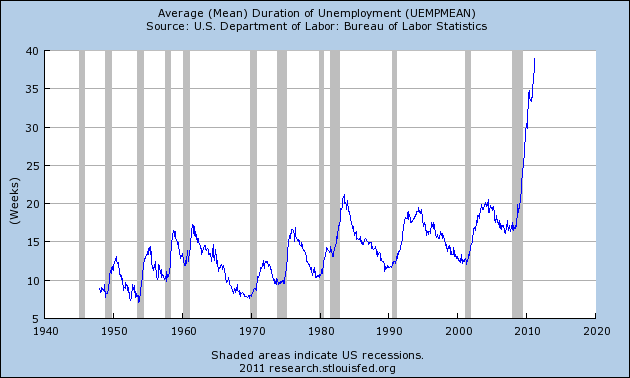
- The competition for decent jobs in America has gotten absolutely insane. There have been reports of people actually getting down on their knees and begging for jobs. Many Americans are starting to wonder if they will ever get a decent job again. According to the U.S. Bureau of Labor Statistics, the average duration of unemployment in the United States is now an all-time record 39 weeks....
- According to the Wall Street Journal, there are 5.5 million Americans that are unemployed and yet are not receiving unemployment benefits.
- The number of "low income jobs" in the U.S. has risen steadily over the past 30 years and they now account for 41 percent of all jobs in the United States.
- Only 66.8% of American men had a job last year. That was the lowest level that has ever been recorded in all of U.S. history.
- Once upon a time, anyone could get hired at McDonald's. But today McDonald's turns away a higher percentage of applicants than Harvard does. Approximately 7 percent of all those that apply to get into Harvard are accepted. At a recent "National Hiring Day" held by McDonald's only about 6.2 percent of the one million Americans that applied for a job were hired.
- There are now about 7.25 million fewer jobs in America than when the recession began back in 2007.
- The United States has lost an average of about 50,000 manufacturing jobs per month since China joined the World Trade Organization in 2001.
The price to just get by, just keeps getting worse..
- A New York post analysis has found that the rate of inflation in New York City has been about 14 percent over the past year.
- Over the past 12 months the average price of gasoline in the United States has gone up by about 30%.
- Spending on energy now accounts for more than 6 percent of all consumer spending. Every time this has happened since 1970 we have also had a recession that followed.
- The average American driver will spend somewhere around $750 more for gasoline in 2011. Unfortunately, it seems likely that the price of oil is going to go up even higher. Already the price of oil is closing in on the all-time record....
- In the United States, over 20 percent of all children are living in poverty. In the UK and in France that figure is well under 10 percent.
- According to the U.S. Census, the number of children living in poverty has gone up by about 2 million in just the past 2 years.
Entitlements are hemorrhaging...taxes coming in can't keep up
- In 1980, government transfer payments accounted for just 11.7% of all income. Today, government transfer payments account for 18.4% of all income.
- U.S. households are now receiving more income from the U.S. government than they are paying to the government in taxes.
- 59 percent of all Americans now receive money from the federal government in one form or another.
Health Care (or lack there of)

- According to the Bureau of Economic Analysis, health care costs accounted for just 9.5% of all personal consumption back in 1980. Today they account for approximately 16.3%.
- One study found that approximately 41 percent of working age Americans either have medical bill problems or are currently paying off medical debt.
- Back in 1965, only one out of every 50 Americans was on Medicaid. Today, one out of every 6 Americans is on Medicaid.
- Total credit card debt in the United States is now more than 8 times larger than it was just 30 years ago.
Our nest eggs... all in one basket
- During the first three months of this year, less new homes were sold in the U.S. than in any three month period ever recorded.
- Now home sales in the United States are now down 80% from the peak in July 2005.
- U.S. home prices have now declined 32% from the peak of the housing bubble.
- For most middle class families, the family home is the number one financial asset.
 Unfortunately, U.S. home values have declined an astounding 6.3 trillion dollars since the housing crisis first began.
 - According to a recent census report, 13% of all homes in the United States are currently sitting empty.
- The housing crisis just seems to keep on getting worse. 31 percent of the homeowners that responded to a recent Rasmussen Reports survey indicated that they are "underwater" on their mortgages.
- Unfortunately, it looks like millions more middle class Americans could soon be in danger of losing their homes. According to the Mortgage Bankers Association, at least 8 million Americans are at least one month behind on their mortgage payments at this point.
Haase - Sorry for all that "Recovery News".... here is a little something to make you feel a little better ;-)

Exxon CEO Admits that Oil Should Be $60-70 Dollars a Barrel Based on Supply and Demand
Under probing questioning by Senator Cantwell, Exxon Mobil CEO Rex W. Tillerson admitted that oil should be $60-70 dollars a barrel based on supply and demand. Read from source
School delivers fruit as punishment for lunch misbehavior while cameras roll
Students at Camp Curtain School have received cold sandwiches and fruit this week as punishment for misbehavior, including failure to clean up after themselves, school officials told The Harrisburg Patriot-News.

Using a $2 million grant from the U.S. Department of Agriculture, the schools in San Antonio are installing sophisticated cameras in the cafeteria line and trash area that read food bar codes embedded in the food trays.
"We're going to snap a picture of the food tray at the cashier and we will know what has been served," said Dr. Roberto Trevino of the San Antonio-based Social and Health Research Center, which is implementing the pilot program at five schools with high rates of childhood obesity and children living in poverty.
"When the child goes back to the disposal window, we're going to measure the leftover." - Read full at Reuters
"We created the opportunity where we could show them what the bare minimum would be,” the administrator told the local Patriot-News
The next time children in some elementary schools in the state of Texas try to sneak extra french fries onto their tray in the cafeteria line, the eye in the sky will be watching them.
"We're going to snap a picture of the food tray at the cashier and we will know what has been served," said Dr. Roberto Trevino of the San Antonio-based Social and Health Research Center, which is implementing the pilot program at five schools with high rates of childhood obesity and children living in poverty.
"When the child goes back to the disposal window, we're going to measure the leftover." - Read full at Reuters

May 13, 2011
Japan Scraps Plans to Expand Nuclear Power Capacity
Washington Post - Japan will scrap a plan to obtain half of its electricity from nuclear power and will instead promote renewable energy and conservation as a result of its ongoing nuclear crisis, the prime minister said Tuesday.
Naoto Kan said Japan needs to “start from scratch” on its long-term energy policy after the Fukushima Dai-ichi nuclear power plant was heavily damaged by a March 11 earthquake and tsunami and began leaking radiation. Nuclear plants supplied about 30 percent of Japan’s electricity, and the government had planned to raise that to 50 percent by 2030. Kan told a news conference that nuclear and fossil fuel used to be the pillars of Japanese energy policy but now the government will add two more pillars: renewable energy such as solar, wind and biomass, and an increased focus on conservation. First Germany slated to shut down their nuclear program, now Japan where is the U.S. on their "nuclear renaissance"
Naoto Kan said Japan needs to “start from scratch” on its long-term energy policy after the Fukushima Dai-ichi nuclear power plant was heavily damaged by a March 11 earthquake and tsunami and began leaking radiation. Nuclear plants supplied about 30 percent of Japan’s electricity, and the government had planned to raise that to 50 percent by 2030. Kan told a news conference that nuclear and fossil fuel used to be the pillars of Japanese energy policy but now the government will add two more pillars: renewable energy such as solar, wind and biomass, and an increased focus on conservation. First Germany slated to shut down their nuclear program, now Japan where is the U.S. on their "nuclear renaissance"
US companies in the electricity, oil and gas, manufacturing and water treatment sectors have been warned remote software can control industrial systems
US-CERT Warns of Serious Hole In ActiveX Control From Iconics
"The US's Computer Emergency Response Team (CERT) issued a warning (PDF) to critical infrastructure firms on Wednesday about a serious security hole in products from Massachusetts firm Iconics that could leave critical systems vulnerable to remote attacks. US companies in the electricity, oil and gas, manufacturing and water treatment sectors have been warned about a flaw in an ActiveX control used in two products by Iconics. The software, Genesis32 and BizViz, are Human-Machine Interface (HMI) products that provide a graphical user interface to various types of industrial control systems. The software can control industrial systems used for a variety of purposes including manufacturing, building automation, oil and gas, water and waste water treatment, among other applications."
Wheat Production Could Be Lowest Since 1996
Kansas: the 2011 crop could be one of the worst in many years.
On May 11, Kansas Agriculture Statistics released its own forecast of the 2011 wheat crop.
It estimates farmers will grow 261.8 million bushels, down 27% from last year and the lowest production since 1996.
The KAS predicts farmers will harvest 7.7 million acres, down 300,000 acres from last year and the smallest area harvested since 1957. Read more from source
It estimates farmers will grow 261.8 million bushels, down 27% from last year and the lowest production since 1996.
The KAS predicts farmers will harvest 7.7 million acres, down 300,000 acres from last year and the smallest area harvested since 1957. Read more from source
FUKUSHIMA REACTOR 1: FULL MELTDOWN, REACTOR VESSEL BREACHED
One of the reactors at Japan’s crippled Fukushima nuclear power plant has a hole in its main vessel following a meltdown of fuel rods, leading to a leakage of radioactive water, its operator said on Thursday.
The disclosure by Tokyo Electric Power Co (TEPCO) is the latest indication that the disaster was worse than previously disclosed, making it more difficult to stabilize the plant.The finding makes it likely that at one point in the immediate wake of the disaster the 4-meter-high stack of uranium-rich rods at the core of the reactor had been entirely exposed to the air, he said. Boiling water reactors like those at Fukushima rely on water as both a coolant and a barrier to radiation. U.S. nuclear experts said that the company may have to build a concrete wall around the unit because of the breach, and that this could now take years.Read full at Reuters
The disclosure by Tokyo Electric Power Co (TEPCO) is the latest indication that the disaster was worse than previously disclosed, making it more difficult to stabilize the plant.The finding makes it likely that at one point in the immediate wake of the disaster the 4-meter-high stack of uranium-rich rods at the core of the reactor had been entirely exposed to the air, he said. Boiling water reactors like those at Fukushima rely on water as both a coolant and a barrier to radiation. U.S. nuclear experts said that the company may have to build a concrete wall around the unit because of the breach, and that this could now take years.Read full at Reuters
Let the GOV run your Business? Postal Service Reports 10's of Billion$ in Losses
Last Time I checked, UPS and FedEx were profitable companies...
Yet the USPS - The Postal Service is continuing to hemorrhage money, reporting a loss Tuesday of more than $2 billion over the first three months of the year and warning it could be forced to default on federal payments. Such a default would not interrupt mail service to millions of Americans, but it could further hobble an agency struggling with a sharp decline in mail because of the Internet and a tough economy.

The U.S. Postal Service is losing money so quickly you'd think it somehow got mixed up in the subprime mortgage business. It's on track this year for an operating loss of between $6 billion and $12 billion, debt surpassing $10 billion, and a $1 billion cash shortfall. For any business, those are some ugly numbers. . . . The post office has a government guaranteed monopoly on first class mail, but even with a monopoly it can't make money. But here's how the USPS is not treated like everyone else: It's exempt from taxes and antitrust law.
No one else is allowed to deliver first-class mail. Those are advantages, but on the other hand USPS is subjected to constant meddling from Congress -- for instance, the postmaster general Jack Potter has to ask Congress for permission to reduce a six-day delivery schedule to five in order to save money. And these same politicians get an earful from constituents anytime a local post-office branch, no matter how unprofitable for the USPS, is threatened with closure. . . Read More at CNN Money What recession? US Post Office Gives Out 3 1/2% raises even though it's $34 billion in debt
US Postal Service: a public Employee Pension and healthcare management organization that delivers mail on the side with a large $33.5 billion Deficit.
Read more here
The U.S. Postal Service is losing money so quickly you'd think it somehow got mixed up in the subprime mortgage business. It's on track this year for an operating loss of between $6 billion and $12 billion, debt surpassing $10 billion, and a $1 billion cash shortfall. For any business, those are some ugly numbers. . . . The post office has a government guaranteed monopoly on first class mail, but even with a monopoly it can't make money. But here's how the USPS is not treated like everyone else: It's exempt from taxes and antitrust law.
No one else is allowed to deliver first-class mail. Those are advantages, but on the other hand USPS is subjected to constant meddling from Congress -- for instance, the postmaster general Jack Potter has to ask Congress for permission to reduce a six-day delivery schedule to five in order to save money. And these same politicians get an earful from constituents anytime a local post-office branch, no matter how unprofitable for the USPS, is threatened with closure. . . Read More at CNN Money What recession? US Post Office Gives Out 3 1/2% raises even though it's $34 billion in debt
US Postal Service: a public Employee Pension and healthcare management organization that delivers mail on the side with a large $33.5 billion Deficit.
Read more here
Turning on our electronics and Turning off our brains...
 UPI - U.S. researchers say a study of 22 U.S. states and a Canadian province shows when funding support for school libraries rises, reading and testing scores go up. Researchers at Mansfield University in Pennsylvania say the study contradicts an article of faith among critics of public schools that there is no correlation between spending and learning outcomes, a university release reported last week.
The High Cost Of Closing Public Libraries - Government budget cuts, at all levels, can have tragic effects. It will take us a long time to recover from the damage the current cuts have done and will do. There are many vital public services – such as health care, aid to the homeless, and schools – that we must do our utmost to protect. But, at least for me, there are few cuts more bothersome than the closing of public libraries.
Sadly, these closings are happening all over the nation, including California, New York, Ohio, Michigan and elsewhere.
At the same time, use of libraries has been increasing for years. In 2008, according to the Institute of Museum and Library Services, the average person visited a public library 5.1 times, an increase of almost 20 percent since 1999. Of course, this use is not equally distributed – some people visit regularly, while others not at all.
In part, this is because many low-income Americans rely on libraries, not only for books and periodicals, but as their primary source of internet access. As a result, the number of computers in public libraries has almost doubled since 2000.
Read more from Matthew Di Carlo
Why we need public libraries

May 10, 2011
How expensive it is to be a poor American.
As if the current job market and economy didn’t make it hard enough for low income households in America to make ends meet, it turns out that living below the poverty line is actually more costly in many respects as well. It not only takes money to make money, it also takes quite a bit of money to live in poverty. -BusinessPundit
Click Graphic for full illustration... Submitted via email by Tony Shin
See full at The Cost of Being Poor
May 9, 2011
Unknown Amount of Radioactive Water Pumped Into Mississippi River
Radioactive Water Pumped Into Mississippi River (WJTV – May 2):
The Nuclear Regulatory Commission is investigating a radioactive release into the Mississippi River from the Grand Gulf Nuclear Plant in Port Gibson.
A spokesperson from Grand Gulf tells News Channel 12 that they found standing water in an abandoned unit.
In an effort to remove the standing water, Entergy began pumping the water out and into a drain that emptyed into the Mississippi River.
A censor went off detecting the chemical “tritium” in the standing water.
NRC officials say the River has diluted the radioactive material and is not causing harm to the people.
Right now the incident is under investigation by the NRC.
Entergy officials tell News Channel 12 they are not sure of the source of the tritium.
There’s no word on how much Tritum was pumped into the river.
-<a href="http://www.infiniteunknown.net/2011/05/08/unknown-amount-of-radioactive-water-pumped-into-mississippi-river/
May 8, 2011
Doc alert: 2011 EIA Energy Conference
The US Dept. of Energy recently held its 2011 EIA (Energy Information Administration) Conference, and they’ve posted PDFs of the presentations.
You can get them all here.
Subscribe to:
Posts (Atom)