Oct 30, 2011

Why Recycling in the US Is Not a Success : Greentech Media

...Recycling rates, overall, are far higher today than they were in the 1970s. But many recycling rates have been flatlined for nearly a decade -- and not just during recent recession. It took until 1990 for recovery rates for recycling to get beyond 15 percent, according to the U.S. Environmental Protection Agency. The volume of municipal waste is rising faster than the rate of recycling participation.

In 2009, nearly 34 percent of the municipal solid waste that was generated was recycled. However, curbside recycling is also nearly flat since 2002, and community composting is down over the same period.

Outside of cities like San Francisco and Los Angeles, recycling is largely an enigma. (In New York, for instance, the NYC Sanitation website tells you to recycle plastic “jugs,” rather than specifying which plastic numbers can be recycled.) The rules change often in New York City, and from town to town across the country. In many places, it is still cheaper to send it to the landfill than to recycle. According to a recent report by Siemens, only 14 of 27 U.S. and Canadian cities have comprehensive waste reduction strategies, compared to all European cities with similar income levels and demographics.

The New York Times did point to some successes, like the Green Restaurant Association, which has about 80 members in New York that can earn ratings for efforts like reducing energy consumption and composting food waste. The city is also looking into larger methods, like pay-as-you-throw, which has been deployed successfully in Seoul.

Recycling is not a failure in the U.S., but it is far from an example of environmental awakening. In most cities where recycling rates are high, there is a financial burden for those that don’t comply. That could be the best lesson of all from recycling to apply to other sustainability issues, including energy efficiency. It’s not a warm, fuzzy habit that the next generation will inherently embrace. Rather, it is solid policy and adequate infrastructure accompanied by enforcement that will bring sustainability practices out of niche areas and into the mainstream.

Read on at

Panel lowers limit of radiation in food | The Japan Times Online

Experts quiz decision to ignore external exposure

Health minister Yoko Komiyama announced Friday that the government will lower the allowable amount of radiation in food products from 5 millisieverts per year to 1, but some experts are puzzled...Citing findings from various studies, the food safety panel concluded Thursday that a cumulative dose of 100 millisieverts or more throughout one's lifetime poses significant health risks.

But experts question the focus solely on internal exposure from food and drink, while ignoring external exposure from radioactive materials, such as fallout on the ground, roofs and in ditches.

"I can't think of a reason why they decided to omit external exposure as a factor in the proposal this time," said Dr. Eisuke Matsui, who heads the Gifu Environmental Medicine Research Institute.

The radiology expert noted that while consuming food contaminated with radiation is a far bigger risk to human health than being exposed to radiation from the environment, it does not mean it can be disregarded.

"Think of the children in the cities of Fukushima or Minamisoma, where there is a relatively high level of radiation in the environment," Matsui said. "Any guideline on radiation should consider the total exposure and not only the limit of contaminated food one can consume."

Read on at

Construction Flaws Blamed In Sewage Plant Collapse - Topix

Full story: PaintSquare

Uncoated, ungalvanized rebar and other construction deficiencies led to the collapse of a massive wastewater containment wall that unleashed millions of gallons of raw sewage, killing two Tennessee men and contaminating a river in April, authorities have concluded.

Government subsidy cut pulls plug on solar panels - Green Living, Environment - The Independent

Independent - (UK) Homeowners who decide to save money by generating their own renewable energy for the National Grid are to lose almost half their Government subsidy, prematurely published documents suggested yesterday.

Drastic cuts to the feed-in tariff (FIT) for solar power, the guaranteed income to anyone who installs working solar panels in their roof, are likely to be announced by the Energy and Climate Change Secretary, Chris Huhne, on Monday.

"Coming from a Government that said it would be the greenest ever, this is completely misguided and will be a devastating blow for the solar industry," said Howard Johns of Solar Trade Association.

"Solar installation will be limited to a few rich people, and all the installation going on in solar housing will stop. Hundreds of companies will go bankrupt."

And the precise level of the cut – from 43.3p per kilowatt hourof solar electricity to just 21p – appeared to be made clear yesterday in a document inadvertently published on the website of the Energy Saving Trust, the public advice body, and quickly taken down.

Although the Department for Energy and Climate Change said later that the published document was "neither final nor accurate", the swingeing 50 per cent cut in the subsidy it revealed was in linewith what observers have been expecting...the Government has become nervous of the subsidy's cost, as it is paid not from the Treasury but by a levy on household electricity bills – an increasingly sensitive subject – and wants to limit it.

Stunning Charts of Manufacturing Complexity | The Solari Report Blog

Manufacturing Complexity

The products we use everyday are complex combinations of specialized knowledge.

Harvard and MIT released a report, “The Atlas of Economic Complexity,” visually mapping the vast knowledge contained within the products we use. And then they show how complex products benefit a country’s economy and growth.

Simple products are natural resources that require less people with specialized knowledge, such as oil or soybeans.
Complex products require many people with specialized knowledge to research, design, develop, and invent, such as cars and computers.

Continue reading the article …

Solar Energy Use in U.S. Agriculture: Overview and Policy Issues « Full Text Reports…

Overview and Policy Issues (PDF)
Source: U.S. Department of Agriculture

This report serves as an overview of solar energy use by farmers and ranchers in the U.S. that identifies trends and future potential. Agriculture was an early adopter for remote applications. These are still cost effective today, but in the last decade agriculture has seen the number of grid-connected systems and the average size of solar systems increase. System sizes range from 5 watts to 1 Megawatt (MW) and cost from a couple hundred to almost 10 million dollars. Some solar thermal installations are also used in agriculture, but are currently overshadowed by solar electric. Though solar energy can reduce energy cost volatility and greenhouse gases, its high capital cost and the lower average price of competing fuel remain impediments to growth. For this reason, development in solar has been policy driven. The report reviews the regulations and incentives that are available to farmers and ranchers and have recently boosted installations, and examines major financial influences.  Solar energy development in agriculture varies considerably by State, incentives, and energy prices.

Top US foreclosure law firm threw Halloween party where staff dressed as homeless, foreclosed-upon A

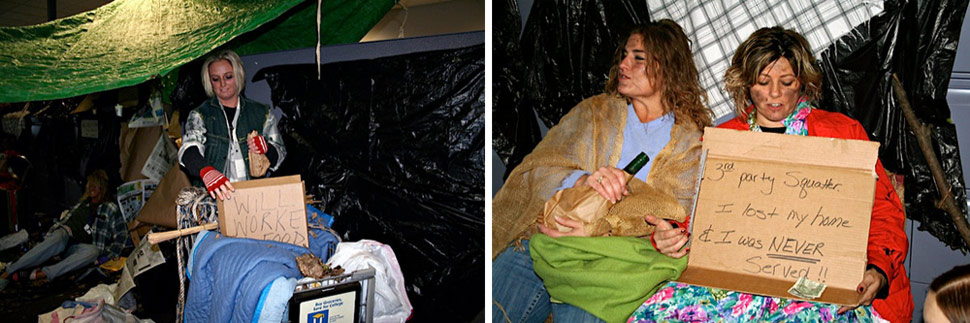
From a NYT opinion piece by Joe Nocera, "What the Costumes Reveal"—

On Friday, the law firm of Steven J. Baum threw a Halloween party. The firm, which is located near Buffalo, is what is commonly referred to as a “foreclosure mill” firm, meaning it represents banks and mortgage servicers as they attempt to foreclose on homeowners and evict them from their homes. Steven J. Baum is, in fact, the largest such firm in New York; it represents virtually all the giant mortgage lenders, including Citigroup, JPMorgan Chase, Bank of America and Wells Fargo.

The party is the firm’s big annual bash. Employees wear Halloween costumes to the office, where they party until around noon, and then return to work, still in costume. I can’t tell you how people dressed for this year’s party, but I can tell you about last year’s.

That’s because a former employee of Steven J. Baum recently sent me snapshots of last year’s party. In an e-mail, she said that she wanted me to see them because they showed an appalling lack of compassion toward the homeowners — invariably poor and down on their luck — that the Baum firm had brought foreclosure proceedings against.

I'm not one to incite illegal activity, but christ, guys: if there were ever a house that deserved T-P-ing on Halloween? This firm's headquarters is it. May not be justice, but it's a start.

Read the rest, and see all the photos, here. (via boing boing)

A Better World ?

Nissan claims average Leaf is driven 37 miles per day, more range not needed

Nissan Leaf garage

How much range does an electric vehicle really need? A hundred miles... two-hundred miles? We suppose the answer to that question depends on who you're asking, and if you're asking Nissan, the answer you'll get may be surprising.

According to Mark Perry, director of product planning and strategy for Nissan North America, drivers of the Leaf electric car almost never go more than 37 miles in a single day, and the average length of a single trip is just seven miles. In other words, the Leaf's 70-plus-mile range is plenty enough for the all-electric machine to satisfy the requirements of a "primary-use car."

This data has been extracted from the daily use cycles of the roughly 7,500 Leafs currently roaming the streets in the U.S. It's probably safe to assume, though, that the majority of these Leaf drivers knew going in that their average driving routines wouldn't be too much for the electric car to handle.

In any case, the Leaf seemingly proves that, for at least a sizable portion of the population, an electric car is completely viable.

Post originally appeared on AutoblogGreen

Nissan to unveil Leaf-based electric e-NT400 Atlas Concept truck

How big can a Nissan Leaf get? How about big box truck big?

While admittedly not built from the same body as Nissan's popular all-electric passenger car, the new three new Nissan trucks based on the ATLAS F24 model that are making their appearances at the 2011 Tokyo Motor Truck Show this week all feature some sort of electrification in the powertrain - one them is even powered by parts of the same EV powertrain that propels the Leaf.

Part of Nissan's Light Commercial Vehicles lineup, the e-NT400 ATLAS (pictured), ATLAS F24 Refrigerator Van by Li-ion Battery and ATLAS F24 Power Supply Truck are all getting into the EV action. The E-NT400 is all-electric and has a range of 62 miles (on the JC08 test cycle) from a "a high-output, high-capacity lithium ion battery." The Refrigerator Van uses a lithium ion battery power system developed by 4R Energy Corporation to cool the cargo area. Lastly, the ATLAS F24 Power Supply Truck has a massive 72-kWh battery (i.e., three Leaf packs) and can be used to power the equivalent of a 20-person office space for four hours, says Nissan.

These aren't the only electric trucks Nissan is working on. Starting this past July, Nissan began global tests of the NV200-based EV.

Continue reading Nissan to unveil Leaf-based electric e-NT400 Atlas Concept truck

Americans ‘Hooked on Government’ as Record Number Get Benefits

Oct. 28 (Bloomberg) -- Political dysfunction is often blamed for Congress’s inability to curb the U.S. budget deficit. An even bigger obstacle may be the American public.

A record 49 percent of Americans live in a household where someone receives at least one type of government benefit, according to the U.S. Census Bureau. And 63 percent of all federal spending this year will consist of checks written to individuals for which the government receives currently no services, the White House budget office estimates. That’s up from 46 percent in 1975 and 18 percent in 1940.

Those figures will climb in coming years. The 75 million baby boomers have only begun their long march into retirement, while President Barack Obama’s health-care overhaul will extend insurance coverage to more than 30 million additional people.

“The more households that are benefiting from the programs, the more difficult it is to rein in their costs,” said Bob Bixby, head of the Concord Coalition, an Arlington, Virginia- based group that promotes balanced budgets. “It’s a troubling phenomenon” and “it explains why it’s politically difficult to deal with these things.”

The increasing reliance on the federal safety net comes as a congressional supercommittee -- charged with coming up with a plan by Thanksgiving to find $1.5 trillion in savings in the U.S. budget -- faces mounting pressure to pare back spending. If the panel fails to meet its goal, $1.2 trillion in across-the-board domestic and defense spending cuts will be triggered.

It’s the Economy

Senator Jon Kyl, an Arizona Republican who sits on the 12- member supercommittee, said the swelling number of beneficiaries is “very distressing” because it means much of the population is “hooked on government” and will oppose any cuts.

The census figure showing 49 percent of Americans, or about 147 million people, live in households where someone gets a federal benefit, is from the first quarter of 2010, the most recent numbers available, according to the bureau.

A confluence of elements is helping drive up the number of beneficiaries. The biggest is the economy. With the unemployment rate stuck at about 9 percent for 30 consecutive months, demand for unemployment benefits, food stamps and Medicaid has soared.

The number of Americans receiving food stamps alone is up 72 percent over the past five years, to a record 45.3 million. Their annual cost, projected this year to reach $80 billion, tops the yearly budgets of most federal agencies.

Read on at

http://www.businessweek.com/news/2011-10-28/americans-hooked-on-government-as-record-number-get-benefits.html

Oct 29, 2011

Build a Thermoelectric Lamp [Video]

Instructables user scraptopower designed a thermoelectric lamp that can convert heat into small amounts of electricity. One of the best uses for this is building an LED lamp that runs from tea candles. Yes, candles generate usable light, but if you've ever tried reading by one of them you might appreciate a more powerful light source during a blackout or camping trip without having to worry about batteries. More »

House of Representatives supports giving federal land and water rights to foreign company

The U.S. House of Representatives has approved a bill that authorizes the transfer of 2,400 acres of Arizona federal forest land to the UK and Australia-based mining company, Rio Tinto.

In a 235-186 vote this week, the House passed the Southeast Arizona Land Exchange and Conservation Act of 2011, which approves the trade of 2,400 acres of federal land for 5,000 acres controlled by the mining company.

A Rio Tinto subsidiary, Resolution Copper Mining, is seeking the land swap in order to better access what it claims may be the largest copper ore body in the world near Superior, Arizona.

The mining company claims that the project will create jobs but the swap is opposed by numerous groups in Arizona.

In testimony to the U.S. Senate Senate Energy and Natural Resources Committee Subcommittee on Public Lands and Forests in June 2009, Sandy Bahr of the Sierra Club’s Grand Canyon (Arizona) Chapter argued that the land swap will diminish recreational opportunities and threaten rare and endangered plants and animals including the black-chinned sparrow, Costa’s hummingbird, Lewis’ woodpecker, and the endangered Arizona hedgehog cactus.

The land sought by the mining company includes the Tonto National Forest’s Oak Flat Campground, which was recognized as an important natural resource and placed off limits to mining activity by President Dwight Eisenhower in 1955.

Bahr also warned that the mine will deplete the area’s already scarce water supply.

According to Resolution Copper Company (RCC), this mine will need as much as 20,000 acre-feet of water per year. An acre-foot of water is roughly the amount of water a family of four uses in one year, so 20,000 acre-feet is enough water for 20,000 families or 80,000 people for one year. … What will the impact of this be? Considering how important as water is in Arizona, the continued long-term droughts we experience, and the predictions of scientists that we are going to get hotter and drier due to the impacts of climate change, it would be irresponsible to move this bill without a thorough analysis and some strong assurances that the water will be there and will not risk riparian areas or drinking water supplies.

Read full at

An apocalyptic end to world’s biggest bubble

SAN LUIS OBISPO, Calif. (MarketWatch) — The theme: Repent. Haunting images of fanatical serial killers warning, “The End is Near, Repent!” That message seared my brain as the “Four Horsemen of the Apocalypse” rode into “Dexter’s” dark world, the Miami Metro Police cable TV series. Now duty calls Dexter, CSI blood splatter expert by day, serial avenger by night.

Yes, the Four Horsemen, again. The perfect biblical metaphor for today’s bizarre world, where irrational ideologies prey on us, driving America deep into a dark world we’ve seen before: Goethe’s Faust, Dorian Gray, Dante’s Inferno.

Are things worse than we think?

Evan Newmark talks to Euro Pacific Capital president Peter Schiff, who fears as bad as we think the global economy is, things might, in reality, be even worse.

How else to accept today’s bizarre plot line: A decade ago Republican George W. Bush took our great nation into a $3 trillion war on lies. Today that party is mindlessly controlled by a cultish anti-tax pledge made to lobbyist Grover Norquist and his Americans for Tax Reform group, who once proclaimed: “I don’t want to abolish government. I simply want to reduce it to the size where I can drag it into the bathroom and drown it in the bathtub.”

Yes, drown. Kill. Folks, this insane plot line has advanced into a no-compromise, scorched-earth vow to do everything necessary to drown the presidency and reinstall another conservative who will return America to the Wild West policies that sabotaged it in the Bush/Cheney years.

They’ve become a vengeful cult that will never back the president on anything, even their own job-growth policies. Will even destroy the economy to achieve their goals. They do not care about democracy. They want absolute control. And they’re succeeding.

America’s an addict, out-of-control, doesn’t care who gets hurts

Read  on if you can stomach it at: 

Changes in U.S. Consumer Spending, 2007-2010

201110281047

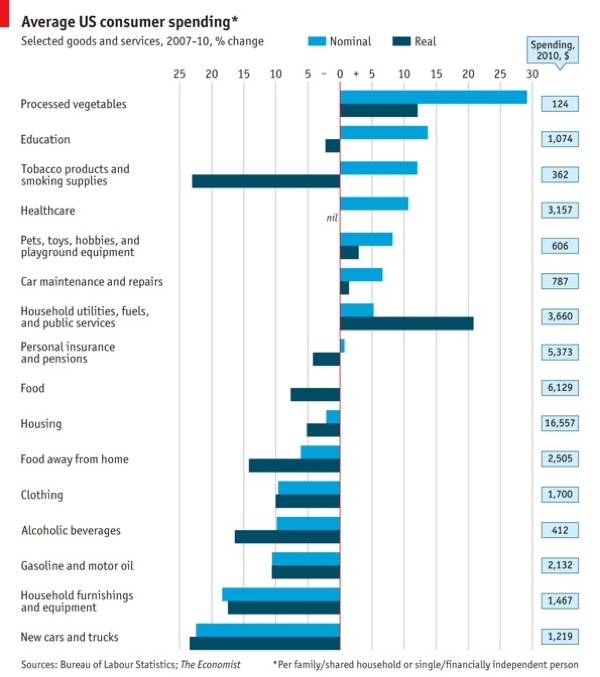
Gwen Sharp of Sociological Images comments on an Economist graph that shows how spending patterns have changed in the US during the Great Recession.

The results provide a good snapshot of the economic trade-offs Americans are making (i.e., we’re buying more canned veggies and eating out less), as well as which industries are taking the biggest hit as consumers redefine their products as less essential.

The “nominal” numbers refer to the unadjusted overall changes in spending; the “real” numbers are adjusted for the fact that prices rose by about 5.2% on average, so consumers are getting less for what they spend. So the light blue bars tell you the absolute change in what we’re spending; the dark blue bars, the change in spending relative to how much we’re buying. When adjusted for price inflation, consumer spending fell by about 8%.

Changes in U.S. Consumer Spending, 2007-2010

Author, unknown... We are wall street, not dinosaurs

‘We are wall Street…we are smarter and more vicious than [dinosaurs]‘

“We are Wall Street. It’s our job to make money. Whether it’s a commodity, stock, bond, or some hypothetical piece of fake paper, it doesn’t matter. We would trade baseball cards if it were profitable. I didn’t hear America complaining when the market was roaring to 14,000 and everyone’s 401k doubled every 3 years. Just like gambling, its not a problem until you lose. I’ve never heard of anyone going to Gamblers Anonymous because they won too much in Vegas.

Well now the market crapped out, & even though it has come back somewhat, the government and the average Joes are still looking for a scapegoat. God knows there has to be one for everything. Well, here we are.

Go ahead and continue to take us down, but you’re only going to hurt yourselves. What’s going to happen when we can’t find jobs on the Street anymore? Guess what: We’re going to take yours. We get up at 5am & work till 10pm or later. We’re used to not getting up to pee when we have a position. We don’t take an hour or more for a lunch break. We don’t demand a union. We don’t retire at 50 with a pension. We eat what we kill, and when the only thing left to eat is on your dinner plates, we’ll eat that.

For years teachers and other unionized labor have had us fooled. We were too busy working to notice. Do you really think that we are incapable of teaching 3rd graders and doing landscaping? We’re going to take your cushy jobs with tenure and 4 months off a year and whine just like you that we are so-o-o-o underpaid for building the youth of America. Say goodbye to your overtime and double time and a half. I’ll be hitting grounders to the high school baseball team for $5k extra a summer, thank you very much.

So now that we’re going to be making $85k a year without upside, Joe Mainstreet is going to have his revenge, right? Wrong! Guess what: we’re going to stop buying the new 80k car, we aren’t going to leave the 35 percent tip at our business dinners anymore. No more free rides on our backs. We’re going to landscape our own back yards, wash our cars with a garden hose in our driveways. Our money was your money. You spent it. When our money dries up, so does yours.

The difference is, you lived off of it, we rejoiced in it. The Obama administration and the Democratic National Committee might get their way and knock us off the top of the pyramid, but it’s really going to hurt like hell for them when our fat a**es land directly on the middle class of America and knock them to the bottom.

We aren’t dinosaurs. We are smarter and more vicious than that, and we are going to survive. The question is, now that Obama & his administration are making Joe Mainstreet our food supply…will he? and will they?”

Congrats to 15 Years of CEH Success!

On Monday, the Center for Environmental Health (CEH) toasted the first 15 years of our successful action to protect children and families from harmful chemicals at a gala...

CEH Executive Director Michael Green explained the “toxic shell game” that the chemical industry plays with our health: how, when they are faced with increasing pressure to eliminate a harmful chemical, the industry often simply substitutes a less well-studied chemical, or worse, one that is known to be harmful but has yet to be tightly regulated.

Michael Green, government regulations recently forced companies to stop selling a toxic strawberry pesticide called methyl bromide. How did the chemical companies respond? By replacing methyl bromide with methyl iodide, a pesticide linked to cancer and miscarriages.

Michael told the audience that CEH works to stop this shell game in five ways:

  • CEH collaborates with national leaders in green business;
  • CEH pressures corporations that are focused on profits at the expense of public health;
  • CEH crafts and advocates for policy changes that create incentives for safer business practices and products;
  • CEH organizes the public to pressure business and support policy changes, with regular advocacy alerts and our network of MOMS activists in all 50 states; and
  • CEH uses cutting-edge science to push for action that protects children and families from harm.

Michael said that, from the outset, CEH had audacious goals, one of which was to end health threats to kids from high levels of lead in children’s products. When CEH was founded in 1996, this seemed an impossible goal – until CEH exposed and eliminated lead threats to children from diaper rash creams, and children’s medicines, and baby bibs, jewelry, candy and many other products. Our work brought national attention to the problem, and in 2008 CEH helped to write and pressured Congress to pass the first-ever federal law banning lead in all children’s products!

Read on at

Gas pumps found to be germiest things we touch

Gasoline pump germs


We think Nissan has found its new spokesman for the all-electric Leaf. A microbiologist at the University of Arizona known as "Dr. Germ" says he's identified gas pumps as the biggest biohazard in modern society.

According to The Los Angeles Times, the results of the good doctor's research show 71 percent of gas pump handles are "'highly contaminated' with the kinds of germs most associated with a high risk of illness." Other cesspools we encounter on an everyday basis include public mailboxes, ATM machines and escalators.

So what should the budding Howard Hughes do when faced with such information? Well, before you try to avoid germ-infested gas pumps by buying an electric vehicle, know this: The study also found 40 percent of parking meters to be similarly infested.

Gas pumps found to be germiest things we touch originally appeared on AutoblogGreen 

400% Rise in Anti-Depressant Pill Use: Americans Are Disempowered -- Can the OWS Uprising Shake Us Out of Our Depression? | Drugs | AlterNet

The U.S. Centers for Disease Control and Prevention (CDC) recently reported that antidepressant use in the United States has increased nearly 400 percent in the last two decades, making antidepressants the most frequently used class of medications by Americans ages 18-44. Among Americans 12 years and older, 11 percent were taking antidepressants by 2005-2008 (the most recently reported study period), and 23 percent of women ages 40–59 years were taking them.

Why has U.S. antidepressant use skyrocketed? Are the symptoms of what is commonly called depressionhelplessness, hopelessness, and immobilizationalways evidence of a medical condition?

Common Explanations for Soaring Antidepressant Use

Nowhere in the CDC report is there any explanation for the 400 percent increase of antidepressant use from 1988 to 2008, however, there are several common explanations offered by mental health professionals and journalists.  

Money is a large factor. It has become more lucrative for psychiatrists and other physicians to prescribe medication than to provide talk therapy. This was detailed in the New York TimesMarch 2011 investigative report “Talk Doesn’t Pay, So Psychiatry Turns Instead to Drug Therapy” which reported, “A 2005 government survey found that just 11 percent of psychiatrists provided talk therapy to all patients.” Actually, most antidepressant prescriptions are written by physicians other than psychiatrists and, according to the recent CDC report, among Americans taking one antidepressant, less than one-third of them  have seen a mental health professional in the past year.  

When Having the US Debt Paid Off Was a Problem?

"NPR reports that not so long ago, the prospect of a debt-free U.S. was seen as a real possibility with the potential to upset the global financial system. As recently as 2000, the U.S. was running a budget surplus, taking in more than it was spending every year — and economists were projecting that the entire national debt could be paid off by 2012. So the government commissioned a secret report outlining the possible harmful consequences of retiring the debt completely. For one thing, paying off the national debt would mean the end of Treasury bonds, a pillar of the global economy. Treasury securities are crucially important to the world financial system in a number of ways: banks buy them as low-risk assets, the Fed uses them for executing monetary policy, and mortgage interest rates vary based on Treasury rates. 'It was a huge issue ... for not just the U.S. economy, but the global economy,' says Diane Lim Rogers, an economist in the Clinton administration. In the end, Jason Seligman, the economist who wrote most of the report titled 'Life After Debt (PDF),' concluded it was a good idea to pay down the debt — but not to pay it off entirely. 'There's such a thing as too much debt,' says Seligman. 'But also such a thing, perhaps, as too little.'"
Source: 

Environmental Consulting Falls for 2nd Year in UK

Environmental Consulting Falls for 2nd Year in UKThe U.K. environmental consulting market contracted by 8.4 percent in 2010, and prospects for 2011 are relatively flat, market research firm Environment Analyst has found. According to The 2011 Market Assessment of the UK Environmental Consulting Sector, last year the market declined for the second consecutive year after more than two decades of constant growth...
Read on at:

Air pollution tied to lung cancer in non-smokers | Reuters

People who have never smoked, but who live in areas with higher air pollution levels, are roughly 20 percent more likely to die from lung cancer than people who live with cleaner air, researchers conclude in a new study.

"It's another argument for why the regulatory levels (for air pollutants) be as low as possible," said Francine Laden, a professor at the Harvard School of Public Health, who was not involved in the research.

Though smoking is the number one cause of lung cancer, about one in 10 people who develop lung cancer have never smoked.

"Lung cancer in 'never smokers' is an important cancer. It's the sixth leading cause of cancer in U.S....After the team took into account other cancer risk factors, such as second-hand smoke and radon exposure, they found that for every 10 extra units of air pollution exposure, a person's risk of lung cancer rose by 15 to 27 percent.

The increased risk for lung cancer associated with pollution is small in comparison to the 20-fold increased risk from smoking.

And the study team didn't prove that the pollution caused the cancer cases, but "there's lots of evidence that exposure to fine particles increases cardiopulmonary mortality," Turner told Reuters Health.

...Laden noted that the pollution levels associated with the increased risk of cancer in the current study are not uncommon in the U.S.

"These levels are within the (regulatory) standards," Laden told Reuters Health. "We're not talking about people who live in a really polluted place with no pollution control."

SOURCE: bit.ly/rMyNsA American Journal of Respiratory and Critical Care Medicine, online

Fukushima towns struggle to store radioactive waste | Reuters

(Reuters) - Japanese officials in towns around the crippled Fukushima nuclear plant reacted guardedly to plans announced on Saturday to build facilities to store radioactive waste from the clean-up around the plant within three years.

Saturday's announcement, seven months after the world's worst nuclear disaster in 25 years, came as towns near the plant are still coping with health fears and disputes over where to store huge amounts of unwanted waste.

"We cannot proceed without cooperation of the prefecture and municipalities. We are very sorry to ask for this, but we hope you will understand," Environment Minister Goshi Hosono told Fukushima Governor Yuhei Sato, Kyodo news agency reported.

The Fukushima Daiichi nuclear power plant, 240 km (150 miles) northeast of Tokyo, was crippled by an earthquake and tsunami in March.

The plume of radioactive materials that leaked from the plant was carried by wind and deposited widely in eastern Japan with rain and snow.

Japan aims to halve radiation over two years in places contaminated by the crisis. To do so, it may have to remove and dispose of massive amounts of radioactive soil, possibly enough to fill 23 baseball stadiums.

Towns near the crippled nuclear plant have barely been able to start cleaning up until now because they have been unable to convince residents about where to store the radioactive waste.

Hosono said it would take about three years to build facilities to store soil and other waste containing radioactive materials, mainly cesium, for up to 30 years.....Local authorities would have to keep the contaminated waste in their towns until the facility is ready.

Artificial Blood Coming to a Hospital Near You!

artificial blood, blood donation, blood supply, national blood supply, blood type, how to make artificial blood, design for health

Researchers at the University of Edinburgh have successfully created artificial, oxygen-carrying red blood cells that they believe could go into human medical trials in as little as two years. The cells aren’t synthetic, they are created using human stem cells, but they can be manufactured, and the researchers are currently working out a way to mass-produce them safely. If successful their findings would eliminate the need for the current mass amounts of energy and electricicity that are needed to gather, transport and store blood for transfusions. Plus, now we have something more than garlic to throw at vampires when they come knocking on Monday evening!

Read the rest of Artificial Blood Coming to a Hospital Near You!

Apocalypse coming or gone? What will it take to get Washington to care about the deficit?

Wasn’t the S&P downgrade supposed to bring down America? What happened?

About three months ago, President Obama glowered into TV cameras and issued an apocalyptic warning about what would happen if a deal to increase the debt limit was not struck.

“For the first time in history,” said the president, “our country’s AAA credit rating would be downgraded, leaving investors around the world to wonder whether the United States is still a good bet. Interest rates would skyrocket on credit cards, mortgages, and car loans, which amounts to a huge tax hike on the American people.” 

The deal got done, zipped through Congress with two quick, emotional votes, then zoomed over to the president’s desk. And then … well, S&P downgraded America’s AAA rating anyway. That was the first unexpected twist, and it roiled markets and Washington for a week. ....How could a saga that captured Washington for 11 weeks have faded so quickly? Why don’t the president’s enemies even talk about it as much as they used to? It’s pretty simple. America lucked out and avoided any of the really negative side effects because investors, in their panic, didn’t abandon U.S. bonds. The Dow Jones and S&P indexes are higher now than they were before the downgrade. Congress, worn to the ragged edge of sanity by the debt fight, moved on. Obama’s Republican rivals found other stuff to talk about. 

Somehow, we dodged buckshot that was fired from three paces away. It’s impressive—and it doesn’t please investors or debt hawks at all. Actually, no: It’s another disaster.

Did he really hope for post-downgrade chaos? “This is why they call economics the dismal science,” he says. “I wish we’d had some! I know that now, more than ever, we need external panic to get anything done about the debt.” 

Obese people regain weight after dieting due to hormones

Worldwide, there are more than 1.5 billion overweight adults, including 400 million who are obese. In Australia, it is estimated more than 50 per cent of women and 60 per cent of men are either overweight or obese.

Although restriction of diet often results in initial weight loss, more than 80 per cent of obese dieters fail to maintain their reduced weight. Obese people may regain weight after dieting due to hormonal changes, a new study has shown.

Professor Joseph Proietto from the University of Melbourne and Austin Health said the study revealed the important roles that hormones play in regulating body weight, making dietary and behavioral change less likely to work in the long-term.

"Our study has provided clues as to why obese people who have lost weight often relapse. The relapse has a strong physiological basis and is not simply the result of the voluntary resumption of old habits," he said.

Dr Proietto said although health promotion campaigns recommended obese people adopt lifestyle changes such as to be more active, they were unlikely to lead to reversal of the obesity epidemic.

"Ultimately it would be more effective to focus public health efforts in preventing children from becoming obese."

Read on at

The Economy Down the…


Smithsonian shows 100 years of electric car's past

1904 Columbia electric runabout went on display Thursday with a 1913 Ford Model T touring car. The cars and other objects, including a  for General Motors' EV1 electric car from the 1990s, are on view through January.

The Columbia was the best-selling U.S. car at the turn of the century, while the Model T was a gasoline car equipped with an electric starter and electric headlights.

A rare EV1 was displayed in the past. It was pulled from view in 2006, weeks before the movie "Who Killed the Electric Car?"

Last year,  were reintroduced to the market... Innovation?

http://media-newswire.com/release_1161053.html

Wind Power, Grid Mismatch Costly To Investors

Wind farm investors face growing losses from "curtailments," as turbine installations outstrip the capacity of local transmission systems to accommodate the new power.

The issue is a "growing pain" of wind technology, Judah Rose, Senior Vice President, ICF International in McLean, VA, said. Curtailment has become an increasing problem since 2008 as wind capacity nationwide increases from almost nothing 10 years ago to more than 42,000 megawatts now. "It's occurring even in RTOs (regional transmission organizations) with advanced pricing and management systems," Rose said.

The Midwest Independent System Operator (MISO) says its curtailments in 2010 amounted to about 8% of wind output, some 824,000 megawatt-hours, up from 292,000 MWh in 2009. The system experienced more curtailments of longer average duration as more wind projects came on linein areas with transmission congestion.

Rose and Kiran Kumaraswamy, a transmission expert with ICF International, told a webinar this week that the situation makes it vital that new projects assess their curtailment risk. Coordination with transmission providers – both traditional utilities and merchant transmission builders – will be increasingly necessary for wind project profitability, they said.

Involuntary curtailments occur when consumer demand is less than the generation available, and grid operators must order some generation disconnected in order to keep the grid stable.

Wind Worries

It's a particular problem for wind, which often doesn't blow during peak demand periods on hot afternoons, but does blow overnight when power usage is low. In the Midwest, Rose said, peak curtailments have occurred in the spring, when demand is low but wind is typically plentiful.
Curtailments can be particularly costly for wind projects, since theircapacity factors are low. Good projects generate just 30-40% of their rated capacity over a year, so being unable to sell output when winds are most productive can hit project revenue hard.

Rose said MISO wind has averaged 3% curtailment over a recent 14-month period, but some locations with particular transmission constraintsexperienced as much as 20% curtailment.
That means projects are losing not just the revenue from selling those megawatt-hours, but also the production tax credits and renewable energy credits. He said the project owner often bears those losses.

Kumaraswamy said grid operators are trying different pricing systems to better manage the variable wind output, like MISO's Dispatchable Intermittent Resources (DIR) rule. It creates a new generator category for wind and sets more flexible rules for wind generators bidding into MISO's forward markets. But it does demand that larger wind operators participate in those markets, and pay penalties if they fail to follow dispatch orders, similar to performance demanded of all other generators.

Read on at

After Calling Energy Subsidies 'Wrong,' Boehner Wants $2 Billion Loan Guarantee For Ohio Nuclear Plant | ThinkProgress

Back in September, as the GOP was getting all riled up over the faux Solyndra scandal, House Speaker John Boehner (R-OH) said that “for the federal government to be out there picking one company over another, one type of energy source over another, I think is wrong.” Evidently, though, his attitude toward energy subsidies does not extend to nuclear plants in his home state of Ohio.

As Bloomberg reported today, despite his professed view on energy subsidies, Boehner is backing a $2 billion loan guarantee for an enriching plant run by USEC Inc., saying that failing to provide the guaranteewould “betray” Ohio’s workers:

House Speaker John Boehner attacked the Obama administration for financing failed solar-panel maker Solyndra LLC, saying government shouldn’t pick winners and losers. That hasn’t stopped him from demanding that the U.S. make a winner of a nuclear-fuel plant in Ohio, his home state.

Boehner is backing a $2 billion Energy Department loan guarantee sought by USEC Inc. (USU) for its American Centrifuge Plant in Piketon, Ohio, aimed at enriching uranium for commercial nuclear reactors. [...]

Read on at

1 MW E-Cat Cold Fusion Device Test Successful?

Here is a brief video excerpt highlight from Rossi during his 1-hour reading of the public report from the customer, followed by a question and answer session. 

In this excerpt, Rossi responds to the question, "So, is this a breakthrough?"

Here's a transcription of the excerpt video:

Mister Sonya has asked me if I think that the test of today is a breakthrough. I think yes, because I think today we have seen enough. No more small five or ten kilowatt units, but now we have overcame the [cannot understand].... disconnected. The basic engineering to make something that.... 

You know, to go in self sustain mode and make 400 [actually 470] kilowatt hours per hour... To understand that this is a breakthrough... 

You can also think that hundreds of millions of dollars have been spent to try to have a COP of 1.1 with nuclear fusion. Today we have made a theoretically endless COP making 470 kilowatt hour per hour of completely free energy, free of fuel. Yes, I think this is a breakthrough. 

Of course this is the first step, but it is a very important first step....

Early this year Andrea Rossi announced his plans to construct and test the world's first one megawatt cold fusion plant. The plant would utilize his E-Cat (Energy Catalyzer) technology that utilizes tiny quantities of nickel powder and hydrogen gas as fuel, while producing large amounts of energy in the form of heat. Importantly, the energy is produced without emitting any pollution, utilizing any radioactive materials, or producing any nuclear waste. Simply put, the E-Cat offers the world a source of cheap, safe, and clean energy. Although the exact plans for the launch of the technology were adjusted a few times throughout the course of this year, October 28th, 2011 was settled on for the date of the official test of the one megawatt plant by the first customer.

These first plants will cost around $2,000 per kilowatt to build one at a time, but once they are mass produced, Rossi expects the price to drop to around $100 per kilowatt installed.

Read on at