People 70 and older who eat food high in carbohydrates have nearly four times the risk of developing mild cognitive impairment, and the danger also rises with a diet heavy in sugar, Mayo Clinic researchers have found.
Please read full and follow at:

.... According to the Congressional Budget Office (CBO), in 2020, ObamaCare will spend $229 billion on a Medicaid expansion and a new subsidy program for health insurance. These expenditures will primarily benefit 29 million people newly enrolled in Medicaid and the insurance subsidy program. That works out to nearly $8,000 for every newly insured American, or about $21,000 per newly insured household.
...The president wants Americans to believe that ObamaCare is painless and without cost for the middle class, but most Americans, using their common sense, don’t believe him. They are right to be skeptical. It is certainly true that ObamaCare expands the entitlement rolls to some 30 million additional people, and thereby reduces — at least on paper — the numbers of uninsured Americans. But there is a massive cost to doing this, running more than $200 billion annually by the end of the decade. Who will pay for this? The middle class, of course. They will pay higher taxes and higher premiums for health insurance and get less back from the Medicare program in retirement. An honest debate would acknowledge these facts.
Please read full and follow at: http://www.economics21.org/commentary/obamacares-heavy-toll-middle-class-americans

The U.S. has 2,400 hydropower dams, many of which sport out-of-date generating equipment that is, well, generations old.

That’s the bad news. The good news is, it all adds up to the potential for a massive energy efficiency upgrade program that could significantly boost U.S. hydropower generation without the monumental expense and environmental disruption involved in new dam construction. In fact, the first round of hydropower upgradesis already underway at an average cost of less than 4 cents per kilowatt-hour.
A Hydropower Upgrade for Boulder, Colorado
The Boulder Canyon Hydroelectric Facility in Boulder, Colorado is a case in point. Dating all the way back to 1910, the facility just underwent an overhaul that replaced two older turbines with one new energy-efficient unit. The new unit alone can generate 30% more energy than both of the older turbines combined.
The upgrades can also cut the energy required to run hydropower facilities. At Boulder, the $1.18 million project included new transformers, storage tanks, and wiring, along with remote operating equipment. More
 |
| To the rescue: Fire trucks converge at Mazda Motor Corp.'s plant in the city of Hiroshima after an explosion injured three workers at the facility in the early hours of Saturday morning. KYODO |
The fire department said it was alerted by a phone call around 1:55 a.m., informing it that three people had sustained injuries in the blast. Of the three, one was hospitalized while the other two sustained only minor burns.
Upon arriving at the scene, firemen found the explosion had occurred during the transportation of molten steel in a cylinder-shaped container measuring 1 meter in diameter and 1.5 meters high. The container accidentally fell over, spilling its contents and causing the blast, the fire department said.
Foxconn Technology Group, the world’s largest contract electronics maker, has acknowledged hiring teenagers as young as 14 in a Chinese factory, in breach of national law, in a case that raises further questions over its student intern program
Labor rights activists in China have accused Foxconn and other big employers in China of using student interns as a cheap source of labor for production lines where it is more difficult to attract young adult workers to lower paid jobs.
Foxconn, the trading name of Taiwan’s Hon Hai Precision Industry, said it had found some interns at a plant in Yantai, in northeastern Shandong province, were under the legal working age of 16. It did not say how many were underage.
Although the process is still in the early developmental stages and needs to take electricity from the national grid to work, the company believes it will eventually be possible to use power from renewable sources such as wind farms or tidal barrages.
“We’ve taken carbon dioxide from air and hydrogen from water and turned these elements into petrol,” said Peter Harrison, the company’s chief executive, who revealed the breakthrough at a conference at the Institution of Mechanical Engineers in London.
“There’s nobody else doing it in this country or indeed overseas as far as we know. It looks and smells like petrol but it’s a much cleaner and clearer product than petrol derived from fossil oil,” Mr Harrison told The Independent.
“We don’t have any of the additives and nasty bits found in conventional petrol, and yet our fuel can be used in existing engines,” he said.
“It means that people could go on to a garage forecourt and put our product into their car without having to install batteries or adapt the vehicle for fuel cells or having hydrogen tanks fitted. It means that the existing infrastructure for transport can be used,” Mr Harrison said.
Being able to capture carbon dioxide from the air, and effectively remove the principal industrial greenhouse gas resulting from the burning of fossil fuels such as oil and coal, has been the holy grail of the emerging green economy.
Using the extracted carbon dioxide to make petrol that can be stored, transported and used as fuel for existing engines takes the idea one step further. It could transform the environmental and economic landscape of Britain, Mr Harrison explained.
“We are converting renewable electricity into a more versatile, useable and storable form of energy, namely liquid transport fuels. We think that by the end of 2014, provided we can get the funding going, we can be producing petrol using renewable energy and doing it on a commercial basis,” he said.
“We ought to be aiming for a refinery-scale operation within the next 15 years. The issue is making sure the UK is in a good place to be able to set up and establish all the manufacturing processes that this technology requires. You have the potential to change the economics of a country if you can make your own fuel,” he said.
The Quality Environmental, Health and Safety (QuEHS) Director will carry out assigned Quality Management initiatives assisting in the preparation of plans and procedures, as well as implementing and supervising a Quality program in compliance with the Company’s Management System. This newly created position will provide oversight to the Quality system audits, corrective action; evaluate accuracy of equipment and testing, measurement and analytical facilities, inspection and sampling procedures, aiding vendors in fulfilling company and regulatory requirements and related communication and training. The QuEHS Director will be responsible for co-coordinating and facilitating implementation of the environmental, health and safety procedures for the Company.
Reporting Line / Stakeholders:
|
Direct Reports:
|
Knowledge & Skills Required:
|
|
|
For more information please contact
Mirjana Beslic
Harvey Nash Executive Search
Tel: +1 (646) 388-7032

Since 2008, the Wisconsin Bioenergy Initiative (WBI) at the University of Wisconsin–Madison has hosted an annual Summit to engage and connect bioenergy stakeholders, the general public and students with research and development updates from throughout campus and the state. (You can see highlights from past summits here.) 
As the United States’ energy needs continue to evolve, the research, policy and technology needed to support these needs will change too. It’s been 260 years since Benjamin Franklin flew a metal key attached to a kite into a thunderstorm. One hundred and thirty years later, the first electric plants were built in New York and Wisconsin. The first gas-powered American automobile was built in 1893, three years after the first American electric vehicle.
In the past 60 years, U.S. energy and technological innovation led to the construction of the first nuclear power plant and commercial photovoltaic cell, and novel energy advancements ranging from mass-cultured microalgae to energy-efficient micro-grids.
Wisconsin farmers and agricultural industries lead the country in the development of on-site waste-to-energy systems and anaerobic digesters, adding energy to the list of critical contributions they make to our society.
True to the Wisconsin idea and our land-grant mission, UW-Madison researchers are working to develop new and innovative technologies that will strengthen our energy future. This year the WBI has partnered with UW–Madison Energy Institute to expand the breadth and scope of the Summit to include a wide-range of energy topics. On October 30, we will host the 2012 Energy Summit, “Innovating Our Way to a Sustainable Energy Future.” The Summit will address the full spectrum of energy challenges and opportunities facing our state and nation, and highlight the many ways UW–Madison is leading the way in energy research, education, and outreach.
This years Energy Summit will feature researchers and energy and industry professionals from across the United States. Session tracks will include: Energy and its Societal Impacts, Energy and the Wisconsin Idea, and Innovation to Solve our Energy Challenges. This year the Energy Summit is proud to bring keynote speakers Bill Banholzer, Executive VP and Chief Technology Officer of DOW Chemical; former U.S. Nuclear Regulatory Commission Chairman Gregory Jaczko, and Gundersen Lutheran CEO Dr. Jeff Thompson.Date: October 30, 2012Monona Terrace and Convention Center
The safety officer, similar to a civilian safety manager, conducts workplace inspections and improvements, resolves safety recommendations, conducts safety training for all employees and investigates accidents. The safety officer also provides the commander with the soldiers' feedback and concerns on how to improve safety. They implement additional programs under the commander's directives and guidance for field and combat operation safety programs and off-duty safety awareness.
Army North's Army Safety Program is clearly evident as we conduct training, as was the case recently during our Vibrant Response exercise in Indiana and Kentucky. Vibrant Response was an Army North-led Department of Defense exercise that involved more than 9,000 military and civilian responders from local, state and federal agencies conducting what is known as Chemical, Biological, Radiological and Nuclear Response Enterprise.
Because safety for all of these forces was such a concern, the commander brought 12 additional safety professionals from across the nation to provide oversight during this month long, hands-on, technical exercise. Due to such an emphasis on safety concerns, there were no major accidents and no OSHA-recordable injuries.
Please read on at:
The Washington Post... In New York City, Panetta called the Internet “a new terrain for warfare.” He also described it as “a battlefield of the future where adversaries can seek to do harm to our country, to our economy and to our citizens.”
It has already become that battlefield, but with little public debate because the United States has been taking the fight to our enemies wrapped in secrecy.
The administration complains about the Russians, the Chinese, the Iranians hacking into U.S. computer networks without noting what U.S. electronic warriors are doing.
Panetta said that the Pentagon is spending $3 billion a year on cybersecurity “to retain that cutting-edge capability in the field” and invest “in skilled cyberwarriors needed to conduct operations in cyberspace.”
http://www.washingtonpost.com/world/national-security/the-inevitable-blowback-to-high-tech-warfare/2012/10/15/dc4c1496-147f-11e2-ba83-a7a396e6b2a7_story_1.html
A123 said in a press release. Johnson Controls plans to acquire A123’s automotive-business assets in a deal valued at $125 million and will provide financing of $72.5 million to support A123’s operations, according to the release. A deal to sell a majority stake to a Chinese company fell through, A123 said.
The company listed assets of $459.8 million and debt of $376 million as of Aug. 31 in Chapter 11 documents filed today in U.S. Bankruptcy Court in Wilmington, Delaware.
The Waltham, Massachusetts-based company said yesterday it expected to fail to make an interest payment due yesterday on $143.8 million of notes expiring in 2016.
The training allows businesses in Portland to list the city's fire department as a trained safety response team, something the federal Occupational Safety and Health Administration requires of businesses that have people working in and around confined spaces.
Please read on at: http://www.pressherald.com/news/Portland-firefighters-train-for-confined-space-rescues.html
The EPA’s determination that more cleanup is needed was based on the findings of a year-long survey of nearly 6,000 locations along the 40 miles of river contaminated when pipeline 6B ruptured in July 2010. Enbridge has until next week to request a conference with the EPA to discuss the additional work and 30 days to submit written comments.
Steve Hamilton, a Michigan State University professor who was among the experts who worked on the study, said the recommendation for dredging was driven by concern that during flooding the pools of oil could break loose and recontaminate parts of the river that have already been cleaned—or flow downriver into areas that were never touched by the gooey oil. 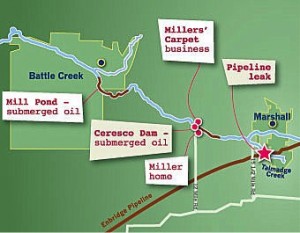
“We will never get all of the oil out [of the river]. It’s impossible,” Hamilton said. “The challenge is to determine when do you get to a point of diminishing returns where the eradication is too environmentally destructive to warrant the removal.”
A spokesman for the EPA said the agency would not have any comment beyond the information contained in its proposed order and the letter it sent to Enbridge.
The EPA acknowledged in the proposed order that Enbridge had conducted substantial cleanup since the pipeline ruptured, but “despite these response actions, oil remains in the Kalamazoo River.”
Enbridge did not respond to requests for comment for this story. But in an Aug. 24 letter to the EPA, the company said it did not believe that more dredging—especially in the area near the Ceresco Dam—was necessary.
“Enbridge’s position is that we have reached a point of diminishing returns where further invasive activities would do more harm than good,” Richard Adams, Enbridge’s vice president of field operation in the United States, said in the letter.
“In fact, we strongly believe that such action solely for the purpose of aesthetics would both negatively impact the riverine environment and create a significant disturbance and inconvenience to local landowners and other river users.”
The company also disputed the EPA’s concern that oil is still pooling in the river, especially near the Ceresco Dam.
“[T]he most significant evidence of submerged oil has been sheen which, when collected, has amounted to a volume of less than 1 gallon of product in total during 2012,” Adams wrote, referring to the area around the dam.
Deb Miller, who lives near the dam in the community of Ceresco said she sees rainbow sheens of oil floating on the surface when she walks along the river near the carpet store she and her husband own. Recently she ran a garden rake along the river’s bottom and said that marble-sized globs of oil popped to the surface, accompanied by the sour whiff of petroleum.
“It’s insane how much oil is still here,” said Miller, who has testified before Congress about the spill’s impact on her life.
That big brain of ours is the reason humans get cancer.
That's what Georgia Institute of Technology researcher John McDonald discovered when comparing our cells with those of other primates:
When cells become damaged or just aren't needed, they self-destruct in a process called apoptosis. In developing organisms, apoptosis is just as important as cell growth for generating organs and appendages – it helps "prune" structures to their final form. [...]
McDonald compared skin cells from humans, chimpanzees and macaques and found that, compared to cells from other primates, our cells are reluctant to undergo apoptosis. When exposed to apoptosis-triggering chemicals, human cells responded significantly less than the chimp and macaque cells. [...]
McDonald suggests that humans' reduced capacity for apoptosis could help explain why our brains are so much bigger, relative to body size, than those of chimpanzees and other animals. When a baby animal starts developing, it quickly grows a great many neurons, and then trims some of them back. Beyond a certain point, no new brain cells are created.
Human fetuses may prune less than other animals, allowing their brains to swell.
The downside to this is that we're more susceptible to developing cancer cells, which do not respond to apoptotic signals: Link

Good news: Americans are exercising more and smoking less ...
Bad news: ... yet we are getting fatter than ever. Probably because we're drinking more (with bad news like these, who can blame you if you need a beer?)
Scientific American has an interactive graphic that lets you see the health trends in your state: Link
 Now in its eleventh year, the American Society of Safety Engineers (ASSE) annual kids’ Safety on the Job poster contest is open for entries through Feb. 14, 2013. The contest, which accepts entries from kids ranging in age from 5 to14, aims to impart to children the importance of workplace safety.
Last year, a record 2,300, entries were received from the United States and 11 other countries including Australia, Bangladesh, Canada, China, Columbia, Greece, Japan, Kuwait, Nigeria, Saudi Arabia and Venezuela.
The winning poster from each of the five age groups is featured on the annual North American Occupational Safety and Health (NAOSH) Week poster distributed worldwide. The five grand prize winners and 15 runners-up each receive prizes and are recognized at NAOSH kick-off events and worldwide through ASSE communications and publications. NAOSH Week runs from May 5-11, 2013, and Occupational Safety and Health Professional Day is May 8.
The contest is open to ASSE members' children, grandchildren, nieces and nephews, as well as all children sponsored by an ASSE member. ASSE members can sponsor schools and the children of their coworkers.
For poster contest rules and information, please visit http://www.asse.org/newsroom/naosh/poster-contest.php.
SAN FRANCISCO — Corrosion that went unchecked – the suspected cause of a fire at Chevron Corp.'s Richmond refinery in August – has been linked to a fire at the plant in October 2011, the San Francisco Chronicle reported Sunday ().http://bit.ly/OzFQcu
According to state inspection documents obtained by The Chronicle, a state Division of Occupational Safety and Health inspector who investigated the smaller 2011 fire documented allegations from two workers of corrosion at the refinery.
The 2011 fire took place during a scheduled maintenance shutdown and was quickly extinguished.
"We're afraid something is going to fall through the cracks," one worker told Cal/OSHA safety inspector Carla Fritz, who went to the plant to investigate the fire last November.
"We're concerned about increased corrosion – we've increased temperatures and increased rates, and it takes a toll on the equipment," said the worker, who was identified in Fritz's notes as head operator of the lube oil plant – the most senior of a 20-member operator crew.
Cal/OSHA said in a statement that a violation notice was not issued to Chevron over the 2011 fire "because the problem alleged and potential hazard had been already identified and corrected."
"People are never going to understand how critical this particular time in history is," said Erskine Bowles, the North Carolina businessman and co-chairman of PresidentBarack Obama's National Commission on Fiscal Responsibility and Reform. "We have $7.7 trillion worth of economic events that are going to hit America in the gut in December, and in Washington they're doing nothing about it."
Bowles' co-chair on the commission was former Wyoming Sen. Alan Simpson, who said political culture in Washington is preventing any action to address what is known as the "fiscal cliff."
"They're both in this," Simpson said of the warring Democratic and Republican parties. "They worship the god of re-election."
Gore charted this path by returning to his longtime passion — clean energy. He benefited from a powerful resume and a constellation of friends in the investment world and in Washington. And four years ago, his portfolio aligned smoothly with the agenda of an incoming administration and its plan to spend billions in stimulus funds on alternative energy.
The recovering politician was pushing the right cause at the perfect time.
Fourteen green-tech firms in which Gore invested received or directly benefited from more than $2.5 billion in loans, grants and tax breaks, part of President Obama’s historic push to seed a U.S. renewable-energy industry with public money.
Please continue reading at:

