Virginia's environmental agency and Honeywell have reached an agreement that calls for the company to pay a $300,000 penalty and make more than $13 million in improvements at its Hopewell chemical plant.
Please continue reading from: Environmental Health News
Aug 26, 2015
Environmental report says sage grouse still in danger from 27,000 oil and gas wells in Wyoming
Despite efforts by the Obama administration to postpone oil and gas activity in the habits of the threatened greater sage grouse, the industry still has more than 27,000 wells in Wyoming that could greatly fragment the breeding grounds of species "and drive it closer to extinction," says a report by WildEarth Guardians, a non-profit environmental organization, Phil Taylor reports for Greenwire. The sage grouse is currently being considered for endangered status by the U.S. Fish and Wildlife Service.
The study "looked at how many oil and gas wells, mines, wind farms and transmission lines have been built within sage grouse core breeding areas in Wyoming over the past six years and how those have impacted grouse," Taylor writes. "Core areas, first designated by Wyoming in 2008, cover about one-fourth of the state and encompass most of its sage grouse. Core areas limit disturbances, both existing and new, to a maximum of an average of 5 percent per square mile, among other restrictions."
The report says that since 2009, the Bureau of Land Management "has approved less than 1 percent of oil and gas wells proposed in projects that partially overlap with sage grouse core areas," Taylor writes. "But BLM has deferred action on several massive projects totaling more than 27,000 wells that intersect core areas while it completes new sage grouse land-use plans to keep the bird from being listed under the Endangered Species Act, the report said. Those land-use plans would essentially codify Wyoming's core sage grouse policy, which WildEarth argues is too weak."
Speaking about the report, BLM Wyoming spokeswoman Kristen Lenhardt told Taylor, "To cross-check the numbers is going to take some time, but the way the study is written leads to a misunderstanding on the public's behalf. These wells are project proposals from companies, and the final projects that may or may not be approved will likely result in a different well count." (Read more)
The study "looked at how many oil and gas wells, mines, wind farms and transmission lines have been built within sage grouse core breeding areas in Wyoming over the past six years and how those have impacted grouse," Taylor writes. "Core areas, first designated by Wyoming in 2008, cover about one-fourth of the state and encompass most of its sage grouse. Core areas limit disturbances, both existing and new, to a maximum of an average of 5 percent per square mile, among other restrictions."
The report says that since 2009, the Bureau of Land Management "has approved less than 1 percent of oil and gas wells proposed in projects that partially overlap with sage grouse core areas," Taylor writes. "But BLM has deferred action on several massive projects totaling more than 27,000 wells that intersect core areas while it completes new sage grouse land-use plans to keep the bird from being listed under the Endangered Species Act, the report said. Those land-use plans would essentially codify Wyoming's core sage grouse policy, which WildEarth argues is too weak."
Speaking about the report, BLM Wyoming spokeswoman Kristen Lenhardt told Taylor, "To cross-check the numbers is going to take some time, but the way the study is written leads to a misunderstanding on the public's behalf. These wells are project proposals from companies, and the final projects that may or may not be approved will likely result in a different well count." (Read more)

In Just Three Years All Dutch Trains Will Run On Wind Power
Popular Science - What if on your next rail journey, the train not only sped along the countryside fast as the wind, it was actually powered by the breeze? If you travel on a train in the Netherlands in 2018, that might just be your reality.
Under a deal written up in 2014, starting this year about half of the electric trains in the Netherlands run on wind power. But the contract between railway companies and power suppliers aims to push that number higher. As Railway Technology reports, the agreement will see the trains running on completely on wind power by 2018. The energy will be generated from wind farms within the country but also in Belgium, and nearby Scandinavian countries.
The railway, which carries 1.2 million passengers every day, released about 550 kilotons of carbon dioxide before it started the switch to wind power earlier this year. The hope is to bring that number down to zero. The decrease comes at just the right time. Dutch citizens recently sued their government to reduce CO2 emissions to levels 25 percent lower than those in 1990 by the year 2020. Cutting out all CO2 from trains by 2018 is a step in that direction.
It will be a long while before wind-powered trains arrive in the United States. Currently, wind power companies in America are focusing on an earlier step in the process; actually building wind farms. The closest point of intersection between the wind power and transportation industries seems to be figuring out how to transport the massive turbine parts from manufacturers to the building site. With some turbine blades weighing thousands of pounds and stretching over 180 feet long just getting from point A to point B requires a logistics nightmare of conventional trucks and trains.
Once wind farms are ubiquitous, rail companies might decide to follow the Dutch model. In the meantime, the United States is developing more efficient train engines that release fewer pollutants into the air. It may not be wind-powered trains, but it's a start.
Aug 24, 2015
Responsible Electronics Recycling Webinar: Sustainability & Your Office Equipment – What can you do?
Sustainability & Your Office Equipment – What can you do?
Free Webinar – September 15th, 2 p.m. Eastern
Buying green, saving power & paper, responsible reuse & recycling - the State Electronics

The Challenge is open to local, regional, tribal, and state governments, all public & private K-12 schools, colleges and universities, and non-profit organizations. Participants receive access to free technical assistance, tools, resources, and recognition in support of their efforts to decrease the environmental impact of electronic office equipment. The Challenge also documents the success of participating organizations. Program participants receive annual sustainability reports that detail their reductions in energy use, greenhouse gases, and waste.
To learn more about the State Electronics Challenge, register for the upcoming introductory webinar: September 15th, 2 – 3 p.m., eastern. Register now:
https://attendee.gotowebinar.com/register/4092797161714863105
For more information, contact info@stateelectronicschallenge.net or visit the website at www.stateelectronicschallenge.net.
Free Webinar – September 15th, 2 p.m. Eastern
Buying green, saving power & paper, responsible reuse & recycling - the State Electronics
The Challenge is open to local, regional, tribal, and state governments, all public & private K-12 schools, colleges and universities, and non-profit organizations. Participants receive access to free technical assistance, tools, resources, and recognition in support of their efforts to decrease the environmental impact of electronic office equipment. The Challenge also documents the success of participating organizations. Program participants receive annual sustainability reports that detail their reductions in energy use, greenhouse gases, and waste.
To learn more about the State Electronics Challenge, register for the upcoming introductory webinar: September 15th, 2 – 3 p.m., eastern. Register now:
https://attendee.gotowebinar.com/register/4092797161714863105
For more information, contact info@stateelectronicschallenge.net or visit the website at www.stateelectronicschallenge.net.
Help Congratulate fellow CHMM,Rich Cartwright on his new opportunity!
I would like to Congratulate my friend and long time HazMat buddy on his new opportunity at USA Environment.
We have been together in hazardous materials management for almost 30 years together!
His new gig is good news for ANYONE who needs nationwide capabilities in Environmental Remediation & Ecological Restoration Construction, NORM, NOW, Low & High Level Radioactive Material, Hazardous Waste Transportation and Disposal, Industrial Services, Sediment Removal, Demolition Services, Mine & Pond Closures, Decommissioning Services (Oil & Gas).
We have been together in hazardous materials management for almost 30 years together!
His new gig is good news for ANYONE who needs nationwide capabilities in Environmental Remediation & Ecological Restoration Construction, NORM, NOW, Low & High Level Radioactive Material, Hazardous Waste Transportation and Disposal, Industrial Services, Sediment Removal, Demolition Services, Mine & Pond Closures, Decommissioning Services (Oil & Gas).
You can reach him at:
Email: rcartwright (at) usaenviro.com
We may not be running out of helium after all
Gizmag: Helium is the second most abundant element in the Universe, but it's relatively rare on Earth – so much so that some have called for a ban on party balloons to ward off a worldwide shortage. However, a team of scientists led by Diveena Danabalan of Durham University conducted a new study that indicates that there may be vast new sources of the gas in the western mountain regions of North America.
.. Continue Reading We may not be running out of helium after all
Super-low loss quantum energy transport could revolutionize sunlight to energy conversion
Gizmag: The use of sunlight as an energy source is achieved in a number of ways, from conversion to electricity via photovoltaic (PV) panels, concentrated heat to drive steam turbines, and even hydrogen generation via artificial photosynthesis. Unfortunately, much of the light energy in PV and photosynthesis systems is lost as heat due to the thermodynamic inefficiencies inherent in the process of converting the incoming energy from one form to another. Now scientists working at the University of Bayreuth claim to have created a super-efficient light-energy transport conduit that exhibits almost zero loss, and shows promise as the missing link in the sunlight to energy conversion process.
.. Continue Reading Super-low loss quantum energy transport could revolutionize sunlight to energy conversion
Aug 22, 2015
New drug protects against the deadly effects of nuclear radiation 24 hours after exposure
EurekAlert! Science News: An interdisciplinary research team led by The University of Texas Medical Branch at Galveston reports a new breakthrough in countering the deadly effects of radiation exposure. A single injection of a regenerative peptide was shown to significantly increase survival in mice when given 24 hours after nuclear radiation exposure. The study currently appears inLaboratory Investigation, a journal in the Nature Publishing group.
UTMB lead author Carla Kantara, postdoctoral fellow in biochemistry and molecular biology, said that a single injection of the investigative peptide drug TP508 given 24 hours after a potentially-lethal exposure to radiation appears to significantly increase survival and delay mortality in mice by counteracting damage to the gastrointestinal system.
The threat of a nuclear incident, with the potential to kill or injure thousands of people, has raised global awareness about the need for medical countermeasures that can prevent radiation-induced bodily damage and keep people alive, even if given a day or more after contact with nuclear radiation.
Exposure to high doses of radiation triggers a number of potentially lethal effects. Among the most severe of these effects is the gastrointestinal, or GI, toxicity syndrome that is caused by radiation-induced destruction of the intestinal lining. This type of GI damage decreases the ability of the body to absorb water and causes electrolyte imbalances, bacterial infection, intestinal leakage, sepsis and death.
The GI toxicity syndrome is triggered by radiation-induced damage to crypt cells in the small intestines and colon that must continuously replenish in order for the GI tract to work properly. Crypt cells are especially susceptible to radiation damage and serve as an indicator of whether someone will survive after total body radiation exposure.
"The lack of available treatments that can effectively protect against radiation-induced damage has prompted a search for countermeasures that can minimize the effects of radiation after exposure, accelerate tissue repair in radiation-exposed individuals and increase the chances for survival following a nuclear event," said Darrell Carney, UTMB adjunct professor in biochemistry and molecular biology and CEO of Chrysalis BioTherapeutics, Inc. "Because radiation-induced damage to the intestines plays such a key role in how well a person recovers from radiation exposure, it's crucial to develop novel medications capable of preventing GI damage."
The peptide drug TP508 was developed for use in stimulating repair of skin, bone and muscle tissues. It has previously been shown to begin tissue repair by stimulating proper blood flow, reducing inflammation and reducing cell death. In human clinical trials, the drug has been reported to increase healing of diabetic foot ulcers and wrist fractures with no drug-related adverse events.
"The current results suggest that the peptide may be an effective emergency nuclear countermeasure that could be delivered within 24 hours after exposure to increase survival and delay mortality, giving victims time to reach facilities for advanced medical treatment," Kantara said.
Please read full and follow at:
http://www.eurekalert.org/pub_releases/2015-08/uotm-ndp082115.php
http://www.eurekalert.org/pub_releases/2015-08/uotm-ndp082115.php
Aug 21, 2015
Let’s Be Clear. There Is No Surviving a Nuclear War
NewsWeek... The reality of nuclear war between nations is that very few nuclear weapons with yields below 10 kilotons would be used: A much more likely scenario would be the use of multiple weapons in the 50-to-500 kiloton range. The result would be a public health emergency for which it is impossible to prepare.
A report released in 2013 by the Nobel Laureate International Physicians for the Prevention of Nuclear War and its U.S. affiliate Physicians for Social Responsibility demonstrated that a limited nuclear war involving just 100 Hiroshima-sized bombs—less than 0.5 percent of the world's nuclear arsenal—would be devastating. More than 20 million people would be dead in a week from the explosions, firestorms and immediate radiation effects. But the global consequences would be far worse. The climatic disruption and resulting decline in global food production would put two billion people at risk worldwide.
We could spend the equivalent of the entire U.S. defense budget (estimated to $590 billion annually) on a Nuclear Global Health Workforce and still not be adequately prepared for the consequences of even such a limited nuclear war. Our entire pattern of civilization, including the design of cities, human health resources and food production, would need to be changed to make it resilient to nuclear war. This has been repeatedly and conclusively determined by studies since the 1970s, including the "Medical Implications of Nuclear War" conducted in 1986 by the National Academy of Sciences and cited in Dallas's research.
Civilization as we know it cannot survive a nuclear war that involved the use of even a fraction of the world's nuclear arsenals on multiple cities. Yes, devoting more resources to preparing for a nuclear incident makes sense, but when it comes to nuclear war prevention is the only responsible course of action.
In order to fully succeed in that objective, nuclear weapons must be outlawed and permanently removed from national arsenals.
James E. Doyle is an independent consultant and former nuclear security specialist at Los Alamos National Laboratory. Ira Helfand, M.D. is a past president of Physicians for Social Responsibility, co-President of International Physicians for the Prevention of Nuclear War, recipient of the 1985 Nobel Peace Prize.
Aug 20, 2015
EPA proposes emissions cuts for oil and gas industry
The Obama administration on Tuesday released proposed requirements to reduce "the emissions of heat-trapping methane from the nation's booming oil and gas industry by 40 percent to 45 percent over the next decade," Ken Ward reports for the Charleston Gazette-Mail. The Environmental Protection Agency proposal is actually a combination of four rules, guidelines and plans. (Associated Press photo: Oil and gas wells are a major source of the greenhouse gas methane)
EPA "said methane, the key constituent of natural gas, is a potent greenhouse gas with a global-warming potential more than 25 times greater than that of carbon dioxide," Ward writes. "Methane is the second most prevalent greenhouse gas emitted in the U.S. from human activities, and nearly 30 percent of those emissions come from oil production and the production, transmission and distribution of natural gas, the EPA said."
EPA said its "new proposals would complement rules issued in 2012 and would extend emissions-reduction requirements further 'downstream,' to cover other equipment in the natural gas transmission segment of the industry," Ward writes. "Among other things, the EPA wants gas companies to find and repair leaks, limit emissions from new and modified pneumatic pumps used throughout the industry and limit emissions from several types of equipment used at gas-transmission compressor stations and storage facilities."
Critics say the proposal, which "could cost the industry between $320 million and $420 million in 2025 and have health-related and other benefits of about $460 million to $550 million," is unnecessary because methane emissions are already falling, even as production skyrockets, Ward writes. Critics also say the new requirements could cost jobs and threaten the development of natural gas in states already struggling economically.
A recent study from Colorado State University researchers published in Environmental Science & Technology said that "methane emissions from natural gas 'gathering' facilities, which collect gas from multiple wells, are 'substantially higher' than they previously were believed to be," Ward writes.
EPA "said methane, the key constituent of natural gas, is a potent greenhouse gas with a global-warming potential more than 25 times greater than that of carbon dioxide," Ward writes. "Methane is the second most prevalent greenhouse gas emitted in the U.S. from human activities, and nearly 30 percent of those emissions come from oil production and the production, transmission and distribution of natural gas, the EPA said."
EPA said its "new proposals would complement rules issued in 2012 and would extend emissions-reduction requirements further 'downstream,' to cover other equipment in the natural gas transmission segment of the industry," Ward writes. "Among other things, the EPA wants gas companies to find and repair leaks, limit emissions from new and modified pneumatic pumps used throughout the industry and limit emissions from several types of equipment used at gas-transmission compressor stations and storage facilities."
Critics say the proposal, which "could cost the industry between $320 million and $420 million in 2025 and have health-related and other benefits of about $460 million to $550 million," is unnecessary because methane emissions are already falling, even as production skyrockets, Ward writes. Critics also say the new requirements could cost jobs and threaten the development of natural gas in states already struggling economically.
A recent study from Colorado State University researchers published in Environmental Science & Technology said that "methane emissions from natural gas 'gathering' facilities, which collect gas from multiple wells, are 'substantially higher' than they previously were believed to be," Ward writes.
Bee-killing pesticides found in 63% of streams tested by U.S. Geological Survey
At least one form of neonicotinoids blamed for killing bee populations was found in 63 percent of 48 streams studied by researchers with the U.S. Geological Survey for a study published in Environmental Chemistry. Overall, neonicotinoids were found in 53 percent of collected samples. The study, from 2011-2014, included samples from 24 states and Puerto Rico.
"Researchers found that the pesticides were present throughout the year in urban streams, while the chemicals typically were seen at higher levels in agricultural streams in 'pulses' during crop planting season," Sam Pearson reports for Environment & Energy Publishing. "Researchers said they detected six neonicotinoids at varying levels, including the pesticide imidacloprid in 37 percent of samples, clothianidin in 24 percent, thiamethoxam in 21 percent, dinotefuran in 13 percent and acetamiprid in 3 percent. None of the concentrations exceeded Environmental Protection Agency aquatic life criteria or are likely to be carcinogenic to humans, the study said."
Michele Colopy, program director at the Pollinator Stewardship Council," told Pearson, "One of the issues we all forget with pesticide exposure and bees is that bees drink water. We think that they just go and get all their liquids from the nectar in the plants, and they do not." She said the pesticides "may be a sign that they affect other insects whose health has not seen the same public attention currently given to pollinators." (Read more)
"Researchers found that the pesticides were present throughout the year in urban streams, while the chemicals typically were seen at higher levels in agricultural streams in 'pulses' during crop planting season," Sam Pearson reports for Environment & Energy Publishing. "Researchers said they detected six neonicotinoids at varying levels, including the pesticide imidacloprid in 37 percent of samples, clothianidin in 24 percent, thiamethoxam in 21 percent, dinotefuran in 13 percent and acetamiprid in 3 percent. None of the concentrations exceeded Environmental Protection Agency aquatic life criteria or are likely to be carcinogenic to humans, the study said."
Michele Colopy, program director at the Pollinator Stewardship Council," told Pearson, "One of the issues we all forget with pesticide exposure and bees is that bees drink water. We think that they just go and get all their liquids from the nectar in the plants, and they do not." She said the pesticides "may be a sign that they affect other insects whose health has not seen the same public attention currently given to pollinators." (Read more)
Aug 19, 2015
Cut Methane 40-45%...and yet, it will not make a measurable dent.
First and foremost.... the China syndrome.

Source: National CO2 Emissions from Fossil-Fuel Burning, Cement Manufacture, and Gas Flaring: 1751-2008.
Global CMM Emissions in 2010 (Total 160.5 MMTCE)

Source: Global Anthropogenic Non-CO2 Greenhouse Gas Emissions, 1990 - 2030
Source: Global Anthropogenic Non-CO2 Greenhouse Gas Emissions, 1990 - 2030
Second problem... the real Methane sources
Let us go over the main contributors to Methane gas generation.

The biggest contributor to Methane generation worldwide is Rice paddies, with about 20%. Of this U.S.A. has 1.2% of the worldwide rice production, so if we eliminate domestic rice production we will reduce the our Methane budget by a quarter of one percent, assuming people switch to potatoes and pasta.
Next, also about 20% of the Methane generation are wetlands. These swamps are most cherished by environmentalists, since they are spawning grounds for all kinds of life. No one seriously wants to drain all swamps anymore, so no cuts there.
Third, with about 12% are Ruminants, Methane belching from cows and people eating beans. We could make a dent in this methane production if people totally switched their diet. Maybe a fart-tax would price beef and dairy products out of the market? Don't forget bean-tax!
Fourth is termites with about 8%. No, Orkin would not be able to handle this. Besides, Orkin uses strong poisons.
Fifth, also about 8% is Biomass burning. Our country are already doing much better than the rest of the world. Much of this burning is sticks and straws and cow-chips for the third world dinner fire.
Sixth is landfills , also about 8%. The largest landfills are already being fitted with methane recovery pipes, which is good. We may recover yer another couple of percent of the Methane budget.
Seventh is coal mining, contributes about 8% world-wide. Obama has promised to obliterate coal mining in the U.S. Unfortunately for him China is consuming over half of the world's coal, so even if we did away with all coal mining, that would reduce the world-wide Methane budget by less than 2%.
Eighth is gas production, about 8%. The U.S. petroleum industry already burns off the methane, converting it to CO2, or recovers it as fuel. Not so worldwide. There can be improvements there, but not more than 2% of the worldwide budget.
Next is Methane wells in the ocean bottom and algae blooms in waters over fertilized by nitrates. This is probably under-estimated at 5%. U.S. has done great strides in for example the Chesapeake Bay, but more can be done. We could possibly gain 1% in the Methand budget from ocean cleanup.
The result? No way can we reduce Methane output by 40 – 45% unless we totally change our standard of living, our eating habits and our life-style.
How much reduction in global temperature would it give us? Less than 0.1C, assuming no thermostat action in the atmosphere.
Any takers?
Background: NY Times, Business day:
WASHINGTON — The Obama administration is expected to propose as soon as Tuesday the first-ever federal regulation to cut emissions of methane, a powerful greenhouse gas that contributes to global warming, by the nation's oil and natural-gas industry, officials familiar with the plan said on Monday.
The proposed rule would call for the reduction of methane emissions by 40 to 45 percent over the next decade from 2012 levels, the officials said. The proposal was widely expected, after the Environmental Protection Agency said in January that it was working on such a plan.
The new rules are part of Mr. Obama's broad push for regulations meant to cut emissions of planet-warming gases from different sectors of the economy. This month, Mr. Obama unveiled the centerpiece of that plan, a regulation meant to cut emissions of carbon dioxide by 32 percent from 2005 levels by 2030, a move that could transform the way the nation produces and consumes electric power.
The new rules on methane could create a tougher regulatory scheme on the nation's fossil fuel production, particularly on the way that companies extract, move and store natural gas.
Environmental advocates have long urged the Obama administration to crack down on methane emissions. Most of the greenhouse gas pollution in the United States comes from carbon dioxide, which is produced by burning coal, oil and natural gas. Methane, which leaks from oil and gas wells, accounts for just 9 percent of the nation's greenhouse gas pollution — but it is over 20 times more potent than carbon dioxide, so even small amounts of it can have a big impact on global warming.
The oil and gas industry has resisted methane regulations, insisting that new rules could stymie a booming natural gas industry and that voluntary industrywide standards are sufficient to prevent methane leaks. Mr. Obama is pressing efforts to cut harmful emissions as he works toward forging a United Nations global warming accord in Paris in December. The aim of the accord is to commit every nation to enact policies to cut greenhouse gases. The United States has already submitted a plan to the United Nations laying out how it will cut domestic greenhouse gas emissions by up to 28 percent from 2005 levels by 2025.
EPA pushes rules slashing methane, hinting energy industry
— The Obama administration on Tuesday proposed the first-ever rules cracking down on the oil and gas industry's emissions of methane, a potent greenhouse gas that contributes to climate change.
Although the draft regulations advanced by the Environmental Protection Agency chiefly target new oil and gas wells, processing equipment and storage facilities, the four-pronged proposal lays the groundwork for the government to eventually go after methane leaking from existing infrastructure too.
Oil and gas companies already reeling from low commodity prices warn the planned rules will throttle domestic energy development and are unnecessary in light of the industry's voluntary work to plug leaks of methane, the primary component of natural gas.
"The oil and gas industry is leading the charge in reducing methane," said American Petroleum Institute CEO Jack Gerard. "The last thing we need is more duplicative and costly regulation that could increase the cost of energy for Americans."
The proposed regulations set to be finalized next year add another layer to President Barack Obama's environmental legacy and give the administration more evidence of concrete greenhouse gas emission cuts to take to international climate negotiations in Paris this December. They also mark another step in the Obama administration's gradual move away from natural gas, a fuel he previously championed as a cleaner burner alternative to coal.
But the EPA's draft rules alone won't fulfill a White House pledge to pare the oil and gas sector's methane emissions by 40 to 45 percent of 2012 levels by 2025. Instead, the proposed regulations along with a 2012 rule targeting volatile organic compounds at new natural gas wells, are expected to reduce the sector's methane emissions by just 20 to 30 percent.
Read more: White House strategy to cut methane takes aim at oil industry
Janet McCabe, the acting assistant administrator of the EPA's Office of Air and Radiation, stressed that the proposal is only one step toward the administration's 2025 benchmark. "As we move forward, additional opportunities will be identified to get to that goal," McCabe said.
There already are other methane-related regulations on the horizon, including at the Interior Department's Bureau of Land Management, which is drafting a plan to limit how much natural gas energy companies can vent and flare from their wells in public lands.
But environmentalists argued that reaching the administration's 40-45 percent target will require the government to eventually regulate methane leaks from existing oil and gas infrastructure — and if finalized, the EPA's plan could trigger a Clean Air Act obligation to do so. EPA's McCabe sidestepped reporters' questions Tuesday about whether additional regulation would be needed.
Conrad Schneider, advocacy director of the Clean Air Task Force, said the EPA is "setting the stage for rules that address emissions from older oil and gas sites."
Oil and gas industry leaders warned about that slippery slope, with Marty Durbin, president of America's Natural Gas Alliance arguing that a "collaborative approach" would yield bigger, faster methane reductions "than new and unnecessary regulation."
Oil industry officials argue they already have a financial incentive to capture leaking natural gas and bring it to market, though the incremental cost of some of those changes may exceed the potential recovery, making them a harder sell amid today's low oil prices.
Although methane represents only about 9 percent of human-related greenhouse gas emissions in the United States, the substance is 25 times more powerful than carbon dioxide in warming the atmosphere.
The oil industry proudly points to an 11 percent decline in methane emissions from natural gas systems since 2005, but some observers expect numbers to start climbing as a result of the oil drilling boom. And recent research suggests many leaks go undetected, so actual emissions could be much higher.
A study published in Environmental Science and Technology on Tuesday, suggests that gathering equipment and processing facilities are leaking natural gas at rates eight times higher than EPA estimates.
Methane emissions also threaten to undo some of the climate change benefits of generating more electricity from natural gas and new EPA rules curbing greenhouse gas emissions from the power sector.
The EPA proposal builds on a 2012 requirement aimed at curbing pollution from new and modified natural gas wells. Although the three-year-old mandates targeted volatile organic compounds at the sites, the approach cut methane emissions as a side benefit.
The new proposal would go further, requiring methane and volatile organic compound reductions from hydraulically fractured oil wells too. And, the new plan would extend those emission-cutting requirements further downstream to natural gas transmission and processing equipment.
Owners and operators also would be required to find and repair leaks.
EPA Administrator Gina McCarthy called the new proposal "cost effective."
"We are underscoring our commitment to reducing the pollution fueling climate change and protecting public health while supporting responsible energy development, transparency and accountability," McCarthy said in a statement.
Although environmentalists generally praised the EPA proposal Tuesday, some pressed the Obama administration to expand it by wrapping in existing oil and gas wells.
"We have a serious problem with existing and abandoned wells, and the final rule needs to address them," said Kate DeAngelis, a climate and energy campaigner with Friends of the Earth. "The real solution to climate change is to leave fossil fuels in the ground and to clean up the abandoned wells that continue to poison our air."
Read more from source:
http://fuelfix.com/blog/2015/08/18/epa-to-propose-rules-cutting-oil-and-gas-industrys-methane-emissions/
http://fuelfix.com/blog/2015/08/18/epa-to-propose-rules-cutting-oil-and-gas-industrys-methane-emissions/
OSHA Addresses Process Safety Management (PSM) as Part of Efforts to Enhance Chemical Facility Safety
From Source: ACA - Piant.org
The U.S. Occupational Safety and Health Administration (OSHA) has been actively working this summer to address chemical facility safety and security as part of President Obama's Executive Order (EO) 13650 initiative to improve Chemical Facility Safety and Security. Recently, OSHA released three memoranda addressing process safety management (PSM) reforms, and is in the process of convening the Small Business Advocacy Review (SBAR) panel on PSM this fall.
The U.S. Occupational Safety and Health Administration (OSHA) has been actively working this summer to address chemical facility safety and security as part of President Obama's Executive Order (EO) 13650 initiative to improve Chemical Facility Safety and Security. Recently, OSHA released three memoranda addressing process safety management (PSM) reforms, and is in the process of convening the Small Business Advocacy Review (SBAR) panel on PSM this fall.
A number of ACA members are impacted by the PSM Standard (29 CFR 1910.119), which contains requirements for the management of hazards associated with processes using highly hazardous chemicals. This standard establishes a comprehensive management program that integrates technologies, procedures, and management practices.
On Aug. 1, 2013, President Obama signed EO 13650 in response to the explosion at the fertilizer plant in West, Texas in April of that year that killed 15 people and wounded 226. The President called upon many federal agencies, including the U.S. Environmental Protection Agency (EPA), OSHA, Department of Homeland Security (DHS) and Department of Justice (DOJ), to establish a working group tasked with carrying out the EO. The EO directs federal agencies to improve operational coordination with state and local partners; enhance federal agency coordination and information sharing; modernize policies, regulations, and standards; and work with stakeholders to identify best practices.
OSHA's three policy enforcement memoranda sent to regional inspectors make important changes in interpretation to the PSM regulations with regard to:
- The concentration of a chemical that must be present in a process for the purpose of determining whether the chemical is at or above the threshold quantity listed in Appendix A Highly Hazardous Chemicals (click here for memo),
- The interpretation of recognized and generally accepted good engineering practices ("RAGAGEP") (click here for memo), and
- The retail exemption policy (click here for memo).
OSHA Memo on Appendix A Chemicals
On June 5, OSHA released a memorandum for regional administrators and state plan designees, effective immediately, regarding changes to its enforcement policy on "the concentration of a chemical that must be present in a process for the purpose of determining whether the chemical is at or above the threshold quantity listed in Appendix A Highly Hazardous Chemicals (HHC) of PSM." Appendix A of the PSM regulations gives the threshold quantity in pounds for each of the 137 chemicals on the list of HHC. Of the 137 chemicals, 126 are listed without reference to a minimum concentration.
In the past, OSHA's policy was that chemicals listed in Appendix A without minimum concentrations are covered at "commercial grade" concentrations (generally 99 percent or higher). However, the new policy establishes that:
In determining whether a process involves a chemical (whether pure or in a mixture) at or above the specified threshold quantities listed in Appendix A, the employer shall calculate:
(a) the total weight of any chemical in the process at a concentration that meets or exceeds the concentration listed for that chemical in Appendix A, and
(b)with respect to chemicals for which no concentration is specified in Appendix A, the total weight of the chemical in the process at a concentration of one percent or greater. However, the employer need not include the weight of such chemicals in any portion of the process in which the partial pressure of the chemical in the vapor space under handling or storage conditions is less than 10 millimeters of mercury (mm Hg). The employer shall document this partial pressure determination.
In determining the weight of a chemical present in a mixture, only the weight of the chemical itself, exclusive of any solvent, solution, or carrier is counted.
This memo also includes a number of examples and Q&A to provide further clarity. This change in enforcement policy is potentially significant because facilities not previously subject to PSM regulations could become covered by PSM under this new policy.
When OSHA released its Request for Information on Process Safety Management potential reforms in 2014, ACA commented on the proposal and argued that if OSHA decides to make substantive changes to Appendix A, it must go through the rulemaking process. However, because this was a memoranda to regional enforcement officers; it was not part of the rulemaking process, so was not subject to notice and comment.
OSHA Memo on Retail Exemption
On July 22,OSHA sent another memo for regional administrators and state plan designees that revises OSHA's interpretation of the exemption for retail facilities from coverage under PSM. Although the term "retail facility" is not defined, the preamble to the final PSM standard explains that chemicals in retail facilities are generally sold in small packages, containers, and allotments.
The revised retail exemption policy moves away from OSHA's previous "50 percent test" (an establishment was exempt from PSM coverage if it derived more than 50 percent of its income from direct sales of highly hazardous chemicals to the end user) and clarifies that the retail exemption applies only to NAICS sector 44-45 Retail Trade and not to NAICS Sector 42 Wholesale Trade. A compliance safety and health officer may recommend issuance of a citation for any applicable violation of the PSM Standard after determining that the employer's primary NAICS related to the sale of HHCs is something other than a retail trade, as defined in NAICS sectors 44 or 45, and PSM coverage is otherwise established.
This new policy also has the potential to bring in new facilities that previously fell under the retail facility exemption. According to OSHA, "it chose to exclude retail facilities from PSM coverage because the small container, package, or allotment sizes of the chemicals typically found at these facilities do not present the same safety hazards as establishments that handle large, bulk quantities of materials. The types of facilities described in the preamble generally fall into NAICS Sectors 44-45 - Retail Trade. In contrast, facilities that handle large, bulk quantities of materials typically fall into NAICS Sector 42 - Wholesale Trade…. Because the exemption is limited specifically to retail facilities, it should never have been interpreted to cover facilities engaged in distinctly wholesale activities."
OSHA also issued a PSM Retail Exemption Interim Enforcement Policy calling for use of its enforcement discretion in the form of a six-month compliance assistance policy for previously exempt facilities unless there is an imminent and severe danger and the employer has not exercised reasonable good faith to eliminate or substantially control the hazard.
OSHA Memo on RAGAGEP
Also on June 5, OSHA released guidance on enforcement of PSM's recognized and generally accepted good engineering practices (RAGAGEP) requirements, including how to interpret "shall" and "should" language in documents related to RAGAGEP.
RAGEGEP is referenced in a number of provisions of the PSM Standard, including in relation to equipment used in PSM-covered processes, inspections and tests performed on process equipment, and inspection and test frequency. Also, RAGAGEP apply to process equipment design, installation, operation, and maintenance. RAGAGEP must be both "recognized and generally accepted" and "good engineering" practices. OSHA allows for employers to select RAGEGEP that they apply to their covered processes, which can come from sources like widely adopted consensus standards (such as NFPA 101), published consensus documents, and published non-consensus documents. Employers can also use appropriate internal standards so long as they meet or exceed the protective requirements of published RAGAGEP.
The memo clarifies that, "shall," "must," or similar language means a mandatory minimum requirement, whereas "should" means an acceptable or preferred approach. So, if an employer does not follow a "shall" requirement in the employer's adopted RAGEGEP, OSHA will presume a violation; but, if the employer chooses to use an alternate approach to a published "should" RAGAGEP, OSHA should evaluate whether the employer has determined and documented that the alternate approach is at least as protective, or that the published RAGAGEP is not applicable to the employer's operation. The memo also includes a number of enforcement considerations for OSHA officers in evaluating RAGAGEP compliance.
OSHA to Commence Small Business Review Panel for PSM Modernization this Fall
On June 8, OSHA announced its intention to convene a Small Business Advocacy Review panel in August 2015 for its PSM Standard. The panel, comprising OSHA, the Small Business Administration (SBA), Office of Management and Budget (OMB), and small entity representatives regulated by PSM, will discuss the potential impacts OSHA's proposed changes to the PSM standard could have on small businesses.
When an OSHA proposal is expected to have a "significant impact on a substantial number of small entities," the agency must notify SBA, and SBA then recommends small entity representatives be consulted on the rule and its effects. OSHA next convenes the SBAR panel, and the panel hears comments from small entity representatives and reviews the draft proposed rule and related analyses prepared by OSHA. A written report of this interagency panel must be submitted to OSHA within 60 days. OSHA can then review the report, make any appropriate revisions to the rule, and publish the proposed rule along with the panel's report in the Federal Register.
A number of industries have nominated small entity representatives to participate in this panel, including ACA.
For more information, please visit SBA's Office of Advocacy website: https://www.sba.gov/advocacy.
Contact ACA's Javaneh Nekoomaram or Stephen Wieroniey for more information.http://www.paint.org/news/industry-news/item/1855-osha-addresses-process-safety-management-psm-as-part-of-efforts-to-enhance-chemical-facility-safety.html

Watch the Startling Evolution of American Obesity - Animating the nation’s expanding waistline over the past three decades.
CityLab.com: 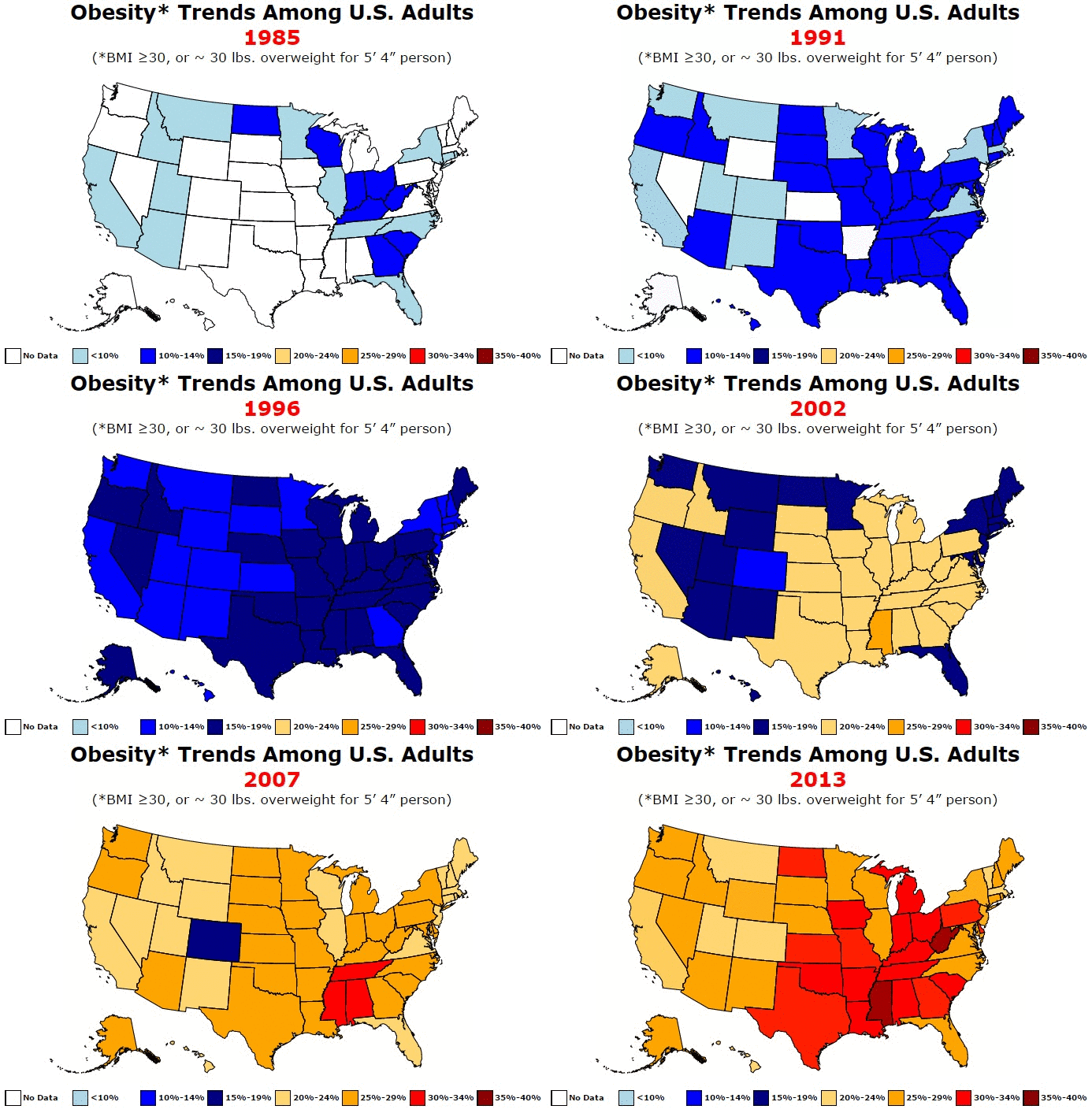
 Galka's also made a tool revealing how differently built people have put on weight over the years. Shown here is the average 5-foot-9, early-30s guy going from 170 to more than 190 pounds since the 1980s. Head over to Metrocosm to check your own population segment
The United States isn't the world's fattest country—that distinction goes to Tonga—but it's up there, with two-thirds of its adults classified as overweight or obese.
But it didn't used to be so heavy, as evidenced in this animated map from Metrocosm's Max Galka (the same guy behind that fascinating visualization of UFO sightings). Using state data from the CDC, Galka shows how trends in obesity (having a BMI equal to or above 30) have shot up since the mid-1980s. Regional patterns shift through time, but basically the entire country has experienced a major, belt-loosening expansion—look for the South frequently leading the charge, perhaps influenced by its heart-hammering cuisine.
What's to blame for the big broadening? "The USDA keeps promoting the 'calories in, calories out' model, which makes the solution to obesity seem simple: eat less/exercise more," emails Galka. "However, there is now a lot of research showing this model to be false." He cites evidence linking obesity to viruses, bacteria, and hormone-altering chemicals. Of course, there's also the global boom in cheap, shrewdly marketed junk foods.
"The obvious culprit is processed starches, which pretty much everyone is aware of now," Galka says. "But there may be other contributing factors, too, some of which sound pretty crazy." (It doesn't help, he adds, "that the sugar industry keeps promoting bad science.")
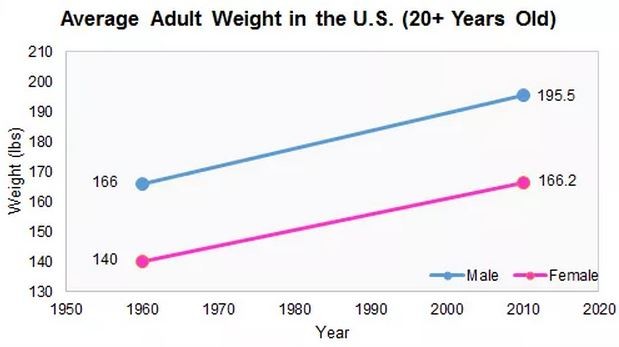
Nowadays the average 5-foot-8 American man weighs 196 pounds with a 40-inch waist; a 5-foot-3 woman is typically 166 pounds with a 38-inch waist, according to the CDC. Galka has put those proportions in historical context with a couple other illustrations. The first is this comparison of weights by sex from 1960 to the near-present. "The average woman today weighs as much as the average man in 1960," writes Galka:
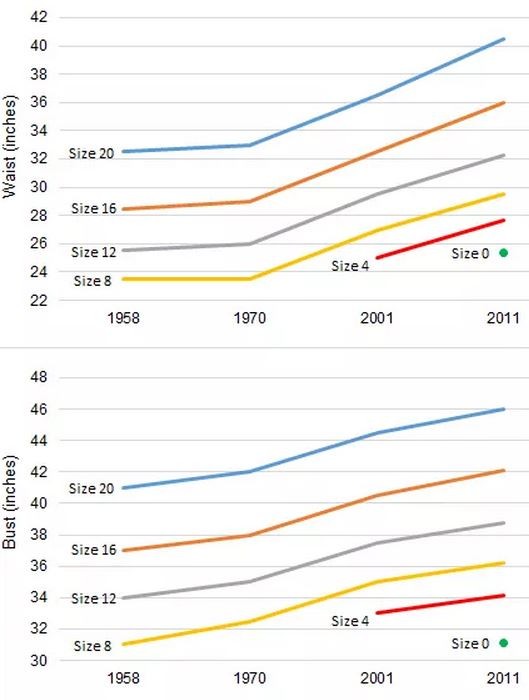
"Today's size 0 dress is larger than a size 8 in 1958," he writes by way of introducing these charts of waist-and-bust sizes:
Galka's also made a tool revealing how differently built people have put on weight over the years. Shown here is the average 5-foot-9, early-30s guy going from 170 to more than 190 pounds since the 1980s. Head over to Metrocosm to check your own population segment
Aug 18, 2015
Tianjin, China Chemical Storage Facility Explosion - A few lessons from this terrible tragedy.
Death toll in Tianjin explosions reaches 112; more than 90 still missing Read on at CNN
A few lessons from this terrible tragedy.
A few lessons from this terrible tragedy.
- China still lags in worker protection and environmental regulations
- The capacity to identify exact mix of chemicals in an explosion of this type is extremely challenging
- First responders are at high risk especially if there are multiple explosions
- Population densities in and around incident sites is a key factor in human death/injury outcomes (About 90,000 people live within a 5-kilometer radius of this blast site, the China Earthquake Networks Center said.)(In Bhopal,India tragedy many workers lived on the plant property)
- Post explosion toxicities in the environment are difficult to assess
- Local Hospitals must drill for such events
- Follow up environmental and human testing must be ongoing until enough data is compiled to ensure that possible long term environmental and human effects are understood
- Trust in Government needs to improve accurate and timely reporting
Thanks for the link via Rick Lippin MD, FACOEM
Bioelectricity "is soooo 2005" Discovery shows bacteria can be used for power
Scientists at Pennsylvania State University, University Park, Pa., have developed a technology that can turn raw sewage into raw power. The device, called a microbial fuel cell, provides a clean energy source with the potential for enormous financial savings due to reduced electricity use, researchers say.
So far, experiments have produced between 10 mW and 50 mW of power per square meter of electrode surface, or about 5% of the amount needed to run one small Christmas tree light. At the same time, the process removes up to 78% of organic matter as measured by biochemical oxygen demand (BOD). As a result, the microbial fuel cell itself acts as a small wastewater treatment plant.
This flat-plate microbial fuel cell, which operates in continuous-flow mode, has a proton-exchange membrane sandwiched between two carbon paper electrodes. Channels force flow into a serpentine path in the system.
Such a unit would be especially attractive in developing countries. It also could be used to treat waste from animal farms, food-processing plants and even manned space missions.
Similar in design to a hydrogen fuel cell, the microbial fuel cell captures electrons that are naturally released by bacteria as they digest organic matter, and then it converts the electrons into electrical current. Dr. Bruce Logan, an environmental engineer at Penn State, doesn't envision using his microbial fuel cell for the same type of applications as hydrogen fuel cells, such as in automobiles or houses. "We see using this any place where there's a high concentration of organic matter," he says.
Logan plans to build a larger version of his microbial fuel cell for demonstrations; he hopes to have the design completed in about six months. "Our goal is a system, around a cubic yard in volume, producing around 30 kWh of electricity," he says.
So far, experiments have produced between 10 mW and 50 mW of power per square meter of electrode surface, or about 5% of the amount needed to run one small Christmas tree light. At the same time, the process removes up to 78% of organic matter as measured by biochemical oxygen demand (BOD). As a result, the microbial fuel cell itself acts as a small wastewater treatment plant.
This flat-plate microbial fuel cell, which operates in continuous-flow mode, has a proton-exchange membrane sandwiched between two carbon paper electrodes. Channels force flow into a serpentine path in the system.
Such a unit would be especially attractive in developing countries. It also could be used to treat waste from animal farms, food-processing plants and even manned space missions.
Similar in design to a hydrogen fuel cell, the microbial fuel cell captures electrons that are naturally released by bacteria as they digest organic matter, and then it converts the electrons into electrical current. Dr. Bruce Logan, an environmental engineer at Penn State, doesn't envision using his microbial fuel cell for the same type of applications as hydrogen fuel cells, such as in automobiles or houses. "We see using this any place where there's a high concentration of organic matter," he says.
Logan plans to build a larger version of his microbial fuel cell for demonstrations; he hopes to have the design completed in about six months. "Our goal is a system, around a cubic yard in volume, producing around 30 kWh of electricity," he says.
60 Minutes: Major privacy breach in SS7 network signalling network
"What it means is that your smartphone is an open book," news.com.au
"Criminals now have access to these huge security holes to steal your data and listen in to your calls. We know telephone companies know about it, we know security agencies know about it, but nothing is being done."
http://www.news.com.au/technology/gadgets/the-end-of-privacy-as-we-know-it-60-minutes-uncovers-huge-mobile-phone-security-vulnerabilities/story-fn6vihic-1227485884359
Breathing Beijing's Air Is the Equivalent of Smoking Almost 40 Cigarettes a Day
The Economist has a story about how bad the air quality is in Beijing. Due to public outcry the Chinese government has created almost 1,000 air quality monitoring stations, and the findings aren't good. They report: "Pollution is sky-high everywhere in China. Some 83% of Chinese are exposed to air that, in America, would be deemed by the Environmental Protection Agency either to be unhealthy or unhealthy for sensitive groups. Almost half the population of China experiences levels of PM2.5 that are above America's highest threshold. That is even worse than the satellite data had suggested. Berkeley Earth's scientific director, Richard Muller, says breathing Beijing's air is the equivalent of smoking almost 40 cigarettes a day and calculates that air pollution causes 1.6m deaths a year in China, or 17% of the total. A previous estimate, based on a study of pollution in the Huai river basin (which lies between the Yellow and Yangzi rivers), put the toll at 1.2m deaths a year—still high."
Read more of this story at Slashdot.
Aug 17, 2015
NATURE - Novel regenerative peptide TP508 mitigates radiation-induced gastrointestinal damage by activating stem cells and preserving crypt integrity
Abstract: In recent years, increasing threats of radiation exposure and nuclear disasters have become a significant concern for the United States and countries worldwide. Exposure to high doses of radiation triggers a number of potentially lethal effects. Among the most severe is the gastrointestinal (GI) toxicity syndrome caused by the destruction of the intestinal barrier, resulting in bacterial translocation, systemic bacteremia, sepsis, and death. The lack of effective radioprotective agents capable of mitigating radiation-induced damage has prompted a search for novel countermeasures that can mitigate the effects of radiation post exposure, accelerate tissue repair in radiation-exposed individuals, and prevent mortality. We report that a single injection of regenerative peptide TP508 (rusalatide acetate, Chrysalin) 24 h after lethal radiation exposure (9 Gy, LD100/15) appears to significantly increase survival and delay mortality by mitigating radiation-induced intestinal and colonic toxicity. TP508 treatment post exposure prevents the disintegration of GI crypts, stimulates the expression of adherens junction protein E-cadherin, activates crypt cell proliferation, and decreases apoptosis. TP508 post-exposure treatment also upregulates the expression of DCLK1 and LGR5 markers of stem cells that have been shown to be responsible for maintaining and regenerating intestinal crypts. Thus, TP508 appears to mitigate the effects of GI toxicity by activating radioresistant stem cells and increasing the stemness potential of crypts to maintain and restore intestinal integrity. These results suggest that TP508 may be an effective emergency nuclear countermeasure that could be delivered within 24 h post exposure to increase survival and delay mortality, giving victims time to reach clinical sites for advanced medical treatment.
References: Carla Kantara, Stephanie M Moya, Courtney W Houchen, Shahid Umar, Robert L Ullrich, Pomila Singh and Darrell H Carney
Aug 15, 2015
China Tianjin blasts: Evacuations as sodium cyanide found - BBC News
The Chinese authorities have ordered the evacuation of residents within a 3km radius of the Tianjin blast site over fears of chemical contamination.
The evacuations came after an apparent change in wind direction, and as police confirmed the highly toxic chemical sodium cyanide was found near the site.
A man was found alive 50m from the blast core, Xinhua news agency said.
At least 104 people are reported to have died in the giant blasts in the north-east Chinese port on Wednesday.
People sheltering at a school used as a safe haven since the disaster have been asked to leave wearing masks and long trousers, reports say.
The order came after the wind apparently changed direction, prompting fears that toxic particles that would have previously been blown out to sea could be blown inland.
Anti-chemical warfare troops have entered the site.
The People's Daily newspaper tweeted that they had been sent to handle highly toxic sodium cyanide which had been found there.
The discovery was confirmed by police "roughly east of the blast site" in an industrial zone, state-run Beijing News said.
Officials had until then only confirmed the presence of calcium carbide, potassium nitrate and sodium nitrate. Calcium carbide reacts with water to create the highly explosive acetylene.
Officials have so far insisted that air and water quality levels are safe.
Meanwhile Chinese President Xi Jinping urged the authorities to learn the "extremely profound" lessons and keep "safe growth" and "people's interest first" in mind to avoid similar accidents.
Please continue reading from:
http://www.bbc.com/news/world-asia-china-33945293
http://www.bbc.com/news/world-asia-china-33945293
Aug 13, 2015
FREE - EPA Webinar on the Clean Power Plan for Communities: Thursday, August 20, 2015
EPA Webinar on the Clean Power Plan for Communities
Thursday, August 20, 2015 |1:00-2:30 PM EDT
EPA is pleased to invite you to participate in a webinar for communities. This webinar will discuss the Clean Power Plan and the first-ever national standards that address carbon pollution from power plants. The webinar will focus on what communities need to know about the Clean Power Plan.
On August 3, 2015, EPA, under the leadership of President Obama, issued the Clean Power Plan, a historic step to fight climate change. The Clean Power Plan will reduce carbon pollution from power plants, the nation's largest source, while maintaining energy reliability and affordability. EPA also issued final Carbon Pollution Standards for new, modified, and reconstructed power plants, and proposed a Federal Plan and model rules to assist states in implementing the Clean Power Plan. For more information on the Clean Power Plan please visit this site.
http://www2.epa.gov/cleanpowerplan/clean-power-plan-existing-power-plants
Webinar Details:
Date: August 20, 2015
Time: 1:00-2:30 pm EDT
*Meeting Link: Clean Power Plan for Communities (click to enter webinar)
https://epa.connectsolutions.com/cpp-community500/
Participant Number: 1-800-309-5450
Conference ID:3084962
*Pre-Registration is not required for this webinar. Materials from this webinar will be posted on the Clean Power Plan Community website afterward.
Thursday, August 20, 2015 |1:00-2:30 PM EDT
EPA is pleased to invite you to participate in a webinar for communities. This webinar will discuss the Clean Power Plan and the first-ever national standards that address carbon pollution from power plants. The webinar will focus on what communities need to know about the Clean Power Plan.
On August 3, 2015, EPA, under the leadership of President Obama, issued the Clean Power Plan, a historic step to fight climate change. The Clean Power Plan will reduce carbon pollution from power plants, the nation's largest source, while maintaining energy reliability and affordability. EPA also issued final Carbon Pollution Standards for new, modified, and reconstructed power plants, and proposed a Federal Plan and model rules to assist states in implementing the Clean Power Plan. For more information on the Clean Power Plan please visit this site.
http://www2.epa.gov/cleanpowerplan/clean-power-plan-existing-power-plants
Webinar Details:
Date: August 20, 2015
Time: 1:00-2:30 pm EDT
*Meeting Link: Clean Power Plan for Communities (click to enter webinar)
https://epa.connectsolutions.com/cpp-community500/
Participant Number: 1-800-309-5450
Conference ID:3084962
*Pre-Registration is not required for this webinar. Materials from this webinar will be posted on the Clean Power Plan Community website afterward.
The threat of inexperience, with 40% of the nuclear workforce set to retire by 2018 the industry is facing a loss of knowledge
Power Engineering magazine:
Every sector of the energy industry is expected to lose a large share of its work force as millions of experienced professionals, baby boomers born between 1946 and 1964, become eligible for retirement over the next few years.
By most accounts, the power sector will need more than 100,000 new skilled workers by 2018 to replace those retiring workers. But attracting new talent has become an arduous undertaking as the industry faces a shortage of qualified workers and increased competition for college graduates.
The Nuclear Energy Institute estimates that 39 percent of the nuclear workforce will be eligible for retirement by 2018, which means the industry must hire 20,000 new workers over the next four years to replace them.
Is the power generation industry prepared to compete with other industries for a new generation of skilled workers? What's more, does the industry have a plan for training and knowledge sharing?
There are about 78 million baby boomers in the U.S. They represent 28 percent of the U.S. population and 68 percent of the existing work force.
About 40 percent of the work force at America's electric and natural gas utilities will be eligible for retirement in the next five years. About 20 percent are eligible now. Who's going to replace them?
According to the Department of Labor, as much as 50 percent of the nation's utility workforce will retire in the next five to 10 years. The challenges associated with replacing the technical and institutional knowledge of these professionals will be significant. Hard decisions must be made soon to preserve intellectual property for the future.
To further illustrate the sense of urgency, here are some eye-opening statistics compiled by the Center for Energy Workforce Development, a nonprofit consortium of electric utilities and associations:
· Almost 62 percent of utility employees have the potential to retire or leave over the next decade
· Nine percent are "ready to retire now" based on current retirement assumptions
· By 2015, 36 percent of employees in positions that the industry deems as critical may retire or leave for other reason and another 16 percent will exit by 2020
The good news is the industry is forming partnerships with universities and other organizations that are designed to tap the nation's pool of talented younger workers. The bad news is electric utilities are losing workers at an increasing rate, according to a report from PricewaterhouseCoopers.
The voluntary turnover rate at electric utilities rose from 3.9 percent in 2010 to 4.9 percent in 2012. For high performers and tenured employees, the turnover rate increased from 2.7 percent in 2010 to 3.7 percent in 2012. The 2013 report also found that the turnover of utility employees during their first year was significantly higher, rising from 2.3 percent in 2011 to 5.5 percent in 2012.
"This has created a turning point for utilities precisely because they have had so many decades of stability," the PwC report found.
Other industries are better equipped to retain employees, the report found. Electric utilities should rethink their approach to employee retention "as they confront the increasing turnover of newer and high performers, as well as the accelerating loss of experienced employees due to retirement."
As the economy improves, PwC expects that first-year turnover at utilities will continue to increase, and so will the cost. "If we assume, for example, that for every 1,000 new employees, 100 or so leave, at a cost of $2,300 to $3,600 per hire, that translates into significant cost – not to mention productivity losses," the report found.
The growing number of retirement-eligible employees, rising turnover costs and the generational shift in utility personnel are driving a loss of productivity in the power sector, according to the report.
Please read on by By Russell Ray, Chief Editor (Twittter @RussellRay1 ), Power Engineering magazine
http://www.power-eng.com/blogs/power-points/2014/12/who_will_replacepow.html
Every sector of the energy industry is expected to lose a large share of its work force as millions of experienced professionals, baby boomers born between 1946 and 1964, become eligible for retirement over the next few years.
By most accounts, the power sector will need more than 100,000 new skilled workers by 2018 to replace those retiring workers. But attracting new talent has become an arduous undertaking as the industry faces a shortage of qualified workers and increased competition for college graduates.
The Nuclear Energy Institute estimates that 39 percent of the nuclear workforce will be eligible for retirement by 2018, which means the industry must hire 20,000 new workers over the next four years to replace them.
Is the power generation industry prepared to compete with other industries for a new generation of skilled workers? What's more, does the industry have a plan for training and knowledge sharing?
There are about 78 million baby boomers in the U.S. They represent 28 percent of the U.S. population and 68 percent of the existing work force.
About 40 percent of the work force at America's electric and natural gas utilities will be eligible for retirement in the next five years. About 20 percent are eligible now. Who's going to replace them?
According to the Department of Labor, as much as 50 percent of the nation's utility workforce will retire in the next five to 10 years. The challenges associated with replacing the technical and institutional knowledge of these professionals will be significant. Hard decisions must be made soon to preserve intellectual property for the future.
To further illustrate the sense of urgency, here are some eye-opening statistics compiled by the Center for Energy Workforce Development, a nonprofit consortium of electric utilities and associations:
· Almost 62 percent of utility employees have the potential to retire or leave over the next decade
· Nine percent are "ready to retire now" based on current retirement assumptions
· By 2015, 36 percent of employees in positions that the industry deems as critical may retire or leave for other reason and another 16 percent will exit by 2020
The good news is the industry is forming partnerships with universities and other organizations that are designed to tap the nation's pool of talented younger workers. The bad news is electric utilities are losing workers at an increasing rate, according to a report from PricewaterhouseCoopers.
The voluntary turnover rate at electric utilities rose from 3.9 percent in 2010 to 4.9 percent in 2012. For high performers and tenured employees, the turnover rate increased from 2.7 percent in 2010 to 3.7 percent in 2012. The 2013 report also found that the turnover of utility employees during their first year was significantly higher, rising from 2.3 percent in 2011 to 5.5 percent in 2012.
"This has created a turning point for utilities precisely because they have had so many decades of stability," the PwC report found.
Other industries are better equipped to retain employees, the report found. Electric utilities should rethink their approach to employee retention "as they confront the increasing turnover of newer and high performers, as well as the accelerating loss of experienced employees due to retirement."
As the economy improves, PwC expects that first-year turnover at utilities will continue to increase, and so will the cost. "If we assume, for example, that for every 1,000 new employees, 100 or so leave, at a cost of $2,300 to $3,600 per hire, that translates into significant cost – not to mention productivity losses," the report found.
The growing number of retirement-eligible employees, rising turnover costs and the generational shift in utility personnel are driving a loss of productivity in the power sector, according to the report.
Please read on by By Russell Ray, Chief Editor (Twittter @RussellRay1 ), Power Engineering magazine
http://www.power-eng.com/blogs/power-points/2014/12/who_will_replacepow.html
America's 47 hours work week
Salon - Gallup reveals the American 40-hour workweek is actually far closer to 47 hours — nearly a day longer than it was 35 years ago.
Americans don't just work more than they have in the past, they work more than most of the industrialized world. A 2004 study from the National Bureau of Economic Research found Americans work "50 percent more than do the Germans, French, and Italians." More recent data from the Organisation for Economic Co-operation and Development found that in 2014, Americans outworked several expected other countries, among them Sweden, Norway, the Netherlands, Finland, Switzerland and Austria, all countries that .... rank higher than us on the most recent World Happiness survey.
We have surpassed Japan, long stereotyped by Americans as a society far more workaholic than our own, in annual hours worked by a tally of 1,789 to 1,729. ...
Yet Japan, at the very least, demands a legal minimum of 10 paid vacation days (though many employers provide more) along with 14 weeks of maternity leave. France goes even further, offering 30 days of vacation and 16 weeks of parental leave, while Scandinavian countries and Australia and New Zealand top even the French.
Then there's the United States, where workers have no legal guarantee to any amount of vacation at all — or sick days, for that matter, despite a report finding all those sick people at work ultimately cost the country $160 billion in lost productivity each year. The U.S. has the distinction of being the world's only industrialized, not to mention rich, nation with no national legislation demanding employers offer maternity leave. And paternity leave? That's not even part of the national discussion
Americans don't just work more than they have in the past, they work more than most of the industrialized world. A 2004 study from the National Bureau of Economic Research found Americans work "50 percent more than do the Germans, French, and Italians." More recent data from the Organisation for Economic Co-operation and Development found that in 2014, Americans outworked several expected other countries, among them Sweden, Norway, the Netherlands, Finland, Switzerland and Austria, all countries that .... rank higher than us on the most recent World Happiness survey.
We have surpassed Japan, long stereotyped by Americans as a society far more workaholic than our own, in annual hours worked by a tally of 1,789 to 1,729. ...
Yet Japan, at the very least, demands a legal minimum of 10 paid vacation days (though many employers provide more) along with 14 weeks of maternity leave. France goes even further, offering 30 days of vacation and 16 weeks of parental leave, while Scandinavian countries and Australia and New Zealand top even the French.
Then there's the United States, where workers have no legal guarantee to any amount of vacation at all — or sick days, for that matter, despite a report finding all those sick people at work ultimately cost the country $160 billion in lost productivity each year. The U.S. has the distinction of being the world's only industrialized, not to mention rich, nation with no national legislation demanding employers offer maternity leave. And paternity leave? That's not even part of the national discussion
Aug 12, 2015
Less than one-third of Appalachian breast cancer survivors continue taking prescribed medicine
About one-third of Appalachian breast cancer survivors stop taking prescribed medicine, despite having insurance that covers the costs, says a study published in the July issue of Medicine. Researchers looked at 428 patients from 2006 to 2008 in Kentucky, North Carolina, Ohio and Pennsylvania, finding that 31 percent "were not adherent to adjuvant endocrine therapy (AET) and 30 percent were not persistent over an average follow-up period of 421 days." Adjuvant drugs are typically used to enhance pain relief from pain medicine in difficult to treat conditions. (Map: Appalachia, as defined by Congress)
Lead author Rajesh Balkrishnan, professor of Public Health Sciences at the University of Virginia School of Medicine, said, "We found that a complex variety of factors including poverty, geography and preventive health orientation affect the health of women with breast cancer in Appalachia."
Patients "receiving catastrophic insurance coverage were three times more likely to adhere to their adjuvant endocrine therapy and also had a 44 percent lower risk of discontinuing therapy," Heather Lindsey reports for Oncology Times. Among the study group, "43 percent of patients were categorized as being economically distressed, 67 percent lived in largely rural environments and 88 percent experienced health care professional shortages."
Some patients stopped taking medication because of doctor shortages or long distances to drive to a pharmacist, Lindsey writes. "Another factor is the amount and type of insurance coverage patients have to cover these costs. While insurance typically covers most adjuvant hormone therapies, people in this study population may be watching every dollar." (Read more)
Lead author Rajesh Balkrishnan, professor of Public Health Sciences at the University of Virginia School of Medicine, said, "We found that a complex variety of factors including poverty, geography and preventive health orientation affect the health of women with breast cancer in Appalachia."
Patients "receiving catastrophic insurance coverage were three times more likely to adhere to their adjuvant endocrine therapy and also had a 44 percent lower risk of discontinuing therapy," Heather Lindsey reports for Oncology Times. Among the study group, "43 percent of patients were categorized as being economically distressed, 67 percent lived in largely rural environments and 88 percent experienced health care professional shortages."
Some patients stopped taking medication because of doctor shortages or long distances to drive to a pharmacist, Lindsey writes. "Another factor is the amount and type of insurance coverage patients have to cover these costs. While insurance typically covers most adjuvant hormone therapies, people in this study population may be watching every dollar." (Read more)
EPA Awards $800,000 to Michigan State University to Research Effects of Chemical Exposure on Ecosystems
(U.S. EPA News) August 11, 2015-- Today, the U.S. Environmental Protection Agency (EPA) announced an $800,000 grant to Michigan State University to study the ecological impacts of manufactured chemicals. This STAR (Science to Achieve Results) grant is part of EPA's Chemical Safety for Sustainability...
A Massive Oil Pipeline Under the Great Lakes Is Way Past Its Expiration Date
Motherboard [feedly] The Straits of Mackinac connect Lake Huron and Lake Michigan, and divide Michigan's lower peninsula from its upper peninsula. But the gorgeous blue expanse of this part of the Great Lakes region is threatened by a danger lurking just beneath its surface: two degrading oil pipelines.
Motherboard correspondent Spencer Chumbley went to Michigan to investigate the situation, and the research is alarming. If just one of the pipelines ruptured, it would result in a spill of 1.5 million gallons of oil—and that's if Enbridge, the company that owns them, is able to fix the pipeline immediately. UMich research scientist Dave Schwab says, "I can't imagine another place in the Great Lakes where it'd be more devastating to have an oil spill."
Enbridge, the company that runs the pipelines, insists they are safe. But Enbridge does not have a particularly inspiring record, with more than 800 spills between 1999 and 2010, totalling 6.8 million gallons of spilled oil. In 2010, its pipeline 6B ruptured in the Kalamazoo River. The nation's focus was pulled by Deepwater Horizon at the time, but the Kalamazoo River spill became the nation's biggest inland oil spill.
The pipelines are now 62 years old
The Mackinac pipelines were built in 1953, and have not been replaced since then. Chumbley managed to track down and interview retired engineer Bruce Trudgen, who is probably one of the last living people to work on the pipelines. At the time of construction, the pipelines were supposed to last fifty years. But now, "Enbridge has decided it's good way past 50 years," Trudgen says. The pipelines are now 62 years old.
In 2013, environmental advocates with the National Wildlife Federation were fed up with not getting enough information about the pipelines' condition from Enbridge or the government. So they decided to dive down themselves to check it out. They found broken structural braces and sections of completely unsupported pipeline. Enbridge public affairs specialist Jason Manshum says these reports are misleading. "The notion that a company like Enbridge would not maintain a line is just atrocious," he said.
Chumbley asks Manshum if spills are just "the cost of doing business" for a company like Enbridge. "No releases are acceptable to Enbridge," Manshum says. "Are we there yet? No, clearly we're not."
Follow @spencerchumbley for updates on this story.
Please read full and follow at: http://motherboard.vice.com/read/the-aging-oil-pipelines-below-the-great-lakes
Shared via my feedly reader
Aug 10, 2015
Shell starts drilling for oil in the Arctic
Russia has just staked a claim to a big chunk of the Arctic. A big reason is the oil under the water. Several countries and companies are betting on this, and first out of the gate is Royal Dutch Shell. It is one week into exploratory drilling there.
In oil company speak, the Arctic is one of the last "elephant fields." Some 20 percent of the world's untapped oil and gas is there. And for big companies like Shell, stock price depends on proving the energy is there.
"Ten years ago, Shell in particular felt that it was going to be very hard to find oil," Steven Kopits of Princeton Energy Advisors says. "And so they looked around the world to see where they could go. And one of the very few places you could add oil in big quantities was in Alaska." Specifically, the Alaskan Arctic just north of the Bering Strait. A Shell rig is doing early exploring now.
If oil is struck, it may take a decade to flow. Kopits considers that good timing. By then, American oil fracked from shale may be fracked out.
"The U.S. shale revolution is slated to last probably through 2020, maybe through 2025," Kopits says. "But it doesn't last forever."
For all the challenges, drilling may be the easy part. It's low-pressure drilling, in shallow waters of less than 150 feet in depth. What's hard is logistics, hauling 20-some vessels to frigid waters far from the Coast Guard, hospitals and other help.
In one attempt two and a half years ago, a Shell rig named the Kulluk separated from its tow boat.
"The cable snapped," McKenzie Funk, author of "The Wreck of the Kulluk," says. "And this giant rig drifted until it slammed into the rocks near Kodiak Island. And it was just a total loss."
The towing disaster came after challenges encountered during the drilling process. Ice floes proved to be unpredictable.
"Suddenly an ice floe the size of Manhattan came drifting, and they had to pull up everything and basically run away," Funk says. "Having been up there a few times and studied this, that's what I think people don't understand, how entirely remote this is."
These problems concern environmental critics, who also argue there's no good fix for a spill. Shell and industry groups counter that machinery to cap leaking wells has a proven track record.
All the interested parties are watching: environmental groups, regulators and other major oil companies who also have their eyes on the Arctic prize.
"It's a multiyear process," says Rice University business professor William Arnold, who once worked in Shell's government relations department. "This year just about has to be error-free in order to get to next year and years of development following that."
If not, $7 billion in investments to date may be lost.
Please continue reading from:
http://www.marketplace.org/topics/sustainability/shell-starts-drilling-oil-arctic----
Shared via my feedly reader
Aug 6, 2015
The 3 deadliest drugs in America are all totally legal - Vox
/cdn0.vox-cdn.com/uploads/chorus_asset/file/3930832/3%20deadliest%20drugs.jpg)
Javier Zarracina/Vox
As the US debates drug policy reforms and marijuana legalization, there's one aspect of the war on drugs that remains perplexingly contradictory: Some of the most dangerous drugs in the US are legal.
Don't believe it? The available data from the Centers for Disease Control and Prevention (CDC) shows tobacco, alcohol, and opioid-based prescription painkillers were responsible for more direct deaths in one year than any other drug. The chart above compares those drug deaths with the best available data for cocaine, heroin, and marijuana deaths.
Please read full and follow at:
Subscribe to:
Posts (Atom)