Apr 29, 2020

Dr Michael Osterholm, head of CIDRAP, weekly podcasts on covid-19

In case you haven't heard these, Dr. Michael Osterholm, Director of CIDRAP (Univ of MN Center for Infectious Disease Research and Policy), has spent his life working with epidemics and he's been giving weekly podcasts on covid-19 for 5 weeks. They are listed here:
  •         Episode 1: How We Got Here (March 24, 2020)
  •         Episode 2: The Global Coronavirus Response (March 31, 2020)
  •         Episode 3: Preparing For What's To Come (April 8, 2020)
  •         Episode 4: The Reality of Testing (April 14, 2020)
  •         Episode 5: Living with the Virus (April 22, 2020)

And you can find them here https://www.cidrap.umn.edu/covid-19/podcasts-webinars They are very interesting and informative.

Apr 24, 2020

WEBINAR | COVID-19 and Your Workplace: Getting Back to Work Safely

COVID-19 and Your Workplace: Getting Back to Work Safely

Here are three simple questions:
  1. Does your organization have an updated infectious disease control program?
  2. Does your organization have training modules for supervisors and employees to understand COVID-19 exposures and best practices?
  3. Do you know the recordkeeping requirements for COVID-19?

If you answered "no" to any of these questions, join us next Wednesday April 29th at 1pm CST for a live webinar. Attendees will leave with:

  • Knowledge from a front-line occupational medicine doctor
  • Insights on supply chain constraints for PPE
  • Action steps for implementing an exposure control plan
  • Opportunity to purchase COVID-19 program documents and training modules

Register for the Webinar Today
https://register.gotowebinar.com/register/1938373435447790351

Apr 22, 2020

EPA Publishes Scope Documents for 20 Risk Evaluation Chemicals

(PAINT.ORG) This month, the U.S. Environmental Protection Agency (EPA) published 20 draft scope documents for high-priority chemicals undergoing Risk Evaluation under the Toxic Substances Control Act (TSCA). These are the 20 high priority chemicals that EPA designated for TSCA Risk Evaluation in December 2019.

EPA is accepting comments on the first 13 scoping documents, made available on April 6, through May 26. By statute, EPA must finalize scoping documents by June 20, 2020. Stakeholders must submit comment on the second batch of seven chemicals within 45 days of publication in the Federal Register. At this writing, EPA had not published in the Federal Register.

The scope documents include the proposed conditions of use, hazards, exposures, and the potentially exposed or susceptible subpopulations that EPA expects to consider in the TSCA risk evaluations. The documents also include: a description of the reasonably available information and the science approaches that EPA plans to use, a conceptual model that outlines the potential hazards and exposures throughout the life cycle of the chemical, an analysis plan to identify the approaches and methods EPA plans to use to assess health and environmental factors, and a potential plan for peer review.

Notably, EPA has not proposed exclusions for de minimis amounts. EPA may consider exclusions for de minimis amounts on a case-by-case basis, with supporting data. Information related to amounts in products or used in processes, exposures or controls/personal protective equipment (PPE) may be useful in seeking such an exemption.

EPA also generally includes disposal as a condition of use where it did not in the first 10 chemicals it evaluated. This is likely due to the 9th Circuit's opinion in Safer Chemicals, Healthy Families, et. al. v. EPA (No. 17-72260), where the 9th Circuit evaluated scope of EPA risk evaluations as required by EPA's risk evaluation framework rule.

The 20 Scoping Documents are as follows:

Apr 17, 2020

New class action launched over Pfas toxic firefighting chemicals used by defense

Lawyers have launched a new class action on behalf of tens of thousands of residents over the defense department's use of toxic firefighting chemicals.

The case will allege defence's use of per-and polyfluoroalkyl substances (Pfas) had "cataclysmic consequences" for residents in Wodonga, Darwin, Townsville, Wagga Wagga, Edinburgh and Bullsbrook.

The highly persistent and probable carcinogens were used for decades in firefighting foam on defence bases, leaching into nearby land and water supplies, contaminating food and accumulating in humans.

Residents near two other military bases – in Oakey, Queensland and Katherine, Northern Territory – reached a $212.5m settlement with the federal government over Pfas contamination in February.

Apr 14, 2020

U.S. Department of Labor Announces OSHA Interim Enforcement Response Plan to Protect Workers during the Coronavirus Pandemic

OSHA – The U.S. Department of Labor's Occupational Safety and Health Administration (OSHA) today announced an interim enforcement response plan for the coronavirus pandemic. The response plan provides instructions and guidance to OSHA Area Offices and compliance safety and health officers (CSHOs) for handling coronavirus-related complaints, referrals, and severe illness reports.

During the coronavirus outbreak, OSHA Area Offices will utilize their inspection resources to fulfill mission essential functions and protect workers exposed to the disease. The response plan contains interim procedures that allow flexibility and discretion for field offices to maximize OSHA's impact in securing safe workplaces in this evolving environment.

"OSHA is committed to protecting the health and safety of America's workers during this challenging time in our nation's history," Principal Deputy Assistant Secretary Loren Sweatt said. "Today's guidance outlines commonsense procedures for investigating complaints related to the coronavirus, while also ensuring the safety of workers, employers, and inspectors."

The response plan outlines procedures for addressing reports of workplace hazards related to the coronavirus. Fatalities and imminent danger exposures related to the coronavirus will be prioritized for on-site inspections. The response plan contains procedures and sample documentation for CSHOs to use during coronavirus-related inspections. Workers requesting inspections, complaining of coronavirus exposure, or reporting illnesses may be protected under one or more whistleblower statutes and will be informed of their protections from retaliation.

This memorandum will take effect immediately and remain in effect until further notice. It is intended to be time-limited to the current public health crisis. Check OSHA's webpage at http://www.osha.gov/coronavirus frequently for updates.

Apr 9, 2020

Free CDC webinar on Elastomeric Respirators for U.S. Healthcare Delivery

Here is a link to details about reusable elastomeric respirator use in healthcare. This includes findings and recommendations from a compilation of ongoing studies.

https://www.youtube.com/watch?v=8wd5Bx2fVDI

This webinar provides an overview of respiratory protection and guidance surrounding supply shortages. This webinar also provides information on infection prevention measures, strategies for optimizing the supply of N95 respirators, and a broad overview of the use of elastomeric respirators in healthcare. Guidance on Elastomeric Respirators is currently in development.

This video can also be viewed at
https://www.cdc.gov/vaccines/videos/low-res/coronavirus/Elastomeric_Respirators_Webinar.mp4

Apr 8, 2020

Risk based chart on when to use masks or respirators for Covid-19

When to use masks or respirators for Covid-19 is confusing.
Chart below suggests general concepts for selecting based on risk and protection effectiveness for worker using it. 

From University of Arizona Occupational Medicine.


OSHA Issues Guidance for Respirators Certified under Other Countries' Standards During COVID-19 Pandemic

On Friday 4/3/2020, OSHA issued guidance that allows for use of some alternative respirators – see news release here:

and Enforcement Guidance here: 

Several Free ASSP podcasts on Covid19

Listen to the latest podcast to learn how to assess your workers'
COVID19 risk level and discover steps you can take to protect them.

https://www.assp.org/standards/safety-standards-and-tech-pubs-podcast

Apr 7, 2020

Department of Energy Announces New Funding to Train Emergency Response and Building Professionals

The U.S. Department of Energy announced $4.5 million in funding for training programs for professionals who interact with distributed energy resources, including solar energy systems, storage systems, "smart" building technologies, and electric vehicles. These professionals include those that lead the nation's emergency response and resilience planning, including firefighters, first responders, and safety officials.

Read more

https://www.energy.gov/eere/articles/department-energy-announces-new-funding-train-emergency-response-and-building

Chernobyl in Ukraine: Firefighters battling radioactive forest

Emergency units are trying to contain fires in radiation-contaminated forest near the abandoned Chernobyl nuclear plant. The fires have caused a spike in radioactivity in the area.

The fires have raised fears that radiation from the area could be dispersed farther afield, but authorities said while radiation in the fire zone was far above normal levels, levels in the capital, Kyiv, some 100 kilometers (60 miles) south, were within norms.

CPAPs can be repurposed into ventilators.

To my friends here in the health and medical fields
please share that CPAPs can be repurposed into ventilators.

A life line to many.

Thank you,
Christopher Haase

Apr 2, 2020

Toxnet Occupational Health relational database information moved to Haz-Map.

With the National Library of Medicine's decision to shutdown Toxnet much of its content moved to other NLM website, independent of NLM at
http://haz-map.com/

The content of the Haz-Map data tables is the same but the user interface has been improved. Improvements include adding chemical structures, adding popup tips to some agent fields, adding new agent and disease fields, alphabetizing chemical lists on base names of chemicals (without prefixes), and improvements in the user interface for both the computer and mobile devices.

On November 2019, Dr. Jay Brown completed the review of the first 1250 chemicals entered into the database. Review of the second 1250 chemicals added was started on March 5. He is busy checking spelling, hyperlinks, IARC classifications, TLVs, IDLHs, vapor pressures, and disease links.

If you have been a previous user of Haz-Map, I encourage you to view the new website and bookmark this new location in your Internet browser application.


Cancer risk among career firefighters are at increased risk for five cancers with typically stronger associations in those diagnosed younger than the age of 50

Conclusion
Male career firefighters in Florida are at increased risk for five cancers with typically stronger associations in those diagnosed younger than the age of 50, while there was evidence for increased thyroid and brain cancer, and possibly melanoma risk in female firefighters. Larger cohorts with adequate female representation, along with the collection of well‐characterized exposure histories, are needed to more precisely examine cancer risk in this occupational group.

Full study at:
https://onlinelibrary.wiley.com/doi/abs/10.1002/ajim.23086

Good webinar from Duke about their massive program to decontaminate N95 filtering facepieces

Good webinar from Duke about their massive program to decontaminate N95 filtering facepieces viewed here;

https://vmw-oesoapps.duhs.duke.edu/N95Webinar/GMT20200331-190119_Duke-Healt_3840x2160.mp4

Apr 1, 2020

Free Webinar: Workplace Safety During Coronavirus

It not only deals with workplace safety and covid19 but how to avoid catching it and spreading it at home.

Listen to webinar on YouTube
https://youtu.be/Snjdcznz8Kw

CDC/NIOSH Guidance on decontamination of N95s just released

The CDC/NIOSH Guidance on decontamination and reuse of filtering facepiece respirators was just released.

https://www.cdc.gov/coronavirus/2019-ncov/hcp/ppe-strategy/decontamination-reuse-respirators.html

Mar 31, 2020

Free Resources for Pandemic Support form CCOHS

To support workplaces in protecting the health and well-being of their employees during the coronavirus disease (COVID-19) pandemic, CCOHS has made helpful resources, courses and PDF versions of guides available free of charge.  

Online Courses

Publications (PDF versions)

View the complete list of available resources, including fact sheets, podcasts and posters.

The Health and Safety Report, a free monthly newsletter produced by the Canadian Centre for Occupational Health and Safety (CCOHS), provides information, advice, and resources that help support a safe and healthy work environment and the total well being of workers.

Personal Protective Equipment (PPE) Supply Equivalents (from ECRI)

Of possible interest is the Personal Protective Equipment (PPE) Supply Equivalents (xlsx): "Best matches for the three most popular exam gloves, disinfecting wipes, face shields, isolation gowns, IV solutions, N95 air purifying respirators, shoe covers, surgical masks, and universal transport medium based on key performance indicators (KPIs) and functional equivalence"

Spreadsheet:

I am but the messenger; I do not have the knowledge to critically evaluate this resource. But I hope it is of utility, thanks.

Also see:

Mar 29, 2020

EPA suspends enforcement of environmental laws amid coronavirus

(The Hill) "This EPA statement is essentially a nationwide waiver of environmental rules for the indefinite future. It tells companies across the country that they will not face enforcement even if they emit unlawful air and water pollution in violation of environmental laws, so long as they claim that those failures are in some way 'caused' by the virus pandemic. And it allows them an out on monitoring too, so we may never know how bad the violating pollution was," she wrote in a statement to The Hill.

The EPA has been under pressure from a number of industries, including the oil industry, to suspend enforcement of a number of environmental regulations due to the pandemic.

"EPA is committed to protecting human health and the environment, but recognizes challenges resulting from efforts to protect workers and the public from COVID-19 may directly impact the ability of regulated facilities to meet all federal regulatory requirements," EPA Administrator Andrew Wheeler said in a statement.

Read on at:
https://thehill.com/policy/energy-environment/489753-epa-suspends-enforcement-of-environmental-laws-amid-coronavirus

Mar 27, 2020

Webinar COVID-19: Transportation Workers--Impact of Emergency Declarations and Other Occupational Health Issues

Topic
COVID-19: Transportation Workers--Impact of Emergency Declarations and Other Occupational Health Issues

Description
COVID-19 has affected many industries including transportation. Truck drivers and many other transportation workers have been identified as essential critical infrastructure workers during this pandemic. Commercial motor vehicle (CMV) drivers and others face unique challenges during normal operations, but during this crisis, many of their routine regulatory, health and safety, and lifestyle challenges have become more complicated. The Federal Motor Carrier Safety Administration and the U.S. Department of Transportation (DOT) have issued several emergency declarations and guidance documents including those affecting CMV medical examinations and drug and alcohol testing.

During this webinar, Dr. Natalie Hartenbaum, co-chair of ACOEM's Transportation Section, will discuss the challenges faced during the COVID-19 pandemic by those in the transportation industry with a focus on truck drivers. She will review pertinent regulatory relief and other guidance provided by DOT or the transportation agencies which relate to the occupational health professional. This webinar is brought to you with support from the ACOEM Transportation Section.

Speaker:
Natalie P. Hartenbaum, MD, MPH, FACOEM
President and Chief Medical Officer of OccuMedix
Dresher, PA
Time

Mar 30, 2020 12:00 PM in Eastern Time (US and Canada)

Full info:

Mar 25, 2020

Webinar COVID-19: Protecting Health Care Workers --Decontamination & Reuse of Respirators

Friday, March 27, 2020, at 12:00 PM EDT

1.5 hour webinar with live Q&A

Occupational health care providers in the United States (U.S.) are currently addressing emergency protocols for protecting health care workers (HCWs) from COVID-19. However, there are many unanswered questions related to protecting HCWs especially with the limited supply of personal protective equipment (PPE) such as N95 respirators.

The U.S. Centers for Disease Control and Prevention; National Institute for Occupational Safety and Health (NIOSH) should release guidance documents this week on decontamination of FFRs, elastomeric respirators, PAPRs, and covering a respirator with a surgical mask.

In this webinar, the speakers will review the NIOSH/CDC guidance followed by a discussion of studies on and systems for the decontamination of N95s. The presentations will be followed by live, moderated Q&A.

Moderator:
David Rempel, MD, FACOEM, Professor Emeritus, Division of Occupational and Environmental Medicine, University of California, San Francisco

Speakers:
CDC/NIOSH Guidance on Decontamination of FFR and Elastomeric Respirators:
TBD, National Personal Protective Technology Laboratory (NPPTL), CDC/NIOSH

Review of Studies on the Decontamination of N95 Respirators:
Lisa Brosseau, ScD, CIH, Professor Emeritus, Division of Environmental and Occupational Health Sciences, School of Public Health, University of Illinois, Chicago

Update on University of Nebraska Medical Center Decontamination System Using UV-C:
Shawn G. Gibbs, PhD, MBA, CIH, Professor of Environmental Health, Indiana University School of Public Health

Reusable Elastomeric Respirators: University of Maryland Experience and Scientific Update:
Stella Hines, MD, MSPH, Assistant Professor, School of Medicine, University of Maryland

The Webinar will be recorded. The recording and slides will be emailed to all registrants following the presentation.

Register here

Mar 24, 2020

Health care workers need protection during pandemic: NUPGE and HSABC release new research showing higher precautions recommended

The National Union of Public and General Employees (NUPGE) and Health Sciences Association of BC (HSA) released today a research paper focused on respiratory protection for health workers caring for COVID-19 patients.

"Health care workers around the world are reporting that personal protective equipment guidelines are inconsistent and in short supply. As this pandemic hits our health care system in Canada, the priority must be to keep our health care workers healthy so they can provide the care patients need," said NUPGE President Larry Brown.

"HSA contacted Dr. John Murphy, an expert on occupational hygiene and adjunct professor at the Dalla Lana School of Public Health, University of Toronto, for science-based guidance on the best measures for infection control among health care workers. His research confirms that the best practice is to use N95 respiratory protection. This supports the position of other national health care unions in Canada, and the joint advice to members from unions across Canada," Brown said. See March 13, 2020 Joint Statement

"HSA represents more than 15,000 health science professionals working in our hospitals, including the respiratory therapists responsible for keeping patients in respiratory distress alive and the diagnostic technologists conducting the scans, x-rays, and other critical tests needed to diagnose hospitalized patients. When working with COVID-19 patients, a surgical mask is simply not the best practice for infection control. It is important our members know that and make sound decisions about how to best protect themselves while providing care," said HSA President Val Avery.

Recognizing the world-wide shortage of personal protective equipment, Dr. Murphy recommends that properly fit-tested N95 masks be prioritized for allocation based on assessment of the extent of potential exposure and risk, and that surgical masks be used as a back up. In all cases, eye protection must accompany respiratory protection.

Link:  Respiratory Protection for Health Workers Caring for COVID-19 Patients (Murphy 2020)
Link:  Advisory Report for the Health Sciences Associat ion of Br i t ish Columbia and the Nat ional Union of Public and General Employees on Respiratory Protection Dur ing Care of Influenza Patients (Murphy 2009)

NIEHS ALL-HANDS MESSAGE**: PRESS RELEASE: COVID-19 Workers Get Training to Protect Their Own

COVID-19 Workers get training to protect their own health

https://www.niehs.nih.gov/news/newsroom/releases/2020/march23/index.cfm


Today, the National Institutes of Health will launch a new website with important educational resources for Coronavirus workers dealing with the spread of COVID-19. The initiative got underway after Congress passed a supplemental appropriation of $10 million on March 6 "for worker-based training to prevent and reduce exposure of hospital employees, emergency first responders, and other workers who are at risk of exposure to coronavirus through their work duties." The law provided a total of $8.3 billion in emergency funding for certain Federal agencies to respond to the coronavirus outbreak.


The worker-based training initiative is being led by NIH's National Institute of Environmental Health Sciences (NIEHS), which has a long-established Worker Training Program (WTP). The program awards grants for training and development of educational resources for employees in high risk occupations who serve the public during emergencies and who need skills to protect their own health as they are potentially exposed to dangerous pathogens, contaminated materials, or infected people. As a part of this effort the Worker Training Program also acts as a clearinghouse among grant recipients to broadly share the training and educational resources developed with the grant money.


Joseph "Chip" Hughes, who has led the NIEHS Worker Training Program for 31 years, said, "These men and women are so dedicated and as they work so hard to serve and protect the public during this COVID-19 pandemic, I want to make sure they know how to protect their own health too. We don't need them getting sick or taking the virus back to their families or their communities."


With this new supplemental funding from Congress, the NIEHS Worker Training Program is creating a COVID-19 virtual safety training initiative for frontline responders including emergency medical personnel, firefighters, law enforcement officers, environmental cleanup workers, high-risk custodial service workers, food processing and delivery workers, water and sewage treatment workers, sanitation workers, and health care facility employees.


The initial focus is to build a virtual safety training delivery platform in partnership with private sector e-learning companies with the capability to deliver synchronized just-in-time web-based training across the country in targeted high-risk industrial sectors. Additionally, a cadre of COVID-19 safety trainers and virtual safety advisors is being created to leverage the delivery of advanced training technology to frontline responders.


After learning of the special appropriation, NIEHS moved quickly to convene a national workshop in partnership with Emory Health Sciences Center on March 17. The workshop titled, "Protecting Infectious Disease Responders During the COVID-19 Outbreak," used virtual meeting technology to bring together hundreds of the country's infectious disease experts, nurses and health care providers, emergency response organizations and academic training centers to map out a web-based, technology-assisted training strategy to respond to the escalating need to ensure protections for COVID-19 responders, particularly in health care and emergency response services.


During a recent Congressional hearing on COVID-19 response, NIH Director Francis Collins, M.D., testified that "NIEHS has played a very critical role in training people who can deal with outbreaks."  He noted the NIEHS Worker Training Program previously helped with the Ebola response.


NIEHS Worker Training Program grant recipients provided occupational safety training to workers during the anthrax attacks in 2001, the H5N1 outbreak in 2007, and the H1N1 avian influenza outbreak in 2009; mold remediation training following Hurricanes Katrina in 2005 and Hurricane Sandy in 2012; and Ebola virus disease preparedness training 2013-2015. A list of program grantees is available at https://www.niehs.nih.gov/careers/hazmat/awardees/index.cfm.


This COVID-19 virtual safety training program will be administered by NIEHS and was developed in collaboration with the Centers for Disease Control and Prevention, the U.S. Department of Health and Human Services Office of the Assistant Secretary for Preparedness and Response, the Occupational Safety and Health Administration, and the National Institute for Occupational Safety and Health.

Mar 20, 2020

Coronavirus Resources Center from Institute of Hazardous Materials Management

The foremost concern of IHMM and HMS is with the safety and health of all of us; our staff, colleagues, certificants and members and those in our communities. As we have been doing the past three weeks, we continue to share credible, authoritative information for you in meeting the threat posed by the COVID-19 virus.

Today, we are opening the Coronavirus Resources Center, where all of the most significant information for you is gathered in one place.

See More from IHMM
https://www.ihmm.org/about-ihmm/coronavirus-resources

National Toxic Substances Incidents Program — Nine States, 2010–2014

Description of System: In 2010, the Agency for Toxic Substances and Disease Registry (ATSDR) initiated the National Toxic Substance Incidents Program (NTSIP), and it was retired in 2014. Nine state health departments participated in NTSIP surveillance: California, Louisiana, North Carolina, New York, Missouri, Oregon, Tennessee, Utah, and Wisconsin. The states conducted surveillance on acute toxic substance incidents, defined as an uncontrolled or illegal acute (lasting <72 hours) release of any toxic substance including chemical, biologic, radiologic, and medical materials. Surveillance focused on associated morbidity and mortality and public health actions. This report presents an overview of NTSIP and summarizes incidents and injuries from the nine participating states during 2010–2014.

Results: During 2010–2014, participating state health departments reported 22,342 incidents, of which 13,529 (60.6%) met the case definition for acute toxic substance incidents, and included 6,635 injuries among 5,134 injured persons, of whom 190 died. A trend analysis of the three states participating the entire time showed a decrease in the number of incidents with injuries. NTSIP incidents were 1.8 times more likely and injured persons were 10 times more likely to be associated with fixed facilities than transportation. Natural gas, carbon monoxide, ammonia, and chemicals used in illegal methamphetamine production were the most frequent substances in fixed-facility incidents. Sodium and potassium hydroxide, hydrochloric acid, natural gas, and sulfuric acid were the most frequent substances in transportation-related incidents. Carbon monoxide was the most frequent substance in incidents with a large number of injured persons, and chemicals used in illegal methamphetamine production were the most frequent substance in incidents involving decontamination.

Read on at CDC Source:
https://www.cdc.gov/mmwr/volumes/69/ss/ss6902a1.htm

Mar 17, 2020

American Chemistry Council Free Workplace Posters for COVID-19 Cleaning Procedures

The American Chemistry Council's outside group of public health advisors, the Water Quality & Health Council, has worked with several other public health partners to develop a user-friendly "pictogram" poster for disinfecting frequently touched surfaces against the COVID-19 virus.

Also includes Pictograms for:

The poster is freely downloadable at https://waterandhealth.org/resources/posters/#COVID-19.

Waiver or Modification of Requirements under Section 1135 of the Social Security Act as the Result of the Consequences of the 2019 Novel Coronavirus (COVID-19)

Waiver or Modification of Requirements under Section 1135 of the Social Security Act as the Result of the Consequences of the 2019 Novel Coronavirus (COVID-19)

What: HHS Secretary Alex M. Azar declared a public health emergency, effective March 15, 2019, at 6:00 p.m. due to the nationwide COVID-19 outbreak.

Where:  Nationwide.

Why:  President Donald J. Trump's declaration that the COVID-19 outbreak in the United States constitutes a national emergency.

Actions/Follow-Up:  

DISCLAIMER: These guidance documents are not a final agency action, do not legally bind persons or entities outside the Federal government, and may be rescinded or modified in the Department's discretion. Noncompliance with any voluntary standards (e.g., recommended practices) contained in these documents will not, in itself, result in any enforcement action.

Mar 16, 2020

OSHA's Temporary Enforcement Guidance - Healthcare Respiratory Protection Annual Fit-Testing for N95 Filtering Facepieces During the COVID-19 Outbreak,

OSHA's Temporary Enforcement Guidance - Healthcare Respiratory Protection Annual Fit-Testing for N95 Filtering Facepieces During the COVID-19 Outbreak, is very important - among other things, OSHA says to perform an initial fit test using a qualitative method, to suspend annual fit-testing requirements during the pandemic, but to perform user seal checks when the respirator is donned.

https://www.osha.gov/memos/2020-03-14/temporary-enforcement-guidance-healthcare-respiratory-protection-annual-fit

Mar 13, 2020

Latest workplace Covid-19 regulatory guidance


Notes below from a WHO webinar 11th March on "EPI-WIN COVID-19 Employers and employees" s (recording and slides will be available at a later date).


1st presentation – Guidance for employers

  • Keep workplaces clean and hygienic (surfaces, keyboards etc.)

  • Encourage employees to regularly wash hands with soap and water (correct method, wash for enough time etc.)

  • Provide travel advice to employees

  • Anyone sick should stay at home

  • Hand sanitisers should be available 

  • Masks and paper tissue should be available in case anyone exhibits symptoms (visitors)

  • All objects like mobile phones and desks should be wiped with disinfectant at least one a day

  • Promote teleworking where possible

  • Brief employers, contractors etc.

  • Advise contractors to consult travel advice before going on business trips

  • It is the responsibility of employees to comply with travel guidance 


2nd presentation

  • Important to think about precarious workers. And health workers, who are at the frontier

  • Promote teleworking as much as possible. Not all workers can do this, e.g. workers facing the public, in social care/education etc.

  • Need to have income protection for those who are self-isolating or asked to take time off

  • Important to have a coming together of companies

  • If factories are open the one meter distance should be kept between workers, hand sanitizers should be readily available (suggested this should be provided by govt. agencies?)

  • Think about access to canteens

  • Use of personal safety equipment

  • Need to support family and workers who go through this change

  • Slowing productive activities if they're not essential, health has to come first

  • Adequate measures need to be followed


3rd presentation

3 areas of focus:

  1. Communication to companies and business associations on how to make workplaces safe and prevent spread

  2. Business impact, value change

  3. Working with govt. to offer preferential policies for businesses


A few examples of what employers and organizations are doing:

In the UK CBI is working closely with Govt, and providing advice to members on how to prevent spread, what to do if someone is showing symptoms. CBI has a special webpage with all the relevant info about the virus. Internal policy for events etc.


Singapore – dedicated webpage with guidance based on latest advice from Ministry of Health and Ministry of Manpower. Different federations coming together.  Advice given to frontline employees.


Cambodia – not too many confirmed cases but ILO already has a huge project and presence through a program set up to ensure workplace compliance. ILO has provided guidance to the main garment association. Garment association sent letter to their members with info, i.e. asking people to isolate if they have been to high risk countries, importance of personal hygiene etc.


Employers globally are taking health and safety as high priority and are taking necessary steps and working with federations and ministries.


4th presentation:

  • Occupational safety and health. Preventing infection in workplace

  • ILO's target is all workers, not just high-risk (health workers)

  • Most important part is to develop and implement policy

  • Need commitment and support

  • Hoping to produce a guideline asap


Other comments/Q&A

  • Informal workers, gig economy, countries with weak health systems and countries with weak protections – they are a concern.

  • Workplaces have a role in stopping the spread. Slowing down the pace.  This protects individuals.  Importance of simple measures like staying home if you're ill, not coughing on other people, social distancing, washing your hands every hour, using hand gel, not touching surfaces that could be infected, not touching your face, coughing in your sleeve.

  • Breathalyzer test – infection prevention control.  Working on developing flexible and appropriate guidance.  Concern about people using same breathalyzer.  Single use items.  If not single use need to be sterilized.  They can be disinfected.  

  • Schools have a responsibility towards staff and students.  Boarding schools, where students come from abroad.  Hosting sports events.  UNICEF guidance for schools is available.  It will also depend on local risk assessment.

  • Can mine workers be considered high risk?  Don't have specific data.  They are working in conditions that may already have affected their respiratory health.  Preexisting conditions could lead to higher vulnerability.

  • Always try to maintain a distance of one meter between yourself and others


Mar 2, 2020

U.S. EPA Webinar Strategies to Engage Food and Beverage Manufacturers in Pollution Prevention Technical Assistance

Getting Your "Food" in the Door: Strategies to Engage Food and Beverage Manufacturers in Pollution Prevention Technical Assistance

Date & Time:  March 24, 1:00 – 2:30 PM ET

Details & Free Registration: https://register.gotowebinar.com/register/2616299318147436555


Food and beverage manufacturers have real opportunities to save money and reduce pollution through pollution prevention (P2). But many Pollution Prevention technical assistance providers (TAPs) struggle to effectively engage and recruit companies to accept assistance. This webinar will provide effective strategies and lessons learned to help TAPs market technical assistance to manufacturers and get 'in the door' with companies. It will feature two seasoned P2 assistance programs sharing their experiences, and one food manufacturer providing their perspective on what makes for successful assistance.

Speakers:
-  Bruce Dvorak, University of Nebraska – Partners for Pollution Prevention
-  Derek Boer, CO Department of Public Health and Environment
-  Brian Morgan, Engineering Manager, Kerry Inc.

Feb 27, 2020

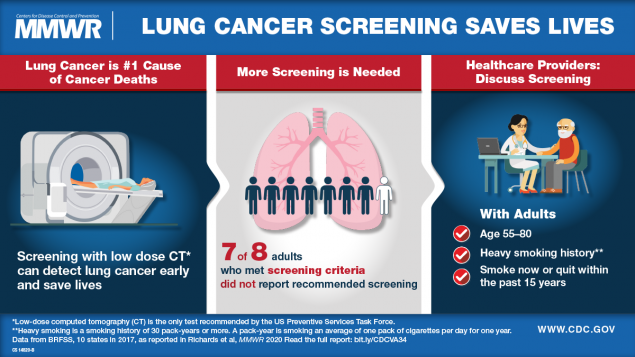
Screening for Lung Cancer — annually 148,869 lung cancer-associated deaths

CDC - The U.S. Preventive Services Task Force (USPSTF) recommends annual lung cancer screening for adults aged 55–80 years who have a ≥30 pack-year cigarette smoking history and currently smoke or have quit <15 years ago.

What is added by this report?

In 10 states, one in eight persons aged 55–80 years met USPSTF criteria, and, among those meeting USPSTF criteria, only one in eight reported a lung cancer screening exam in the last 12 months.

What are the implications for public health practice?

Public health initiatives to prevent cigarette smoking, increase smoking cessation, and increase recommended lung cancer screening could help reduce lung cancer mortality.

The figure is a visual abstract with text describing that lung cancer screening saves lives and the need for increased screening when recommended.
 
Lung cancer is the leading cause of cancer death in the United States; 148,869 lung cancer-associated deaths occurred in 2016 (1). Mortality might be reduced by identifying lung cancer at an early stage when treatment can be more effective (2). In 2013, the U.S. Preventive Services Task Force (USPSTF) recommended annual screening for lung cancer with low-dose computed tomography (CT) for adults aged 55–80 years who have a 30 pack-year* smoking history and currently smoke or have quit within the past 15 years (2). This was a Grade B recommendation, which required health insurance plans to cover lung cancer screening as a preventive service.§ To assess the prevalence of lung cancer screening by state, CDC used Behavioral Risk Factor Surveillance System (BRFSS) data collected in 2017 by 10 states.** Overall, 12.7% adults aged 55–80 years met the USPSTF criteria for lung cancer screening. Among those meeting USPSTF criteria, 12.5% reported they had received a CT scan to check for lung cancer in the last 12 months. Efforts to educate health care providers and provide decision support tools might increase recommended lung cancer screening.


Read on at:

https://www.cdc.gov/mmwr/volumes/69/wr/mm6908a1.htm?s_cid=mm6908a1_w&deliveryName=USCDC_921-DM20955#suggestedcitation

Be Ready for New Strains on Worker Health

CCOHS- The identification of 2019 Novel Coronavirus (COVID-19) in China in late 2019 has highlighted the need for workplaces in Canada to follow good practices to minimize the potential for infection. Coronaviruses are a large family of common viruses that are typically associated with mild illnesses. However, novel strains can develop into serious diseases, including Middle East Respiratory Syndrome (MERS-CoV) and Severe Acute Respiratory Syndrome (SARS-CoV).

Coronaviruses are common in animals, but in rare cases, the virus can evolve to infect people, then spread from person-to-person. The route of transmission is not always known, but the viruses are generally thought to spread by respiratory droplets when people are in close contact.

People caring for individuals with a coronavirus are at the greatest risk for contracting the disease such as health care workers and others who work close to their clients or patients. However, everyone can adopt good hygiene practices to minimize the potential for infection.

Prevent the spread

Workplaces can promote the adoption of many good hygiene practices that will help prevent the spread of any virus or infection, including the flu. The most important day-to-day action everyone can take is proper and regular hand washing with soap and water. Individuals should use tissues, or cough and sneeze into their arm or elbow (not their hand) while turning away from other people. Dispose of used tissues and wash your hands right away. Avoid touching your eyes, nose or mouth, especially after you have touched surfaces such as doorknobs and handrails that others have touched. Avoid sharing cups, glasses, dishes and cutlery, and wash your dishes with soap and water immediately after use. If a vaccine is available, encourage everyone to get the shot, or consider setting up a mini clinic for convenience and coverage.

Have a policy in place

Workplaces should have a policy in place that outlines requirements to follow when people may be sick, or when they are absent because they are caring for others. This policy should indicate how the individual will notify the workplace of their situation. Let workers know they can and should stay home if they are not feeling well. Workplaces must plan for these absences as well as for possible increases and decreases in business, and for changes in how they do their business. Provide cross-training for coverage of job duties, and make sure that workers are comfortable performing these added job tasks and responsibilities. Employers should also stay up to date on the latest situation by monitoring public health agency websites and keep everyone informed.

Develop an infection control plan

In addition to having a policy in place, workplaces (non-healthcare) can set up an infection control plan that includes providing clean hand washing facilities, or alcohol-based sanitizers when regular facilities are not available, for example to workers on the road. Objects that are touched frequently, including doorknobs, handles, and railings, should be cleaned more often using regular disinfectants or soap and water.  If a person has been suspected or identified with an infection, employers should clean that person's station, along with other areas where they have been. Ventilation systems should be checked for proper functioning.

Provide boxes of tissue throughout the workplace and encourage its use by displaying good hygiene practice posters. Consider temporarily removing magazines and papers from waiting areas or common rooms. Use social distancing techniques as necessary to minimize contact. Conduct business via telephone or online, allow employees to work from home, and encourage flexible work hours to avoid peak public transportation times and crowding the workplace.


Resources