Jan 25, 2011

Free Webinar Introduction to the State Electronics Challenge

Collectively, state and local government purchase more than $35 billion worth of technology equipment annually*, and has the opportunity to provide leadership in the environmentally sound and cost effective management of electronic assets.
About The State Electronics Challenge (SEC)
http://www3.gotomeeting.com/g2w/images/599061742/202045432818265632/embed.jpgThe SEC is now open to government entities around the country!  Thanks to the support of the Challenge Sponsors we are able to offer this free program nationally.
    The State Electronics Challenge (SEC) is a voluntary program that encourages state, regional, and local governments, including schools and other public entities, to:
    • Purchase greener electronic products.
    • Reduce the impacts of electronic products during use.
    • Manage obsolete electronics in an environmentally safe way.
    The SEC provides resources to help state, local, and regional government and agencies to become leaders and face the new challenges posed by the electronics waste stream.
    The SEC is modeled after the very successful Federal Electronics Challenge (FEC), which was created by the U.S. Environmental Protection Agency and the Office of the Federal Environmental Executive.
    Join us for a free Webinar on February 17, 2 p.m. EST
    This Webinar is an opportunity to learn how to decrease the environmental footprint of your computer equipment through participation in the State Electronics Challenge.  The Challenge is a free program that provides support to state, tribal, regional, and local governments for lifecycle stewardship of computer equipment.
    http://img.gotomeeting.com/g2mimages/webinar/themes/basic/button_registerNow.gif

    The expanded format of the 2011 Forums

    The State of Green Business Forum rallies the world's foremost innovators, thought leaders, and executives across all industries to discuss sustainability opportunities realized and challenges met in 2010.

    Together, they provide insight into how to leverage that knowledge to increase profitability, efficiency and generate real value in 2011. The forum brings the year to life with compelling speakers and panels focusing on key business trends and issues — emphasizing not only big-picture constructs, but also how to implement real-world solutions applicable in today's business landscape.

    sogbf2011_logo_825x121.jpg
    Among the topics we'll cover:
    • Next generation sustainability reporting
    • LCA tools that unleash business opportunity
    • Metrics to assess the environmental impact of consumer products
    • Inside the Sustainability Consortium
    • Moving a cleantech innovation from idea to startup
    • Social media for sustainability
    • Engaging employees through behavior-based sustainability
    • Green business travel beyond teleconferencing

    Plus keynote interviews and presentations on:
    • Smarter Buildings of Epic Proportions
    • The Employee Engagement Challenge
    • Crowdsourcing for Sustainable Innovation
    Find our more and register at
    www.greenbiz.com/stateofgreenbusinessforum2011

    DOE Webinar Integrated Biorefinery (IBR) technology & Biofuels Infrastructure

    The Biomass Program will host the proceedings of the IBR review uBiomass to Biofuels supply chain diagram with red highlight of biofuels production segment. Feedstock production (photo of two men in a field of switchgrass) leads to feedstock logistics (photo of combine harvester in corn field), which leads to biofuels production (photo of biorefinery), which leads to biofuels distribution (photo of fuel pump for E85), which leads to biofuels end use (photo of car).sing GoToWebinar from 8:00 a.m. - 5:00 p.m. on February 1–3, 2011,
    The U.S Department of Energy's (DOE) Biomass Program is hosting a series of Webinars associated with its biennial Peer Review of Integrated Biorefinery (IBR) technology and Biofuels Distribution Infrastructure and End Use (Infrastructure) projects. This year's meetings are available to provide interested stakeholders the opportunity to learn more about federally funded research, development, and deployment activities that are focused on bioenergy technologies.

    During the meetings, project principal investigators will discuss their projects' status, budgets, goals, accomplishments, challenges, and relevance to the Biomass Program, and answer questions from expert review panelists. External stakeholders will be able to hear the project presentations and participate in limited Q&A sessions. The results of Peer Review evaluations will form the basis for the overall Biomass Program Peer Review meeting, which will be held June 27-28, 2011 (see the Biomass website) and cover a large majority of Program projects. Peer Review results are also used to generate future work plans and develop Annual Operating Plans, Multiyear Program Plans, and potentially redirect individual projects (see results from the Program's last two biennial reviews). Results of the Peer Review process will be publically available online.

    Go to EERE for Registering for the Webinar EERE

    First N Korea now Italian Scientists Demonstrate Cold Fusion?

    Italian scientists Andrea Rossi and Sergio Focardi of the University of Bologna announced that they developed a cold fusion device capable of producing 12,400 W of heat power with an input of just 400 W....when the atomic nuclei of nickel and hydrogen are fused in their reactor, the reaction produces copper and a large amount of energy. The reactor uses less than 1 gram of hydrogen and starts with about 1,000 W of electricity, which is reduced to 400 W after a few minutes. Every minute, the reaction can convert 292 grams of 20C water into dry steam at about 101C. Since raising the temperature of water by 80C and converting it to steam requires about 12,400 W of power, the experiment provides a power gain of 12,400/400 = 31 VIA SlashDot

    And the land with the dumbest man
    claims success in nuclear fusion – North Korea claimed it had carried out a nuclear fusion reaction that could lead to a limitless supply of clean energy -- a process that the world's scientists have so far yet to achieve.  But North Korea said it had triumphed using its own technology.

    Fusion Really?
      Nope they just don't know how to measure it....


    Chrysler partners with EPA for better hybrid

    "Chrysler announced Wednesday that it would partner with the US Environmental Protection Agency to build and test prototypes of a different kind of hybrid vehicle, one that accumulates energy not in a battery pack but by compressing a gas hydraulically. The system in question, originally developed at the EPA labs, uses engine overrun torque to capture otherwise wasted energy, as do conventional hybrid-electric vehicles. The engine is Chrysler's standard 2.4-liter four-cylinder, the base engine in its minivan line. But rather than turning a generator, that torque powers a pump that uses hydraulic fluid to increase the pressure inside a 14.4-gallon tank of nitrogen gas, known as a high-pressure accumulator." Read more at SlashDot

    Jan 24, 2011

    Please join us at Brownfields 2011!

    The Educational Program for the 2011 National Brownfields Conference is now avahttp://www.brownfields2011.org/Images/183x183/BannerAd/Image/6ilable. Click here to view over 100 panel sessions, roundtables, town hall meetings and training workshops that will be offer at the conference this year!

    Brownfields 2011 will take place at the Pennsylvania Convention Center in Philadelphia on April 3-5

    Brownfields 2011 is the largest, most comprehensive conference focused on redeveloping America's brownfield properties and promoting environmental revitalization and economic redevelopment. Registration for the conference is FREE. Sign up today and gain access to the educational program, as well as outstanding plenary sessions, 200 exhibitors, scores of networking events, film screenings, book signings, and much, much more. Whether you're a newcomer to the world of economic and environmental redevelopment, or a seasoned professional looking to make new connections and increase your business, and community revitalization efforts, Brownfields 2011 offers something for you!

    For more information please visit the conference web site at http://www.brownfields2011.org

    Bailout bonus: GM becoms a foreign corporation

    General Motors has joined General Electric as a major foreign corporation, having sold more cars and trucks last year in China than in the U.S. Some of these cars and trucks were made in China. GM also has a factory in India. From TPR


    General Motors last year sold more cars and trucks in China –now the world’s largest and fastest-growing auto market — than it did in the U.S. GM sold 2,351,610 vehicles in China in 2010, up 28.8% over 2009. By contrast it sold 2.215,227 in the U.S., up 6.3%. - USA Today


    Jan 23, 2011

    Transition Milwaukee - The case against (but also for) renewable energy

    What would it look like if Transition Milwaukee made it a practice of protesting renewable energy? And, most of all, we really do need wind turbines and solar panels in our community. - Erik Lindberg,
    ... passionately opposed to a new experimHTML clipboardental wind project being proposed in Milwaukee and will at some point need to sit on my hands to stop some unadvised posts from flying from my computer out into the world of public mis-conception. Using federal funds, the city of Milwaukee is proposing a 20 to 100 megawatt system on the lakeshore, in a prominent, yet unobtrusive location.
    Many of the claims that the city sustainability office is making about the miniature wind-farm are not entirely incorrect yet its main rational, the one that I hear most frequently, is that this will demonstrate "our cities commitment to renewable energy."

    ... the greater the enthusiasm, the more severe my reaction, which gained enough steam to power a rant I posted on our listserv. In that rant I argued that this show-project would provide an insubstantial amount of electricity and therefore was merely symbolic, nothing more than a collective pat on the back. Who, after all, I wondered, is Milwaukee trying to impress with this "commitment"? It was a near empty gesture, I fumed, that was meant to convince ourselves that Milwaukee is a good, forward looking city; a sleek and shiny wind turbine would look dazzling against the blue of the lake and would make many a sustainability activist feel good about our progress; the buzz of the ribbon cutting ceremony and the first slow rotations of the blades would confirm to us all that those letters and petitions, even the constant facebook grumbling, were worth it after all.HTML clipboard

    https://blogger.googleusercontent.com/img/b/R29vZ2xl/AVvXsEjdDZM3YD0M7ri3t0EyIHuYuN3e_jsRYkRUvIdR5kdk8GXkMA5eSbPqrjQtWTBFgvFvzOLUE_zbZ_bXoQHSVGWkOlLxi0O83ksLlwR53cwvqY80xKF3N4MMd9mJIal4VX02BdiDog/s400/Wind+Turbine+Failure+(1).jpg
    So it might be a somewhat empty gesture, but what is the harm in it? Well, there is another sort of symbolism at work here that most raises my indignation--a far more dangerous symbolism. When the average American, at least those who are somewhat conscious of global warming and the finite nature of oil, closes his or her eyes and imagines the future, this future is one that looks pretty much like the present, except for the omnipresent solar panels, wind turbines, and electric cars. It seems likely that the futuristic design of the turbines we see today is not only a matter of the engineering needs. At any rate, the emergence of a city-owned wind garden (we might call it) gives the impression that we are finally on our way to this clean, green, and entirely prosperous, new world order. It gives the impression that we are finally making the switch from our coal-fired power plants to something clean and renewable. It gives the impression that our leaders are on top of things. Thus a project like this not only risks being an empty symbolic gesture; it has the potential to be down right hazardous to the important project of creating a realistic view of the future.

    These views are of course premised on the belief that it is all but impossible that renewable energy will ever have the capacity to power an industrialized, growth-based luxury economy—the view that the future won't look much like today. What sort of installation, I therefore asked, would instead symbolize the absolute futility of replacing fossil fuels with wind power—that's the sort of lake-side installation I could get behind. Perhaps the model of a defunct wind turbine fashioned from cob. http://windconcernsontario.files.wordpress.com/2010/03/alternative-energy-fail.jpg?w=300&h=214My level-headed colleagues in Transition Milwaukee responded with a mixture of cautious agreement ("there, there Erik"?) and disagreement, though perhaps more of the latter. Their reasoning is sound: it is a start and wind is necessary for a smoother ride down Hubbert's peak; the presence of wind turbines might get people thinking about energy and the problems created by fossil fuels; it might, some suggested, even help precipitate a conversation about the necessity of powering-down.


    Protesting it would put us on the side of coal and natural gas activists, would be a de facto endorsement of mountain-top removal.


    ...Nevertheless, I am not going to go to the public meeting to protest or to squeeze in a 10 second sound bite about the irreplaceability of fossil fuels, or about how we can't run an industrialized society on photovoltaics. This is true dilemma. I am unable to imagine a responsible way of being publically anti-renewable energy, of discouraging projects like this for the right reasons. To make things even more complicated yet, I'm not exactly anti-renewable energy nor am I sure I really want to discourage this project. But celebrating it would also feel morally awkward. read more at EnergyBulletin


    Haase comment:
    RE: "Transition Milwaukee is the only game in town. If we don’t speak the truth about energy, no one else will." -  Erik Lindberg

    Nice post Mr. Lindberg, I would make the correction that not only was the industrial revolution powered by renewable energy in WI...Wisconsin still has powerful, profitable, privately funded programs that drive our economy.

    While "Transition Milwaukee" is a nice concept the truth is that there are 100's of sustainable farming and community programs in Wisconsin (for decades)... Shoot me an email sometime and I will share with you what can actually make Wisconsin and even milwaukee actually sustainable beyond peak and all political smoke and mirrors.  

    Jan 22, 2011

    U.S. nuclear waste... to Russian with love

    Lets point out first that this is a good thing with a few bad...

    While the U.S.-Russia 123 Agreement handles a variety of civilian nuclear projects, the most interesting aspect of the treaty is the new markets opened up to American energy firms. The provisions of the agreement ease the barriers for both technical and commercial collaboration in Russia, the United States and third countries around the world. Nursultan Nazarbayev U.S. President Barack Obama (R) and Kazakhstan President Nursultan Nazarbayev pose for a photograph at the start of the Nuclear Security Summit at the Washington Convention Center April 12, 2010 in Washington, DC. Forty-seven delegations from around the world have converged on the United States' capital to discuss nuclear security.And, American companies will also be permitted to sell nuclear material and equipment to Russia. Micah Zenko, a conflict resolution fellow at the Council on Foreign Relations, told TPM that the agreement "clears the constraints as found in the Atomic Energy Act of 1954, so U.S. and Russian firms can begin exploring joint civilian nuclear cooperation."HTML clipboard


    According to Matthew Rojansky, Deputy Director of the Russia and Eurasia Program at the Carnegie Endowment, although the short-term effects of the agreement are primarily diplomatic and political, it opens the way to Russian energy companies doing civilian energy work in the United States and more. He told TPM that "In a few years' time, over the next decade, and beyond it is likely that the U.S. and Russia will be able to cooperate much more extensively in a number of areas: supplying unmet demand for enriched uranium reactor fuel for U.S. reactors, building new enrichment facilities in the U.S. which take advantage of advanced Russian enrichment technology,and exporting spent fuel to Russia for storage and reprocessing."

    Rojansky added, "It will also be possible for U,S. and Russian companies to jointly bid on peaceful nuclear projects in third countries, e.g. in Asia and the Middle East, ensuring control over the fuel cycle and strict non-proliferation standards."


    The export of spent fuel to Russia, under the treaty, opens a vast new  area of potential profit for American companies. Kim Iskyan, a director at the Eurasia Group consulting firm, noted that this 123 Treaty might help solve "[struggles] with nuclear waste fuel management [...] Russia has positioned itself as a repository for nuclear waste, and under the terms of the 123 Agreement, U.S. companies may be able to send nuclear waste to Russia for reprocessing and storage."

    Read more at TalkingPoints


    My guess is it will end up in Kazakhstan... but hey, what do I know ;-)

    Accidentally Medicating Ourselves Into a Mind-Numbing, Body-Weakening Stupor?

    The Chairman of the Department of Medicine at Cedars-Sinai, Glenn D. Braunstein, M.D., noted Wednesday:

    In a ... study by the United States Geological Survey that tested for 95 contaminants in water supplies nationwide, 80 percent of the samples from 139 streams in 30 states had at least one of the substances being tested for, with an average of seven contaminants in each sample. These findings included traces of anti-anxiety medications in the drinking water delivered to approximately 18.5 million Southern Californians. In western Montana, the study found aquifers had been penetrated by waste water from a high school, and contained trace elements of acetaminophen, caffeine, codeine, antibiotics and warfarin, in addition to a mood-stabilizing drug for bipolar disorder and nicotine.

    ***

    Is Bottled Water the Solution?

    Not necessarily. Tap water suppliers are required to perform regular water quality tests and publish the findings; makers of bottled water aren't. In fact, in a survey by the Environmental Working Group (EWG), 38 contaminants were found in 10 big-selling brands.


    The United States Geologic Survey
    reports:
    Xi

    HTML clipboard In streams and rivers across the Nation, scientists are finding detectable concentrations of pharmaceuticals and other organic wastewater chemicals. For example, a recent study of the water-quality of streams in the Boulder Creek Watershed, Colorado, found a diverse set of pharmaceuticals and organic wastewater chemicals in water samples. In fact, U.S. Geological Survey (USGS) scientists found 12 of the 22 (55 percent) pharmaceuticals, and 32 of the 47 (77 percent) organic wastewater chemicals looked for in the watershed. Many of the water samples contained a complex mixture of pharmaceuticals, wastewater chemicals, pesticides, and trace metals .... The scientists found that:

    • The concentration of many of these chemicals, such as sulfamethoxazole (an antibiotic used to treat a wide range of bacterial infections), triclosan (an antimicrobial agent commonly used in soaps), and caffeine, increased dramatically downstream from the first major wastewater treatment plant .... However, some organic wastewater indicators (such as triclosan) were also found in much lower concentrations in the relatively pristine upper part of the watershed, and scientists attributed their occurrence to home septic systems and other sources on the landscape.
    • Few of the detected compounds exceeded water-quality standards; however, many do not have water-quality standards.... Native fish populations were found to exhibit endocrine disruption, including low male-to-female sex ratio and fish having both female and male reproductive organs (gonadal intersex).


    "Antidepressants in Stream Waters! Are They in the Fish Too?", the U.S. Geological Survey points out:
    For some fish living downstream of sewage treatment plants the answer is yes. U.S. Geological Survey (USGS) scientists and their colleagues published a paper in Environmental Science and Technology documenting that specific antidepressants and their degradates found in wastewater discharged into streams by municipal wastewater treatment plants are taken up into the bodies of fish living downstream of the plants. The antidepressants were found in fish collected over 8 kilometers (approximately 5 miles) downstream of the location of the wastewater discharge. The scientists detected several commonly used antidepressants in water, streambed sediment, and the brain tissue of white suckers, a native fish species. Fish collected upstream from the wastewater discharge did not have antidepressants present in their brain tissues....

    AP
    reported in 2009:

    U.S. manufacturers, including major drugmakers, have legally released at least 271 million pounds of pharmaceuticals into waterways that often provide drinking water — contamination the federal government has consistently overlooked, according to an Associated Press investigation.

    ***

    Last year, the AP reported that trace amounts of a wide range of pharmaceuticals — including antibiotics, anti-convulsants, mood stabilizers and sex hormones — have been found in American drinking water supplies. Including recent findings in Dallas, Cleveland and Maryland's Prince George's and Montgomery counties, pharmaceuticals have been detected in the drinking water of at least 51 million Americans.

    Most cities and water providers still do not test. Some scientists say that wherever researchers look, they will find pharma-tainted water.

    ***

    Researchers have found that even extremely diluted concentrations of drugs harm fish, frogs and other aquatic species. [This may be part of the reason that amphibians are disappearing.] Also, researchers report that human cells fail to grow normally in the laboratory when exposed to trace concentrations of certain drugs. Some scientists say they are increasingly concerned that the consumption of combinations of many drugs, even in small amounts, could harm humans over decades.


    A year earlier, the Associated Press
    noted:
    A vast array of pharmaceuticals — including antibiotics, anti-convulsants, mood stabilizers and sex hormones — have been found in the drinking water supplies of at least 41 million Americans, an Associated Press investigation shows. [The estimate was raised to 46 million a couple of months later.]

    ***

    Bottlers [i.e. bottled water producers], some of which simply repackage tap water, do not typically treat or test for pharmaceuticals, according to the industry's main trade group.

    ***

    There's growing concern in the scientific community, meanwhile, that certain drugs — or combinations of drugs — may harm humans over decades because water, unlike most specific foods, is consumed in sizable amounts every day.

    Our bodies may shrug off a relatively big one-time dose, yet suffer from a smaller amount delivered continuously over a half century, perhaps subtly stirring allergies or nerve damage. Pregnant women, the elderly and the very ill might be more sensitive.

    Many concerns about chronic low-level exposure focus on certain drug classes: chemotherapy that can act as a powerful poison; hormones that can hamper reproduction or development; medicines for depression and epilepsy that can damage the brain or change behavior; antibiotics that can allow human germs to mutate into more dangerous forms; pain relievers and blood-pressure diuretics.


    The University of Arizona College of Agriculture and Life Sciences wrote in 2000:

    Certain pharmaceuticals are now attracting attention as a potentially new class of water pollutants. Such drugs as antibiotics, anti-depressants, birth control pills, seizure medication, cancer treatments, pain killers, tranquilizers and cholesterol-lowering compounds have been detected in varied water sources.

    Where do they come from? Pharmaceutical industries, hospitals and other medical facilities are obvious sources, but households also contribute a significant share. People often dispose of unused medicines by flushing them down toilets, and human excreta can contain varied incompletely metabolized medicines. These drugs can pass intact through conventional sewage treatment facilities, into waterways, lakes and even aquifers. Further, discarded pharmaceuticals often end up at dumps and land fills, posing a threat to underlying groundwater.

    Farm animals also are a source of pharmaceuticals entering the environment, through their ingestion of hormones, antibiotics and veterinary medicines. (About 40 percent of U.S.-produced antibiotics are fed to livestock as growth enhancers.) Manure containing traces of such pharmaceuticals is spread on land and can then wash off into surface water and even percolate into groundwater.

    ***

    Researchers Christian G. Daughton and Thomas A. Ternes reported in the December issue of "Environmental Health Perspectives" that the amount of pharmaceuticals and personal care products entering the environment annually is about equal to the amount of pesticides used each year.

    ***

    In the United States, the issue might have attracted earlier notice if officials had followed up on observations made 20 years ago. At that time, EPA scientists found that sludge from a U.S. sewage-treatment plant contained excreted aspirin, caffeine and nicotine. At the time, no significance was attached to the findings.

    ***

    Europeans, however, took the lead in researching the issue. In the mid-1990s, Thomas A. Ternes, a chemist in Wiesbaden, Germany, investigated what happens to prescribed medicines after they are excreted. Ternes knew that many such drugs are prescribed, and that little was known of the environmental effects of these compounds after they are excreted. He researched the presence of drugs in sewage, treated water and rivers, and his findings surprised him.

    Expecting to identify a few medicinal compounds he instead found 30 of the 60 common pharmaceuticals that he surveyed. Drugs he identified included lipid-lowering drugs, antibiotics, analgesics, antiseptics, beta-blocker heart drugs, residues of drugs for controlling epilepsy as well as drugs serving as contrast agents for diagnostic X rays.


    ***

    http://www.celsias.com/media/uploads/admin/drugs_on_tap.jpgAt the recent American Chemical Society conference, Chris Metcalfe of Trent University in Ontario reported finding a vast array of drugs leaving Canadian sewage treatment plants, at times at higher levels than what is reported in Germany. Such drugs included anticancer agents, psychiatric drugs and anti-inflammatory compounds. North American treatment plants may show higher levels of pharmaceuticals because they often lack the technological sophistication of German facilities.

    ***

    Scientists generally agree that aquatic life is most at risk, its life cycle, from birth to death, occurring within potentially drug-contaminated waters.... For example, recent British research suggest that estrogen, the female sex hormone, is primarily responsible for deforming reproductive systems of fish, noting that blood plasma from male trout living below sewage treatment plants had the female egg protein vitellogenin.

    Discovery News
    pointed out last year:

    Scientists are particularly concerned about a class of pharmaceuticals known as endocrine-disruptors. Traces of estrogen from birth control pills, for example, are now known to affect animals at really tiny concentrations.

    Antibiotics are another concern, because once they are unleashed in the environment, they can prompt the development of dangerously drug-resistant bacteria.

    Even drugs that don't fit into those categories have been shown to cause problems in some cases, especially when levels get high enough, said Bryan Brooks, director of the Environmental Health Science program at Baylor University in Waco, Texas.

    http://fearlessrevolution.com/storage/rbgh-cow.jpg?__SQUARESPACE_CACHEVERSION=1287901062688A 2004 paper in the Journal Nature, for example, documented a catastrophic vulture die-off in India. It turned out that the birds were eating the carcasses of cows that had been given a type of non-steroidal anti-inflammatory medication, similar to ibuprofen or naproxen. The drug was making the birds sick.

    In a paper published earlier this year in the journal Environmental Toxicology and Chemistry, scientists reported that minnows exposed to certain antidepressants were slower to flee from predators. Another paper in the same journal issue found that tadpoles exposed to antidepressants -- at levels similar to what might show up in the environment in some places -- ate less and grew more slowly.


    As the New York Times' Lede
    notes:
    "We recognize it is a growing concern and we're taking it very seriously," said Benjamin H. Grumbles, the Environmental Protection Agency's water chief. But the government has not established any safety limits for pharmaceutical drugs in drinking water, as it has for many other chemicals; the agency is just learning how to detect low concentrations of drugs in water, let alone assess the risk posed by them.

    And see
    this, this, this, this, this and this at George Washington's Post

    Antibiotics May Be Responsible for Increase in Asthma in Children

    Boston Globe One of HTML clipboard the great public health mysteries is why asthma has become more common among children, even as air pollution has decreased and fewer parents are smoking. One possibility is that antibiotics have kept infants' immune systems from developing properly, making them vulnerable to asthma and allergies later on. The Yale study, published in the American Journal of Epidemiology, supports this hypothesis.

    Researchers found that infants treated with antibiotics in their first six months were up to 52 percent more likely to develop asthma and allergies by age 6 than babies who did not get antibiotics. This result buttressed scientists' suspicion that early use of the drugs can cause imbalances in the immune system and a poor allergic response. Boston Globe

    Global Warming Hype, soooo 1922...

    Within a few years it is predicted that due to the ice melt the sea will rise and make most coastal cities uninhabitable.

    The Washington Post HTML clipboard
    The Arctic ocean is warming up, icebergs are growing scarcer and in some places the seals are finding the water too hot, according to a report to the Commerce Department yesterday from Consulafft,at Bergen, Norway. Reports from fishermen, seal hunters and explorers all point to a radical change in climate conditions and hitherto unheard-of temperatures in the Arctic zone. Exploration expeditions report that scarcely any ice has been met as far north as 81 degrees 29 minutes.
    Soundings to a depth of 3,100 meters showed the gulf stream still very warm.

    Great masses of ice have been replaced by moraines of earth and stones, the report continued, while at many points well known glaciers have entirely disappeared.

    Very few seals and no white fish are found in the eastern Arctic, while vast shoals of herring and smelts which have never before ventured so far north, are being encountered in the old seal fishing grounds. 


    Oops!Never mind.This report was from November 2, 1922,as reported by the Associated Press and published in the Washington Post - 88 years ago!

    Jan 21, 2011

    Facebook is bad for your health

    This year, 480,000 U.S. Facebook users w HTML clipboardill die, and 1.78 million of them internationally, which works out to about three every minute.

    This data comes from Entrustet, a so-called digital asset planning company, which analyzed data from the U.S. Centers for Disease Control along with information served by Facebook's advertising platform.

    The digital asset management company determined that Facebook lost almost 200,000 users under the age of 14. While the numbers could be skewed for various reasons, most likely the statistic includes duplicate accounts getting purged from the site.

    Facebook data shows that those 25 to 54 are declining on the site, while those 64 and older represent 50 percent of new user deaths on Facebook.

    Truth About Toyota's New Magnesium Battery

    HTML clipboardMany of the most advanced battery concepts being studied today are are, in fact, still based on lithium-they just operate differently than the particular type of rechargeable lithium battery that we call "lithium-ion." For instance, lithium-air batteries could theoretically match the effective energy density of gasoline....


    PopSci As always, context is important http://www.sixuntilme.com/blog-mt2/blog_images/2009June/failed_batt_test.gif

    Last week, when Toyota told the press that it was working on a magnesium-based electric-car battery that could beat or even replace lithium-ion, the news dashed across the Internet. But anyone inclined to start calling magnesium the "new lithium" needs to keep a few important things in mind.

    One...there's no way of knowing exactly what kind of battery Toyota is talking about. Masaki Matsui, lead scientist on the project, says the only thing he can say is that the battery's carrier ion is magnesium (Mg2+).

    Two... Nearly every big automaker, battery maker, national lab and university materials-science department in the world has a team of PhDs whose lives consist of testing countless combinations of elements in an effort to build a better battery. Why would Toyota start talking about this particular project-which it admits is at least nine years away from yielding anything useful?

    Toyota also has a long history of talking trash on lithium-ion batteries to cast doubt on the worth of electrified cars from GM, Nissan, and others. Undermining lithium-ion technology-by teasing the Next New Thing, and by arguing that even a lithium-ion battery with a theoretically maximal energy capacity is "still not enough to really make a very competitive battery that's necessary for future plug-in, electric and hybrid-electric vehicles," as Toyota's Jeffrey Makarewicz told Bloomberg last week-serves Toyota's competitive purposes.

    Three...Any time we hear Toyota bemoan the state of lithium-ion technology, it's important to remember that Toyota has in fact built an extensive supply chain for lithium-ion batteries over the past few years... Which is interesting, because Toyota's suppliers at Panasonic are set to release a laptop-battery-size lithium-ion cell next year that uses a silicon-based anode for a 30-percent jump in energy capacity over today's cells of the same type.

    Read full at PopSci

    Solar Panels Save Marines' Lives in Afghanistan

    A battalion of Marines in Afghanistan is gHTML clipboardhttp://media.sundancechannel.com/UPLOADS/blog/wordpress/images/2010/08/marines-solar.jpgoing green, using solar panels to reduce their energy consumption and thereby reduce the things they carry - and even save lives.

    The Marines and sailors of 3rd Battalion, 5th Marine Regiment arrived last October at Forward Operating Base Jackson, outside Sangin, Afghanistan, with an array of solar equipment. The battalion's generators typically use more than 20 gallons of fuel a day, but the Marines have cut that to 2.5 gallons a day, according to Staff Sgt. David Doty, who maintains the gear.

    Saving generator fuel can cut down on the number of convoys the Marines must make to fueling stations, and therefore lessen the chances of becoming a target. The 3/5, based at Camp Pendleton, Calif., lost more than a dozen Marines right after deployment last fall, including nine men killed by IEDs over a four-day period in October.

    Read on at PopSci

    (Dubious) Cold Fusion Breakthrough????

    Rossi and Focardi's Cold Fusion Device The future of energy involves tin foil and Dell laptops.

    Good science is always rooted in good data, but the most entertaining science is the stuff that transcends the need for data by rooting itself fantastical claims and a rejection of the idea that data is even necessary. So naturally it's a thrill to learn that two Italian scientists claim to have successfully developed a cold fusion reactor that produces 12,400 watts of heat power per 400 watts of input. Not only that, but they'll be commercially available in just three months. Maybe.

    Cold fusion is a tricky business-some say a theoretically implausible business-and exactly zero of the previous claims of successful cold fusion have proven legitimate (remember when North Korea developed cold fusion?). Hypothetically (and broadly) speaking, the process involves fusing two smaller atomic nuclei together into a larger nucleus, a process that releases massive amounts of energy. If harnessed, cold fusion could provide cheap and nearly limitless energy with no radioactive byproduct or massive carbon emissions.

    Andrea Rossi and Sergio Focardi claim to have done exactly that. Their reactor, they claim, fuses atomic nuclei of nickel and hydrogen using about 1,000 watts of electricity which, after a few minutes, is reduced to an input of just 400 watts. This reaction purportedly can turn 292 grams of 68 degree water to turbine-turning steam - a process that would normally require 12,400 watts of electricity, netting them a power gain of about 12,000 watts. They say that commercially-scaled their process could generate eight units of output per unit of input and would cost roughly one penny per kilowatt-hour, drastically cheaper than your average coal plant.

    The problem is, they haven't provided any details on how the process works. After their paper was rejected by several peer reviewed scientific journals, it was published in the Journal of Nuclear Physics-an online journal apparently founded by Rossi and Focardi. Further, they say they can't account for how the cold fusion is triggered, fostering deep skepticism from others in the scientific community.

    Read on at PopSci

    How To Create A Million Clean Energy Jobs

    The current economic distress has invigorated the discussion about jobs creation as a way to incubate new growth. Alternative energy advocates who previously have been singing for more government support for environmental reasons have added verses which claim that green investments will be a stimulus as opposed to a drag on the economy. In divvying out stimulus money for energy projects, the Obama administration has made their preference for alternative energy clear. Traditional energy advocates, such as the American Petroleum Institute, are not happy with this tune and are defending their turf. The argument has evolved into one of which energy industry can claim the most new jobs created and the greatest economic bang for the stimulus buck. It is true that job creation is necessary to maintain social order, and it is hard to argue that there is a downside to a lot of employment in the clean energy sector. 

    Where your energy payments go

    But I will. Everything you have read recently about energy and jobs is wrong.

    We had 40 years to fix this...

    Peak oil: Ecologists and geologists have warned about oil depletion for decades. Geophysicist M. King Hubbert described the phenomenon in 1956. He was largely ignored. Global peak oil per capita occurred in 1979 and we have now arrived at the absolute peak - just as predicted.

    Net Energy: Oil depletion and society's oil addiction drives us toward lower-grade reserves, such as tar sands, with a low net energy, costing more energy to retrieve, returning less to society and emitting more pollution. Researchers such as Charles Hall at the State University of New York warned society about this in the 1970s.

    See more at The Oil Drum

    Subsidizing Ethanol Is Bad Policy

    The federal policy of trying to reduce energy dependence through the use of ethanol runs counter to free-market economics. Increasing the use of ethanol will not reduce dependence upon foreign energy sources, according to a research paper published by the National Academy of Science, which concluded this about ethanol: "Neither can [it] replace much petroleum without impacting food supplies."
     
    This finding is similar to other studies. The Magleve Research Center of the Polytechnic University of New York found that the use of ethanol as a subsidized fuel is "not a practical long-term solution," and it could have a "devastating" impact on agriculture. Some of the arguments for making corn into fuel have been that the sugar byproduct in corn could be used; however, a recent EPA study shows that there was no sugar from the cellulose agricultural byproduct, so called “biomass,” in the ethanol produced in the second half of 2010.

    The promotion of ethanol began decades ago upon a premise of economic siege as a result of the “energy crisis” in the early 1970s. There was at that time a comprehensive review of all the myriad types of energy that had been used in recent modern history. That review found that several alternative fuel sources have worked, but they were based upon particular circumstances in the geographical areas that used these sources. Geothermal power, for example, is a highly efficient energy source in Iceland because of the volcanic activity and many thermal springs on the island — a unique set of conditions that are not equaled anywhere else on Earth. One-quarter of Iceland’s electrical power generation and 87 percent of its heating requirements are met using this geothermal power.

    Geothermal energy: All the benefits of nuclear - but none of the problems

    By mass, 99.9% of the Earth is hotter than 100C. That means that not far below our feet is the power to boil unlimited water and generate clean, renewable energy. Is the UK throwing all it can at this extraordinary opportunity? Of course not, who do you think we are? Germans?

    I'll declare an interest: I used to be a geologist and I like geothermal's style. It is simple and proven. And it has all of the advantages of the nuclear power coveted by successive governments, but none of the problems. And while the nuclear industry will benefit handsomely from low-carbon energy incentives, geothermal stands to get next to nothing. If there was ever a time to hold our minister's feet to a renewable fire, this is it.
    Read on at the Gaurdian

    The Truth Wears Off

    NewYorker This excellent article was originally written to describe "declining results" in scientific studies and offer a possible explanation or two. Especially notice it is applicable to virtually all scientific disciplines. What it should do is make everyone far more skeptical of studies that rely on statistics.

    As Nobel-laureate Richard Feynman said: "Statistics are not proof." Ron P. http://comiccoverage.typepad.com/.a/6a00d8345158e369e200e554f7e9078834-piExcerpt: The test of replicability, as it's known, is the foundation of modern research. Replicability is how the community enforces itself. It's a safeguard for the creep of subjectivity. Most of the time, scientists know what results they want, and that can influence the results they get. The premise of replicability is that the scientific community can correct for these flaws. But now all sorts of well-established, multiply confirmed findings have started to look increasingly uncertain.

    HTML clipboardIt's as if our facts were losing their truth: claims that have been enshrined in textbooks are suddenly unprovable. This phenomenon doesn't yet have an official name, but it's occurring across a wide range of fields, from psychology to ecology. In the field of medicine, the phenomenon seems extremely widespread, affecting not only antipsychotics but also therapies ranging from cardiac stents to Vitamin E and antidepressants: Davis has a forthcoming analysis demonstrating that the efficacy of antidepressants has gone down as much as threefold in recent decades. For many scientists, the effect is especially troubling because of what it exposes about the scientific process.
    If replication is what separates the rigor of science from the squishiness of pseudoscience, where do we put all these rigorously validated findings that can no longer be proved? Which results should we believe? Francis Bacon, the early-modern philosopher and pioneer of the scientific method, once declared that experiments were essential, because they allowed us to "put nature to the question." But it appears that nature often gives us different answers. (…) Leigh Simmons, a biologist at the University of Western Australia, suggested one explanation when he told me about his initial enthusiasm for the theory….

    http://youarebeingdeceived.com/wp-content/uploads/2010/02/climate-gate-cartoon-2.jpgHe decided to conduct a few experiments of his own, investigating symmetry in male horned beetles. "Unfortunately, I couldn't find the effect," he said. "But the worst part was that when I submitted these null results I had difficulty getting them published. The journals only wanted confirming data.

    It was too exciting an idea to disprove, at least back then." For Simmons, the steep rise and slow fall of fluctuating asymmetry is a clear example of a scientific paradigm, one of those intellectual fads that both guide and constrain research: after a new paradigm is proposed, the peer-review process is tilted toward positive results. But then, after a few years, the academic incentives shift—the paradigm has become entrenched—so that the most notable results are now those that disprove the theory.

    Comment: Well, 43.78% of statistics are made up....including this one. ~Bob


    Related??? 
    An online news service sponsored by the world's premier scientific association unwittingly promoted a study making the false claim that catastrophic global warming would occur within nine years, the Guardian has learned.

    Exploring the “Methanol Economy.”

    ....a few years ago some other researchers put together an entire book exploring the "Methanol Economy." Methanol was first explored as a viable alternative after the '73 Oil Crisis, but it never really caught on. Methanol is the simplest form of alcohol, and while it can be found in coal, the air, and even wood, these days it is mostly derived from the methane component of natural gas. But unlike say, ethanol, there is no major lobbying effort to use methanol as fuel despite its abundance in American natural gas reserves. 

    In fact, methanol is regularly used in performance cars and heavy-duty vehicles as something of an octane booster. It burns cleaner and better than gasoline, though it has even less energy than ethanol. Methanol can be created from any organic matter though, and its half-life is much less than that of gas, and it burns cleaner (though you must burn more of it to get the same energy, probably negating any environmental benefit).

    There certainly is a case to be made for methanol, though I'd argue it'd be better to blend it with gasoline, much the same way we are blending ethanol, then try to use it as a stand-alone fuel. China mixed in over a billion gallons of methanol fuel into its fuel supplies last year, and it'll probably out pace that even next year. Sure, modifications to cars are minimal, and since it is a liquid the infrastructure is already in place. But perhaps it'd be better to focus on the alternatives that are already making headway like electricity, hydrogen, and ethanol. Sorry methanol, looks like you missed the bus this time.

    Source: Green Car Congress

    Carbon Trading Halted After EU Exchange Is Hacked

    "The European Commission (EC) suspended trading in carbon credits on Wednesday after unknown hackers compromised the accounts of Czech traders and siphoned off around $38 million, Threatpost reports. EU countries including Estonia, Austria, The Czech Republic, Poland and France began closing their carbon trading registries yesterday after learning that carbon allowances had been siphoned from the account of the Czech based register. A notice posted on the Web site of the Czech based registry said that it was 'not accessible for technical reasons' on Thursday and the EC issued an order to cease spot trading until January 26 so that it can sort out what appears to be chronic security lapses within the system."
     
    Read more at SlashDot

    Underwater Nuclear Power Plant Proposed In France

    "The French HTML clipboardFlexblue (DCNS)state-owned DCNS (French military shipyard) announced today a concept study for an underwater nuclear reactor dedicated to power coastal communities in remote places. It is derived from nuclear submarine power plants, and its generator would be able to produce between 50 MWe and 250MWe. Such a plant would be fabricated and maintained in France, and dispatched for the different customers, thus reducing the risk for proliferation."

    Read more from SlashDot

    Jan 20, 2011

    Mysterious dying 40,000 acres of Oregon wheat new problem feared

    Content ImageThe Oregon Department of Agriculture and Oregon State University are investigating the yellowing of upward of 40,000 acres of wheat in Umatilla and Morrow counties.

    So far, the cause is a mystery, and researchers do not know if the problems in the two counties are related.

    "There's probably more than one thing going on in these particular fields, like in any field," he said.

    OSU Morrow County Extension associate professor Larry Lutcher said 30,000 to 40,000 acres of wheat in his county have plants with yellow or purple tips. The discoloration spreads inward and downward on the leaf. In some cases, plants are completely desiccated and will not recover.

    The symptoms have been observed in many fields in the county, Lutcher said, but do not appear tied to any particular location.

    "Most of the symptoms in Morrow County are unlike anything I have ever seen," Lutcher said.

    "This does appear to be a new problem -- a problem that no one seems to have experience with," he said.

    Please read full at CapitalPress


    Why does Bernanke hate me?

    O.K. I will not pretend to even understand what Bernanke is thinking, as it goes against everything learned in recent and longterm studies on sustainable economies.
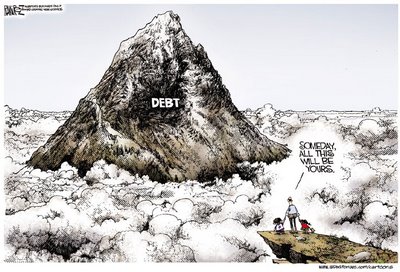
    http://netrightdaily.com/wp-content/uploads/2010/08/National-Debt-Cartoon.jpg
    But, I thought I was doing the right thing in 2008 by moving my 401K from market volatility and investing in the solvency of America by moving to government bonds? 

    Bernanke then sold my investment to by $600 Billion more debt... I gave him the money to pay off his debt -WTF

    He is now planning on asking me for more as Fed Prints Another $600 Billion to Keep US Recovery on Track???

    I have worked and paid taxes since the age of 14, and have a hard time understanding how my family and I could ever pay off our "contributions" to our household debt toll of more than $170,000 as we enter the next decade of hardship?

    Most experts say if there were signs of this happening, the U.S. government would go for a combination of persuading Americans to buy more U.S. debt, the same way they did in World War II, and finding friendly foreign governments to make additional purchases. 
    "The U.S. government should have and maybe still could call on the people of the U.S. to invest in U.S. debt," said David Walker, a former U.S. comptroller general who heads an advocacy group calling on the government to curb the U.S. budget deficit and borrowings.


    To be sure, the idea that China would suddenly sell its U.S. debt holdings is almost unimaginable to some.
    http://etfdesk.files.wordpress.com/2010/03/fed-balance-sheet.pngIs  Bernanke punishing everyone who wants to invest in Americas?
    Telegraph: The latest round of quantitative easing (QE) comes on top of the $1.7 trillion already completed and is intended "to promote a stronger pace of recovery", the Fed said. It is changing tack, however, buying US government bonds instead of corporate debt and mortgage-backed securities. Existing QE will be rolled over, but also recycled into treasuries.

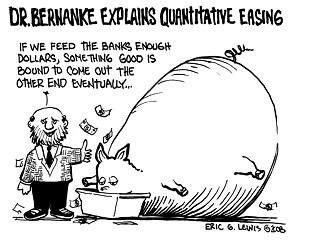
    https://blogger.googleusercontent.com/img/b/R29vZ2xl/AVvXsEhsiyq9kc2bphoS1YQZsQxSekV-FmYvfWTS3PHhZ8bCc4WqJ2ERHhO_6Mwo9HXymXj5RL0xZzwOsF_9zxyhflzmvjF8wrg_RwZ_93uBQQKtP6oU2Pe6krJResMqtu0UCe8p1cbP/s1600/bernanke-qe-cartoon.jpgBy the end of June, the Fed expects to have bought $850bn to $900bn of treasuries – roughly $110bn a month, $75bn of which will be additional QE.

    • Yields on 10-year US government bonds dipped
    • The dollar fell against most currencies due to QE,
    • The Fed's decision will also heap pressure on the Bank of England to follow suit

    Sources:
    As previously noted, interest rates have risen both times after the Fed implemented quantitative easing.

    Graham Summers points out that food prices have also skyrocketed both times:
    In case you’ve missed it, food riots are spreading throughout the developing world Already Tunisia, Algeria, Oman, and even Laos are experiencing riots and protests due to soaring food prices.
    As Abdolreza Abbassian, chief economist at the UN’s Food and Agriculture Organization (FAO), put it, “We are entering a danger territory.”
    Indeed, these situations left people literally starving… AND dead from the riots.
    And why is this happening?
    A perfect storm of increased demand, bad harvests from key exporters (Argentina, Russia, Australia and Canada, but most of all, the Fed’s money pumping. If you don’t believe me, have a look at the below chart:
    [Summers shows the share price of Elements Rogers International Commodity Agriculture ETN as a proxy for food prices generally.]
    As you can see, it wasn’t until the Fed announced its QE lite program that agricultural commodities exploded above long-term resistance. And in case there was any doubt, QE 2 sent them absolutely stratospheric.

    This isn't really unexpected.

    Last November, David Einhorn warned:
    HTML clipboard
    It is quite likely that QE2 will slow the economy by raising food and energy prices [because it is easier to generate these price increases]. [These price hikes] would act as a tax on consumers and businesses.
    Also in November, Karl Denninger wrote:
    We have a Federal Reserve that, in the last two years, has printed and debased the currency of this nation by more than 100%, taking their balance sheet from $800 billion to more than $2 trillion. They now threaten, today, to do even more of that. This has resulted in insane price ramps in soft commodities ....
    ("soft commodities" means food crops).

    As the Wall Street Journal, Tyler Durden, the Economic Policy Journal and others note, inflation in food prices isn't limited to developing nations, but is coming to the U.S

      'Star Wars' Creator George Lucas believes the world will end in 2012.

      http://blahmovies.files.wordpress.com/2010/05/lucas.jpgGeorge Lucas Believes in 2012, For Real, Says Concerned Citizen Seth Rogen | Movieline
      Creator George, the 66-year-old filmmaker revealed his apocalypse theory to Seth Rogen during a meeting.

      Rogen is quoted by the Toronto Sun newspaper as saying: "George Lucas sits down and seriously proceeds to talk for around 25 minutes about how he thinks the world is gonna end in the year 2012. Like, for real. He thinks it."

      "I first thought George was joking … and then I totally realized he was serious and then I started thinking, 'If you're George Lucas and you actually think the world is gonna end in a year, there's no way you haven't built a spaceship for yourself … So I asked him …

      'Can I have a seat on it?' He claimed he didn't have a spaceship, but there's no doubt there's a Millennium Falcon in a garage somewhere with a pilot just waiting to go … It's gonna be him and Steven Spielberg and I'll be blown up like the rest of us."