Professor Chris Rhodes: Making choices about the kind of light bulbs we should be using, on the simple basis of energy consumption, and hence carbon emissions, may be a little short-sighted. Thus, the old fashioned incandescent bulbs … Continue reading
Jan 26, 2013
The U.S. #1 in Early Deaths. Americans had “the lowest probability over all of surviving to the age of 50.”
The Institute of Medicine and the National Research Council released some damaging numbers this month: Americans ranks startlingly low in life expectancy, compared to 16 other similarly developed countries. This is especially true for younger Americans. Indeed, among people 55 and under, we rank dead last. Among those 50-80 years old, our life expectancy is 3rd or 2nd to last.

Sabrina Tavernise at the New York Times reports that the “major contributors” to low life expectancy among younger Americans are high rates of death from guns, car accidents, and drug overdoses. We also have the highest rate of diabetes and the second-highest death rate from lung and heart disease.
Americans had “the lowest probability over all of surviving to the age of 50.” The numbers for American men were slightly worse than those for women. Overall, life expectancy for men was 17 out of 17; women came in 16th. Education and poverty made a difference too, as did the more generous social services provided by the other countries in the study.
What isn’t making a difference? Apparently our incredible rate of health care spending.
Lisa Wade is a professor of sociology at Occidental College. You can follow her on Twitter and Facebook.
FDA panel votes to place tighter controls on narcotics like Vicodin
In a monumental pushback against America's narcotic painkiller epidemic, a U.S. Food and Drug Administration advisory panel recommended Friday that stricter controls be placed on popular narcotic painkillers such as Vicodin.
Please continue reading at:
TODAY: The day Americans gave up their digital device rights. Unlocking Mobile Phones Becomes Illegal #tech #news
"Referencing a decision outlined in the Federal Register, Tech News Daily has published an article noting that the window to unlock your new mobile phone in the U.S. is closing. 'In October 2012, the Librarian of Congress, who determines exemptions to a strict anti-hacking law called the Digital Millennium Copyright Act (DMCA), decided that unlocking mobile phones would no longer be allowed. But the library provided a 90-day window during which people could still buy a phone and unlock it. That window closes on January 26.' While this doesn't apply to phones purchased before the window closes, this means that after 1/26/13, for any new mobile phone you purchase, you'll have to fulfill your contract, or break the law to unlock it.
Please read full and follow at:
http://yro.slashdot.org/story/13/01/25/144204/unlocking-new-mobile-phones-becomes-illegal-in-the-us-tomorrow
Peugeot Citroen To Introduce Compressed Air Hybrid By 2016 - Slashdot
"With a few exceptions, such as Volvo's Air Motion Concept, major automotive manufacturers have generally shied away from compressed air technology. PSA Peugeot Citroen is bucking this trend with its 'Hybrid Air' powertrain that addresses the limited range of compressed air energy storage technology by combining it with a gasoline powered internal combustion engine. The company plans to have Hybrid Air powered vehicles on the road by 2016."
Please read full and follow at:
http://tech.slashdot.org/story/13/01/25/1713215/peugeot-citroen-to-introduce-compressed-air-hybrid-by-2016
PREPARE For 90% Correction? Currency War Escalating, Inflationary Targets Will Fail – Financial Catastrophe On Horizon
Bloomberg Market exposed this danger in an article about bond investor Jeffrey Gundlach, who’s doing a flip-flop as we speak: “Bond guru buying stocks. Sees ‘Kaboom’ Ahead,” something overwhelming that will even dwarf the bizarre fiscal-cliff insanity: Yes, there’s a “financial catastrophe on the horizon.”
Gundlach, the CEO of DoubleLine Capital, who predicted the 2008 Wall Street credit meltdown, says it’s real damage is still to come. Earlier at TCW Group, he had a 7.9% annual average return for the 2000-2009 decade. He warns: “The first phase of the coming debacle consisted of a 27-year buildup of corporate, personal and sovereign debt. That lasted until 2008.”
Then all that cheap money “finally toppled banks and pushed the global economy into a recession, spurring governments and central banks to spend trillions of dollars to stimulate growth.” America piled on an estimated $29.7 trillion in debt in the shadow markets.
BILLIONAIRES DUMPING STOCKS, ECONOMIST KNOWS WHY!
Despite the 6.5% stock market rally over the last three months, a handful of billionaires are quietly dumping their American stocks . . . and fast.
Warren Buffett, who has been a cheerleader for U.S. stocks for quite some time, is dumping shares at an alarming rate. He recently complained of “disappointing performance” in dyed-in-the-wool American companies like Johnson & Johnson, Procter & Gamble, and Kraft Foods.
In the latest filing for Buffett’s holding company Berkshire Hathaway, Buffett has been drastically reducing his exposure to stocks that depend on consumer purchasing habits. Berkshire sold roughly 19 million shares of Johnson & Johnson, and reduced his overall stake in “consumer product stocks” by 21%. Berkshire Hathaway also sold its entire stake in California-based computer parts supplier Intel.
With 70% of the U.S. economy dependent on consumer spending, Buffett’s apparent lack of faith in these companies’ future prospects is worrisome.
Unfortunately Buffett isn’t alone.
Fellow billionaire John Paulson, who made a fortune betting on the subprime mortgage meltdown, is clearing out of U.S. stocks too. During the second quarter of the year, Paulson’s hedge fund, Paulson & Co., dumped 14 million shares of JPMorgan Chase. The fund also dumped its entire position in discount retailer Family Dollar and consumer-goods maker Sara Lee.
Finally, billionaire George Soros recently sold nearly all of his bank stocks, including shares of JPMorgan Chase, Citigroup, and Goldman Sachs. Between the three banks, Soros sold more than a million shares.
So why are these billionaires dumping their shares of U.S. companies?
After all, the stock market is still in the midst of its historic rally. Real estate prices have finally leveled off, and for the first time in five years are actually rising in many locations. And the unemployment rate seems to have stabilized.
It’s very likely that these professional investors are aware of specific research that points toward a massive market correction, as much as 90%.
And this is where Wiedemer explains why Buffett, Paulson, and Soros could be dumping U.S. stocks:
“Companies will be spending more money on borrowing costs than business expansion costs. That means lower profit margins, lower dividends, and less hiring. Plus, more layoffs.”
Please read full and follow at:
Where America is going... 60% of Children in Detroit Live in Poverty #economic #news
CBS Detroit: A new report from Data Driven Detroit reveals that in spite of the many families with kids that left Detroit between 2000 and 2010 — much of the city’s population still consists of children living in poverty.
Sixty percent of children in Detroit live in poverty, per the “State of Detroit” report. This represents a 64.7 percent increase in child poverty in the city since 1999. Children account for 194,347 of Detroit’s residents, or 27 percent of the city’s total population.
Please continue reading at:
Jan 25, 2013
Researchers discover new mutations driving malignant melanoma
Two new mutations that collectively occur in 71 percent of malignant melanoma tumors have been discovered in what scientists call the "dark matter" of the cancer genome, where cancer-related mutations haven't been previously found.
Reporting their findings in the Jan. 24 issue of Science Express, the researchers from Dana-Farber Cancer Institute and the Broad Institute said the highly "recurrent" mutations – occurring in the tumors of many people – may be the most common mutations in melanoma cells found to date.Please read and follow source posts at:
EPA Releases New Report on Children's Health & the Environment in America - #Children #Health #Environment #America
WASHINGTON – EPA today released “America’s Children and the Environment, Third Edition,” a comprehensive compilation of information from a variety of sources on children’s health and the environment. The report shows trends for contaminants in air, water, food, and soil that may affect children; concentrations of contaminants in the bodies of children and women of child-bearing age; and childhood illnesses and health conditions. The report incorporates revisions to address peer review and public comments on draft materials released in 2011. “This latest report provides important information for protecting America’s most vulnerable – our children. It shows good progress on some issues, such as reducing children’s blood lead levels and exposure to tobacco smoke in the home, and points to the need for continued focus on other issues”, said EPA Administrator Lisa P. Jackson. “Although we are encouraged by these findings, there is still much work to be done. By monitoring trends, identifying successes, and shedding light on areas that need further evaluation, we can continue to improve the health of our children and all Americans.” Among the contaminants clearly linked to health conditions in children, key findings include: The median concentration of lead in the blood of children between the ages of 1 and 5 years was 92 percent lower in 2009-2010 compared to 1976-1980 levels. Although the majority of the decline occurred in the 1980s, consistent decreases have continued since 1999.
The median level of cotinine (a marker of exposure to environmental tobacco smoke) measured in blood of nonsmoking children ages 3 to 17 years was 88 percent lower in 2009-2010 than it was in 1988–1991. In 2010, 6 percent of children ages 0 to 6 years lived in homes where someone smoked regularly, compared with 27 percent in 1994.
The percentage of children living in counties where pollutant concentrations were above the levels of one or more national air quality standards declined from 75 percent to 59 percent from 1999 to 2009.
The level of knowledge regarding the relationship between environmental exposures and health outcomes varies widely among the topics presented in this report, and the inclusion of an indicator in the report does not necessarily imply a known relationship between environmental exposure and children’s health effects. The report provides data for selected children’s health conditions that warrant further research because the causes, including possible contributing environmental factors, are complex and not well understood at this point. In the case of asthma, researchers do not fully understand why children develop the condition. However, substantial evidence shows exposure to certain air pollutants, including particulate matter and ozone, can trigger symptoms in children who already have asthma. Although the report found the percentage of children reported to currently have asthma increased from 8.7 percent in 2001 to 9.4 percent in 2010 and that minority populations are particularly affected by asthma, the severity of children’s asthma and respiratory symptoms has declined. The rate of emergency room visits for asthma decreased from 114 visits per 10,000 children in 1996 to 103 visits per 10,000 children in 2008. Between 1996 and 2008, hospitalizations for asthma and for all other respiratory causes decreased from 90 hospitalizations per 10,000 children to 56 hospitalizations per 10,000 children. The report also looks at trends in other health conditions, such as Attention-Deficit/Hyperactivity Disorder (ADHD) and preterm births, for which rates have increased. There is no conclusive information on the role of environmental contaminants in ADHD or preterm births, and additional research is ongoing. The national indicators presented in this comprehensive report are important for informing future research related to children’s health. Children may be more vulnerable to environmental exposures than adults because children’s bodies are still developing. Children eat more, drink more, and breathe more in proportion to their body size; and their behavior can expose them more to chemicals and organisms. This report includes 37 indicators of children’s environmental health to address 23 important topics. The expanded content reflects the latest research on children’s health issues and the availability of data for more topics. Each indicator and its supporting text were peer reviewed by independent external experts and made available for review and comment by the public. More on “America's Children and the Environment, Third Edition”: http://www.epa.gov/ace/
The median level of cotinine (a marker of exposure to environmental tobacco smoke) measured in blood of nonsmoking children ages 3 to 17 years was 88 percent lower in 2009-2010 than it was in 1988–1991. In 2010, 6 percent of children ages 0 to 6 years lived in homes where someone smoked regularly, compared with 27 percent in 1994.
The percentage of children living in counties where pollutant concentrations were above the levels of one or more national air quality standards declined from 75 percent to 59 percent from 1999 to 2009.
The level of knowledge regarding the relationship between environmental exposures and health outcomes varies widely among the topics presented in this report, and the inclusion of an indicator in the report does not necessarily imply a known relationship between environmental exposure and children’s health effects. The report provides data for selected children’s health conditions that warrant further research because the causes, including possible contributing environmental factors, are complex and not well understood at this point. In the case of asthma, researchers do not fully understand why children develop the condition. However, substantial evidence shows exposure to certain air pollutants, including particulate matter and ozone, can trigger symptoms in children who already have asthma. Although the report found the percentage of children reported to currently have asthma increased from 8.7 percent in 2001 to 9.4 percent in 2010 and that minority populations are particularly affected by asthma, the severity of children’s asthma and respiratory symptoms has declined. The rate of emergency room visits for asthma decreased from 114 visits per 10,000 children in 1996 to 103 visits per 10,000 children in 2008. Between 1996 and 2008, hospitalizations for asthma and for all other respiratory causes decreased from 90 hospitalizations per 10,000 children to 56 hospitalizations per 10,000 children. The report also looks at trends in other health conditions, such as Attention-Deficit/Hyperactivity Disorder (ADHD) and preterm births, for which rates have increased. There is no conclusive information on the role of environmental contaminants in ADHD or preterm births, and additional research is ongoing. The national indicators presented in this comprehensive report are important for informing future research related to children’s health. Children may be more vulnerable to environmental exposures than adults because children’s bodies are still developing. Children eat more, drink more, and breathe more in proportion to their body size; and their behavior can expose them more to chemicals and organisms. This report includes 37 indicators of children’s environmental health to address 23 important topics. The expanded content reflects the latest research on children’s health issues and the availability of data for more topics. Each indicator and its supporting text were peer reviewed by independent external experts and made available for review and comment by the public. More on “America's Children and the Environment, Third Edition”: http://www.epa.gov/ace/
Sr. Environmental Manager Opportunity in Alberta, Canada - # Environmental #Energy #OHS #Job
Sr. Environmental Manager - large coal fired power plant Western Canada
Be key member of a plant turn around team on a 155 mw plant in Alberta, Canada. This position has oversight of OSHA, Alberta Environment and NERC/AESO regulations and how these regulations impact the workplace at the plant. Work closely with Corporate Environmental Director, Plant Manager, Operations Manager and Maintenance Managers to assist in all Environment, Safety and regulatory programs. Primarily focus will be to provide environmental support and guidance to power plant operations in the development and implementation of corporate and Station objectives and strategies for compliance with environmental regulations at the Station. Work has been started and I am told that local regulators are relieved that a new O&M group is starting to implement required procedures of what has been neglected in prior years. This will be a strong career building position in that over the next 18-24 months the proactive EHS Manager can catch up in a doable EHS project. This O&M company has earned an excellent reputation as a company dedicated to rejuvenating power projects in need of technical or economic remediation. They not only apply a broad spectrum of professional, creative and cost-effective owner and general management services to a wide array of project needs, they take on ownership positions in projects to provide restructuring alternatives. They continue to expand their portfolio of power plants they operate across the US and Canada, which will offer many career advancement opportunities. The compensation package range is robust, comprehensive, & well above average.Contact Dave Weir for details including more detailed job description at:
(800) 606-6440 x 114
davew(at)searchstonepartners.com
Be key member of a plant turn around team on a 155 mw plant in Alberta, Canada. This position has oversight of OSHA, Alberta Environment and NERC/AESO regulations and how these regulations impact the workplace at the plant. Work closely with Corporate Environmental Director, Plant Manager, Operations Manager and Maintenance Managers to assist in all Environment, Safety and regulatory programs. Primarily focus will be to provide environmental support and guidance to power plant operations in the development and implementation of corporate and Station objectives and strategies for compliance with environmental regulations at the Station. Work has been started and I am told that local regulators are relieved that a new O&M group is starting to implement required procedures of what has been neglected in prior years. This will be a strong career building position in that over the next 18-24 months the proactive EHS Manager can catch up in a doable EHS project. This O&M company has earned an excellent reputation as a company dedicated to rejuvenating power projects in need of technical or economic remediation. They not only apply a broad spectrum of professional, creative and cost-effective owner and general management services to a wide array of project needs, they take on ownership positions in projects to provide restructuring alternatives. They continue to expand their portfolio of power plants they operate across the US and Canada, which will offer many career advancement opportunities. The compensation package range is robust, comprehensive, & well above average.Contact Dave Weir for details including more detailed job description at:
(800) 606-6440 x 114
davew(at)searchstonepartners.com
Fed’s Holdings of U.S. Gov’t Debt Hits Record $1,696,691,000,000 — Up 257%!
(CNSNews.com) – In data releasedThursday afternoon, the Federal Reserve revealed that its holdings of U.S. government debt had increased to an all-time record of $1,696,691,000,000 as of the close of business on Wednesday.
The Fed’s holdings of U.S. government debt have increased by 257 percent since President Barack Obama was first inaugurated on Jan. 20, 2009, and the Fed is currently the single largest holder of U.S. government debt.
STUDY: Smoking shortens life by 10+ years
Kicking the habit by age 40 reduces the excess risk of death by about 90%, new research finds.
People who smoke take at least 10 years off their life expectancy, a new study has found.
On the other hand, those who kick the habit before age 40 reduce the excess risk of death associated with continued smoking by about 90%, according to the study in Thursday’s New England Journal of Medicine.
Read more: http://www.usatoday.com/…/smoking-cessation-life-expectancy/1858913/
Hypocrisy, mans greatest sin... Obamacare will cover everyone BUT smokers
The Affordable Care Act — “Obamacare” to its detractors — allows health insurers to charge smokers buying individual policies up to 50 percent higher premiums starting next Jan. 1.

For a 55-year-old smoker, the penalty could reach nearly $4,250 a year. A 60-year-old could wind up paying nearly $5,100 on top of premiums.
Please continue reading at: http://xfinity.comcast.net/articles/news-general/20130124/US.Health.Overhaul.Smokers/
------------------___________________________________________
I agree smokers should pay more... "Choice" they made it. However, drug users, heavy drinkers and obese get a pass?
Choice = consequence$
BREAKING: Underground Explosion At Iran’s Fordow Nuclear Facility… 240 Personnel Trapped Deep Underg
An explosion deep within Iran’s Fordow nuclear facility has destroyed much of the installation and trapped about 240 personnel deep underground, according to a former intelligence officer of the Islamic regime.
...An explosion deep within Iran’s Fordow nuclear facility has destroyed much of the installation and trapped about 240 personnel deep underground, according to a former intelligence officer of the Islamic regime.
Please continue reading at: http://www.wnd.com/2013/01/sabotage-key-iranian-nuclear-facility-hit/
U.S. Could Be The Biggest Electric Car Market By 2020
 There's no doubt about it: Electric car sales are going up. 2012 saw sales triple compared to 2011, and while the overall number of electric cars will increase in modest amounts, improved education and more choice should ensure a general upward trend. According to Pike Research, there could be as many as 1.8 million plug-in electric vehicles on...
Please continue reading at:
Hydrogen From Artificial Photosynthesis: Future For Fuel Cells?
 For the most abundant element in the universe, hydrogen is remarkably hard to come by on good ol' planet earth. While the techniques for extracting it are easy enough to understand, the energy required to do so is often significant--meaning hydrogen fuel cell vehicles aren't as squeaky-clean and perfect as they seem. New research in the UK could...
Please continue reading at:
Study Shows High Blood Calcium Levels May Indicate Ovarian Cancer
A new study from Wake Forest Baptist Medical Center is the first to report that high blood calcium levels might predict of ovarian cancer, the most fatal of the gynecologic cancers. read more
Post and link source
Researchers prevent cancer spread by blocking tissue scarring
What to fear most if faced by a cancer diagnosis is the spread of the cancer to other parts of the body. This process called metastasis accounts for over 90% of cancer patient deaths and therefore is a strong focus for cancer researchers. Researchers at BRIC, University of Copenhagen have shown that the enzyme Lysyl Oxidase (LOX) can create a “scarred” microenvironment that enhances cancer spreading. By blocking activity of the LOX enzyme, the researchers succeeded in significantly decreasing metastasis in a model of breast cancer.
From
#CSR greatest profitability accrues with highest commitment to sustainability. - #Business #Sustainability
...
The Relationship between CSR and Profit Is U-Shaped
The firms rated low and high in social performance tended to have high financial performance, and the firms with the highest social performance had the highest income and ROA. The most unattractive position was in the middle: firms with only moderate levels of social performance had the lowest financial performance. In other words, the relationship between sustainability and profitability is “U-shaped” and—crucially—the right side of the U rises higher than the left. The greatest profitability accrues to the companies with the highest commitment to sustainability.
Relationship Between Social Performance and Financial Performance

Everyone Was Right
Milton Friedman and his detractors were both correct because their theories were focused on different parts of the U-curve. Barnett and Salomon reconcile seemingly conflicting past research findings by factoring in a firm’s ability to influence stakeholders over time by investing in social performance.
http://nbs.net/knowledge/csr-pays-when-you-bake-it-in-or-ignore-it-completely
Water for the Desert Home...there would be no such thing as waste water - #Sustainable #water
classwarinamerica: Here’s something we need now, and may need desperately before long: a closed home water system for the desert. For places like Los Angeles and San Diego. These places, and many others, are naturally dry, and will be getting drier. Having closed water systems could literally save them, because there would be no such thing as waste water.
We need a closed home water system for the desert,
for places like Los Angeles and San Diego.
Why do we need closed water systems? After all, the way we use water now has been around a long time, and it works very well. In fact, there are certainly places in the US that will never need such a system. But there are others in which water might well become the most costly item in the budget. Where it would be impossible to live comfortably without such systems because there simply isn’t enough water. The only water input needed in such closed systems would replace evaporated and consumed water.
The Southwest has several areas that could easily revert to desert in the coming years of global warming. In fact, with rising temperatures everywhere, there will be many places that will simply go dry, and therefore become uninhabitable.
But what if we had workable closed water systems? The only water input needed would be small amounts to replace evaporated water and water we consume in drinking and cooking. If the water supply could be limited to such small amounts, many otherwise uninhabitable places—perhaps even San Diego and Los Angeles at a not distant future date—might be saved from ruin. In fact, closed systems would surely be better than the unsuitable and very expensive desalination plant that San Diego is now building, not to mention the ill-advised pipeline being considered for the Sacramento River Delta.
The only water input needed
would be small amounts to replace
evaporated water and water we consume.
No water would be needed for human waste disposal, because there are already quite civilized ways to deal with it without water. Feces would be used as fuel to evaporate urine, which would become valuable crop fertilizer. Systems of this type already exist. There would be no need for a public waste disposal system or a sewer.
All water in a household would be continuously purified and recycled. Food waste, including hard substances like bones, could be processed by stronger garbage disposals. It could then be strained out of the water cycle and composted for home or commercial use.
Used water would flow into a purification system, which would recycle it as completely pure potable water. This could be done with either a completely natural system of plants, a tank in which algae or other primitive plants purify the water, or a synthetic system in which the water flows through manufactured filters. Combinations of these three methods and others might also be used.
The only thing lacking is design,
but design is not the real challenge.
All these things are presently available. In fact, water recycling that includes even human waste is being done effectively right in the lobby of at least one commercial building.
The science is ready. The individual processes are ready. The hardware is available. The only thing lacking is the commercial development of economically viable designs for the home. However, the designs themselves are not the real challenge.
The most difficult part of the challenge is gaining acceptance by individuals and city agencies. This is because minds do not readily accept the new, and we who live in cities are well used to the water systems we have had for more than a century. But the need is already here.
What I have described here is not the only way to tackle the problem. Here’s an article by Terry O’Day from the California Progress Report about how Santa Monica and other cities are modernizing city water systems.
That water from your shower? It could water your garden. #Water saving DYI #Sustainable grey water system
Marketplace.org: Jimmy Lizama is a bike messenger in Los Angeles. He lives his wife, Josie, and their 2-year-old son in a place called the Eco-Village. It's a building with 40 apartments, whose residents share a mission to reduce their environmental impact.
One day Lizama had an epiphany. He was working on an apartment "doing some really heavy duty work and I was getting filthy."
That day, the water was shut off for maintenance work, so Jimmy had thought ahead and filled up a five-gallon bucket. "So I go to take a shower with my five gallons of water and I used two gallons to become very, very clean," Lizama said.
A typical shower uses anywhere from two-and-a-half to five gallons of water per minute.
"That's a ton of water that can be used to do a lot more than just take shower," Lizama said.
He did a little research and decided to install a system to take the water from his shower to a banana plant in the garden outside his apartment. He chose the banana plant for a reason. Both his father and his grandfather worked on banana plantations in Honduras. Once the system was installed, Lizama explained, "any day I took a shower or did anything where water was taken out of this unit, it was going directly to grow my plants. To grow food, so yeah, it was great."
But then the city plumbing inspector discovered that one of the parts Jimmy used wasn't up to code, so he had to disconnect his system.
California allows residents to install a greywater system without a permit, but only in single-family houses. And since Lizama lives in an apartment, he had to get an exemption. So he went to Osama Yousan, head of the green building division at the Los Angeles Department of Building and Safety. Yousan was familiar with the Eco-Village so he granted the exemption.
"You know greywater has been in the city for a long time," Yousan said. "I remember in the '80s, when I first started, there was a pilot program to do greywater, but then it went away."
But when a drought hit southern California in early 2000, it prompted a shift in thinking at the state level.
Yousan said, "The drought that we had, the shortage of water made people come back and say we should have greywater as a means of savings, and that's when the state started looking seriously at it."
Please continue reading at:
Jan 24, 2013
Antibiotic-resistant diseases pose 'apocalyptic' threat, top expert says | #health Via: @Guardian
Britain: Britain’s most senior medical adviser has warned MPs that the rise in drug-resistant diseases could trigger a national emergency comparable to a catastrophic terrorist attack, pandemic flu or major coastal flooding.
Dame Sally Davies, the chief medical officer, said the threat from infections that are resistant to frontline antibiotics was so serious that the issue should be added to the government’s national risk register of civil emergencies.
She described what she called an “apocalyptic scenario” where people going for simple operations in 20 years’ time die of routine infections “because we have run out of antibiotics”.
http://www.guardian.co.uk/society/2013/jan/23/antibiotic-resistant-diseases-apocalyptic-threat
Get Involved in #Green #Milwaukee #Sustainability Plan- #Environment Work Group will host a public meeting on January 30, 2013
You have a Milwaukee.Gov E-Notification for Environmental Sustainability Initiatives category.The Milwaukee Green Team Environment Work Group will host a public meeting on January 30, 2013 to learn what issues on Air and Natural Resources should be included in the city Sustainability Plan. Please join us.
Who: Milwaukee Green Team - Environment Work Group
What: Air & Natural Resources Issues Meeting
When: 5:30p - 7:00p, Wednesday, January 30, 2013
Where: Villard Square Branch Library - Milwaukee Public
Library
5190 N. 35th Street
Milwaukee, WI 53209
Why: Public feedback on city Sustainability Plan
concerning Air & Natural Resources Issues
Courtesy RSVP to Kimberly Kujoth at (414) 286-5453 or kimberly.kujoth (at) milwaukee.gov.
Who: Milwaukee Green Team - Environment Work Group
What: Air & Natural Resources Issues Meeting
When: 5:30p - 7:00p, Wednesday, January 30, 2013
Where: Villard Square Branch Library - Milwaukee Public
Library
5190 N. 35th Street
Milwaukee, WI 53209
Why: Public feedback on city Sustainability Plan
concerning Air & Natural Resources Issues
Courtesy RSVP to Kimberly Kujoth at (414) 286-5453 or kimberly.kujoth (at) milwaukee.gov.
Goldman Sachs Made $400 Million Betting On Food Prices, While Hundreds Of Millions Starved #humanity
InvestmentWatch: Why does it seem like wherever there is human suffering, some giant bank is making money off of it? According to a new report from the World Development Movement, Goldman Sachs made about 400 million dollarsbetting on food prices last year. Overall, 2012 was quite a banner year for Goldman Sachs. As I reported in a previous article, revenues for Goldman increased by about 30 percent in 2012 and the price of Goldman stock has risen by more than 40 percent over the past 12 months. It is estimated that the average banker at Goldman brought in a pay and bonus package of approximately $396,500 for 2012. So without a doubt, Goldman Sachs is swimming in money right now. But what is the price for all of this “success”? Many claim that the rampant speculation on food prices by the big banks has dramatically increased the global price of food and has caused the suffering of hundreds of millions of poor families around the planet to become much worse. At this point, global food prices are more than twice as high as they were back in 2003. Approximately 2 billion people on the planet spend at least half of their incomes on food, and close to a billion people regularly do not have enough food to eat. Is it moral for Goldman Sachs and other big banks such as Barclays and Morgan Stanley to make hundreds of millions of dollars betting on the price of food if that is going to drive up global food prices and make it harder for poor families all over the world to feed themselves?
Please continue reading at:
Proposed bill makes it illegal to possess or distribute cigarettes without a doctor's prescription. #health
...Rep. Mitch Greenlick, from Portland, is sponsoring a bill that makes cigarettes a Schedule III controlled substance, meaning it would be illegal to possess or distribute cigarettes without a doctor's prescription.
Under the proposal, offenders would face maximum punishments of one year in prison, a $6,250 fine or both.
Other drugs and substances that are considered Schedule III controlled substances are ketamine, lysergic acid and anabolic steroids.
"The State Board of Pharmacy may adopt rules placing requirements and limitations on the sale or transfer of products containing nicotine," the bill's text says.
How to Use a Fire Extinguisher | Fires double in size every 60 seconds
Nice short review from The Art of Manliness:
Fire extinguishers. You pass them all the time as you walk the hallways at work or school, and hopefully at home too.
But no matter how many times you’ve seen them in your day-to-day life, you’ve probably given little thought as to how you actually use one. Maybe it never crossed your mind, or maybe you assume it’s so simple it’s not something you need to learn.
Well, it’s true that using a fire extinguisher isn’t rocket science by any stretch, but there are a few basics you need to be aware of – and probably aren’t. According to FEMA, the majority of Americans don’t know how to use an extinguisher, even if they have one in their home. This is a dangerous knowledge gap. Fires double in size every 60 seconds, so you don’t want to be fumbling around in an emergency situation, reading over the instruction manual as a small flame on the stove grows into an inferno.
Today we’ll talk about some guidelines for choosing an extinguisher and storing it in your house, and then discuss how to use it.
The Right Fire Extinguisher for the Right Fire
Fire extinguishers come in a wide variety of types — each one designed to put out a different kind of fire. Classification systems have been developed to help users know what sort of extinguisher they’re working with. Because the majority of our readers are based stateside, I’ll be focusing on the system used to classify extinguishers in the US.
 | Class A – Ordinary solid combustibles like wood, cloth, and paper products. |
 | Class B - Flammable liquids and gases. |
 | Class C - Electrical fires. (Do not use water to put out this kind of fire – you could get electrocuted!) |
 | Class D - Flammable metals. |
 | Class K - Oils and grease fires. (Never use water on a grease fire – it will cause the flames to explode and spread.) |
Cont...
Where to Put a Fire Extinguisher in Your House
Your office or school very likely already has fire extinguishers in place. But it’s up to you to get ones for your own home. Some states require that you do so by law, but even if yours doesn’t, they’re an essential safety item – your second line of fire defense after smoke detectors. A fire extinguisher can keep a small incident from turning into a dangerous emergency.
You should, at minimum, have one ABC extinguisher per level of your house. It’s best to have one near each of the rooms where fires are most likely to break out – the garage and especially the kitchen.
Store extinguishers where your kids can’t get to them, but they’re still easy to access – you don’t want to be looking around and digging through a closet when every second is crucial. Don’t place them near stoves and heating appliances, or behind curtains and drapes – places where fires may start and quickly spread; if you can’t reach the extinguisher because the thing that’s on fire is right by it, you’re in trouble. The best location for your fire extinguisher is mounted near a door – your escape routes.
Once you’ve gotten an extinguisher or two to protect your castle, try to check it periodically to see if its pressure is still in the green zone, the seals haven’t been broken, the hoses are intact, and it hasn’t been damaged by things like dents, leaks, or rust.
How to Use a Fire Extinguisher
Alight. So you’re familiar with the different kinds of fire extinguishers and where to put them in your house. It’s time to get down to how to actually use these suckers. If you chance to encounter a fire, mentally go through this checklist of questions before attempting to put it out with an extinguisher:
Are you taller than the fire? Fire extinguishers are designed to put out fires in the incipient stage. That’s fireman talk for when the fire is just getting started. When it gets past the beginning stage, a fire becomes too large to fight with a portable extinguisher.
How do you know if the fire is still in the incipient stage?
Just give the flame the once over to see if it’s taller than you.
It is? Hightail it out of there and call 911. Your fire extinguisher will likely be no match for the flames.
You’re still taller than the fire? Proceed to the next question.
Do you have the right fire extinguisher for the type of fire? Remember, extinguishers are designed for certain fire types. If you’re facing a grease fire, a simple A extinguisher (which contains only pressurized water) won’t put it out.
Is the fire extinguisher pressurized? Check the gauge on the extinguisher to see if it’s fully charged and pressurized. If the needle is in the green, you’re good. If not, you won’t have enough pressure to put the fire out. Forget it and get out of there.
Get in Position
If you can answer “yes” to all three of those questions, you’re ready to put out the fire with the extinguisher.
If possible, position yourself with your back to an unobstructed exit so that you can get out quickly if you need to. The discharge range for extinguishers can run from 6-20 feet (know your extinguisher’s range beforehand), and you want to be far enough away to not be in danger of being burned, and close enough that the discharge will be effective.
PASS!
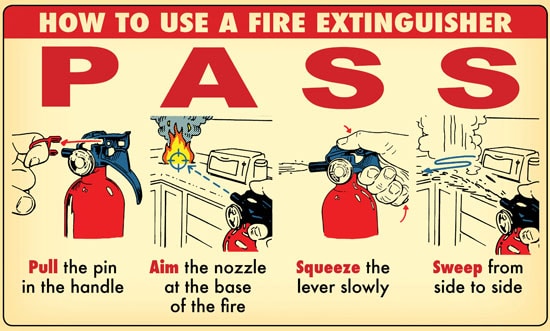
To employ the extinguisher with proper technique, just remember the acronym ”PASS.”
- Pull the pin.
- Aim the nozzle at the base of the fire. Hitting the tops of the flame with the extinguisher won’t be effective. You got to smother the sucker at its base.
- Squeeze the trigger. In a controlled manner, squeeze the trigger to release the agent.
- Sweep from side to side. Sweep the nozzle from side to side until the fire is put out. Keep aiming at the base while you do so. Most extinguishers will give you about 10-20 seconds of discharge time.
Slowly back away. Even if the fire appears to be extinguished, don’t turn your back on it. There might be unseen hot spots or hidden fires that can ignite into a large flame at any moment. You want to be on guard for that.
Please continue reading at: http://artofmanliness.com/2013/01/23/how-to-use-a-fire-extinguisher/
Jan 23, 2013
Wind turbine component failure data Infopack! Assessing failure rates & adopting effective monitoring strategies #energy
Research indicates that component service and spare parts can take up 26% of an annual O&M budget alone - the largest single expense of running a turbine. In the first of a series of infopacks, Wind Energy Update delves into the key challenges and considerations operators face with regards to maintaining and operating turbine components, and competing strategies to monitor their performance.
Fill in the form on the right and receive:- Exclusive insight from Infigen Energy on the techniques utilised to extend the lifetime of their blades
- Data on the main causes of wind turbine failure, giving a unique insight into where budget should be allocated to maintain performance
- Annual failure rate of components, indicating the least reliable and most reliable aspects of a turbine
- A podcast from the Gearbox Reliability Collaborative on their work towards reducing the costs incurred by gearbox failures
Jan 22, 2013
FREE #Sustainability #Energy Webinar “Multiple Facets of Sustainability - Cool Plasma Gasification” via @SustBusnMgmtLLC
ISTC (The Illinois Sustainable Technology Center) – has scheduled adaptiveARC, from San Jose, CA, as one of the companies ISTC is currently evaluating, to present a FREE Sustainability Webinar at their Champaign, IL facilities entitled “Multiple Facets of Sustainability - Cool Plasma Gasification”. The webinar will be presented in front of a live audience and through the Internet on January 31, 2013, 12-1 PM. You and your interested colleagues are welcome to attend in person at ISTC’s facilities or to register as a remote participant using the web link:
https://www4.gotomeeting.com/register/306782247
https://www4.gotomeeting.com/register/306782247
Oxford University Annals of Occupational Hygiene vol 57 issue 1 is now available on line with free to access 45 other papers
The full texts of the Editorial, the Review and the penultimate paper are free to access.
45 other papers which have been published on advance access and are awaiting assignment to an issue are at
http://annhyg.oxfordjournals.org/content/early/recent
45 other papers which have been published on advance access and are awaiting assignment to an issue are at
http://annhyg.oxfordjournals.org/content/early/recent
Jan. 21 US: OSHA Updates Guidance on Hazardous Chemical Exposures in Labs
This article is brought to you by Occupational Health and Safety Magazine.
OSHA is issuing a technical amendment to the non-mandatory appendix in its standard on occupational exposure to hazardous chemicals in laboratories, 1910.1450, which is known as the OSHA Laboratory Standard. Published Jan. 22 in the Federal Register, the amendment takes effect upon publication. It was made in order to include contents from a 2011 National Academy of Sciences publication.
Adhering to the hierarchy of controls is the third general principle listed in the technical amendment, following minimization of chemical exposures/risks and making an accurate assessment of the risks.
The Laboratory Standard requires laboratories to have Chemical Hygiene Plans, which the standard defines as “a written program developed and implemented by the employer which sets forth procedures, equipment, personal protective equipment and work practices that are capable of protecting employees from the health hazards presented by hazardous chemicals used in that particular workplace.”
For more information and the full article please refer to the link above.
Jan 21, 2013
Repost: "Our lives begin to end the day we become silent about things that matter." - Martin Luther King Jr.
This is a repost from "Our dreams shall be recognized in the words of Martin Luther King Jr."
"Our lives begin to end the day we become silent about things that matter." - Martin Luther King Jr.
"Our lives begin to end the day we become silent about things that matter." - Martin Luther King Jr.

Observed on the third Monday of January each year, Martin Luther King Jr. Day marks the anniversary of the birth of civil rights leader Reverend Martin Luther King, Jr..
In 1994, the Congress initiated the King Day of Service to transform the federal holiday honoring King into a national day of community service grounded in his teachings of nonviolence and social justice. As our nation makes progress toward realizing King's dream of racial equality, the work to achieve liberty and justice for all is never-ending.
Following in the footsteps towards equality... the historic signing of the "Hate Crimes Prevention Act" President Barack Obama reflects the real advances our nation has made in the fight against the bigotry and hate that King opposed. Further supporting the original 1964 Federal Civil Rights Law, 18 U.S.C. § 245(b)(2) and subsequent 1969 federal hate-crime law (18 U.S.C. § 245(b)(2))
To mark the 25th anniversary of the holiday, and to continue the momentum for the MLK Day of Service throughout the year, on Monday the White House is launching the MLK Day: What Are You Doing for Others? | The White House
The King Legacy of Service 25th Anniversary video tells the story of how Dr. King's birthday evolved into a national day of service. Featuring civil rights luminaries such as Congressman John Lewis, Reverend Dr. Joseph Lowery, and Ruby Bridges, the video reminds us of the importance of keeping Dr. King's legacy of service alive and challenges us to make service a part of our lives - everyday of the year. Watch the Video
"Let no man pull you low enough to hate him." In the end, we will remember not the words of our enemies, but the silence of our friends. - Martin Luther King Jr.
Listen, learn, love...
The NEED for nature: More trees could improve mortality rates & birth outcomes #green #health via @kprengaman
: A study published last week in the American Journal of Preventative Medicine entitled "A relationship between trees and human health," found correlations between the loss of ash trees in midwestern communities to increased mortality from cardiovascular and lower respiratory diseases.
http://kateprengaman.com/need-for-nature/
It's certainly not the first study to link exposure to nature with better mental and physical health. The Williams piece reviews some of the research on stress hormone levels, which can affect both our mental and longterm physical health. Studies have shown that gazing out a window
at a natural environment can improve recovery from gallbladder surgery and exposure to tree canopy has positive correlation with improved birth outcomes for pregnant women. But research with large sampled sizes and control over other variables have been rare.This study takes advantage of the major destruction of ash trees by an invasive insect, the Emerald Ash Borer
Introduced in Michigan and discovered about a decade ago, EAB has spread out across the midwest as people moved infected nursery stock and infected fire wood, as well as it's slow independent advance on forests. This resulted in a patchwork distribution of the dying trees. The midwest has lost more than 100 million trees lost so far, and more to come as the EAB continues to spread. Because of the patchy distribution of ash tree mortality, Donovan et al were able to compare data across 15 states and thousands of counties, controlling for other demographic variables, including income and race.
Spending time in this snowy forest in Michigan's Upper Peninsula reduced my stress significantly. Photo thanks to Erin Luhmann.
They found that across the entire infested area, the "borer was associated with an additional 6113 deaths related to illness of the lower respiratory system, and 15,080 cardiovascular-related deaths," from 1990 to 2007. The relationship appears to be particularly strong in higher income areas- perhaps because there tends to be more tree cover in wealthier neighborhoods to begin with. As an observational study, there are certainly limitations to this research, but the finding seem to stand up to some basic scrutiny. To test their model, they also used the accidental death data for the same period, because there is no mechanism for the EAB to influence accidental death rates, and found no correlations.
But how would tree loss lead to increased mortality from heart and respiratory disease? This study only provides some ideas suggested by other researcher on the links between exposure to nature and human health.
Further research needed. Not a surprising conclusion. But given the complexity of both human health and forest ecology, there's a lot remaining to sort out here.Read full by By at:Results do not provide any direct insight into how trees might improve mortality rates related to cardiovascular and lower-respiratory-tract illness. However, there are several plausible mechanisms including improving air quality, reducing stress, increasing physical activity, moderating temperature, and buffering stressful life events. Future research could fruitfully investigate the possible mechanisms linking the natural environment and health.
http://kateprengaman.com/need-for-nature/
The end of the E-Cat story? Andrea Rossi loses supporters for his "cold fusion" device via @gelderon52
The story of the E-Cat, the "cold fusion" device proposed by Mr. Andrea Rossi seems to be losing interest everywhere. Yesterday, Jan 14, another of Rossi's supporters, Mr. Daniele Passerini, announced that he is abandoning the fray and closing down his blog, at least for the time being.Mr Passerini's blog, titled "22 steps of love" has been the main focus of support for the E-Cat in Italy up to now. He says in his last post, titled "ad maiora" that "Some time ago, I wrote that, after that two years would have passed from the date of January 14 2011, I would quit in any case in the absence of official and certain announcements on the reality of the E-Cat." Passerini states that he will be waiting patiently and "will return when the news that we have been waiting for during the past two years will arrive"The closing of Mr. Passerini's blog comes after that, in November of last year, another of Mr. Rossi's supporters, Mr. Paul Story of "eCatNews" declared that he would close his blog because, "with scant hope of Rossi delivering on his promises, I find myself wondering why I would waste any more time on him. If he is committing fraud, he should be pursued by the police. Interest in the man or the subject is now relegated to the level of curiosity, not dedication."
Please continue reading at:
Americans Collecting Disability Increased 1,385,418—Now 1 for Each 13 Full-Time Workers
(CNSNews.com) - During President Barack Obama’s first term, the number of Americans collecting federal disability insurance increased by 1,385,418 to a record 8,827,795.
As a result, there is now one person collecting disability in this county for every 13 people working full-time. Forty-two years ago, in December 1968, there were 51 people working full-time in this country for each person collecting disability.
Please continue reading at:
Subscribe to:
Posts (Atom)