Feb 21, 2013

Impacts of Germany’s nuclear phase-out on electricity imports & exports #Energy #News

Source: Institute for Applied Ecology (Germany)

From Executive Summary:

After the decision to return to the accelerated phase-out of nuclear energy in Germany in 2011, the development of electricity imports and exports between Germany and its neighboring countries has become a sensitive matter in energy and nuclear policy. Both in Germany and in other countries it has been repeatedly postulated that after the shutdown of nuclear power plants in March 2011 additional power would have to be imported from foreign nuclear power plants in order to make up for the loss of domestic nuclear energy, and that as a result the integrity of Germany’s nuclear phase-out would ultimately be compromised.

Against this background comprehensive data analysis was conducted for the development of electricity imports and exports with neighboring countries and for the development of power generation of German and foreign nuclear power plants.

In 2011 the power generation of nuclear energy plants in Germany fell by 23% compared to the previous year. Nevertheless, in 2011 and the first nine months of 2012, Germany exported more electricity than it imported. Two thirds of the fall in nuclear power generation was replaced in the overall balance for 2011 by the expansion of the use of renewable energies and one third by a reduction of export surpluses.

+ Direct link to document (PDF; 14.6 MB)

Please read full and follow post link source:

Veterans Affairs Suicide Prevention & Data Report, 2012

Source: U.S. Department of Veterans Affairs From the Introduction: In 2008, VA’s Mental Health Services established a suicide surveillance and clinical support system based on reports of suicide and suicide events (i.e. non-fatal attempts, serious suicide ideation, suicide plan) submitted by Suicide Prevention Coordinators located at each VA Medical Center and [...]

Please continue reading at:

Exposure to air pollution is associated with increased deaths after heart attacks

Source: European Society of Cardiology

From Press Release:

The largest study yet to investigate the links between fine air-borne particulate matter (PM) and patient survival after hospital admission for acute coronary syndrome (ACS) found death rates increased with increased exposure to PM2.5 – tiny particles that measure 2.5 micrometers (μm) in diameter or less, approximately 30 times smaller than a human hair [2. The amount of PM in the air is measured as micrograms per cubic meter of air (μg/m3). The main sources of PM2.5 in the UK are emissions from road traffic and industry, including power generation.

+ Press Release

+ Study via European Heart Journal (PDF; 117 KB)

Next Generation Fish Farming will Multiply the Yield

Improvements in fish-farm construction are also expected to boost aquaculture production.

1. Split Ponds for Boosting Yield

Catfish farmers have found success with split-pond designs. Such a design entails separating a smaller area, where the fish are kept, from a much larger area, where the water is treated. Split-pond farming has helped catfish farmers see their yields triple to 15,000 pounds per acre from 5,000 pounds per acre in the last several years, according to Silverstein.

2. Microbial Fish Food

Frequently, farmed fish have to be fed fish oil near the end of their lives to help make them healthier for humans to eat. One of the ways to mitigate that dip in nutrition could be to turn to an alternative source of fish food: microbes.

Researchers are currently trying to perfect the production of various microbes that could bulk up a farmed fish’s diet, thereby cutting the amount of food and agricultural land used indirectly by fish food production.

Margareth Overland, a nutritionist with the Aquaculture Protein Center at the Norwegian University of Life Sciences, said one of the more promising microbial sources for fish food is yeast grown on processed spruce wood. Algae and bacteria are also being studied.

However, microbe-based food is years away from being ready to supply large industries, and researchers still need to conduct taste tests to make sure there's nothing especially fishy about a salmon that's been dining on yeast.

Read more at NBF

Doubling Farm Yield to 300 bushels per acre by 2030. Monsanto to unleash mega crops

Corn has doubled its yield twice in history. The first came from the mechanization of farming. Then the move from 75 to 150 bushels/acre came from a new age in the science of seeds and fertility. Both of these advances were on an average basis, with one improved crop for all conditions. The average solution loses a lost of potential value, and the next doubling to 300 bushels/acre will take a systems approach for micro-specialization.

Steve Jurvetson described a presentation by Monsanto.

Agriculture is set to undergo a series of dramatic changes as IT/Big Data intersects with Robotics, Novel Sensors and Life Science innovations.

Monsanto is the largest seed company and the largest gene sequencer on Earth. They turn over their entire seed product line every three years.

In their molecular breeding program, they sample and sequence each individual corn kernel to detect variation across the cob, with a fleet of ten automated machines, each of which can chip one seed/second to look for 10-100 genetic markers per seed. They test the seeds at 7 million plots at 500 sites in 50 countries. In 2012, they moved from daily data collection to every two hours. It becomes a big data problem. They went from 3 to 8 Petabytes of data in 2012.

This year they will introduce drought-tolerant seeds with a transgene from bacteria. The product has been in development for 12 years with a combination of breeding, biotech and agronomics.

Read more at NBF

Pesticides may directly cause Parkinson's disease #Health #News

Pesticide exposure may not just increase the risk of Parkinson's disease, but may actually start a cascade of events that directly cause the disease, according to a study conducted by researchers from the University of California-Los Angeles (UCLA), UC-Berkeley and the...

Please continue reading at:

Feb 20, 2013

Climate Ready Water Utilities Workshop Planner Available for Download

Extreme weather events such as hurricanes and continuing drought can have devastating impacts to utilities. It's important that utilities identify actions they can be taking to better prepare for these events. EPA's Climate Ready Water Utilities initiative has released a workshop planner to help utilities plan for extreme events. The workshop planner provides all of the materials needed to plan, conduct, and facilitate an adaptation planning workshop on five extreme event scenarios:  floods, drought, wildfire, sea level rise, and reduced snowpack. Download the workshop planner at http://epa.gov/climatereadyutilities
 
.


Artificial sweeteners tied to obesity, Type 2 diabetes - #Health

CBC News..."A number of epidemiological studies show that people who do consume high intensity sweeteners show differences in metabolic responses, have an increased risk for things like Type 2 diabetes and also have an increased risk for overweight and obesity."

Writing in the American Journal of Clinical Nutrition, the researchers said the women's age and body size were taken into account but eating habits may have changed over time and factors besides consumption of artificially sweetened drinks couldn't be ruled out.This week, researchers in France who followed the drinking habits of 66,000 women for 14 years reported that both regular and diet pop increase the risk of developing Type 2 diabetes, but the risk was higher among diet drinkers — 15 per cent higher for consumption of as little as 500 ml per week and 59 per cent higher for those having 1.5 litres per week.

Scientists in the U.S. have also found this association.

More difficult to manage weight

No longer being able to rely on the body's built-in and subconscious process for regulating eating makes it more difficult for people to manage their own weights, Small and Swithers agreed.

"They might actually have to read labels, pay attention to how many calories are in things because they've lost this easy process," Swithers said.

Please read full and follow at:

Will skyrocketing energy costs implode recovery? Americans Haven’t Spent This Much On Gas In 3 years

Americans Haven’t Spent This Much Of Their Paycheck On Gas In 30 Years

4% Paid over $4.00 a gallon this weekend.  This high this early in the year brings the gas price back on the macro radar screen.

The EIA notes,

Gasoline expenditures in 2012 for the average U.S. household reached $2,912, or just under 4% of income before taxes, according to EIA estimates.  This was the highest estimated percentage of household income spent on [...]

Please read full and follow at:

Lack of Education = Prison Terms = Poverty - Young men more likely to land in prison than to land a job.

NY Times - For black men in their 20s and early 30s without a high school diploma, the incarceration rate is so high — nearly 40 percent nationwide — that they’re more likely to be behind bars than to have a job. 

China connects a new nuclear reactor to the grid and Areva has a record year in uranium production

Unit 1 of the Hongyanhe plant in Liaoning province in northeast China has been connected to the electricity grid. The reactor is expected to enter commercial operation later this year. The 1080 MWe Chinese-designed pressurized water reactor was connected to the grid at 3.09pm on 17 February. It now enters a phase of commissioning tests, after which it will enter commercial operation.

Hongyanhe 1 is the first of four CPR-1000 reactors currently being built at the Hongyanhe Phase I project. Its construction started in August 2007. Cold testing of the nuclear island of the unit was successfully completed in October 2012; it achieved first criticality on 16 January.

...Hongyanhe 1 will reduce annual coal consumption by some 10 million tonnes while cutting carbon dioxide emissions by around 24 million tonnes.

Read more at NBF »

Honda Joins Steel and Aluminum to Reduce Car Door Weight by 17%

Honda announced that it has newly developed a technology to join steel and aluminum and applied it to enable adoption of aluminum for an outer door panel, which has conventionally been made of steel. Honda will adopt this technology first to the North American version of the all-new Acura RLX, which will go on sale in the United States in March 2013, and will expand application sequentially to other models.

The new technology contributes to the improvement of fuel economy and dynamic performance of the vehicle by reducing door panel weight by approximately 17% compared to the conventional all-steel door panel. In addition, weight reduction at the outer side of the vehicle body enables to concentrate the point of gravity toward the center of the vehicle, contributing to improved stability in vehicle maneuvering.

Read more by Brian Wang at NBF

Healthcare spending and Social Security to hit over $3 trillion a year

A new report from the non-partisan Congressional Budget Office paints a bleak economic picture for the country in the near-term: Spending on Social Security and government-provided healthcare will consume a staggering $3.2 trillion a year ...
Please continue reading at:

Feb 19, 2013

BigDay! House bill targets deadly dust explosions

A group of House Democrats introduced legislation this week that aims to protect workers from combustible dust – a fire and explosion threat that has killed or injured hundreds in recent decades. Last year, the Center for Public Integrity examined the toll triggered by recent preventable tragedies – and the political and bureaucratic forces that impeded greater protection from a hazard recognized for more than a century. Workers across a range of industries face dust dangers from materials as varied as sugar, coal, wood and plastic.

The federal Occupational Safety and Health Administration began the process of issuing a rule to address the hazard in 2009, but its progress has stalled.

The new bill, announced Thursday, would compel the agency to issue interim protections within a year and set deadlines for finalizing a permanent rule.

While OSHA has taken some limited steps to protect workers and property from combustible dust explosions, the widely recommended protections necessary to prevent these explosions are caught up in red tape and special interest objections,” Rep. George Miller, the senior Democrat on the House Committee on Education and the Workforce, said in a statement announcing the bill’s introduction.

Standards set by the nonprofit National Fire Protection Association have existed for decades, but are optional in many areas. Enforcement is often weak or nonexistent. Thursday’s bill would require OSHA to base much of its interim standard on these NFPA guidelines. It would mandate more worker training, a regimen of cleaning and inspections to prevent dust buildups, and work procedures and equipment design to minimize explosion and fire risk.

The new bill would require OSHA to issue an interim standard within a year, then a proposed rule within another 18 months. The agency would then have to finalize the rule within the next three years.

The rule could affect a large number of businesses, and many industry groups have pushed back, arguing for exemptions or calling the measure unnecessary.

The American Chemistry Council has taken one of the strongest positions opposing the rule, saying in a statement last year to the Center, “We believe that the accidents that have occurred might have been prevented if current OSHA regulations and relevant combustible dust consensus standards had been followed and enforced.” A representative for the trade group did not respond to a request for comment Friday.

OSHA has repeatedly set rule deadlines, then moved them back. OSHA is one of only three federal agencies that must convene a panel of potentially affected small businesses to allow them to raise objections to an unpublished rule draft. The agency’s most recent agenda said it hopes to begin this stage in the process in October.

Please read full at: http://www.publicintegrity.org/2013/02/15/12216/house-bill-targets-deadly-dust-explosions

Fusion Power Could Happen Sooner Than You Think

PopSci...Despite the fact that nuclear fusion has been pursued as a power source since the 1950s, fusion reactors have yet to be effectively turned into a regular power source. Tokamaks, the first kind of fusion reactor attempted, generated power by using magnets to squeeze and heat plasma in a giant ring. To make it work, you need a massive donut-shaped vacuum chamber, and it can take years to go from construction to power generation. There has been something of a modern revival of fusion reactor attempts, but most designs still are tremendous undertakings, requiring the kinds of resources and infrastructure that usually only governments can provide. And such coordination efforts are difficult in the best of times and can be an impossible sell during severe financial constraints.

So in part, it's the feasibility of the new Lockheed project that makes it so compelling. Much smaller than traditional fusion attempts, the compact fusion reactor uses a cylinder, not a ring, which makes for a stronger magnetic containment field and leaves fewer points where the energy could escape. This could make for a reactor that's small enough for a truck to transport and still robust enough to generate power for 100,000 homes. Lockheed hopes to have a test model available by 2017, and scale up to regular production by 2022.

Please read full and follow at: http://feeds.popsci.com/c/34567/f/632419/s/28b0e9ce/l/0L0Spopsci0N0Ctechnology0Carticle0C20A130E0A20Cfusion0Epower0Ecould0Ehappen0Esooner0Eyou0Ethink/story01.htm

Huge Mystery 'oil sheen' grows near site of BP Gulf disaster, NBC News

"We had maybe three or four days (of calm weather) and that’s all it took for the stuff to build up considerably," Bonny Schumaker, the physicist who now runs the non-profit On Wings of Care, which makes regular flights over regions of the Gulf affected by the 2010 oil spill.

In a flight report from Jan. 27 posted on the group’s website, she described the oily expanse as "huge."

Please continue reading by By John Roach, Contributing Writer, NBC News

http://science.nbcnews.com/_news/2013/01/31/16792048-mystery-oil-sheen-grows-near-site-of-bp-gulf-disaster-says-researcher?lite

Are Plastic Bag Bans Making People Sick? - #Green #Health

"A paper by Wharton's Jonathan Klick and Joshua Wright suggested thatSan Francisco's eco-friendly ban on plastic bags might actually be killing people. Klick and Wright found that food-borne illnesses in San Francisco increased 46% after the bag ban went into effect in 2007, with no such uptick in neighboring counties. Most likely, the authors concluded, this was due to the fact that people were putting their food into dirty reusable bags and not washing them afterward
Please read full and follow at:

Feb 18, 2013

Your Webinar Invitation: Sustainable Electronics Initiative (SEI) in Green Colleges & Universities

Featured speaker this month will be the wonderful Joy Scrogum of the Illinois Sustainable Technology Center.  Her topic is "Sustainable Electronics Initiative (SEI): Overview and Relevance to Green Colleges and Universities."

February meeting
Title: GUCS Monthly Meeting
Date: Wednesday, February 20, 2013
Time:10:30 AM - 11:30 AM CST

Join us for a Webinar on February 20 for GUCS Monthly Meeting

Space is limited.
Reserve your Webinar seat now at:
https://www3.gotomeeting.com/register/227356150
 
After registering you will receive a confirmation email containing information about joining the Webinar.

Webinar: Join Us for Sharing Successes from the Safer Chemistry Challenge Program: Washing Systems

Summary "Switch to Neutrals" :-) neutralcleaner.com
 

Join Us for Sharing Successes from the Safer Chemistry Challenge Program: Washing Systems
Webinar Title: Sharing Successes from the Safer Chemistry Challenge

Date: Wed, Feb 27, 2013 2:00 PM - 3:00 PM EST

Register: https://attendee.gotowebinar.com/register/6697412645320370432


Description: This webinar will examine the successes of the past year of the Safer Chemistry Challenge Program. It will provide attendees with background into the program and a case study of the program in action.
Washing Systems, a SCCP charter member, has put significant effort and research toward safer chemistry in their cleaning formulations. Working with their customers, they are eliminating or reducing chemicals of concern. Washing Systems set the following reduction goals as part of their SCCP commitment: 100% nonylphenol ethoxylates (NPE); 100% butyl cellosolve; 100% petroleum hydrocarbon based solvents; and 100% EDTA or ethylenediaminetetraacetic acid. They have seen significant strides in reaching those goals and all chemical reductions are thus far on target.

The most significant reduction has been with phosphates with a goal of 50% and a reduction of less than 5% prior to entering SCCP--they have already reduced 95%, exceeding their program goal.

This webinar is part of the Spring 2013 Safer Chemistry Challenge Program Webinar Series.

Presenters:
Leah Boyd
Safety, Environmental, and Regulatory Manager Washing Systems Facilities in the Great Lakes basin can join the program at no cost for two years under the current EPA grant.

Questions can be directed to saferchemistry@gmail.com.

Example Papers for Disaster Mitigation using safer chemicals and processes that remove the possibility of a catastrophic chemical release.

Paper Author, Paul Orum, has written several reports on options for facilities in about 20 different industries to use safer chemicals and processes that remove the possibility of a catastrophic chemical release. These include the following, through the Center for American Progress:

Chemical Security 101: What You Don't Have Can't Leak, or Be Blown Up By Terrorists
http://www.americanprogress.org/wp-content/uploads/issues/2008/11/pdf/chemical_security.pdf
 

Safer Chemicals Create a More Secure America
This includes an interactive map of more than 500 water and wastewater facilities that have converted off chlorine gas.
http://www.americanprogress.org/issues/security/news/2010/03/02/7539/safer-chemicals-create-a-more-secure-america/
 
Toxic Trains and the Terrorist Threat
http://www.americanprogress.org/issues/security/report/2007/04/02/2901/toxic-trains-and-the-terrorist-threat/
 
Preventing Toxic Terrorism
http://www.americanprogress.org/issues/security/news/2006/04/24/1924/preventing-toxic-terrorism/

Contact information:
http://www.louisvillecharter.org/paper.righttoknow.shtml
 

Human health exposure scenarios for petroleum substances

John Cherrie... came across an new report on "Developing human health exposure scenarios for petroleum substances under REACH", which has been written by the European oil industry group CONCAWE. This report describes how they prepared the exposure estimates for REACH registration dossiers for petroleum substances.

Read and follow source at:
http://johncherrie.blogspot.co.uk/2013/02/human-health-exposure-scenarios-for.html
 

Free journal articles on endotoxins

There is a new free virtual issue of the Annals of Occupational Hygiene available. It contains sixteen articles that mostly cover assessments of endotoxin exposure in different industries.

Read from source:
http://johncherrie.blogspot.co.uk/2013/02/free-journal-articles-on-endotoxins.html

European regulators classify formaldehyde as a presumed carcinogen

The Committee for Risk Assessment (RAC) of the European Chemical Agency (ECHA) has concluded that formaldehyde should be listed as a “presumed human carcinogen” (Carc. 1b) based on laboratory animal evidence.  This in in contrast to the US National Toxicology Program’s decision to classify formaldehyde as a known human carcinogen in its 12th Report on Carcinogens and by the International Agency for Research on Cancer (IARC).  IARC decided that '...formaldehyde is carcinogenic to humans, based on sufficient evidence in humans and in experimental animals.

Please read on at:
http://johncherrie.blogspot.co.uk/2013/02/european-regulators-classify.html
 

A New Google SolveforX looks to replace plastics with biodegradable plastics

Problem: Plastics are useful and inexpensive but are manufactured out of fossil fuels, used once and then thrown away and create systemic health and environmental health risks.

Solution: Develop biodegradable plastics that are less expensive than petrochemicals while having similar or better material properties.

Breakthrough technology that makes it possible: Bacteria eat methane gas from landfills to create polyhydroxyalkalate (PHA) - a polymer that can replace polypropylene, one of the most commonly used petrochemical plastics.

More at SolveforX.com via NextBigFuture:

Converting Municipal Waste to Energy at industrial and personal scales

Problem: Global annual production of municipal solid waste (MSW) is expected to grow from 1.3 billion tonnes today to 9.8 billion tonnes in 2050. That waste represents 4-5 billion barrels of oil, about 2/3 of the oil the United States uses annually.

Solution: Imagine a box that you put on a landfill where you pump in municipal solid waste on one side and energy and valuable resources comes out the other. Sound crazy? Jeff's already built such a system.

Breakthrough technology that might make it possible: The system uses plasma gas to super heat waste, turning organic materials into synthetic gas which can be harvested and used as a fuel and inorganic materials into a construction product.

More at SolveforX.com! Via NextBigFuture:

Tank storing radioactive waste leaking in Washington

KAJ - A tank storing radioactive waste at the Hanford Nuclear Reservation in southeast Washington is leaking liquids to the tune of 150 to 300 gallons per year, the governor said Friday. "This is an extremely toxic substance, and we have to have a zero-tolerance policy for leaks of radioactive material into the ground and potentially groundwater of the state of Washington," Gov. Jay Inslee said. The Hanford site is a 586-square-mile area that once played a major part in U.S. plutonium production.

Please continue reading at:

Feb 17, 2013

OBAMA: CHINA – “ALL IN ON CLEAN ENERGY”

You’ve got to hand it to Obama. He sure has a good sense of humor. He’s a huge fan of clean energy and is willing to put your money where his mouth is (Solyndra, ethanol, etc.) He hates dirty coal and dirty oil. Below is a snippet from his inspirational State of the Union address, watched by 20% of the nation’s households. The other 80% were watching reruns of Honey Boo Boo and the Kardashians. He has thrown down the gauntlet. He solemnly declared to his millions of willfuly ignorant fans that since China has gone all in on clean energy, we must also.

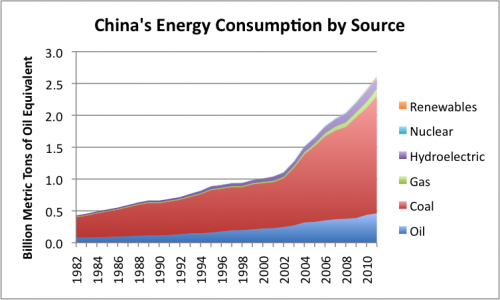
For your reference, I’ve provided a little chart to support the Savior’s “All-In” thesis about China’s energy sources. It appears China has gone all-in with coal. I’m sure the Obamanistas would support us following China’s lead. The Savior has thus spoken. So it shall be.  

“I will direct my Cabinet to come up with executive actions we can take, now and in the future, to reduce pollution, prepare our communities for the consequences of climate change, and speed the transition to more sustainable sources of energy. Four years ago, other countries dominated the clean energy market and the jobs that came with it.  We’ve begun to change that.  Last year, wind energy added nearly half of all new power capacity in America.  So let’s generate even more.  Solar energy gets cheaper by the year – so let’s drive costs down even further.  As long as countries like China keep going all-in on clean energy, so must we.”

President Barack Obama

Figure 5. China's energy consumption by source, based on BP's Statistical Review of World Energy data.

I can’t seem to find that Orange Renewable section on the graph. It must be a misprint. 


Please continue reading at:

Alcohol is to blame for one in every 30 cancer deaths each year in the United States annually and just one drink a day can boost the risk of dying from the disease, according to a new study.

Alcohol is to blame for one in every 30 cancer deaths each year in the United States annually and just one drink a day can boost the risk of dying from the disease, according to a new study. 

'As expected, people who are higher alcohol users were at higher risk, but there was really no safe level of alcohol use,' study author Dr. David Nelson, director of the Cancer Prevention Fellowship Program at the U.S. National Cancer Institute, told HealthDay News.

While moderate drinking has been linked to heart benefits, 'in the broader context of all the issues and all the problems that alcohol is related to, alcohol causes 10 times as many deaths as it prevents,' Nelson said.  

The study, which was published in the American Journal of Public health on Thursday, found that consuming just 1.5 drinks a day - or less - was associated with up to 35 percent of deaths from seven kinds of cancer. 

Among those who consume more than three drinks a day, alcohol was the culprit in up to 60 percent of deaths from those seven cancers.

Overall, nearly 20,000 cancer deaths reported in the U.S. annually are attributable to alcohol, the researchers found. 

Roughly 577,000 people die of cancer each year nationwide.

Please continue reading at:

Gulf of Mexico Well Evacuated Due to Uncontrolled Gas Flow | #energy #news

WWNO...A natural gas well in the Gulf of Mexico, located approximately 50 miles east of Venice, is releasing gas uncontrolled and has been partially evacuated, according to the well's operator and a report today in Fuel Fix, an energy news website operated in part by the Houston Chronicle.

Apache Corp., the operator of the rig, is attempting to kill the well, and is sending a drilling rig manned by employees of the Boots & Coots company to the site to drill a relief well if it becomes necessary. Boots & Coots oversaw the drilling of the relief well at the BP Macondo spill site in 2010.

15 workers were evacuated from the Ensco 87 rig, which sits in 218 feet of water, after tests found natural gas had migrated from the 8300-foot well to a sand formation approximately 1100 feet below the seabed.

There are still 50 people on board the rig, according to a press release issued by Apache.

This uncontrolled flow happened after a blowout preventer had been activated. According to Fuel Fix:

Problems first arose  on Feb. 4, when workers on the Ensco 87 jackup rig detected a kick, or uncontrolled flow of fluid, in the well. In response, they activated a blowout preventer, which apparently was  successful in keeping natural gas from escaping the well.

However later testing revealed that gas had migrated from the bottom of the roughly 8,300-foot well to a shallower sand formation 1,100 feet below the seabed.

all Americans are entitled to clean air to breathe, safe water to drink & a healthy community

whitehouse.gov: When I first became Administrator of the U.S. Environmental Protection Agency, I made a list of my priorities for the Agency. Working for environmental justice was at the top of that list. Ensuring equal environmental protections for all Americans is the unfinished business of the environmental movement.

It’s a simple idea – that all Americans are entitled to clean air to breathe, safe water to drink and a healthy community to raise their families – but often, it is America’s low-income and minority communities that bear the brunt of our country’s pollution.

As a result, these communities are also hit harder by the many illnesses pollution is linked to – conditions like asthma, heart disease, cancer and strokes. Studies show that minority groups face a greater risk of having asthma, and once they have it, they are at a greater risk of needing emergency treatment. African-American children are hospitalized for asthma at twice the rate of white children, and asthma-related deaths among African-American children take place at a rate of four times that of non-Hispanic white children. Hispanic children -- especially of Puerto Rican descent -- also face higher rates of asthma.

Dirty air, polluted water and contaminated lands not only put families at higher risks of serious and potentially costly diseases – they also discourage new developments and new jobs. Poison in the ground often means poison in the economy. Limiting the economic possibilities of low-income and minority communities only makes it harder to break the cycle of poverty.

read more

Feb 16, 2013

Citroën to showcase Hybrid Air technology at Geneva with 78mpg

Green Car Congress: Citroën will showcase its Hybrid Air system (earlier post) at the upcoming Geneva International Motor Show. The system, developed in partnership with Bosch, combines compressed air and hydraulic power to deliver fuel consumption of less than 3 l/100 km (78 mpg US).

...The Hybrid Air powertrain combines a PureTech gasoline engine, a compressed air energy storage unit, a hydraulic pump/motor unit and an automatic transmission with an epicyclic gear train. Eighty patents were filed by the PSA Peugeot Citroën Group during the development process

Please continue reading at:

Feb 15, 2013

Report Demonstrates Over $6.6 Billion in Economic Benefits from Pollution Prevention from Waste Reductions, Resource Conservation & Cost Savings

A Cornerstone of Environmental Sustainability: Pollution Prevention Results from 2007 to 2009 presents available information on the achievements of state and local P2 programs for the calendar years 2007 to 2009. The Report was produced by the National Pollution Prevention Roundtable (NPPR) based upon the results shared by 90 pollution prevention (P2) programs in the United States.


The Report shows that there were almost $6.6 billion in economic benefits and more than 7 billion pounds of pollution minimized or eliminated during the three year period.  7 billion pounds of waste is equivalent to the amount of waste generated by 350 thousand households, the approximate size of Columbus, Ohio.  This study affirms that pollution prevention results in conservation of valuable resources and significant waste reductions, as well cost savings that were four times greater than the funds used to support the various P2 programs.


The Report is a product of the P2 Results Task Force, whose membership includes representatives from State P2 programs, EPA Headquarters and Regions, Pollution Prevention Resource Exchange Centers (P2Rx), as well as NPPR. The Task Force has developed a National Pollution Prevention Results Data System, (the System). The System aggregates data that is collected, managed, and synthesized by state and local P2 programs, non-profits, companies, and other organizations.


The Report documents additional benefits of P2 activities, including: approximately 16 billion gallons of water conserved; almost 2.5 billion kilowatt hours of reduced energy usage; more than 33 billion pounds of greenhouse gases (GHG) no longer being released into the atmosphere. 


To view the Report, go to http://www.p2.org/wp-content/uploads/p2-results-2007-9-final.pdf.


NPPR will be hosting a webinar on Thursday, February 21 at 2 ET to provide an overview of the Report:

Image001

A Cornerstone of Environmental Sustainability: Pollution Prevention Results from 2007 to 2009 Report

Join us for a webinar on Feb 21, 2013 at 2:00 PM EST.

Register now!

https://attendee.gotowebinar.com/register/2030884086456328960

This webinar will provide attendees with an overview of the "A Cornerstone of Environmental Sustainability: Pollution Prevention Results from 2007 to 2009" Report that the National Pollution Prevention Roundtable recently released. The purpose of the Report is to present national results from government agencies involved in promoting P2 approaches for the years 2007-2009. 

Presenter: 
Jeffrey Burke 
Executive Director 
National Pollution Prevention Roundtable

After registering, you will receive a confirmation email containing information about joining the webinar.

Sewage lagoons remove most—but not all—pharmaceuticals

(Phys.org)—2012 marked the 40th anniversary of the Clean Water Act, which established regulations for the discharge of pollutants to waterways and supported the building of sewage treatment plants. Despite these advances, sewage remains a major source of pharmaceuticals and personal care products (PPCPs) and naturally occurring hormones found in the environment.

Please continue reading at:

Senators propose first US carbon tax

US senators proposed a tax on carbon emissions Thursday amid growing calls for action on climate change, but the bill is expected to face staunch opposition from many conservatives.

Please continue reading at:

NASA: Huge Freshwater Loss In the Middle East

SlashDot: writes with news from NASA about the state of available water in the Middle East. From the NASA article: "'GRACE data show an alarming rate of decrease in total water storage in the Tigris and Euphrates river basins, which currently have the second fastest rate of groundwater storage loss on Earth, after India,' said Jay Famiglietti, principal investigator of the study and a hydrologist and professor at UC Irvine. 'The rate was especially striking after the 2007 drought. Meanwhile, demand for freshwater continues to rise, and the region does not coordinate its water management because of different interpretations of international laws.'" dstates adds:"Water is a huge global security issue. To understand the middle east, you need to understand that the Golan Heights provides a significant amount of the water used in Israel. Focusing on conflicts and politics means that huge volumes of valuable water are being wasted in the Middle East, and this will only exacerbate future conflicts. Water is a serious issue between India and China. And then there is Africa. U.S. food exports are in effect exporting irrigation water drawn from the Ogallala aquifer. Fracking trades water for energy, and lack of water limits fracking in many parts of th world. Think about it."
Please read full and follow at:
http://politics.slashdot.org/story/13/02/13/1731237/nasa-huge-freshwater-loss-in-the-middle-east