Aug 18, 2013

Sustainable Energy Breakthrough: Hydrogen Fuel from Sunlight - National Science Foundation.

Sustainable Energy Breakthrough: Hydrogen Fuel from Sunlight - Yahoo! News

This Research in Action article was provided to LiveScience in partnership with the National Science Foundation.

A University of Colorado Boulder research team has moved closer to what some call the Holy Grail of a sustainable hydrogen economy — splitting water with sunlight.

The CU-Boulder team has devised a solar-thermal system designed to use a vast array of ground mirrors to concentrate sunlight onto a single point atop a central tower up to several hundred feet tall. The tower would gather heat to roughly 2,500 degrees Fahrenheit (1,350 Celsius) and then deliver it into a reactor containing chemical compounds known as metal oxides.

As the metal oxide compound heats up, it releases oxygen atoms, changing its material composition and causing the newly formed compound to seek out new oxygen atoms. The team showed that adding steam to the system would cause oxygen from the water molecules to adhere to the metal oxide surface, freeing up hydrogen molecules for collection as hydrogen gas. To get the steam, the concentrated sunlight beamed to the tower would heat the water to boiling. [Hydrogen: Future of Fuels Finally Drives Up | Video]

Conventional theory holds that producing hydrogen through the metal oxide process requires 1) heating the reactor to a high temperature to remove oxygen 2) then cooling it to a low temperature before 3) injecting steam to re-oxidize the compound and release hydrogen gas for collection. The innovation here is that no swing in temperature is required. The whole process can be undertaken at the same temperature, and can be driven by turning a steam valve on or off.

With the new method, the amount of hydrogen produced to power fuel cells or for storage is entirely dependent on the amount of metal oxide (a combination of iron, cobalt, aluminum and oxygen), and how much steam is introduced into the system.

Oh crap, more than 4 cups of coffee per day greater risk of an early death.

Those of us under 55 who drink a lot of coffee – more than four cups per day – may be at greater risk of an early death. And not just death from heart problems, but death from all causes. The study, published inMayo Clinic Proceedings (abstract), followed people for almost two decades, and found that in both sexes, younger people were more likely to die of anything than people who drank less.Please continue reading at:http://m.slashdot.org/story/190373

Dishwasher-Size, 25kW Fuel Cell In Development


Forbes has an article about a new type of fuel cell that is 90% less costly than current cells at one tenth the size (making it the size of a dishwasher), with far higher efficiency than current cells. It runs at only 149 degrees Celsius (300F) . It was jointly developed by Diverse Energy and the University of Maryland. 'The first-generation Cube runs off natural gas, but it can generate power from a variety of fuel sources, including propane, gasoline, biofuel and hydrogen. The system is a highly efficient, clean technology, emitting negligible pollutants and much less carbon dioxide than conventional energy sources. It uses fuel far more efficiently than an internal combustion engine, and can run at an 80 percent efficiency when used to provide both heat and power.' It produces enough power to run a moderate-sized grocery store, or five homes. A smaller, home-sized unit is on the way. Is the municipal power plant on the way out?

Scientists 'Nature Is Better at Carbon Farming’ Jatropha trees can take 25 tons of carbon dioxide out of the air annually over 20 years

Climate Central – Large forests planted with a single species of tough small trees could capture enough carbon from the atmosphere to slow climate change and green the world's deserts at the same time, researchers say.

A group of German scientists says the tree Jatropha curcas is resistant to arid conditions and can thrive where food crops would not survive.

Jatropha curcas could be the way to remove atmospheric carbon, the researchers say.
Credit: Immersia via Wikimedia Commons

Unlike other geo-engineering schemes, which are expensive and rely on humans interfering with nature, this project merely encourages natural tree growth.

Under the slogan "Nature Does it Better," the scientists say the costs are comparable with the estimated cost of developing carbon capture and storage (CCS) technology at power stations. With only a small proportion of the world's deserts, they say, these trees could take out most of the additional carbon dioxide emitted by humans since the beginning of the industrial revolution.

The study, published in Earth System Dynamics, a journal of the European Geosciences Union, says "carbon farming" addresses the root source of climate change by taking carbon out of the atmosphere as fast as we put it in.

One hectare (.0039 square miles) of Jatropha trees can take 25 tons of carbon dioxide out of the air annually over 20 years. As it grew, a plantation occupying just 3 percent of the Arabian Desert would remove from the atmosphere the same amount of CO2 as all the motor vehicles in Germany produced over the same period.

The German scientists say all they are doing is working with nature. The trees would need a little help, however, in the form of water. The team therefore proposes starting the plantations near the coast where desalination plants would provide enough water to get the saplings established.

"To our knowledge, this is the first time experts in irrigation, desalination, carbon sequestration, economics and atmospheric sciences have come together to analyze the feasibility of a large-scale plantation to capture carbon dioxide in a comprehensive manner.

Please continue reading at:

Aug 17, 2013

Sequester's troubling impacts on public health and NIH

George Will, conservative columnist for Washington Post, wrote about the troubling impacts of the sequester on public health, and in particular the cuts on the programs of the National Institutes of Health (NIH).  He did not discuss the NIH constrictions on the international side of public health endeavors, but they are just as devastating.

http://www.washingtonpost.com/opinions/george-will-the-sequester--a-public-health-hazard/2013/08/16/4bb96982-05ca-11e3-9259-e2aafe5a5f84_story.html?hpid=z2

Aug 16, 2013

ECOS/WWU Release Toxic Trends Application Webinar EPA Web Application using air data from the TRI database and risk values from EPA’s RSEI model.

FYI – A new toxic trends web application released using air data from the TRI database and risk values from EPA's RSEI model. A webinar will provide more information on this new tool, please see below for more information.

FOR IMMEDIATE RELEASE – Environmental Council of the States and Western Washington University Officially Launch the Toxic Trends Interactive Web Application
Washington, DC — The Environmental Council of the States (ECOS) is pleased to announce the release of the Toxic Trends web application.  This important tool was produced by our grant recipient, The Huxley Spatial Institute at Western Washington University (WWU) lead by Associate Professor, Troy Abel and a pair of graduate students, Jacob Lesser and Ben Kane. 
The interactive Toxic Trends map application visually represents industrial air pollution information and relative risk scores to citizens across the United States.  The application also maps how those risks might change over time.
 
Toxic Trends can now be found at toxictrends.org
 
The application utilizes facility air data from the Toxics Release Inventory (TRI) database coupled with risk values based on modeled output data from the EPA's Risk Screening Environmental Indicators (RSEI) model for assessing TRI data.
 
Toxic Trends is designed to provide public access to toxic pollution data regarding environmental releases from medium to large pollution sources like local refineries and aluminum smelters.
Project lead Troy Abel said he hoped the application helps facilitate a productive dialogue about moving towards better environmental performance between citizens and their local industries.
 
"The Toxic Trends application is an invaluable public tool that allows users to access important industrial chemical information from any internet connected device," said Bryan Shipley, project manager for ECOS. "We feel the map's unique visual mapping layout provides an easier method for the public to learn about toxic chemical information and the associated risks within their community."
 
 
Toxic Trends Webinar
 Join ECOS and The Huxley Spatial Institute at Western Washington University for the free webinar: Exploring the Toxic Trends Map Application on 
August 28, 2013 from 1:00-2:00 pm EST.  This webinar will provide an overview of the Toxic Trends map application.  Attendees will hear information on project background, access to the application, information on the data utilized, sample searches, and everyday uses of the application. 
 
Please join us by signing up at the following link: https://attendee.gotowebinar.com/register/152761000192114176
 

"Can voluntary pollution prevention programs make an impact?"

Read the August P2 Pathways article for GreenBiz: http://www.greenbiz.com/blog/2013/08/13/can-voluntary-pollution-prevention-programs-make-impact

In his article, "Can voluntary pollution prevention programs make an impact?" author Keith Boisvert from the Virginia Department of Environmental Quality (DEQ) Office of Pollution Prevention explains how Virginia DEQ through the VEEP (Virginia Environmental Excellence Program) helps facilities meet their own goals rather than setting goals for them. 


Here is the link to the P2 Pathways landing page:

http://www.greenbiz.com/business/engage/enterprise-blogs/p2-pathways

‘Safe’ levels of sugar harmful to mice : #health via @Nature

images

Too much sugar is bad for you, but how much, exactly, is too much? A study in mice has found that the animals' health and ability to compete can be harmed by a diet that has sugar levels equivalent to what many people in the United States currently consume.

High-sugar diets are associated not only with obesity and diabetes, but also with other human conditions such as coronary heart disease. However, the exact causal links for many of these has not been established. When studies are done in mice to evaluate health effects of sugar, the doses given are often so high, and outside the range of equivalent human consumption, that it is hard to tell conclusively whether the results are relevant to people.

Put down the doughnut and keep reading at:

'Safe' levels of sugar harmful to mice : Nature News & Comment

Aug 14, 2013

Beauty product distributor fined $213,000 for selling hair-styling products that violate VOC air quality regulations

SACRAMENTO - Midway Importing Inc., a nationwide distributor and marketer of Hispanic health and beauty care brands, has paid a penalty of $213,000 for violating consumer products regulations that protect air quality, the Air Resources Board announced today.

The Houston, Texas-based company agreed to pay the fine after the Air Resources Board determined that multiple hair gel products that were sold and/or supplied by Midway Importing exceeded state limits for volatile organic compounds.

These compounds are regulated by the Air Resources Board because they react with other pollutants under sunlight to form ground-level ozone, a main ingredient in smog. As a result of direct sales to consumers, the products in question contributed an estimated 23.9 tons of excess VOC emissions to California's air. 

During routine inspections at retail outlets in California in 2010, Enforcement Division staff purchased Moco de Gorila Gel Estilo Galan hair gel, also known as Gorilla Snot, manufactured by Nattura Laboratorios of Mexico.

The product was tested by ARB's Monitoring and Laboratory Division and found to have exceeded the VOC limit for hair styling products. Further investigation revealed that other similar hair gel products were imported into the U.S. and distributed into California by Midway Importing.

As part of the settlement, Midway agreed not to sell, supply or offer for sale for use in California, any consumer products in violation of ARB consumer products regulations.

For more information about the Consumer Products Program, go to: http://www.arb.ca.gov/consprod/consprod.htm

USFDA Allows Chemicals in Food Despite Lack of Toxicity Testing via @JBSass

Chemicals are added to food to preserve, flavor, thicken, or otherwise alter it in some desirable way. Used this way, the chemicals are called 'food additives'. In other contexts the same chemicals may be considered industrial chemicals or pesticides.

For example, sulfites were banned by FDA in 1986 for use on fruits and vegetables that are eaten raw, but are still allowed as a preservative in cooked and processed foods, and they occur naturally in wines and beers. They are also approved by EPA aspesticides, to prevent fungus and preserve grape crops. When eaten in foods, they induce allergy-like reactions in many people (FDA estimates that 1 in 100 people are sensitive to sulfites in food). When FDA approved their use as a food additive in the 1970s, sulfites were deemed to be Generally Recognized As Safe (GRAS) and exempted from FDA premarket approval requirements. 

In 1974, the FDA allowed asbestos-contaminated salt produced by one company, United Salt in Houston, to be sold as table salt, as GRAS. FDA had even received comments from the trade group Salt Institute that it had looked at this type of salt – called diaphragm salt - and seen asbestos fibers by optical microscopy. Only in response to public outrage did FDA do a proper analysis of the salt at outside labs, using the more powerful electron microscopy, whereupon tens of millions of asbestos fibers per gram was found and FDA revoked its approval.

...Today, Pew released a report on Reproductive Toxicology reporting that "Less than 38% of [over 10,000] FDA-regulated additives have a published feeding study. For chemicals directly added to food, 21.6% [of about 3,000] have feeding studies necessary to estimate a safe level of exposure and 6.7% have reproductive or developmental toxicity data in FDA's database."  It appears FDA and companies were often making safety decisions by comparing one chemical to another rather than doing an actual toxicology study.  They were building a house of cards based on assumptions and unsupported extrapolations instead of direct scientific evidence. 

How did our food regulations go so terribly wrong? 

Please read on by Jennifer Sass at:http://switchboard.nrdc.org/blogs/jsass/usfda_allows_chemicals_in_food.html

How a White or Green Roof Can Keep Your Building Up to 84% Cooler This Summer


Inhabitat has a look at the effect habving a white or green roof can have on urban temperatures - How a White or Green Roof Can Keep Your Building Up to 84% Cooler This Summer
The benefits of white and green roofs are nothing new to us, but a recent study by two top NYC universities has shed light on just how effective these non-traditional roofs can be at lowering building temperatures. Non-reflective dark roofs are known to exacerbate the urban heat island effect and do absolutely nothing to reduce storm water runoff, which is why New York City sewers overflow almost every time it rains. But a recent study released by Columbia University and City University of New York has found that greening NYC rooftops or adding a few coats of white paint can reduce temperatures by as much as 84%! ...
Please continue reading on Peak Energy // visit site

Timelapse Map Illustrates Rapid Growth of U.S. Wind Energy Sector [feedly]

The U.S. installed more than 13 gigawatts of new wind energy capacity in 2012, nearly doubling the amount of wind power installations added in 2011 and pushing the

Click to enlarge
Department of Energy Wind US

Department of Energy
Wind energy projects in the U.S., 1992-2012
total capacity connected to the grid nationally to 60 gigawatts, according to a new report from the U.S. Department of Energy (DOE). That capacity represents enough electricity to power 15 million homes annually, officials say, adding that for the first time wind energy has become the top source of new electricity generation in the U.S. To coincide with the report, the DOE published an interactive map illustrating the steep growth in wind projects nationwide, particularly in the last decade. The map shows that until the mid-1990s, only a few dozen wind projects existed, all in California. But by 2000, projects started appearing in states nationwide, particularly in Texas and Iowa. In the past two decades the number of wind energy projects has increased from 49 to 815, the DOE said.
Please continue reading Yale Environment 360 // visit site

Corn prices are falling at a rapid rate, dropping 40 percent since last year

"The boom in corn prices that helped propel the U.S. farm economy is fading amid expectations for a record-high harvest," Mark Peters and Jesse Newman report for The Wall Street Journal. And "the slide is bad news for farmers who saw their incomes surge to the highest levels since the early 1970s, adjusted for inflation, while farmland values ballooned so much that some analysts worried about a bubble. Lower corn prices will squeeze profit margins, farmers who rent land for their crops might struggle to make money, and sales of tractors and other farm supplies likely will suffer."

Corn, the largest U.S. crop, saw its prices reach an all-time high last year, but are down 40 percent to their lowest point in three years, the Journal reports. Prices dropped from $8.31 a bushel last August to $4.65 as bushel last week, and analysts predict it will continue to decline. The "slide is bad news for farmers who saw their incomes surge to the highest levels since the early 1970s, adjusted for inflation, while farmland values ballooned so much that some analysts worried about a bubble. Lower corn prices will squeeze profit margins, farmers who rent land for their crops might struggle to make money, and sales of tractors and other farm supplies likely will suffer."
Please continue reading on The Rural Blog // visit site

S. 1363 “Energy Consumers Relief Act of 2013” to reduce energy-related rules that are adverse effects to the economy.

S. 1363 : To protect consumers by prohibiting the Administrator of the Environmental Protection Agency from promulgating as final certain energy-related rules that are estimated to cost more than $1,000,000,000 and will cause significant adverse effects to the economy.

Please continue reading at:

Aug 13, 2013

Appeals court: Nuclear Regulatory Commission has been violating federal law by delaying a decision on a proposed nuclear waste dump in Nevada - Yahoo! News

WASHINGTON (AP) — In a rebuke to the Obama administration, a federal appeals court ruled Tuesday that the Nuclear Regulatory Commission has been violating federal law by delaying a decision on a proposed nuclear waste dump in Nevada.

By a 2-1 vote, the U.S. Court of Appeals for the District of Columbia ordered the commission to complete the licensing process and approve or reject the Energy Department's application for a never-completed waste storage site at Nevada's Yucca Mountain.

In a sharply worded opinion, the court said the nuclear agency was "simply flouting the law" when it allowed the Obama administration to continue plans to close the proposed waste site 90 miles northwest of Las Vegas. The action goes against a federal law designating Yucca Mountain as the nation's nuclear waste repository.

"The president may not decline to follow a statutory mandate or prohibition simply because of policy objections," Judge Brett M. Kavanaugh wrote in a majority opinion, which was joined Judge A. Raymond Randolph. Chief Judge Merrick B. Garland dissented.

The appeals court said the case has important implications for the separation of powers between the executive and legislative branches of government.

"It is no overstatement to say that our constitutional system of separation of powers would be significantly altered if we were to allow executive and independent agencies to disregard federal law in the manner asserted in this case by the Nuclear Regulatory Commission," Kavanaugh wrote. "The commission is simply defying a law enacted by Congress ... without any legal basis."

A spokesman for the NRC said Tuesday the agency was reviewing the decision. He declined further comment.

Energy Secretary Ernest Moniz said the Energy Department was not a party to the lawsuit, but he characterized the Yucca Mountain project as "a complete stalemate." He said he saw no evidence of that changing.

"Currently we do not have funding," he told reporters at a clean energy conference Tuesday in Las Vegas.

The court's decision was hailed by supporters of the Yucca site, which has been the focus of a dispute that stretches back more than three decades. The government has spent an estimated $15 billion on the site but has never completed it. No waste is stored there.

"This decision reaffirms a fundamental truth: The president is not above the law," said South Carolina Attorney General Alan Wilson. The Obama administration "cannot pick and choose which laws to follow and which to ignore," Wilson said.

Please read full and follow at:

This is bad...China about to become world’s largest oil importer | via @SmartPlanet

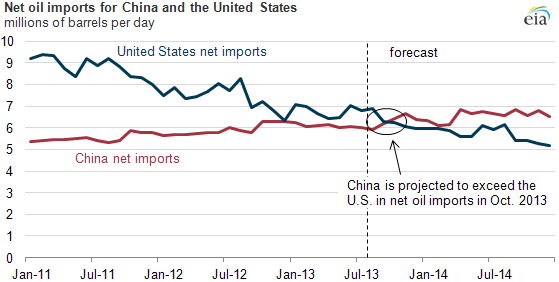
SmartPlanetChina is calling for the oil can. So much so that the Asian economic giant will surpass the U.S. as the world's largest oil importer in October, according to the U.S. Energy Information Administration.

"The imminent emergence of China as the world's largest net oil importer has been driven by steady growth in Chinese demand, increased oil production in the United States, and a flat level of demand for oil in the U.S. market," EIA said in a press release.

With China yearning for so much foreign oil, it makes you wonder how geopolitics will change, and which flags might fly from the ships patrolling places like Middle East sea lanes.

graph of net oil imports for China and the U.S., as explained in the article text

Photo from theiranproject.com. Chart from U.S. Energy Information Administration.

Read on from China about to become world's largest oil importer |

Aug 12, 2013

World changing technology enables crops to take nitrogen from the air

A major new technology has been developed by The University of Nottingham, which enables all of the world's crops to take nitrogen from the air rather than expensive and environmentally damaging fertilisers.

Nitrogen fixation, the process by which nitrogen is converted to ammonia, is vital for plants to survive and grow. However, only a very small number of plants, most notably legumes (such as peas, beans and lentils) have the ability to fix nitrogen from the atmosphere with the help of nitrogen fixing bacteria. The vast majority of plants have to obtain nitrogen from the soil, and for most crops currently being grown across the world, this also means a reliance on synthetic nitrogen fertiliser.

Study: US debt six times greater than declared - $211 trillion

...The real shocker in the report, however, came with the cost of Medicare and Social Security, which ran at $27.6 trillion and $26.5 trillion respectively.   

Hamilton could not conceal his surprise at the findings.

"These numbers are so huge it is hard even to discuss them in a coherent way," he said before providing a caveat on the US demographic situation. "The US population is aging, and an aging population means fewer people paying in and more people expecting benefits. This reality is unambiguously going to be a key constraint on the sustainability of fiscal policy for the United States.

"One would think we should be saving as a nation today as preparation for retirement, and if in fact we are not, the current enormous on-balance-sheet federal debt is all the more of a concern."

It is not just the sick and elderly, however, who are adding to the US debt burden. Government loans for students also featured high in the report.

The US Department of Education approved $714 billion at the end of 2012, which is a significant jump from the $104 billion issued at the end of 2007.  But with the US economy failing to generate new jobs, many of these now college graduates lack the financial means to return their debt.

Although the report paints an extremely worrisome picture of America's fiscal situation, some say it may actually be overly optimistic.

The US debt burden is much greater says Boston University economics professor Laurence J. Kotlikoff, who served on President Ronald Reagan's Council of Economic Advisers.

"If you add up all the promises that have been made for spending obligations, including defense expenditures, and you subtract all the taxes that we expect to collect, the difference is $211 trillion. That's the fiscal gap," Kotlikoff said in an interview with National Public Radio. "That's our true indebtedness." Please continue reading at:

Eating raw garlic just twice a week can almost halve the risk of lung cancer, new research shows.

A study carried out in China found adults regularly consuming raw garlic as part of their diet were 44 per cent less likely to suffer the disease.

Even when researchers allowed for whether people smoked – the biggest single cause of lung cancer – they found garlic still seemed to reduce the dangers by around 30 per cent.

Read More 

The Battle for Water - #water = #life

Water is different from other natural resources. After all, there are substitutes for many resources, including oil, but none for water. Similarly, countries can import fossil fuels, mineral ores, and resources from the biosphere like fish and timber; but they cannot import water, which is essentially local, on a large scale and on a prolonged – much less permanent – basis. Water is heavier than oil, making it very expensive to ship or transport across long distances even by pipeline (which would require large, energy-intensive pumps).

The paradox of water is that it sustains life but can also cause death when it becomes a carrier of deadly microbes or takes the form of a tsunami, flash flood, storm, or hurricane. Many of the greatest natural disasters of our time – including, for example, the Fukushima catastrophe in 2011 – have been water-related.

...Rapid economic and demographic expansion has already turned adequate access to potable water into a major issue across large parts of the world. Lifestyle changes, for example, have spurred increasing per capita water consumption, with rising incomes promoting dietary change, for example, especially higher consumption of meat, production of which is ten times more water-intensive, on average, than plant-based calories and proteins.


Splenda goes from 'safe' to 'caution' after leukemia found in mice #Health

The Center for Science in the Public Interest is urging caution in the use of the artificial sweetener Splenda.

A food safety advocacy group has downgraded its rating for sucralose, the artificial sweetener better known as Splenda, from "safe" to "caution" in its chemical guide to food additives.

The Washington-based Center for Science in the Public Interest announced Wednesday that it had long rated sucralose as "safe" but is now categorizing it with a "caution," pending peer review of an unpublished study by an independent Italian lab that found the sweetener caused leukemia in mice.

Previously, the only long-term animal-feeding studies were done by sucralose's manufacturers, the CSPI said.

Other artificial sweeteners such as saccharinaspartame and acesulfame potassium have received the center's lowest rating, "avoid."

Dogs Trained To Sniff Out Ovarian Cancer

Slashdot Dogs have been trained to sniff out drugs, explosives, cadavers, mobile phones, firearms, and money but now AP reports that researchers havestarted training canines to sniff out the signature compound that indicates the presence of ovarian cancer. If the animals can isolate the chemical marker, scientists at the nearby Monell Chemical Senses Center will work to create an electronic sensor to identify the same odorant. "Because if the dogs can do it, then the question is, Can our analytical instrumentation do it? We think we can," says organic chemist George Preti. More than 20,000 Americans are diagnosed with ovarian cancer each year. When it's caught early, women have a five-year survival rate of 90 percent. But because of its generic symptoms — weight gain, bloating or constipation — the disease is more often caught late.

Hybrd wind-current turbine world's first capable of maximizing the harvesting of ocean energy from wind and current".

Tree Hugger -Combining a three-bladed Darrieus turbine on top, a Savonius turbine underneath, and a generator in between, the SKWID power generation concept is claimed to be the world's first hybrid system "capable of maximizing the harvesting of ocean energy from wind and current".

The SKWID, from the Japanese company Mitsui Ocean Development & Engineering Company, is designed to capitalize on the energy potential available both in the winds above the ocean, and in the currents flowing beneath the waves. The device uses an omnidirectional Darrieus wind turbine sitting 47 meters above the sea on one end of a vertical shaft, with a different type of omnidirectional turbine design, a 15 meter diameter Savonius, spinning at the other end under the surface.

Aug 11, 2013

Six Japanese nuclear reactors likely to resume operating by March next year and a total of 16 reactors by March 2015 [feedly]

Six Japanese nuclear reactors likely to resume operating by March next year and a total of 16 reactors by March 2015
The Institute of Energy Economics Japan says that their forecast is that the first nuclear reactor of the new batch (of about ten applicant reactors) will restart by July 2014.

Out of Japan's 50 reactors, only two have been online since they were forcibly shut down in 2011, following the nuclear meltdown at the Fukushima Daiichi plant. With the rising costs of fossil fuel imports and the country's strong reliance on nuclear power for its electricity supply, there is an enormous pressure to bring the reactors back online. This is in spite of the growing public disapproval of nuclear power.

Read more »

Taking pills for unhappiness reinforces the idea that being sad is not human

The Raw Story....The same thing has happened with depression and drugs like Prozac; though calling it depression is already to classify a particular kind of experience as something quasi-medical, thus leading one to think in terms of medical treatment. Sometimes I am just sad. Sometimes pissed off. Sometimes smothered in darkness. But we often lump all these experiences together simply because pharmaceutical companies have developed a certain sort of treatment. And, once you have a hammer in your hand, it is convenient to see every problem in terms of its being a nail. We have found the solution, now let's make the problem fit the solution we have available. It's a form of reverse engineering.

It is significant that psychoactive drugs were originally developed for other purposes. Drugs such as Thorazine, Miltown and Marsilid were developed in the 50s as ways to treat infections. But they were also seen to have mood-altering side-effects – though scientists had no idea why or how. So, as several writers have pointed out, "instead of developing a drug to fit an abnormality an abnormality was postulated to fit a drug". Thus we are encouraged to think of our problems in terms of the lucrative solutions to problems we didn't know we had. In this way, the pharmaceutical companies are responsible for the very conditions they propose to alleviate

Forget the fact that some people are miserable because they are struggling on zero-hours contracts, or have lost their partner or have been watching the news too much – if we translate misery into some sort of chemical imbalance then someone can make big money out of it. But unhappiness is often a perfectly proper response to the state of the world. If you have a shit job or a shit home life, being unhappy is hardly inappropriate. At best, many of the drugs we are popping only deal with the symptoms of all this, not the causes. At worst, they pathologise deviations for normalcy, thus helping to police the established values of consumer capitalism, and reinforcing the very unhappiness that they purport to cure.

Please continue reading at: http://www.rawstory.com/rs/2013/08/10/taking-pills-for-unhappiness-reinforces-the-idea-that-being-sad-is-not-human/

China faces its worst economic crisis: water - uses 4 to 10 times more water per unit of GDP than similar economies

MarketWatch... According to China's own water-resources officials, more than 400 Chinese cities lacked enough water last year, with 110 of those facing "serious scarcity."

The key culprit is industry, which Economy said uses 4 to 10 times more water per unit of GDP than similar economies and is polluting the nation's existing water resources at an alarming rate. She cited a February 2013 report by the Geological Survey of China saying a full 90% of the country's groundwater was polluted, while the Ministry of Environmental Protection said the water from about 25% of China's major river systems was so filthy that it couldn't be even used for industry or agriculture.

Tap water is mostly undrinkable, and those who do drink it run major health risks. And the contamination is making it into the food system, resulting in cadmium-tainted rice among other threats, she said.

It's not like the government isn't aware of the problem, but solutions such as raising the price of water have moved ahead at a snail's pace. And "of the 1.3% of GDP that Beijing currently spends on environmental protection … half finds its way into other local priorities such as infrastructure development," Economy told U.S. lawmakers.

A Material That Could Make Solar Power “Dirt Cheap” | MIT Technology Review

MIT Technology Review...Researchers developing the technology say that it could lead to solar panels that cost just 10 to 20 cents per watt. Solar panels now typically cost about 75 cents a watt, and the U.S. Department of Energy says 50 cents per watt will allow solar power to compete with fossil fuel.

In the past, solar researchers have been divided into two camps in their pursuit of cheaper solar power. Some have sought solar cells that can be made very cheaply but that have the downside of being relatively inefficient. Lately, more researchers have focused on developing very high efficiency cells, even if they require more expensive manufacturing techniques.

The new material may make it possible to get the best of both worlds—solar cells that are highly efficient but also cheap to make.

One of the world's top solar researchers, Martin Green of the University of New South Wales, Australia, says the rapid progress has been surprising. Solar cells that use the material "can be made with very simple and potentially very cheap technology, and the efficiency is rising very dramatically," he says.

Perovskites have been known for over a century, but no one thought to try them in solar cells until relatively recently. The particular material the researchers are using is very good at absorbing light. While conventional silicon solar panels use materials that are about 180 micrometers thick, the new solar cells use less than one micrometer of material to capture the same amount of sunlight. The pigment is a semiconductor that is also good at transporting the electric charge created when light hits it.

"The material is dirt cheap," says Michael Grätzel, who is famous within the solar industry for inventing a type of solar cell that bears his name. His group has produced the most efficient perovskite solar cells so far—they convert 15 percent of the energy in sunlight into electricity, far more than other cheap-to-make solar cells. Based on its performance so far, and on its known light-conversion properties, researchers say its efficiency could easily rise as high as 20 to 25 percent, which is as good as the record efficiencies (typically achieved in labs) of the most common types of solar cells today. The efficiencies of mass-produced solar cells may be lower. But it makes sense to compare the lab efficiencies of the perovskite cells with the lab records for other materials. Grätzel says that perovskite in solar cells will likely prove to be a "forgiving" material that retains high efficiencies in mass production, since the manufacturing processes are simple.

Please continue reading at: MIT Technology Review 

Aug 9, 2013

Sweden does not have enough garbage and imports it but fortunately they are paid to take garbage [feedly]

Due to Sweden's innovative waste-to-energy program and highly efficient recycling habits, the Scandinavian nation faces an interesting dilemma. They have run out of trash.

Only four percent of Sweden's waste ends up in landfills while the EPA reports over half of the waste produced by U.S. households ends up in landfills.

In order to continue fueling the waste-to-energy factories that provide electricity to a quarter of a million homes and 20 percent of the entire country's district heating, Sweden is now importing trash from the landfills of other European countries. In fact, those countries are paying Sweden to do so.

Countries are paying Sweden to get rid of a source of fuel they themselves produced so that Sweden can continue to have the energy output they need. You don't have to be an economist to know that's one highly enviable energy model. Aside from the economic benefit, Sweden's system of sustainability clearly has vast environmental benefits. Aside from traditional recycling programs, their waste-to-energy system ensures minimal environmental impact from the country's waste.
Shared via feedly // published on Next Big Future // visit site

Healthier for people, more environmentally friendly and more efficient fish farming that is independent of any wild fish feedstocks

Australian CSIRO scientists have perfected the Novacq™ prawn feed additive. Farmed prawns fed with Novacq grow on average 30 per cent faster, are healthier and can be produced with no fish products in their diet, a world-first achievement in sustainability. 

Until now, Australian prawn farmers have needed to feed their prawns with a pellet that includes some sustainably sourced fish meal or fish oil, in order to ensure that the prawns grew fast, and were a healthy and high quality product for consumers.

Novacq is an entirely natural food source based on the smallest organisms in the marine environment, the marine microbes which are the foundation of the marine food pyramid.

Production of Novacq relies on the controlled production of these marine microbes. CSIRO researchers have discovered how to feed and harvest them, and convert them into a product that can then be added to feeds as a bioactive ingredient, like a dietary supplement for prawns.

Including Novacq in the diet of farmed prawns has shown for the first time that fish meal and fish oil can be completely replaced in the prawn diet, potentially freeing the prawn aquaculture industry from reliance on wild fishery resources.

Read more Shared via feedly // published on Next Big Future // visit site

China's Pollution Fighting Budget Will Have to Be Bigger than its Military Budget

China will spend $275 billion over the next five years improving air quality—roughly the same as the GDP of Hong Kong, and twice the size of the annual defence budget [40% of the defence budget over the same five years]. China is also spending to clean up water pollution. 

China plans to invest 2.3 trillion yuan ($375 billion) in energy saving and emission-reduction projects in the five years through 2015 to clean up its environment. This is about 54% of the projected $685 billion that China will spend on its military over 5 years. The plan, which has been approved by the State Council, is on top of a 1.85 trillion yuan investment in the renewable energy sector. Combined the energy saving and emission-reduction projects and the renewables buildup is $675 billion. China would benefit more by shifting military budget into pollution fighting. China has sufficient military and has nuclear and military to deter any attack and to meet basic military goals. China's pollution is harming its economy now and harming the health of everyone and killing upwards of 1 million people each year.

The health costs of air and water pollution in China amount to about 4.3 percent of its GDP. By adding the non-health impacts of pollution, which are estimated to be about 1.5 percent of GDP, the total cost of air and water pollution in China is about 5.8 percent of GDP.

China's economy will go from $8.5 trillion this year to about $12-20 trillion in 2018 (depending upon RMB currency appreciation). The cost to China will be $490 billion to 1.2 trillion in each of the years. It will be in the range of $3-5 trillion over the 5 year timeframe.

In January 2013 the air of Beijing hit a level of toxicity 40 times above what the World Health Organization deems safe. A tenth of the country's farmland is poisoned with chemicals and heavy metals. Half of China's urban water supplies are unfit even to wash in, let alone drink. In the northern half of the country air pollution lops five-and-a-half years off the average life.

Read more Shared via feedly // published on Next Big Future // visit site

How unsustainable our techno future is...25 times more power efficiency is needed for exaflop supercomputers with reasonable energy needs

How unsustainable our techno future is...An exascale system built with NVIDIA Kepler K20 co-processors would consume about 150 megawatts. That's nearly 10 times the amount consumed by Tianhe-2, which is composed of 32,000 Intel Ivy Bridge sockets and 48,000 Xeon Phi boards.

Theoretically, an exascale system – 100 times more computing capability than today's fastest systems – could be built with only x86 processors, but it would require as much as 2 gigawatts of power.

That's the entire output of the Hoover Dam.

Instead, HPC system developers need to take an entirely new approach to get around the power crunch, Dally said. The NVIDIA chief scientist said reaching exascale will require a 25x improvement in energy efficiency. So the 2 gigaflops per watt that can be squeezed from today's systems needs to improve to about 50 gigaflops per watt in the future exascale system.

Relying on Moore's Law to get that 25x improvement is probably not the best approach either. According to Dally, advances in manufacturing processes will deliver about a 2.2x improvement in performance per watt. That leaves an energy efficiency gap of 12x that needs to be filled in by other means.

Dally sees a combination of better circuit design and better processor architectures to close the gap. If done correctly, these advances could deliver 3x and 4x improvements in performance per watt, respectively.

Read more Shared via feedly // published on Next Big Future // visit site

Bill Gates Promotes Vaccine Projects, Swipes At Google

In a new interview with Bloomberg Businessweek, Bill Gates discussed his Foundation's work to eradicate polio and malaria, while suggesting that vaccine programs and similar initiatives to fight disease and poverty will ultimately do much more for the world than technology projects devoted to connecting everybody to the Internet. While Gates professes his belief in the so-called digital revolution, he doesn't think projects such as Google's Internet blimps (designed to transmit WiFi signals over hundreds of miles, bringing Internet to underserved areas in the process) will do the third world nearly as much as good as basic healthcare. "When you're dying of malaria, I suppose you'll look up and see that [Internet] balloon, and I'm not sure how it'll help you," he said. "When a kid gets diarrhea, no, there's no website that relieves that." Gates then sharpened his attack on the search-engine giant: "Google started out saying they were going to do a broad set of things. They hired Larry Brilliant, and they got fantastic publicity. And then they shut it all down." Google focusing on its core mission is fine, he added, "but the actors who just do their core thing are not going to uplift the poor." The Microsoft co-founder also has no intention of following Elon Musk, Jeff Bezos, and other tech entrepreneurs into the realm of space exploration. "I guess it's fun, because you shoot rockets up in the air," he said. "But it's not an area that I'll be putting money into."
Navigated from Slashdot | shared via feedly mobile

60% of Federal Student Loan Borrowers, or 17 million, don't pay the US government a single cent!

...Said otherwise, of the 28 million Americans with federal student loans, 60%, or 17 million, don't pay the US government a single cent!

  Only 40% Of Federal Student Loan Borrowers Are Currently Making A Payment | Zero Hedge | shared via feedly mobile

Why we can kiss the US economy goodbye

By ...The results are in. The picture is grim. 
Here are some frightening economic numbers to think about the next time ....mainstream media tells you that we are in "recovery."

First, almost 50% of Americans have less than $500 in savings. Not surprisingly 1 out of 3 residents of Obama's home state of Illinois live in poverty. A mind numbing 4 of 5 Americans are either experiencing poverty, foreclosure or welfare, or will in their lifetime. Four out of five.Say goodbye to the myth of the American Dream. It's only a nightmare now.


Ditto for the American middle class. Obama has massacred them. Our middle class now ranks 27thin the world. 


...More grim news just in: Auto sales are collapsing. Construction jobs are falling off a cliff. And U.S. factory orders just suffered the biggest drop in a year.

Almost 80% of the jobs created in Obama's America are part-time jobs that won't pay the bills of an average middle class lifestyle.

What about jobs? Isn't that picture getting rosier by the minute? 

Well actually, no. Let's analyze the REAL numbers: Since the start of 2013 we've gained 953,000 jobs, but amazingly 731,000 of them are crummy low-wage part time jobs. That means almost 80% of the jobs created in Obama's America are part-time jobs that won't pay the bills of an average middle class lifestyle.

High quality jobs under Obama they are losing out by 10 to 1 versus crummy low-paying jobs. Facts don't lie: So far this year over 246,000 low-paying waiter or bartender jobs have been added to the U.S. economy, versus only 24,000 high-paying manufacturing jobs.


How bad is it? Well here's a Hall of Fame Triple Play:

The Obama administration just hired a company to promote ObamaCare over the phone to Americans -- guess what? Even those jobs are part-time, with no health insurance!

The head of the IRS just testified in front of Congress that he'd rather keep his own health insurance, rather than switch to ObamaCare. The IRS is in charge of ObamaCare, and even they don't want any part of it.

And, the second biggest employer in America is now a temp agency! 

Good luck looking for a quality job in this Obama economy.


Still not convinced? 

Food stamp rolls are growing seventy-five times as fast as employment. The national debt has increased by 50% under Barack Obama. Obama promised to reduce health insurance bills for an average American family by $2,500 per year, instead your health bills went up by $3,000 per year. 

Meanwhile, labor participation by men is at the lowest rate ever measured – since they started tracking it in 1948. And here's the clincher: 90 million able-bodied, working-age Americans are not working.


Please continue reading at: