Nov 16, 2013

Uranium contamination near San Fran. bay jogging trail, suspect a former chemical plant

 Amber Lee, KTVU.com — 

A contaminated site near the popular Bay Trail in Richmond is raising concerns.

The area is popular with cyclists, joggers and families.

Neighbors say soil samples show high levels of radioactive material at the site, 100 times what's normal.  They suspect a former chemical plant that processed uranium used it as a dump site. Please continue reading 

Singapore: Where the water is rented

Treehugger - The government of Singapore doesn't want you to think of water as something you can use once and dispose of forever. They not only want citizens to see water as something valuable, but also something that they'll use and return to a greater system.

"We're renting you the water," said George Madhavan, the director of the Public Utilities Board or PUB.

Singapore is working towards water independence. Currently, the country has a long-term contract to import water from its northern neighbor, Malaysia. Imported water accounts for about 30 percent of the nation's supply, but Singapore wants to meet a higher percent of the country's water demand through domestic sources. Supporting technology-driven efforts to recycle water while at the same time promoting conservation are the two major ways Singapore aims to achieve its goal. Recycling Water
Please continue reading from TreeHugger | shared via feedly mobile

Nov 15, 2013

Incredible High-Resolution Interactive Map of the World’s Shrinking Forests [feedly]

Incredible High-Resolution Interactive Map of the World's Shrinking Forests
This beautiful data visualization tool gives the first comprehensive, high-resolution look at deforestation around the world. It is based on 654,178 Landsat satellite images from the U.S. Geological Survey that were analyzed by a team of academic, government and Google researchers. ...Please continue reading published on Wired Science » Science Blogs // visit site
Shared via feedly


Report: U.S. will lead world in oil production, but only for 20 years


Beginning in 2015, the U.S. will be the world's top oil producer, but our reign on top will only last 20 years before the Middle East reclaims the crown, according to an annual outlook released Tuesday by the International Energy Agency, David Unger reports for The Christian Science Monitor. The current boom in hydraulic fracturing in the U.S. is why the nation "is expected to lead the world in oil production between 2015 and the early 2030s, according to IEA," Unger writes. (U.S. Energy Information Administration graphic)

After that, "U.S. oil imports will rapidly drop on increased production and greater consumer efficiency, pushing the country toward 'meeting all of its energy needs from domestic resources by 2035,'" Unger writes. "That's when the picture gets fuzzy. Some in the industry say that the shale oil and gas boom radically redefines how much oil and gas is recoverable across the globe. China leads the world in shale gas resources with an estimated 1,115 trillion cubic feet, according to the U.S. Energy Information Administration. Russia stands to dominate in supplies of oil from shale, with an estimated 75 billion barrels in technically recoverable resources. The key word is 'technically.' Shale resources are difficult and costly to extract, and many, including the IEA, do not expect the success in the US to be replicated elsewhere. While oil prices will continue to remain historically high, it won't be enough to compete with the Middle East's abundant supply of cheap, conventional oil."

The outlook states: "The Middle East, the only large source of low-cost oil, remains at the centre of the longer-term oil outlook. The role of OPEC countries in quenching the world's thirst for oil is reduced temporarily over the next ten years by rising output from the United States, from oil sands in Canada, from deepwater production in Brazil and from natural gas liquids from all over the world. But, by the mid-2020s, non-OPEC production starts to fall back, and countries in the Middle East provide most of the increase in global supply." (Read more) (Market Place graphic)

Shared via feedly // published on The Rural Blog // visit site

China will look to Thorium Molten Salt Reactors to for energy without water cooling for Arid regions starting in 2040

"The TMSR (thorium molten salt reactor) is getting $400 million in support from the Chinese government, because several regions of China face water shortages in large part because China's many coal-fired power plants require water for for cooling, as do China's 17 conventional nuclear reactors. "Water scarcity is very serious for China," he said. "Most of the water has been consumed by electricity companies – for coal but also nuclear."

Xu Hongjie of the Chinese Academy of Sciences (CAS) in Shanghai indicated that one of the two reactors he's developing should be ready in a 100-megawatt demonstrator version by 2024, and for full deployment by 2035. A second one, based on liquid thorium fuel instead of solid, would come later, he said, hinting that it might not yet have full government financial backing.

Please continue reading presentation Shared via feedly // published on Next Big Future // visit site

World Energy Forecast to 2035 sees Renewables slowing the growth of coal, oil and natural gas but not replacing them

The International Energy Association published its World Energy Outlook 2013. They forecast world energy to 2035.

Longterm solutions to global challenges remain scarce
* Renewed focus on energy efficiency, but CO2 emissions continue to rise
* Fossil-fuel subsidies increased to $544 billion in 2012, renewables received $101 billion in support in 2012
* 1.3 billion people lack electricity, 2.6 billion lack clean cooking facilities

Renewable energy will have significant growth but will only be able to slow the growth of coal, oil and natural gas. Half of the renewable energy added be regular hydroelectric dams (mainly in China.)

Also CO2 emissions continue to increase.

Therefore more nuclear energy is needed for safer energy with less air pollution, less CO2 emissions and fewer deaths. Air pollution kills 2 million each year.

China will have nearly twice the energy usage of the United States because the IEA is forecasting that China will have nearly double the GDP of the United States

Canada's energy sector is under pressure to shift to selling to China and Asia as the US will no longer be importing oil in a few years. The US will become the number one producer of crude oil and natural gas liquids in 2015.

Read more »published on Next Big Future // visit site

Nov 14, 2013

Denmark surpasses 100 percent wind power – German Energy Transition

On November 3, wind power production in Denmark exceeded the level of power consumption. Craig Morris says the event was not even especially exceptional.

Denmark is flooded with electricity, and it is increasingly wind power. As you can see from this website of current power production, the Danes publish a real-time overview of their power sector broken down into the categories of central power stations, cogeneration (local CHP), and wind turbines. At those three together and subtract electricity consumption, and you get the net power exchange. When it is positive, the country is exporting.

As you can see from the screenshot below, power production exceeded power consumption in the country on Sunday evening – when, admittedly, power demand is relatively low. But the days when renewable electricity completely offset conventional power on workdays are fast approaching. And Denmark has near 100 percent wind power increasingly often.

Danish Grid
Please continue reading

Prescription Drug Abuse: Strategies to Stop the Epidemic

Prescription Drug Abuse: Strategies to Stop the Epidemic finds that 28 states and Washington, D.C. scored six or less out of 10 possible indicators of promising strategies to help curb prescription drug abuse. Two states, New Mexico and Vermont, got the highest score, receiving all 10 possible indicators, while South Dakota scored the lowest with two out of 10.

According to the report, prescription drug abuse has quickly become a top public health concern, as the number of drug overdose deaths - a majority of which are from prescription drugs - doubled in 29 states since 1999. The rates quadrupled in four of these states and tripled in 10 more of these states.

Prescription drug related deaths now outnumber those from heroin and cocaine combined, and drug overdose deaths exceed motor vehicle-related deaths in 29 states and Washington, D.C. Misuse and abuse of prescription drugs costs the country an estimated $53.4 billion a year in lost productivity, medical costs and criminal justice costs, and currently only one in 10 Americans with a substance abuse disorder receives treatment.

Nov 13, 2013

Quebec funds efforts by RER Hydro, Boeing to build river turbine farm

BECANCOUR, – The Quebec government is helping to bankroll a $130-million project by RER Hydro, Hydro-Quebec and Boeing to generate clean energy on the St. Lawrence River in what officials say would be the world's largest river-generated turbine farm.

The three-phase project could eventually culminate in nine megawatts of renewable power being generated in Montreal from 46 riverbed turbines, with installation beginning in 2016.

The province could contribute up to a maximum of $85 million in equity and loans. That's on top of the $3 million it has already provided RER Hydro Inc. for its initial $230-million prototype testing phase that lasted three years.

Quebec, which is a leader in production of hydroelectricity, hopes that the technology will take off and support the manufacture of about 500 turbines annually and some 600 direct and indirect jobs at RER Hydro's plant in Becancour, near Trois-Rivieres.

Premier Pauline Marois said at the plant's official opening on Monday that the government is actively helping new industries that hold promise for the Quebec economy, such as its strategy to support the electrification of transportation.

"Our participation in this partnership agreement will promote the development of the industrial sector of turbines, which has great economic potential for Quebec, particularly because of the significant export opportunities," Marois said, while also stressing the job creation potential of the project.

The secret, dirty cost of Obama's green power push, consequences are so severe that environmentalists and many scientists have now rejected corn-based ethanol as bad environmental policy.

Yahoo Finance [feedly] — The hills of southern Iowa bear the scars of America's push for green energy: The brown gashes where rain has washed away the soil. The polluted streams that dump fertilizer into the water supply.

Even the cemetery that disappeared like an apparition into a cornfield.

It wasn't supposed to be this way.

With the Iowa political caucuses on the horizon in 2007, presidential candidate Barack Obama made homegrown corn a centerpiece of his plan to slow global warming. And when President George W. Bush signed a law that year requiring oil companies to add billions of gallons of ethanol to their gasoline each year, Bush predicted it would make the country "stronger, cleaner and more secure."

But the ethanol era has proven far more damaging to the environment than politicians promised and much worse than the government admits today.

As farmers rushed to find new places to plant corn, they wiped out millions of acres of conservation land, destroyed habitat and polluted water supplies, an Associated Press investigation found.

Five million acres of land set aside for conservation — more than Yellowstone, Everglades and Yosemite National Parks combined — have vanished on Obama's watch.

Landowners filled in wetlands. They plowed into pristine prairies, releasing carbon dioxide that had been locked in the soil.

Sprayers pumped out billions of pounds of fertilizer, some of which seeped into drinking water, contaminated rivers and worsened the huge dead zone in the Gulf of Mexico where marine life can't survive.

The consequences are so severe that environmentalists and many scientists have now rejected corn-based ethanol as bad environmental policy. But the Obama administration stands by it, highlighting its benefits to the farming industry rather than any negative impact.

Farmers planted 15 million more acres of corn last year than before the ethanol boom, and the effects are visible in places like south central Iowa.

The hilly, once-grassy landscape is made up of fragile soil that, unlike the earth in the rest of the state, is poorly suited for corn. Nevertheless, it has yielded to America's demand for it.

"They're raping the land," said Bill Alley, a member of the board of supervisors in Wayne County, which now bears little resemblance to the rolling cow pastures shown in postcards sold at a Corydon pharmacy.

All energy comes at a cost. The environmental consequences of drilling for oil and natural gas are well documented and severe. But in the president's push to reduce greenhouse gases and curtail global warming, his administration has allowed so-called green energy to do not-so-green things.

In some cases, such as its decision to allow wind farms to kill eagles, the administration accepts environmental costs because they pale in comparison to the havoc it believes global warming could ultimately cause.

Please continue reading from The secret, dirty cost of Obama's green power push - Yahoo Finance | shared via feedly mobile

Study says nuclear waste can be cut 90%

Engineers from the University of Sheffield have developed a way to significantly reduce the volume of some higher activity wastes, which will reduce the cost of interim storage and final disposal.

The researchers, from the University's Faculty of Engineering, have shown that mixing plutonium-contaminated waste with blast furnace slag and turning it into glass reduces its volume by 85-95 per cent. It also effectively locks in the radioactive plutonium, creating a stable end product.The approach could also be applicable to treating large volume mixed wastes generated during the eventual clean-up of the damaged Fukushima plant.

Please continue reading published on Nuclear Energy Insider // visit site

China to Build More Renewables Than EU, U.S. Combined, IEA Says - Bloomberg

China is expected to build more renewable power plants through 2035 than the U.S., European Union and Japan combined, according to the International Energy Agency.

The share of energy sources including hydropower, biomass, wind and solar in world electricity supply will rise above 30 percent in that period, "drawing ahead of natural gas in the next few years and all but reaching coal as the leading fuel for power generation in 2035," the Paris-based adviser to 28 nations said in its annual World Energy Outlook report yesterday.


The Easy Energy Is Gone. Mexico’s oil industry pumped dry

Mexico's oil industry is in a bad way. The country's once massive petroleum reserves have basically been sucked dry. Production is plummeting, and the state oil monopoly, Petróleos Mexicanos (Pemex) is hemorrhaging money. Unless something is done soon, for the first time in decades Mexico could fall from its coveted spot among the world's top 10 oil producers.

Shared via feedly // published on Slate Articles // visit site

5 million acres have vanished since Obama took office in push for #green #energy,

phys.org...Across the Dakotas and Nebraska, more than 1 million acres of the Great Plains are giving way to cornfields as  transform the wild expanse that once served as the backdrop for American pioneers.

This expansion of the Corn Belt is fueled in part by America's green energy policy, which requires oil companies to blend billions of gallons of  ethanol into their gasoline. In 2010, fuel became the No. 1 use for corn in America, a title it held in 2011 and 2012 and narrowly lost this year. That helps keep prices high.

"It's not hard to do the math there as to what's profitable to have," Malsam said. "I think an ethanol plant is a farmer's friend."

What the green-energy program has made profitable, however, is far from green. A policy intended to reduce global warming is encouraging a farming practice that actually could worsen it.

That's because plowing into untouched grassland releases carbon dioxide that has been naturally locked in the soil. It also increases erosion and requires farmers to use fertilizers and other industrial chemicals. In turn, that destroys native plants and wipes out wildlife habitats.

It appeared so damaging that scientists warned that America's corn-for-ethanol policy would fail as an anti-global warming strategy if too many farmers plowed over virgin land.

The Obama administration argued that would not happen. But the administration didn't set up a way to monitor whether it actually happened.

It did.

More than 1.2 million acres of grassland have been lost since the federal government required that gasoline be blended with increasing amounts of ethanol, an Associated Press analysis of  found. Plots that were wild grass or pastureland seven years ago are now corn and soybean fields.

That's in addition to the 5 million acres of farmland that had been aside for conservation - more than Yellowstone, Everglades and Yosemite National Parks combined - that have vanished since Obama took office.

Read more from Prairies vanish in the US push for green energy | shared via feedly mobile

Nov 12, 2013

Greenhouse Gas Reporting Program: Final Amendments and Confidentiality Determinations for Electronics Manufacturing

*Pre-release of Final Rule — Environmental Protection Agency
...reviewed as a potential alternative to EPA Method 320 (77 FR 63575). In the preamble to the proposed amendments, the EPA stated, "All data and information EPA has received in support of the stack testing method used EPA Method 320. Since this industry contains specialized gases in low concentrations, EPA would prefer to have supporting data prior to approving another test method. Because of this, we are not proposing this standard as an acceptable alternative for EPA Method 320 in this proposed...Please see full at: https://s3.amazonaws.com/public-inspection.federalregister.gov/2013-23804.pdf

*NOTE: This is a pre-release version of this Final Rule. It will be formally published on Nov 13, 2013 in the Federal Register.

#Solar #energy storage below $100/kWh - with the help of a steam engine

Renew Economy: As RenewEconomy wrote in its profile of the company last month, the company is planning on volume production of its technology in 2015.  It has already teamed up with solar power systems supplier JKB Energy, and Roush Industries, a leading developer of automotive and energy systems.

It is targeting systems from 100kW to 20MW that operate 24/7, and promises a "compelling" payback for off-grid and on-grid power. Its initial focus will be industrial and agricultural sectors, particularly in those locations which have expensive or inadequate grids, or where waste heat can be used to improve the efficiency of industrial operations.

solar storageThe first pilot project was installed in an irrigated almond farm in California's Central Valley (pictured), and the company sees a huge demand among the irrigated farm community, particularly in the solar-rich south west of the US, and in Australia. Irrigated farm operations in Australia are watching with interest, because if the company delivers what it says it can, it will be an attractive proposition.

Terrajoule says it is aiming in 2015 for a price per peak watt of $1.50 to $2.00 at a 20 per cent capacity factor, depending on system size, the strength of the solar resource (DNI) and other factors.  Mostly, this is comparable to the price for a PV solar panel system (without storage) at the equivalent capacity factor.

But it says its price of net electrical storage capacity will be less than $100/kWh.  This is a fraction of the cost of most battery storage technologies, and comes without cycle limitations, degradation of capacity, disposal costs, and all balance of system costs. It sees further cost falls as production is scaled up.

Terrajoule's chief technology office Robert Mierisch searched back into the historical manuals to develop his idea of using the 300-year-old technology of a steam engine and a pressurised water tank as the means of storage and delivering electricity and/or waste heat on demand. Its proposal use a type of steam engine that has been out of service for decades, apart from tourist ferry or two, has raised eyebrows....

Desert Farming Experiment Yields Good Initial Results

For the past year or so, a tiny scale farming experiment in has been carried out in the desert field of Qatar, using only sunlight and seawater. From the article: 'A pilot plant built by the Sahara Forest Project (SFP) produced 75 kilograms of vegetables per square meter in three crops annually (or 25 kilograms per square meter, per crop)' If the yield level can be maintained, a farm of the size of 60 hectares would be enough to supply the nation of Qatar with all the cucumbers, tomatoes, peppers, and egglants that it needs. 'The project will proceed to the next stage with an expansion to 20 hectares, to test its viability into commercial operation.'
Shared via feedly // published on Slashdot // visit site

Nov 11, 2013

Nestle draining more countries' ground water dry.

Sum of Us - Nestlé is draining developing countries' groundwater to make its Pure Life bottled water, destroying countries' natural resources before forcing its people to buy their own water back.

Now Nestlé is moving into Pakistan and sucking up the local water supply, rendering entire areas uninhabitable in order to sell mineral-enriched water to the upper class as a status symbol, while the poor watch wells run dry and their children fall ill.

In the small village of Bhati Dilwan, villagers have watched their water table sink hundreds of feet since Nestlé moved in. Children are getting sick from the foul-smelling sludge they're forced to choke down. Meanwhile, Nestlé spends millions marketing "Pure Life" to wealthy Americans, Europeans, and Pakistanis who can afford to watch their kids grow up healthy. This scenario is played out again and again in countries around the globe. But this is where we say: enough!

At the World Water Forum in 2000, Nestlé led the way in fighting against defining access to water a universal right. Nestlé and other big corporations won out, and government officials around the globe officially downgraded water's classification to a "need" instead, meaning it could be captured, commoditized, and exploited by major corporations without regard for local populations.
Please read and follow: Sum of Us

#Fukushima is an enormous problem that’s getting bigger, the scariest part is not what has already happened;


ABC Los Angeles  Fukushima is an enormous problem that's getting bigger....The scariest part of Fukushima is not what has already happened; it's what could still happen. Every day is a desperate effort to keep the plant from melting down. ... Japanese Nuclear Engineer Yastel Yamada came to America to shine a light on what he feels is a flawed approach. He says TEPCO is over their heads. "The cleanup job is too large for their capability," Yamada said. Yamada is one of many experts who say this is a bad solution, and that a meltdown is still possible. Dr. Jimmy Hara, from Nuclear Age Peace Foundation and professor of clinical family medicine at UCLA, agrees. ... Fukushima is potentially the biggest ticking time bomb in human history.  

AWESOME! Home Depot will trade in your energy-wasting Christmas lights for LEDs

GRISTY!!! Alright guys, we're on board, as much as anyone else, with the idea that Christmas comes after Thanksgiving and that maybe we don't need to think about shopping and decorating for another few weeks. But American retailers are not — they want you to start thinking about Christmas now. Which means we have to go against our better instincts and tell you to start thinking ahead. Because you can now go into Home Depot, trade in your old, incandescent Christmas lights, and get energy-saving, LED replacements — but only for the next few days.

This is a great switch for people to make. The Department of Energyhas estimated that Christmas lights use as much electricity as half a million homes do in an average month. That's a ton of power. And it's expensive. The DOE also says that U.S. households could save a total of $410 million or so in electricity if everyone switched to LEDs.

And it looks like more people are making that choice. The Kansas City Star reports that retailers are expecting LED lights to be a big trend this year:

Wal-Mart is devoting half of its shelf space for Christmas lights to LEDs and offering a string of 50 mini LED lights for $5, down from $6.30 last year.

"We know our customers are gravitating toward them," said Debbie Serr, a Wal-Mart spokeswoman.
Costco is selling no incandescent Christmas lights at all.

General Electric, which has peddled holiday lighting for more than a century, expects that two out of every five strings of lights sold this year will be LEDs.

Please read and follow: http://grist.org/living/home-depot-will-trade-in-your-energy-wasting-christmas-lights-for-leds/

New-Build Nuclear Is Dead: Morningstar - #energy #news via @Forbes

Nuclear reactors are not a viable source of new power in the West, Morningstar analysts conclude in a report this month to institutional investors.

Nuclear's "enormous costs, political and popular opposition, and regulatory uncertainty" render new reactors infeasible even in regions where they make economic sense, according to Morningstar's Utilities Observer report for November.

"Aside from the two new nuclear projects in the U.S., one in France, and a possible one in the U.K., we think new-build nuclear in the West is dead," Morningstar analysts Mark Barnett and Travis Miller say in the report.

This view puts Morningstar on the same page as former Exelon CEO John Rowe, who said in early 2012 that new nuclear plants "don't make any sense right now" and won't become economically viable for the forseeable future.

Please continue reading from New-Build Nuclear Is Dead: Morningstar - Forbes | shared via feedly mobile

#Apple plans Arizona factory that will run on #renewable #energy

MAcWorld reports that Apple are looking to use renewable energy to power a new manufacturing plant in Arizona - Apple plans Arizona factory that will run on renewable energy.
Apple plans to build a components plant in Mesa, Arizona, that will run entirely on renewable energy. ...

The project will create 700 jobs in the first year, in addition to about 1,300 construction and other jobs in Arizona, according to Governor Jan Brewer. "Their investment in renewable energy will also be greening our power grid, and creating significant new solar and geothermal power sources for the state," Brewer said in a statement.

Shared via feedly // published on Peak Energy // visit site

Flashlight Powered by Body Heat, by 15-year-old student

A flashlight powered by your body temperature would be really useful for power outages or camping. Ann Makosinski, a 15-year-old student from Victoria, British Columbia, developed a flashlight that does just that.

In her research, Ann learned about Peltier tiles. Peltier devices — devices that produce electricity when one side of the tile is heated while the other side is cooled. What better way to generate power? And what better outlet for Ann's device than a flashlight?
 
After reworking the voltage and circuitry, Ann was able to create a light powered only by her own body heat. Next, she figured out how to use her idea to power a flashlight. Using a simple flashlight, the STEM-savvy teen cut away the plastic exterior so that the flashlight user's hand would come in direct contact with the built-in Peltier tiles. And just like that — she had light!

Makosinski took her project to the Google Science Fair, and was the winner in the 15-16-old division. -via HuffPo Green

Neatorama / by Miss Cellania 
/ 
Shared via feedly // published on Neatorama // visit site

Veterans of Iraq, Afghanistan battle lung trouble upon return home | Fox News

This article neglects mentioning the use of depleted uranium in our munitions which, when exploded, turns into a radioactive aerosol which when breathed in can cause all sorts of terrible ailments including cancers of all sorts. Who knows how long this truth will be hidden.

Fox News  Staff Sgt. Moses Scarberry was a former high-school football player who could easily run seven-minute miles when he joined the military in 2001.  

After convoys through sandstorms and exposure to trash burning in open pits during a tour each in Iraq and Afghanistan, he has changed. In a recent physical-fitness test, he couldn't complete a mile run without stopping to walk. "I felt like I was breathing through a plastic bag," said the 30-year-old military policeman with the West Virginia Army National Guard.

Please continue reading at

Nov 10, 2013

Zero Waste #Energy breaks ground on organic waste to CNG fuel facility

Zero Waste Energy, LLC (ZWE) broke ground on an anaerobic digestion facility in South San Francisco, CA that will convert organic waste into compressed natural gas (CNG) and compost. The Blue Line Biogenic CNG facility will convert 11,200 TPY of food and green waste into 100,000+ diesel equivalent gallons of CNG fuel. The company estimates that each collection vehicle will gather enough organic waste during just one route to fuel it for an entire day, creating a closed-loop system.

The facility is scheduled to commence operation in the second quarter of 2014.

The Blue Line Biogenic CNG Facility is being developed in a partnership with Blue Line Transfer Inc., South San Francisco Scavenger Co., Inc., and Zero Waste Energy, LLC.

The project addresses numerous AB 32 requirements, diverting almost 95% of the organic waste feedstock from landfills. The project will include a SMARTFERM anaerobic digestion facility with 8 dry digesters that will transform 11,200 tons of food and green waste per year into compressed natural gas (CNG), produce 60 kW of electric power and heat to run the facility, an in-vessel composting system that will mitigate odor issues and provide digestate that will be matured into compost.

SMARTFERM is an advanced dry anaerobic digestion system that processes organic waste feedstocks and generates renewable energy. SMARTFERM systems can include biogas-processing technology for combined heat and power (CHP) generation as well as compressed natural gas (CNG). In addition, in-vessel composting options can provide partial or complete maturing of compost for the wholesale or retail market. SMARTFERM facilities can process 4,000 TPY to 100,000 TPY of almost any organic material.

Shared via feedly // published on Green Car Congress // visit site

#Microsoft invests in #Texas wind #energy project


Salon has another example of tech companies investing in renewable energy to power their data centres - Microsoft invests in Texas wind power project.
How important can it be when giant companies that consume vast amounts of energy commit to buying renewables?

Well, the 110-megawatt Keechi wind power project in Texas, which Microsoft on Monday said it would get behind through a power purchase agreement, "would not have happened otherwise," according to Susan Reilly, president and CEO of project developer RES Americas.

This is an interesting project for a variety of reasons. First, for the Microsofties it moves them beyond greening their energy profile through the purchase of renewable energy credits, according to company chief environmental strategist Rob Bernard, "to actually investing directly in green energy."


Shared via feedly // published on Peak Energy // visit site

Nov 9, 2013

Underground Heat From Cities Could Help Power Them, Study Says

The heat generated by urban areas and their buildings, factories, sewers, and transportation systems could be used to power those cities, according to a new study by German and Swiss researchers. Thermal energy produced by the so-called "urban heat island effect" warms shallow aquifers lying below cities, and geothermal and groundwater heat pumps could tap into those warm reservoirs to heat and cool buildings, the scientists say. In the southwest German city of Karlsruhe, the researchers found that the city of 300,000 generated 1 petajoule of heat per year — enough to heat 18,000 households. Karlsruhe's underground heat production increased by about 10 percent over the past three decades, the team reported in Environmental Science and Technology. Please continue reading published on Yale Environment 360 // visit site

No batteries needed! Future EcoBots may run on urine and re-charge from urinals in public lavatories,

Computerworld  - Scientists have found a way to power future robots using an unusual source -- urine.

Researchers at the University of the West of England, Bristol and the University of Bristol worked together to build a system that will enable robots to function without batteries or being plugged into an electrical outlet.

Based on the functioning of the human heart, the system is designed to pump urine into the robot's "engine room," converting the waste into electricity and enabling the robot to function completely on its own.

Scientists are hoping the system, which can hold 24.5 ml of urine, could be used to power future generations of robots, or what they're calling EcoBots.

"In the city environment, they could re-charge using urine from urinals in public lavatories," said Peter Walters, a researcher with the University of the West of England. "In rural environments, liquid waste effluent could be collected from farms."

In the past 10 years, researchers have built four generations of EcoBots, each able to use microorganisms to digest the waste material and generate electricity from it, the university said.

Mysterious disease, Compared to medieval ‘Black Death’ turning starfish to 'slime' on U.S. West Coast

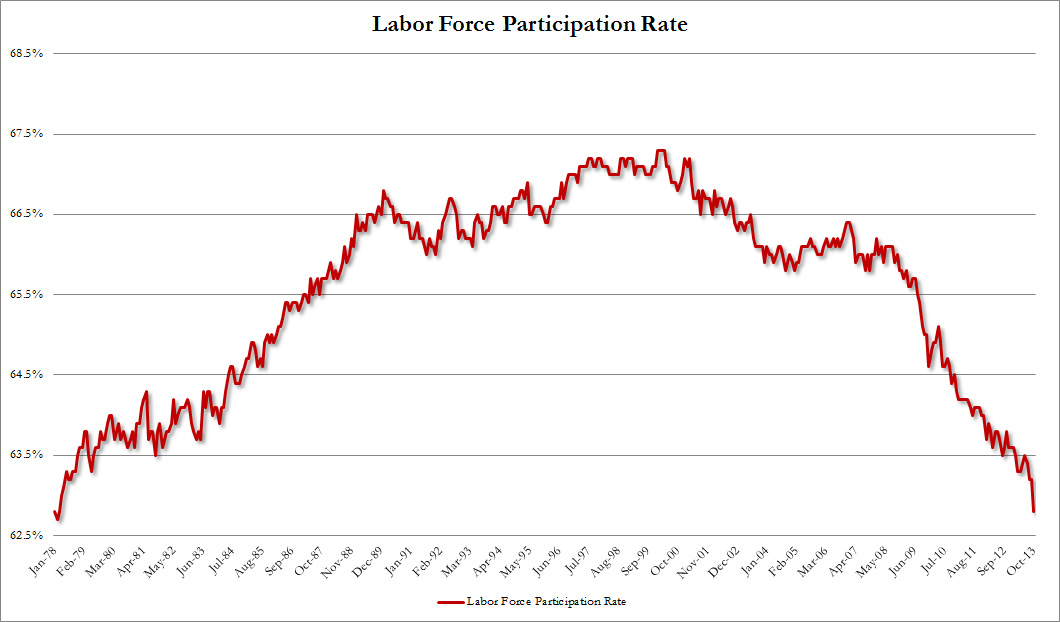
Whopping 932,000 Americans Drop Out Of Labor Force In October; Participation Rate Drops To Fresh 35 Year Low

(ZeroHedge, Nov 8, 2013):  - RECOVERY? 623,000 Full Time Jobs Lost Last Month - Whopping 932,000 Americans Drop Out Of Labor Force In October; Participation Rate Drops To Fresh 35 Year Low The only two charts that matter.... Please continue reading from Whopping 932,000 Americans Drop Out Of Labor Force In October; Participation Rate Drops To Fresh 35 Year Low | Zero Hedge | shared via feedly mobile

Emerging Cyberthreats Report 2014 #Tech #Security

Source: Georgia Institute of Technology | shared via feedly mobile
From press release:

As more businesses find their way into the cloud, few engage in security measures beyond those provided by the associated cloud storage firm, a new report from Georgia Tech notes. Even fewer seek heightened data protection because of concerns that usability and access to remote data would be significantly reduced.

These concerns are among findings made by the Georgia Tech Information Security Center (GTISC) and the Georgia Tech Research Institute (GTRI) in today's release of the Georgia Tech Emerging Cyber Threats Report for 2014. The report was released at the annual Georgia Tech Cyber Security Summit, a gathering of industry and academic leaders who have distinguished themselves in the field of cyber security.
…
In related findings, the report reveals security issues involving the "Internet of Things," referring to the notion that the increase of Internet-capable devices could create opportunities remote hacking and data leakage. With everything from home automation to smartphones and other personal devices becoming connected to the Internet, these devices will capture more real-world information and could permit outside parties, companies, and governments to misuse that information.

In the mobile space, even though designers of mobile devices and tablets have developed a robust ecosystem to prevent large-scale device compromises, the report finds that the threat of malicious and potentially targeted use remains. Earlier this year, researchers at Georgia Tech reported that they found ways to bypass the vetting process of Apple's App Store and subsequently showed how malicious USB chargers can be used to infect Apple iOS devices.

OSHA Wants To Post All Workplace Injury Reports Online

AP reports that federal safety regulators are proposing major changes in workplace reporting rules that would require large companies to file injury and illness reports electronically so they can be posted online and made available to the public. 'Public posting of workplace illness and injury information will nudge employers to better identify and eliminate hazards,' says OSHA head David Michaels. OSHA says the change is in line with President Barack Obama's initiative to increase public access to government data. The plan would require companies with more than 250 employees to submit the data electronically on a quarterly basis. That would cover about 38,000 American companies, says Michaels. Under current rules, employers are required to post annual summaries of injury and illness reports in a common area where they can be seen by employees. While the OSHA web site contains raw numbers about incidents at certain workplaces, it doesn't describe what the injury was or how it occurred. OSHA will hold a public meeting on the proposed rule on January 9 in Washington and is accepting public comments for 90 days, until February 6, 2014. Not everyone is enamored of the change. 'Just because you have an injury, it does not mean there was employer fault,' says Marc Freedman, executive director of labor law policy at the U.S. Chamber of Commerce. 'Reporting the injury records does not tell the full story of the company.' Some company safety professionals and researchers say they are concerned that the new proposal might unintentionally create an under-reporting problem. Companies may feel pressure to report lower injury numbers if they know they will be made public.
Shared via feedly // published on Slashdot // visit site

The $100,000 Battery That Could Help Hotels Save Bundles of Money

Todd Woody - The Atlantic.... To avoid these so-called demand charges—which can account for half of a monthly power bill—businesses can participate in programs that cut their bills if they allow their local utility take control of their air conditioners or lighting to reduce electricity use when the grid is overloaded.

Letting hotel guests who pay $300 a night sweat, however, is not an option. So Hobbs has pulled the plug on his utility by storing electricity in lithium-ion battery packs when rates are low for use when demand and prices rise. The battery and sophisticated software was built by a Silicon Valley startup called Stem and is another example of how technological innovation is upending utilities' century-old stranglehold on power.

"We measure a business' electricity usage and predict when there will be spikes in usage and make decisions on whether to charge or discharge batteries," says Prakesh Patel, Stem's vice president of capital markets and strategy, who notes that demand charges have risen 30 percent in the San Francisco Bay Area over the past three years.

That means Stem's algorithms are constantly analyzing a customer's power demand as well as other factors, such as weather patterns and past energy use, and then charging and discharging the batteries in tiny increments. Such fine-tuning keeps a customer's utility bills down while minimizing wear and tear on the expensive lithium ion battery packs, which are similar to those found in electric cars.

Please continue reading from The $100,000 Battery That Could Help Hotels Save Bundles of Money - Todd Woody - The Atlantic | shared via feedly mobile

Nov 8, 2013

We All Start Out as Scientists, But Some of Us Forget

Up until fairly recently, scientists, writers and philosophers alike have viewed human babies as little more than primitive adults. Through love and attention, babies were to be shaped into autonomous thinkers—like us. It was almost as if their brains were like new computers, whose software we needed to install over time.

But in the past few decades, explains University of California-Berkeley psychologist Alison Gopnik, science has turned this view on its head. Not only are babies' brains structurally quite different from those of adults, but they also function in a way that makes them better than adults at learning new things. In other words, babies seem to be specially designed for exploration and finding out how things work. They're little scientists...at least, that is, until those exploratory habits get replaced over time by less flexible thinking styles.

"Babies have many, many more neural connections being formed, many more synapses being formed, than we adults do," says Gopnik. "So it's as if early on, we have this brain that is really designed for learning, a brain that's very flexible and plastic and responds a lot to experiences. And then later on, as we get older, we have a brain that's more sort of a lean, mean machine, really designed to do things well, but not nearly as flexible, not nearly as good at learning something new."

Gopnik spoke with Inquiring Minds  last weekend at the Bay Area Science Festival. You can listen to the interview above.

An internationally recognized leader in the study of children's development, Gopnik was the first to argue that children's minds could help us understand deep philosophical questions. She's written more than 100 journal articles and several books, including "The Scientist in the Crib" and "The Philosophical Baby," and her 2011 TED talk has generated over a million views.

Indre Viskontas interviews Alison Gopnik at the Bay Area Science Festival.
Inquiring Minds co-host Indre Viskontas interviews Alison Gopnik in AT&T Park at the Bay Area Science Festival. Adam Isaak

"Babies and young children are like the research and development division of the human species, and we grownups are production and marketing," Gopnik says. What this means is that in many ways, babies are very good at thinking scientifically—as a number of experiments have shown–while many adults are not.

Understanding statistics and probabilities, for instance, is something that is difficult for most adults. So it's striking that young children are actually quite good at solving problems using an intuitive understanding of probability.

Take one study of babies' statistical prowess by Cornell psychologist Tamar Kushnir and her colleagues, who had 20-month-old infants watch while an experimenter pulled either yellow rubber ducks or green rubber frogs from a clear plastic box. Sometimes the box contained mostly ducks, and other times mostly frogs—meaning that if the experimenter pulled five frogs in a row from a duck box, she was doing something statistically improbable, something that could only have been done by choice.

Infants knew that too: When their turn came to choose either a frog or a duck for the experimenter to play with, they often chose the statistically unlikely option when the experimenter herself had done so. If the experimenter had pulled frogs from the duck box, then the infants tended to choose a frog as well. However, in scenarios where the experimenter had done nothing improbable—e.g., simply pulling ducks from the duck box—the infants' choices were less clear, as presumably they were inferring that since the experimenters' choice wasn't improbable, she didn't much care what kind of animal she got. In other words, even 20-months-olds can figure out that by defying probabilities, the experimenter was showing a preference for a particular kind of toy.

"To a striking extent, children use data to formulate and test hypotheses and theories in much the same way that scientists do," writes Gopnik in the journal Science. "Scientists learn about the world in three ways: They analyze statistical patterns in the data, they do experiments, and they learn from the data and ideas of other scientists. The recent studies show that children also learn in these ways."

Shared via feedly // published on MoJo Articles | Mother Jones // visit site

Power-harvesting device converts microwave signals into #energy

The five-cell metamaterial array developed by Duke engineers that converts stray microwave...

Joining the ranks of devices designed to harvest energy from ambient electromagnetic radiation comes an electrical circuit from researchers at Duke University that can be tuned to capture microwave energy from various sources, including satellite, sound or Wi-Fi signals. The researchers say the device converts otherwise lost energy into direct current voltage with efficiencies similar to that of current solar cells... Continue Reading Power-harvesting device converts microwave signals into electricity