1. Rossi's first customer who is now the proud owner of their very own 1 megawatt fusion reactor looks almost certainly military in origin, and could well be SPAWAR. Space And Naval Warfare Systems Command The US Navy has a long history and association with cold fusion going back to the Pons and Fleischmann era, even studying cold fusion in secret for over a decade while mainstream science shrugged at it's very mention. Fox News - Cold Fusion Experiment: Major Success or Complex Hoax? Sterling Allan (PESN blog) hinted that an unnamed “customer” of Rossi's device is a military organization that starts with an N. Rossi said this customer measured and verified the test -- and told FoxNews.com that Paul Swanson with the U.S. Navy’s Space and Naval Warfare Systems unit (SPAWAR) can vouch for the demonstration. Read on and comment at:
Nov 3, 2011

Thailand is 20% underwater, and is second-biggest hard drive producer after China. Now do you care a
http://boingboing.net/2011/11/03/thailand.html
A boy and girl give rides for a fee to flooded residents in Bangkok November 2, 2011. The floods began in July and have devastated large parts of the central Chao Phraya river basin, killed nearly 400 people and disrupted the lives of more than two million. REUTERS/Adrees Latif
There may be a shortage of hard drives for the big Christmas retail season because of the catastrophic floods in Thailand. By some estimates the total global output of magnetic hard drives could fall as much as 30% in the final three months of 2011.
Production of laptops and other devices that use these drives may be impacted through early 2012. Second only to China, Thailand is one of the world's top hard drive producing countries. Western Digital and Seagate now produce about 90% of hard drives, and both have affected plants in Thailand. Western Digital's factory is literally underwater.
What stock remains will grow more expensive, with price increases of 20-40%, as demand outstrips supply.
Car production is affected too, as many auto makers use electronic parts made in Thailand. Toyota will slow production of cars in the US because of a shortage of Thai-made parts. Shipments of cameras will be impacted, too—and likely, their price.
(notes and links from Ned Sublette)

Nutrient management key to reducing dissolved phosphorus in lakes
Farmers and other key stakeholders successfully reduced total phosphorus going into Lake Erie over the past 50 years, but must revaluate nutrient management practices to more effectively manage dissolved phosphorus in those same bodies of water, according to one Ohio State University Extension expert.
Nov. 3 US: New chemical added to Proposition 65 List
Effective October 28, 2011, the Office of Environmental Health Hazard Assessment (OEHHA) is adding tris(1,3-dichloro-2-propyl) phosphate (TDCPP) (CAS No. 13674-87-8) to the list of chemicals known to the State to cause cancer for purposes of the Safe Drinking Water and Toxic Enforcement Act of 1986 (Proposition 65).
Tris(1,3-dichloro-2-propyl) phosphate (TDCPP) was considered by the Carcinogen Identification Committee (CIC) in its official capacity as the “state’s qualified experts” at a public meeting held on October 12, 2011. The CIC determined that tris(1,3-dichloro-2-propyl) phosphate (TDCPP) was clearly shown, through scientifically valid testing according to generally accepted principles, to cause cancer.
A revised Propsition 65 list in available on the OEHHA website.
Berkeley Lab team building new total cost of ownership model for fuel cells; intrinsic and external
Funded by a $2-million grant from the US Department of Energy, a team of scientists at Lawrence Berkeley National Laboratory (Berkeley Lab) led by Eric Masanet is building a sophisticated cost model for fuel cells that will will take into account the total cost of ownership.
The project will cover two types of fuel cells—solid oxide and proton-exchange-membrane—in systems of up to 250 kW. While vehicles are a common application for fuel cells, there is demand for stationary applications such as primary and backup power for commercial and residential buildings. This project will look at several specific stationary markets, including backup power, baseload power and combined heat and power, as well as forklifts. Success with forklifts could lead to bigger transportation markets.
New MRI algorithm could reduce the time patients spend in the machine from 45 to 15 minutes
New algorithm could substantially speed up MRI scans. ![]()

Faster scans could reduce the time patients spend in the machine from 45 to 15 minutes. Using GPUs (graphical processing units) could improve the speed even more.
Toxic chemicals: Agency hardens stance on products
The state agency charged with regulating toxic substances has taken another crack at writing a "green chemistry" regulation intended to provide consumers with information about harmful chemicals in products, after its first draft was criticized as too weak.
The new proposal includes a much larger list of so-called chemicals of concern, expands who would be responsible for complying with the new regulation, and sets a higher bar for products that include even traces of potentially harmful chemicals such as lead and bisphenol A.
One of the most vocal critics of the previous proposal, UC Berkeley scientist Michael Wilson, said Monday that the new regulation appears sound and scientifically based.
The regulation, required by a 2008 law, is meant to help consumers identify harmful chemicals in household products - and ideally encourage manufacturers to replace those with safer alternatives. But the state agency charged with creating the regulation last year withdrew its first attempt, after health advocates accused officials of caving to industry pressure.
Debbie Raphael, director of the Department of Toxic Substances Control, said the initiative will eventually require businesses that sell or manufacture products with dangerous chemicals to either replace those chemicals or explain to state regulators why they are needed and warn consumers or undertake steps to mitigate the public's exposure to those toxic substances.
They hope it will spur California manufacturers to create less-harmful chemicals.
"The problem we are trying to fix is that just because something is legal does not mean it is safe," Raphael said.
Last time, environmental and health organizations criticized the proposal as too limited.
Read more: http://www.sfgate.com/cgi-bin/article.cgi?f=/c/a/2011/10/31/BAII1LOJ2O.DTL#ixzz1cdlEWbhk
Oncolytic virotherapy – a new weapon in the war against cancer?
Genetically engineered viruses capable of selectively targeting cancer cells while leaving healthy cells unharmed are gaining popularity as a promising oncolytic treatment. San Francisco-based biotech firm Jennerex debuted JX-594, a genetically engineered virus that can selectively target tumors and cancerous …Continue reading
Collapsed bluff got pass from state regulators - JSOnline
Oak Creek - State environment regulators gave We Energies a pass in 2008 - exempting it from certain rules so that construction work could be done atop coal ash landfills on a bluff on the Lake Michigan shoreline at the utility's Oak Creek Power Plant, officials said Tuesday.
Department of Natural Resources officials determined in 2008 that construction activities on an ash-filled ravine and other small landfills south of the utility's two plants on the property would not increase the risk of the ash or other contaminants getting into the lake, said Frank Schultz, the department's waste supervisor in Milwaukee. We Energies is building an air quality control facility for the older power plant at the site.
State environmental and utility regulators at the time decided that the construction activity would not significantly damage the environment, so no impact studies were needed.
Work progressed until Monday, when a wide section of the bluff, including part of an ash-filled ravine, collapsed, sending a destructive cascade of mud down the slope and into the lake. No one is certain of the extent of the environmental damage, DNR officials said.
The ravine was filled in the 1950s.
The Public Service Commission's 2008 decision approving the project said the agency determined the $900 million pollution control project at the original Oak Creek coal plant was not a project that required either a detailed environmental impact statement or a less exhaustive environmental assessment.
An environmental study could have explored the potential impact of building a storm-water retention pond so close to an ash-filled lake bluff, said Jennifer Feyerherm of the Sierra Club in Madison.
"The whole point of one of these assessments is to identify things that could go wrong and try to mitigate them or decide if that risk is too big," she said.
"Any large construction project poses risks to the environment, especially a large construction project that is next to a national treasure that supplies drinking water to millions," Feyerherm said.
...."The ash has been in that ravine for 50 years," the DNR's Schultz said. The top of the bluff had not been unstable in the past.
"Something changed on the site," he said.
Please read full at:
U.S. carbon emissions down 7% in four years
Earth Policy Institute - Between 2007 and 2011, carbon emissions from coal use in the United States dropped 10 percent. During the same period, emissions from oil use dropped 11 percent. In contrast, carbon emissions from natural gas use increased by 6 percent. The net effect of these trends was that U.S. carbon emissions dropped 7 percent in four years. And this is only the beginning.  The U.S. Department of Energy projects that residential electricity use per person will drop by 5 percent during this decade as light bulbs are replaced and as more-efficient refrigerators, water heaters, television sets, and other household appliances come to market.

Via: http://prorevnews
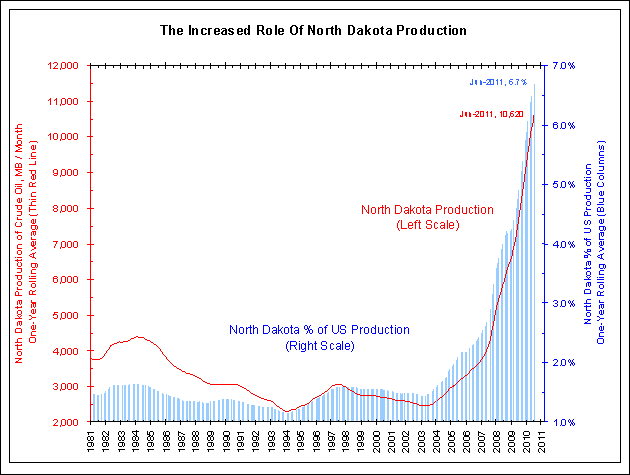
Where The Jobs Are - ND Oil..
CNN/Money – Finding jobs in America’s Boomtown
Workers are landing jobs that pay six-figures in the oil boomtowns of North Dakota. But the abundance of jobs and money comes with some steep trade-offs, including a lack of housing and extremely harsh winters. At 3.5%, North Dakota’s unemployment rate is the lowest in the country. (Nationwide, the rate is 9.1%). But among the small towns that lie along the Bakken oil formation, like Williston, Watford City and Belfield, unemployment is just 1.5%. Many of the highest-paying jobs are at oil companies, where workers make an average salary of about $100,000, often with little-to-no experience or need for a college degree. Halliburton, Continental Resources, Hess and Whiting Petroleum are among some of the biggest players in the area. And jobs include everything from working on a rig to hauling crude and equipment in trucks to helping with administrative work, said Shawn Wenko, workplace development coordinator for the city of Williston. But it’s not just the oil companies that are hiring. The oil boom has brought such a big influx of people that every single industry — from hospitality to retail — has been hit with overwhelming demand as a result.
Source: Bianco Research, LLC
Greek bailout loan withheld
The leaders of Germany and France told Greece on Wednesday it would not receive another cent in European aid until it decides whether it wants to stay in the euro zone.They also made clear that saving the euro was ultimately more important to them than rescuing Greece...
Fukushima reactor is not in critical state - xenon traces were from natural reactions
Tokyo Electric Power Co. said the No. 2 reactor at its destroyed Fukushima Dai-Ichi nuclear station isn’t in a critical state after the company detected signs of nuclear fission.
The discovery of xenon, announced yesterday, at the plant was caused by “natural” nuclear fission, Junichi Matsumoto, a general manager at the company known as Tepco, said today at a press briefing in Tokyo
Tepco may not be able to achieve its goal of stabilizing Fukushima by the end of this year....
U.S. Considered Taking Partial Ownership of Solyndra - NYTimes.com
In the days just before the solar panel maker Solyndra sought bankruptcy protection, the Obama administration considered another emergency debt restructuring that would have made the government the owner of 35 to 40 percent of the company, according to e-mail messages provided to House investigators.
The reorganization was penciled out by Lazard, an investment banking firm retained by the federal Department of Energy to figure out what options remained after Solyndra had borrowed nearly all of a $535 million line of credit extended by the government and was still years away from profitability. The government would have converted the amount it was owed into equity.
Lazard projected that Solyndra could market its solar modules for more than what it cost to manufacture them by late 2012, and could become quite profitable by 2015. According to Lazard, by that year, the profitability as measured by “earnings before interest, taxes, depreciation and amortization,’’ a common financial measure, would be nearly 32 percent.
...the company had drawn down $414 million of the $535 million that the government promised it. But it was selling the panels for far less than they cost to produce because Chinese imports had flooded the market and depressed the price....
Nov 2, 2011
India To Build A Thorium Reactor
Guardian- 'Officials are currently selecting a site for the reactor, which would be the first of its kind, using thorium for the bulk of its fuel instead of uranium – the fuel for conventional reactors. They plan to have the plant up and running by the end of the decade.'" Before anyone gets too excited, this is only a modified Heavy Water Reactor and not one of those fancy Molten Salt Reactors folks like Kirk Sorenson have been evangelizing for a while now. Read more of this story at Slashdot.
Belgium To Give Up Nuclear Power
"Belgium's political parties have reached a conditional agreement to shut down the country's two remaining nuclear power stations. Older reactors will be decommissioned by 2015, with the final closures happening before 2025. The exit is conditional on alternatives being available. 'If it turns out we won't face shortages and prices would not yskyrocket, we intend to stick to the nuclear exit law of 2003,' a spokeswoman for Belgium's energy and climate ministry said."
Read more of this story at Slashdot.
New Algorithm Could Substantially Speed Up MRI Scans
"In a paper to be published in the journal Magnetic Resonance in Medicine, researchers detail an algorithm they have developed to dramatically speed up the process of producing MRI scans. The algorithm uses information gained from the first contrast scan to help it produce the subsequent images. In this way, the scanner does not have to start from scratch each time it produces a different image from the raw data, but already has a basic outline to work from, considerably shortening the time it takes to acquire each later scan."
Read more of this story at Slashdot.
Rare-Earth Mineral Supply Getting Boost From California, Australia
"In recent times, the world's supply of rare-earth minerals has suffered from both increased demand, due to their use in modern technological devices, and uncertain supply, as China restricts the flow of exports. Now, Molycorp's mine in California has re-opened, and another in Australia is set to open later this year, easing — but not erasing — worries about skyrocketing costs. '[The mine had closed] in 2002 following radioactive wastewater spills and price competition. The largest spills, from a pipeline to Nevada, occurred in the late 1990s, in protected lands in the Mojave Desert. The company has since changed its ownership structure. ... It's being rebuilt to produce up to 40,000 metric tons of rare-earth elements by 2013, which would be a 700 percent increase from its production target for the end of this year."
Read more of this story at Slashdot.
Bluff collapse at power plant sends dirt, coal ash into lake.
A large section of bluff collapsed Monday next to the We Energies Oak Creek Power Plant, sending dirt, coal ash and mud cascading into the shoreline next to Lake Michigan and dumping a pickup truck, dredging equipment, soil and other debris into the lake.
Home Li-ion Batteries Let Users Store 6 kWh of Solar or Low-Cost Grid Electricity.
NEC Corp. has commercialized a power storage system using a lithium-ion battery to control household power use automatically. The system comprises a lithium-ion battery with an input/output capacity of two kilowatts and a storage capacity of six-kilowatt hours, and a controller. When connected to a household power panel, the system links to the power system of a utility company, electric devices at home, a photovoltaic generation system, and others so that automatic power control may operate interactively. Users can store photovoltaic (PV) generated power or low-cost late-night electricity for use in daytime, which will result in reduced consumption of power from the ordinary power grid at peak times and lowered utility costs.
Read full from Japan for Sustainability http://www.japanfs.org/en/pages/031323.html
Senate approves $182 billion spending bill for some government agencies
The Senate has approved a $182 billion appropriations measure that lays out spending for some government agencies through next September and could lead to an agreement with the House that would avoid a spending showdown later this month.
By a vote of 69 to 30, the Senate agreed to the bill for agriculture, criminal justice, transportation and housing agencies through the 2012 fiscal year.
Read full article
Toxic chemicals: California hardens stance on products.
The state agency charged with regulating toxic substances has taken another crack at writing regulations intended to provide consumers with information about harmful chemicals in products, after its first draft was criticized as too weak.
http://www.sfgate.com/cgi-bin/article.cgi?f=/c/a/2011/10/31/BAII1LOJ2O.DTL
Mazda shows off lightweight, isobutanol-powered MX-5 Miata Spyder at SEMA

Continue reading Mazda shows off lightweight, isobutanol-powered MX-5 Miata Spyder at SEMA
TEPCO finds sign of fresh nuclear fission at Fukushima reactor | Kyodo News
Source: http://english.kyodonews.jp/news/2011/11/123753.html Tokyo Electric Power Co. said Wednesday there may be signs of fresh nuclear fission in the No. 2 reactor at its quake-damaged Fukushima Daiichi power plant and that it has begun injecting boric acid to control a possible nuclear reaction.
There has been no change in the temperature, pressure and radiation levels at the reactor, whose nuclear fuel is believed to have melted when the cooling system failed following the March 11 earthquake and tsunami, the utility known as TEPCO said.
Gas samples taken Tuesday from inside the reactor's containment vessel may contain radioactive xenon, a gas typically generated by nuclear fission, the company said.
There has been no change in the temperature, pressure and radiation levels at the reactor, whose nuclear fuel is believed to have melted when the cooling system failed following the March 11 earthquake and tsunami, the utility known as TEPCO said.
Gas samples taken Tuesday from inside the reactor's containment vessel may contain radioactive xenon, a gas typically generated by nuclear fission, the company said.
Home prices heading for triple-dip... Noooo
NEW YORK (CNNMoney) -- The besieged housing market has even further to fall before home prices really hit rock bottom.
According to Fiserv (FISV), a financial analytics company, home values are expected to fall another 3.6% by next June, pushing them to a new low of 35% below the peak reached in early 2006 and marking a triple dip in prices.
U.S. Food-Stamp Use Reaches Record 45.8 Million, USDA Says - Businessweek
Bloomberg - The number of Americans receiving food stamps reached a record 45.8 million in August, the government said...The number of Americans receiving food stamps under the Supplemental Nutrition Assistance Program has set records every month but one since December 2008.
Nature By the Numbers - Parks.

America's national parks make up an important part of our society. Besides preserving our history and protecting natural ecosystems, national parks are economic engines. Every $1 of federal investment in our national parks creates $4 of economic value to the public. These investments include projects to build, maintain, and repair facilities, replace outdated machinery and equipment with more energy efficient systems, and preserve natural and cultural resources. In fact, national parks generate $13.3 billion in local private-sector activity and support 267,000 private-sector jobs nationwide due to economic activity they generate.
Today, President Obama designated Fort Monroe in Hampton, Virginia, as our 396th national park. Fort Monroe, a historic fort in Virginia’s Tidewater region, played a pivotal role in the history of slavery in the United States. During the Civil War, the fort remained in Union possession and became a place for escaped slaves to find refuge. Fort Monroe closed its doors as a military base in September, but today’s proclamation ensures its legacy continues as a national monument.
Sent with MobileRSS HD FREE
Chart of the Day! US economy in one word...

motherjones:
Chart of the Day! The Kauffman Foundation asked economics bloggers to describe the US economy in one word. Most of those words are synonyms for “bad.” They found some other interesting stuff, too.
Nov 1, 2011
261 MPG VW XL1 Concept Confirmed for 2013 Production
 Remember the world’s most fuel-efficienct car? Volkswagen has been showing off increasingly-efficient versions of their original 1L concept for the past decade…and now it appears as though VW will do more than tease use. According to one VW exec, the German automaker will start a smaller series of production of the XL1 in Germany starting in 2013.This is the second time rumors of XL1-production have surfaced, in my mind making it more than just hearsay. Powered by a 27-horsepower electric motor and 48-horsepower two-cylinder diesel engine, the XL1 can go 100 km on less than a liter of fuel. That equates to about a 261 mpg rating on the U.S. cycle, thanks to an extremely low weight of just over 1,700 pounds. Martin Winterkorn, CEO of VW Group, told Autonews Europe regarding the XL1 concept that “We will start small series production by 2013 – in Germany.”
 With a 0-62 mph time of about 12-seconds, the XL1 isn’t exactly a rocketship. But what it lacks in performance it will make up for in fuel efficiency, or so VW hopes. The reality will hinge on the cost, and I doubt this little foray into extreme fuel efficiency will be cheap. However, it could lead to a future of ultra-efficient commuter vehicles. I also imagine a few of these lightweight pod cars will get a performance boost from thrill-seekers like myself.
What would you pay for a 261 mpg car? And would you be willing to sacrifice any illusion of speed for such extreme efficiency?
Source: Autonews Europe
Biogas plant to create Yorkshire jobs, controversy.
Yorkshire has been promised an employment boost after the government backed plans for a 108 MW and a 1,500 MW gas plant....
Changes in U.S. Consumer Spending, 2007-2010 » Sociological Images
The Economist posted a graph, based on Bureau of Labor Statistics data, that shows how U.S. consumer spending changed between 2007 and 2010. The results provide a good snapshot of the economic trade-offs Americans are making (i.e., we’re buying more canned veggies and eating out less), as well as which industries are taking the biggest hit as consumers redefine their products as less essential.
 The “nominal” numbers refer to the unadjusted overall changes in spending; the “real” numbers are adjusted for the fact that prices rose by about 5.2% on average, so consumers are getting less for what they spend. So the light blue bars tell you the absolute change in what we’re spending; the dark blue bars, the change in spending relative to how much we’re buying. When adjusted for price inflation, consumer spending fell by about 8%:
Source: thesocietypages.org/socimages
Ford's big battery breakthrough... from 1966

So, imagine if you saw an announcement in the Wall Street Journal noting that Ford had developed batteries with 15 times the storage of the best currently available. It would be tempting to think of a Ford Focus EV with a range that would take it from New York to Chicago and back on a charge. Or EVs with the same range and performance, but with batteries so small and inexpensive that they quickly displaced gas-burners for our daily commute.
It was exactly a breakthrough of this magnitude that Ford had in mind... 45 years ago. What Ford had developed were batteries based around sodium and sulfur. This type of battery has a lot going for it. Just as Ford announced, it packs high energy capacity and a high discharge rate, so it can both store the power that EVs need and provide that power to the motor(s) in a hurry. It may not actually pack the density needed for a continent-hopping EV, but it does have twice the energy density of lithium ion while using much cheaper materials.
Unfortunately, sodium sulfur batteries have a very high operating temperature (over 570 degrees Fahrenheit) and the materials have proved to be highly corrosive and hard to deal with. This type of battery is still being manufactured for use in fixed installations for grid storage, but it has been difficult to harness for mobile applications.
Still, it's fun to think of those classic Mustangs and Thunderbirds humming forward on the silent power of electricity. Just imagine all the batteries that could fit under the hood of the 1968 Thunderbird pictured above - and how far it could go!
Ford's big battery breakthrough... from 1966 originally appeared on AutoblogGreen
Churches Begin Pulling Parish Accounts From BoA, Wells Fargo, and Other Big Banks
As part of a growing movement to divest funds from corporate banks, Most Holy Trinity Catholic Church in San Jose, CA, is closing its $3 million accounts with Bank of America and moving the money to a community credit union. St. Andrew's Episcopal Church in neighboring Saratoga is ending its 15-year relationship with Wells Fargo and placing $150,000 in savings in a local credit union.Father Jesus Nieto-Ruiz, pastor of St. Anthony Catholic Church in Oakland, California, closed his parish's accounts with Wells Fargo during an action by Oakland Community Organizations. Father Aidan McAleenan, parochial administrator of St. Columba Catholic Church in Oakland, whose parish is moving its checking and savings accounts from Wells Fargo to a local credit union, has asked his 500 parishioners who have accounts with Bank of America and Wells Fargo to move their money and he hopes all 88 parishes in the Oakland Diocese will do the same.
Source: National Catholic Reporter - ncronline.org
Via - Sustainable Practices
Subscribe to:
Posts (Atom)