Mar 31, 2012
American Spending Goes Into Overdrive As Savings Plunge To 2008 Levels
The Consumption Dysfunction | ZeroHedge
The latest reports from the Bureau of Economic Analysis on economic growth and personal income and spending have, on the surface, appeared to show improvement. Spending is up more than expected and economic growth is clipping along at a 3% annual growth rate in the fourth quarter. That is the good news. As we have discussed in the past the consumer is the key to this whole economic equation. Consumption is 70% of the economy and, as long as the consumer has the ability to consume, the economy can chug along. However, therein lies the dysfunction as well.
The first chart shows GDP on a 10 year rolling percentage change basis. That massive decline in economic growth occurred even as consumption expanded from below 60% to over 70% of the economy. The belief is that expanding consumption should drive stronger economic growth but in reality the strongest economic growth was occurring while spending and debt levels remained at lower ranges and savings rate were high. Savings, as a function leads to productive investment as money is loaned to businesses for expansion or startup, real estate development, or the purchases of equipment. In turn production is increased which leads to higher levels of employment and income. During the 60-70's savings rates ranged between 6% and 15% versus 3.7% today.
Today, the belief is that if the system is flooded with cheaper dollars that the near-term dysfunction of the economy can be fixed through a consumption driven recovery. The problem, however, as we just discussed, is that production must come first. Production is the real source of healthy consumption in the economy. The debt driven consumption of the 80-90's was a slow moving cancer through the economy. Debt has to be serviced which, as debt levels increased without commensurate increases in income, diverted more and more income away from savings and ultimately productive investment.
The problem is that with the media viewing data from only one month, or quarter, to the next the long term trends are being missed.
In order for consumers to continue to consume at rates high enough to support long term economic growth they need increasing wage growth to offset the effects of inflation over time. This is currently not the case. In fact wages have been stagnant and declining since October of 2010. As of today's latest read - the year over year change in real disposable incomes fell 50% from where it stood in January. Even on a monthly basis real disposable incomes fell in both January and February. Mortgage and debt payments, insurance, utilities, food and auto payments must be met every month and these are just the bare essentials that consume a very large portion of the monthly household budget.
Food & Energy On The Rise - Savings On The Decline
Therein lies the obvious problem. As the rate of increase in income declines as food and energy costs rise - the deficit between income and expenses is made up with either decreased personal savings, increased debt or both. However, with credit tight, limited savings and engaged, either by force or choice, in debt deleveraging - consumers are struggling with higher food and energy prices as they try to maintain their current standard of living.
Food Poisoning's Hidden Legacy: Scientific American @marynmck
...It is a scary idea that food poisoning—which we think of as lasting just a few days—could instead have lifelong aftereffects. The incidence of such “sequelae,” in medical parlance, has been thought to be low, but not many researchers studied the problem until recently. New findings by several scientific teams suggest the phenomenon is more common than anyone thought.
A Common Problem?
Foodborne disease has an enormous public health impact even if you count only the initial, acute episodes of illness. The Centers for Disease Control and Prevention estimated in 2011 that the U.S. sees 48 million illnesses, 128,000 hospitalizations and 3,000 deaths every year from foodborne organisms. (The European Union had 48,964 cases and 46 deaths in 2009, the most recent year tallied.) The U.S. Department of Agriculture’s Economic Research Service calculates the cost of foodborne illnesses just from bacterial infection to be at least $6.7 billion, counting medical care, premature deaths and lost productivity. Researchers who attempt to track chronic effects say that the actual bill is much higher.
“People don’t understand the full consequences of foodborne disease,” says Kirk Smith of the Minnesota Department of Health, which lends its investigators around the U.S. “They think you get diarrhea for a few days and then you are better. They don’t understand that there is a whole range of chronic sequelae. And although any of them may not be common individually, when you put them together they add up to a lot.”
Does Foodborne Illness Trigger Lifelong Health Problems? @marynmck
Does Obamacare have a $17 trillion funding gap?
Senate Republican staffers continue to look though the 2010 health care reform law to see what’s in it, and their latest discovery is a massive $17 trillion funding gap.
“The more we learn about the bill, the more we learn it is even more unaffordable than was suspected,” said Alabama Sen. Jeff Sessions, the Republicans’ budget chief in the Senate.
“The bill has to be removed from the books because we don’t have the money,” he said.
The hidden shortfall between new spending and new taxes was revealed just after Supreme Court justices grilled the law’s supporters about its compliance with the Constitution’s limits on government activity. If the court doesn’t strike down the law, it will force taxpayers to find another $17 trillion to pay for the increased spending.
GreenWashing is killing longterm environmental protection efforts
Geothermal energy could generate 3 million megawatts power in US alone
But David Blackwell, one of the leading minds in the field of geothermal energy has reiterated the fact that there is endless potential that is going untapped across the globe in form of the heat generated by earth’s core. While the general perception is that we can harvest geothermal power only in places where there are hot natural springs, much like the Yellowstone national Park and its spectacular geyser field, the fact is that there are many other ways in which we can generate clean power from the endless heat engine that we call Earth’s core.
According to experts, United States alone could easily generate around three million megawatts of power from geothermal energy if the proper infrastructure is in place. This can be done by injecting liquids into sites and creating artificial geysers that can generate clean energy and the use of old and discarded crude oil stations, where an underground reservoir for injection of liquids would be already in place thanks to fuel companies.
Cooking up Energy: Waste gases from fried chicken offer clean power
In essence, the idea of Yu Chin’s invention is to create a cooking unit that will be independent from external power sources and can power itself on with ease. The process of frying a chicken obviously produces plenty of heat and all this heat and the gas produced can be channeled to generate energy in a unique way. It would be interesting to know if other cooking processes too can produce the same result. There are many kitchens across the globe that get uncomfortably hot while cooking and this technology might be translated to achieve similar results.
This special chicken cart is currently on display at the exhibition of dual use military technology in Lung-Yuan Research Park, Taiwan. The fried chicken power was inspired by military technology that uses heat from vehicles to produce additional power for the vehicle. While the technology in itself might not be revolutionary, it could help those many scores of fried chicken stands that you normally see and could improve quality of working conditions a whole lot.
iZen's Bamboo Keyboard for iPad Takes the Plastic Out of Electronics
Mississippi Residents Find Death Along Oily Gulf Shores
Government to reconsider nerve agent pesticides - Independent
The Government is to reconsider its refusal to ban neonicotinoid pesticides, the nerve-agent chemicals blamed for the collapse of bee colonies worldwide, the chief scientist at the Department of the Environment, Sir Robert Watson, told The Independent.
...The Government has refused previous requests to consider a precautionary suspension of the chemicals, which have been banned in France and Italy, despite mounting evidence that they are harmful to bees and other pollinating insects, even in minute doses.
Bees' role in pollinating crops is worth billions of pounds annually to global agriculture.
Even on Thursday, after the new studies were published, a spokesman for Defra said the new research did not change the Government's position, and that "the evidence shows that neonicotinoids do not pose an unacceptable risk to honey bees".
Mar 30, 2012
U.S. Employment by Industry, 1940 and 2010 » How we fell
Matthew Yglesias posted an image from an infographic released by the Census Bureau showing differences in the U.S. population between 1940 and 2010. This section of the graphic focuses on changes in the industries in which the U.S. workforce is employed. For instance, in 1940 23.4% of Americans worked in manufacturing, down to 10.4% in 2010:
Education, health, and social services have emerged as a major employment sector. On the other hand, while agriculture is a minor sector today (in terms of % of people employed), in 1940 nearly 1 in 5 people worked in agriculture. As Yglesias says,
Neonicotinoid Pesticides Linked To Bee Colony Collapse Disorder - Slashdot
Chinese leader asks Apple's Tim Cook to care for workers - Computerworld
In response to criticism of the working conditions at Foxconn's plants in China, Apple has defended its policies and opened up its Chinese supplier factories for an internal audit by a labor rights group.
On Wednesday, Cook visited a Foxconn factory in China. Apple released photos showing Cook at an iPhone production line at a newly built Foxconn manufacturing plant, which employs 120,000 people.
This is Cook's first visit to China as Apple CEO. Before becoming company head, Cook visited the country in 2010 to investigate working conditions at Foxconn factories following a string of worker suicides.
A Very Long Road for Military Nuclear Waste - NYTimes.com
Slowly, slowly, the Energy Department is moving forward with solidifying the liquid nuclear wastes left over from cold-war weapons production. On Thursday, the department said it had closed two more of the 51 underground tanks at the Savannah River Site in western South Carolina. The high-level waste was mixed with molten glass to keep it chemically locked up for millennia, and the lower-level material was mixed with a kind of cement that is supposed to keep it in place until the radioactivity dies down.
The department has 22 tanks at Savannah River that do not meet Environmental Protection Agency standards, mostly because they are single-wall tanks rather than double-wall. It closed two of them in 1997 but has faced numerous technical problems. Now it says it will have four more done by 2014 or 2015, and all of them by 2028. It is starting with the tanks that are closest to the water table because their contents would spread most rapidly if they leaked. (The area has a high water table.)
Please continue reading at:http://green.blogs.nytimes.com/2012/03/29/a-very-long-road-for-military-nuclear-waste/
Scripps Institute develops simple blood test to predict heart attacks and strokes

The rise of the machines, as told by workplace safety signs
Featured below is a small sampling from an incredibly amusing set of mechanical warning labels, collected by the folks at NOTCOT during this year's WESTEC manufacturing convention in Los Angeles.
For those unfamiliar with it, NOTCOT describes the convention as "the ultimate manufacturing show from the Society of Manufacturing Engineers… [featuring] amazing tools, waterjets, 3D printers, CNCs, microCNCs, robot arms, welding devices… and SO much more." In other words: The perfect birthplace for a robot insurrection.
May we all learn from the mistakes of these hapless stick figures, that we might be prepared for the very worst in the years ahead.
Check out the rest of the set over on NOTCOT.
Michigan Economy Shifts Into High Gear in January as Economic Activity Index Reaches 6-Year High
Comerica Bank's Michigan Economic Activity Index rose seven points in January, up to a level of 98. The January index level is 38 points, or 63%, above the index cyclical low of 60, and marks the highest index reading since January 2006 (see chart above).
I will be reading the "Hazard Communication Answer Book (Answer Books) by Mark Moran this weekend.
One day, this system will let you flush the toilet to keep the heat on.
Please continue reading at:
Great Lakes residents clash over water levels.
Please continue reading at:
Tightening up antibiotics on US farms.
Please read more from source:
Occupational cancer rates in China climb as Several cancer rates decrease in USA
Li and colleagues estimate that in China about 3% of all cancer deaths in men and about 2% in women are due to workplace exposures. However, these figures are likely to underestimate the true situation.
http://johncherrie.blogspot.co.uk/2012/03/occupational-cancer-in-china.html
Several cancer rates decreasing in the USA
The US Centers for Disease Control (CDC) have published the latest "Annual Report to the Nation on the Status of Cancer", which shows that death rates from all cancers combined for men, women, and children continued to decrease between 2004 and 2008.
http://johncherrie.blogspot.co.uk/2012/03/several-cancer-rates-decreasing-in-usa.html
A proposed study could help determine a link between living near nuclear facilities and risk of cancer
living near U.S. nuclear facilities and having a higher risk of
cancer, but challenges and limitations exist, says a new report from
the National Research Council. To evaluate the feasibility of such a
study, the report recommends that a pilot study of seven nuclear
facilities be completed first, although the ultimate decision about
whether to perform either would be the responsibility of the U.S.
Nuclear Regulatory Commission. Please continue reading at:
http://www.nationalacademies.org/morenews/20120329.html
CBO | S. 1023, Haiti Reforestation Act of 2011... environmental recovery of 35% of Haiti’s land area within five years
increase efforts to restore forest cover, and improve management of
natural resources. The bill would set specific targets for those
efforts: promote the environmental recovery of 35 percent of Haiti’s
land area within five years, restore forest cover to at least 10
percent of Haiti within 30 years, and increase agroforestry (the
simultaneous production of trees with crops or livestock) cover to
more than 25 percent of Haiti within 10 years. Please continue reading at:
http://www.cbo.gov/publication/43145
Capsule removes radioactive substances from beverages

US $16.394 Debt Ceiling D-Day: September 14, 2012
Floating wind turbines to produce low cost renewable energy

Wind turbines that use human-like learning to improve efficiency
Australia: No emission limit on new coal plants.
Please read more from source:
CDC - Severe Hand, Foot, and Mouth Disease Associated with Coxsackievirus A6 — Alabama, Connecticut,
http://www.cdc.gov/mmwr/preview/mmwrhtml/mm6112a5.htm?s_cid=mm6112a5_w
Researchers generate liquid fuel using solar generated electricity.

The Chart Of The Decade - ZeroHedge & infiniteunknown
The Chart Of The Decade (ZeroHedge):
This chart tells millions of stories. I’m trying to get my head around its implications.
That’s right: since 1984 (surely an appropriate year) while the elderly have grown their wealth in nominal terms, the young are much worse off both in inflation-adjusted terms, as well as nominal terms (pretty hard to believe given that the money supply has expanded eightfold in the intervening years). So why are the elderly doing over fifty times better than the young when they were only doing ten times better before?
Are young people a stupefied generation coddled by parents and government, addicted to welfare, junk food, drugs and reality TV?
To some extent, but are they any less fiscally and morally responsible than the marijuana-smoking, free-love-embracing, national-debt-accruing baby boom generation? That’s a matter of opinion, but my answer is probably not. Baby boomers hate Ron Paul, while the under-35s seem to love him.
Is it due to government policies that favour the elderly and screw the young?
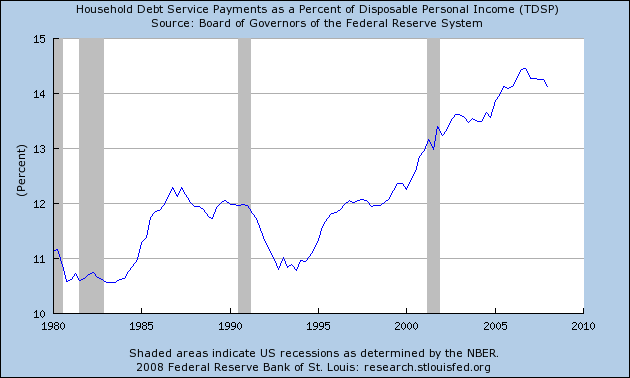
America is suffering from excessive consumer debt:
Net worth is calculated by subtracting debt from assets. The biggest debt for most people is a mortgage. So having more mortgage debt or less mortgage debt tends to be a pretty good determinant of net worth. (And no — unlike in the United Kingdom and Australia which have a severe problem with housing affordability — housing in the USA is still cheap today priced in wages)
The biggest issue though, is this:
The truth may be that the inability of the unemployed to become self-employed is the force that is squeezing the jobless most. Certainly, job migration overseas has changed America, but why should it mean continued elevated unemployment? There is enough money to keep the economy flowing so long as there are opportunities for people to make themselves useful in a way that pays. With the crushing burden of overregulation and the problem of barriers to entry, these opportunities are often restricted to large corporations.
These issues of youth unemployment and growing inequality between the generations are critically important. Unemployed and poor swathes of youth have a habit of creating volatility in response to restricted economic opportunity.