Jun 29, 2012

World Energy Consumption Facts, Figures, and Shockers via @RRapier

@RRapier - In the first installment of this series, I reviewed U.S. and global oil reserves according to the 2012 BP Statistical Review of World Energy. The second installment covered oil production. Today, I want to examine the changes in consumption of coal, oil, and natural gas since 1965 in the three major consuming regions of the world: Asia Pacific, the United States, and European Union countries.

Highlights of this article and topics that will be explored include:

  • Explosive consumption growth in all categories from Asia Pacific
  • Why the arguments of climate change advocates are misplaced
  • Recent declines in coal and oil consumption in the U.S. and EU
  • Why natural gas consumption is increasing in the U.S.

How Much Energy Does the World Consume?

I have often said that I view the growth of carbon emissions as an unstoppable hurricane, for reasons I will reiterate in the next article. Further, I believe one of the reasons that climate change advocates are so ineffective is that they are constantly aiming at the wrong target. The first figure of regional coal consumption emphasizes that point.

Statements and press releases from organizations involved in climate change advocacy leave the strong impression that the biggest obstacle in the war on climate change is Big Oil. In fact, this is where advocates spend the vast majority of their time; fighting against oil consumption. The battle over the Keystone Pipeline is a case in point. But compared to the explosive growth of coal consumption in the Asia Pacific region, potential emissions as a result of the Keystone Pipeline are trivial.

Since 1965, consumption of coal in the U.S. and in European Union countries (the European Union did not exist in 1965, but I will refer to these countries here as the “EU”) has changed at a relatively slow pace. Over the past 46 years, coal consumption in the U.S. has grown by 72%, but it has fallen by 44% in the EU. In recent years, coal consumption has declined in the U.S. as well — down 13% since 2005.

It’s All About Asia Pacific

The Asia Pacific region — dominated by consumption in China and India — is an entirely different story. Coal consumption in the region has increased by more than an order of magnitude since 1965, and is currently more than triple the coal consumption of the EU and U.S. combined. This represents enormous growth in global carbon emissions, which will be the topic of the next post.

The next figure shows that oil consumption trends for Asia Pacific are similar; the region has experienced rapid growth since 1965. The past 46 years has seen oil consumption grow by 63% in the U.S., 60% in the EU, and 777% in Asia Pacific. Oil consumption in the U.S. and the EU has been trending downward since about 2005. But the reason there has been little relief from high oil prices — despite the drop in demand in the West — is that global oil consumption continues to climb on the back of very strong Asian demand.

Natural gas consumption trends tell a somewhat different story. While the trend for Asia Pacific is the same — 2011 is more than 100 times the region’s 1965 consumption — the next figure shows that natural gas consumption in the U.S. is also on the rise

Please continue reading at:

Jun 28, 2012

Another solar company bites the dust after $400 million Energy Dept. Loan Guarantee, Goes Bankrupt

Another one bites the dust. Colorado-based thin solar panel manufacturing company Abound Solar on Thursday announced that it will be filing for bankruptcy next week.

The company was awarded a $400 million loan guarantee from the Department of Energy in 2010, but as both the company and the Energy Department have made clear today, it only claimed about $70 million of the total before the guarantee was frozen by the government after Abound failed to hit financial targets.

Read on at: http://idealab.talkingpointsmemo.com/2012/06/abound-solar-recipient-of-70m-energy-dept-loan-guarantee-goes-bankrupt.php

Gov Report - Carbon Capture & Storage (#CCS) 75%more costly than by conventional coal-fired plants.

CBO Releases Report on Federal Efforts to Reduce the Cost of Capturing and Storing Carbon Dioxide June 28, 2012

Coal-powered facilities account for roughly a third of all U.S. emissions of carbon dioxide, and most climate scientists believe that the buildup of carbon dioxide and other greenhouse gases in the atmosphere could have costly consequences.

Today CBO released a report—prepared at the request of the Chairman of the Senate Energy and Natural Resources Committee—on federal efforts to reduce the cost of carbon capture and storage (CCS), a much-discussed option for reducing the nation’s greenhouse gas emissions while preserving the ability to produce electricity at coal-fired power plants.

No CCS-equipped coal-fired power plants have been built on a commercial scale because any electricity generated by such plants would be much more expensive than electricity produced by conventional coal-burning plants: Engineers’ estimates indicate that electricity generated by the first CCS-equipped commercial-scale plants would initially be about 75 percent more costly than electricity generated by conventional coal-fired plants. Since 2005, lawmakers have provided the Department of Energy with about $6.9 billion to develop CCS technology, demonstrate its commercial feasibility, and reduce the cost of electricity generated by CCS-equipped plants.

In the absence of a significant technological breakthrough, it seems clear that a large amount of new CCS capacity—installed either at new plants or, through retrofitting, at existing plants—would be needed to reduce costs substantially. Such an investment seems unlikely in the foreseeable future and it might not occur even if the technology became more competitive economically. Unless the federal government adopts policies that encourage or require utilities to generate electricity with fewer greenhouse gas emissions, the projected high cost of using CCS technology means that the government’s current program for developing CCS is unlikely to do much to support widespread use of the technology.

Please read full at: http://www.cbo.gov/publication/43360

‘Made in the USA’ Label Will Disappear If the World Trade Organization Plan Succeeds | #Economy In Crisis

“Made in the USA” labels may be disappearing more quickly than most consumers realize. As if buying American made goods was not difficult enough, shoppers may soon not even be able to determine where a prospective purchase is manufactured. The World Trade Organization (WTO) is pushing for an elimination of country-of-origin labels on all consumer products, the World News Daily (WND) reports. The organization wants to replace the current labeling policy of identifying the nation where items are manufactured with a “Made in the World” tag.

Please continue reading at:

eBay's #renewable #energy bloom latest in green data center race. Big step towards solving both problems.

GreenBiz - Dean Nelson, who oversees data centers for eBay, told Marc Gunther recently that he had two big business problems to solve: getting control of the company's power costs and finding an alternative source of energy to the coal used to power the electricity in its Utah data center. Nelson and his boss, CEO John Donahoe, have just taken one big step towards solving both problems. The company announced on Thursday that it will expand a data center in South Jordan, Utah, by acquiring fuel cells from Bloom Energy, a private company that already supplies fuel cells to eBay headquarters in San Jose.

Read on:
http://www.glrppr.org/news/newsItem.cfm?id=17825

Harmonization of Chemical Emissions Labeling for Indoor Products Proposed - #consumer #health #news

The European Commission's Joint Research Centre issued Report No. 27 on May 29, Harmonisation Framework for Indoor Products Labeling Schemes in the EU, which proposes to standardize chemical emissions labeling for indoor products, including paint and coatings, across the European Union. The Joint Research Centre serves a purely advisory role and its report is not binding on the European Commission.  Read More

California Supreme Court Reverses Appellate Court Ruling in ACA v. SCAQMD

The California Supreme Court on June 25 handed down a decision in favor of California’s South Coast Air Quality Management District (SCAQMD) in American Coatings Association v. South Coast Air Quality Management District. Read on

Why Mennonite Urine Is Four Times Lower in BPAs Than the Rest of Ours -via @GOOD

We all carry in our bodies the legacy of our dependence on plastic products: 93 percent of U.S. urine samples contain bisphenol A (BPA), a chemical compound used in the production of plastics and resins. Most of this exposure comes from food packaging. You may also recall the shift away from the use of BPA by Nalgene, the water bottle maker.

Sydney Brownstone over at Mother Jones points out the growing body of scientific research showing that BPAs screw around with our hormones and much more:

Exposure to the chemical has been associated with risk for obesitybreast cancer, prostate cancer, cardiovascular disease, infertility, diabetes, thyroid dysfunction, and neurological problems.

BPAs are ubiquitous in the modern industrial food system, and figuring our just how they find their way into our bodies can be complicated, points out Brownstone. Earlier this week researchers from the University of Rochester and Mount Sinai Medical Center published a study with a novel approach to this question. They tested the urine of pregnant Mennonite women in upstate New York for their exposure and found their levels to be four times lower than average.

Please continue reading at:

We are entering the great depression of 1931, the year everything fell apart, Nobel prize winning economist Krugman - NYTimes.com

“Suddenly normally calm economists are talking about 1931, the year everything fell apart,” writes Nobel prize winning economist Paul Krugman in the New York Times.

“The parallels between Europe in the 1930s and Europe today are stark, striking, and increasingly frightening, write Bradford DeLong and Barry Eichengreen in [external] the new preface to Charles Kindleberger, The World in Depression 1929-1939.

“We see unemployment, youth unemployment especially, soaring to unprecedented heights. Financial instability and distress are widespread. There is growing political support for extremist parties of the far left and right.”

Please continue reading at:

Fiscal Cliff: 1 Million Jobs at Risk. Jan 1st the country goes back into recession.

Congress has six months to prevent the U.S. economy from falling off the so-called fiscal cliff. If Congress does not act, on Jan. 1, 2013 a mix of tax hikes and $1.2 trillion in budget cuts are set to take effect, which the Congressional Budget Office says will likely throw the country back into recession.

Most economists agree that failing to act will have about a $600 billion drag on the economy in 2013. But little discussion has been given to the direct impact on jobs, particularly in the defense sector, which will suffer from half of the budget cuts. The $500 billion cut to defense spending would be phased in over 10 years with $55 billion to take effect next year.

A recent study by the National Association of Manufacturers (NAM), a lobbying and advocacy group, found that more than 1 million private sector jobs could be lost by 2014 due to fiscal constraints. The proposed job cuts would increase the national unemployment rate by 0.7 percent and decrease Gross Domestic Product by nearly 1 percent, according to NAM.

Please continue reading at:

Jun 27, 2012

Rhode Island Governor Signs PaintCare(R) Bill for proper & effective management of post-consumer paint.

Rhode Island is now the fourth state after Oregon, California and Connecticut to embrace the PaintCare® program — the ACA and industry conceived platform for the proper and effective management of post-consumer paint.

More at: http://paint.org/news/industry-news/item/906-rhode-island-governor-signs-paintcare%C2%AE-bill.html

FDA Denies Two of Three Petitions to Ban Certain Uses of #BPA - #Green #Health

FDA will be soliciting comment on an amended version of Rep. Edward Markey's (D-Mass.) third petition, which is asking the agency to ban BPA from epoxy resin coatings used in infant formula packaging. Read more

CARB Reporting Requirements for Multi-purpose Solvent & Paint Thinner Products Extended to Sept. 2012

The California Air Resources Board's Consumer Product Rule requires that responsible parties report information on product sales and composition for the year 2011 and R&D efforts to achieve the 3 percent paint thinner and multipurpose solvent volatile organic compound (VOC) limits.
More here

GMO Scientists Identify Hazards of GMO Crops. #food #safety #health

“GMO Myths and Truths” is a new, evidence-based examination of the claims made for the safety and efficacy of genetically modified crops. The initiative for the report came not from campaigners but from two genetic engineers who believe there are good scientific reasons to be wary of GM foods and crops. One of the report’s authors, Dr. Michael Antoniou of King’s College London School of Medicine, uses genetic engineering for medical applications but warns against its use in developing crops for human food and animal feed. He reports that research studies show genetically modified crops to have increased the use of pesticides and have failed to increase yields. Another author, Dr. John Fagan, is a former genetic engineer who in 1994 returned to the National Institutes of Health $614,000 in grant money due to concerns about the safety and ethics of the technology. He subsequently founded a GMO testing company. He notes that “Crop genetic engineering as practiced today is a crude, imprecise, and outmoded technology.”

Read on at:
http://earthopensource.org/index.php/news/60-why-genetically-engineered-food-is-dangerous-new-report-by-genetic-engineers

Post source: http://www.sustainablepractices.info

Companies Tie Executive Compensation to #Sustainability Performance. - #green #news

Several large US companies tying executive compensation to sustainability performance, according to a report from The Conference Board. The report, “Linking Executive Compensation to Sustainability Performance,“ says shareholders are placing more value on corporate sustainability initiatives, and are becoming increasingly interested in linking such performance to executives’ compensation. Intel has linked sustainability performance to bonuses for all employees since 2008. Intel’s bonus calculations take into account the energy efficiency of the company’s products, commitments to renewable energy, and the company’s performance related to its carbon footprint reduction goals. Xcel Energy links its annual incentive awards for executives to sustainability performance metrics, including greenhouse gas reduction. Alcoa included sustainability performance in its executive bonus plan in 2010, linking 20 percent of the bonus to non-financial metrics, such as carbon dioxide reduction, safety and diversity.

Read on at Environmental Leader.com
http://www.environmentalleader.com/2012/06/01/intel-xcel-energy-alcoa-among-us-companies-linking-exec-pay-to-sustainability

Post Source:
http://www.sustainablepractices.info

Pesticides endanger U.S. farmworkers plagued by exposure and red tape.

Pesticides can endanger U.S. farmworkers, but thin layers of government protect them and no one knows the full scope of the environmental perils in the fields. The Environmental Protection Agency administers a protection standard, but the agency does not track pesticide exposure incidents nationwide.

Please continue reading at:

Experts warn of another disaster awaiting at Fukushima - 10 times the scale of Chernobyl. Without repairs

Another major earthquake in Japan could mean a nuclear disaster 10 times the scale of Chernobyl. Without repairs, 10 times more cesium than has already been released by the Fukushima meltdown will go into the atmosphere. Depending on which way the wind is blowing, Tokyo could become uninhabitable.

Please continue reading at:

Jun 26, 2012

Pesticides still affecting our daily #health associated with disorders of breathing, brain development and reproduction.

Your city may have banned certain pest-killing chemicals, but they continue to quietly cause illness in society. The Ontario College of Family Physicians recently conducted a review of 142 studies on pesticides, and found their use is associated with disorders of breathing, brain development and reproduction.

Please continue reading at:

Fertility drugs may increase breast #cancer risk in women. #health

Women who started taking fertility drugs and went through IVF around their 24th birthday were found to have a 56 per cent greater chance of developing breast cancer than those in the same age group who went through treatments without IVF.

Please continue reading at:

Chemicals in furniture target of California lawmakers.

The foam in furniture sold in California has to meet flammability standards set by state regulators in 1975. The cheapest way for furniture makers do that is by using chemicals, many of which have been linked to health concerns, but are not banned. The State now has the chance to change that.

Please continue reading at:

How The Grassroots Rocket Stove Movement Continues to Push Efficient Cooking

Big bucks are pouring in to high-tech, mass produced cook stoves for the developing world. But grassroots activists insist that a lower tech, open source model is still relevant.
Please continue reading at:
http://www.treehugger.com/clean-technology/how-grassroots-rocket-stove-moveme...

Toilet that uses almost no water to separate urine from poop & make fertilizer & methane


Prof Chang, Dr Giannis, Prof Wang, Dr Rajagopal, and Dr Chen with the No Mix Vacuum Toilet./Promo image

Science Daily titles their post New Toilet Turns Human Waste Into Electricity and Fertilizer; It's based on a presser from Nanyang Technological University titled NTU’s new loo turns poo into power. Neither is accurate.

What the scientists from Nanyang Technological University are standing around is a urine separating toilet that uses a vacuum to evacuate it instead of water. All you get out of this is urine and poop, much like you do with theSwedish No-Mix toilets


Roediger vacuum system/Promo image

What matters is the whole system, what they do with it. The scientists at NTU have connected it to a vacuum system, like those used in airplanes or in theRoedigner No-Mix vacuum separating toilet, described our post Waste Not, Want Not: The Future of Toilets

Please continue reading at:

Coal-Plant Plunge Threatens Billion$ in Pollution Spend - @Bloomberg

The coal-fired power industry in the U.S. is facing the biggest plunge in asset values in a decade, risking billions of dollars in pollution-control spending by utilities such as Exelon Corp. (EXC) and American Electric Power Co. (AEP)

U.S. utilities are switching to burning gas for electricity and preparing to retire 33,000 megawatts of coal-fired generation after the U.S. Environmental Protection Agency tightened rules for mercury and other toxins, Dumoulin-Smith, a New York-based analyst with UBS AG, said. 

An indication of how much new emissions rules and cheaper natural gas have hammered the value of coal-burning generation will come when Exelon announces the results of the first big sale of U.S. coal-fired power plants in four years.

Exelon, the largest U.S. power company, may have to take a 40 percent discount for three Maryland plants it’s seeking to sell by the end of August. Bidders including NRG Energy Inc. (NRG) have offered $600 million to $700 million for the units, which have a fair value of $1 billion, said Travis Miller, Chicago- based director of utilities research for Morningstar Inc.

“This is going to be the first meaningful transaction for coal assets since the downturn,” Julien Dumoulin-Smith, a New York-based analyst with UBS AG, said in a phone interview. “You can get a little anxious about what the repercussions are.”

Constellation Energy Group, which Exelon bought this year, spent $1 billion on the plants to keep them in compliance with pollution rules. Their sale, the biggest since 2008, comes in an era of more stringent pollution rules and competition from facilities burning gas, a fuel cost that is near 10-year lows.


Please continue reading at:

Jun 24, 2012

Malaysia sets up Asia's largest biorefinery site

An official from the government of Malaysia's biotechnology investment agency BiotechCorp sent the blog an email today regarding their Malaysian ringgit (M$)170m (€42.3m, $53.3m) investment for a biorefinery complex in Kertih, in the Terengganu State, which is expected to attract foreign companies to set up shop for their cellulosic-based manufacturing facilities.

The site will reportedly be Asia's largest biorefinery complex, which will sit on a 1,000 hectare land located at Kertih Biopolymer Park (developed by the East Coast Economic Region Development Council or ECERDC or Malaysia).

The site will also have a 30,000 hectares of land dedicated for feedstock plantations that will produce 10.5m tonnes/year of woodchips from Acacia mangium and Leucaena leucocephala -- I have no idea how to pronounce this -- but it is also locally known as "Petai Belalang."

...The agencies expect to get a total of M$6.8bn investment from foreign companies. Operation of the complex is expected to start by early 2014. The site will also use renewable energy coming from cellulosic feedstock instead of natural gas.

Please continue reading at:

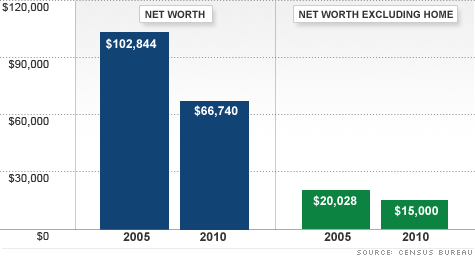
Net Worth Implosion: It’s Not Just Housing. Age 35 To 44 See 59% Decline - CNN

net worth housing

NEW YORK (CNNMoney) -- Americans' net worth collapsed in recent years, but don't blame the housing market for it all.

A CNNMoney analysis of new Census Bureau data shows that if you strip out the effects of the housing collapse, median household net worth still fell by 25% between 2005 and 2010. The decline was driven largely by the plummeting stock market, which devastated Americans' portfolios and retirement accounts.

"The median household is no wealthier than they were in 1984," said Scott Winship, economic studies fellow at Brookings Institution.

...Asian, black and Hispanic households each lost a much greater share of median net worth, around 60%, than their white counterparts, at 30%.

As for median home equity values, Hispanic households experienced a 55% drop, while Asians saw a 43% decline and blacks a 35% decrease. Whites, on the other hand, lost just under a quarter.

Age was also a factor, with younger Americans losing a greater share of their wealth than their parents' generation.

Households of people age 35 to 44 saw the largest percent decline in median net worth of any age group: 59%. If home equity isn't factored in, they lost 40%.

Please continue reading at:

http://money.cnn.com/2012/06/19/news/economy/net-worth-housing/index.htm

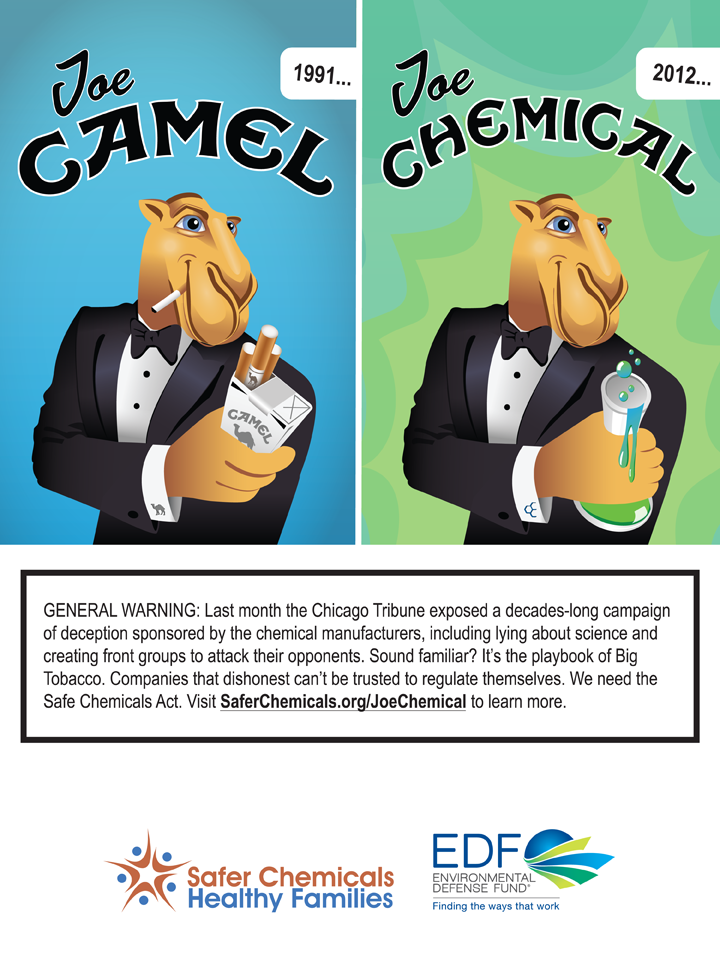
EPA & Joe Chemical Move to Act on TSCA Reform

The EPA is actually considering regulating chemicals under the law that was put in place in the 1970′s to regulate chemicals: Toxic Substances Control Act (TSCA). Most environmental lawyers don’t even bother looking at TSCA because they assume that it gives them nothing to work with in terms of actually getting toxic chemicals out of our products and environment. But in speaking to state officials attending the Environmental Council of the States’ forum, Jim Jones, EPA’s acting assistant administrator for chemical safety and pollution prevention said, “We will try and exercise some muscle we have not exercised for decades.”

...In the meantime, meet Joe Chemical in Safer Chemicals Healthy Families’ latest ad in Politico for the Safe Chemicals Act, which would inject some steroids into that TSCA muscle so that when the EPA exercises it, it actually does its job.


Please continue reading at:

Rio: Killing the earth since 1992. #Rio+20

 Here are the facts: the catastrophic Anthropogenic Global Warming on which Maurice Strong and his watermelon cohorts asked us to bet the world economy back in 1992 hasn't happened. That's why, at this Rio they're playing down the "Climate Change" issue and concentrating on "Biodiversity" instead. But as Driessen and Rothbard note at Watts Up With That, there is no scientific evidence whatsoever for the greenies projections of catastrophic species loss.

Please continue reading By James Delingpole

Pink Slips for Everyone. Lockheed Martin cuts 120,000 #jobs

Lockheed Martin will formally notify its 120,000 employees this fall that they may lose their jobs because of sequestration, said company chairman and CEO Bob Stevens June 19. During a press conference in Arlington, Va., Stevens said the Budget Control Act "is on the books, and the President has said he would veto" any change to it.

Please continue reading at:
http://www.airforce-magazine.com/DRArchive/Pages/2012/June%202012/June%2020%202012/PinkSlipsforEveryone.aspx

12 Most Toxic Fruits and Vegetables : via @TreeHugger

Dirty Dozen: The 12 to buy organic (in order of pesticide load, apples being the worst offenders).

1. Apples
2. Celery
3. Sweet bell peppers
4. Peaches
5. Strawberries
6. Imported nectarines
7. Grapes
8. Spinach
9. Lettuce
10. Cucumbers
11. Domestic blueberries
12. Potatoes

Clean Fifteen: Buying organic is more sound environmentally, but if you can't, these options are less contaminated and don't pose as much of a health threat as do the dozen above.

1. Onions
2. Sweet corn
3. Pineapples
4. Avocado
5. Cabbage
6. Sweet peas
7. Asparagus
8. Mangoes
9. Eggplant
10. Kiwi
11. Domestic cantaloupe
12. Sweet potatoes
13. Grapefruit
14. Watermelon
15. Mushrooms

Other disheartening data from the report includes:

  • Some 98 percent of conventional apples have detectable levels of pesticides.
  • Domestic blueberries tested positive for 42 different pesticide residues.
  • Seventy-eight different pesticides were found on lettuce samples.
  • Every single nectarine USDA tested had measurable pesticide residues.
  • As a category, grapes have more types of pesticides than any other fruit, with 64 different chemicals.
  • Thirteen different pesticides were measured on a single sample each of celery and strawberries.

For the full list, see Shopper’s Guide to Pesticides in Produce. You can also download a pocket-sized guide here.

Please read full and follow at:

People are hungry not because there is too little food: they are hungry because they are marginalized economically & powerless politically.

A quickie, this is great: Next time someone tries telling you that without using such and such genetically engineered biotech crop we won't be able to solve world hunger, just quote them some Olivier De Schutter, the UN Special Rapporteur on the right to food:

People are hungry not because there is too little food: they are hungry because they are marginalized economically and powerless politically. Securing the right to food is therefore the only path to durably tackling hunger.

The importance of improving the incomes of the poor, facilitating internal and foreign investment, and increasing agricultural yields cannot be downplayed in the hunger equation. But for genuine, sustainable progress to be made in tackling hunger and malnutrition, political processes must first be made accountable, participative, and attuned to the cross-cutting complexities of the hunger question.

Only when the political process is human rights-proofed in this way can we be confident that the reinvestment in a country and its agriculture will truly benefit the poor and food insecure.

Read more: The Drum

By the way, De Schutter has also said some choice words on the role of sustainable agriculture:

To feed 9 billion people in 2050, we urgently need to adopt the most efficient farming techniques available.Today's scientific evidence demonstrates that agroecological methods outperform the use of chemical fertilizers in boosting food production where the hungry live -- especially in unfavorable environments. [...] To date, agroecological projects have shown an average crop yield increase of 80% in 57 developing countries, with an average increase of 116% for all African projects. Recent projects conducted in 20 African countries demonstrated a doubling of crop yields over a period of 3-10 years.

Conventional farming relies on expensive inputs, fuels climate change and is not resilient to climatic shocks. It simply is not the best choice anymore today.

Please read full and follow at:

Study: Worldwide Obesity Could Drain Natural Resources as Much as Half a Billion More People

The conclusion most certainly makes sense: There’s more people on Earth that are eating more food than ever before. This, according to a new study published in BMC Public Health, could further drain the world’s natural resources.

“Increasing population fatness could have the same implications for world food energy demands as an extra half a billion people living on the earth,” the studyconcluded.

Leading the Pack in Obesity

The U.S., not surprisingly, leads the pack in obesity and is among the largest drainers of food resources. Researchers used body mass indexes (BMI) and overall population to calculate biomass or overall weight of the nation. “Total biomass by age-sex group was estimated as the product of the number of people in the group and their average body mass.”

Researchers then used “extreme scenarios” to calculate usage of natural resources. They calculated the drain on natural resources if all the countries had BMIs like the U.S. versus if all the countries had BMIs like Japan. These particular countries were chosen because while they are similar socioeconomically, their obesity rates are at two different ends of the spectrum as shown in the study below.

Please continue reading at:

Corporate Profits Just Hit An All-Time High, Wages Just Hit An All-Time Low - Three Charts Tell it All

1. Corporate profit margins just hit an all-time high.

2. Fewer Americans are working than at any time in the past three decades.

3. Wages as a percent of the economy are at their lowest since 1940

Please read full and follow at:

Jun 23, 2012

Japan Announces Huge New Incentives for #Solar Power - @GOOD

The nuclear meltdown in Fukushima last year was a disaster in every sense of the word, and a reminder of just how dangerous nuclear power can be. But if anything good comes out of it, it might be this: In an effort to move away from nuclear power, Japan announced big, big plans this week to incentivize solar power.

Before the meltdown, atomic energy provided about 30 percent of Japan’s power, but now, post-meltdown, even the prime minister realizes that the country needs to decrease its reliance on nuclear power. Taking a page from Germany’s book, Japan’s government is sharply increasing the amount that utilities must pay consumers who generate solar power, a subsidy that is expected to rejuvenate the country's struggling solar industry.

Japanese consumers who decide to install solar panels will be paid roughly 53 cents per kilowatt-hour of solar power that they produce. (To put that number into context, it's about twice as high as the subsidy rate in Germany, which has long been the world leader in solar power). Bloomberg New Energy Finance estimates that the subsidy will encourage consumers to invest up to $9.6 billion in solar power, leading to new solar output equivalent to not one, not two, but three nuclear plants. In other words, the subsidy will make solar power more profitable for both consumers and solar companies, likely making Japan the world’s second-largest market for solar power. 

Please continue reading at:

Great Lakes water diversion of Waukesha. Radium is a cancer causer gets into the water as aquifers get sucked dry.

The City of Waukesha, Wis. (pop. 70,718), which sits on the western edge of Metropolitan Milwaukee, has a bad problem with its water supply—radium. Radium is a cancer causer that gets into the water as aquifers get sucked dry.

Please read full and follow at:

Biggest Environmental Secret - Injection Wells: most of our future groundwater is polluted

Abrahm Lustgarten, Pro Publica - Over the past several decades, U.S. industries have injected more than 30 trillion gallons of toxic liquid deep into the earth, using broad expanses of the nation's geology as an invisible dumping ground.

"In 10 to 100 years we are going to find out that most of our groundwater is polluted," said Mario Salazar, an engineer who worked for 25 years as a technical expert with the EPA's underground injection program in Washington. "A lot of people are going to get sick, and a lot of people may die."

No company would be allowed to pour such dangerous chemicals into the rivers or onto the soil. But until recently, scientists and environmental officials have assumed that deep layers of rock beneath the earth would safely entomb the waste for millennia.

Records from disparate corners of the United States show that wells drilled to bury this waste deep beneath the ground have repeatedly leaked, sending dangerous chemicals and waste gurgling to the surface or, on occasion, seeping into shallow aquifers that store a significant portion of the nation's drinking water.

In 2010, contaminants from such a well bubbled up in a west Los Angeles dog park. Within the past three years, similar fountains of oil and gas drilling waste have appeared in Oklahoma and Louisiana. In South Florida, 20 of the nation's most stringently regulated disposal wells failed in the early 1990s, releasing partly treated sewage into aquifers that may one day be needed to supply Miami's drinking water.

There are more than 680,000 underground waste and injection wells nationwide, more than 150,000 of which shoot industrial fluids thousands of feet below the surface. Scientists and federal regulators acknowledge they do not know how many of the sites are leaking.

Please continue reading at: