Jul 10, 2012

Electric Power Facility Converts Sewage Sludge into Carbonized Biomass Fuel

...utilizing sewage sludge at a facility built in the Kinuura Tobu Sewage treatment Center. It plans to produce 2,700 tons of carbonized biomass fuel annually which will then be used at the adjacent Chubu Electric Power Co.'s Hekinan Thermal Power Plant for the next 20 years starting from fiscal 2012.

Read on at:
http://www.japanfs.org/en/pages/032036.html

Pollution kills 500 each year in Sheffield.

Five hundred people a year are dying prematurely because of illegal levels of pollution in Sheffield, a shock new report reveals.

Please continue reading at:

Wind farms on land grow with few critics. Via @bostonglobe

Despite controversy that has slowed the Cape Wind project in Nantucket Sound, land-based wind farms are expanding rapidly in the US Northeast. Driving this growth are technological advances reducing the cost of wind turbines and increasing their efficiency, making wind power more competitive with traditional power sources.

Please continue reading at:

System for Predicting Wave Energy Could Double Wave Power Generation

EcoGeek has a post on research into optimising wave power generation - System for Predicting Wave Energy Could Double Wave Power Generation.
As part of a new study on wave power, the University of Exeter and Tel Aviv University have come up with a system that predicts the power of waves in order to maximize wave energy devices' ability to generate energy from the sea. The researchers found that this system could potentially double the amount of wave energy generated by a device.

Phys.org reports, "The research focused on point absorbers, commonly-used floating devices with parts that move in response to waves, generating energy which they feed back to the grid. Point absorbers are already known to be much more efficient in the amount of energy they produce if their response closely matches the force of the waves and previous research has looked at trying to increase this efficiency. However, this is the first study that has focused on increasing the device's efficiency by predicting and controlling internal forces of the device caused by forthcoming waves."

Please continue reading at:

First half of 2012 USA's warmest on record, 4.5 degrees above average

USA Today - Twenty-eight states and more than 100 cities have posted their warmest first six months on record, based on national weather data that go back to 1895, according to the report from NOAA's National Climatic Data Center.

The national temperature this year was 52.9 degrees, which is 4.5 degrees above average and 1.2 degrees above the next-warmest year, which was 2006, the climate report notes.

Please continue reading at:

Monsanto's Roundup: What's Behind Illinois Stealing Local Hero's Bee Hives?

An Illinois beekeeper whose bee hives were stolen and allegedly destroyed by the Illinois Department of Agriculture has stirred up a hornet's nest with his questions on why the state did this, and most importantly, what they did with his bees.

The state claims the bees were destroyed because they were infected with a disease called foulbrood.

But when the 58-year apiary keeper had his hearing—three weeks after the removal of his bees without his knowledge—the state's "evidence" had disappeared, leaving more questions than answers about the raid on the beekeeper's hives.

Some people, including the beekeeper, Terrence Ingram, suspect the raid has more to do with Ingram's 15 years of research on Monsanto's Roundup and his documented evidence that Roundup kills bees, than it does about any concerns about his hives.

Interestingly, the state's theft targeted the queen bee and hive he'd been using to conduct the research.

Please continue reading at:

Jul 9, 2012

China starts stockpiling rare earths: AP report

SHANGHAI — China has started stockpiling rare earths for strategic reserves, a state-backed newspaper said Thursday, in a move that may raise more worries over Beijing's control of the coveted resources.
China has already started the purchase -- using state funds -- and storage of rare earths for strategic reserves, the China Securities Journal said, but did not specify exactly when the initiative was launched.
"This is China's start of work for state strategic buying and storage of rare earths," the newspaper said.
The country produces more than 90 percent of the world's rare earths, which are used in high-tech equipment ranging from iPods to missiles, and it has set production caps and export quotas on them.

Please continue reading at:
http://www.google.com/hostednews/afp/article/ALeqM5gSMK_qr0ed7lHzPIX34ytLuEKjgw

Firefly a 100% Solar-Powered 6 person Boat That Only Costs $2900!

Firefly, Dan Baker, solar-powered boat, solar power, green transportation, electric boat, electric motor, green boat

This awesome boat, dubbed Firefly, is a six-person boat that is powered entirely by the sun. The first Firefly was built in 2010 by Dan Baker who decided to construct his own pontoon to cruise around Fraser Lake, British Columbia. Originally the Firefly was powered by two trolling motors and a car charger, but today it’s the ultimate 100% solar-powered lake boat. The Firefly got its name from the 900 LED lights that are positioned on the top of the boat.

Read the rest of The Firefly is a 100% Solar-Powered Boat That Only Costs $2900!

Free Technical Assistance Webinar on Improving #Water & #Energy Efficiency - ICORE Project

Improving Water and Energy Efficiency Through Technical Assistance: The ICORE Project

Through the Illinois Conservation of Resources and Energy (ICORE) project, the Illinois Sustainable Technology Center (ISTC) provides technical assistance to water and wastewater treatment facilities and businesses to reduce water and energy consumption; wastewater generation; and carbon emissions. This webinar will focus on the first two years of ICORE, covering activities, obstacles, and achievements, as well as example(s) of technologies and case studies relevant to the project.

Join us for a Webinar on Thursday, July 19, 2012
Time: 1:00 PM - 2:00 PM CDT

Reserve your Webinar seat now at:
https://www4.gotomeeting.com/register/960023943

Progressing Unevenly, China’s Smart Cities Offer a $153 Billion Opportunity via @luxresearch


While China’s build‐out of “smart cities” is significantly smaller than the hype might suggest, it still represents a $153 billion opportunity across 54 projects, mostly in the southern and eastern provinces. This week’s graphic appeared in a report (client registration required) published in March by Lux Research’s China Innovation Intelligence Service. It illustrates analysis revealing that over half – 31 – of China’s smart city projects are slated to unfold in cities that in 2010 yielded a minimum GDP of USD 100 billion (Tier A) and USD 60 billion (Tier B).

In terms of the speed at which these projects are unfolding, 15 are already under construction. Another 21 were announced with details such as investment amount, smart city applications involved, project deadline, and even participating suppliers. Fifteen additional smart city projects rated an official announcement, but few details to date. Finally, three Tier C cities – with a minimum 2010 GDP of USD 15 billion – have expressed an intention to launch projects, but haven’t formally announced them yet.

Read  on at Lux Research

Bank Uses #CSR, #Environmental and #Socialmedia Tools to Choose Clients.

Standard Chartered Bank has developed sector-specific environmental and social (E&S) risk assessment (ESRA) tools used to evaluate a client’s operations and ability to manage E&S risks. ESRAs help the bank assess a client’s performance against industry peers and build a long-term view of their ability and capacity to manage E&S risks and associated challenges. It considers prospective clients’ track record in complying with relevant laws and regulations along with their E&S management systems, and their plan and strategy for reducing greenhouse gas emissions and water conservation and pollution. All project finance transactions are categorized and assessed against the Equator Principles. Standard Charter will not finance certain projects such as forestry operations in primary forests or operations with evidence of child labour.

Read full at:
www.standardchartered.com/en/sustainability/index.html

Sources provided by David Schaller
www.sustainablepractices.info

#CSR Research Shows Increasing Customer Demand for #Sustainable Products. Truth in Marketing - Shopper sensitivity to greenwashing

One Green Score for One Earth is the first in a series of sustainability research white papers Ryan Partnership Chicago and Mambo Sprouts Marketing will publish to assist brand marketers and retailers in communicating sustainability to consumers. Three trends emerge from the white paper: Sustainability Wins - Shoppers will devote a larger share of their spending to products and stores that are able to convince them of their sustainability claims; 2) Truth in Marketing - Shopper sensitivity to greenwashing will intensify and consumers will demand an accurate way of understanding and comparing sustainability across products, companies and retailers; and 3) Eco-Accounting - Brands and retailers will increasingly focus on the triple bottom line and strive to provide their customers with product sustainability information. The research shows shoppers would increase sustainable product spending if only they could determine which products were truly green and which had been green-washed.

See report at:
http://onegreenscore.com/images/One_Green_Score_for_One_Earth_WHITEPAPER_opt.pdf

Post source:
www.sustainablepractices.info

Marketplace for #Sustainable Community Transactions in #Environmental Credits.

Mission Marketplace is a new financial marketplace for the impact and sustainability community. Members can raise capital, discover investment and crowdfunding opportunities, buy and sell environmental credits, access comprehensive data, promote 3rd party products and services and connect and collaborate with stakeholders using investor and community building tools. On The Mission Marketplace members can transact in a variety of regulated and voluntary credits including water pollution, carbon, sustainable agri-commodities, habitat and wetlands. The Mission Marketplace is the first platform to offer multi environmental credit and sustainable commodity certificate transactions in one centralized location.

Source:
http://www.sustainablepractices.info

Jul 7, 2012

35 Years Ago Today: Global Cooling Caused Severe Wind Damage

The recent thunderstorm wind event which caused widespread wind damage from Ohio to the mid-Atlantic coast has, rather predictably, led to claims that global warming is the root cause.

Known as a “derecho“, these events are indeed uncommon, but have always been around: the term was originally coined in 1888 in a study of thunderstorm wind damage which occurred in 1877.

In fact, one of the most famous events occurred when global temperatures reached a minimum, back in the 1970’s. Known simply as “The Storm”, it occurred 35 years ago today, on July 4, 1977. There were widespread blowdowns of trees (see the photo, above). Even though the event occurred over relatively unpopulated areas in Minnesota, Wisconsin, and Michigan, the highest recorded wind speed was an astonishing 115 mph, officially recorded with an airport anemometer.

Compare that to the derecho event of last week, which occurred over heavily populated areas: the highest measured wind speed in the extensive list of reports at the Storms Prediction Center was only 92 mph, and even that was on a home weather station, and so is unofficial.

So, why all the fuss over last weeks storm? Because it didn’t hit flyover country. Tens of millions of people were affected, and millions went without power.

Please continue reading at:

Helping U.S. Farmers Increase Production and Protect the Land

...U.S. agriculture has been far behind the curve in adopting the principles of “lean manufacturing,” which has seen businesses as varied as Toyota, General Electric, and FedEx use key performance indicators, statistical analysis of outcomes, and goal-setting to improve profitability — and protect the environment. But the good news is that enormous opportunities exist to turn the situation around, creating profitable farms across the U.S. that produce an abundance of healthy food while improving the soil, enhancing biodiversity, and protecting habitats. Such farms might seem like an impossible dream today, but they are not.

As a sustainability consultant who has worked to help improve the economic and environmental performance of the U.S. retail, apparel, and dairy industries, I have seen how a systematic emphasis on helping individuals and companies improve their environmental performance has led to real economic gains. For example, my colleagues worked with the U.S. dairy industry to mobilize a campaign from “grass-to-glass” that aims to reduce greenhouse gas emissions across the industry by 25 percent by 2020. The 12 innovation projects launched to reach this goal — including energy efficiency initiatives and installation of methane digesters — should also generate more than $250 million a year in savings by 2020.

The U.S. agriculture system cannot afford to wait for piecemeal adoption of better practices and solutions. If we are going to help feed the world’s 9 billion to 10 billion people in 2050, food production must increase by 70 percent. To preserve the ecosystems and resources upon which food production depends, this dramatic increase needs to happen on the same amount of land, with fewer resources and less waste. Through interviews with agriculture experts — including farmers, food processors, academics, and representatives from non-profit organizations — I have identified three keys to unlocking an unprecedented wave of change in agriculture.

Please continue reading by by Julie Menter:

Will Congress Continue to Push Inefficient and Uneconomic Biofuels?

instituteforenergyresearch.org - With expiration of the current Farm Bill looming at the end of this year, Congress is working on a new version that will lay the groundwork for the next five years of U.S. agricultural policy.  However, those hopeful that the new measure will reflect Congress’ newfound interest in fiscal restraint will be disappointed.  Just like previous Farm Bills, the Senate version of the bill contains plenty of handouts for the ultimate agricultural special interest group: biofuel producers.

In 2005 and 2007, Congress created a guaranteed market for billions of gallons of biofuel a year. Yet despite having already provided biofuel producers with a mandate that people use their product, Congress is looking to sweeten the deal with even greater amounts of taxpayer-funded subsidies. According to the Congressional Budget Office, under the Senate version of the Farm Bill, “spending on the energy programs covered in the legislation would total $1.5 billion—an increase of $780 million over the 2013-2022 period above estimated expenses for those programs under the baseline.”  Unsurprisingly, much of this increased spending will be for programs related to biofuels, and the majority of biofuel spending would be mandatory.  This means that Congress would not have to include these amounts in the annual appropriations bills.  These programs include:

  • $216 million for the Biorefinery Assistance Program, which provides grants and loans for the development of demonstration and commercial-scale bio-refineries
  • $174 million for the Biomass Crop Assistance Program, which encourages producers to grow biomass crops and subsidizes a portion of their cost to transport biomass crops for processing
  • $130 million for Biomass Research and Development, which will fund efforts by the Secretaries of Agriculture and Energy to coordinate policies that promote research and development for biofuels and bio-based products

Continuing these subsidies would ultimately mean millions and millions more taxpayer dollars of pure waste. After all, biofuel is not new technology. Many of the automobiles made in the 1800s ran on ethanol, and there was cellulosic ethanol production in the United States during World War I. Furthermore, the United States has vast oil resources and is in no danger of running out of oil for at least the next century.

Moreover, biofuels are simply not efficient enough to power a modern industrial economy. After all, if biofuels were efficient, they would not need subsidies and mandates to compete with other sources of energy.  But even with subsidies and mandates, such as the Renewable Fuels Standard, biomass currently provides for only 4.5 percent of U.S. energy consumption. Moreover, biofuel blends like E85 (which is 15 percent ethanol) provide about 30 percent less power than gasoline, meaning cars drive fewer miles for the same amount of fuel.

Another problem with Congress’ plan for ethanol lies in the diversion of corn crops from food to fuel.  During 2005, the year that Congress enacted the original RFS ethanol mandate, the average price of corn on the commodities market was $1.96; in 2011, it was $6.01, which is an increase of over 200 percent.  To remedy the problem of rapidly escalating corn prices, Congress created a mandate in 2007 for cellulosic ethanol—which is biofuel made from non-food sources—and required refiners to blend cellulosic ethanol in fuel. But in classic fashion, Congress created another problem in its attempts to fix the old one.  Cellulosic ethanol is inefficient and expensive, and despite the mandate to blend 250 million gallons of cellulosic ethanol last year into our fuel supply, late in the year the Energy Information Administration still couldn’t determine if any was even produced.

Even though cellulosic biofuels don’t exist commercially, refiners were fined $6.8 million by EPA last year for not using this phantom fuel. This is a perfect example of how federal policy with seemingly good intentions can go horribly wrong.  And of course, farmland used for producing cellulosic ethanol might be reallocated from food crops, which would still pose the problem of increasing food prices.

Cellulosic biofuels are a boondoggle for Americans any way you look at it, and the 2012 Farm Bill has the potential to further the charade that is subsidized and mandated ethanol. 

Please continue reading at:

U.S.’s Largest Solar Factory Halted in Face of Dropping Prices

General Electric has halted construction of what would have been the largest solar factory in the U.S. due to the falling price of photovoltaic modules globally and says it will focus instead on developing the next generation of cadmium-telluride thin-film technologies for the developers of solar plants. Construction 

A Solar Panel on Every Roof?
In U.S., Still a Distant Dream

A Solar Panel on Every Roof? In U.S., Still a Distant Dream
Daunted by high up-front costs, U.S. homeowners continue to shy away from residential solar power systems, even as utility-scale solar projects are taking off. But residential solar is having modest growth.
READ THE e360 REPORT
of the 400-megawatt factory in Aurora, Colo, which had been announced after GE purchased Primestar Solar in April 2011, will be put on hold for at least 18 months, company officials say. While the thin-film panels are less efficient than conventional silicon panels, they had emerged as a popular option for large utilities since they can be built at a cheaper cost — particularly when silicon prices are high. But with a steep drop in silicon prices and increased production by Chinese solar companies, the price of conventional solar modules has dropped roughly 50 percent in recent months. “Given those dynamics… we’re focusing our efforts on developing the next generation of [cadmium-telluride] module technology so we can reach higher efficiency levels and a more competitive cost position,” Danielle Merfield, GE’s general manager for solar technologies, told Forbes. The Colorado-based startup Abound Solar, which had received a $400 million federal loan to build cadmium-telluride panel factories, filed for bankruptcy last week.

Please read full and follow at:

Jul 6, 2012

Mankind was causing climate change long before the combustion engine was even invented

Developing world caused more climate change before Industrial Revolution.
Mankind was causing climate change long before the combustion engine was even invented, according to a new study that suggests developing countries like China and India have contributed more to global warming than previously thought.

Please continue reading at:

GE halts work on the U.S.'s biggest solar factory to return to the lab.

Faced with plummeting prices for photovoltaic modules, General Electric has stopped work on what was to be the U.S.'s largest solar factory to return to the lab to retool the cadmium-telluride thin-film technology it aims to sell to developers of solar power plants.

Please continue reading at:

Future bleak for carbon-cutting technology.

The United States’ multi-billion dollar effort to develop carbon capture and storage for coal power plants hasn’t significantly expanded the use of the emissions-cutting technology, according to the Congressional Budget Office.

Please continue reading at:

Diseases from animals hit over two billion people a year.

A global study mapping human diseases that come from animals like tuberculosis, AIDS, bird flu or Rift Valley fever has found that just 13 such diseases are responsible for 2.4 billion cases of human illness and 2.2 million deaths a year.

Please continue reading at:

Infographics: This Is Your Teen on Drugs - @GOOD

For nearly four decades, the University of Michigan has monitored the prevalence of smoking, drinking, and illicit drug use among eighth, tenth, and twelfth graders in the United States in its report "Monitoring the Future." The most recent findings suggest that drug use among teens—particularly the consumption of tobacco and alcohol—is not nearly as prevalent as during the hard-partying (and DARE-saturated) 1990s

Please continue reading at:

Could economics doom California's aging nuke energy plants

...The twin reactor plant between San Diego and Los Angeles has long been a source of lower-cost power, but its complex and costly mechanical troubles have raised questions that might have seemed unrealistic just months ago.

"Shutting down the plant, at the end of the day, might not be the worst-case scenario for shareholders or customers," says Travis Miller, director of utilities research at equities analyst Morningstar Inc.

Two decades ago, San Onofre's Unit 1 reactor was shut down and then dismantled when owners faced the prospect of swallowing a $125 million bill for upgrades and repairs. Oregon's Trojan nuclear plant closed its doors in 1993, rather than replace steam generators that had leaky tubes.

Now, similar issues will be on the table for San Onofre's two remaining reactors, shuttered as engineers try to figure out how to stop unprecedented decay in generator tubes that carry radioactive water. The plant hasn't produced electricity since Jan. 31.

Please continue reading at:

Jul 4, 2012

Sea Level Rise Can't Be Stopped even if we reverse global warming - @Slashdot

Sea level rise won't stop for several hundred years even if we reverse global warming, according to a study published in the journal Nature Climate Change. As warmer water is mixed down into the oceans, it causes thermal expansion of the water. Under the best emissions scenario, the expected rise is 14.2 cm by 2100; under the worst, 32.2 cm from thermal expansion alone. Any water pumped from aquifers or glacial/ice sheet melt is added to that.
Please read full and follow at:

Healthcare - Americas biggest FAIL & compared spending around the world @guardian

...The data shows that the US has the highest health spending in the world - equivalent to 17.9% of its gross domestic product (GDP), or $8,362 per person. And it's not all private - government spending is at $4,437 per person, only behind Luxembourg, Monaco and Norway

• Under half of all US health spending is by private companies - 46.9%. But it has the highest rate for health insurance in the world - 67.8% of all private spending. Which means the rest comes from out of pocket expenses, ie paying for health as you go

Please continue reading at:

Jul 3, 2012

H.R. 4273, Resolving Environmental & Grid Reliability Conflicts Act of 2012 - #environmental #energy #doe

H.R. 4273 would amend existing law regarding actions taken by electric utilities when the Department of Energy (DOE) determines that the electric power system is experiencing emergency conditions. Under current law, during a designated emergency, DOE can require firms to produce or supply electricity to avoid or resolve blackouts or other risks to the electric power system. If those actions violate other regulatory requirements, such as air pollution limits, the affected firms may be liable for penalties under those laws. H.R. 4273 would revise this framework by establishing new procedures for ensuring compliance with environmental standards during designated emergencies. The bill also would exempt firms from certain civil and criminal liability if the actions taken to comply with DOE’s emergency orders violate environmental or other regulatory standards.

Please read on at:
http://www.cbo.gov/publication/43384

Honda will be world's first recycling initiative for rare earth metals #green #news #CSR

Honda will begin recycling rare earth metals from its own used products.
This will be the world's first recycling initiative for rare earth metals. The company says it is possible to extract, at a high collection rate of 80 percent or above, rare earth metals with the same purity of those that are mined and refined.

Please read on at:
http://www.japanfs.org/en/pages/032032.html

Global Carbon Dioxide Emissions — Facts and Figures

In the first installment of this series, I reviewed U.S. and global oil reserves according to the 2012 BP Statistical Review of World Energy. The second installment covered oil production, and the third looked at global consumption trends. Today, I look at the growth of global carbon dioxide emissions since 1965. A great deal has changed over the past 46 years.

Major Worldwide Growth in CO2 Emissions

In the U.S., the public is bombarded with messages about climate change. One may get the impression that if we only stop the next pipeline and slow down the growth of Canada’s oil sands, we are one step closer to victory. But this is really akin to fighting a small local skirmish while a war rages on the other side of the globe. But the skirmish does not change the outcome of the war. I am going to take up this theme in a follow-up column, but for now let’s examine what’s going on in the world.

First, here is the global carbon dioxide emissions picture:

The graph shows that the growth rate in emissions over the past decade is faster than that of previous decades — indicating carbon dioxide emissions have accelerated in recent years. Prior to 2002, the incremental annual increase had never reached 1 billion new metric tons of carbon dioxide. Since 2002, 1 billion incremental tons have been added three times: In 2003, 2004, and 2010.

In fact, 2010′s addition of 1.58 billion new tons globally is the largest annual increase on record. The incremental increase over the past decade was at least 0.87 billion new tons on 4 other occasions. Only once during the decade — in 2009 in response to recession — was there a measured year-to-year decrease.

Breakdown by Region

One reason I think climate change advocacy has been so ineffective is that most advocates are misinformed about the present mixture of global carbon emissions. The next figure tells the tale:

This figure closely resembles the coal graph from World Energy Consumption Facts, Figures, and Shockers because in fact global coal consumption is the largest contributor to rising carbon dioxide emissions. Asia Pacific is the source of 45% of global carbon dioxide emissions, and is on a growth trajectory to reach 50% by the end of the decade. In the U.S., coal consumption is on the decline because new supplies of natural gas are displacing coal in power plants. The change has been so dramatic that since 2006, the U.S. is the world leader in reducing carbon dioxide emissions:

US emissions have now fallen by 430 Mt (7.7%) since 2006, the largest reduction of all countries or regions. This development has arisen from lower oil use in the transport sector … and a substantial shift from coal to gas in the power sector.

One bit of irony here is that some environmental groups are seeking to stop fracking altogether, or have otherwise fought against the expansion of natural gas. However, if they were successful this would in the short-term absolutely mean a return to coal and an increase in carbon dioxide emissions. (Wind and solar will make large contributions long-term, but in the short term can’t displace idled coal plants). So emissions in the U.S. have declined despite misinformed environmental obstructionism.

The next graphic shows the picture in the rest of the world:

While each region’s total is far less than Asia Pacific’s 15 billion tons of emissions in 2011, the trends are the same. Developing countries are increasing their emissions as they increase standards of living.

One question that often comes up concerns the historical U.S. contribution to the atmospheric carbon dioxide inventory. Developing countries will point to historical U.S. emissions and argue that these emissions enabled U.S. development. They don’t believe it is in any way fair to restrict their development since developed countries have already emitted huge quantities of carbon dioxide.

There is truth to this argument. From 1965 through 2011, U.S. cumulative emissions of carbon dioxide were 255 billion metric tons. That is enough carbon dioxide to raise the atmospheric carbon dioxide concentration over the past 46 years by 18 parts per million (PPM) from just the U.S. contribution. (See Footnote for calculation).

As a region, Asia Pacific has added even more cumulative carbon dioxide than that since 1965 at 287 billion metric tons. EU countries added another 203 billion tons. But as far as countries go, the U.S. has by far the highest cumulative emissions since 1965. China is in 2nd place at 133 billion tons, but no other country even breaks the 100 billion ton barrier. Globally, cumulative emissions since 1965 are 1.0 trillion tons, which should have increased (according to the calculation in the footnote) atmospheric carbon dioxide by 73 ppm. And if we cross-check the data from the Mauna Loa Observatory, we see that atmospheric carbon dioxide was about 320 ppm in 1965 and is just above 390 ppm in 2012.

Per Capita Emissions

The U.S. also has much higher per capita emissions than developing countries and EU countries. In 2008, the U.S. had the 12th highest per capita carbon dioxide emissions, but due to decreases in recent years are probably further down the list now. Based on the newly-released BP data, here is how the U.S. compares to the rest of the world:


We can see that despite the decline in carbon dioxide emissions in the U.S., we are still far above the EU and the developing world. Therein lies a problem. While we can acknowledge our historical emissions, and recognize that we still emit a lot of carbon dioxide per person, how exactly does this help the developing world? One answer I sometimes hear is “We have to provide the blueprint.” It is one thing to imagine that developing countries could develop without increasing their use of fossil fuels, but the reality is that even the developed regions have not shown that it can be done. We are so accustomed to our way of life and the high carbon emissions that it entails that we can’t begin to imagine how to show a country that emits 1/10th of what we do how to improve their standard of living without increasing their emissions.

Developing countries seek the same modern conveniences—dishwashers, televisions, computers, and cars—enjoyed by the developed world and which are currently powered mostly by fossil fuels. We can imagine that they can improve their standard of living without increasing their fossil fuel consumption, but what do we have to point to in order to show that it can be done? Even Iceland — which many believe to be a country that is largely running on renewable energy — has carbon dioxide emissions in line with the rest of the EU, and far above those of the developing world.

Conclusion

It is a quandary, and I not only see no easy answer — I see no viable answer period that doesn’t involve shutting down development in developing countries. This is why I am extremely skeptical that carbon emissions will be reined in. I might feel differently if there was not such a wide gap between the developed world and the developing world, but I believe over time that gap will close as the developing world’s emissions continue to increase. Given that overall emissions from the developing world are already much higher than those of the developed world, small increases in the standard of living have the potential to hugely increase global carbon dioxide emissions.

Footnote: According to this analysis, the average amount of CO2 emissions that causes an atmospheric increase of 1 ppm is 14.138 billion metric tons of CO2. The U.S. contribution of 255 billion tons over the past 36 years would then contribute 255/14.138 = 18.1.

Link to Original Article: Global Carbon Dioxide Emissions — Facts and Figures

By Robert Rapier


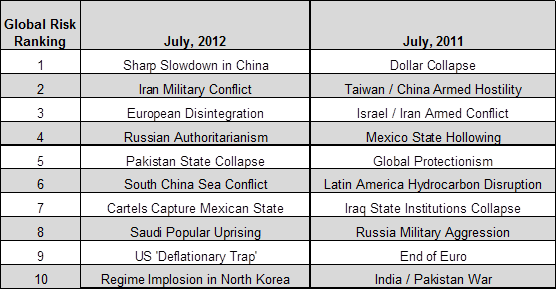
Top 10 Warning Risks in one Infographic

ETF Daily news: Among the top 10 global risks this year, we see ‘Sharp Slowdown in China’ as the most clear and present danger to the world.

Graphic Source: Oxford Analytica, July 1, 2012


Please continue reading at:

Jul 2, 2012

U.S. offering more $50,000 electric cars while china makes them for less than $7,500 tax subsidy.

Tom Konrad CFA

English: Photo of the Tesla Model S, from the ...
The Tesla Model S, from the unveiling on 26-Mar-2009. (Photo credit: Wikipedia)

An EV for the 1%

The chatter among electric vehicle (EV) enthusiasts and investors is all about the launch of the Tesla (NASD:TSLA) model S.  A cool ride, no doubt, but not many of us are ever going to buy a sedan that starts at $49,900, even after the $7,500 tax subsidy.

Fortunately for the rest of us, this week also brought news about two much more affordable EVs.

An EV for the 99%

Chicago EV enthusiasts will soon not have to stump up $50K to ride an EV, they’ll be able to ride an EV for just $2.  That’s because the Chicago Transit Authority (CTA) just placed the first order for two of New Flyer Industries’ (OTC:NFYEF, TSX:NFI) recently launched battery-electric transit bus. The CTA will pay $2.2 million for the buses, and will begin a pilot program to understand how they will operate in Chicago’s harsh climate.

....  The reporter was shown a Kandi tw0-seater, and Kandi’s mini-EVs were identified by a local power company official (which is a partner in the program) to “possibly” be promoted as they are “more suitable for city driving.”

Another official stated that the rental fee would be low and affordable to working class families.  Previous articles have put the monthly rental at 800 yuan a month, or about $126, a price which includes free charging and battery exchanges.   At such low rental prices, Kandi’s $7,500-$8,000 EVs will clearly be favored over their competitors’ EVs, all of which cost more than $20,000.  The next-cheapest competitor, the 

Please continue reading at:

Jul 1, 2012

Will Supreme Court's health care ruling kill Clean Air Act? A qualified "yes."

Within hours of yesterday's monumental Supreme Court ruling upholding the 2010 health care reform law, environmental law scholars were already pondering whether it could have an impact on the Clean Air Act.

Their answer? A qualified "yes."

They focused on two elements of the decision.

...Some see similarities between the Medicaid provisions in the health care law and how the federal government interacts with states over of their role in enforcing the Clean Air Act via so-called state implementation plans, known in U.S. EPA lingo as SIPs.

The federal government has in the past sought to withhold highway funding unless a state plays ball, although disputes have always been settled, according to environmental law experts.

Chief Justice John Roberts wrote in his majority opinion that the Medicaid section of the law was unconstitutional if existing funding was withdrawn if a state didn't want to expand its Medicaid program as part of the 2010 reforms.

"Congress has no authority to order the states to regulate according to its instructions," he wrote. "Congress may offer the states grants and require the states to comply with accompanying conditions, but the states must have a genuine choice whether to accept the offer."

Congress cannot "penalize states that choose not to participate in that new program by taking away their existing Medicaid funding," Roberts concluded.

Please continue reading at:

Electricity generation 'burning' rivers of drought-scorched Southeast.

Power plants are guzzling water across the United States and increasing the risk of blackouts in the Southeast, where the precious resource is drying up.

Please continue reading at:

Toxic Chemicals In Your Home. Who pays for your health problems? @thetoxies

Rather than placing the burden on consumers to prevent disease caused by chemicals, shouldn’t the burden be placed on those who profit (handsomely) from their use? 

By Christina Medina and Rebecca Fuoco, crossposted from California Progress Report

On Sunday an unusual and quirky red carpet award show in Hollywood brought the normally faceless and intangible issue of chemical exposure and regulation to life. The Third Annual “Toxies”, an event put on by Physicians for Social Responsibility-Los Angeles and Californians for a Healthy and Green Economy, featured actors in colorful costumes in-character as toxic chemicals accepting “awards” for the harm they are doing to the American public.

D.W. Moffett who stars in the ABC Family series Switched at Birth and TV Land’s Happily Divorced emceed the event portraying Tex Doolittle, an agent who promotes positive PR for the chemicals by twisting or even denying evidence of their toxicity, the role played in real life by chemical industry lobbyists.

The theatrics of the costumes, red carpet interviews, and acceptance speeches told a story of the overwhelming amount of toxic or untested chemicals (“bad actors”) and their myriad usages (“roles”) in our homes and environment. Halogenated Flame Retardant, dressed in a super hero cape representing her purported (but inaccurate) life-saving fire squelching, accepted her award for “Best Replacement in a Series” by thanking her lobbyists for keeping her in furniture and baby products by altering her chemical formulas and names several times to escape regulation.

Spinning a human twist on the issue made our exposure to these invisible threats more vivid. Simply promoting shopping and personal hygiene tips to avoid these chemicals would be a feeble campaign against this goliath issue. Instead, event coordinator Ana Mascarenas, ended the ceremony by calling for support for the Safe Chemicals Act, Safe Cosmetics Act, and other state and national measures that can help prevent and clean up toxic chemical exposures.

Whereas the upstream solution focuses on reducing the entry of chemicals to homes in the first place, most national and local public health programs use a downstream approach. Instead of limiting production of potentially hazardous chemicals or even requiring manufacturers to submit any toxicity information on new chemicals, the U.S. government spends most of its environmental health resources providing information to consumers on how to reduce exposure to the chemicals already in their homes.  Countless glossy pamphlets are produced each year instructing concerned individuals to take on strict, time-consuming, and quite often expensive house cleaning, food washing, personal hygiene regimens, and shopping guides to prevent chemical ingestion and inhalation.... Please continue reading at: http://generationgreen.org/2012/06/are-toxic-chemicals-in-your-home-your-problem/

Vice President Biden accidentally says right thing, "It's a depression." hon


Photo

Vice President "It's a depression for millions & millions of Americans," "It's a depression."  - Joe Biden

What does that mean? Who knows, because we’re 27th in math @ColbertReport #quotes

“According to (a) report, although only six percent of the global population lives in America, we are responsible for more than a third of its obesity. What does that mean? Who knows, because we’re only 27th in math.”  - STEPHEN COLBERT, The Colbert Report