The Wisconsin Supreme Court dealt a blow to environmentalists concerned about water pollution from huge livestock farms Wednesday, when it said communities couldn't set stricter standards than the state.
Please continue reading at:

The U.S. Agriculture Department has issued a natural disaster declaration for more than1,000 U.S. counties facing severe drought. This disaster declaration is the largest ever from the Agriculture Department and includes one-third of counties and spans 26 states. Some 53 percent of the Midwest is facing moderate or severe drought, but areas beyond the drought’s borders could pay higher world grain prices, due to a poor harvest.
This disaster declaration makes farmers eligible for disaster assistance, but lawmakers will continue to remain silent on the root cause: Climate change. The year of record heat isn’t achance occurrence, but comes from a climate system on steroids, “juiced” by manmade greenhouse gas emissions.

More than one-third of U.S. counties are facing severe drought.
|


The International Energy Agency (IEA) just published an optimistic prediction for the future of renewable energy, suggesting that world-wide green energy usage will increase by forty percent or more by 2017. The agency estimates that the use of wind, solar, hydro and biopower will jump exponentially over the next five years as the world embraces renewable energy, reducing our dependence upon fossil fuels.

Amtrak, the government-owned national rail corporation, on Monday released an ambitious $151 billion plan to develop a high-speed rail line along the currently existing Northeast Corridor rail network by 2040.
The proposed high-speed rail line would travel at top speeds of 220 miles-per-hour in some sections and be able to deliver passengers from Washington, D.C. to Boston in a little over 3 hours.
Travel times between other major Northeastern cities would be shortened even more markedly, with travel times between New York and Boston or New York and Washington, D.C. down to 94 minutes, and a little over a half-hour between New York and Philadelphia.
Compare that to the current fastest Amtrak trains along the route, those in the Acela Express line, which take three-and-a-half hours to get from Boston to New York and a little under three hours to get from Washington, D.C. to New York.
The new Amtrak plan included the following chart showing the estimated time saved as construction on the new plan proceeds over the next 28 years.

"With an expected 30 percent population increase by 2050, we must move beyond mere preservation and rehabilitation of the current system to a new vision for expanded transportation capacity and growth," said Amtrak President and CEO Joe Boardman in a statement.
But the plan proposes that Amtrak spend the next 13 years making improvements and upgrades to the 457 miles of current rail infrastructure in the Northeast Corridor, which stretches from Washington, D.C. to Boston, before laying down the new track that would be necessary for a high speed rail line.
In fact, Amtrak's detailed outline, titled "The Amtrak Vision for the Northeast Corridor: 2012 Update Report," is itself an updated and consolidated version of two other rail plans released by the corporation back in 2010, one focused on improving existing infrastructure and the other on high-speed rail, which Amtrak at that time estimated would cost $117.5 billion
Three of the new Better Buildings Neighborhood Program case studies announced today profile the successes and lessons learned in workforce and small business development efforts in Maine, Oregon, and Pennsylvania, which are training American workers for jobs as energy efficiency professionals. Three additional case studies provide details on how Better Buildings Neighborhood Program partners are leveraging incentives in Maine, Michigan, and Oregon to increase the demand for and availability of energy efficiency upgrades for homes. By providing practical information to help boost the participation of homeowners, engage local partner organizations, expand job training opportunities, and reduce cost barriers, these case studies show how Better Buildings Neighborhood Program partners are creating sustainable business models and impactful programs to help residents live more comfortably and save money.
Additionally, The Better Buildings Business Models Guide is now available to assist Better Buildings Neighborhood Program partners, energy efficiency program administrators, and building contractors deploy successful local energy efficiency initiatives. The guide offers multiple approaches for expanding the range of energy efficiency services available, carrying out effective business strategies, and developing partnerships to deliver home energy upgrades to consumers.
The Energy Department also announced a new video today, Strengthening the Workforce in Better Buildings Neighborhoods, a three-minute piece that captures how Better Buildings Neighborhood Program partners are training and expanding their local contractor workforce.
Please Read Full story at EERE
http://apps1.eere.energy.gov/news/progress_alerts.cfm/pa_id=765
CBO - The recent recession has had a substantial impact on income, the amount of taxes owed, and average tax rates. Changes in households’ before-tax income and average tax rates in 2008 and 2009 were substantial and differed markedly across the income distribution. Average after-tax income fell notably, owing to a drop in market income caused by the recession that began in December 2007 that was only partially offset by increases in government transfers and decreases in federal taxes.
In this report CBO extends its estimates of the distribution of household income and federal taxes through 2008 and 2009, the latest year for which comprehensive data are available, and compares those estimates with estimates for 2007 and for the 1979–2009 period.
...The overall average federal tax rates of 18.0 percent in 2008 and 17.4 percent in 2009 were the lowest in the 1979–2009 period and were well below the previous low of 19.4 percent in 2003 and the average of 21.0 percent over that period. For most income groups, the 2009 average federal tax rate also was the lowest observed in the 1979–2009 period. The pattern in the intervening years is more varied, reflecting the interaction of numerous changes to tax law and changes in the composition and distribution of income.
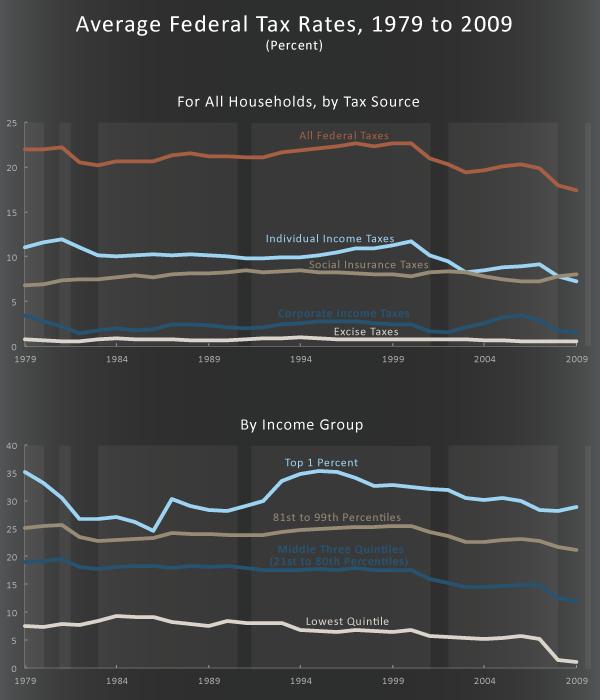
With the decline in before-tax income offset in part by the decrease in federal taxes, average after-tax income fell 10 percent in real terms. The decline in after-tax income for the highest-income households reversed a substantial portion of the sharp rise in their income between 1979 and 2007.
Please see full at Source: http://www.cbo.gov/publication/43373
As part of a new study on wave power, the University of Exeter and Tel Aviv University have come up with a system that predicts the power of waves in order to maximize wave energy devices' ability to generate energy from the sea. The researchers found that this system could potentially double the amount of wave energy generated by a device.Phys.org reports, "The research focused on point absorbers, commonly-used floating devices with parts that move in response to waves, generating energy which they feed back to the grid. Point absorbers are already known to be much more efficient in the amount of energy they produce if their response closely matches the force of the waves and previous research has looked at trying to increase this efficiency. However, this is the first study that has focused on increasing the device's efficiency by predicting and controlling internal forces of the device caused by forthcoming waves."
An Illinois beekeeper whose bee hives were stolen and allegedly destroyed by the Illinois Department of Agriculture has stirred up a hornet's nest with his questions on why the state did this, and most importantly, what they did with his bees.
The state claims the bees were destroyed because they were infected with a disease called foulbrood.
But when the 58-year apiary keeper had his hearing—three weeks after the removal of his bees without his knowledge—the state's "evidence" had disappeared, leaving more questions than answers about the raid on the beekeeper's hives.
Some people, including the beekeeper, Terrence Ingram, suspect the raid has more to do with Ingram's 15 years of research on Monsanto's Roundup and his documented evidence that Roundup kills bees, than it does about any concerns about his hives.
Interestingly, the state's theft targeted the queen bee and hive he'd been using to conduct the research.

This awesome boat, dubbed Firefly, is a six-person boat that is powered entirely by the sun. The first Firefly was built in 2010 by Dan Baker who decided to construct his own pontoon to cruise around Fraser Lake, British Columbia. Originally the Firefly was powered by two trolling motors and a car charger, but today it’s the ultimate 100% solar-powered lake boat. The Firefly got its name from the 900 LED lights that are positioned on the top of the boat.
Read the rest of The Firefly is a 100% Solar-Powered Boat That Only Costs $2900!

While China’s build‐out of “smart cities” is significantly smaller than the hype might suggest, it still represents a $153 billion opportunity across 54 projects, mostly in the southern and eastern provinces. This week’s graphic appeared in a report (client registration required) published in March by Lux Research’s China Innovation Intelligence Service. It illustrates analysis revealing that over half – 31 – of China’s smart city projects are slated to unfold in cities that in 2010 yielded a minimum GDP of USD 100 billion (Tier A) and USD 60 billion (Tier B).
In terms of the speed at which these projects are unfolding, 15 are already under construction. Another 21 were announced with details such as investment amount, smart city applications involved, project deadline, and even participating suppliers. Fifteen additional smart city projects rated an official announcement, but few details to date. Finally, three Tier C cities – with a minimum 2010 GDP of USD 15 billion – have expressed an intention to launch projects, but haven’t formally announced them yet.
