Please continue reading at:
Jul 17, 2012
Utility suggested downgrading leaks to cut costs before Bruno pipeline explosion — and potentially not fixing them
Please continue reading at:
Jul 16, 2012
#Chemical #Safety for #Sustainability (CSS) Free Webinar/Seminar: Life-Cycle Considerations
This presentation will be followed up by a discussion session led by Matthew Small of Region 9. The discussion session will cover topics on regional office and program office regulatory needs, scientific interest and how CSS development of life-cycle data, tools and research can help to meet those needs.
Registration not necessary. Click the link or dial in via teleconference at the scheduled time.
Contact Information:
URL: https://epa.connectsolutions.com/csswebinar/
New #DOE Database Makes Costs of #Energy #Tech More Transparent for #wind #solar#biofuel
Read Full Story at EERE
JOB in Environmental Pathology/Toxicology Fellowship Available (Wash -DC)
Please have your candidates visit the site below to apply, but please note the modifications below.
http://www.pathology.washington.edu/academics/ept/apply/
1. Completed Application Form
2. Project Title and Abstract
3. All Collegiate Institution Transcripts
4. One letter of recommendation from advisor; two additional recommendation letters will be needed but can be submitted after deadline
5. CV 6. Summary of Project's Relevance to EP/T and Career Plans (up to half page)
7. Project Proposal (up to three pages)
Thank you and we look forward to your submissions!
East Texas Getting Compressed Air Energy Storage Plant - via @Slashdot
Jul 15, 2012
Via @Nature - Global cooling. Roman times were higher than current temperatures
Please read full and follow at:
http://science.slashdot.org/story/12/07/11/1559252/nature-global-temperatures-are-a-falling-trend
Why Ultra-Efficient 4,000 mph Vacuum-Tube Trains Aren't Being Built - Slashdot
A Build-It-Yourself Electric Vehicle
"Chemical intolerance" a common complaint.
Please continue reading at:
Study finds association between phthalates and risk of diabetes.
Please continue reading at:
Jul 14, 2012
Minnesota Town to Tap into its Own Sewers for Geothermal Energy
Cities and companies around the world tap into geothermal energy — the thermal energy below the Earth’s surface — but there’s another type of man-made energy coursing through sewer pipes beneath cities and towns: sewage. The town of Brainerd, Minnesota plans to develop a unique alternative energy system that will tap into the thermal energy in sewer pipes to heat and cool buildings.
Read the rest of Minnesota Town to Tap into its Own Sewers for Geothermal Energy
Infographic Compares Acting Green Vs Buying Green Products
Green products enable us to live healthier, more efficient lifestyles – but even if you’ve upgraded every light bulb and appliance in your house to the most environmentally-friendly model, you can still eek out even more efficiency by adopting greener habits. For example, you use the same amount of water with a low-flow shower head in a 15 minute shower, as a 9 minute shower with a regular shower head. If you also limited the amount of your shower in combination with a low-flow fixture, you are saving a ton! Check out eLocal‘s infographic on Acting Green vs. Buying Green after the break for more ways to lower your carbon footprint by living a greener lifestyle.
The article above was submitted to us by an Inhabitat reader. Want to see your story on Inhabitat? Send us a tip by following this link. Remember to follow our instructions carefully to boost your chances of being chosen for publishing!
Read the rest of Infographic Compares Acting Green Vs Buying Green Products
The popular news you read is now written by machines
The new reporter on the US media scene takes no coffee breaks, churns out articles at lightning speed, and has no pension plan.
That's because the reporter is not a person, but a computer algorithm, honed to translate raw data such as corporate earnings reports and previews or sports statistics into readable prose.
Algorithms are producing a growing number of articles for newspapers and websites, such as this one produced by Narrative Science...
Please continue reading at: http://ca.news.yahoo.com/reporter-call-him-al-algorithm-190751150.html
In historic drought... Wisconsin town barred from beefing up farm water rules.
Please continue reading at:
Lifetime thyroid doses of radiation in Fukushima children.
Please continue reading at:
Drought Covers One-Third Of U.S. Counties, The Largest Agricultural Disaster Area Ever Declared
The U.S. Agriculture Department has issued a natural disaster declaration for more than1,000 U.S. counties facing severe drought. This disaster declaration is the largest ever from the Agriculture Department and includes one-third of counties and spans 26 states. Some 53 percent of the Midwest is facing moderate or severe drought, but areas beyond the drought’s borders could pay higher world grain prices, due to a poor harvest.
This disaster declaration makes farmers eligible for disaster assistance, but lawmakers will continue to remain silent on the root cause: Climate change. The year of record heat isn’t achance occurrence, but comes from a climate system on steroids, “juiced” by manmade greenhouse gas emissions.

More than one-third of U.S. counties are facing severe drought.
Research murky on danger of Asian carp invasion.
Please continue reading at:
Cookstoves threaten health of 3 billion people as solution remains elusive.
Please continue reading at:
Apple back to protecting environment, will relist products on EPEAT | Resource Recycling
|
Voyage studying plastic waste in Great Lakes sets sail.
Please continue reading at:
Jul 13, 2012
Sewage as energy: An essentially unlimited renewable resource.
Please continue reading at:
Canada's environment minister to crack down on "third world" sewage practices.
Please continue reading at:
Gulf oil spill had dramatic impact on microscopic life, study suggests.
Please continue reading at:
Renewable energy could provide 80% of US electricity - at what cost?
Please continue reading at:
Crop technology helps limit corn losses in drought.
Please continue reading at:
Update: Midwest drought slashes US corn estimate, jolts market.
Please continue reading at:
Disaster declared in 26 states as drought sears US.
Please continue reading at:
Jul 11, 2012
Stanford scientists give new life to Thomas Edison's nickel-iron battery

Triboelectric generator could allow electricity-generating touchscreens

Cost-effective solar power module energy twice as efficiently, could also serve as an eco-friendly furnace

IEA Predicts 40 Percent World-Wide Increase of Renewable Energy Usage by 2017
The International Energy Agency (IEA) just published an optimistic prediction for the future of renewable energy, suggesting that world-wide green energy usage will increase by forty percent or more by 2017. The agency estimates that the use of wind, solar, hydro and biopower will jump exponentially over the next five years as the world embraces renewable energy, reducing our dependence upon fossil fuels.
Read the rest of IEA Predicts 40 Percent World-Wide Increase of Renewable Energy Usage by 2017
Jul 10, 2012
Amtrak Unveils $151B Plan For Northeast High Speed Rail By 2040 | TPM Idea Lab

Amtrak, the government-owned national rail corporation, on Monday released an ambitious $151 billion plan to develop a high-speed rail line along the currently existing Northeast Corridor rail network by 2040.
The proposed high-speed rail line would travel at top speeds of 220 miles-per-hour in some sections and be able to deliver passengers from Washington, D.C. to Boston in a little over 3 hours.
Travel times between other major Northeastern cities would be shortened even more markedly, with travel times between New York and Boston or New York and Washington, D.C. down to 94 minutes, and a little over a half-hour between New York and Philadelphia.
Compare that to the current fastest Amtrak trains along the route, those in the Acela Express line, which take three-and-a-half hours to get from Boston to New York and a little under three hours to get from Washington, D.C. to New York.
The new Amtrak plan included the following chart showing the estimated time saved as construction on the new plan proceeds over the next 28 years.

"With an expected 30 percent population increase by 2050, we must move beyond mere preservation and rehabilitation of the current system to a new vision for expanded transportation capacity and growth," said Amtrak President and CEO Joe Boardman in a statement.
But the plan proposes that Amtrak spend the next 13 years making improvements and upgrades to the 457 miles of current rail infrastructure in the Northeast Corridor, which stretches from Washington, D.C. to Boston, before laying down the new track that would be necessary for a high speed rail line.
In fact, Amtrak's detailed outline, titled "The Amtrak Vision for the Northeast Corridor: 2012 Update Report," is itself an updated and consolidated version of two other rail plans released by the corporation back in 2010, one focused on improving existing infrastructure and the other on high-speed rail, which Amtrak at that time estimated would cost $117.5 billion
#Energy Department Announces New Case Studies, Business Models to Support Energy Efficiency Upgrade Programs
EERE News July 10, 2012 - As part of the Obama Administration's all-of-the-above strategy to reduce energy costs for consumers and American businesses, the Energy Department today released a new suite of resources supporting the design and implementation of energy efficiency upgrade programs. Developed through the Department's Better Buildings Neighborhood Program, these new resources include six case studies, a business model guide, and a video, all of which leverage the experiences and knowledge of participating partners in testing new program models while upgrading more than 20,000 homes. These tools will help communities across the country replicate successful energy efficiency programs—creating new jobs and business opportunities and saving consumers money on their utility bills.
Three of the new Better Buildings Neighborhood Program case studies announced today profile the successes and lessons learned in workforce and small business development efforts in Maine, Oregon, and Pennsylvania, which are training American workers for jobs as energy efficiency professionals. Three additional case studies provide details on how Better Buildings Neighborhood Program partners are leveraging incentives in Maine, Michigan, and Oregon to increase the demand for and availability of energy efficiency upgrades for homes. By providing practical information to help boost the participation of homeowners, engage local partner organizations, expand job training opportunities, and reduce cost barriers, these case studies show how Better Buildings Neighborhood Program partners are creating sustainable business models and impactful programs to help residents live more comfortably and save money.
Additionally, The Better Buildings Business Models Guide is now available to assist Better Buildings Neighborhood Program partners, energy efficiency program administrators, and building contractors deploy successful local energy efficiency initiatives. The guide offers multiple approaches for expanding the range of energy efficiency services available, carrying out effective business strategies, and developing partnerships to deliver home energy upgrades to consumers.
The Energy Department also announced a new video today, Strengthening the Workforce in Better Buildings Neighborhoods, a three-minute piece that captures how Better Buildings Neighborhood Program partners are training and expanding their local contractor workforce.
Please Read Full story at EERE
http://apps1.eere.energy.gov/news/progress_alerts.cfm/pa_id=765
#CBO - Income for All Households Fell 12% from 2007 to 2009 in Real (Inflation-Adjusted) Terms
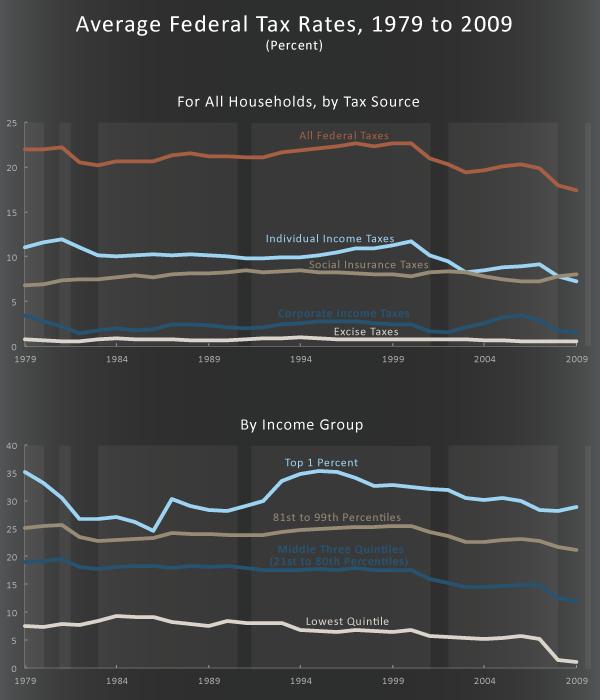
CBO - The recent recession has had a substantial impact on income, the amount of taxes owed, and average tax rates. Changes in households’ before-tax income and average tax rates in 2008 and 2009 were substantial and differed markedly across the income distribution. Average after-tax income fell notably, owing to a drop in market income caused by the recession that began in December 2007 that was only partially offset by increases in government transfers and decreases in federal taxes.
In this report CBO extends its estimates of the distribution of household income and federal taxes through 2008 and 2009, the latest year for which comprehensive data are available, and compares those estimates with estimates for 2007 and for the 1979–2009 period.
Average Before-Tax Income for All Households Fell 12 Percent from 2007 to 2009 in Real (Inflation-Adjusted) Terms
...The overall average federal tax rates of 18.0 percent in 2008 and 17.4 percent in 2009 were the lowest in the 1979–2009 period and were well below the previous low of 19.4 percent in 2003 and the average of 21.0 percent over that period. For most income groups, the 2009 average federal tax rate also was the lowest observed in the 1979–2009 period. The pattern in the intervening years is more varied, reflecting the interaction of numerous changes to tax law and changes in the composition and distribution of income.

With the decline in before-tax income offset in part by the decrease in federal taxes, average after-tax income fell 10 percent in real terms. The decline in after-tax income for the highest-income households reversed a substantial portion of the sharp rise in their income between 1979 and 2007.
Please see full at Source: http://www.cbo.gov/publication/43373California's $100 billion Bullet Train May to Nowhere...while running $16 billion budget deficit
After clearing a major legislative hurdle, California's proposed bullet train between Los Angeles and San Francisco still faces obstacles—including lawsuits and uncertainties over future funding—that could delay it for years. Friday's narrow state Senate vote approving $4.7 billion in bonds for the train and related projects sends the funding bill to a likely signing by Gov. Jerry Brown, a proponent of high-speed rail. Defining Insanity Down. By Victor Davis Hanson - There are lots of insane things about California, like going ahead with a $100 billion high-speed rail project — while running a $16 billion budget deficit — designed to run, in the first phase, from above Fresno to Corcoran, apparently for those tourists interested in visiting at high speed Charles Manson in the Corcoran prison at the end of the proposed line.