Oct 10, 2012

The 12th Annual Great Lakes Beach Association Conference will be held October 16-18 (Free Webinar Series)

The 12th Annual Great Lakes Beach Association Conference will be held October 16-18, 2012, on Mackinac Island, Michigan. For conference information and agenda, please go to:
http://www.glin.net/glba/2012conference.html

For those unable to travel to the conference, you may tune in via webinar. Following are web links to register for the conference sessions.
Great Lakes Beach Association Conference - Workshops
Tue, Oct 16, 2012 8:00 AM - 12:00 PM EDT
Registration Web Link: https://www1.gotomeeting.com/register/665907280

Great Lakes Beach Association Conference - Workshops (continued)
Tue, Oct 16, 2012 1:00 PM - 5:00 PM EDT
Registration Web Link: https://www1.gotomeeting.com/register/859258601

Great Lakes Beach Association Conference - Opening session
Wed, Oct 17, 2012 8:00 AM - 9:40 AM EDT
Registration Web Link: https://www1.gotomeeting.com/register/588503649

Great Lakes Beach Association Conference - Great Lakes Restoration Initiative success stories
Wed, Oct 17, 2012 10:00 AM - 12:00 PM EDT
Registration Web Link: https://www1.gotomeeting.com/register/384591393

Great Lakes Beach Association Conference - Management of beaches
Wed, Oct 17, 2012 1:20 PM - 3:00 PM EDT
Registration Web Link: https://www1.gotomeeting.com/register/602551705

Great Lakes Beach Association Conference - Communicating beach water quality to the public
Wed, Oct 17, 2012 3:20 PM - 5:00 PM EDT
Registration Web Link: https://www1.gotomeeting.com/register/749188553

Great Lakes Beach Association Conference - Physical, hydrological and geological
Thu, Oct 18, 2012 8:00 AM - 10:00 AM EDT
Registration Web Link: https://www1.gotomeeting.com/register/590424128

Great Lakes Beach Association Conference - Sources and sinks of fecal contamination
Thu, Oct 18, 2012 10:20 AM - 12:00 PM EDT
Registration Web Link: https://www1.gotomeeting.com/register/814214609

Great Lakes Beach Association Conference - Predictive tools and rapid testing
Thu, Oct 18, 2012 12:50 PM - 2:10 PM EDT
Registration Web Link: https://www1.gotomeeting.com/register/188265473

Great Lakes Beach Association Conference - Predictive tools and rapid testing (continued)
Thu, Oct 18, 2012 2:20 PM - 4:00 PM EDT
Registration Web Link: https://www1.gotomeeting.com/register/692422345

How California is harnessing P2 to make safer products

Twenty-two years ago, the Pollution Prevention Act marked a significant change in how U.S. companies manage hazardous waste. Shifting away from an “end of the pipe” approach to controlling chemical hazards, it focused on controlling those hazards at their source and marked a major change in how we think about protecting our health and preserving the environment.

Today, we are in the midst of another change, one that will further the vision of pollution prevention by advancing efforts to find safer alternatives to toxic ingredients in consumer products.

Building on the foundational efforts of several countries and at least four states, California has released the nation’s first comprehensive approach for reducing toxics in products. Our proposed Safer Consumer Products Regulation requires manufacturers to ask the questions: “Is this toxic ingredient necessary?” and “Is there a safer alternative?”

The regulation takes pollution prevention to a higher level. P2 programs well understood that finding safer alternatives for the toxic chemicals in our products provides a long-lasting sustainable approach to environmental protection. Instead of reducing the use of chemicals that threaten our health and contaminate our environment, our new approach mandates the rethinking of ingredients during the design phase of a product. That mandate is a fundamental change in the way the department regulates toxics in consumer products.

The alternative assessment process is an essential component of this effort. The assessment affects manufacturers whose products contain one or more ingredients designated as a “chemical of concern” that has the ability to cause health or environmental impacts and where there is evidence of exposure. Boiled down to its most essential element, the assessment is meant to determine if a particular toxic ingredient is necessary, and to compare that ingredient with alternatives, giving consideration to life cycle impacts; impacts on product function; performance and legal requirements; and economic impacts.

If a safer alternative is not feasible, or cannot be found, the department is now authorized to impose a number of regulatory responses including mandating end-of-life management, use restrictions, engineering or administrative controls, the funding of research to design safer alternatives and ultimately a ban on sales in California.

Read more by Debbie Raphael here
http://www.greenbiz.com/blog/2012/10/09/how-california-harnessing-p2-safer-products


Energy from Wisconsin Cow Manure Could Replace A Coal Plant, Report Says

MADISON - According to a recent Wisconsin Bioenergy Initiative (WBI) study, Wisconsin can be a national leader in bioenergy production using waste from the state's prosperous agriculture and food processing sectors.

In dairy cow manure alone, the report found 4.77 million dry tons available per year, which is the potential energy equivalent of replacing a large-scale coal plant.

read more

Controversial study finds little environmental impact from oil sands.

Downstream communities have long pointed the finger at oil-sands operations for sullying water, fish and people with toxics. But a new study concludes that the level of pollutants travelling by air and water through these communities are not high enough to merit the concern.

Please continue reading at:

High cancer numbers around California Superfund site.

When Jane Horton first heard about a huge plume of toxic chemicals found under the ground in her neighborhood she worried about her family’s health as well as the long term health of her neighbors. Now some of those fears appear to have been at least partially realized.

Please continue reading at:

Oct 9, 2012

The most polluted place in the world

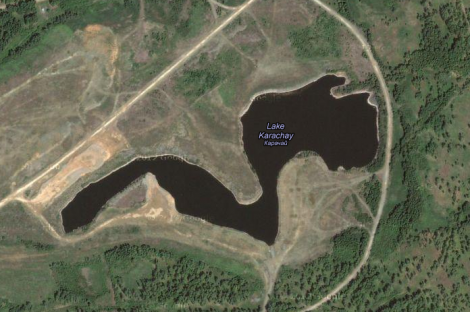
At Grist, Jess Zimmerman has an interesting piece about a lake near a notoriously leaky former Soviet nuclear research site, where the radiation level is so high that an hour on the beach can be enough to kill you.

You can’t really blame Lake Karachay for acting up — it comes from a really rough area. The lake is located within the Mayak Production Association, one of the largest — and leakiest — nuclear facilities in Russia. The Russian government kept Mayak entirely secret until 1990, and it spent that period of invisibility mainly having nuclear meltdowns and dumping waste into the river. By the time Mayak’s existence was officially acknowledged, there had been a 21 percent increase in cancer incidence, a 25 percent increase in birth defects, and a 41 percent increase in leukemia in the surrounding region of Chelyabinsk. The Techa river, which provided water to nearby villages, was so contaminated that up to 65 percent of locals fell ill with radiation sickness — which the doctors termed “special disease,” because as long as the facility was secret, they weren’t allowed to mention radiation in their diagnoses. Read the rest at Grist

Green Car Congress: Ford Fiesta ECOnetic wins ALD Automotive/Shell Marathon with 90.6 mpg US; benefits of smart driving techniques

The Ford Fiesta ECOnetic 1.6 TDCi won the 2012 ALD Automotive/Shell FuelSave MPG Marathon in the UK, clocking up 108.78 mpg UK (90.6 mpg US, 2.6 l/100 km) over a 370-mile route involving tough, real-world driving in challenging weather conditions.

Please read full and follow at:

Oct 8, 2012

Superweeds, Superpests: The Legacy of Pesticides - via @NYTimes

The rapid adoption of a single weed-killer for the vast majority of crops harvested in the United States has given rise to superweeds and greater pesticide use, a new study suggests. Roundup was supposed reduce the need to apply harsher chemicals, but instead farmers now must use more herbicides.

Please continue reading at:
http://green.blogs.nytimes.com/2012/10/05/the-legacy-of-pesticides-superweeds...

Lowe’s, Kohler, KB Home Win EPA Water Awards

Lowe’s, Kohler, KB Home Win EPA Water AwardsLowe’s helped its customers save about 4 billion gallons of water last year, and Kohler introduced 40 new water-efficient toilet models to the North American market in 2011, earning both companies EPA awards. Colorado Springs Utilities, American Standard Brands and KB Home also received 2012 WaterSense partners of the year awards for their water-conservation efforts. [...]

Please continue reading at:

Oct 7, 2012

‘We don’t need to build more highways out in the suburbs’

When it comes to infrastructure, politicians usually prefer shiny new projects over humdrum repairs. A brand-new highway is exciting: There's a ribbon-cutting, and there's less need to clog up existing lanes with orange cones and repair crews. So it's not surprising that 57 percent of all state highway funding goes toward new construction, often stretching out to the suburbs, even though new roads represent just 1.3 percent of the overall system. Now Brad Plumer writes in the Washington Post that many transportation reformers think this is a wrong-headed approach and that we should focus our dollars on fixing and upgrading existing infrastructure rather than continuing to build sprawling new roads). UCLA economist Matthew Kahn and the University of Minnesota's David Levinson made a more detailed case for a "fix-it first" strategy. They noted that, at the moment, federal highway spending doesn't get subjected to strict cost-benefit analysis, and governments often build new roads when they arguably shouldn't (PDF). And that's to say nothing of data suggesting that poor road conditions are a "significant factor" in one-third of all fatal crashes, and cause extra wear and tear on cars."
Please continue reading at:
http://www.washingtonpost.com/blogs/ezra-klein/wp/2012/10/03/we-dont-need-to-build-more-highways-out-in-the-suburbs/

Oct 6, 2012

Oct. 5 US: EPA Has Received Data on Half of Chemicals Slated for Risk Assessments in 2013, 2014

This article is brought to you by Bloomberg BNA concerning data received by the EPA on chemicals for risk assessment.

Chemical manufacturers provide EPA data on half of the chemicals for which it sought information for risk assessments in 2013 and 2014.

“Submissions have been received and posted to the docket on 1,1,2-trichloroethane, 1,2-dichloroethane, 4-tert-octylphenol, the four ethanone fragrance chemicals, 2,6-di-tert-butyl-4-sec-butylphenol, and 1-bromopropane,” EPA said in a Sept. 27 response to emailed questions. The agency has not posted additional information since that date.

“All of the information being received is being placed in docket EPA-HQ-OPPT-2011-0516 unless there are copyright concerns or claims of confidential business information,” EPA said.

The 18 chemicals were selected from a list of 83 compounds for which EPA’s Office of Pollution Prevention and Toxics (OPPT) plans to conduct risk assessments over the next several years (36 CRR 269, 3/5/12).

OPPT’s risk assessment effort is part of the agency’s initiative, announced in 2009, to increase its examinations of chemicals that are on the U.S. market and to regulate them when necessary (33 CRR 993, 10/12/09).

For more information, links and the full article please refer to the link above and read more updates at http://www.nexreg.com/regulatorynews/index.php/2012/10/05/oct-5-usepa-has-received-data-on-half-of-chemicals-slated-for-risk-assessments-in-2013-2014/

Obesity among baby boomers is more than double the rate of their parents at the same age, with chronic Obesity among baby boomers is more than double the rate of their parents at the same age, and boomers with three or more chronic conditions was 700 perc

....It seems like there is a health food store or a vitamin store on almost every corner, and yet as a whole we are in much worse condition than our parents were.  The following is from a recent news story by the CBS News affiliate in Washington D.C.....

Obesity among baby boomers is more than double the rate of their parents at the same age, and boomers with three or more chronic conditions was 700 percent greater than the previous generation.

But it isn't just the Baby Boomers that are obese.  Sadly, obesity has become a raging epidemic in America and all of the numbers show this.

For example, a study by the RAND corporation discovered that the percentage of Americans that are severely obese rose from 3.9 percent in the year 2000 to 6.6 percent in 2010.

That is a huge increase in just a decade.

And the numbers are even more sobering when you look at the percentage of Americans that are just obese (rather than being severely obese).

As I wrote about the other day36 percent of all Americans are considered to be obese, and it is being projected that by 2030 that number will rise to 42 percent.

To put that in perspective, it is important to note that only 13 percent of all Americans were obese back in 1962.

Sadly, not only are we getting fatter, many of us are also living shorter lives.

In a previous article, I quoted a CBS News story that discussed recent research which shows that the lifespans of poor Americans have been dropping rapidly in recent years....

Overall life expectancy has dropped for white Americans who have less than a high school diploma to rates similar to those of the 1950s and 1960s, new research finds.

The study found non-Hispanic white men without a diploma lived on average until 67.5 in 2008, three years less than they did in 1990. The drop in lifespan was even bigger for non-Hispanic white women with low education: They live five years shorter than 1990 rates, from 78 years old to just 73.5.

Why are people not living as long?

Well, our lifestyles certainly are not helping things.  The average American watches 28 hours of television every single week.  That is not conducive to a long and happy life.

But of course a lot of other factors are at play as well.

When you don't have a lot of money, you can't afford to eat healthy and you can't afford to go see the doctor much.

Please continue reading at:

The Federal Reserve Sends Thank You Letters To Congress For Allowing Them To Destroy Our Economy

...Sadly, most Americans don't even realize that the Federal Reserve has more control over our economy than anyone else does.  Most Americans that are actually concerned about politics are busy arguing over whether Obama or Romney will be better for the economy when it is actually the Fed that controls the levers of economic power.

Just think about it.

The Federal Reserve played a major role in creating the housing bubble which severely damaged our financial system a few years ago.

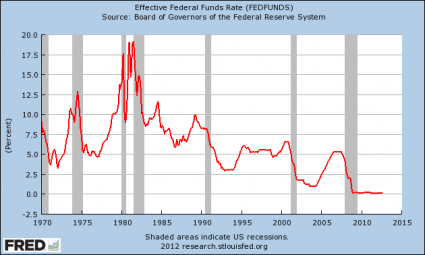
As the chart below shows, after 9/11 the Federal Reserve dropped interest rates to historically low levels.  This allowed potential home buyers to get into much larger mortgages, and the big banks (which the Fed supposedly "regulates") started making home loans to almost anyone with a pulse.

When interest rates started to go back up to normal levels in 2005, many home owners discovered that their adjustable rate mortgages started to become much more painful.  By 2007, we started to see a massive wave of mortgage defaults.  In 2008, the financial system crashed.

In response to the financial crisis of 2008, the Federal Reserve dropped interest rates to record low levels.  The effective federal funds rate is essentially at zero at this point, and the Fed has promised to keep interest rates at ultra-low levels all of the way into 2015.

But didn't artificially low interest rates cause many of our problems in the first place?  The central planners over at the Fed are convinced that this is the right course for our economy, but can we really live in a zero interest rate bubble indefinitely?  Won't this eventually cause even greater problems?....

The Fed is also destroying our economy by recklessly printing money.

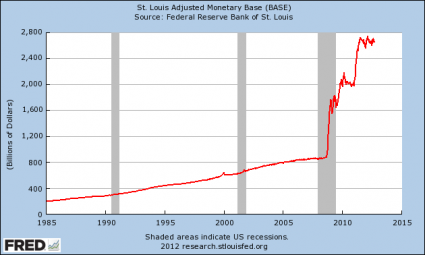
Once upon a time, the U.S. monetary base rose at a very steady pace.  But since the financial crisis of 2008, Ben Bernanke has been flooding the financial system with money and this has caused an unprecedented explosion in our money supply.

It isn't too hard to see from this chart what the foolish "quantitative easing" policies of the Federal Reserve have done to our monetary base....

Fortunately a lot of the money from previous rounds of quantitative easing is being stashed by the big banks as "excess reserves" with the Federal Reserve, but when that money starts flowing into the "real economy" (and it will at some point), we are going to have a major problem on our hands.

But more than tripling our monetary base was not enough for Bernanke.  He recently announced yet another round of quantitative easing which he says will last indefinitely.

Basically, Bernanke is taking a sledgehammer to the U.S. dollar.  Our currency is being systematically destroyed, and the U.S. Congress is standing by and doing nothing.

For a lot more on why QE3 is going to be so incredibly destructive for our economy, please see the following five articles....

-"QE3: Helicopter Ben Bernanke Unleashes An All-Out Attack On The U.S. Dollar"

-"How QE3 Will Make The Wealthy Even Wealthier While Causing Living Standards To Fall For The Rest Of Us"

-"The Federal Reserve Is Systematically Destroying Social Security And The Retirement Plans Of Millions Of Americans"

-"QE4? The Big Wall Street Banks Are Already Complaining That QE3 Is Not Enough"

-"Quantitative Easing Did Not Work For The Weimar Republic Either"

The Federal Reserve seems to think that printing more money is always the solution to whatever economic problems we are having.

But of course the Fed has been debasing our currency from the very beginning.  The entire Federal Reserve system is designed to create inflation.

From the time that the Federal Reserve was created back in 1913, the purchasing power of a U.S. dollar has declined from $1.00 to only about 4 pennies today.

And now Bernanke seems bound and determined to wipe out those last 4 pennies.

The Federal Reserve system was also designed to create a never ending spiral of government debt.

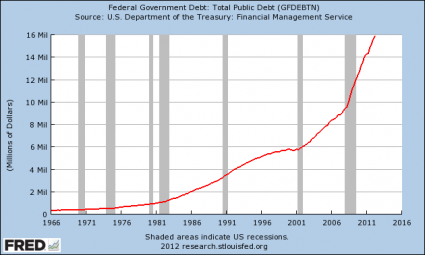
Sadly, most Americans simply have no idea where money comes from.  Most Americans have no idea that money that the Federal Reserve zaps into existence out of thin air is loaned to the U.S. government at interest.  Most Americans have no idea that the primary reason why we are 16 trillion dollars in debt is because this is what the system was designed to do to us.

Today, the U.S. national debt is more than 5000 times larger than it was when the Federal Reserve was originally created in 1913.  This did not happen by accident....

Not that our politicians should be off the hook for this.  They have been spending money as if there is no tomorrow.  Most of them have shown no concern at all about the legacy of debt that they are passing on to future generations of Americans.

If our politicians had been more responsible, the national debt would still be there, but it would be at a much more manageable level.

If we ever want to totally get rid of our national debt, the Federal Reserve must be abolished.

There is no other way.

And government debt is not the only bubble that the Federal Reserve has pumped up.

The following is a chart that shows the growth of all forms of debt (government, business, consumer, etc.) in the United States.  The total amount of debt in the United States has grown from less than $2 trillion to more than $55 trillion over the past 40 years....

How in the world could we have been so foolish?

How in the world did we allow the total amount of debt in our country to get more than 27 times larger over the past 40 years?

As you can see, there was a slight "hiccup" in the bubble as a result of the financial crisis of 2008, but now it has started growing again.

At this point our entire financial system is based on debt, and if the debt bubble does not continue to expand the entire thing will collapse.

But no financial bubble grows forever.  History has proven that to us over and over.

At some point this bubble is going to burst.

Please read full and follow at:

The People Who Made Your iPhone Just Went On Strike

There's a huge labor strike happening at Foxconn's Zhenzhou factory in China, involving thousands of workers.

Source: chinalaborwatch.org

There's a massive labor strike happening right now at Foxconn's Zhengzhou factory, China Labor Watch reports, and it's very much tied to the way the iPhone 5 is produced, as Gizmodo noticed.

The 3,000-4,000 striking workers mostly come from the onsite quality control line, where workers were most directly affected by "overly strict demands on product quality" implemented by Foxconn over the holiday:

According to workers, multiple iPhone 5 production lines from various factory buildings were in a state of paralysis for the entire day. It was reported that factory management and Apple, despite design defects, raised strict quality demands on workers, including indentations standards of 0.02mm and demands related to scratches on frames and back covers. With such demands, employees could not even turn out iPhones that met the standard. This led to a tremendous amount of pressure on workers. On top of this, they were not permitted to have a vacation during the holiday.

That account echoes what an undercover journalist from the Shanghai Morning Post that worked at Foxconn for two weeks reported:

I’m being assigned to mark placement points on the iPhone 5 back-plate using an oil-based paint pen. I’m being scolded many times for spilling too much oil on the markings. My roommate has being assigned to paste the masking tapes of not more than 5mm wide on the right spots that I have marked. And he has being scolded many times for pasting them too slow. Our supervisor said that these works [sic] were actually being assigned to females workers with nimbler fingers, but due to too many workers have resigned lately they have no choice but to assign these jobs to male workers

Please read full and follow at:

Why Waterless Worm compost Toilet Might Be a Good Idea

Billions worldwide still don't have access to proper sanitation, and those that do still require a ton of water and electricity to keep waste flowing. A French company is offering one solution: Use turd-eating worms to compost waste right at the source. Ecosphere Technologies has developed an outhouse that, rather than relying on chemicals like a port-a-john, relies on about a pound of red wiggler worms. A new installation in Quebec uses imported worms, placed inside of a mixture of dung and straw underneath to toilet, to devour feces delivered to them by a conveyor belt system. (When someone uses the toilet, pee filters through sand to wash away, while a pedal allows the user to transport their poo to the worm space.) The whole system uses no water or electricity, and a series of passive vents allegedly keeps the toilet smelling great. The company claims it can be used 10,000 times without servicing, which is far better than what a port-a-potty can boast, although with a current price tag of
Please read full and follow at:
http://science.slashdot.org/story/12/10/05/2245206/why-worms-in-the-toilet-might-be-a-good-idea

Fiscal cliff could cost U.S. households an extra US$3,446 in taxes “This is a very large tax increase,”

U.S. households are facing an average tax increase of $3,446 in 2013 if Congress doesn’t avert the so-called fiscal cliff, the nonpartisan Tax Policy Center said in a study released Monday.

The top 1% of households face some of the largest tax increases in 2013 and would see their after-tax incomes fall by 10.5% if Congress does nothing. That would translate to an average tax increase of $120,537 for that group.

A typical middle-income household earning between about US$40,000 and US$60,000 would face a tax increase of about US$2,000.

After the Nov. 6 election, Congress is scheduled to return to Washington to debate the automatic spending cuts and tax increases starting in January unless lawmakers act. For calendar year 2013, taxes would increase by US$536-billion, or about 20%.

“This is a very large tax increase,” Donald Marron, the center’s director, told reporters in Washington Monday.


Please read full and follow at:
http://business.financialpost.com/2012/10/01/fiscal-cliff-could-cost-u-s-hous...

Oct 5, 2012

Across America; Water Prices Double & Triple as days of endless clean & cheap water are behind us.

It’s often overlooked and taken for granted, but it’s the most essential of all human resources.

Water.

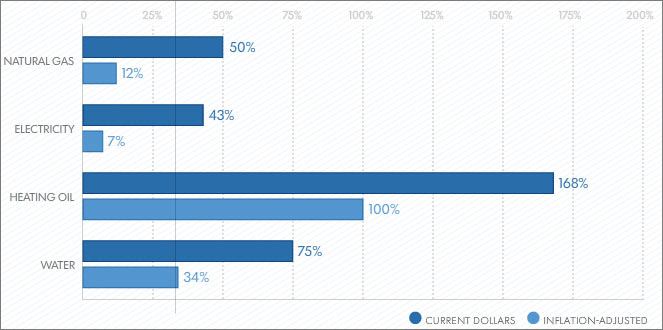
We’re paying 75% more for it today than we were in the year 2000.

According to a recent study by USA Today, which looked at 100 large municipalities across the country, the price increases over the last decade are so significant that many Americans are having to cut other expenses just to keep up:

…the cost of this necessity of life has outpaced the percentage increases of some of these other utilities, carving a larger slice of household budgets in the process.

“I don’t know how they expect people to keep paying more for water with the cost of gas and day care and everything else going up,” complains Jacquelyn Moncrief, 60, a Philadelphia homeowner who says the price hikes would force her to make food-or-water decisions. She gathered signatures on a petition opposing a proposed water rate increase in her city this year.

USA Today’s study of residential water rates over the past 12 years for large and small water agencies nationwide found that monthly costs doubled for more in 29 localities. The unique look at costs for a diverse mix of water suppliers representing every state and Washington, D.C. found that a resource long taken for granted will continue to become more costly for millions of Americans. Indeed, rates haven’t crested yet because huge costs to upgrade or repair pipes, reservoirs and treatment plants loom nationwide.

In three municipalities — Atlanta, San Francisco and Wilmington, Del. —water costs tripled or more.

Source: USA Today

According to the report, we can expect rates to continue to rise at a whopping 5% to 15% per year going forward, and for a variety of reasons.

The trend toward higher bills is being driven by:

- The cost of paying off the debt on bonds municipalities issue to fund expensive repairs or upgrades on aging water systems.

- Increases in the cost of electricity, chemicals and fuel used to supply and treat water.

- Compliance with federal government clean-water mandates.

- Rising pension and health care costs for water agency workers.

- Increased security safeguards for water systems since the 9/11 terror attacks

One critical aspect USA Today failed to mention as a reason for higher prices and the adverse effects on our purchasing power is, of course, monetary expansion over this same time period. While water prices are up in the high double digits over the last decade, the same cannot be said for Americans’ wages.

Taking that into consideration, we may well see rates go even higher than estimated.

Coupled with an ever expanding global population, the notion that countries will soon be fighting water wars over this critical resource is not out of the question.

Please read full and follow at:
http://www.shtfplan.com/commodities/report-water-prices-rise-sharply-across-america-double-and-triple-in-some-locales_10012012

Yale Environment 360: Decline in Fisheries Can Still be Reversed, Study Says

Although the majority of global fisheries remain in decline, they can still rebound if managed sustainably, according to a new study. In a comprehensive statistical analysis of the world’s 10,000 fish stocks, nearly 80 percent of which are not regulated, a team of U.S. scientists found that the world’s smaller, managed fisheries are in far worse shape than larger, regulated ones. But while those smaller fisheries, such as those for snapper, are in steep decline, “they’re not yet collapsed,” said Christopher Costello, an economist at the University of California at Santa Barbara and lead author of the study, published in the journal Science. According to the analysis, effective management of unregulated fisheries could boost global fish abundance by 56 percent. “If we turn things around now, we can recover them in a matter of years, not decades, and that has big implications for conservation and food security,” Costello said. According to the study, major gains have been made in large fisheries, such as skipjack and albacore tuna, where strong science-based management policies have been enacted, including the closing of some areas to let stocks recover.

Please read full and follow at:

Oct 4, 2012

Providing Free Eye Exams & Glasses To Those Who Need Them Would Save a trillion dollars over five years, a new study says.

Popular Science - Providing Eye Exams And Glasses Could Save Hundreds Of Billions Of Dollars Globally 
An up-front investment in eyes could generate a trillion dollars over five years, a new study says.

Vision problems are also serious economic problems, at least according to a soon-to-be-released study claiming that providing eye exams and corrective lenses to the 703 million people globally who needed glasses (but didn't get them) in 2010 would save the global economy $202 billion annually. The cost to fix this problem: a mere one-time investment of $28 billion.

The economic costs of vision impairment are many, and in the developing world they are rampant. Refractive errors in vision make it difficult to read (and thus become educated), to drive or operate machinery, and to be productive in the workplace and in society in general. Limited mobility caused by visual impairments can also lead to other physical and mental health problems.

All said, the costs associated with these byproducts of refractive error are high--more than $200 billion per year globally. A study coming out of the Australia's Brien Holden Vision Institute and Johns Hopkins University says that with an initial investment of just $28 billion globally, authorities could train up 47,000 clinical eye car providers to provide exams and prescriptions as well as 18,000 optical dispensers to create those glasses. That would set up the program for five years, the study says, over which time nearly a trillion dollars in global economic benefits would be generated.

Moreover, the above figures only take into account distance vision impairment. There are many more (almost five times more) people suffering from near vision impairment as well that aren't even accounted for here. That means the burden of refractive error is likely far higher than is described here--and the benefits of its correction much higher as well.

[Brien Holden Vision Institute

Alberta Tar Sands To Be Turned Into New Lakes District

...They plan to turn the area into a new Lakes District, like the one Turner paints in England. Nathan Vanderklippe of the Globe and Mail says it might be "a recreational haven complete with campgrounds, boating, fishing – even swimming." Who knows, maybe a new generation of artists like Turner or Canada's Group of Seven might be painting the scene a few decades from now. After all, the Lakes District in England wasn't always so beautiful and bucolic; when Daniel Defoe visited in 1724 he described it as "the wildest, most barren and frightful of any that I have passed over in England, or even Wales itself." And look what happened there in 200 years.

Alternatively, the new Alberta Lakes District might turn out to be " a landscape of ponds sullied by toxins and oil, a malingering presence left by an industrial experiment gone wrong."

http://www.treehugger.com/green-investments/alberta-tar-sands-be-turned-new-lakes-district.html

U.S. EPA Honors Dixon Ridge Farms as Sustainable Agricultural Champion (CA)

Walnut Farm in Winters,Calif. Receives Environmental Award SAN FRANCISCO - The U.S. Environmental Protection Agency’s Regional Administrator Jared Blumenfeld today recognized Dixon Ridge Farms in a Winters, Calif. environmental award ceremony. The Pacific Southwest Region’s 2012 Sustainable Agricultural Champion Award was presented to the organic walnut farm’s founder, Russ Lester

Please continue reading at:

Oct 3, 2012

FREE Webinar on New Substances Program in Canada and New Chemicals Program in the U.S. - A comparison of CEPA & TSCA

New Substances Program under Canadian Environmental Protection Act (CEPA) and New Chemicals Program under Toxic Substance Control Act (TSCA) requirements are extremely important in terms of gaining and maintaining marketplace access with a myriad of chemical substances and mixtures. As intracontinental commerce continues to grow between Canada and the United States, complying with CEPA and TSCA manufacturing and import requirements is essential to a having a successful business and must be considered prior to the manufacturing and importation of chemicals.

Join 3E’s Senior Regulatory Specialist, Bonita Reynolds, and 3E's North American Regulatory Analyst, James Lee, as they help navigate through the different components of CEPA and TSCA while providing a comparative analysis and insight into the following topics:
*The Regulations - Chemicals vs. Polymers
*The Act – CEPA 1999
*TSCA vs. DSL/NDSL
*NSN Package vs. PMN
*The EC Review Process

The confirmation link you will receive will be unique to your name and E-mail address only.  If you know others who may be interested in joining this webinar then please forward this email to them so that they can sign up individually.

Date: Thursday, November 1, 2012
Duration: 2 hours *01:00 pm US - Eastern (Cost: Free)

 Registration Here
https://www1.gotomeeting.com/register/622915065

The last day to register is October 30th.

OSHA Focusing on Improving Wind Energy Industry Safety

For years, the wind power industry maintained that the Occupational Safety and Health Administration (OSHA) did not understand the nuances of wind energy and, therefore, did not give the industry fair treatment in cases involving safety-related incidents at wind farms. However, the agency is sharpening its focus on wind energy.

In fact, more than 40 inspectors and department heads recently spent two days learning about techniques for wind turbine tower climbing, climb and rescue procedures, and proper lockout/tagout procedures.

Michele Myers Mihelic, manager of labor, health and safety policy at the American Wind Energy Association (AWEA), says the program's intent was to clear up the misconceptions about wind energy.

In turn, AWEA hopes that by inviting OSHA, it will receive more consistent treatment among the organization’s federal office, 15 state offices and 10 regional offices.

"In the past, safety incidents would have been judged differently across OSHA districts," Myers Mihelic says. "Now, hopefully, that will not be the case."

Myers Mihelic says the program was spurred by several recent safety incidents that attracted media coverage - and more attention from OSHA.

According to AWEA, 37 OSHA personnel were trained to climb the ladder structure of a wind turbine and perform self-rescue. They were also able to access a wind turbine nacelle in order to develop a better understanding of how a wind turbine operates, Myers Mihelic says.

The seven OSHA employees who did not climb the wind turbine toured Invenergy's Grand Ridge wind project, located in Marseilles, Ill. Trainers from Tech Safety Lines, UpWind Solutions and Rope Partners assisted in the program.

"Trainees went through a rigorous six-station course to practice all essential elements of a successful rescue operation," Myers Mihelic explains. "They learned how to operate a harness from a standing and suspended position, how to escape from inside a turbine tower and the top of a nacelle, how to deploy a fall-arrest lanyard and rigging, and how to rescue incapacitated victims on a fixed ladder."

This understanding is crucial for OSHA workers when they review safety incidents, she adds.
Please read on at: http://www.nawindpower.com/naw/e107_plugins/content/content.php?content.10483

EPA Awards 21 Grants to Combat Invasive Species in the Great Lakes Basin

CHICAGO (October 2, 2012) -- The U.S. Environmental Protection Agency today announced 21 Great Lakes Restoration Initiative (GRLI) grants totaling nearly $8 million for projects to combat invasive species in the Great Lakes basin in Illinois, Indiana, Michigan, Minnesota, New York, Ohio and Wisconsin

Please continue reading at:

Oct 2, 2012

CBO - S. 847, Safe Chemicals Act - chemical manufacturers to prove substances are safe before they enter the marketplace.

S. 847 would modify the Toxic Substances Control Act (TSCA), the law that regulates the manufacture, importation, and processing of chemicals, with the aim of shifting the burden from the Environmental Protection Agency (EPA) to chemical manufacturers to prove that substances are safe before they enter the marketplace. This new responsibility for chemical manufacturers would be accomplished primarily by increasing the amount of information about chemical toxicity and usage that they would be required to submit to EPA. Enacting this legislation also would require EPA to undertake other activities that would encourage and support the development of safer alternatives to existing hazardous chemical substances.

CBO estimates that implementing this legislation would cost $128 million over the next five years, assuming appropriation of the necessary amounts, as EPA would incur additional administrative costs to meet the new requirements imposed by S. 847.

Enacting S. 847 could affect direct spending and revenues because the bill would increase some existing civil and criminal penalties for violations of TSCA, establish some new civil and criminal penalties for violations related to that act, and authorize EPA to charge fees to chemical manufacturers. Therefore, pay-as-you-go procedures apply to S. 847. CBO estimates that any changes in revenues and direct spending would not be significant.

PDF document here

Record Antarctica Ice Contradicts Global Warming Trend

As climatologists worry about the effects of global warming, Antarctica has quietly set a new record for the greatest sea ice extent ever measured at either pole, according to various sources.

“NSIDC (National Snow and Ice Data Center) seems disinterested in their own data, choosing instead to write stories about Penguins being threatened by declining Antarctic sea ice,” states the web site Real Science. “If current trends continue, the earth will be completely covered with ice much faster than the climate models predicted.” 

“Anyone wonder why NOAA isn’t making a fuss about this?” adds the website Sunshine Hours.

U.S. 'Drowning In Unemployment,' Says Federal Reserve President

 On Friday, Dallas Federal Reserve President Richard Fisher said the U.S. is "drowning in unemployment" and that the Fed's monetary easing was not the solution; certainty on taxes and regulation are what's needed to jump start hiring. Mr. Fisher's comments, delivered during a speech at the University of Texas at Dallas, highlighted the intractable nature of unemployment over the last few years and the folly of so-called "quantitative easing" by the Federal Reserve.

Please continue reading at:
http://www.breitbart.com/Big-Government/2012/09/30/U-S-Drowning-In-Unemployment-Says-Federal-Reserve-Member

Deprived of Nature, Kids Exposed to 'Shocking' Amount of TV | via @CommonDreams

In addition to the troubling 80 minutes of TV that the average child in the United States watches each and every day, a new study released on Monday found that the amount of "secondhand" exposure to television for young children was "staggering" and should be of additional concern to parents and pediatricians both.

So-called indirect or "background" TV exposure can detract from play, homework, and family time, a new study finds. (Photo: Getty images)The study, Background Television in the Homes of US Children, which appeared in the official journal of the American Academy of Pediatrics discovered that the average child between 8 month and 8 years old is exposed to 232.2 minutes (nearly four hours) of this secondhand television on a typical day. Averages were even highest, they found, among young toddlers, African American children, and those who had televisions in their bedrooms.

Although other recent research has shown the negative consequences associated with background television, the new study focused on determining "how much" of this exposure children were receiving by asking parents to keep of kids' exposure with a 24-hour time diary. The amount of exposure for the average child, they said, was "startling".

Please continue reading at: http://www.commondreams.org/headline/2012/10/01-10

Passings: Barry Commoner - pioneering environmental scientist

Common Dreams - Barry Commoner, a pioneering environmental scientist, died Sunday at age 95. Barry Commoner, a founder of modern ecology and one of its most provocative thinkers and mobilizers, died Sunday, September 30, 2012 in Manhattan. He was 95 and lived in Brooklyn Heights. His wife, Lisa Feiner, confirmed his death.

Described in 1970 by Time magazine as the "Paul Revere of ecology," Commoner followed Rachel Carson as America's most prominent modern environmentalist. He viewed the environmental crisis as a symptom of a fundamentally flawed economic and social system. A biologist and research scientist, he argued that corporate greed, misguided government priorities, and the misuse of technology undermined "the finely sculptured fit between life and its surroundings."

Commoner insisted that scientists had an obligation to make scientific information accessible to the general public, so that citizens could participate in public debates that involved scientific questions. Citizens, he said, have a right to know the health hazards of the consumer products and technologies used in everyday life. Those were radical ideas in the 1950s and 1960s, when most Americans were still mesmerized by the cult of scientific expertise and such new technologies as cars, plastics, chemical sprays, and atomic energy.

Please continue reading at:Common Dreams 

Oct 1, 2012

Fraudulent OSHA credentials used in hazardous waste safety training in Gulf Cleanup. Defrauded more than 1,000 individuals throughout the Eastern District of Louisiana.

 In the wake of the Deepwater Horizon oil spill, many fisheries were closed, causing many fishermen in the Gulf region to seek other sources of employment, including as oil spill clean-up personnel. All clean-up personnel were required to receive hazardous waste safety training before working in contaminated areas due to dangers from the oil itself and clean-up materials.

Today, a 22-count federal indictment was unsealed in federal court in New Orleans charging Connie M. Knight, 46, with impersonating a federal employee for the purpose of enticing people to pay her for fraudulent hazardous waste safety training, announced Ignacia S. Moreno, Assistant Attorney General of the Justice Department's Environment and Natural Resources Division and Jim Letten, U.S. Attorney for the Eastern District of Louisiana.http://ehssafetynews.files.wordpress.com/2011/12/1osha-sm.jpg

The indictment also charges Knight with possessing false federal identification documents, creating false federal identification documents and transferring false federal identification documents to her employees.

Knight, previously of Belle Chasse, La., was arrested by federal agents earlier today in Wiggins, Miss., where she currently resides. She was scheduled to appear in federal court in New Orleans at 2:00 p.m. today.

The indictment states that Knight impersonated an Occupational Safety and Health Administration (OSHA) "Master Level V Inspector and Instructor" by utilizing false OSHA credentials, a false OSHA email address, and various other means. Knight thereby enticed individuals to pay for fraudulent hazardous waste safety and awareness training under the pretense that they would get work helping to clean the Gulf.

According to the indictment, from August to December of 2010, it is estimated that Knight defrauded more than 1,000 individuals throughout the Eastern District of Louisiana.

The indictment alleges that Knight created and used fraudulent OSHA credentials, along with numerous false diplomas and certifications, to convince individuals that she was an authorized trainer and that they would be able to procure lucrative cleanup work if they attended and paid for her hazardous waste training courses. Knight targeted members of the Southeast Asian communities in Southern Louisiana, many of whom neither read nor spoke English proficiently.

According to the indictment, in October of 2010, while impersonating an OSHA employee, Knight created false federal OSHA identification badges for others as well. Knight is charged with creating those additional false OSHA identification badges, as well as providing them to four residents of Southern Louisiana fishing communities whom she had hired as employees. The indictment states that Knight knew she had no authority to produce or transfer the false OSHA identification badges.

The charges of producing and transferring fraudulent federal identification documents each carry a maximum sentence of 15 years in prison and a fine of $250,000. The charge of possessing a fraudulent federal identification document carries a maximum sentence of one year in prison and a fine of $5,000. The 19 counts of falsely impersonating a federal employee each carry a maximum sentence of three years in prison and a fine of $250,000.

Please read on at:
http://www.marinelog.com/index.php?option=com_content&view=article&id=2986:indictment-alleges-gulf-clean-up-training-scam&catid=1:latest-news&Itemid=195

OSHA Finalizes Major Changes to Hazard Communication Standard to GHS (But help is here :)

OSHA has finalized a rule revising its hazard communication standard to align it with the United Nations' Globally Harmonized System of Classification and Labeling of Chemicals (GHS). The change will affect more than five million US businesses.  This standard was developed more than 30 years ago. OSHA’s final rule makes three significant changes to the current standard. The first two affect chemical manufacturers directly. The third, impacts any employer in the country using hazardous chemicals in the workplace.

The rule changes the means by which chemical manufacturers determine to what extent and whether a chemical is hazardous. OSHA’s current hazard communication standard requires manufacturers to consider as hazardous any chemical used in the workplace for which there is statistically significant evidence, based on at least one study conducted in accordance with established scientific principles, that acute or chronic health effects may occur in exposed employees. Under the existing standard, a health hazard includes chemicals that are carcinogens, toxic or highly toxic agents, reproductive toxins, irritants, corrosives, and sensitizers, among others.
Keep readin at: http://www.khl.com/magazines/access-lift-and-handlers/detail/item79385/OSHA-finalizes-major-changes-to-hazard-communication-standard?source=breaking-news

HELP! I have dedicated a whole page to help out at:
http://ehsmanager.blogspot.com/p/ghs-compliance-resources.html

Also see EHS Safety News:
http://ehssafetynews.com/tag/globally-harmonized-system-of-classification-and-labelling-of-chemicals/

Endless hot water without power!

Endless hot water without power! water heater out of used parts and used a Stovetec Rocket stove to start the thermo siphoning process. Coil vid ... Please continue watching at:

New study distils the eco footprint of biofuels

A new study by Swiss research group Empa found that some biofuels, especially the ones mad...

The controversial debate over the sustainability of biofuels has been reignited by new research from Swiss-based research institute Empa. While the study maintains that biofuels can be sustainable depending on certain conditions and the technology involved, the findings suggest that only a few are more environmentally friendly than gasoline... Continue Reading New study distils the eco footprint of biofuels

NFPA Offering Free Combustible Dust Webinar Oct. 11 -- via @OccHealthSafety

The National Fire Protection Association is now registering attendees for a free webinar about 2013 NFPA 654 and combustible dust hazard assessment that will be presented from 12:30 to 2 p.m. EDT on Oct. 11 by a well-known expert on the topic: Guy Colonna, division manager for the Industrial & Chemical Engineering -- Hazardous Chemical & Materials Department at NFPA.

He'll be discussing the 2013 edition of NFPA 654: Standard for the Prevention of Fire and Dust Explosions from the Manufacturing, Processing, and Handling of Combustible Particulate Solids, as well as related standards and safety best practices and controls.

Colonna has engineering degrees from the US Coast Guard Academy and Stanford University and is a registered professional engineer in chemical engineering in Massachusetts. He is Staff Liaison to NFPA committees concerned with safeguards at dust hazard process locations, explosives, industrial fire brigades, explosion protection systems including venting of deflagrations, and pyrotechnics and special effects, according to the webinar's registration page.

Source:
http://ohsonline.com/articles/2012/09/26/nfpa-offering-free-combustible-dust-webinar.aspx

Transferring Flammable/Combustible Materials Safely

Newson Gale has published a white paper that provides detailed,
practical guidelines to ensure safe transfer of flammable or combustible products to or from tanker trucks or similar mobile equipment. Titled “Achieving Safe Tanker Truck Loading / Unloading,” this free paper informs readers on how high-voltage electric charges can be generated when some liquids or powders come into contact with...

Please read full and follow at: