Jan 5, 2013

Here Comes The Student Loan Bailout | another taxpayer funded bailout for those who bought things they can't afford on credit"

Zero Hedge / 2012 is the year the student loan bubble finally popped. While on one hand the relentlessly rising total Federal student debt crossed $956 billion as of September 30, and was growing at a pace that will have put it over $1 trillion by the end of 2012, the one data point confirming the size, severity and ultimately bursting of this latest debt bubble was the disclosure in late November by the Fed that the percentage of 90+ day delinquent loans soared from under 9% to 11% in one quarter.

Which is why we were not surprised to learn that the Federal government has now delivered yet another bailout program: this time focusing not on banks, or homeowners who bought McMansions and decided to not pay their mortgage, but on those millions of Americans, aged 18 to 80, that are drowning in student debt - debt, incidentally, which has been used to pay for drugs, motorcycles, games, tattoos, not to mention countless iProducts. Which also means that since there is no free lunch, all that will happen is that even more Federal Debt will be tacked on to replace discharged student debt loans, up to the total $1 trillion which will promptly soar far higher as more Americans take advantage of this latest government handout. But when the US will already have $22 trillion in debt this time in four years, who really is counting? After all, "it is only fair" that the taxpayer funded "free for all" bonanza must go on.

The latest debt bailout, not surprisingly is not titled "Yet another taxpayer funded bailout for those who bought things they can't afford on credit" as that would not be very politically prudent, especially for those politicians who still have taxpaying citizens as their voters. Instead, its name is the much more PC: "Pay as You Earn Repayment Plan." Alas, it really should be called the former, because what it does is it incentivizes Americans to borrow even more Federal student loans, well aware that there will now always be a cap on the associated monthly interest payment which will never leave a mark regardless what the full underlying loan notional is. It also provides for full debt discharge should the borrowers end up with cushy Federal jobs - because the one thing the US government needs afford is more debt-saddled government workers.

What is the "Pay as You Earn Repayment Plan"? The WSJ explains:

A new federal program should make it easier for some recent college graduates to keep their student-loan payments manageable.

The new option, known as the "Pay as You Earn Repayment Plan," lets eligible borrowers sharply lower their monthly loan payments and qualify for loan forgiveness quicker than they might otherwise.

"It's a very good safety net for students who borrow too much," says Mark Kantrowitz, publisher of the financial-aid site FinAid.org. "If your debt exceeds your annual income, you will probably benefit." 

Pay as You Earn, which took effect on Dec. 21, "is designed to help offset the effects of the recession for student borrowers most likely to take a hit in this tough job market," says Lauren Asher, president of the Institute for College Access and Success, which has pushed for the creation of income-based repayment plans.

Which in the New Normal, means everyone with a student loan will benefit. It also means, that courtesy of knowing this safety net is there, more and more people will take advantage of the government's latest generosity with other taxpayer's money.

What are the terms of this new bailout?

The new program comes at a time when rising student-loan balances—amid a still shaky job market—have weighed heavily on many families. 

Typically, federal student loans must be repaid within 10 years. At current interest rates, that can work out to a monthly payment of roughly $300 for a borrower with $26,000 in debt.

Pay as You Earn, by contrast, limits student-loan payments to 10% of "discretionary income" as defined by government formulas. Borrowers who make regular payments could have the remaining unpaid amounts forgiven after 20 years.

So much for student debt being non-dischargeable: borrow hundreds of thousands, but make your monthly payment of a hundred or so bucks, and in 20 years you will be debt free, courtesy of US taxpayers. Actually, scratch that: one doesn't even have to make a payment!

Please read full and follow at:

Don't say I didn't warn congress... Please see @varvel Best of 2012 Gallery

bilde

Check out a gallery of my best of 2012 cartoons.

Billionaires Dumping Stocks, Economist Knows Why... Investing in another meltdown,

Despite the 6.5% stock market rally over the last three months, a handful of billionaires are quietly dumping their American stocks . . . and fast.

Warren Buffett, who has been a cheerleader for U.S. stocks for quite some time, is dumping shares at an alarming rate. He recently complained of "disappointing performance" in dyed-in-the-wool American companies like Johnson & Johnson, Procter & Gamble, and Kraft Foods.

In the latest filing for Buffett's holding company Berkshire Hathaway, Buffett has been drastically reducing his exposure to stocks that depend on consumer purchasing habits. Berkshire sold roughly 19 million shares of Johnson & Johnson, and reduced his overall stake in "consumer product stocks" by 21%. Berkshire Hathaway also sold its entire stake in California-based computer parts supplier Intel.

With 70% of the U.S. economy dependent on consumer spending, Buffett's apparent lack of faith in these companies' future prospects is worrisome. 

Unfortunately Buffett isn't alone.

Fellow billionaire John Paulson, who made a fortune betting on the subprime mortgage meltdown, is clearing out of U.S. stocks too. During the second quarter of the year, Paulson's hedge fund, Paulson & Co., dumped 14 million shares of JPMorgan Chase. The fund also dumped its entire position in discount retailer Family Dollar and consumer-goods maker Sara Lee.

Read Latest Breaking News from 

Nurses Fired for Refusing Flu Shot - Indiana hospital has fired eight employees, including at least three veteran nurses

Yahoo! News - An Indiana hospital has fired eight employees, including at least three veteran nurses, after they refused mandatory flu shots, stirring up controversy over which should come first: employee rights orpatient safety. The hospital imposed mandatory vaccines, responding to rising concerns about the spread of influenza.

Ethel Hoover wore all black on her last day of work as a nurse in the critical care unit at Indiana University Health Goshen Hospital. She said she was in "mourning" because she would have been at the hospital 22 years in February, and she's only called out of work four or five times in her whole career , she said.

"This is my body. I have a right to refuse the flu vaccine," Hoover, 61, told ABCNews.com. "For 21 years, I have religiously not taken the flu vaccine, and now you're telling me that I believe in it."

More than 15,100 flu cases have been reported to the Centers for Disease Control and Preventionsince Sept. 30, including 16 pediatric deaths. Indiana's flu activity level is considered high, according to the CDC, which last month announced that the flu season came a month earlier than usual.


Please continue reading at:

Obama Staffer of Harvard Law confirms my conspiracy theory that the only “conspiracy theory” is ignorance of the obvious

Conspiracy of ignorance: It can be safely argued that the biggest threat to life on this planet is ignorance.

While Sunstein,  Vermeule and I may agree on the problem we clearly do not agree on the cure. I believe the only way to bring understanding is through dialogue, education and transparency.

As you can see by their paper, the typical "command, control and deceive" appears to be their recipe for success...

Sunstein's article, published in the Journal of Political Philosophy, states that "our primary claim is that conspiracy theories typically stem not from irrationality or mental illness of any kind but from a 'crippled epistemology,' in the form of a sharply limited number of (relevant) informational sources." Thus, people who believe in conspiracy theories have a limited number of sources of information that they trust.  - That is a good point

Where Sunstein "goes down the rabbit hole" in the article, is where he argues it would not work to simply refute the conspiracy theories in public... the very sources that conspiracy theorists believe would have to be infiltrated - I am  not sure conspiring to change a group from within is a good theory :(


Harvard Law School Abstract:   Many millions of people hold conspiracy theories; they believe that powerful people have worked together in order to withhold the truth about some important practice or some terrible event...Those who subscribe to conspiracy theories may create serious risks, including risks of violence, and the existence of such theories raises significant challenges for policy and law. The first challenge is to understand the mechanisms by which conspiracy theories prosper; the second challenge is to understand how such theories might be undermined. Such theories typically spread as a result of identifiable cognitive blunders, operating in conjunction with informational and reputational influences. A distinctive feature of conspiracy theories is their self-sealing quality. Conspiracy theorists are not likely to be persuaded by an attempt to dispel their theories; they may even characterize that very attempt as further proof of the conspiracy. Because those who hold conspiracy theories typically suffer from a crippled epistemology, in accordance with which it is rational to hold such theories, the best response consists in cognitive infiltration of extremist groups. Various policy dilemmas, such as the question whether it is better for government to rebut conspiracy theories or to ignore them, are explored in this light.

Please continue reading Conspiracy Theories by Cass Sunstein, Adrian Vermeule at:

Caffeinated Seas - Human coffee waste has unknown effect on marine life.

The Pacific Northwest may be the epicenter of U.S. coffee culture, and now a new study shows the region's elevated caffeine levels don't stop at the shoreline.

The discovery of caffeine pollution in the Pacific Ocean off Oregon is further evidence that contaminants in human waste are entering natural water systems, with unknown consequences for wildlife and humans alike, experts say.

Scientists sampled both "potentially polluted" sites—near sewage-treatment plants, larger communities, and river mouths—and more remote waters, for example near a state park.
Surprisingly, caffeine levels off the potentially polluted areas were below the detectable limit, about 9 nanograms per liter. The wilder coastlines were comparatively highly caffeinated, at about 45 nanograms per liter.

Please continue reading at:

America's Real Criminal Element: Lead | Even low levels have a significant effect on I.Q. & Crime

Mother Jones...Giuliani won the election, and he made good on his crime-fighting promises by selecting Boston police chief Bill Bratton as the NYPD's new commissioner. Bratton had made his reputation as head of the New York City Transit Police, where he aggressively applied broken-windows policing to turnstile jumpers and vagrants in subway stations. With Giuliani's eager support, he began applying the same lessons to the entire city, going after panhandlers, drunks, drug pushers, and the city's hated squeegee men. And more: He decentralized police operations and gave precinct commanders more control, keeping them accountable with a pioneering system called CompStat that tracked crime hot spots in real time.

The results were dramatic. In 1996, the New York Times reported that crime had plunged for the third straight year, the sharpest drop since the end of Prohibition. Since 1993, rape rates had dropped 17 percent, assault 27 percent, robbery 42 percent, and murder an astonishing 49 percent. Giuliani was on his way to becoming America's Mayor and Bratton was on the cover of Time. It was a remarkable public policy victory.

But even more remarkable is what happened next. Shortly after Bratton's star turn, political scientist John DiIulio warned that the echo of the baby boom would soon produce a demographic bulge of millions of young males that he famously dubbed "juvenile super-predators." Other criminologists nodded along. But even though the demographic bulge came right on schedule, crime continued to drop. And drop. And drop. By 2010, violent crime rates in New York City had plunged 75 percent from their peak in the early '90s.

All in all, it seemed to be a story with a happy ending, a triumph for Wilson and Kelling's theory and Giuliani and Bratton's practice. And yet, doubts remained. For one thing, violent crime actually peaked in New York City in 1990, four years before the Giuliani-Bratton era. By the time they took office, it had already dropped 12 percent.

THE PB EFFECT

What happens when you expose a generation of kids to high lead levels? Crime and teen pregnancy data two decades later tell a startling story.

Second, and far more puzzling, it's not just New York that has seen a big drop in crime. In city after city, violent crime peaked in the early '90s and then began a steady and spectacular decline. Washington, DC, didn't have either Giuliani or Bratton, but its violent crime rate has dropped 58 percent since its peak. Dallas' has fallen 70 percent. Newark: 74 percent. Los Angeles: 78 percent.

There must be more going on here than just a change in policing tactics in one city. But what?


THERE ARE, IT TURNS OUT,
 plenty of theories. When I started research for this story, I worked my way through a pair of thick criminology tomes. One chapter regaled me with the "exciting possibility" that it's mostly a matter of economics: Crime goes down when the economy is booming and goes up when it's in a slump. Unfortunately, the theory doesn't seem to hold water—for example, crime rates have continued to drop recently despite our prolonged downturn.

Another chapter suggested that crime drops in big cities were mostly a reflection of the crack epidemic of the '80s finally burning itself out. A trio of authors identified three major "drug eras" in New York City, the first dominated by heroin, which produced limited violence, and the second by crack, which generated spectacular levels of it. In the early '90s, these researchers proposed, the children of CrackGen switched to marijuana, choosing a less violent and more law-abiding lifestyle. As they did, crime rates in New York and other cities went down.

Another chapter told a story of demographics: As the number of young men increases, so does crime. Unfortunately for this theory, the number of young men increased during the '90s, but crime dropped anyway.

There were chapters in my tomes on the effect of prison expansion. On guns and gun control. On family. On race. On parole and probation. On the raw number of police officers. It seemed as if everyone had a pet theory. In 1999, economist Steven Levitt, later famous as the coauthor of Freakonomics, teamed up with John Donohue to suggest that crime dropped because of Roe v. Wade; legalized abortion, they argued, led to fewer unwanted babies, which meant fewer maladjusted and violent young men two decades later.

But there's a problem common to all of these theories: It's hard to tease out actual proof. Maybe the end of the crack epidemic contributed to a decline in inner-city crime, but then again, maybe it was really the effect of increased incarceration, more cops on the beat, broken-windows policing, and a rise in abortion rates 20 years earlier. After all, they all happened at the same time.

To address this problem, the field of econometrics gives researchers an enormous toolbox of sophisticated statistical techniques. But, notes statistician and conservative commentator Jim Manzi in his recent book Uncontrolled, econometrics consistently fails to explain most of the variation in crime rates. After reviewing 122 known field tests, Manzi found that only 20 percent demonstrated positive results for specific crime-fighting strategies, and none of those positive results were replicated in follow-up studies.

DID LEAD MAKE YOU DUMBER?

Even low levels have a significant effect.

So we're back to square one. More prisons might help control crime, more cops might help, and better policing might help. But the evidence is thin for any of these as the main cause. What are we missing?

Experts often suggest that crime resembles an epidemic. But what kind? Karl Smith, a professor of public economics and government at the University of North Carolina-Chapel Hill, has a good rule of thumb for categorizing epidemics: If it spreads along lines of communication, he says, the cause is information. Think Bieber Fever. If it travels along major transportation routes, the cause is microbial. Think influenza. If it spreads out like a fan, the cause is an insect. Think malaria. But if it's everywhere, all at once—as both the rise of crime in the '60s and '70s and the fall of crime in the '90s seemed to be—the cause is a molecule.

A molecule? That sounds crazy. What molecule could be responsible for a steep and sudden decline in violent crime?

Well, here's one possibility: Pb(CH2CH3)4.

FDA begins implementing sweeping food-safety law - 1,200 Pages of New ‘Food Safety’ Regulations

The rules, which span 1,200 pages, are aimed at creating safer conditions from farm to fork. Produce farmers would be required to ensure that their crops aren't contaminated by bad water or animal waste. Some will likely be compelled to build fences to keep out wildlife and to provide adequate restrooms and hand-washing facilities for field workers.

Please continue reading at:

HP, Apple don't sign US EPA electronics recycling challenge #green

When the U.S. EPA launched the electronics recycling challenge in September, some of the biggest electronics retailers and manufacturers in the country were the first to sign on the dotted line. But noticeably absent were two of the biggest names in the field: Apple Inc. and Hewlett-Packard Co. HP is the world's biggest computer manufacturer and Apple makes many popular devices, including the iPhone and iPad, along with computers, and has a number of retail stores throughout the country. Both companies would not answer why they didn't sign on or if they plan to join the challenge, which asks companies to use only electronics recyclers that are certified by either R2 or e-Stewards. The challenge also requires participants to share data with the EPA and the public.

Please continue reading at:

Jan 4, 2013

CBO Answers tough questions on “Fiscal Cliff” Deal - #economics #fiscalcliff #news

The "Fiscal Cliff" Deal CBO - We've received a number of questions in the past few days about the budgetary and economic impact of the significant budget legislation just enacted by the Congress. Here are some of the most common questions and our answers to them here: http://www.cbo.gov/publication/43835

Don't Miss! 2013 Minnesota GreenScreen training & Green Chemistry Conference - #GreenChemistry #green

GreenScreen Training
Held in conjunction with the Minnesota Green Chemistry Conference, this  in-depth experiential training will focus on how to use the GreenScreenTM for Safer Chemicals, a tool developed by Clean Production Action for identifying chemicals of concern and selecting safer alternatives. The training will include the core technical elements of the GreenScreen method and a special focus on applying the GreenScreen to polymeric materials. Case studies and new developments in the GreenScreen program will also be presented. Space
is limited!

Thursday, January 24, 2013 from 8:30 a.m. - 5:00 p.m.
University of Minnesota Humphrey School of Public Affairs - Minneapolis, MN

Online registration and view the agenda: http://www.greenchemistrymn.org/events/greenscreen2012
 
Minnesota Green Chemistry Conference 2013: Beakers to Business Plans
This day-long conference will include keynotes, panels and break-out sessions. Morning sessions will focus on research, technology, work force and labor issues, and academic partnerships. The focus of the afternoon will be business success stories, and the "nuts and bolts" of implementing green chemistry for either start-ups or established companies.

Dr. Paul Anastas of Yale University, one of the "fathers of green chemistry," and Jim Hobbs, Vice President of Business Development at BioAmber, will present the keynotes.

Friday, January 25, 2013 from 8:00 a.m. - 5:00 p.m.
University of Minnesota Carlson School - Minneapolis, MN

Detailed agenda and online registration:
http://www.greenchemistrymn.org/events/minnesota-green-chemistry-2013-beakers-business-plans
 

Huge Opportunity for International Environmental, Health and Safety Director #EHS, #OHS

They are looking for a strong EH&S leader with international experience. 
 
Director, Environmental, Health & Safety
Position Summary:
This company in Oak Brook, Illinois, is reorganizing its corporate Environmental, Health & Safety team as it prepares to re-launch their 'state of the art' EH&S strategy globally with plans to improve the overall EH&S Management System for applicable ISO and OHSAS international standards for environmental and safety programs.

The Director of Environmental, Health & Safety has global responsibility for the Environmental, Health & Safety management systems and compliance. This position will implement and foster high level 'Safety First' and Environmental Compliance practices in corporate facilities that comply with international regulations and company values.

From a career development standpoint, there will be lots of visibility in this role.

Please contact Maryla Smith for details on this opportunity
(919) 803-7422  Ext 305 or email her at msmith@beaker.com


U.S. Army Field Manual First Aid for Soldiers is available for free download.

FM 21-11 - First Aid for Soldiers - 

http://www.enlisted.info/field-manuals/fm-21-11-first-aid-for-soldiers.shtml

The Good, The Bad And The Ugly From The Fiscal Cliff Deal | Senators voted before even reading it

...Every American worker is going to pay higher taxes next year as a result of this deal.  The fiscal cliff deal represents the biggest tax increase in 20 years, and it is also projected to increase the U.S. national debt by an additional 4 trillion dollars over the next decade.  In the final analysis, U.S. government finances are still wildly out of control and we are all going to be paying higher taxes.  Not a whole lot to be excited about, and nothing has really been fixed for the long-term.  Our politicians have kicked the can down the road once again, but someday they will run out of road and all of this debt will absolutely crush us.  And of course a lot of our politicians didn't even really know what they were voting for.  The fiscal cliff bill was more than 150 pages long, and our Senators got the bill into their hands just 3 minutes before they voted on it.  So none of them actually read the bill.  But that is the way things work in America today.  The blind are leading the blind and everyone is mindlessly hoping that everything will turn out okay somehow.

For a few moments, let's take a closer look at the fiscal cliff deal.  There are some good things in there, there are some bad things in there, and there are some things about the deal that are downright ugly.


...The Bad

-Payroll taxes are going up for every American worker.  The fiscal cliff deal allows the 2 percent payroll tax cut to expire, and so now the average U.S. household bringing in about $50,000 a year will pay approximately $1,000 more per year in payroll taxes.  As a result, it is being projected that U.S. consumers will have $115 billionless in disposable income to spend in 2013.  Happy New Year American workers!

-The fiscal cliff deal did nothing about the new Obamacare taxes that went into effect on January 1st.  Many of these taxes will hurt the middle class.  To see an example of a receipt where a consumer was charged the new "medical excise tax" in Obamacare, just check out this article.

-The carried-interest deduction loophole remains intact, so incredibly wealthy hedge fund managers will continue to get away with paying very little in taxes.  If the rest of us are being taxed into oblivion, then they should share in the pain with the rest of us.  Of course I personally believe that the income tax should be abolished entirely, but none of our politicians seem interested in that idea at all.

-Income tax rates will increase for high earners.  This will hurt a lot of small businesses.  Many small businesses that earn more than $400,000 a year will now be faced with making some really tough choices.  Some may have to lay off workers.  The top rate will now be 39.6 percent, but when other federal and state taxes are factored in, many small businesses will now be paying a top marginal rate of well over 50 percent.  That is absolutely obscene.

-A compromise was reached on the estate tax.  The exemption was scheduled to fall to just $1 million and the rate was scheduled to go up to 55 percent, and fortunately Congress decided to do something about that.  As I have written about previously, that would have been a disaster for many small businesses and family farms.  As a result of the fiscal cliff deal, the estate tax will only rise from 35 percent to 40 percent.  The exemption for individuals will be about 5 million dollars and for couples it will be about 10 million dollars, and those figures will now be indexed for inflation.  A tax increase is never a good thing, but if Congress had done nothing things would have been far worse

-The fiscal cliff deal contains a lot of pork.  In particular, it contains provisions that extend specific tax breaks related to Puerto Rican rum, electric motorcycles, biodiesel and renewable diesel fuel, the film and television business, and motorsports entertainment complexes.

The Ugly

According to the Congressional Budget Office, as a result of this deal the U.S. national debt will be about $4 trillion higher a decade from now than it would have been if Congress had done nothing.

The deficit for fiscal year 2013 alone will be about $330 billion higher than it would have been if Congress had done nothing.

So this deal has made our debt problems even worse.

Right now, the U.S. has a debt to GDP ratio of about 103 percent.  We are already well into the "danger zone", yet most Americans still don't seem very concerned about all of this debt.

The fiscal cliff deal contained hardly any spending cuts at all.  In fact, there was a 41 to 1 ratio of tax increases to spending cuts in the deal.  The Democrats definitely won this round.  But of course they had most of the leverage.  If Congress had done nothing, the middle class would have been absolutely devastated by all of the tax increases, and the Republicans were desperate to prevent that.

But now that the battle over taxes is done, the leverage is going to shift over to the Republicans for the next big fight.

The battle over the debt ceiling is next.  If Congress does not act, the U.S. government will soon not be able to borrow any additional money.  This battle will be one of the stories that dominates the headlines over the next few months.

If the Republicans want to do something serious about spending, now is their chance.  The battle over tax rates is already over, and there is no election in November.  The Republicans could conceivably say "NO" to a debt ceiling increase if they want to.  If that happened, the federal government would only be able to spend the money that it already has.  It would not be able to borrow more.  That would mean that we would have to start living within our means.

What a novel concept.

Of course there is no reason to believe that the Republicans in the House will suddenly grow a spine.  They have folded every other time that the debt ceiling has come up.  It will probably be the same again in 2013.

And Barack Obama is already saying that there will be "no negotiations" over the debt ceiling this time.  He expects the Republicans to raise the debt ceiling for him without getting anything in return

"I will not have another debate with this Congress over whether they will pay the bills they've already racked up."

But the U.S. government cannot spend a single penny or borrow a single penny without the approval of the U.S. House of Representatives.

If the Republicans in the House want to ever get serious about government spending, the upcoming battle over the debt ceiling is a golden opportunity.

They could stop the Obama administration from piling up crazy amounts of debt if they want to.  All they need is the courage to take a stand.

During the first four years of the Obama administration, the U.S. government accumulated about as much debt as it did from the time that George Washington took office to the time that George W. Bush took office.

The Republicans have had control of the House for about half of that time.  That means that they have been willing accomplices.

So will they take a stand?


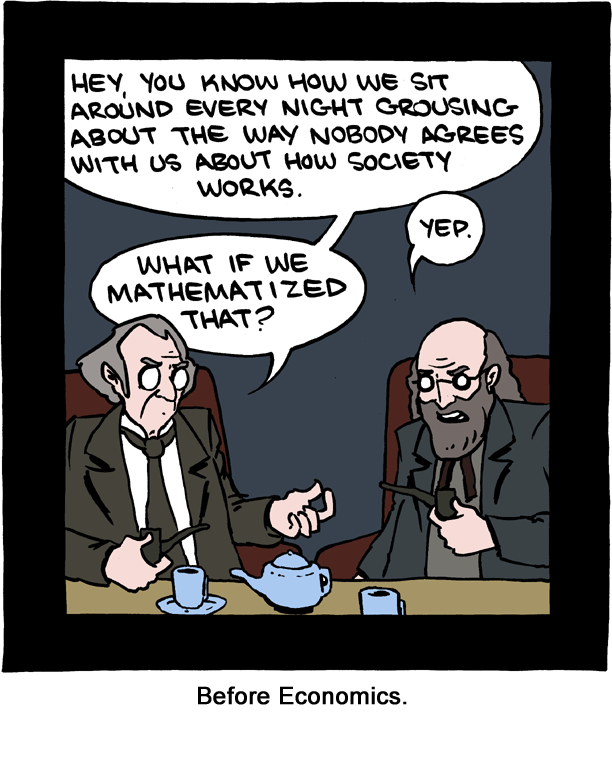
What people did before economics - SMBC


Hey geeks! Saturday Morning Breakfast Cereal is beta testing a new site design. Please leave comments here.

Report: 100,000 children in U.S. prisons and thousands more are incarcerated in adult prisons.

...Today, an estimated 100,000 children and teens are locked up in juvenile facilities across the country, and thousands more are incarcerated in adult prisons. Children in adult prisons and jails face even worse conditions than those in the juvenile justice system.

U.S. Department of Justice re­search shows that youths incarcerated with adults are eight times more likely to commit suicide than in juvenile facilities, five times more likely to be sexually assaulted, three times more likely to be assaulted by prison staff and 50 percent more likely to be assaulted with a weapon than youths in a juvenile facility. And incarcerating children in the adult system doesn't only put them at risk of unspeakable abuses — it fails to protect communities. The Depart­ment of Justice also has found "higher recidivism rates among juveniles convicted for violent offense in criminal court when compared with similar offenders retained in juvenile court."

By reforming the juvenile justice system and providing support in our schools and communities, this cycle can be broken and we can dramatically reduce our country's prison population – the world's largest.

Please continue reading at:

U.S. Postal Service, We are on an unsustainable financial path...defaulted on $11.1 billion in Treasury Payments

The U.S. Postal Service warned today that it will consider "a range of accelerated cost cutting and revenue generating measures" because Congress has not passed a bill to help the service get back in the black. That could create more pressure to end Saturday home delivery, take other measures that could cause trouble for rural newspapers, and revive plans to close post offices.

Postmaster General Patrick Donahoe issued a statement, saying in part, "We are on an unsustainable financial path. We are currently losing $25 million per day, we have defaulted on $11.1 billion in Treasury payments and exhausted our borrowing authority. The Postal Service should not have to do business this way, which has undermined the confidence of our customer base and the $800 billion mailing industry we serve."

Please continue reading at:

Jan 2, 2013

Being moderately overweight might not pose as bad as health risk

LA Times: It's a common medical refrain: Carrying extra pounds raises the risk of ills such as heart disease and diabetes and therefore the risk of a premature death.

But does that heightened risk of early death apply across the board to those who are merely overweight?

A new analysis of nearly 3 million people suggests maybe not.

The finding, published online Tuesday in the Journal of theAmerican Medical Assn., pooled data from 97 studies encompassing adult men and women in the United States, Canada, Europe, Australia, China, Taiwan, Japan, Brazil, India and Mexico.

A total of 270,000 people died of any cause during the studies. When the scientists crunched the numbers, they found, as expected, that people who were significantly obese — with a body mass index, or BMI, of 35 or more — had shorter life spans on average than those who were of normal weight, defined as having a BMI of 18.5 to 24.9.

But the scientists also found that people classified as overweight, with a BMI of 25 to 29.9, died at slightly lower rates — not higher — than those of so-called normal weight. And they found that those who were mildly obese, with a BMI of 30 to 34.9, died in no greater numbers than did their normal-weight peers.

Study lead author Katherine M. Flegal, an epidemiologist with the Centers for Disease Control and Prevention, said she and her colleagues could not say what lay behind the apparent survival edge for overweight people. But she noted that it had been observed before in other studies.

Flegal added that smoking — which raises the risk of early death but also tends to keep people thinner — doesn't appear to be the explanation, since that factor was carefully controlled for in the analysis.


Please continue reading at:
http://www.latimes.com/news/science/la-sci-overweight-survival-20130102,0,7418358.story

Senate-Passed Deal Means Higher Tax on 77% of Households - Bloomberg

The budget deal passed by the U.S. Senate today would raise taxes on 77.1 percent of U.S. households, mostly because of the expiration of a payroll tax cut, according to preliminary estimates from the nonpartisan Tax Policy Center in Washington.
More than 80 percent of households with incomes between $50,000 and $200,000 would pay higher taxes. Among the households facing higher taxes, the average increase would be $1,635, the policy center said. A 2 percent payroll tax cut, enacted during the economic slowdown, is being allowed to expire as of yesterday.

Please continue reading By Richard Rubin at:
http://www.bloomberg.com/news/2013-01-01/senate-passed-deal-means-higher-tax-on-77-of-households.html

Jan 1, 2013

#Fiscalcliff #news update: CBO Estimates "Obama Tax Cut" To Add $4 Trillion To Deficit Over Next Decade

ZeroHedge...Two things:

First - it is no longer the "Bush (temporary) tax cut" - it is now the "Obama (permanent) tax cut", with a loophole ... (whose big picture "impact" we showed previously)

Second - according to the just released scoring by the CBO, the total impact on the US budget deficit of said permanent tax cuts, will be a $4 trillion increase in the deficit over the next decade. In reality, due to the CBO's perpetual optimistic bias, this number will likely be orders of magnitude lower than what it actually ends up being.

Please continue reading at:
http://www.zerohedge.com/news/2013-01-01/cbo-estimates-obama-tax-cuts-add-4-trillion-deficit-over-next-decade

That’s not beer! A biofuel project aimed at providing a temperature controlled environment for fermenting biofuel.

biofuel-fermentation-controller

Any home brewer will recognize the setup pictured above as a temperature controlled fermentation chamber. They wouldn't be wrong either. But you're not going to drink what results. This project is aimed at providing a temperature controlled environment for fermenting biofuel.

[Benjamin Havey] and [Michael Abed] built the controller as their final project in his microprocessor class. The idea is to monitor and control the mini-refrigerator so that the strain of Saccharomyces Cerevisiae yeast produce as much ethanol as possible. An MSP430 microcontroller was used. It monitors a thermister with its analog to digital converter and drives a solid state relay to switch mains power to the fridge. At 41 degrees Fahrenheit this is down below what most lager yeasts want (which is usually in the low fifties). But the nice thing about using a microcontroller is you can set a schedule with different stages if you find a program that gives the yeast the best environment but requires more than one temperature level.

Please read full and follow at:

In 2002, CBO predicted 2012 US debt would be 7.4% of GDP. In reality, it was almost 74% of GDP | AEIdeas


122812cblo3

Making economic and budget predictions is hard, especially when wars, recessions, and financial crises pop up unexpectedly. Here's the Congressional Budget Office's ten-year budget forecast from 2002 (note that this was after the Bush tax cuts were passed...

Please continue reading at:
http://www.aei-ideas.org/2012/12/in-2002-cbo-predicted-2012-u-s-debt-would-be-7-4-of-gdp-in-reality-it-was-almost-74-of-gdp/

Dec 31, 2012

Fiscal cliff: America goes to the brink, but millions already fell into poverty

Whatever the outcome of the political haggling, Congress has failed the 50 million Americans below the bread line

The one comfort of government incompetence is that it is never a surprise: it is, if anything, a starting point for the public's expectations of Washington.

Still, even that certainty doesn't pay the bills, and that is a problem for 2.1 million Americans who have been out of work for more than 27 weeks and will be cut off from unemployment insurance tonight. No matter what happens, the fiscal cliff talks have been a failure: Congress will not achieve a "grand bargain" to save Americans from the brunt of ill-considered, sweeping tax hikes and government spending cuts.

That's why we'd be better off talking about the "fiscal conscience", the era of which seems to be coming to a sharp end tonight. Unemployment is the American crisis you hear about; poverty is the one you don't. And what the fiscal cliff covers up is what will be the slow transition of the US unemployment problem into a serious poverty problem.

The biggest failure of the fiscal conscience is the disregard for those unemployed Americans. Some of those 2.1 million Americans who stand to lose their benefits tonight only started collecting unemployment in July. Those who have been out of work for more than six months make up 40% of all the unemployed people in America.

The predicament of the long-term unemployed only has a passing relationship to the fiscal cliff. There happens to be no one in the government who can put their hand up and protect the unemployed. As Congress goes about wrecking confidence in the economy, there are other agencies that can pick up some of the slack.

The Treasury Department is finding room to avoid the debt ceiling. The Internal Revenue Service has said it will hold off on imposing tax increases. The Defense Department has promised it will do what it can to delay cuts.

But the unemployed have no one to protect their benefits. There is no agency to buy them some time: they are at the mercy of congressional bickering.

Nothing new. For the unemployed, the fiscal cliff is the final boot on the neck of their prospects, not the first time they've been knocked down by an aggressive Congress. Congress has been chipping away at unemployment benefits for well over a year. 

Lawmakers in Washington have been pretending to pass "extensions" to unemployment benefits, but what they have really been doing is cutting them. From 2009 to 2011, when nearly one-sixth of the country was out of work, some Americans could receive 99 weeks of unemployment insurance. This year, Congress cut that maximum down to 73 weeks and, with the help of some states, put further barriers to unemployment insurance, including drug tests and national job search requirements. 

This would make sense if unemployment insurance were taking money out of the pockets of other, worthier programs; but it's not. American taxpayers and employers pay for unemployment insurance through taxes imposed on every paycheck. When the economy is good, and few people are unemployed, the government collects a surplus, because many people are paying the unemployment tax but few are collecting it.

Please continue reading by Heidi Moore at:

Senate Outraged at Having to Work Weekend to Save Nation : via @BorowitzReport

us-capitol-boro-465.jpg

WASHINGTON (The Borowitz Report)—Howls of protest filled the halls of the U.S. Senate today as dozens of Senators expressed their outrage at having to work through the weekend to save the United States from financial Armageddon.

"We're hearing a lot about the country plunging back into recession and millions of people being thrown out of work," said Senate Minority Leader Mitch McConnell (R-Kentucky). "What we're not hearing much about is how our Sunday is being completely and irrevocably ruined."

Senator McConnell said that when President Obama called the Senate back to work on a budget deal this weekend, "At first I thought he was kidding. Not only have I never worked on a weekend, I've never met anyone who's done such a damn fool thing."

The Senate Minority Leader added that "if saving this country means working Saturday and Sunday, then I'm not sure this is a country worth saving."


Please continue reading at:
http://www.newyorker.com/online/blogs/borowitzreport/2012/12/senate-outraged-at-having-to-work-weekend-to-save-nation.html

Dec 30, 2012

Celebrate safety in science education with The Online Lab Safety Dictionary

In celebration of thirty-five years of service to safety in science education, the Laboratory Safety Institute (LSI) invites you to join us in creating "The Online Laboratory Safety Dictionary".  It will be located on the resources page of our website: http://www.labsafetyinstitute.org/Resources.html