May 11, 2015

Oil leaked into Hudson River after fire at nuclear reactor near NYC | Reuters

REUTERS - Reporting by Fiona Ortiz in Chicago; Editing by Chris Reese

Oil leaked into the Hudson River on Sunday after a transformer fire and explosion a day earlier at the Indian Point nuclear plant north of New York City, and Governor Andrew Cuomo said he was concerned about environmental damage.

Cuomo visited the plant for a briefing on Sunday. The governor, who in the past has called for the plant to be shut down because of its proximity to densely populated New York City, also visited the plant on Saturday.

When the transformer exploded, it released oil into a holding tank, which then overflowed, sending oil onto the ground and into the river, Cuomo told reporters on Sunday after he was briefed by emergency and plant officials.

He said crews were working to contain and clean up the oil spill but it was not clear yet how much oil had been released.

"If you are on site, you see an oil sheen all over the area where the transformer went on fire, and it was a significant area that was covered by oil, foam and water," Cuomo said.

The transformer explosion and fire at the nuclear power reactor 40 miles (65 km) north of New York City was quickly put out. The fire triggered the closure of the plant's Unit 3 reactor, while the other Unit 2 reactor continued to operate.

Entergy Corp (ETR.N), which runs the facility and is one of the largest U.S. nuclear power operators, said the plant was stable and there was no danger to the public or to employees.

"Anything that happens at this plant obviously raises concerns," due to the proximity to the largest U.S. city, Cuomo said.

"The transformer fire in and of itself was not dangerous.

But the fear is always that one situation is going to trigger another. If something goes wrong here, it goes very wrong for a lot of people."

Cuomo said emergency crews thought the fire was out but it reignited and had to be extinguished again.

The transformers are located around 300-400 feet away from the reactor.

The plant, which dates back to the 1960s, has around 1,000 employees.

It is one of 99 nuclear power plants licensed to operate in the United States and which generate about 20 percent of U.S. electricity use, according to the Nuclear Regulatory Commission's website.

(Reporting by Fiona Ortiz in Chicago; Editing by Chris Reese)
Please continue reading from: 

http://www.reuters.com/article/2015/05/10/us-usa-nuclearplant-incident-idUSKBN0NV0UE20150510
----
Shared via my feedly reader

34 percent of Americans financially carry the country: Those not in the labor force hits another record at 93,194,000.

34 percent of Americans financially carry the country

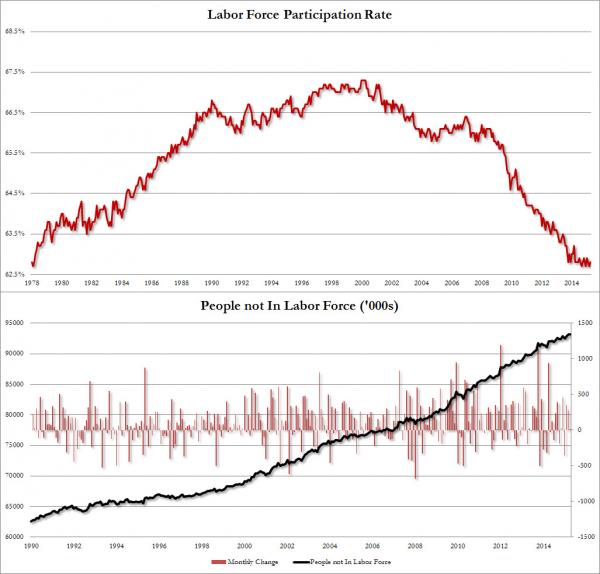
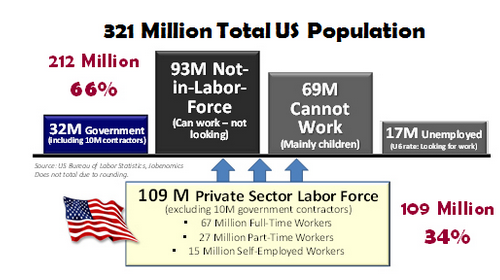
The number of Americans not in the labor force has hit another new record.  The latest figures show that 93,194,000 Americans are not in the labor force.  How big is this figure?  How about the populations of our three most populated states in California, Texas, and Florida combined and you would still need to find millions more.  To be exact, add all three up and you would still need another 8 million people to add up to this figure.  This is about a third of the entire United States that is not in the labor force, and this is excluding the 69 million that can't work (i.e., mostly children).

The trend itself doesn't seem to be letting up.  Plus you have a large number of added jobs coming from low wage employment.  The trend for those not in the labor force is unmistakable:

Not in Labor Force

Another problematic aspect of this transition is that you have 34 percent of the country supporting the rest financially.  Does that come as a shock to you?  I'm sure the media doesn't bother going into this because they are too caught up in the narrative that money is flowing into all corners of the United States.  That is simply not true.  Sure, the stock market is near a peak.  But very few Americans actually own stocks out right.

Take a look at the raw numbers of the entire United States:

employment us by segment

Let us go through the categories one by one:

Government workers:  Government workers are paid via tax revenues collected from the private sector.  While many of these are legitimate jobs, the revenue for paying for these come from tax dollars collected from the private sector.  That is simply a fact.

Not in the labor force:  This is the black box of it all.  These are able-bodied people that can work but choose not to do so.  Some are old and some are in college, but this figure has to be examined closely.  With more Americans going to college and more diving deep into debt, how many in this group should be working but are not?  The growth here is not explained by old age trends or disability growth with the population.  Something else is going on here.

Cannot work:  This group is mainly made up of children so probably needs no further investigation.

Unemployed:  This is the headline calculating group.  These are Americans looking for work but are unable to do so.  We keep hearing how great things are but we have 17 million Americans ready and wanting to work but not being able to do so.

Private sector:  In terms of tax revenues, this is really the group that is supporting the rest of the country.  Their tax revenues fuel and fund the government.  But even their tax revenues are not enough as we go deeper into debt as a country.

Now maybe all of the above doesn't fit in conveniently in a one minute television segment.  But don't you think this is important to think about when one-third of the country is supporting the rest financially?  And isn't it troubling that many new private sector jobs are also in the low wage segment of the economy?

Please continue reading from: 
http://www.mybudget360.com/not-in-labor-force-one-third-americans-carry-rest-of-country-financially/

May 10, 2015

What Humans Are Really Doing to Our Planet, in 19 Jaw-Dropping Images

Source: Peter Essick/Foundation for Deep Ecology

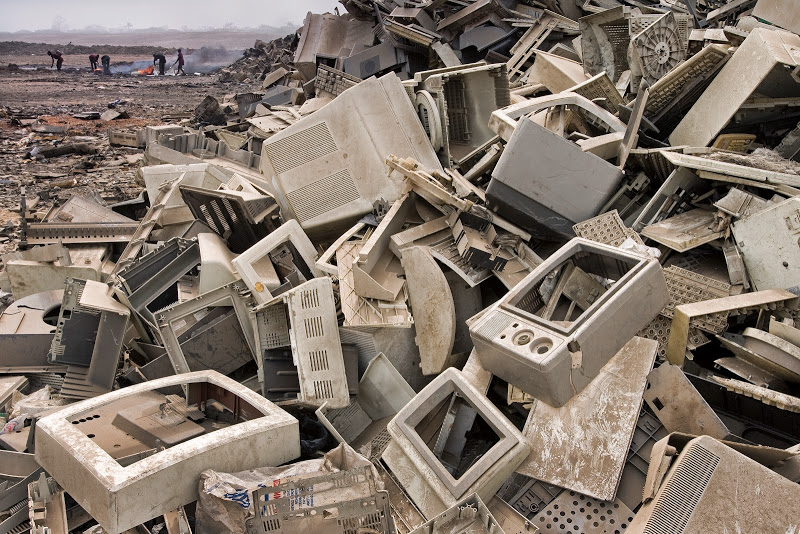
Electronic waste, from around the world, is shipped to Accra, Ghana, where locals break apart the electronics for minerals or burn them. 

Source: Pablo Lopez Luz/Foundation for Deep Ecology

Mexico City, Mexico, one of the most populous cities in the Western Hemisphere.

Source: Digital Globe/Foundation for Deep Ecology

New Delhi, India, where many landfills are reaching a breaking point. The surrounding population of Delhi totals some 25 million people

Source: Mike Hedge/Foundation for Deep Ecology

Los Angeles, California, which is famous for sometimes having more cars than people.

Source: Mark Gamba/Corbis/Foundation for Deep Ecology

Kern River Oil Field, California, USA.

Source: Daniel Dancer/Foundation for Deep Ecology

Former old-growth forest leveled for reservoir development, Willamette National Forest, Oregon, per the Population Media Center.

Source: Jason Hawkes/Foundation for Deep Ecology

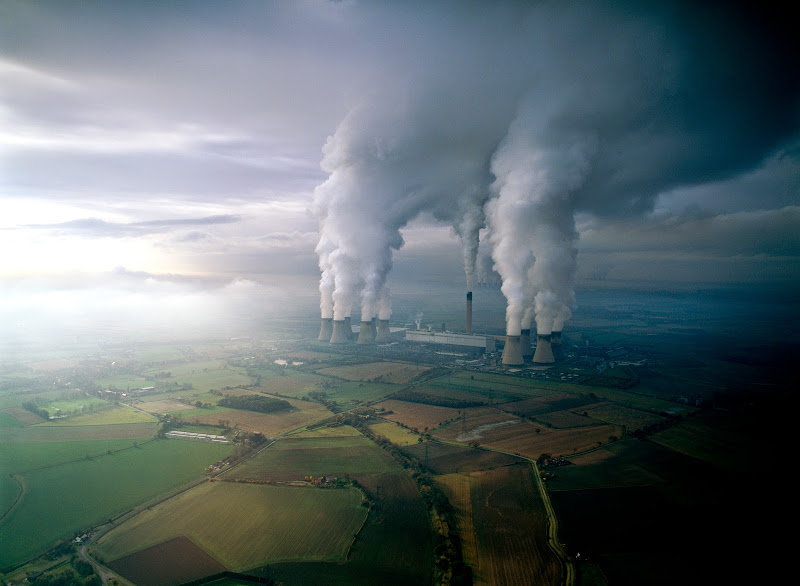
Coal power plant, United Kingdom.

Source: Cotton Coulson/Keenpress/Foundation for Deep Ecology

North East Land, Svalbard, Norway, where rising global temperatures are fundamentally changing the ecology.

Source: Digital Globe/Foundation for Deep Ecology

The world's largest diamond mine, Russia.

Source: Daniel Beltra/Foundation for Deep Ecology

Amazon jungle burns to make room for grazing cattle, Brazil.

Source: Garth Lentz/Foundation for Deep Ecology

Tar sands and open pit mining in an area so vast, it can be seen from space. Alberta, Canada.

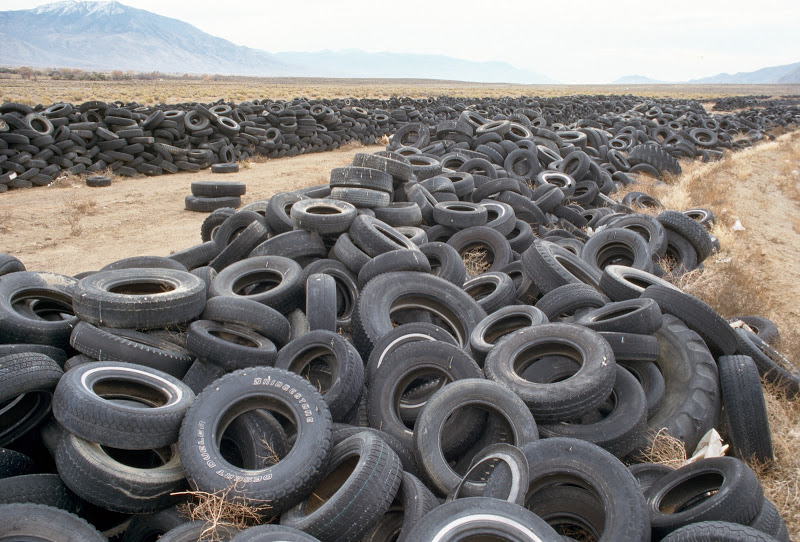
Source: Daniel Dancer/Foundation for Deep Ecology

Tires discarded in Nevada.

Source: Garth Lentz/Foundation for Deep Ecology

Vancouver Island, Canada.

Source: Yann Arthus Bertrand/Foundation for Deep Ecology

Industrial agriculture in Almeria, Spain, stretches for miles.

Source: Garth Lentz/Foundation for Deep Ecology

Tar sands, Alberta, Canada.

Source: Lu Guang/Foundation for Deep Ecology

A man turns away from the smell of the Yellow River in China.

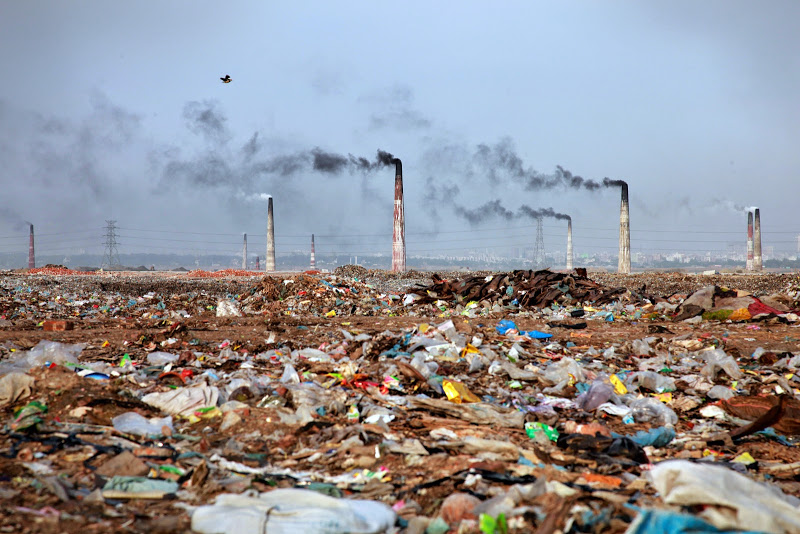
Source: M.R. Hasasn/Foundation for Deep Ecology

Bangladesh, where much of the world's clothing and goods are manufactured.

Source: Darin Oswald/Idaho Statesman/Foundation for Deep Ecology

Black Friday, Boise, Idaho.

Source: Zak Noyle/Foundation for Deep Ecology

A remote bay in Java, Indonesia, where local residents, without infrastructure for waste disposal, discard waste directly into streams and rivers.


May 7, 2015

Heartbeat Radar Saves 4 Men Trapped Under Rubble In Nepal

Heartbeat Radar Saves 4 Men Trapped Under Rubble In Nepal that is still reeling from the 7.8 magnitude earthquake that struck near Kathmandu on April 25. The quake has flattened three quarters of the city's buildings and killed…

Firefighters' union says new oil-by-rail rules fall short.

The largest union representing firefighters in North America said Tuesday that a new Department of Transportation rule for transporting oil by rail does not go far enough to enable firefighters to respond effectively in the case of an accident. 
Please continue reading from: 1Environmental Health News

Probe takes aim at US methane plume mystery.

NASA and NOAA scientists identify and measure man-made and natural sources of a vast methane plume billowing over the hydrocarbon-soaked San Juan Basin, more commonly known as the Four Corners area of Arizona, Colorado, New Mexico and Utah. 
Please continue reading from: Environmental Health News

Memristor brain mimicking chip, with digital logic circuits but with elements that mimic, in simplified form, the neurons and synapses of biological brains

Next Big Future
An all memristor chip, built by researchers at the University of California, Santa Barbara, and Stony Brook University, processes data not with digital logic circuits but with elements that mimic, in simplified form, the neurons and synapses of biological brains. When a network like that is exposed to new data, it "learns" as the synapses that connect neurons adjust the neurons' influence on one another.

Robert Legenstein, an associate professor at Graz University of Technology in Austria, wrote: "If this design can be scaled up to large network sizes, it will affect the future of computing … Laptops, mobile phones and robots could include ultra-low-power neuromorphic chips that process visual, auditory and other types of sensory information.

Brain-inspired—or "neuromorphic"—chips have been made before, and IBM is trying to commercialize them. They generally use the same silicon transistors and digital circuits that make up ordinary computer processors. But those digital components are not suited to mimicking synapses, says Dmitri Strukov, an assistant professor at the University of California, Santa Barbara, who led work on the new memristor chip. Many transistors and digital circuits are needed to represent a single synapse. By contrast, each of the 100 or so synapses on the UCSB chip is represented using only a single memristor.

"A [biological] synapse is an analog memory device, and there is really no good way of implementing that in a compact, energy-efficient way with conventional technology," says Strukov. "Memristors by themselves are an analog memory device; it's a perfect match."

The UCSB group's simple chip is just a proof of concept, but the researchers believe their techniques can be scaled up to make larger, more powerful devices. Strukov says the technology could get a helping hand from the efforts companies such as HP and SK Hynix are making to commercialize memristors for data storage.

HP should be able to scale memristor chips to billions and even trillions.

This circuit can learn to recognize simple black-and-white patterns, thanks to devices called memristors located at each place the wires cross.

Nature - Training and operation of an integrated neuromorphic network based on metal-oxide memristors

Read more »

IBM’s Watson Will Make Decisions About Cancer Care in 14 Hospitals in the U.S. and Canada

Via: BBC:

IBM's supercomputer Watson will be used to make decisions about cancer care in 14 hospitals in the US and Canada, it has been announced.

Using computers to trawl through vast amounts of medical data speeds up the diagnosis process.

The system will help assess individual tumours and suggest which drug should be used to target them.

Doctors have welcomed the new computer which will learn from each case it examines.

"When you are dealing with cancer, it is always a race," said Dr Lukas Wartman, assistant director of cancer genomics at the McDonnell Genome Institute at Washington University in St. Louis, one of those signed up to use the Watson system.

"As a cancer patient myself, I know how important genomic information can be.

"Unfortunately, translating cancer-sequencing results into potential treatment options often takes weeks with a team of experts to study just one patient's tumour and provide results to guide treatment decisions. Watson appears to help dramatically reduce that timeline," he explained.

Please continue reading from: BBC

May 5, 2015

Wisconsin's quality drinking water cause for celebration during National Drinking Water Week

WDNR - Wisconsin communities enjoy safe drinking water and continue to make steady progress in improving drinking water quality, offering cause for celebration during National Drinking Water Week.

More than 95 percent of the state's public water systems meet all health-based standards and during the three year period from 2011 to 2013, municipal community water systems invested a total of $134.9 million in upgrades through the Safe Drinking Water Loan Program, a fund administered by the Wisconsin Department of Natural Resources.

"Clean water plays a fundamental role in human health and remains essential to a strong economy," said DNR Secretary Cathy Stepp. "In Wisconsin, we're fortunate to have abundant groundwater supplies and the continued reinvestment in municipal water systems ensures this water is delivered safely to the public from the tap."

According to the U.S. Centers for Disease Control, many improvements in the health, prosperity and longevity of the U.S. population can be attributed to improvements in water quality. A century ago, the average life expectancy in the United States was 47 years compared with 78 years today and experts say a significant reduction in water borne diseases has contributed to the increased longevity.

Wisconsin is home to 11,400 public water systems--more than any other state--and from state fiscal years 2012 to 2014, DNR's Safe Drinking Water Loan Program provided funds for 93 projects statewide. DNR also conducted more than 2,200 engineering plan reviews for new facilities, wells, facility upgrades and other projects during the period. All the state's public water systems also get inspected regularly.

"Wisconsin's public water systems have the capacity and technology to safely deliver 1 ton of clean water, on average, to each house every day," said Steve Elmore, DNR's public water supply section chief. "Through regular monitoring, we know more about what's in our water than ever before and this allows us to adopt strategies that address emerging issues. In Wisconsin, we also make a point of sharing this information publicly--the results of water testing at all the state's public water systems are available online."

Consumers interested in learning more can search the DNR website, dnr.wi.gov, for "Wisconsin drinking water data." For more resources on National Drinking Water Week, May 3-9, visit the American Water Works Association (exit DNR).

To celebrate National Drinking Water Week, join DNR's drinking water and groundwater experts for an online chat at noon on Thursday, May 7. To participate, visit the DNR home page, dnr.wi.gov, and click on the graphic or search the phrase "ask the experts." You can also join the conversation via our Facebook page at facebook.com/WIDNR by clicking the "Ask the Experts Chat" tab at the top of the page.

Wisconsin approves changes to state invasive species law

WDNR - A state law aimed at preventing the spread of invasive species and reducing their statewide impacts has been updated and following legislative approved went into effect May 1, 2015.

Revisions to Chapter NR 40 of the Wisconsin Administrative Code include the listing of additional species and delisting or down listing of some of currently regulated species under the state's Invasive Species Identification, Classification and Control rule. In total, listings of more than 100 different species were updated and revised to respond to changing conditions and statuses of invasive species around the state.

"Invasives like the emerald ash borer, Eurasian water-milfoil and garlic mustard harm our environment, cost billions of dollars annually across the nation and threaten core Wisconsin business sectors such as agriculture, tourism and forestry," said Paul Schumacher, chair of the Wisconsin Invasive Species Council. "These revisions to the invasive species rule are an adaptive approach to tackle the threats from invasive species and meet the department's charge from the legislature to address these challenges."

The updates to the invasive species rule were a result of several partnerships with the Department of Natural Resources including the Wisconsin Invasive Species Council, Department Agriculture, Trade and Consumer Protection, Wisconsin Green Industry Federation, the University of Wisconsin, and input from species experts, stakeholders and the public.

A major update includes revising the status of species that have become established in Wisconsin since they were first listed as prohibited in 2009, such as emerald ash borer, a beetle responsible for the destruction of tens of thousands of ash trees in Wisconsin. Under the rule, prohibited species are those that are not well established in the state and whose spread can be prevented or limited to certain areas using eradication methods. Since being listed, EAB has spread to 37 counties prompting a proposal to change the beetle's regulatory status to restricted.

Restricted species are those already found in the state and may be more widespread; eradication is improbable but the spread can still be managed. When this happens, measures to manage the spread of invasives like EAB apply, such as DATCP quarantines and DNR firewood transportation restrictions.

Other revisions include changes to plants species like non-native phragmites, Japanese hedgeparsley and forest pests like jumping worms [PDF]. A full list of the new invasive species rule changes and literature reviews are available by going to the DNR website, dnr.wi.gov, and searching keyword "NR 40."

"The Wisconsin Invasive Species Council is appreciative of all the hard work from our partners and stakeholders who helped make these changes possible," said Schumacher. "Wisconsin is one of the first states to have an identification and listing rule like NR40, which goes a long way in our efforts to reduce the impacts of invasives."

People can learn more about the changes to NR40 during an online chat at noon on Thursday, May 28. To participate, visit the DNR home page, dnr.wi.gov, and click on the graphic or search the phrase "ask the experts." You can also join the conversation via our Facebook page at facebook.com/WIDNR by clicking the "Ask the Experts Chat" tab at the top of the page.

Wisconsin celebrates Clean Air Month this May, and reminds us that, "It all adds up to cleaner air"

WDNR- It is May and once again time to celebrate Clean Air Month. The Department of Natural Resources is celebrating our state's clean air and the part we all have played in improving our air quality.

The DNR website, dnr.wi.gov, has tips for reducing air emissions, the opportunity for the public to sign-up for air quality notices and information on the department's annual poetry contest for third, fourth and fifth grade students in Wisconsin by searching Clean Air Month.

"At your DNR, we continue to work hard so Wisconsin citizens can enjoy some of the cleanest air in the nation." said DNR Secretary Cathy Stepp.

Stepp noted that the state's air quality has been improving since the 1980's. Other successes from the past year include:

  • the department's use of social media tools such as Twitter to inform the public when Air Quality Advisories are announced; and
  • increased outreach to businesses through the department's new LinkedIn account. Businesses can more easily tap into DNR air updates, and LinkedIn users can follow @WisconsinDNR to see posts related to Wisconsin business.

"We are breathing healthier air and continuing to see positive trends in air quality thanks to the partnership among businesses, citizens and the department," said Bart Sponseller, DNR Air, Waste and Remediation and Redevelopment deputy division administrator. "Businesses and citizens across our state continue to support our clean air mission by the voluntary actions they take each and every day."

To learn more about voluntary actions we can take to reduce air emissions visit the Do A Little Save a Lot page of the DNR website.

Lake Huron nuclear waste burial report expected this week

A Canadian environmental assessment of a proposal to bury nuclear waste deep underground near the shores of Lake Huron is expected this week amid fierce opposition to the idea from home and abroad.

Ontario Power Generation argues that storing the radioactive material in a huge underground bunker set in rock -- the deep geological repository or DGR -- is the safest way to deal with waste that is potentially dangerous for centuries.

    For decades, the waste has been stored above ground at the Bruce nuclear power plant near Kincardine, Ont., and OPG says it could continue doing so safely but says a long-term solution is needed.

The proposed facility would be about 680 metres deep and close to the Bruce reactors and house hundreds of thousands of cubic metres of what is considered to be low- and intermediate-level waste from facilities across Ontario.

Stable bedrock and shale would essentially seal the facility, protecting both the surface and nearby lake for thousands of years, proponents say.

"Very favourable geologic features make the Bruce site in Kincardine one of the best possible locations," OPG states.

"Experts agree, it's the responsible choice and reflects international best practices."

Opponents say proposal is dangerous

Opponents, however, argue no system is foolproof and any problems - especially with a facility about one kilometre from a major water source for millions of people - could be catastrophic.

While the municipality, where many jobs and the economy are closely tied to the power generator, is officially a "willing host community" for the repository, grassroots groups have sprung up in the area to give voice to those concerns.

One of them, Stop the Great Lakes Nuclear Dump, has collected almost 75,000 signatures on an online petition and is already pledging to keep fighting the plan if the review panel green-lights it.

Group spokeswoman, Bev Fernandez, argues the intermediate-level waste -- components from within the reactors -- is almost as dangerous as spent nuclear fuel for which authorities are also seeking a permanent storage solution.

"This Kincardine waste dump is really the Trojan horse," Fernandez says. "There is absolutely nothing stopping OPG from putting the high-level waste, the nuclear spent fuel, into this (repository); all it would take is a stroke of the pen."

U.S. senator opposes underground storage of nuclear waste

Opposition has also been heard much farther afield. More than 150 communities, many in Michigan and Illinois, have passed resolutions opposing such underground storage.

Earlier this month, for example, Sen. Debbie Stabenow of Michigan introduced a resolution in the U.S. Senate calling on the Canadian government to ban any nuclear waste repository within the Great Lakes basin.

"A spill of nuclear waste into the Great Lakes could have lasting and severely adverse environmental, health, and economic impacts," the resolution states.

Please continue reading from:  - CBC News
http://www.cbc.ca/news/canada/kitchener-waterloo/lake-huron-nuclear-waste-burial-report-expected-this-week-1.3059419

California Drought Killed 12 Million Forest Trees Since Last Year | KPBS

An estimated 12 million trees across California's forestlands have died over the past year because of extreme drought conditions, according to an aerial survey conducted April 8-17 by the U.S. Forest Service.

In San Diego County, 82,528 trees, mostly Jeffrey pines across Mt. Laguna, have succumbed to a lack of rainfall, with many more struggling to survive, said Jeffrey Moore, interim aerial survey program manager for the U.S. Forest Service.

DOCUMENT

Tree Mortality In Southern California Forests

Tree Mortality In Southern California Forests

The extent and severity of tree mortality, which occurred after the 2014 aerial surveys in Southern California Forests.

Download

DOCUMENT

Southern Sierra Tree Mortality

Southern Sierra Tree Mortality

Recently dead or injured trees were mapped visually by a surveyor using a digital aerial sketch-mapping system flying in a light fixed-wing aircraft approximately 1,000 feet above ground level.

Download

There is "very heavy mortality, a lot of discoloration in the pine trees that probably will expire sometime during this growing season, as well as oak trees that are suffering," Moore said.

Moore was part of a team that surveyed the trees visually, using a digital mapping system while flying in a fixed-wing aircraft 1,000 feet above ground.

A tree's survival often depends on its proximity to other trees, he said.

"A lot of trees are competing for whatever available moisture there is in a drought situation," Moore said. "When you have too many trees in an area, it makes it hard on all of the trees."

In Southern California, the researchers tracked more than 4.2 million acres in Cleveland, San Bernardino, Angeles and Los Padres National Forests, where they found an estimated 2 million perished trees. They combed another 4.1 million acres in the Southern Sierra Nevada, where they documented approximately 10 million dead trees. Their findings were compared to similar surveys taken in July 2014, Moore said.

In San Diego County, Moore said they found substantial pine mortality near Descanso Road in the Cleveland National Forest, and throughout Mt. Laguna.

The team did not attempt to map gold-spotted oak borer beetle-related mortality in this survey, he said. Nor did they track black oak trees, since it's unclear whether those without leaves are dead or just "leafing out"—bare but in the process of growing their new leaves for the spring.

The county's forests are already reeling from the 2003 Cedar Firethat devoured 280,000 acres, including in the Cuyamaca Mountains. The region was formerly blanketed by a coniferous forest, but recovery has been poor, Moore said.

"Most of those areas aren't even coming back into trees at all," Moore said. "They're kind of being switched over now into Chaparral plants because they burned so hot the seed source is gone."


Can Elon Musk's battery really cut your power lines?

ComputerworldTo eliminate the world's dependency on fossil fuel-generated power, all you need is two billion of Tesla's new commercial-grade battery systems.

That was part of Tesla CEO Elon Musk's message last week, when he announced a new line of batteries for households and businesses, which will allow distributed electrical storage from renewable sources like solar power.

Sounds crazy, right? However, as Musk pointed out, the area needed to power the entire globe with photovoltaic panels would be less than 1% of the U.S.'s total land mass, and most of that could be deployed on rooftops.

To read this article in full or to leave a comment, please click here

May 4, 2015

Chernobyl fire radiation hazard as 'hot particles' of plutonium go up in smoke

Forest fires raging near the abandoned Chernobyl nuclear disaster site in north Ukraine are releasing a surge of airborne plutonium particles as radioactive twigs, branches and leaf litter burn.

The dominance of plutonium in the smoke is especially worrying since it is hard to detect using Geiger counters owing the very short range of the alpha radiation it emits. Yet even small particles embedded in lung tissue can cause cancer.

The Ukrainian National Guard has been put on high alert due to worsening forest fires around the crippled Chernobyl nuclear power plant, according to Ukraine Interior Minister Arsen Avakov.

"The forest fire situation around the Chernobyl power plant has escalated", a statement onAvakov's Facebook page says.

"The forest fire is heading in the direction of Chernobyl's installations. Treetop flames and strong gusts of wind have created a real danger of the fire spreading to an area within 20 kilometers of the power plant. There are about 400 hectares [988 acres] of forests in the endangered area."

He added that there was "reasonable suspicion of intentional arson" since fires had been ignited on both sides of the river.

Police and National Guard units are on high alert. Ukraine's Prime Minister personally went to the affected area to oversee the firefighting. He says the situation is under control, "but this is the biggest fire since 1992."

However, in comments to Russia's Moscow Speaks radio, a representative of Greenpeace Russia said that the situation is much worse:

"A very large, catastrophic forest fire is taking place in a 30-km zone around the Chernobyl power plant. We estimate the real area of the fire to be 10,000 hectares; this is based on satellite images. This hasn't been officially acknowledged yet."

Serious radiation risk from re-suspended 'hot particles'

The potential danger in this fire comes from the radioactive contaminants the burning plants have absorbed, Christopher Busby, scientific secretary of the European Committee on Radiation Risk, told RT.


Please continue reading from - The Ecologist

Large ocean dead zones found off Africa

Independent UK - Swathes of oxygen-deprived water up to 100 miles long, unable to sustain any form of animal life, have been found in the Atlantic, scientists have said.

Researchers of the GEOMAR Helmholtz Centre for Ocean Research Kiel in Germany discovered the unexpectedly low oxygen environments several hundred kilometres off the coast of West Africa.

A paper, published in Biogeosciences, describes 100-mile-long eddies of swirling water spinning their way across the Atlantic for months at a time. 

Dead zones are usually found in shallow bodies of water, such as lakes and shallow coastlines.

However, the swirling movement of the eddies found in the Atlantic ensures that no water can escape, so the oxygen supply is quickly used up 
Please continue reading from: http://www.independent.co.uk/news/science/animal-life-at-risk-as-oxygenstarved-dead-zones-discovered-in-the-atlantic-ocean-10221983.html

Apr 30, 2015

How to Leverage $5.4 billion in P2 economic benefits

How to Leverage the P2 Results, $5.4 billion in economic benefits

Join us for a webinar on Tue, May 5, 2015 10:00 AM - 11:30 AM CST
From 2010-2012, approximately 90 P2 programs in the U.S. reported almost $5.4 billion in economic benefits; more than 8.9 billion pounds of pollution minimized or eliminated; approximately 8.8 billion gallons of water conserved; energy usage reduced by 1.4 billion kilowatts; over 1.7 billion pounds of greenhouse gases (GHG) no longer being released into the earth’s atmosphere associated with P2 activities.

What exactly does this mean for the P2 community and how can state and local P2 numbers use this information to leverage their programs?

Members of the P2 Results Taskforce including Andy Bray from NEWMOA, Jeffrey Burke from the NPPR, and Ken Grimm from PPRC will highlight the report and give you some tips on how to get value from the data and use the report in your programs.

Register now!
https://attendee.gotowebinar.com/register/2642832693962368514

Free Zero Waste Illinois - ISTC Sustainability Seminar Reminder

Don't miss the Free Zero Waste Illinois - ISTC Sustainability Seminar

Shantanu Pai - Assistant Sustainability Researcher, Illinois Sustainable Technology Center, a division of the Prairie Research Institute at the University of Illinois Urbana-Champaign

The presentation will briefly cover the concept of zero waste and our objectives through the Zero Waste Illinois program. I will cover current projects that we have undertaken through the program. Our long term goals for the program as well as ways for people to collaborate and partner with ISTC in achieving the Zero Waste program.

This webinar will be broadcast live and also archived on
www.istc.illinois.edu for later viewing.

If you cannot attend the event at ISTC, you may view the webinar live by registering at: https://attendee.gotowebinar.com/register/7792068845789351938.  ISTC is a division of the Prairie Research Institute at the University of Illinois Urbana-Champaign.


Upcoming Sustainability Seminars
May 7, 2015  12 – 1 pm CDT at ISTC (as a webinar)

How sustainable is information technology? Trends, challenges, and opportunities
Eric Masanet - Morris E. Fine Junior Professor in Materials and Manufacturing and Associate Professor of Mechanical Engineering and Chemical and Biological Engineering, McCormick School of Engineering and Applied Science, Northwestern University

The growing numbers of information technology (IT) devices--and the environmental impacts associated with their manufacture, use, and disposal--are topics that have received much attention in both the media and research communities. While the environmental footprint of IT devices is indeed significant, each new device generation typically brings substantial operational energy efficiency improvements. Furthermore, a singular focus on their direct impacts ignores the indirect environmental benefits that IT devices might provide by improving societal energy and resource efficiencies. A growing body of research suggests that such benefits might be substantial across the economy through such applications as replacing physical goods with digital services, building controls for energy efficiency, and real-time logistics optimization. This presentation will review the life-cycle impacts of IT systems, discuss trends in these impacts as a function of technology progress and growing consumption over time, and highlight the challenges and opportunities associated with managing and reducing the environmental impacts of IT systems moving forward.

This webinar will be broadcast live and also archived on our website www.istc.illinois.edu for later viewing. If you cannot attend the event at ISTC, you may view the webinar live by registering at: https://attendee.gotowebinar.com/register/1552395335262917122.  ISTC is a division of the Prairie Research Institute at the University of Illinois Urbana-Champaign.

Apr 29, 2015

Feds Say It's Time To Cut Back On Fluoride In Drinking Water

Slashdot
Federal health officials Monday changed the recommended amount of fluoride in drinking water for the first time since 1962, cutting by almost half the maximum amount of fluoride that should be added to drinking supplies. The Department of Health and Human Services recommended 0.7 milligrams of fluoride per liter of water instead of the long-standing range of 0.7 to 1.2 milligrams. The change is recommended because now Americans have access to more sources of fluoride, such as toothpaste and mouth rinses, than they did when fluoridation was first introduced in the United States,' Dr. Boris Lushniak, the deputy surgeon general, told reporters during a conference call.

Read more of this story at Slashdot.

Apr 28, 2015

Why Our Antiquated Power Grid Needs Battery Storage

Slashdot
Last year, renewable energy sources accounted for half of new installed electric-generation capacity (natural gas units made up most of the remainder). As more photovoltaic panels are installed on rooftops around the nation, an antiquated power grid is being overburdened by a bidirectional loadits was never engineered to handle. The Hawaiian Electric Company, for example, said it's struggling with electricity "backflow" that could destabilize its system. Batteries for distributed renewable power has the potential to mitigate the load on the national grid by allowing a redistribution of power during peak hours. Because of this, Tesla, which is expected to announce batteries for homes and utilities on Thursday, and others are targeting a market estimated to be worth $1.2B by 2019. Along with taking up some of the load during peak load, battery capacity can be used when power isn't being generated by renewable systems, such as at night and during inclement weather. That also reduces grid demand.

Read more of this story at Slashdot.

Apr 24, 2015

Africa E-Waste Dump Continues Hyperbole War

Two stories appear today which feature close up photos of young African men surrounded by scrap metal in the city of Accra. The headlines state that this iswhere our computers go to die (Wired). The Daily Mail puts it in even starker terms, alleging "millions of tons" are dumped in Agbogbloshie.

The stories appear the same day as a press release by investigators who returned this week from 3 weeks at the site. The release claims that Agbogbloshie's depiction as the worlds "largest ewaste dump site" to be a hoax. It is a scrap automobile yard which accounts for nothing more than local scrap from Accra. Three Dagbani language speaking electronics technicians, three reporters, Ghana customs officials and yours truly visited the site, interviewed workers about the origins of the material, and assessed volumes. About 27 young men burn wire, mostly from automobile scrap harnesses. The electronics — 20 to 50 items per day — are collected from Accra businesses and households. The majority of Accra (population 5M) have had televisions since the 1990s, according to World Bank metadata (over 80% by 2003).

The investigation did confirm that most of the scrap was originally imported used, and that work conditions were poor. However, the equipment being recycled had been repaired and maintained, typically for a decade (longer than the original OECD owner). It is a fact that used goods will, one day, eventually become e-waste. Does that support a ban on the trade in used goods to Africa? Or, as the World Bank reports, is the affordable used product essential to establish a critical mass of users so that investment in highways, phone towers, and internet cable can find necessary consumers?

Apr 23, 2015

How The state of Wisconsin celebrated Earth Day

Milwaukee Journal Sentinel - Fifty-seven employees of the state Department of Natural Resources began receiving formal notices this week that they might face layoff as part of Gov. Scott Walker's budget for the next two fiscal years.

DNR spokesman Bill Cosh said that of that number, 27 employees are in the Bureau of Science Services, a unit of the DNR where Walker is proposing significant cuts.

The bureau performs significant research duties for the DNR, and the cuts have come under fire from wildlife and environmental groups who say research is the underpinning of many agency activities. Other positions that could be cut are education and communications personnel.

Six Environmental Heroes Honored With Prestigious Prize

Six Environmental Heroes from around the world were honored this week with the annual Goldman Prize for their role in defending the earth, "often at great personal risk." Selected by an international jury, this year's recipients hail from Kenya, Myanmar, Scotland, Haiti, Canada, and Honduras. They will be bestowed with $175,000 "to pursue their vision of a renewed and protected environment," according to the Goldman Environmental Foundation. An award ceremony that took place in San Francisco on Monday will be followed by another in Washington, D.C. later this week. The winners' stories are captured in the short descriptions and videos below, all of which were provided by the Goldman Environmental Foundation. 

How quickly they forget...Cheap Gas Fuels Switch From Electric Cars For SUVs

Slashdot....sure to clash with Earth Day narratives: drivers who bought hybrid and electric cars are switching back to SUVs at a higher rate than ever. Quoting:According to Edmunds.com, about 22 percent of people who have traded in their hybrids and EVs in 2015 bought a new SUV. The number represents a sharp increase from 18.8 percent last year, and it is nearly double the rate of 11.9 percent just three years ago. Overall, only 45 percent of this year's hybrid and EV trade-ins have gone toward the purchase of another alternative fuel vehicle, down from just over 60 percent in 2012. Never before have loyalty rates for alt-fuel vehicles fallen below 50 percent. ... Edmunds calculates that at the peak average national gas price of $4.67/gallon in October 2012, it would take five years to break even on the $3,770 price difference between a Toyota Camry LE Hybrid ($28,230) and a Toyota Camry LE ($24,460). At today's national average gas price of $2.27/gallon, it would take twice as much time (10.5 years) to close the same gap.

Read more of this story at Slashdot.

USDA awards $72 million to six renewable energy projects in rural communities

The U.S. Department of Agriculture on Tuesday announced $72 million in funding for six rural electric infrastructure projects in North Carolina, South Carolina, Kansas and Vermont. Agriculture Secretary Tom Vilsack said in a statement: "These solar projects represent an ongoing commitment from rural electric cooperatives to increase the diversity of their fuel sources with a focus on renewable energy." 

Funds include: $20 million to Montgomery Solar Owner in Cornelius, N.C., to build a 20 megawatt solar farm; $5 million to Chocowinity Solar and Cirrus Solar in Cornelius to build 5 megawatt solar farms; $17 million to Rolling Hills Electric Cooperative in Kansas to build or improve 197 miles of transmission and distribution line and make other system improvements; $18 million to Broad River Electric Cooperative in North and South Carolina, to build or improve 138 miles of line and make other system improvements; and $7 million to Washington Electric Cooperative in Vermont to build or improve 46 miles of line and make other system improvements. (Read more

Chinese Scientists Claim To Have Genetically Modified Human Embryos

... now it's been confirmed. Chinese scientists have attempted the ethically questionable feat of genetically modifying human embryos. The scientists try to head off ethical concerns by using 'non-viable' embryos, which cannot result in a live birth, obtained from local fertility clinics. The study is a landmark — but also a cautionary tale.

Read more of this story at Slashdot.