May 19, 2015

Highly contagious, antibiotic-resistant food poisoning establishes US presence.

In April the CDC reported an outbreak of Shigella sonnei that is resistant to ciprofloxacin—one of the last remaining medications in pill form that can kill the germ. The worrisome strain is still circulating in the U.S. a year after it first emerged.
Please continue reading from: Environmental Health News

May 15, 2015

Fast Blood Test For Radiation Exposure Could Save Lives | Popular Science

In the aftermath of a nuclear event like the Fukushima disaster, medical professionals have to quickly determine which victims they should treat for radiation poisoning, and which are beyond help. Right now, the only way doctors can figure it out is to estimate how much medication to give a patient based on her estimated distance from the center of the radiation leak, or to look at how many white blood cells had died in a patient's blood sample. But at the moment it's nearly impossible to be more exact within the 24 hours after the initial exposure, according to Popular Mechanics. Now, a team of researchers has found a tiny genetic indicator that reflects how much radiation the patient has been exposed to and the amount of damage it has done in the body.

The hematopoietic system--blood and the organs that produce it--are a great place to look for the first signs of radiation damage because it's the most vulnerable. In thestudy, published yesterday in Science Translational Medicine, researchers exposed mice to low, medium, and lethal amounts of radiation. When they checked the rodents' blood, they found that genes floating in the blood, called microRNA, were excellent indicators for the level of radiation to which the mice had been exposed. For one kind of microRNA--there are more than 60 that have been used as biomarkers for various diseases--the code is almost identical in everyone, but radiation scrambles the code. Higher levels of radiation lead to more mutations.

When researchers tried the same thing on "humanized" mice that had received transplants of human blood stem cells, they found that the microRNA changed the same way when exposed to radiation.


Please continue reading from | Popular Science
http://www.popsci.com/quick-blood-test-could-save-people-exposed-radiation

EPA requires Southern California metal finishers to stop illegal hazardous waste releases, wastewater discharges

LOS ANGELES -- The U.S. Environmental Protection Agency announced today the resolution of a series of enforcement actions at five Southern California metal finishing companies which will collectively pay more than $223,700 in civil penalties for hazardous waste and Clean Water Act violations. ... 
Please continue reading from:  U.S. EPA News

Duke will plead guilty in federal court for environmental crimes, pay $102 million fine

As Duke Energy prepares to plead guilty to violating the federal Clean Water Act, it has started delivering bottled water to people with tainted wells close to its North Carolina coal ash pits.

Duke has long denied its 32 dumps in the state have contaminated the drinking water of its neighbors. But recent state-mandated tests found that more than 150 residential wells tested near Duke's dumps have failed to meet state groundwater standards.

Company spokeswoman Erin Culbert says any homeowner who gets a letter warning of a tainted well will get safe bottled water from Duke, if they request it.

Duke is scheduled to plead guilty Thursday to nine environmental crimes as part of a negotiated settlement with federal prosecutors requiring it to pay $102 million in fines and restitution.

Please continue reading from: 
http://www.foxnews.com/us/2015/05/14/duke-will-plead-guilty-in-federal-court-for-environmental-crimes-pay-102/
----
Shared via feedly

Bees Are Dying and We'll All Pay for It

Bee colonies are still dying, and food may get more expensive as a result.

Beekeepers in the U.S. lost 42.1 percent of their bee colonies between April 2014 and April 2015, according to a recent annual survey. Those losses continue a trend of die offs among bee colonies, which beekeepers say could drastically affect our food supply.

Without bees to pollinate crops, we stand to lose many staple foods that we eat every day, from apples and tomatoes, to onions and berries.

It's normal to lose some colonies. Beekeepers say it's acceptable to lose about 18.9 percent of colonies during a winter season. At that rate, it's still economically feasible to keep bees without charging higher prices to rent them out for pollination. But winter losses have been much higher than that for at least a decade. Last winter, U.S. beekeepers lost 23.1 percent of their colonies, just a slight improvement from the winter of 2013-2014. Those numbers look like a huge improvement over previous years, though; from 2006-2013, winter losses averaged about 30 percent.

Winter losses tell only part of the story. In fact, U.S. beekeepers lost enough colonies during the last two summers to make up for the improvements in winter losses. Last summer, about 27.4 percent of colonies died out. Large-scale commercial beekeepers, those with more than 50 colonies, seem to be especially prone to losing bee colonies during the summer.

Why are bee colonies dying? Several reasons: sometimes they succumb to winter cold, and sometimes a colony falls prey to mites, viruses, or fungi. Colony collapse disorder, or CCD, is one of the biggest problems, and it's actually pretty creepy. Colonies that have succumbed to CCD are eerily deserted. The adult bees are gone, but there aren't any bodies. It's likely that the workers died elsewhere, but they left with unhatched young in the brood chamber, ample supplies of food in the hive, and the queen all alone in the hive.

Researchers think CCD is the product of an unfortunate combination of pesticides, parasites, pathogens, and nutritional problems caused by less diversity and availability of sources of pollen and nectar. Any of those causes could also contribute to more ordinary kinds of colony loss.

We're not in danger of losing bees altogether, but if these losses continue, produce could get more expensive. Most commercial beehives don't make their money on honey; they earn their living by renting out their bee colonies to pollinate farmers' crops. Often, this involves actually loading the beehives onto a truck (at night, when the bees are asleep in the hive) and driving to a farm.

Please continue reading from: 
http://gizmodo.com/bees-are-dying-and-well-all-pay-for-it-1704222852
----
Shared via feedly

Nestle refuses to stop seizing California water

Guardian - The boss of Nestlé Waters has said the company wants to increase the amount of water it bottles in California despite a devastating drought across the state that has triggered demonstrations at the corporation's bottling plant.

Tim Brown, chief executive of Nestlé Waters North America, said the company would "absolutely not" stop bottling in California and would actually like to "increase" the amount of ground source water it uses.

Asked in a local radio interview if Nestlé would consider following Starbucks' lead and stop bottling water in California during the drought, Brown said: "Absolutely not. In fact, if I could increase it, I would. Advertisement

"The fact is, if I stop bottling water tomorrow, people would buy another brand of bottled water," Brown said in a discussion with a NASA hydrologist on 89.3 KPCC radio. "People need to hydrate. As the second largest bottler in the state, we're filling a role many others are filling. It's driven by consumer demand, it's driven by an on-the-go society that needs to hydrate. Frankly, we're very happy they are doing it in a healthier way."

Brown admitted that Nestlé currently wastes about 30% of the 700m gallons of water a year it draws from the ground in California. On Tuesday, the company announced plans to reduce water waste at its bottling plants in Bakersfield and Tulare by 12%. 
Please continue reading from: 

Subaru of America is a leader in green manufacturing, with 10 years of experience building its cars in zero landfill plants.

Sure, everyone's doing it nowadays, but Subaru's been building cars in zero landfill plants for a decade, and now teaches other companies how to do it as well.

Subaru doesn't make electric cars, and it only has a single entry in the hybrid market, so it's a stretch to say that the company is a green car maker. However, thanks to its long-time sustainability initiatives, and its willingness to teach other companies how to clean up their operations, Subaru of America is a leader in green manufacturing, with 10 years of experience building its cars in zero landfill plants.

In the quest to build more sustainability into businesses, many companies are taking a long hard look at their waste streams these days, and the idea of a manufacturer going "zero landfill" at its plants isn't something that only applies to outliers and early adopters. But it wasn't very long ago that car makers and other large industrial manufacturers considered waste to be just another cost of doing business, and while it might be better overall to produce less waste, that wasn't enough to spend the time and money to design and implement plant-wide waste reduction initiatives.

Today, however, many big car companies are actively pursuing zero landfill policies at their plants, and along with a number of other businesses, are following the lead of Subaru, which was the first auto assembly plant in North America to throw the full weight of its organization behind the push to go zero landfill.

Since 2004, Subaru's plant in Lafayette, Indiana (Subaru of Indiana), has been turning out hundreds of thousands of cars each year with only a minimal amount of waste.

Please continue reading from: 
http://www.treehugger.com/corporate-responsibility/subaru-celebrates-10-years-zero-landfill-manufacturing.html

May 14, 2015

Honeybee population lost 42.1% of colonies during the last year, up from 34.2% the previous year

The Rural Blog: Thousands of beekeepers reported losing 42.1 percent of their colonies from May 1, 2014 to April 30, 2015, well above the 34.2 percent losses from the previous year, says a survey released today by the Bee Informed Partnership, Michael Wines reports for The New York Times. "The bees are not in danger of extinction, but their health is of major concern to agriculture, where their pollination services are estimated to be worth $10 billion to $15 billion a year." 

The survey consisted of 6,128 beekeepers, who represent 14.5 percent of the nation's 2.74 million managed honeybee colonies, says the Bee Informed Partnership. Of those surveyed, 67.2 percent "experienced winter colony loss rates greater than the average self-reported acceptable winter mortality rate of 18.7 percent."

The number of bees lost during the winter of 2014-15 was actually lower than in the winter of 2013-14, but an increase of summer losses led to higher overall losses, the survey said. Beekeepers lost 27.4 percent of colonies in the summer of 2014, compared to 19.8 percent in 2013.

"Nobody knows with certainty why. Beekeepers once expected to lose perhaps 10 percent of their bees in an average year," Wines writes. "But deaths began to spike in the middle of the past decade, when a phenomenon in which bees deserted their hives and died en masse—later named colony collapse disorder—began sweeping hives worldwide." Losses also have been partly blamed on pesticides. (Bee Informed graphic)

May 13, 2015

American Coatings Association Submits Comments to EPA in Response to Proposed Significant New Use Rule for Consumer Uses of TDIs

PAINT.ORG:
On April 30, ACA submitted comments to the U.S. Environmental Protection Agency (EPA) on the agency’s proposed significant new use rule (SNUR) for 2,4-toluene diisocyanate, 2,6-toluene diisocyanate, toluene diisocyanate unspecified isomers (TDI), and related compounds. The proposed SNUR applies to any use in a consumer product, with a proposed exception for use of certain chemical substances in coatings, elastomers, adhesives, binders, and sealants that results in less than or equal to 0.1 percent by weight of TDI in a consumer product. EPA states this proposed SNUR would apply to the uses it has identified as not ongoing at the time of this proposed rule. To the extent that additional ongoing uses are found in the course of rulemaking (i.e., in the public comments), EPA would exclude those specific chemical substances for those specific uses from the final SNUR. EPA is also proposing to exclude from application the general SNUR article exemption for persons who import or process these chemical substances as part of an article.

According to EPA, diisocyanates are well known dermal and inhalation sensitizers in the workplace and have been documented to cause asthma, lung damage, and in severe cases, death. Worker exposures are already subject to protective controls in occupational settings, but EPA is concerned about potential health effects that may result from exposures to the consumer or self-employed worker while using products containing uncured TDI, such as spray-applied sealants and coatings.
ACA expressed concern that EPA based its perception of the usage of TDI on the agency’s most recent Chemical Data Reporting Rule (CDR) results. ACA underscored that chemical manufacturers, importers, and formulators are not required to report usage of chemicals below 25,000 pounds; as such, EPA’s data on usage of TDI is not complete because there are products on the market that contain very low concentrations of the listed TDI chemicals, or the substance qualifies for the polymer exemption and therefore does not trigger CDR reporting. ACA encouraged the agency to carefully review the data gathered during the comment period to ensure that it is not limiting current usage of the listed TDI and related compounds.

Read on from source:
http://paint.org/news/industry-news/item/1774-aca-submits-comments-to-epa-in-response-to-proposed-significant-new-use-rule-for-consumer-uses-of-tdis.html

Senate Environment and Public Works Committee Approves TSCA Reform Bill with Amendments

On April 28, the Senate Environment and Public Works Committee (EPW) held a
full-committee markup and passed Sen. Tom Udall’s (D-NM) and Sen. David Vitter’s (R-LA) legislation, S. 697, “The Frank R. Lautenberg Chemical Safety for the 21st Century Act.” The legislation seeks to update the 39-year-old Toxic Substances Control Act (TSCA) and is a product of months of bipartisan negotiations. The legislation passed with broad support with a vote of 15-5.

....
TSCA was enacted in 1976 to protect the public by regulating chemicals that may be harmful to human health and the environment. Given that the core provisions of the law have not been updated since its passage, stakeholders and Congress alike have advocated for reform in order to address the inefficiencies of the current regulations. The Frank Lautenberg Chemical Safety for the 21st Century Act builds on and bolsters the progress made with the Chemical Safety Improvement Act (S.1009) introduced last year by making a number of improvements to the current law, including:

  • Ensuring the safety standard is purely risk-based so the U.S. Environmental Protection Agency (EPA) cannot consider costs when determining the safety of a chemical;
  • Requiring the protection of vulnerable subpopulations;
  • Strengthening deadlines for the EPA to evaluate existing chemicals;
  • Adding new structure and requirements for confidential business information claims;
  • Creating a system to prioritize chemicals so that EPA’s resources are devoted to evaluating potentially dangerous, active chemicals in commerce;
  • Giving EPA more authority to request health and safety testing of chemicals;
  • Creating federal preemption provisions that balance the interests of states and EPA; and
  • Giving EPA the resources it needs to carry out the TSCA program by giving EPA the authority to impose narrowly tailored user fees.

The bill secured 22 cosponsors (11 Democrat and 11 Republican) before the Senate EPW Committee markup. In an effort to bring on more bipartisan support, Senator Vitter introduced a Manager’s Amendment that would amend S.697 to address several concerns from other members of the EPW Committee. This Manager’s Amendment passed and the changes will be incorporated into the bill when it is reported out of committee. No other amendments offered by members of the Committee passed.

The key changes to the bill made in the Manager’s Amendment include the following:

Pre-emption: Before the markup, S. 697 would have “grandfathered in” existing state regulations on chemicals that are in effect on or before Jan. 1, 2015 (to the extent that a state has taken a specific action on a chemical such as a ban). During the markup, that date was moved back to Aug. 1, 2015.

Additionally, while the bill preserves the “high priority pause” (meaning that once EPA has designated a chemical as high priority and determined the scope of its safety assessment, states cannot take new actions on that chemical), the amendments shorten the preemption period from 5-7 years to 3-5 years, the amount of time in which EPA must complete a safety assessment. Once EPA completes a safety assessment and determination that the chemical does or does not meet the safety standard, both new and existing state regulations are preempted by EPA’s decision. The amendments also clarify that state air and water laws and information collection and disclosure laws are not pre-empted.

Also, the amendments allow for state waivers of a chemical to be automatically granted if EPA fails to meet its deadline for the safety determination for that chemical, or if EPA does not make a decision on a state waiver within 90 days. Also, the changes would require EPA to approve state waivers if they meet the following criteria: the state requirement does not violate federal law, the state requirement does not unduly burden interstate commerce, and the state’s concern about the chemical is based on peer-reviewed science.

Safety Standard: In order to be more consistent with the language of the current TSCA statute, the safety standard language was amended from requiring EPA to assess whether a chemical presents an “unreasonable risk of harm to human health or the environment” to “unreasonable risk of injury…”

Co-enforcement: Based on a number of concerns from Senate EPW Committee members, these amendments allow states to have the ability to co-enforce identical federal regulations promulgated by EPA under TSCA. However, states would not be permitted to collect penalties if EPA has already done so for a particular violation, and state penalties cannot be greater than penalties levied under federal EPA.

Low priority chemicals: the amendments allow for EPA designations of low priority chemicals to be subject to judicial review.

PBTs: the amendments require EPA to give preference to TSCA Work Plan Chemicals that are persistent and bioaccumulative toxic chemicals (PBTs), and PBTs are now added as a criteria for EPA to consider when making prioritization determinations.

Animal testing: the amendments require that, for the purposes of TSCA submissions to EPA, industry look at available alternatives to animal testing.

Deadlines: the amendments say that compliance deadlines for risk management rules are to be “as soon as practicable,” and bans and phase-outs are to be implemented “in as short a period as is practicable.”

Industry-requested safety assessments: the amendments increase the amount of chemical safety assessments that industry can request to a maximum of 30 percent of the total number of high priority chemicals. Industry still must pay 100 percent of the costs for these assessments. Also, for chemicals that EPA has already identified as high risk chemicals on the TSCA Work Plan, manufacturers can petition for those chemicals to move to a safety assessment and determination, and pay 50 percent of the cost. EPA has full discretion to approve or deny these industry petitions.

ACA believes that S. 697 is a pragmatic compromise that balances the interests of multiple stakeholders while making significant improvements to chemicals management and facilitating a more cohesive federal approach to chemical regulation. ACA is hopeful that members of Congress will continue to recognize the importance of TSCA reform and work in a bipartisan manner for passage. Toward that end, ACA staff continues to participate in Hill visits to urge Congress to progress TSCA reform. The bill may potentially receive floor time as early as June 2015, and ACA will continue to supports its passage.

ACA members are encouraged to send letters to their senators urging passage of the TSCA bill, and may do so through ACA’s CoatingsConnect grassroots advocacy website at www.coatingsconnect.org, under the “Take Action” tab.

In the meantime, the House Energy and Commerce Committee, Subcommittee on Environment and the Economy is expected to amend and mark up its draft TSCA legislation, the “TSCA Modernization Act,” on May 14. Of note, during the Senate EPW hearing, Sen. Kirsten Gillibrand (D-NY) offered an amendment to have the S.697 adopt the pre-emption language in the House discussion draft. That amendment was defeated in committee.


o
Goto


Contact ACA’s  http://paint.org/news/industry-news/item/1776-senate-environment-and-public-works-committee-approves-tsca-reform-bill-with-amendments.html

 for more information. 

EPA Finalizes Cleanup Plan for Removal of PCBs From Bound Brook in South Plainfield, NJ; $422 million dollar cleanup underway at site of defunct electronics facility (NJ)

(New York, N.Y.) – The U.S. Environmental Protection Agency has finalized its 
plan to clean up a nine mile stretch of Bound Brook as the final phase of the 
cleanup of the Cornell-Dubilier Electronics Superfund site in South Plainfield, 
New Jersey. Cornell-Dubilier Electronics, Inc. manufacture... 
Please continue reading from: EPA News

Emergency responders criticize oil tank car rules, say employees lack training to respond to accidents

Emergency responders have expressed opposition to new rules for crude-oil trains, criticizing the information-sharing requirements, while saying many employees lack the training opportunities to respond to accidents involving hazardous materials, Curtis Tate reports for McClathchy Newspapers. A 2010 survey by the National Fire Protection Association said that "65 percent of fire departments involved in responding to hazardous materials incidents still have no formal training in that area." 

Elizabeth Harman, an assistant to the general president of the International Association of Fire Fighters, told Tate, "The training that's needed has been developed. This is the first step that needs to be funded and expanded for all first responders . . . We need to be prepared for it, and we're willing to be prepared for it."

Harman said the new regulations "didn't go far enough with respect to information that railroads provided to communities," Tate writes. "Under an emergency order the department issued last May, railroads were required to report large shipments of Bakken crude oil to state emergency-response commissions, which then disseminated that information to local fire departments."

"But under the department's new rules, starting next year, railroads will no longer report the information to the states, and fire departments that want the information will have to go directly to the railroads," Tate writes. "It also will be shielded from public disclosure." Harman told Tate, "These new rules fall short of requiring rail operators to provide the information fire departments need to respond effectively when the call arrives." A Department of Transportation spokesperson said the agency was reviewing feedback from emergency responders. (Read more) 

OSHA Final Rule for Confined Spaces in the Construction Industry

By Mark A. Lies, II, James L. Curtis, and Craig B. Simonsen

Last week the Occupational Safety and Health Administration announced and issued a 161 page final rule to increase protections for construction workers in confined spaces. 80 Fed. Reg. 25366 (May 4, 2015), which is effective on August 3, 2015.

Confined spaces can be loosely defined as manholes, crawl spaces, tanks, and other places that are not intended for continuous occupancy. Confined spaces are also, because of their calculated design for other purposes, difficult to exit in an emergency. People working in confined spaces, without taking proper precautions, can face life-threatening hazards such as toxic substances, electrocutions, explosions, and asphyxiation.

The Secretary of Labor Thomas E. Perez said of the rule that "in the construction industry, entering confined spaces is often necessary, but fatalities like these don't have to happen." "This new rule will significantly improve the safety of construction workers who enter confined spaces. In fact, we estimate that it will prevent about 780 serious injuries every year." OSHA Administrator, Dr. David Michaels, said "this rule emphasizes training, continuous worksite evaluation and communication requirements to further protect workers' safety and health."

The OSHA final rule adds a new subpart to 29 CFR Part 1926 to provide protections to employees working in confined spaces in construction. The new subpart replaces OSHA's one training requirement for confined space work with a "comprehensive standard that includes a permit program designed to protect employees from exposure to many hazards associated with work in confined spaces, including atmospheric and physical hazards." According to the Agency, the final rule is similar in content and organization to the general industry confined spaces standard, but it also incorporates several provisions from the proposed rule to address construction-specific hazards, to account for advancements in technology, and to improve the "enforceability of the requirements."

Members of the regulated community, that is property owners, construction contractors, and sub-contractors, need to timely review this expansive rule, in order to meet the compliance date of August 3, 2015 and avoid OSHA citations. There are now new obligations on the various employers who may have their employees involved with construction site confined spaces.

One important requirement added to the rules relates to the responsibilities of the host employer (the owner of the site containing the confined space), the controlling contractor (who has primary control over the construction project), and the entry employer (whose employees will enter the confined space). The regulation makes the controlling contractor, rather than the host employer, the primary point of contact for information about the permit confined spaces at the worksite. The host employer must provide information it has to the controlling contractor who in turn passes the information to the entry employer.

In addition, the controlling contractor is responsible for making sure that employers outside of the confined space do not create hazards in the confined space, and that multiple entry employers working in a confined space at the same time do not create hazards for each other's employees.

With such a complex and immense rule, employers are encouraged now to review their construction confined space policies, procedures, and training programs to ensure compliance with the new standard.

Please continue reading from: Environmental & Safety Law Update
---- 

Shared via my feedly reader

Apple Promises To Use 100% Renewable Energy In All China Factories

Apple announced on Monday that it will expand its environmental protection and clean energyplans in China. Its green initiatives' goals will include using 100 percent of renewable energy to operate all of its factories.

Apple's manufacturing facilities in China have recently received much media criticism due to the company's environmental practices and labor practices in the past.

Apple's new environmental initiatives include a 5-year partnership with the World Wildlife Fund (WWF) to protect 1 million acres (4,046 sq. km) of forests, according to a WWF press release. The tech giant can harvest the trees for materials, but the process must be through sustainable energy.

China is now the largest timber importer in the world, according to Gizmodo. This highlights the importance of boosting Apple's production of sustainable paper products.

Apple has recently attempted to become a leader in environmental protection. One goal is to power all of its worldwide operations with 100 percent renewable energy. Another objective is a "net-zero impact" on Earth's sustainable virgin fiber.

China itself has plans to improve the country's infamous air pollution. It is currently the world's biggest producer of greenhouse gasses.

China has promised that the country's greenhouse emissions will peak by 2030. It also hopes to boost its use of renewable energy to 20 percent by the same year.

Lisa Jackson, an Apple vice president, has stated that forests are renewal resources. The company wants to protect and create enough "sustainable working forest."

However, critics refer to Apple's promises as "greenwashing" methods. Apple is using environmental issues to counter bad public relations regarding its controversial treatment of factory workers.

Still, Apple CEO Tim Cook has stated that fighting global warming is a "core value" of the tech company. In fact, 87 percent of Apple's worldwide operations are powered by renewable energy.

Last month Apple made a forest protection deal in the U.S. similar to the one in China with WWF. It conserves working forestland threatened by real estate development.

Please continue reading from:
http://en.yibada.com/articles/32307/20150512/apple-promises-use-100-renewable-energy-china-factories.htm
----
Shared via my feedly reader

May 12, 2015

Free webinar on Utility Short Circuit Current Data, Arc Flash Studies and Change by Jim Phillips, P.E.


It goes up, it goes down, sometimes it is thought to be infinite (although it really isn’t!) and other times it seems impossible to find. “It” refers to the available short circuit current from the electric utility which is one of the more important pieces of information for an arc flash hazard calculation study. Used to help define the severity of an arc flash hazard, it represents the magnitude of current that could flow from the electric utility during a short circuit.

The available short circuit current is one of two main variables used in performing incident energy calculations. Why would the utility short circuit current change? Why would it change? Who’s fault is it if it affects the results of a study? How can you stay one step ahead of the possible changes?

This webinar is based on Jim Philips’ experience in both arc flash studies and his work with the IEEE 1584 working group and also from experience earlier in his career as the head of the short circuit studies group for a large public utility system.
Date:     Thursday, May 21st
Time:     10 AM - 11 AM Pacific
Register: https://attendee.gotowebinar.com/register/3799936740991939329

Jim's Bio:
Jim Phillips has taught tens of thousands of people from around the world understand electrical power system design, analysis and safety throughout his 30 plus year career.  He is the founder of  Brainfiller and ArcFlashForum.

Jim is Secretary of IEEE 1584,  Liaison to the International Electrotechnical Commission Working Group 15 based in Geneva, Switzerland for arc flash related standards and active with many other national and international standards.
 
He literally “wrote the book” about arc flash studies with “Complete Guide to Arc Flash Calculation Studies” .  He is also  Contributing Editor for Electrical Contractor Magazine in the subject of Arc Flash.
 
Jim continues to travel the globe typically flying over 150,000 miles a year to work with various U.S. and international standards organizations and speak at many conferences and training events.
 
After registering you will receive a confirmation email containing information about joining the webinar.  Interested but can’t attend? Register now and we’ll send you a link to the video recording.

Drug-resistant 'superbug' strain of typhoid spreads worldwide | Reuters

An antibiotic-resistant "superbug" strain of typhoid fever has spread globally, driven by a single family of the bacteria, called H58, according to the findings of a large international study.

The research, involving some 74 scientists in almost two dozen countries, is one of the most comprehensive sets of genetic data on a human infectious agent and paints a worrying scene of an "ever-increasing public health threat", they said.

Typhoid is contracted by drinking or eating contaminated matter and symptoms include nausea, fever, abdominal pain and pink spots on the chest. Untreated, the disease can lead to complications in the gut and head, which may prove fatal in up to 20 percent of patients.

Vaccines are available -- although, due to limited cost effectiveness, not widely used in poorer countries -- and regular strains of the infection can be treated with antibiotic drugs. However, this study found that the H58 "superbug" version, which is resistant to multiple types of antibiotics, is now becoming dominant.

"H58 is displacing other typhoid strains, completely transforming the genetic architecture of the disease and creating a previously under appreciated and on-going epidemic," the researchers said in a statement about their findings.

Vanessa Wong of Britain's Wellcome Trust Sanger Institute, who was part of the international team, said that since typhoid affects around 30 million people a year, robust and detailed good global surveillance is critical to trying to contain it.

The research team, whose work was published in the journal Nature Genetics on Monday, sequenced the genomes of 1,832 samples of Salmonella Typhi bacteria that were collected from 63 countries between 1992 and 2013.

They found 47 percent were from the H58 strain.

Please continue reading from: Reuters
http://www.reuters.com/article/2015/05/11/us-health-typhoid-idUSKBN0NW1E920150511

on Monday approved petroleum giant Shell's request to begin drilling for oil and gas in the Arctic Sea under certain conditions, despite opposition from environmental groups.

WASHINGTON (AFP) - 

US President Barack Obama's administration on Monday approved petroleum giant Shell's request to begin drilling for oil and gas in the Arctic Sea under certain conditions, despite opposition from environmental groups.

The decision by the Bureau of Ocean Energy Management granted Shell the right to explore the Chukchi Sea as long as the correct permits are obtained by agencies that regulate the environment and marine mammal health.

"We have taken a thoughtful approach to carefully considering potential exploration in the Chukchi Sea," said BOEM Director Abigail Ross Hopper.

"As we move forward, any offshore exploratory activities will continue to be subject to rigorous safety standards."

Environmental groups have opposed drilling in the Arctic due to the vulnerability of animals that are already struggling to the melting sea ice, and the risk that an oil spill would pose to the region.

"Once again, our government has rushed to approve risky and ill-conceived exploration in one of the most remote and important places on Earth," said Oceana deputy vice president Susan Murray.

In April 2010, the explosion of the BP-leased Deepwater Horizon in the Gulf of Mexico killed 11 people and spewed 4.9 million barrels of oil into the sea.


Please continue reading from: 
http://www.france24.com/en/20150512-obama-approves-drilling-arctic
----
Shared via my feedly reader

May 11, 2015

Liberia is free of ebola, World Health Organization declares.

The World Health Organization declared Liberia free of Ebola on Saturday, making it the first of the three hardest-hit West African countries to bring a formal end to the epidemic. 
Please continue reading from: Environmental Health News

Earthquakes Predicted Algorithmically

Slashdot
A company called Terra Seismic says that earthquakes can be predicted 20-30 days before they occur, by sifting data for thermal, ionic, and other abnormalities in areas where quakes are considered likely. Says the linked article: "The company claims to have successfully predicted a number of earthquakes. For example, on 5th of April 2013, the firm issued a forecast for Japan. On 12th April 2013, an earthquake hit the identified area and 33 people were injured. On 4th June 2013, the firm again made a prediction for an earthquake in North Italy. On 21st June, an earthquake hit the identified area. On 3rd March 2013, the firm issued a forecast for an earthquake in Iran. Again, after 35 days, an earthquake hit the identified area."

Read more of this story at Slashdot.

Oil leaked into Hudson River after fire at nuclear reactor near NYC | Reuters

REUTERS - Reporting by Fiona Ortiz in Chicago; Editing by Chris Reese

Oil leaked into the Hudson River on Sunday after a transformer fire and explosion a day earlier at the Indian Point nuclear plant north of New York City, and Governor Andrew Cuomo said he was concerned about environmental damage.

Cuomo visited the plant for a briefing on Sunday. The governor, who in the past has called for the plant to be shut down because of its proximity to densely populated New York City, also visited the plant on Saturday.

When the transformer exploded, it released oil into a holding tank, which then overflowed, sending oil onto the ground and into the river, Cuomo told reporters on Sunday after he was briefed by emergency and plant officials.

He said crews were working to contain and clean up the oil spill but it was not clear yet how much oil had been released.

"If you are on site, you see an oil sheen all over the area where the transformer went on fire, and it was a significant area that was covered by oil, foam and water," Cuomo said.

The transformer explosion and fire at the nuclear power reactor 40 miles (65 km) north of New York City was quickly put out. The fire triggered the closure of the plant's Unit 3 reactor, while the other Unit 2 reactor continued to operate.

Entergy Corp (ETR.N), which runs the facility and is one of the largest U.S. nuclear power operators, said the plant was stable and there was no danger to the public or to employees.

"Anything that happens at this plant obviously raises concerns," due to the proximity to the largest U.S. city, Cuomo said.

"The transformer fire in and of itself was not dangerous.

But the fear is always that one situation is going to trigger another. If something goes wrong here, it goes very wrong for a lot of people."

Cuomo said emergency crews thought the fire was out but it reignited and had to be extinguished again.

The transformers are located around 300-400 feet away from the reactor.

The plant, which dates back to the 1960s, has around 1,000 employees.

It is one of 99 nuclear power plants licensed to operate in the United States and which generate about 20 percent of U.S. electricity use, according to the Nuclear Regulatory Commission's website.

(Reporting by Fiona Ortiz in Chicago; Editing by Chris Reese)
Please continue reading from: 

http://www.reuters.com/article/2015/05/10/us-usa-nuclearplant-incident-idUSKBN0NV0UE20150510
----
Shared via my feedly reader

34 percent of Americans financially carry the country: Those not in the labor force hits another record at 93,194,000.

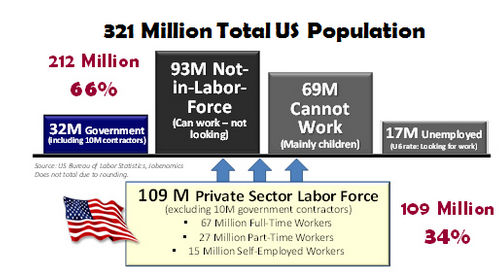
34 percent of Americans financially carry the country

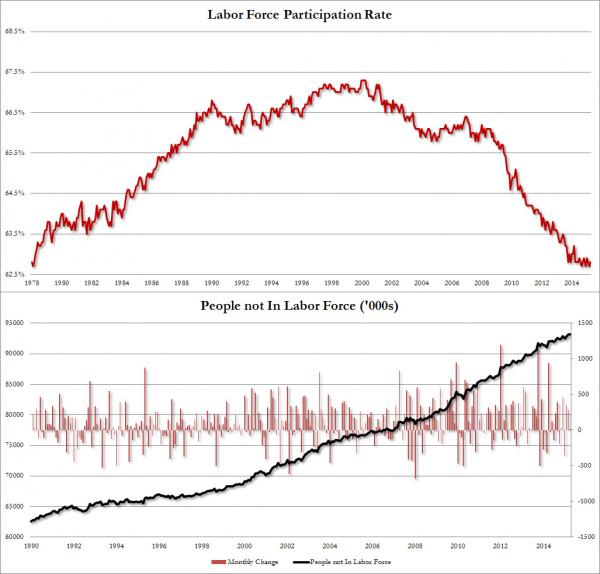
The number of Americans not in the labor force has hit another new record.  The latest figures show that 93,194,000 Americans are not in the labor force.  How big is this figure?  How about the populations of our three most populated states in California, Texas, and Florida combined and you would still need to find millions more.  To be exact, add all three up and you would still need another 8 million people to add up to this figure.  This is about a third of the entire United States that is not in the labor force, and this is excluding the 69 million that can't work (i.e., mostly children).

The trend itself doesn't seem to be letting up.  Plus you have a large number of added jobs coming from low wage employment.  The trend for those not in the labor force is unmistakable:

Not in Labor Force

Another problematic aspect of this transition is that you have 34 percent of the country supporting the rest financially.  Does that come as a shock to you?  I'm sure the media doesn't bother going into this because they are too caught up in the narrative that money is flowing into all corners of the United States.  That is simply not true.  Sure, the stock market is near a peak.  But very few Americans actually own stocks out right.

Take a look at the raw numbers of the entire United States:

employment us by segment

Let us go through the categories one by one:

Government workers:  Government workers are paid via tax revenues collected from the private sector.  While many of these are legitimate jobs, the revenue for paying for these come from tax dollars collected from the private sector.  That is simply a fact.

Not in the labor force:  This is the black box of it all.  These are able-bodied people that can work but choose not to do so.  Some are old and some are in college, but this figure has to be examined closely.  With more Americans going to college and more diving deep into debt, how many in this group should be working but are not?  The growth here is not explained by old age trends or disability growth with the population.  Something else is going on here.

Cannot work:  This group is mainly made up of children so probably needs no further investigation.

Unemployed:  This is the headline calculating group.  These are Americans looking for work but are unable to do so.  We keep hearing how great things are but we have 17 million Americans ready and wanting to work but not being able to do so.

Private sector:  In terms of tax revenues, this is really the group that is supporting the rest of the country.  Their tax revenues fuel and fund the government.  But even their tax revenues are not enough as we go deeper into debt as a country.

Now maybe all of the above doesn't fit in conveniently in a one minute television segment.  But don't you think this is important to think about when one-third of the country is supporting the rest financially?  And isn't it troubling that many new private sector jobs are also in the low wage segment of the economy?

Please continue reading from: 
http://www.mybudget360.com/not-in-labor-force-one-third-americans-carry-rest-of-country-financially/

May 10, 2015

What Humans Are Really Doing to Our Planet, in 19 Jaw-Dropping Images

Source: Peter Essick/Foundation for Deep Ecology

Electronic waste, from around the world, is shipped to Accra, Ghana, where locals break apart the electronics for minerals or burn them. 

Source: Pablo Lopez Luz/Foundation for Deep Ecology

Mexico City, Mexico, one of the most populous cities in the Western Hemisphere.

Source: Digital Globe/Foundation for Deep Ecology

New Delhi, India, where many landfills are reaching a breaking point. The surrounding population of Delhi totals some 25 million people. 

Source: Mike Hedge/Foundation for Deep Ecology

Los Angeles, California, which is famous for sometimes having more cars than people.

Source: Mark Gamba/Corbis/Foundation for Deep Ecology

Kern River Oil Field, California, USA.

Source: Daniel Dancer/Foundation for Deep Ecology

Former old-growth forest leveled for reservoir development, Willamette National Forest, Oregon, per the Population Media Center.

Source: Jason Hawkes/Foundation for Deep Ecology

Coal power plant, United Kingdom.

Source: Cotton Coulson/Keenpress/Foundation for Deep Ecology

North East Land, Svalbard, Norway, where rising global temperatures are fundamentally changing the ecology.

Source: Digital Globe/Foundation for Deep Ecology

The world's largest diamond mine, Russia.

Source: Daniel Beltra/Foundation for Deep Ecology

Amazon jungle burns to make room for grazing cattle, Brazil.

Source: Garth Lentz/Foundation for Deep Ecology

Tar sands and open pit mining in an area so vast, it can be seen from space. Alberta, Canada.

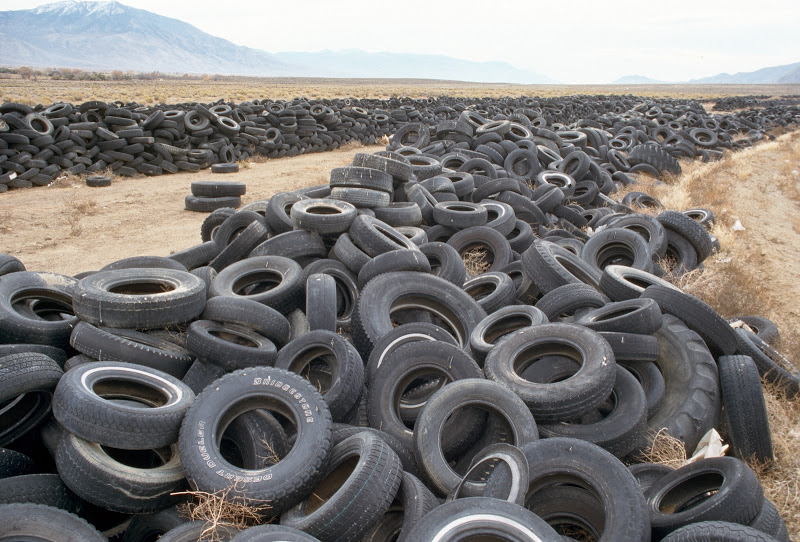
Source: Daniel Dancer/Foundation for Deep Ecology

Tires discarded in Nevada.

Source: Garth Lentz/Foundation for Deep Ecology

Vancouver Island, Canada.

Source: Yann Arthus Bertrand/Foundation for Deep Ecology

Industrial agriculture in Almeria, Spain, stretches for miles.

Source: Garth Lentz/Foundation for Deep Ecology

Tar sands, Alberta, Canada.

Source: Lu Guang/Foundation for Deep Ecology

A man turns away from the smell of the Yellow River in China.

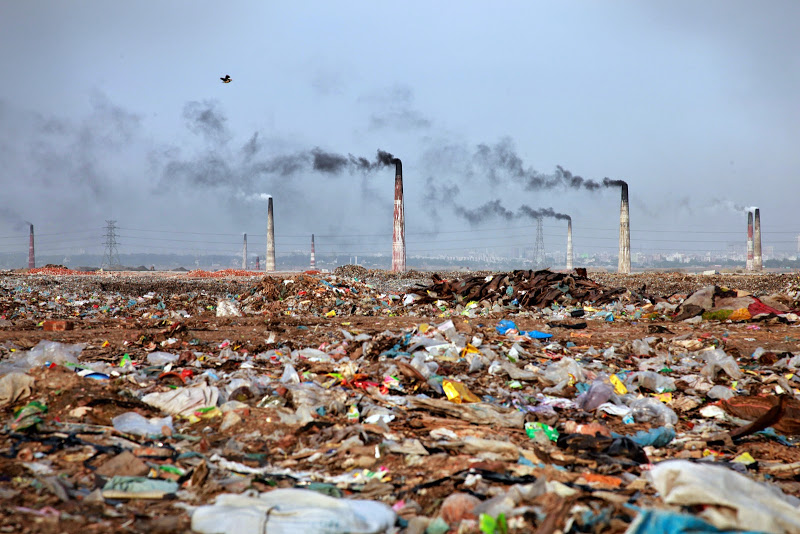
Source: M.R. Hasasn/Foundation for Deep Ecology

Bangladesh, where much of the world's clothing and goods are manufactured.

Source: Darin Oswald/Idaho Statesman/Foundation for Deep Ecology

Black Friday, Boise, Idaho.

Source: Zak Noyle/Foundation for Deep Ecology

A remote bay in Java, Indonesia, where local residents, without infrastructure for waste disposal, discard waste directly into streams and rivers.