Read full at:
https://phys.org/news/2023-03-newly-enzyme-air-electricity-source.html
"EPA's top priority is to protect public health and the environment, and today's proposal is a significant step forward to further protect the farmworkers, farmers and pesticide handlers who deliver the fuel, fiber and food that runs America," said EPA Administrator Michael S. Regan. "Farmworker justice is environmental justice, and we're continuing to take action to make sure these communities are protected equally under the law from pesticide exposure."
Application Exclusion Zone
The Worker Protection Standard regulations offer protections to over two million agricultural workers and pesticide handlers who work at over 600,000 agricultural establishments. In 2015, EPA made significant changes to the standard to decrease pesticide exposure among farmworkers and their family members. Less pesticide exposure means a healthier workforce and fewer lost wages, medical bills and absences from work.
Among the changes, the revised standard included a new provision requiring agricultural employers to keep workers and all other individuals out of an area called the AEZ during outdoor pesticide applications. The AEZ is the area surrounding an ongoing pesticide application that people must not enter to avoid exposure. An AEZ moves with the equipment during applications to protect farmworkers and bystanders that could be contacted by pesticides.
In 2020, the previous administration published a rule specific to the AEZ requirements, limiting the applicability of the protections to the agricultural employer's property and shrinking the AEZ size from 100 feet to 25 feet for some ground-based spray applications. Prior to the effective date of the 2020 AEZ Rule, petitions were filed in the U.S. District Court for the Southern District of New York (SDNY) and in the U.S. Second Circuit Court of Appeals challenging the 2020 Rule (now consolidated as case number 20 Civ. 10642). The SDNY issued an order granting the petitioners' request for a temporary restraining order. As a result, the 2020 AEZ Rule has not gone into effect, and the AEZ provisions in the 2015 WPS remain in effect.
Through its review, EPA has determined that the provisions in the 2020 AEZ Rule that weakened protections for farmworkers and nearby communities from pesticide exposure should be rescinded to protect the health of farmworkers, their families, and nearby communities.
Please read full EPA announcement here:
"Advances in enhanced geothermal systems will help introduce geothermal energy in regions where, until recently, the use of this renewable power source was thought to be impossible," said U.S. Secretary of Energy Jennifer M. Granholm. "These pilot demonstrations will help us realize the enormous potential of the heat beneath our feet to deliver clean, renewable energy to millions of Americans."
Geothermal energy currently generates about 3.7 gigawatts of electricity in the United States, but a new analysis shows it could provide 90 gigawatts of firm, flexible power to the U.S. grid by 2050, as well as heating and cooling solutions nationwide. This substantial geothermal energy potential is, however, largely inaccessible with conventional geothermal technologies. The use of geothermal energy for electricity requires three elements: heat, fluid, and a permeable section of the Earth's crust. While heat exists everywhere underground, many locations lack adequate water and/or permeability. EGS employ human-made underground reservoirs to enable the fluid flow necessary to draw geothermal energy to the surface, where it can be captured to power homes across the country. Achieving this goal would make geothermal energy a clean, cost-effective option across the country, while spurring progress toward President Biden's goals of 100% carbon-pollution-free electricity by 2035 and net-zero emissions by 2050.
Read full at:
The resource details the Chemical Safety Board's investigation into the October 2019 hydrogen sulfide release at the Aghorn Operating Waterflood Station in Odessa, TX. During the incident, a worker responded to an alarm from a water pump, which was part of the process of extracting natural gas and crude oil. The worker was alone in the pump house when he tried to close process valves to isolate the pump.
"Either before the worker's arrival or during his work, the pump unexpectedly energized, releasing water containing H2S gas into the pump house," the newsletter states. "The H2S concentration reached fatal levels, killing the worker."
OSHA offers likely causes for the incident and lists steps to prevent future incidents. Recommendations include:
Yet despite this knowledge, light pollution has been challenging to document, especially on a global scale. But now, a new study shows that light pollution is rapidly worsening.
The analysis comes from Globe at Night, a citizen science program run by the National Science Foundation's NOIRLab. The study concludes that stars are disappearing from human sight at a stunning rate. By relying on the observations of sky-gazers across the globe, the researchers found that light pollution has had much more of an impact than indicated by satellite measurements.
From the glimmering swath of our home galaxy, the Milky Way, to a multitude of constellations, the human eye should be able to see thousands of stars on a clear, dark night. Yet thanks to light pollution, 80% of people in the United States can't even see the Milky Way swirl of our galaxy anymore.
The revisions to the FTC's Green Guides reflect a wide range of public input, including hundreds of consumer and industry comments on previously proposed revisions. They include updates to the existing Guides, as well as new sections on the use of carbon offsets, "green" certifications and seals, and renewable energy and renewable materials claims.
"The introduction of environmentally friendly products into the marketplace is a win for consumers who want to purchase greener products and producers who want to sell them," said FTC Chairman Jon Leibowitz. "But this win-win can only occur if marketers' claims are truthful and substantiated. The FTC's changes to the Green Guides will level the playing field for honest business people and it is one reason why we had such broad support."
In revising the Green Guides, the FTC modified and clarified sections of the previous Guides and provided new guidance on environmental claims that were not common when the Guides were last reviewed.
Revisions to Previous Guidance. Among other modifications, the Guides caution marketers not to make broad, unqualified claims that a product is "environmentally friendly" or "eco-friendly" because the FTC's consumer perception study confirms that such claims are likely to suggest that the product has specific and far-reaching environmental benefits. Very few products, if any, have all the attributes consumers seem to perceive from such claims, making these claims nearly impossible to substantiate.
The Guides also:
New Sections. The Guides contain new sections on: 1) certifications and seals of approval; 2) carbon offsets, 3) free-of claims, 4) non-toxic claims, 5) made with renewable energy claims, and 6) made with renewable materials claims.
NASA's space radiation team is comprised of 25 people across the agency, universities, industries, and government facilities. Representatives meet periodically with the Presidential Cancer Cabinet, which includes Administrator Nelson, to discuss the status of their research, and brainstorm ideas to further progress and interagency collaboration.
"The White House has requested all hands on deck to improve the outcome of cancer diagnoses," said Vanessa Wyche, director of NASA's Johnson Space Center in Houston. "We are honored to have employees from the Space Radiation Element not only work to protect our astronauts, but also work to protect our nation through the Cancer Moonshot Initiative."
For instance, scientists are seeking to develop and test new screening technologies for specific cancers as only a handful of cancers currently have well-vetted, early-detection protocols. They strive to incorporate these new detection methods into the astronaut health surveillance program, which could help spot certain cancers earlier and make these measures more widely available.
"We want to know: What are those cancers' early 'tells'? And how feasible is it to screen for those tells?" explained Robin Elgart, Space Radiation Element lead scientist at Johnson. "If we could find these early-detection technologies and implement them into the astronaut health surveillance program, collaborations through the Cancer Moonshot could pave the way for broader use and acceptance of these new detection methods."
"NASA support could even help the new technologies to come to market," added Brock Sishc, Space Radiation Element cancer discipline lead at Johnson. "Then we can help not only our astronauts, but also potential cancer patients on Earth."
Scientists are also working to identify medicines and dietary supplements that could help reduce the risk of cancer from radiation exposure. Searching for such compounds requires scrutinizing large groups of people over long durations – something NASA's small set of astronauts can't provide. Using connections forged through the Cancer Moonshot to access and process vast data sets involved with modern drug screening may help. Finding patterns in these data sets could reveal new insights.
In addition, NASA seeks to harness cutting-edge technologies to develop personalized cancer risk assessments from radiation exposure. The research, still in its early stages, involves using small devices called tissue chips, which help scientists model human systems.
EPA designates five economy-wide categories of entities potentially affected by the proposed rule:
Given the widespread historic use of PFOA and PFOS for fire suppression and in the manufacture of consumer products and packaging, the proposed rule has wide-reaching impact and EPA's "categories" confirms the same.
Designation as Hazardous Substances
There are two ways that a substance may defined as a "hazardous" substance under CERCLA. The first is automatic when the substance is identified as hazardous or toxic pursuant to other specified federal environmental statutes (such as the Clean Air Act, Clean Water Act, Resource Conservation and Recovery Act, etc.). The second is where the substance is designated as hazardous pursuant to CERLCA Section 102. EPA's rulemaking is pursuant to CERCLA Section 102(a) which allows EPA to promulgate regulations designating as hazardous a substance "which, when released into the environment may present substantial danger to the public health or welfare or the environment." 42 U.S.C. § 9602(a).
Notably, EPA has never exercised its authority pursuant to Section 102(a) before so it has not previously issued an interpretation of the standard for designating a hazardous substance under CERCLA. The proposed rule conducts such an analysis to defend its rulemaking. Given that EPA has not used its authority in this manner before, expect this to be an area of focus for future legal challenges.
"Direct Impact" of the Proposed Rulemaking
EPA identifies three direct effects of the proposed rule. First, any person in charge of a vessel or facility must report releases of PFOA and PFOS of one (1) pound or more within a 24-hour period. EPA acknowledges this will apply to very few facilities/vessels because the Agency's estimate is that this will cause an increased cost of $561/release and an estimated annual cost of $370,000. The second direct effect is that Federal agencies would be required to meet all of the property transfer requirements of CERCLA 120(h) when selling or transferring Federally-owned real property. This would require providing notice when any hazardous substance was stored for one year or more, known to have been released or disposed of, and providing a covenant warranting that all remedial action necessary to protection human health and the environment with respect to hazardous substances has occurred before the transfer (or will be conducted by the Federal government after the transfer). With PFOA and PFOS included as hazardous substances, Federal agencies would need to consider those compounds in any property transfer notice. The third direct effect is that upon designation as a hazardous substance, the Department of Transportation (DOT) would be required to list and regulate PFOA and PFOS as hazardous materials under the Hazardous Materials Transportation Act (HMTA).
"Indirect Impacts" of the Proposed Rulemaking
EPA seemingly acknowledges that the real "action" of this proposed rulemaking is what the agency considers "indirect, downstream effects" of the designation. These "indirect effects" include:
EPA asserts that the CERCLA designation would "likely increase the pace at which cleanups occur because it will allow the Federal government to require responsible private parties to address releases of PFOS and PFOA at sites without other ongoing cleanup activities, and allow the government and private parties to seek to recover cleanup costs from PRPs assuming relevant statutory criteria are met."
EPA considers CERCLA response actions, including the investigation of hazardous substance releases and determining if removal or remedial action is necessary, to be "contingent, discretionary, and site-specific actions" as compared to the "only automatic, private party obligation that flows from designation as a CERCLA hazardous substance" which is the obligation to report releases of PFOA and PFOS. EPA uses this apparent distinction to assert that this designation "does not create new costs, but rather allows costs to be shifted from the taxpayer to parties responsible for pollution under CERCLA" and that "[e]ven in those circumstances, where the government is able to transfer costs, a private party's ability to pay response costs is taken into account under the statute and in EPA's implementation" of CERCLA.
Read full from Michael Best & Friedrich:
https://www.michaelbest.com/Newsroom/296003/EPA-Advances-Rule-to-Designate-PFOA-PFOS-as-CERCLA-Hazardous-Substances
"Once you give it a chance, this thing will unzip," Dr. Dichtel said.
Dr. Strathmann, who was not involved in the research, said that the new study was important because it was based on chemistry profoundly different from other methods that were being studied. "We're going to need some creative solutions," he said.
Read full at NY Times;
https://www.nytimes.com/2022/08/18/science/pfas-forever-chemicals.html
The damage can occur with just a few seconds of exposure, officials say. Symptoms include a burn-like skin reaction and photokeratitis, a painful eye condition that can lead to a feeling of sand in the eyes.
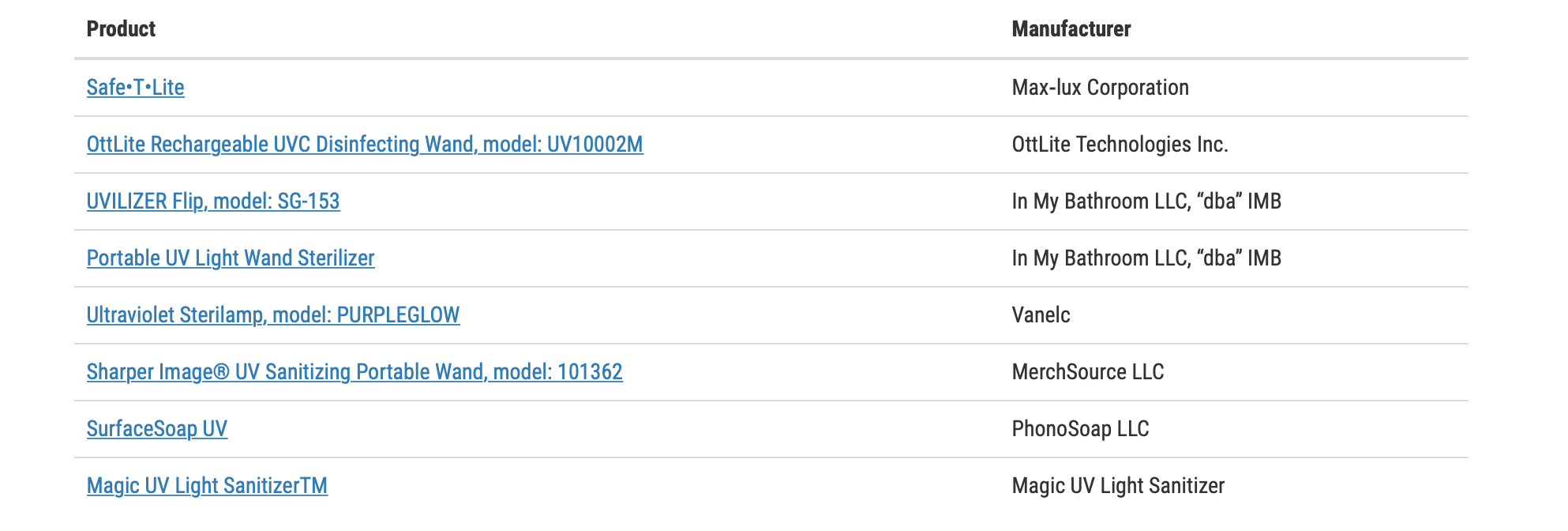
Safety investigators on the case said the following list includes products not properly equipped to protect people from the radiation (but noted that the list is not exhaustive, and other products on the market may be unsafe, as well). In some cases, UV-C radiation levels were 3,000 times more than the exposure limit recommended by the International Commission on Non-Ionizing Radiation Protection.

Image Source: FDA (Content draxe.com)
Home cleaning products are generally not tested for long-term impact on public health. In fact, it's difficult to even know all of the ingredients in cleaners, since they only have to account for active ingredients.
It may come as no surprise, then, that people who clean for a profession can experience lung damage equivalent to smoking 20 cigarettes a day for 10 to 20 years.
Knowing the chemical damage that can occur from chemical cleaning products, it's no wonder people are looking for alternatives like UV disinfectants. The problem is we don't have strong laws to make sure they are safe before going on sale to the general public.
You can even take a look at its database, focusing in on how products rank in its disinfectant category.
Here are a few cleaning tips to remember:
We determined restrictions are needed for the following chemical-product combinations:
We determined reporting requirements are needed for the following chemical-product combinations:
We made a number of changes to integrate feedback from our stakeholders and communities. Read how we incorporated feedback in our comment overview. Three regulatory determinations changed between draft and final:
If interested, you can view comments from other stakeholders on the draft report. To hear a summary of the results from our public comment survey, watch our video covering the highlights (also available in Spanish). For more details, check out our infographic (also available in Spanish) and blog post covering the results. You can also review the complete, unedited responses to the survey.
About this workshop
The Environmental Health Matters Initiative (EHMI) of the National Academies invites you to register for the first workshop in our three-part series on Indoor Air Management of Airborne Pathogens building upon the 2020 workshop on the airborne transmission of SARS-CoV-2. These workshops will explore strategies needed for airborne disease control and risk reduction in enclosed places by drawing on accumulated community and institutional knowledge, on-the-ground observations of indoor environments management during the pandemic, and novel and promising scientific discoveries.
The first workshop in the series will engage multidisciplinary speakers and active participants to investigate the state of knowledge concerning building management to reduce the transmission of airborne pathogens. Speakers will highlight progress made since 2020, identify critical research gaps, and explore technical and social barriers to implementation. Participants will share their experiences with the management of enclosed spaces during the pandemic and identify promising practices to be adopted to make these places safer.
Learn more about the structure of the workshop and the speakers by visiting our webpage, where you will soon be able to download the meeting agenda.
Your Voice Matters!
We want to hear a broad range of perspectives before the workshop to inform the conversation during the event. Please fill out any or all questions included in this anonymous questionnaire if you are or aren't able to attend the event.
Thu, August 18, 2022
11:30 AM – 3:30 PM EDT
Here are the links to the videos:
PFAS Doctor's Perspective - YouTube
PFAS Questions with Dr. Nicholas Newman - YouTube
Via Susan Buchanan, MD, MPH
In July 2021, Public Law c. 477, An Act To Stop Perfluoroalkyl and Polyfluoroalkyl Substances Pollution (LD 1503, 130th Legislature) was enacted by the Maine Legislature. This new law requires manufacturers of products with intentionally added PFAS to report the intentionally added presence of PFAS in those products to the Department beginning January 1, 2023. The law also prohibits the sale of carpets or rugs, as well as the sale of fabric treatments, that contain intentionally added PFAS beginning on January 1, 2023. Effective January 1, 2030, any product containing intentionally added PFAS may not be sold in Maine unless the use of PFAS in the product is specifically designated as a currently unavoidable use by the Department.
To implement the product notification requirements the Department is working with the Interstate Chemicals Clearinghouse to develop an online reporting database similar to those already in use by other states. The Department is also in the process of developing a rule to clarify the upcoming reporting requirements. During the rule development process there will be an opportunity for stakeholder input on the implementation of the program. If you are interested, please sign up to receive notification of Department rulemaking and opportunity to comment notices on our website.
There is also a FAQ at https://www1.maine.gov/dep/spills/topics/pfas/PFAS-products/index.html