Jun 23, 2012

2012 Global Fuel Supply Still Flat - @biggav

Stuart at Early Warning has a look at global oil production trends - 2012 Global Fuel Supply Still Flat.
I seem to be the only person paying much attention to this, but I still think it's significant. May figures for global liquid fuel supply are out from OPEC and the IEA and they continue to show that global supply has increased very little since January (in contrast to the very strong increases in the second half of 2011).

Other things being equal, we would expect this to lead to rising prices. Instead, prices have been weak/falling as a result of Eurozone fears. The fears about the eurozone are legitimate, but still, at present the global economy has got to be growing, if a little weaker than normal. Only Europe is actually contracting at present and that mildly. Thus, if the fears do not translate into much more pronounced global contraction in reality fairly soon, oil prices could jump up quite a bit. On the other hand, of course, if Europe does turn into a full-blown financial crisis then they could fall further.

There is a strong Schrodinger quality to the oil markets at present: prices are a superposition of the state in which Europe turns into a major global financial crisis, and the state in which it doesn't. I wonder how long before the measurement is made?

Stuart also has a look at oil production in Iraq and some of the dodgy reporting of production trends- Is "Soaring" the Right Word Here?.

Please continue reading at:

Study Finds Western World Must Halve Meat Consumption To Feed Global Population By 2050

It is estimated that the world’s population will reach 9.3 billion people by 2050, which raises significant questions as to how exactly we are going to feed such a massive number of people — and according to a new report from the University of Exeter, the answer is to eat less meat. The researchers also recommend that we recycle our waste and increase the efficiency of our farming processes, but to make a substantial enough difference the world needs to reduce its average global meat consumption from 16.6% to 15 % of average daily calorie intake. For much of the Western world, that translates into a 50 percent reduction in meat consumption.

Read the rest of Study Finds Western World Must Halve Meat Consumption To Feed Global Population By 2050

eBay To Power Its Flagship Data Center With a Bloom Energy Fuel Cell Farm

ebay, bloom energy, fuel cell farm, data center, ebay renewable project, servers, data center power, biogas,

eBay recently announced that it’ll be teaming up with Bloom Energy as part of its “bold new vision for powering commerce with clean energy.” The online retail giant announced that it will be powering its flagship data center in Utah using a Bloom Energy fuel cell farm as its primary power source. eBay obviously needs a lot of energy to power its vast number of servers, so the fact that they are turning to a greener option than the predominately fossil fuel-powered electrical grid is a testament to how far clean energy has come.

Read the rest of eBay To Power Its Flagship Data Center With a Bloom Energy Fuel Cell Farm

Horticulture, technology, architecture and art converge in Plant-in City project

Plant-in City is a smart garden system that uses computer software to monitor water and li...

Despite large, lush open spaces like Central Park, New York City is the stereotypical concrete jungle – a dense synthesis of buildings, roadways, machines and human flesh that leaves little in the way of nature. Small urban gardens tucked on the top of ten-story apartment buildings do little to change that. The Plant-In City project aims to provide a more substantial garden space in New York City, with a technologically advanced terrarium concept. It's like gardening for geeks. .. Continue Reading Horticulture, technology, architecture and art converge in Plant-in City project

Selenium shows promise as antibiotic coating for medical devices

Brown University's Qi Wang swirls a solution of selenium nanoparticles

Although it’s known to kill bacteria, selenium has never been tried as an antibacterial coating for implanted medical devices ... until now, that is. Engineers from Rhode Island’s Brown University have applied coatings of selenium nanoparticles to pieces of polycarbonate – the material used for things like catheters and endotracheal tubes – and then exposed those samples to Staphylococcus aureus bacteria. In some cases, populations of the bacteria were subsequently reduced by up to 90 percent... Continue Reading Selenium shows promise as antibiotic coating for medical devices

B9 Shipping developing 100 percent fossil fuel-free cargo sailing ships

B9 Shipping's sailing cargo ships would feature a Dyna-rig sail system

Ireland-based B9 Shipping has started work on a full-scale demonstration vessel as part of its goal to design the modern world’s first 100 percent fossil fuel-free cargo sailing ships. Unlike most conventional large cargo vessels, which are powered by bunker fuel, B9 Shipping’s cargo ship would employ a Dyna-rig sail propulsion system combined with an off-the-shelf Rolls-Royce engine powered by liquid biomethane derived from municipal waste... Continue Reading B9 Shipping developing 100 percent fossil fuel-free cargo sailing ships

Jun 22, 2012

Energy Department Announces Draft Guide for Large-Scale #Renewable #Energy Projects Available for Public Comment

The Energy Department today announced the publication of the draft Federal Renewable Energy Guide: Developing Large-Scale Renewable Energy Projects at Federal Facilities Using Private Capital in the Federal Register for industry and agency comment. This Guide provides a project development framework to help federal agencies, private developers, and financiers coordinate on large-scale renewable energy projects that will help achieve federal renewable energy goals. The Guide underscores the comprehensive efforts by the Energy Department to increase the deployment of clean, renewable energy that diversifies our nation's energy portfolio and boosts our energy security.

The Guide is available on the Federal Register website and is open to public comment until July 2, 2012. The Federal Register Notice contains specific questions from the Energy Department for public consideration

Full story

InfoGraphic Amazon huge sales growth, but at what cost? Breaking workers & small publishers #jobs #humanrights


With all their focus on the consumer, Amazon lacks in some basic human rights areas:
“On a 102-degree day, 15 workers in an Amazon warehouse collapsed from the heat, six of whom needed to be rushed to the emergency room.”
“Despite a $5 billion cash reserve, Amazon donates nothing to charities — if an employee wants to deduct a donation from his or her paycheck, they have to pay an additional 6% fee.”
“Amazon buys books at up to 45% off the cover price causing small book publishers to lose over $3 per transaction.”

See full graphic here

Never Mind Your Abs -- How flabby is Your Brain @Forbes

You may just be more likely to find your car in the parking lot if you’ve briskly walked there. Why? Because your brain needs physical exercise as much as your body does. You can get a date without abs, but just try getting that attractive stranger to go out with you if you forget your prospect’s name.

Neuroscientists have found that exercise increases blood flow and the release of beneficial chemicals including dopamine, norepinephrine, and serotonin, plus a substance known as BDNF (brain-derived neurotrophic factor), which essentially fertilizes new neurons, or brain cells.

So, armed with this knowledge, but with limited time – and, if you’re anything like me, mental discipline – how do you choose the best workout for both brain and body? I asked three leading experts in the field what they do, and here are their secrets:

Please continue reading on behalf of Katherine Ellison, a Pulitzer-Prize winning investigative journalist, author, writing consultant and former foreign correspondent:

Issa Uncovers the Truth About #Green #Jobs. Not good, not green

Slugging it out in the debates over federal energy policies can be a thankless task, but sometimes you have a fun day. For example, Rep. Darrell Issa’s June 6 grilling of representatives from the Bureau of Labor and Statistics on their definition of “green jobs” is laugh-out-loud funny. Beyond the humor, Issa’s pointed questions underline the arbitrariness of the whole “green jobs” agenda, not to mention the dubious economic rationales put forward by its proponents.

IER was on to the BLS’ hilariously “big tent” methodology when its “Green Goods and Services” index first came out. Upon the release in March, we wrote:

[T]he 3.1 million “green” goods and services don’t come solely from guys building solar panels. There are plenty of things thrown in there, such as nuclear power plants, people whose job it is to write grant proposals, federal and state government officials who enforce regulations, and even logging and petroleum & coal products manufacturing. Some of these are hardly what the layperson would think of as “green jobs.”

Yet the problem wasn’t merely one of overzealous counting. We went on to question the very focus on “green jobs” in the first place:

In the context of today’s political debates, “green jobs” is a pointless concept, as IER’s study from 2009 demonstrated. The government has no business picking winners and losers, whether green, blue, or yellow. One reason is that the government does a poor job of picking winners—just consider the debacles of Solyndra, Beacon Power, Evergreen Solar, Range Fuels, and many other businesses that received special favors from the government because they create “green jobs” but fail in the marketplace.  The market economy will direct resources to their most efficient niches, and jobs will grow in those sectors where labor can be most effectively deployed.

The point of an economy isn’t to “create jobs,” whether green, yellow, or blue. The point is to efficiently allocate scarce resources—including labor—into the appropriate sectors, in order to best satisfy consumers given the constraints imposed on us by nature. Yes, a well-functioning economy will create jobs for workers, but that is a by-product of the more fundamental task.

The government doesn’t help citizens, or even the environment for that matter, by artificially promoting certain jobs that it designates as “green.” As Chairman Issa’s recent questioning makes clear, the entire “green jobs” agenda is built on quicksand

Please read full and follow at:

Green roofs now mandatory in Toronto

 From The Atlantic: Toronto has been aggressive about it: they have a new, comprehensive green roof law, the first one in North America.

Like all laws, it’s complicated, but new building permit applications for residential, commercial, and institutional developments must now have green roofs. New industrial developments (as of April 30, 2012) will soon have to be green, also.

The law states a minimum roof size, so it doesn’t apply to gardening sheds. And the larger the roof, the greater the percentage of it will have to be green. People can opt out, but they have to pay toward a fund.

Efforts are already paying off: Green Roofs for Healthy Cities is reporting that the law has resulted in more than 1.2 million square feet of new green space planned on new commercial, institutional, and multi-unit residential developments. It will also keep enough rainwater runoff out of the lakes and rivers to fill fifty Olympic sized swimming pools. It’s reduced the heat island effect and led to an annual energy savings of over 1.5 million KWH for building owners.

And there are still other benefits: opportunities for parks and recreational areas. Birds and bees do well with these changes. To get an idea of what these roofs can look like, here’s a collection of still images of green roofs around the world.

Read the whole story

Jun 21, 2012

Wait, Did This 15-Year-Old From Maryland Just Change How We Treat Cancer?

If you’re feeling anxious about how U.S. kids lag the world in science and math, or just in a funk about politics or the mess in Europe, take in this story of a high school freshman from Crownsville, Md. who came up with a prize-winning breakthrough that could change how cancer and other fatal diseases are diagnosed and treated. His name is Jack Andraka, and he loves science and engineering with every inch of his 15-year-old soul. Just spend a minute or so watching this video.

Read on at:
http://www.forbes.com/sites/bruceupbin/2012/06/18/wait-did-this-15-year-old-from-maryland-just-change-cancer-treatment/

Space mirrors would dry out US geoengineering cannot restore both temperature & rain to previous levels.

Installing huge mirrors in space would help reverse global warming, but they would come at a price: less rain for the Americas and northern Eurasia. Previous studies have shown that geoengineering cannot restore both temperature and rain to previous levels.
Read more http://www.newscientist.com/article/mg21428695.700-space-mirrors-will-dry-out-us-and-eurasia.html

China creates touted as a model for #sustainable living in this rapidly urbanising heavily polluted country.

At first glance, Tianjin Eco-City looks much like any other upscale Chinese urban development, with its rows of identical apartment blocks, wide roads and manicured verges. In fact, it is being touted as a touted as a model for sustainable living in this rapidly urbanising and heavily polluted country.

H.R. 4965, a bill to preserve existing rights to waters of the United States regarding Clean Water Act’s jurisdiction

H.R. 4965 would prohibit the Environmental Protection Agency (EPA) and the Army Corp of Engineers (Corps) from finalizing or implementing guidance provided in the document entitled “EPA and Army Corps of Engineers Guidance Regarding Identification of Water Protected by the Clean Water Act.” That document was sent to the Office of Management and Budget for regulatory review earlier this year. Enacting this legislation also would prohibit those federal agencies from using similar guidance as the basis for any decision regarding the scope of the Clean Water Act’s jurisdiction or in any rulemaking activities.
Read on at: http://www.cbo.gov/publication/43344

The U.S. War on Coal; But Global Consumption Increases

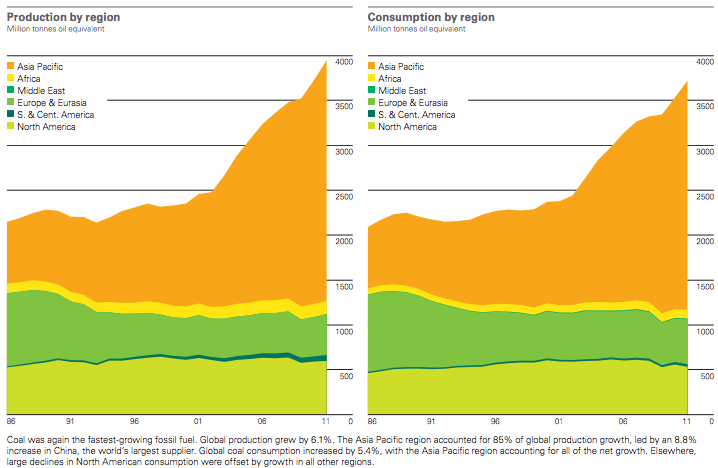
Coal consumption in the United States is contracting rapidly while in the global economy, it is growing as a fuel of choice.  President Obama presaged this development when he said that under his plans, building a coal plant would not be economically viable. Coal’s share of U.S. electricity is expected to fall to below 40 percent this year from 42 percent last year and produce the lowest share since data was collected in 1949.[i] Just five or six years ago, its share of electricity generation was 50 percent. But those statistics are atypical of how the global economy is treating coal. The BP Statistical Review of World Energy shows coal to be the fastest growing fossil fuel worldwide, garnering a 30 percent share of world supplies in 2011, the highest share since 1969.[ii]

According to the latest BP Statistical Review, world coal consumption grew 5.4 percent in 2011 and world coal production grew by 6.1 percent.[iii] The decline in U.S. coal consumption was offset by a large increase in Asia’s coal consumption, which accounted for all the net growth in 2011. China’s coal consumption grew 9.7 percent between 2010 and 2011, and India’s coal consumption increased 9.2 percent. China consumed 49 percent of the world’s coal supply in 2011.

Source: http://goo.gl/fqw6Q

The U.S. Coal Market

Electric utilities are switching from coal to natural gas due to the low cost of natural gas and excessive regulation by the Environmental Protection Agency (EPA), which is causing the cost of coal-fired generation to increase. Natural gas is expected to produce 29 percent of the country’s electricity this year, up from 21 percent in 2008. The electric utility companies are now tackling how to store growing piles of unused coal, cancelling coal contracts and deferring deliveries. According to the Energy Information Administration, electric utilities are expected to burn 808 million tons of coal this year, a 13 percent decline from last year and the fewest tons since 1992.

Please continue reading at: http://www.instituteforenergyresearch.org/2012/06/19/the-u-s-war-on-coal-but-global-consumption-increases/

Growth of Renewables Is Being Underestimated, Yale 360

While renewable energy sources still provide a small portion of the world's power needs, several new reports suggest the global community may be

Click to enlarge
Global solar generation

Global solar consumption, 2001-2011
 
underestimating the growth potential for the green energy sector. The Washington Post cited studies showing that global solar generation nearly doubled in 2011, with consumers using more than 55 terawatt-hours of solar power, compared with about 30 terawatt-hours in 2010. According to one analyst, solar energy has the potential to provide nearly 10 percent of global electricity by 2018 if current trends continue, although growth in recent years has been largely driven by a decline in solar panel prices and government subsidies in the U.S., China, and Germany. The International Energy Agency (IEA) has projected a slower growth for renewables, although the IEA previously underestimated the expansion of alternative energy

Please continue reading at:

Jun 20, 2012

Nuclear power and waste disposal will burden taxpayers for millennia

While the lack of responsibility for the collateral damage may seem like the fault of too much government. We live in a culture where all the collateral damage from all the power sources are being left to the future generations.

There is a simple solution to the nuclear power industry: repeal the laws that limit the financial and moral responsibility of the owners (the shareholders) of such industries, and allow a true 'free-market' to assess their investment potential.

If the TEPCO shareholders that own the Fukushima reactors knew that they would be held responsible for the possible cost of rectification and for compensation, instead of these costs being socialised, they would not have been so willing to invest. Instead, the TEPCO shareholders responsibilities are passed on to the Japanese people through their government, which has paid out $11 billion for compensation and clean-up, and are facing requests for another $8.7 billion, and, no doubt, there will be massive on-going costs.

This is a great weakness of our economic system: because the investors are legally protected from the consequences of their investment those risks are not taken into account when potential investments are evaluated, so we don't get a true 'free-market' assessment of the investments – the market is skewed. Would the Bhopal accident have occurred if Union Carbide's investors knew they would be held truly responsible for the possible consequences?

If all business and industrial activity, including nuclear power, was exposed to a true and honest test of its financial viability with full responsibility carried by the investors, the Earth would be a very different place.

No amount of less government is going to fix that.

The "free" market just has the rich getting richer and the middle getting poorer. The lack of responsibility still gets dropped for future generations to deal with.

Read more at:
http://www.abc.net.au/environment/articles/2012/06/13/3523494.htm

H.R. 3668, Counterfeit Drug Penalty Enhancement Act of 2012 would establish a new federal crime for trafficking in counterfeit drugs.

H.R. 3668 would establish a new federal crime for trafficking in counterfeit drugs. As a result, the government might be able to pursue cases that it otherwise would not be able to prosecute.  Read more at: http://www.cbo.gov/publication/43330

H.R. 4223, SAFE DOSES Act, would establish new federal crimes relating to the theft of certain medical products. A

H.R. 4223 would establish new federal crimes relating to the theft of certain medical products. As a result, the government might be able to pursue cases that it otherwise would not be able to prosecute.  Read more at: http://www.cbo.gov/publication/43329

S. 2276, Officer Safety Act of 2012 for People Who Protect

S. 2276 would clarify when federal law enforcement officers who are indicted in a state court for actions taken while off-duty may transfer their cases from a state court to a federal district court. Under the bill, an off-duty law enforcement officer protecting an individual from violence, providing assistance to a victim of violence, or preventing the escape of an individual that the officer suspected of committing violence would be considered to be acting in their official capacity as a federal law enforcement officer and thus eligible to have their case transferred to a federal court.
Read more at: http://www.cbo.gov/publication/43333

DOE Announces Upcoming Energy Efficiency and #Renewable #Energy Free Webinars

EERE offers webinars to the public on subjects ranging from how to adopt the latest energy efficiency and renewable energy technologies to training for the clean energy workforce. Webinars are free; however, advanced registration is typically required. You can also watch archived webinars and browse previously aired videos, slides, and transcripts.

Full story
http://apps1.eere.energy.gov/news/progress_alerts.cfm/pa_id=753

Federal Disability Insurance Nears Collapse projected to run dry in 2016.

The pot of money the Social Security Administration is using to cover disability insurance is projected to run dry in 2016. That means more than 9 million out-of-work disabled Americans, plus their spouses and children, who also qualify for benefits, would see their checks shrink 21 percent. As more and more people qualify as “disabled,” for conditions we didn’t envision, like self-inflicted obesity and drug-fried brains, systems are on the verge of collapse.

Please read on at:
http://www.businessweek.com/articles/2012-05-31/federal-disability-insurance-nears-collapse

@WDNR helps with $75,000 in grants that aids citizen-based environmental monitoring projects

$75,000 in grants will aid citizen-based monitoring projects
MADISON - Eighteen Wisconsin organizations and projects will share a combined $75,000 from the Department of Natural Resources for efforts using volunteers to carry out natural resources management projects including building bat houses and monitoring bat populations, assessing eagle populations, checking brook trout for gill lice and collecting rain, hail and snow totals

Read on at
http://dnr.wi.gov/news/DNRNews_article_Lookup.asp?id=2197

H.R. 1171, the Marine Debris Act Amendments - Helping Oceans and Pacific Gyre

H.R. 1171 would reauthorize and amend the Marine Debris Research, Prevention, and Reduction Act. The bill would authorize the appropriation of $4.9 million annually through 2015 for the National Oceanic and Atmospheric Administration (NOAA) to carry out activities to reduce the amount of marine debris (such as plastic and lost fishing gear) in oceans and coastal areas. Read on at: http://www.cbo.gov/publication/43341

H.R. 3128, bill to amend the Wall Street Reform and Consumer Protection Act

H.R. 3128 would expand the definition of a small institution, for purposes of this exemption, to include depository institution holding companies with total consolidated assets of less than $15 billion as reported on either December 31, 2009, or March 30, 2010. CBO estimates that the expanded definition would allow TruPS issued by one institution to count as tier 1 capital that would not otherwise qualify under current law. As a result, that institution may reduce other types of tier 1 capital that would be more flexible if its capital position were to deteriorate; however, CBO does not expect any significant effect on either the institution’s probability of failure or assistance provided by the federal government. As such, CBO estimates no effect on the federal budget over the next 10 years.

Please read on at:
http://www.cbo.gov/publication/43342

#EPA and the #Veterans Admin Connect Veterans to Career Water #Jobs.

The U.S. Environmental Protection Agency (EPA) and the U.S. Department of Veterans Affairs (VA) have announced a plan to connect veterans with disabilities to career opportunities in the water and wastewater sectors—such as at wastewater plants and drinking water facilities—as part of EPA’s Water Sector Workforce Initiative. EPA and the VA will work with water utilities, states and local VA counselors to promote water sector careers and resources for finding water jobs for veterans as well as educational programs to help veterans transition into careers in water industries. More than one-third of all current water operators are eligible to retire within seven years and, according to the U.S. Department of Labor, employment for water and wastewater operators is expected to grow by 20% between 2008 and 2018, faster than the national average for all other occupations.

Please read on at Water and Waste Digest
http://www.wwdmag.com/small-systems/epa-and-va-connect-veterans-jobs-water-sectors

Source David Schaller www.sustainablepractices.info

Seven “green” reasons to raise a glass during June Dairy Month - protect the environment & farmers’

WDNR Video: More dairies are joining Wisconsin’s environmental leadership program, Green Tier.

“Dairying is a huge part of who we are what we do in Wisconsin,” says Department of Natural Resources Secretary Cathy Stepp. “We recognize the importance of our dairy farmers and the industry, and want to highlight some important gains that help better protect the environment and farmers’ bottom line.”

Stepp says that dairy farmers and others in the dairy industry have worked hard with county, state and federal agricultural, energy and natural resource staff to achieve the following green gains:

  1. Wisconsin is the nation’s leader in converting animal manure into green energy. In 2009, methane gas produced by anaerobic manure digesters generated 657.1 million Kilowatt hours in Wisconsin, up 600 percent from a decade earlier and enough to power more than 67,000 homes. Wisconsin Boasts Lead in cow power (exit DNR).
  2. More dairies are entering DNR’s environmental leadership program, called Green Tier, to help improve their environmental performance and their bottom line, with the lessons learned helping benefit the industry and regulators.
  3. Counties reported a 12 percent increase statewide in the number of nutrient management plans developed to help farmers manage manure and commercial fertilizer in 2010, the most recent years for which statistics are available. Such plans guide when, where and how much manure and other nutrients farmers spread, maximizing manure as a crop fertilizer, reducing overapplication that can result in runoff that can pollute lakes, streams and drinking water, according to the 2010 Wisconsin Land and Water Conservation Annual Progress Report (PDF) (exit DNR).
  4. Nearly 170,000 acres of buffers, reduced tillage and other best management practices to reduce erosion from cropland were installed in 2010 in Wisconsin, and more than 500 manure storage facilities, sediment basins, and other best management practices to better manage manure on farms were installed in 2010, according to the 2010 Wisconsin Land and Water Conservation Annual Progress Report (PDF) (exit DNR).
  5. More Wisconsin farmers are developing emergency plans for handling manure spills and reporting such occurrences immediately, environmental officials say, allowing for quicker response that can prevent or minimize runoff into lakes, streams or drinking water. Case in point: An Allenton farmer’s emergency planning and quick action on April 4, 2012 in calling the DNR’s Spill Emergency Hotline, close cooperation with the DNR, and fast clean up work prevented a 100-gallon manure spill from polluting Wisconsin waters. Watch DNR’s “How to Respond to a Manure Spill” video (exit DNR) to see other measures that farmers and the county, state and federal staff working with them take to keep manure on the land.
  6. Wisconsin led the nation in grass-based dairy farms, with one survey showing that nearly 30 percent of new dairy farmers using managed grazing, almost twice the rate for dairy farmers as a whole at that time. The benefits to farmers, their dairy cows, and the soil and water are detailed in “Green pastures, green futures,” in the December 2008 Natural Resources magazine.
  7. Wisconsin leads the nation in organic dairy farms, with the number of such farms growing 157 percent from 2002 to 2007. Wisconsin sales of organic milk accounted for 11.4 percent of the U.S. total, according to Organic Agriculture in Wisconsin: 2012 status report (exit DNR).

For more information on dairy farming and green gains, go to the DNR website and search for agri-business.


Source: http://dnr.wi.gov/news/DNRNews_article_Lookup.asp?id=2198

Plastic pollution study to be conducted on Great Lakes for first time.

An environmental survey of Lake Erie and other Great Lakes to be done this summer will, for the first time, identify how seriously micro plastics pollute the lakes, food supplies and even the world's oceans.

Please continue reading at:

Arizona, Minnesota and Wisconsin are the US’s Fastest Warming States

climate central, global warming, climate change, continental us, fastest warming states, us fastest warming states, arizona, minnesota, wisconsin,

new study from Climate Central has revealed that although the continental U.S. has warmed by about 1.3°F over the past 100 years, the temperature rise is not the same everywhere. Some states are getting warmer than others due to natural variability and air pollution. According to the research, Arizona, Minnesota and Wisconsin are among the fastest-warming states in the country since 1970.

Read the rest of Arizona, Minnesota and Wisconsin are the US’s Fastest Warming States

Jun 19, 2012

Oceans of pollution. Pacific Gyre has increased 100-fold in the past four decades

A drumbeat of recent scientific studies emphasizes an increasingly alarming convergence of crises for Earth's oceans. Among the impacts, the amount of plastic floating in the Pacific Gyre has increased 100-fold in the past four decades, and growing 'dead zones' in the world's oceans.

Please continue reading at:

Bernie Sanders... balance the budget on backs of the elderly, the sick, the children, and the poor.

Sen. Bernie Sanders (I-VT) on Thursday urged the congressional debt committee not to propose any cuts to Social Security, Medicare or Medicaid.

“This country does in fact have a serious deficit problem,” he said to about 200 people packed in the Senate Budget Committee room.

“But the reality is that the deficit was caused by two wars — unpaid for. It was caused by huge tax breaks for the wealthiest people in this country. It was caused by a recession as result of the greed, recklessness and illegal behavior on Wall Street. And if those are the causes of the deficit, I will be damned if we’re going to balance the budget on backs of the elderly, the sick, the children, and the poor. That’s wrong.”

Source: Raw Story (http://s.tt/1deGt)

Jun 18, 2012

Electric Micro-hybrids And The Multi-Billion Dollar Battery Battle

....In a car without stop-start, the battery has to start the engine when you leave for work and it can use the entire commute to recover the 400 to 600 amp-seconds of energy used by the starter. In a micro-hybrid with stop-start, the battery has to start the engine when you leave for work and it has to provide another 3,600 amp-seconds of energy for each engine-off event. In a typical 15-mile commute, a micro-hybrid requires its battery to do 100 times more work than the battery in a car without stop-start. This is not a modest change. It's an immense technical challenge.

The next graph comes from the same Ford-BMW presentation and shows how the performance of a high-quality AGM battery degrades in a micro-hybrid duty cycle. The downward curving blue line near the bottom is the amount of current the battery can accept as it ages. The upward curving black line in the middle is the amount of time required for the battery to regain an optimal state of charge in preparation for the next engine-off opportunity. Once again the core lesson is simple – a micro-hybrid with a new battery can recover from an engine-off event in under a minute, but a micro-hybrid that has 5,000 miles on the battery will need five minutes or more to prepare for the next engine-off event. Micro-hybrids that can't turn the engine off because they're waiting for the battery to recharge can't save fuel or reduce air pollution.

6.17.12 VRLA.png

Automakers understand the problem and their current solution is to disable the stop-start system when the battery hasn't returned to an acceptable state of charge. They also know that a short-term patch is not a long-term solution. Once you understand these two graphs, you'll understand why enhanced flooded batteries and even AGM batteries must eventually lose the battle for the micro-hybrid market. They just can't stand the strain.

The most important word in that last paragraph is "eventually." Automakers plan to build about ten million micro-hybrids this year and global production should ramp to 35 million micro-hybrids a year by 2015. There are several new battery technologies that are better suited to the micro-hybrid duty cycle, but they can't be manufactured in big enough volumes to make a difference over the next few years. That means automakers will be forced to settle for batteries they can buy in volume until the newer batteries are available at relevant scale. For the next several years, enhanced flooded batteries and AGM batteries will win the battle for short-term market dominance, even though they can't win the war...

Please read more by John Petersen

Jun 17, 2012

USGBC Milestone: Over 20,000 US Homes Are Now LEED Certified

US Green Building Council, USGBC, LEED program, LEED certification, LEED for homes, green buildings, green homes, energy efficient buildings,Green Homes Image from Shutterstock

The US Green Building Council (USGBC) has announced that over 20,000 homes across the country have earned certification through the USGBC’s LEED for Homes program. Like the LEED certification program for government and business buildings, LEED for Homes is a national voluntary certification system that provides guidance and verification for homes that are designed and built to be energy- and resource-efficient and healthy for occupants.

Read the rest of USGBC Milestone: Over 20,000 US Homes Are Now LEED

US Coal-Produced Electricity To Fall To The Lowest Level Since 1949!

As we reported in March, coal currently accounts for less than 40% of US electricity production. But now new research from IHS CERA reveals that coal use in the US has dropped to the lowest level since 1949, as the nation switches to natural gas and cleaner, cheaper alternatives. This year, US utilities firms are forecast to burn 808 million tons of coal, a 13% decline from last year and the fewest tons since 1992. Amazingly, this is the lowest level of coal-produced electricity since the government began collecting this data in 1949, but what’s even more impressive is the speed at which it is happening. Four years ago, the amount of electricity that came from coal was 50% and by 2020, it is expected to account for just 30% of the country’s power supply.

Read the rest of US Coal-Produced Electricity To Fall To The Lowest Level Since 1949