Sep 18, 2015

Over 800 trillion microbeads enter US wastewater daily(@MelissaBreyer)

TreeHugger "We're facing a plastic crisis and don't even know it," says author of new report.

In our continued pursuit to scrub the daylights out of everything, we've created quite a mess. From abrasive cleaners to face wash and toothpaste, plastic sand-sized microbeads are added to hundreds of products for a good gritty texture. Given that these products are meant to be rinsed down the drain, the impact on water habitats is substantial.

How substantial? A new analysis that used extremely conservative methodology, put the number at 8 trillion microbeads per day going straight into aquatic habitats in the United States – with another 800 trillion remaining in sewage plant sludge which is often distributed to land … where many of the microbeads find their way into streams and oceans. To get a grasp of how much a trillion is, a trillion seconds adds up to 31,709.8 years.

"We're facing a plastic crisis and don't even know it," said Stephanie Green from Oregon State University, and co-author of the study.

Microbeads© 5Gyres/Oregon State UniversityIn the analysis, scientists from seven institutions say that an outright ban on the use of plastic microbeads from products that enter wastewater is the best way to protect water quality, wildlife, and resources used by people, noting that nontoxic and biodegradable alternatives exist for microbeads.

"Contaminants like these microbeads are not something our wastewater treatment plants were built to handle, and the overall amount of contamination is huge. The microbeads are very durable," says Green.

"Microbeads are just one of many types of microplastic found in aquatic habitats and in the gut content of wildlife," says lead author Chelsea Rochman from the University of California at Davis.

"We've demonstrated in previous studies that microplastic of the same type, size and shape as many microbeads can transfer contaminants to animals and cause toxic effects," Rochman says. "We argue that the scientific evidence regarding microplastic supports legislation calling for a removal of plastic microbeads from personal care products."

Although microbeads are just one piece of the larger plastic pollution problem, they are one of the easier ones to control.

"The probability of risk from microbead pollution is high, while the solution to this problem is simple," the study concluded.

A number of places have already banned the use of microbeads in personal care products. Until they are prohibited across the board, check banthemicrobead.org for which products do and don't contain them.

Source: Follow Melissa Breyer (@MelissaBreyer)

Wisconsin 'health hazard' ruling could shock wind industry

Rural wind turbine

Residents in rural Wisconsin claim noise from a nearby wind farm is making them sick. Their campaign to shut down the turbines could pose a major threat to the national wind industry. Photo by Noelle Straub.

A Wisconsin town of fewer than 1,200 stands on the verge of sending shock waves through the wind energy industry.

Late last year, Glenmore, a rural community just south of Green Bay, persuaded its county's board of health to declare that the sounds of an eight-turbine wind farm pose a "human health hazard."

It was the first time a health board has made such a determination. Wind energy opponents from across the country seized on the decision as proof of "wind turbine syndrome," a supposed illness caused by low-frequency noise and "infrasound" that is typically undetectable to the human ear.

Local activists have continued to press the issue in hopes of shutting down the turbines, pointing to families who complain of sleep deprivation, headaches, nausea and dizziness -- symptoms similar to sea sickness. Lawns display signs saying, "Turbines kill: Birds, Bats, Communities" and "Consider How Your Turbine May Harm Your Neighbor." More than one family has moved out of their home.

Duke Energy Corp., which purchased the Shirley wind farm in 2011, has strongly pushed back against the hazard determination, pointing to a series of studies that have found no connection between infrasound and the symptoms described by the local residents. The case has caught the attention of the national wind industry, which is concerned about the precedent it could set and whether it could embolden local activists around the country. They claim it is part of a politically motivated campaign by anti-wind advocates.

Attention has now turned to the county's lead health official, who has said she will rule on the issue by the end of the year. It's unclear whether the official can force the wind farm to shut down, but if she does, Duke will be quick to challenge the decision in court.

By the end of the month, the local campaign, Duke Energy and other parties will submit binders of public comments making their cases. The local advocates appear bullish about their chances.

"Abandoned homes, sick families, continued Duke Energy ordinance violations," said Steve Deslauriers of the Brown County Citizens for Responsible Wind Energy, the principal group opposing the farm. "If this were any other industry, they would already be shut down. It is high time that wind developers are held accountable for the hell they levy upon families."

The Shirley wind farm looms large over Glenmore, with its sweeping turbines situated close to farms and family homes. It went online in December 2010 amid local opposition. Local newspapers featured opinion pieces and letters to the editor that expressed various concerns about the project, including health effects.

It produces 20 megawatts of electricity that it supplies to the utility Wisconsin Public Service Corp., enough to power 6,000 homes.

The controversy over the farm ramped up after Duke purchased it at the end of 2011. As the state was preparing to permit a larger wind farm elsewhere, it requested a study on the sound and health issues reported at the Shirley turbines.

In December 2012, the Public Service Commission of Wisconsin, which is an independent regulatory agency, and the environmental group Clean Wisconsin released a study that included the findings of four acousticians. The consultants spanned the ideological spectrum; some worked primarily for opponents of wind farms, while others had worked on both sides of the issue.

Homemade signs

Local advocates are posting home-made signs on their lawns in Glenmore. Photo by Noelle Straub.

The report's top-line conclusion appeared incriminating.

"The four investigating firms are of the opinion that enough evidence and hypotheses have been given herein to classify [low frequency noise] and infrasound as a serious issue, possibly affecting the future of the industry," it said.

It acknowledged that there is "sparse or non-existent" evidence of sickness in "peer-reviewed literature" but concluded that the four specialists "strongly recommend additional testing" at the Shirley farm.

Local advocates seized on the findings as validation that their symptoms were caused by the turbines. They pressed the seven-member Brown County Board of Health to declare the farm a health hazard. In particular, they highlighted the conclusions of Robert Rand, a Maine-based "acoustics investigator" who has primarily worked for groups opposing wind projects.

Rand said turbine sounds and infrasound cause effects similar to sea sickness and health boards shouldn't need peer-reviewed scientific papers to accept the health impacts.

"Most people accept -- because it's been occurring for thousands of years -- that people get motion sickness," Rand said in an interview. "And yet, in this particular case, there seems to be a lot of pushback."

The findings grabbed the attention of the health board. Audrey Murphy, its president, said in an interview that the "symptoms are pretty universal throughout the world."

Murphy insisted the board doesn't oppose wind energy, saying the turbines should be located farther from homes. In Wisconsin, they must be at least 1,250 feet away.

There is some precedent for the board's decision. The issue has long plagued local health boards in Massachusetts. Fairhaven, Mass., for example, in June 2013 shut down the town's two turbines at night in response to complaints about sleep deprivation.

Falmouth, Mass., found in 2012 that one turbine was violating local ordinances because it was too close to a home and emitting too much audible noise -- not infrasound. But the controversy spurred studies by acousticians, including Rand, that concluded the turbines produce sounds capable of disturbing nearby residents and may lead to annoyance, sleep disturbance and other impacts. That led multiple residents to file lawsuits seeking damages for their health problems, claiming the turbines were to blame.

But wind supporters cite other studies showing no such linkages.

Murphy said the Wisconsin board has sought to take all the relevant findings into account.

"This has been done very slowly and very methodically," she said. "The board has been concerned about the health of these people."

'No factual basis'

Wind proponents are quick to try to poke holes in the board's findings, as well as the local activists' evidence.

They start in Massachusetts. After the action in Falmouth, the state agency convened a panel of independent scientists and doctors. They found no evidence that wind turbines pose a tangible health risk to those living near them.

Plus, there have been several peer-reviewed scientific studies since then that have reached similar conclusions, including one by the Massachusetts Institute of Technology and another by Canada's health ministry. The Centers for Disease Control and Prevention doesn't recognize "wind turbine syndrome" as an illness. The term was created by a pediatrician, Nina Pierpont, around 2006. Pierpont's husband is an anti-wind activist.

Health Canada's 2014 study, for example, found no evidence to suggest a link between exposure to turbine noise and any self-reported illnesses, including dizziness, migraines and chronic conditions.

North Carolina-based Duke Energy claims the complaints are unique to Brown County.

"Duke Energy Renewables operates about 1,200 wind turbines around the United States, and we've only had health complaints about the eight turbines we operate in Brown County," said Tammie McGee, a company spokeswoman. "We don't see these kinds of complaints, for the most part, anywhere else."

She added: "We feel confident that we've met all the state and the town of Glenmore's conditions for operations and compliance with all noise ordinances and laws and regulations."

The American Wind Energy Association has also responded to the local group's claims and pointed to some research on a "nocebo" effect. The concept is the opposite of the placebo effect, meaning that people who are told to expect certain symptoms may experience them whether or not the supposed cause of the symptom -- in this case, turbines -- is actually present.

But perhaps most importantly, some who were involved in the 2012 Public Service Commission study dispute the advocates' interpretation.

Katie Nekola, the general counsel of Clean Wisconsin, which helped fund the study, said it was only an inventory of noise levels and shouldn't be used to draw conclusions on health effects.

The local groups, she said, "took the equivocal nature of the preamble to mean that things are falling apart and everyone is going to die."

There is "no factual basis in what they found for the health determination that the county made," she added. "Nothing in our study provided any kind of basis to say that noise was making them sick."

Rand, the acoustician who worked on the earlier study, contended that the results show what he's argued for years: Some people experience the health effects, and they are real and scary. Others simply don't and refuse to acknowledge they exist.

"Some people are saying this isn't happening -- or people are making it up in their heads," Rand said. "People who don't get seasick will never understand what you're talking about. ... It doesn't require peer-reviewed scientific studies to accept that some people get motion sickness and sea sickness."

What comes next... read from source 

Jeremy P. Jacobs, E&E reporter
Greenwire: Wednesday, September 16, 2015

No one at GM going to jail for killing 124 people

Institute for Public Accuracy
Corporate Crime Reporter writes: "General Motors will pay $900 million, enter into a deferred prosecution agreement and accept a monitor for three years as part of a settlement of allegations that it failed to disclosed a faulty engine switch in GM automobiles that resulted in 124 deaths. … 

"Consumer advocate Ralph Nader said that 'letting off General Motors — this homicidal fugitive from justice — once again desecrates the memory of over 100 victims and counting of General Motors criminality.'" 

Rena Steinzor, a professor of law at the University of Maryland, is author of Why Not Jail? Industrial Catastrophes, Corporate Malfeasance, and Government Inaction. She said: "So much for the Justice Department's new strong policy on individual prosecution," referring to recent claims from the administration that that it would finally get serious about corporate crime, 
Steinzor continued: "This settlement is shamefully weak. A GM engineer knew about the fatal defect even before the first car rolled off the line. He secretly changed the part in 2005 but left hundreds of thousands of cars on the road with the bad switch. GM lawyers conspired to delay the recall. Much harsher penalties and individual prosecutions are warranted. The deferred prosecution is a toothless way of approaching a very serious problem." 

At a news conference this afternoon, U.S. Attorney for the Southern District of New York Preet Bharara defended the fact that no individuals would be going to jail: "We apply the laws as we find them, not as we wish they were." He argued that his hands were tied as a result of "complex structures" in corporations that silo information and reporting responsibilities. 

Steinzor responded: "All of these claims are contradicted by their own creative and aggressive behavior in other cases. So, for example, they did a RICO/second degree murder indictment against the compounding pharmacy in Massachusetts that shipped fungal meningitis tainted steroid injections. The government can use the wire fraud statute

"The government indicted individuals associated with a very small  company, the Peanut Corp. of America that shipped peanut paste contaminated by salmonella. The DOJ tried the case and got felony convictions. The independent sentencing authority has recommended life for [executive] Stewart Parnell. Sentencing is on Sept. 21. The case had no 'specific' statute at stake - like the TREAD Act [Transportation Recall Enhancement, Accountability and Documentation], the FDA Act imposes inadequate penalties for shipping adulterated food." 

Executive director of the Center for Auto Safety, Clarence Ditlow said today: "GM killed over 100 people by knowingly putting a defective ignition switch into over one million vehicles. Yet no one from GM went to jail or was even charged with criminal homicide. This shows a weakness in the law not a weakness in the facts. GM killed innocent consumers. GM has paid millions of dollars to its lobbyists to keep criminal penalties out of the Vehicle Safety Act since 1966. Today thanks to its lobbyists, GM officials walk off scot free while its customers are six feet under."

Sep 17, 2015

Last chance to register for Zero Waste training at Resource Recycling Conference, 9/28/15 Indianapolis

Zero Waste Training

at Resource Recycling Conference

Indianapolis, IN, September 28, 2015

9:00 am - 4:00 pm

Presented by Zero Waste USA


Are you going to the Resource Recycling Conference, the nation's best national recycling conference?


Seeking a very thorough and up-to-date introduction to Zero Waste from hands-on experts? Here is your chance.


This class will demonstrate how Zero Waste can be a key part of the community and business sustainability plans, help reduce greenhouse gases and global cooling and create jobs. 


Businesses are leading the way for Zero Waste and many are diverting over 90% of their discards from landfill and incineration. Zero Waste Communities have adopted Zero Waste goals and plans to implement those goals. Examples will be presented from around North America and the globe.


By attending the session, participants will learn:

Ø  Connection between Zero Waste and greenhouse gases;

Ø  Job potential from Zero Waste; and

Ø  Benefits to communities and businesses from pursuing Zero Waste. 


Zero Waste USA will provide a Certificate of Completion to those who take a test at the end of the class (for an optional additional fee). 


For More info and bios of Instructors, go to:

http://zerowasteusa.org/wp-content/uploads/2015/06/ZWUSA_RR_Flyer_09_2015.png


Register Now!

Fee: $100 plus $20 for certificate of completion (optional)

Celebrating P2 Week and the 25th Anniversary of the Pollution Prevention Act

 Twenty-five years ago, Congress passed the Pollution Prevention Act. Pollution Prevention (P2) Week, celebrated during the third week of September each year (September 21-27, 2015),  highlights the efforts of EPA, its state partners, industry, and the public in preventing pollution right from the start.

How can your organization tell the P2 story all year long? Here are some ideas.

  • Buy greener products for your home or office.
  • Develop and implement a green purchasing policy for your organization. There are links to model policies here.
  • If you're a public agency (including a public school or a library), join the State Electronics Challenge.
  • Give tours of your green business to showcase your efforts.
  • Organize a green business fair.
  • Host a workshop, brown bag lunch, or seminar related to pollution prevention.
  • Share stories about successfully implemented pollution prevention projects. For example, the Illinois Sustainable Technology Center has developed a series of case studies that highlight organizations that have won the Governor's Sustainability Awards.
  • Designate a place in your organization for people to share office supplies that they no longer need.
  • Organize a contest to reward employees for sharing ideas to prevent pollution.
  • Visit a local classroom to talk with kids about things that they can do to waste less stuff. Resources, including suggested picture books and craft ideas, are available here.
  • Use reusable utensils, lunch bags, and cups/mugs for meals.
  • Make your meetings, conferences, and workshops more sustainable. EPA's green meetings guide has excellent tips.
  • Host a "Bike to Work" day. Looking ahead, encourage your staff to participate in National Bike to Work Week.
  • Make your home and office more energy efficient. The ENERGY Star web site has many suggestions.
  • Add the 25th Anniversary of the P2 Act logo (at the top of the post) to your web site. Use it as a button to link to your organization's or GLRPPR's P2 resources. Or simply use the logo on your agency or program pages to identify and promote P2.
  • Use the National Pollution Prevention Roundtable's P2 Week Toolkit to add P2 to your social media strategy. Use #P2Week on Twitter when promoting P2 during P2 Week. Use #25YearsofP2 to raise awareness all year long.

This is a small sample of things that you can do. Have other suggestions? Share them in the comments!


Source:

http://www.glrppr.org/blog/?utm_source=Great+Lakes+Regional+Pollution+Prevention+Roundtable

The Bees Have Their Day in Court—and Win Big

Taylor Hill - A federal court has overturned the United States Environmental Protection Agency's approval of sulfoxaflor, a pesticide linked to the mass die-off of honeybees that pollinate a third of the world's food supply.

The three-judge panel said the EPA green-lit sulfoxaflor even though initial studies showed the product was highly toxic to pollinators such as bees. The chemical compound belongs to a class of insecticides, known as neonicotinoids, that scientific studies have implicated in bee deaths.

"Because the EPA's decision to unconditionally register sulfoxaflor was based on flawed and limited data, we conclude that the unconditional approval was not supported by substantial evidence," the U.S. Court of Appeals for the Ninth Circuit panel wrote in its opinion.

In her opinion, Judge Mary M. Schroeder wrote that the EPA had initially decided to conditionally approve the chemical but ordered more studies done to better understand the effects the systemic insecticide would have on bees.


"A few months later, however, the EPA unconditionally registered the insecticides with certain mitigation measures and a lowering of the maximum application rate," Schroeder wrote. "It did so without obtaining any further studies."

The product, sold in the U.S. as Transform or Closer, must be pulled from store shelves by Oct. 18.

Gregory Loarie, lead counsel for environmental group Earthjustice, which represented beekeepers and beekeeping groups in the case, said the ruling could lead to reviews of other EPA-approved pesticides. 


"The EPA rarely, if ever, has reliable information regarding the impact that insecticides have on honeybee colonies writ large, as opposed to individual, adult worker bees," Loarie said in an email. "With the findings in this case, EPA should move quickly to re-examine other registrations for possible flawed and limited data." 

Sulfoxaflor, created by Indianapolis-based Dow AgroSciences, is a systemic insecticide. When it's sprayed on soybean, cotton, citrus, fruit, and vegetable crops, it kills bugs on contact and is also absorbed into the plant's flowers, stems, and roots. When insects ingest any part of the plant, they die too.


Paul Towers, spokesperson for advocacy group Pesticide Action Network, said that because sulfoxaflor was only approved in 2013, it hasn't been widely used. "The prospect of greater use loomed, especially as other neonicotinoids are under increased scrutiny and pressure for phase-out," Towers said.

That phase-out already has started in Europe; EU member nations banned three neonicotinoids in 2013 for two years after the chemicals were linked to the dramatic decline in bee populations there.

"This is the classic pesticide industry shell game," Towers said. "As more science underscores the harms of a pesticide, they shift to newer, less studied products. And it takes regulators years to catch up." 

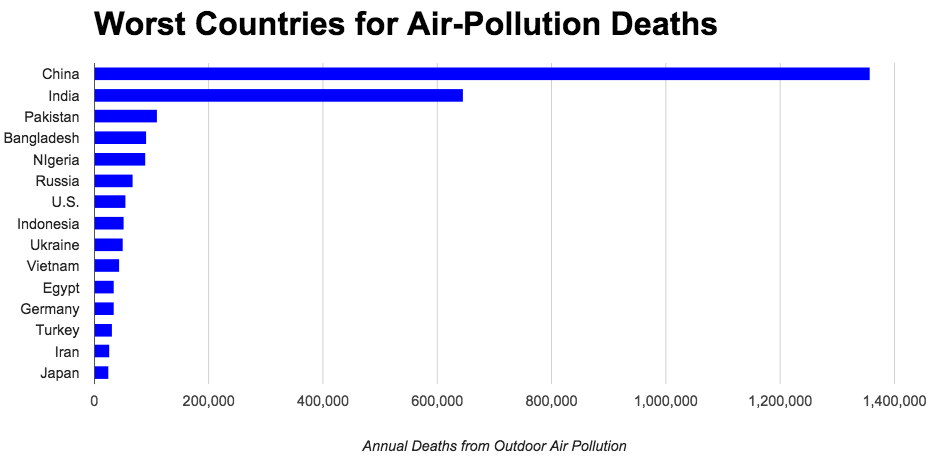
Breathing Is Deadliest in These 15 Countries. The worlds rate of air pollution deaths is headed in the wrong direction.

BloomBerg Take a breath and consider this: Deaths caused by outdoor air pollution are already shockingly high, and they're expected to keep rising. That's despite efforts to clean up the world's factories, roads, and energy supplies.

In 2010, about 3.3 million people around the world died from prolonged exposure to tiny bits of dust and chemicals floating through the air. That figure is set to double by 2050, according to the most comprehensive study yet of global outdoor air pollution and its causes, published today in the journalNature.  

If you live in a country such as the U.S., which has been cleaning up its coal-burning power plants and increasing the gas mileage of its auto fleet, don't think you're in the clear. Of the 15 countries with the most deaths from outdoor air pollution, the U.S. comes in at No. 7. 

"This projection should sound alarm bells for public-health agencies around the world," wrote Michael Jerrett, an environmental health professor at UCLA, in a editorial published simultaneously in Nature. He said the results of the study were "surprising."

Outdoor air pollution and its health effects are difficult to track in countries where sensors are limited. The authors used new models of atmospheric chemistry, along with detailed country-level health and economic data, to estimate how many people die prematurely each year from outdoor pollution exposure. The findings give the best estimates yet of how different sectors of the economy contribute to negative health outcomes around the world.

Residential and commercial energy use—such things as burning trash and relying on diesel generators for electricity—are the biggest contributors to outdoor pollution deaths around the world, especially in densely populated areas in Asia, according to the study. An additional 3.5 million people die each year from indoor air pollution from wood and coal-burning stoves for cooking and home heating, according to previous research. 

In the U.S., the biggest producers of dangerous pollution are agriculture, power generation, and traffic. The findings about agriculture are somewhat controversial, because not enough research has been done comparing the toxicity of the pollution generated from fertilizers with the toxicity of other forms of pollution, the study authors noted.  


Source: BloomBerg

Ban on microbeads offers best chance to protect oceans, aquatic species

An outright ban on the common use of plastic "microbeads" from products that enter wastewater is the best way to protect water quality, wildlife, and resources used by people, a group of conservation scientists suggest in a new analysis.

These  are one part of the microplastic problem in oceans, freshwater lakes and rivers, but are a special concern because in many products they are literally designed to be flushed down the drain. And even at conservative estimates, the collective total of microbeads being produced today is enormous.

In an article just published in the journal Environmental Science and Technology, scientists from seven institutions say that nontoxic and biodegradable alternatives exist for microbeads, which are used in hundreds of products as abrasive scrubbers, ranging from face washes to toothpaste. Around the size of a grain of sand, they can provide a gritty texture to products where that is needed.

"We're facing a plastic crisis and don't even know it," said Stephanie Green, the David H. Smith Conservation Research Fellow in the College of Science at Oregon State University, and co-author of this report.

"Part of this problem can now start with brushing your teeth in the morning," she said. "Contaminants like these microbeads are not something our  were built to handle, and the overall amount of contamination is huge. The microbeads are very durable."

In this analysis, and using extremely conservative methodology, the researchers estimated that 8 trillion microbeads per day are being emitted into aquatic habitats in the United States - enough to cover more than 300 tennis courts a day. But the other 99 percent of the microbeads - another 800 trillion - end up in sludge from sewage plants, which is often spread over areas of land. Many of those microbeads can then make their way into streams and oceans through runoff.

Read on at:

http://phys.org/news/2015-09-microbeads-chance-oceans-aquatic-species.html

Zero Waste Business Training November 4th

U.S. Zero Waste Business Council (www.uszwbc.org) is offering a course to prepare participants for Zero Waste Business certifications and to institute sustainable business policies that reduce waste and save money at San Diego Intl Airport on Wednesday, November 4th, 2015.
 
The two-part course will provide attendees with hands-on activities, a tour of a local sustainable business, an overview of the USZWBC Zero Waste Business Scorecard certification system, the definition of Zero Waste, and give corporate examples of Zero Waste policies and programs. The Training will also provide educational resources and tools to help businesses get started (or complete) their efforts to pursue Zero Waste. This course is a requirement for those interested in pursuing the professional Zero Waste Business Associate (ZWBA) Certification; however, enrollment is open to anyone interested in learning more about Zero Waste or the USZWBC Zero Waste Business Certification.
 
Space is limited and the course may sell out, so register TODAY at http://www.uszwbc.org/!! Early bird registration discounts end Wednesday, October 14th. Additional discounts are available for USZWBC members.
 
When: Wednesday, November 4th, 2015, 9:30am – 5:00pm

Where: San Diego Intl Airport 3225 N Harbor Dr, San Diego, CA
Organized by: U.S. Zero Waste Business Council
Contact: 949-724-1060 or info(at)uszwbc.org

What Happened 153 Years Ago on September 17th? Start of the first national drinking water regulation

September 17, 1862: Samuel Crumbine, American physician, was born. He was best known as the "frontier doctor," and as a "pioneer in public health" who campaigned against the common drinking cup, the common towel, and spitting in public in order to prevent the spread of tuberculosis & other germs. As a direct result of Crumbine's efforts, the first national drinking water regulation outlawing the common cup on interstate carriers was passed in 1912. It was said that this led to the invention of the paper drinking cup.

Source:

Homeless children in public schools has doubled since before recession

Washington Post - The number of homeless children in public schools has doubled since before the recession, reaching a record national total of 1.36 million in the 2013-2014 school year, according to new federal data.

The latest homeless count, an 8 percent increase over the 2012-2013 school year, is a sign that many families continue to struggle financially even as the economy recovers from the housing collapse of 2008. And it offers a glimpse of the growing challenges that public schools face nationwide as they seek to educate an increasing number of low-income children.

The impact is profound on public schools, which struggle to try to address the needs of homeless children. Teachers often find themselves working not only to help children learn but also to clothe them, keep them clean and counsel them through problems — including stress and trauma — that interfere with classroom progress. 

Florida, California citrus markets under siege from bug that carries devastating disease

A disease that has the Florida citrus market under siege—costing it about $975 million per year on average over the last decade—is now threatening California's $2.5 billion industry, Tiffany Stecker reports for Greenwire. The Asian citrus psyllid is a carrier of a devastating bacterial disease called huanglongbing (HLB), better known as citrus greening, which stunts the growth of citrus, leading to small, bitter fruit. (Stecker photo: Jessica Rodriguez uses her pooter, a device to catch insects, to survey for the Asian citrus psyllid)

The Florida industry was caught off guard by the speed of the epidemic of ACP, which was likely smuggled into the U.S. "in private shipments that did not go through proper inspections," Stecker writes. "Many growers are holding out for a resistant, genetically engineered orange, while scientists are experimenting with HLB-sniffing dogs and technology that identify the infection through metabolic changes within the plant to halt the spread."

In California, 16 counties "are wholly or partially under quarantine for the psyllid, including the top citrus-producing area, the Central Valley's Tulare County," Stecker writes. Mark Hoddle, principal investigator for the University of California, Riverside's Applied Biological Control Research laboratory, told Stecker, "Much of the industry has come to terms with the fact that the question of citrus greening begins not with an if, but with a when." 

In Los Angeles County, about half of all homeowners have a citrus tree on their property, Stecker writes. Kurt Floren, Los Angeles County agricultural commissioner, told her, "This county is effectively one continuous grove, from border to border. The presence of the disease presents an equally devastating potential as it would should it be found in a commercial grove." (Read more

Sep 16, 2015

EPA proposes rules to improve hazardous waste management, protect waterways New rules also reduce regulatory burden on businesses

EPA is proposing two new hazardous waste rules to strengthen environmental protection while reducing regulatory burden on businesses. One of the proposed rules will protect waterways, including drinking and surface water, by preventing the flushing of hazardous waste pharmaceuticals, and simplify the requirements for healthcare workers. The other rule will provide greater flexibility to industry while requiring new safeguards to protect the public from mismanagement of hazardous waste.

According to EPA, the proposed hazardous waste pharmaceuticals rule will make drinking and surface water safer and healthier by reducing the amount of pharmaceuticals entering the nation's waterways. EPA's proposal is projected to prevent the flushing of more than 6,400 tons of hazardous waste pharmaceuticals annually by banning healthcare facilities from flushing hazardous waste pharmaceuticals down the sink and toilet.

The proposed rule will reduce the burden on healthcare workers and pharmacists working in healthcare facilities by creating a specific set of regulations for these facilities, including hospitals, clinics, and retail stores with pharmacies and reverse distributors that generate hazardous waste.

EPA's proposed generator rule will enhance the safety of facilities, employees, and the general public by improving labeling of hazardous waste and emergency planning and preparedness. The proposal will also reduce burden by providing greater flexibility in how facilities and employees manage their hazardous waste and make the regulations easier to understand.

EPA solicited public comment on improving hazardous waste management from states, healthcare facilities, retailers, facilities generating hazardous waste, and other key stakeholders. Both proposals directly address the challenges raised by these stakeholders in implementing and complying with hazardous waste regulations.

Both proposals are expected to be published in the Federal Register within the next few weeks, and EPA will accept public comments on them for 60 days following their publication.


OSHA rolls out new process for early resolution of whistleblower complaints Action expands offerings under alternative dispute resolution program

Source
:
On August 19, OSHA issued policies and procedures for applying a new process for resolving whistleblower disputes. The new early resolution process is to be used as part of a regional Alternative Dispute Resolution (ADR) program. The ADR program offers whistleblower parties the opportunity to negotiate a settlement with the assistance of a neutral, confidential OSHA representative who has subject-matter expertise in whistleblower investigations. The Administrative Dispute Resolution Act requires that each federal agency "adopt a policy that addresses the use of alternative means of dispute resolution and case management."

OSHA piloted an ADR program in two of its regions from October 2012 to September 2013. According to OSHA, the pilot proved that the early resolution ADR process is a successful method for helping parties to reach a mutual and voluntary outcome to their whistleblower cases. The pilot program demonstrated that having staff dedicated to facilitating settlement negotiations provides an efficient and effective service that is desired by complainants and respondents alike.

The success of the early resolution ADR process has resulted in the agency making it available to all of its regions. This directive does not prohibit OSHA whistleblower offices from offering complainants and respondents other alternative dispute resolution processes, such as third-party mediation.

OSHA enforces the whistleblower provisions of 22 statutes protecting employees who report violations of various securities laws, trucking, airline, nuclear power, pipeline, environmental, rail, maritime, health care, workplace safety and health regulations, and consumer product safety laws.

To view the early resolution process policies and procedures instruction see www.osha.gov.

Waters of the U.S. Rule Blocked for 13 States

PAINT.ORG: On Aug. 27, Judge Ralph Erickson of the U.S. District Court for the District of North Dakota, blocked the U.S. Environmental Protection Agency (EPA) and Army Corps of Engineers' Waters of the U.S. Rule (WOTUS), granting a preliminary injunction for 13 states to prevent the rule from taking effect Aug. 28.

In June of 2015, North Dakota and 12 other states filed suit in the U.S. District Court for the District of North Dakota against the federal government against the WOTUS rule. The states argued that EPA went outside its authority because the final rule violates state sovereignty, asserting jurisdiction over waters that are subject to state rather than federal control. The states that requested a temporary injunction against the rule were Alaska, Arizona, Arkansas, Colorado, Idaho, Missouri, Montana, Nebraska, New Mexico, Nevada, North Dakota, South Dakota and Wyoming.                 

EPA issued a statement that this ruling only applies to those 13 states involved in the suit, so the rest of the 37 states must abide by the new WOTUS rule: http://www2.epa.gov/cleanwaterrule/clean-water-rule-litigation-statement. On Sept. 4, Judge Erickson also ruled that the injunction only applies to the 13 states involved in this lawsuit.

The states prevailed because they sufficiently demonstrated that their claim is likely to succeed on the merits and that the states would suffer irreparable harm without injunctive relief. "The risk of irreparable harm to the states is both imminent and likely," Erickson was quoted in the Washington Post, and noted that the rule would require "jurisdictional studies" of every proposed natural gas, oil or water pipeline project in North Dakota.

A number of other states have also filed suit against EPA against the WOTUS rule, including Georgia, West Virginia, Alabama, Florida, Kansas, Kentucky, South Carolina, Utah, Wisconsin, Oklahoma, Ohio, Michigan, Texas, Louisiana and Mississippi. Additionally, organizations such as the U.S. Chamber of Commerce, the American Farm Bureau Federation, and the American Petroleum Institute have sued. A number of these suits have been consolidated in the Sixth Circuit Court of Appeals.

The WOTUS rule will likely significantly expand federal jurisdiction over waters. Because the Clean Water Act (CWA) affects many aspects of federal and state regulation, many are calling this proposed rule the most significant CWA development in years.  

On Nov. 14, 2014, ACA joined with more than 300 trade associations and chambers of commerce from 50 states representing a wide range of industries to voice strong concerns about the WOTUS proposed rule to dramatically expand the scope of federal authority over water and land uses across the United States, and calling for the proposal to be withdrawn. The effort was led by the U.S. Chamber of Commerce.

ACA's comments submitted to EPA/Army Corps of Engineers argued that the proposed rule further complicates CWA jurisdiction with new, vague terms, expands far outside the scope established by Congress, compromises state authority, and could have profound and costly impacts on facilities regulated under federal permits. ACA also stated that the expansive WOTUS definition would trigger greater regulatory obligations in regard to federal permitting programs, and the new broad and vague definitions would allow for significantly more waters to be connected and eventually lead to a traditional navigable water, so that businesses will face tremendous difficulty determining which waters meet the WOTUS definition.

Final Rule

Under the CWA, jurisdictional waters include traditional navigable waters, interstate waters, territorial seas, impoundments of them. These jurisdictional waters remain the same under the final rule.

However, the new rule impacts the definition of tributaries, adjacent wetlands (adding now "adjacent waters," which are determined by physical, distance limitations for how far the water can be and still be considered "adjacent"), similarly situated regional waters, and case specific determinations of jurisdiction based on the significant nexus test. The final rule retains current exclusions and enumerates a number of new exclusions.

Defining "Tributary" for the First Time

EPA defines the terms tributary as a water that contributes flow, either directly or through another water (including an impoundment), to a traditional navigable waters, interstate waters, or the territorial seas that is characterized by the presence of the physical indicators of a bed and banks and an ordinary high water mark. These physical indicators demonstrate there is volume, frequency, and duration of flow sufficient to create a bed and banks and an ordinary high water mark, and thus to qualify as a tributary.

A tributary can be a natural, man-altered, or man-made water and includes waters such as rivers, streams, canals, and ditches that are not excluded under the Rule. A water that otherwise qualifies as a tributary under this definition does not lose its status as a tributary if, for any length, there are one or more constructed breaks (such as bridges, culverts, pipes, or dams), or one or more natural breaks (such as wetlands along the run of a stream, debris piles, boulder fields, or a stream that flows underground) so long as a bed and banks and an ordinary high water mark can be identified upstream of the break. EPA emphasized that you need both sufficient flow and volume, and frequency to make it an ordinary high water mark and bed and bank.

Adding "Adjacent Waters"

Under the CWA, all wetlands adjacent to traditional navigable waters, interstate waters, or the territorial seas are considered WOTUS. Under the new definition, EPA has added "adjacent waters" to navigable waters, interstate waters or the territorial seas, impoundments, and tributaries, including wetlands, ponds, lakes, oxbows, impoundments, and similar waters. EPA also clarified the meaning of "adjacent" which means bordering, contiguous, or neighboring including waters separated by constructed dikes or barriers, natural river berms, beach dunes, and the like. For purposes of adjacency, an open water such as a pond or lake includes any wetlands within or abutting its ordinary high water mark. Adjacent waters also include all waters that connect segments of a water or are located at the head of a water and are bordering, contiguous, or neighboring such water.

Significantly, EPA also provides a definition of "neighboring," which for the first time establishes distance thresholds for what waters are considered to be neighboring: The term neighboring means:

(i) All waters located within 100 feet of the ordinary high water mark of traditional navigable waters, interstate waters, territorial seas, impoundments, tributaries, and adjacent waters. The entire water is neighboring if a portion is located within 100 feet of the ordinary high water mark;

(ii) All waters located within the 100- year floodplain of traditional navigable waters, interstate waters, territorial seas, impoundments, tributaries, and adjacent waters, and not more than 1,500 feet from the ordinary high water mark of such water. The entire water is neighboring if a portion is located within 1,500 feet of the ordinary high water mark and within the 100-year floodplain;

(iii) All waters located within 1,500 feet of the high tide line of a water identified in paragraphs of traditional navigable waters, interstate waters and the territorial seas, and all waters within 1,500 feet of the ordinary high water mark of the Great Lakes. The entire water is neighboring if a portion is located within 1,500 feet of the high tide line or within 1,500 feet of the ordinary high water mark of the Great Lakes.

EPA stated in its webinar that the FEMA map identifies the 100-year floodplain, but if there is no FEMA map available, there are other resources available to agencies such as the NRCS soil maps.

Adding Similarly Situated Regional Waters

One of the significant changes EPA makes to the definition of WOTUS is a list of five categorically jurisdictional waters, or "similarly situated regional waters" that have been determined by EPA to have a significant nexus to traditional navigable waters, interstate waters and the territorial seas:

(i) Prairie potholes. Prairie potholes are a complex of glacially formed wetlands, usually occurring in depressions that lack permanent natural outlets, located in the upper Midwest.

(ii) Carolina bays and Delmarva bays. Carolina bays and Delmarva bays are ponded, depressional wetlands that occur along the Atlantic coastal plain.

(iii) Pocosins. Pocosins are evergreen shrub and tree dominated wetlands found predominantly along the Central Atlantic coastal plain.

(iv) Western vernal pools. Western vernal pools are seasonal wetlands located in parts of California and associated with topographic depression, soils with poor drainage, mild, wet winters and hot, dry summers.

(v) Texas coastal prairie wetlands. Texas coastal prairie wetlands are freshwater wetlands that occur as a mosaic of depressions, ridges, intermound flats, and mima mound wetlands

EPA Discretion: Case-Specific Waters Based on Significant Nexus Test

EPA has also "clarified" that certain waters can be considered WOTUS on a case-by-case jurisdictional basis. The test the EPA would use to determine jurisdiction is the "significant nexus" test established by Justice Kennedy in Rapanos v. U.S. Significant nexus means a water, including wetlands, either alone or in combination with other similarly situated waters in the region, significantly affects the chemical, physical, or biological integrity of the traditional navigable waters, interstate waters, or the territorial seas. A water has a significant nexus when any single function or combination of functions performed by the water, alone or together with similarly situated waters in the region, contributes significantly to the chemical, physical, or biological integrity of the nearest navigable water, interstate water, or the territorial sea.

EPA stated in its webinar that the significant nexus test would be a three step process: 1) determining what waters are in the watershed that drain into a navigable water, interstate water or territorial sea, 2) seeing which waters are similarly situated, and 3) evaluating whether any of these functions alone or in combination affect the chemical, physical or biological integrity of the waters. For an effect to be significant, it must be more than speculative or insubstantial. Waters are similarly situated when they function alike and are sufficiently close to function together in affecting downstream waters.

EPA lists factors that are relevant for a significant nexus evaluation, but explained that even if all 9 factors are present, that does not automatically mean the water is jurisdictional, the effect has to be significant: (i) Sediment trapping, (ii) Nutrient recycling (iii) Pollutant trapping, transformation, filtering, and transport, (iv) Retention and attenuation of flood waters, (v) Runoff storage, (vi) Contribution of flow, (vii) Export of organic matter, (viii) Export of food resources, and (ix) Provision of life cycle dependent aquatic habitat (such as foraging, feeding, nesting, breeding, spawning, or use as a nursery area) for species located in traditional navigable waters, interstate waters, or the territorial seas.

Additionally, EPA adds a section to the definition of WOTUS that all waters are WOTUS that are 1) located within the 100- year floodplain of a traditional navigable water, interstate water or territorial sea, and 2) all waters located within 4,000 feet of the high tide line or ordinary high water mark of a traditional navigable water, interstate water or territorial sea, impoundment, tributary or adjacent water where they are determined on a case-specific basis to have a significant nexus. For waters determined to have a significant nexus, the entire water is a water of the United States if a portion is located within the 100-year floodplain or within 4,000 feet of the high tide line or ordinary high water mark.

Clarifying and Adding New Exclusions

EPA retained a number of exclusions and "clarified" several new exclusions. These are not considered waters of the United States:

(1) Waste treatment systems, including treatment ponds or lagoons designed to meet the requirements of the Clean Water Act. (retained in new rule)

(2) Prior converted cropland. Notwithstanding the determination of an area's status as prior converted cropland by any other Federal agency, for the purposes of the Clean Water Act, the final authority regarding Clean Water Act jurisdiction remains with EPA. (retained in new rule)

(3) The following ditches: (i) Ditches with ephemeral flow that are not a relocated tributary or excavated in a tributary. (ii) Ditches with intermittent flow that are not a relocated tributary, excavated in a tributary, or drain wetlands. (iii) Ditches that do not flow, either directly or through another water, into traditional navigable waters, interstate waters and the territorial seas.

(4) The following features: (i) Artificially irrigated areas that would revert to dry land should application of water to that area cease; (ii) Artificial, constructed lakes and ponds created in dry land such as farm and stock watering ponds, irrigation ponds, settling basins, fields flooded for rice growing, log cleaning ponds, or cooling ponds; (iii) Artificial reflecting pools or swimming pools created in dry land; (iv) Small ornamental waters created in dry land; (v) Water-filled depressions created in dry land incidental to mining or construction activity, including pits excavated for obtaining fill, sand, or gravel that fill with water; (vi) Erosional features, including gullies, rills, and other ephemeral features that do not meet the definition of tributary, non-wetland swales, and lawfully constructed grassed waterways; and (vii) Puddles.

(5) Groundwater, including groundwater drained through subsurface drainage systems. (retained in new rule)

(6) Stormwater control features constructed to convey, treat, or store stormwater that are created in dry land.

(7) Wastewater recycling structures constructed in dry land; detention and retention basins built for wastewater recycling; groundwater recharge basins; percolation ponds built for wastewater recycling; and water distributary structures built for wastewater recycling. 

EPA/Army Corps Next Steps

In the EPA/Army Corps webinar that took place on Aug. 27, the agencies indicated that they will be posting "commonly asked questions" on their websites as they continue to receive them. Also, in an effort to increase transparency, the agencies will be posting jurisdictional determinations (JDs) as they are made, as well as basic information that went into making that determination.

The agencies also seek to improve the permitting process (improving flexibility, making the process work smoothly) but did not provide specifics as to how and what they are going to change. The agencies are also holding training sessions for their field officers and are planning for regional offices to conduct local field training events, and joint field assessments later this spring. The agencies have also initiated a subcommittee the National Advisory Council for Environmental Policy and Technology (NACEPT) to examine how to facilitate section 404 permitting in more states and tribes.

More information on the final rule is available at http://www2.epa.gov/cleanwaterrule]http://www2.epa.gov/cleanwaterrule