Oct 3, 2007

After southpark sales of hybrids in the US dropped to an aggregate 22,859 units in September 2007, down 1.9% from September 2006.

Has anyone put together the correlation of the infamous southpark "smug" episode and the decline in HyBrid sales.
 

The decline occurred despite the total net number of hybrid models on the market increasing to 10 from 9 in September 2006. The hybrid share of new vehicle sales stayed below the 2% mark at 1.75%. August results saw the hybrid share of new vehicle sales drop back below 2% for the first time since February 2007.

In 2006 Southpark air a episode where "Hybrid" drivers created so much "smug" driving thier self apprciation veihcles that they threthend the very air they were trying to protect.

If you missed it, you can see the full episode here:  http://www.southparkzone.com/episode-vid-1002.htm
 
Seriously hard to believe the power of "smug".

Oct 2, 2007

Whole Earth's Stewart Brand -- "Jolly Green Heretic"

 "In some respects Stewart Brand's green credentials are impeccable. His mentor was Paul Ehrlich, an environmental thinker at Stanford university and author of 'The Population Bomb,' published in 1968. ... Mr. Brand made his name with a publication of his own, which also appeared in 1968, called 'The Whole Earth Catalogue.' It was a path-breaking manual crammed with examples of small-scale technologies to enable individuals to reduce their environmental impact, and is best known for its cover, which featured a picture of the Earth from space ...

... Rather than basking in past glories or sailing off to a quiet retirement, the 68-year-old counter-cultural icon remains determined to rock the boat. But this time his target is the environmental movement itself. He has come up with a series of what he calls 'environmental heresies,' which he hopes will influence a new generation of pragmatic, problem-solving greens. Three things that most greens vehemently oppose -- genetic engineering, urbanisation and nuclear power -- should, he believes, be embraced on environmental grounds." The Economist ran the profile 9/6/07.

Read it here:
http://www.economist.com/science/tq/displaystory.cfm?story_id=9719001
 
Source: www.sej.org
 

The everyman who exposed tainted toothpaste

... two words that had been overlooked by government inspectors and health authorities in dozens of countries: diethylene glycol, the same sweet-tasting, poisonous ingredient in antifreeze that had been mixed into cold syrup here, killing or disabling at least 138 Panamanians last year.

China to switch to energy-efficient lightbulbs

Reuters: China, which makes 70 percent of the world's lightbulbs, has agreed to phase out incandescent bulbs in favor of more energy-efficient ones, part of a push by a leading world environmental funding agency. The transition could be made in the next 10 years, said Monique Barbut, chief executive officer of the Global Environment Facility. "We are starting a world campaign to ban all inefficient lightbulbs," Barbut said at the Reuters Environmental Summit in Washington. ...

2% of the population feeds the rest (NOT that easy)

Industrial farming -- however destructive to the land and our nutrition -- has held out as its main selling point the allure of freedom: Two percent of the population would be able to feed everyone. The rest could do as we pleased. Shiva sees straight through that promise. "Most of those who have moved off of farms are still working in the industry of creating food and bringing it to consumers: as cashiers, truck drivers, even the oil-rig workers who generate the fuels to run the trucks. Those jobs are all necessary to a travel-dependent, highly mechanized food system. And many of those jobs are menial, life-taking work, instead of the life-giving work of farming on the land. The analyses we have done show that no matter what, whether the system is highly technological or much more simple, about 50 to 60 percent of a population has to be involved in the work of feeding that population. Industrial agriculture did not 'save' anyone from that work, it only shifted people into other forms of food service."
 
Traditional farming retains soil structure, but intensive modern agriculture does not: Since the 1970s, while global grain production has tripled, an estimated 30 percent of the world's farmland has become too damaged to use. Also shrinking are the fossil fuel reserves for a system that requires petroleum to run the farm machines, serve as the chemical base of fertilizers, fuel the milling and processing plants and drive the food to widely dispersed consumers. Shiva puts it this way: "The new modified crops brought to us by the Green Revolution were described as 'green oil of the future.' Ironically, that has turned out to be correct in a way, as the Green Revolution makes a renewable resource -- food -- into a nonrenewable one, just like petroleum."
 

Clean Cities Program Saves 375 Million Gallons Of Gas In 2006

Clean Cities coalitions around the nation displaced the equivalent of 375 million gallons of gasoline in 2006, according to a recent report. Clean Cities coalitions are on track to reach 3.2 billion gallons of gasoline displaced in 2020, exceeding their established goal by 700 million gallons.

Chemical Compound Found In Tree Bark Stimulates Growth, Survival Of Brain Cells

Researchers have identified a compound in tree bark that mimics the chemical reactions of a naturally occurring molecule in the brain responsible for stimulating neuronal cell signaling. The tree bark compound, known as gambogic amide, behaves much like Nerve Growth Factor, a molecule found in the brain. NGF binds to TrkA, a neuronal receptor, and activates neuronal signaling. It is known that the loss of TrkA density correlates with neuronal atrophy and severe cognitive impairment such as that associated with Alzheimer's disease.

Fire Up The NUKES - Point Beach nuclear plant sale completed

We Energies said it has completed the sale of the Point Beach nuclear plant, the utility said today. The utility, a subsidiary of Wisconsin Energy Corp said the plant was sold for $924 million, and the utility also received $482 million in plant decommissioning funds as part of the transaction. Adjustments at closing mean the deal will result in $882 million in proceeds, or about $57 million more than the utility had first projected. The proceeds from the sale are planned to be used to offset a portion of the $652 million price increase the utility has requested for 2008 and 2009.

IT ISN'T EASY BEING GREEN

FROM: climateprogress.org

Chevron's website as the ads suggest, you'll see this press release on the front page: Chevron Announces $15 Billion Share Repurchase Program. Delightful. The company's idea of being green is to launch a $15 million ad campaign touting its greenness while spending a stunning $15 billion buying back its own stock, rather than, say, investing the money in developing new sources of clean energy.

If you google "greenwashing Chevron" you'll find a lot of great information about just how "green" and "socially responsible" this company is. My new favorite is oilwatchdog.org. That site has a great story on Chevron's scorched-earth denial tactic against foreign environmental and human rights lawsuits, which begins: (read more…)

How old masters are helping study of global warming

From The Guardian:

The results will feed into the scientific study of a phenomenon called global dimming, which is caused by air pollution blocking sunlight. Some experts believe this has acted as a brake on global warming, and that climate change could accelerate as air pollution from industry is reduced.

Professor (Christos) Zerefos and his team looked at natural global dimming caused by volcanoes, the results of which can be severe. The eruption of Mount Tambora in Indonesia in 1815 threw out so much material that it triggered the notorious "year without a summer", which caused widespread failure of harvests across Europe, resulting in famine and economic collapse.

The team found 181 artists who had painted sunsets between 1500 and 1900. The 554 pictures included works by Rubens, Rembrandt, Gainsborough and Hogarth. They used a computer to work out the relative amounts of red and green in each picture, along the horizon. Sunlight scattered by airborne particles appears more red than green, so the reddest sunsets indicate the dirtiest skies. The researchers found most pictures with the highest red/green ratios were painted in the three years following a documented eruption.

Prof Zerefos's team is now talking to the Tate in London about repeating the study with 40 paintings from the 20th century, to see whether artists have captured the effects of pollution on sunsets since the industrial revolution.

Big bangs

1783 Laki, Iceland Volcanic eruption spread sulphurous haze across western Europe, killing thousands.

1816 Tambora, Indonesia Eruption killed 10,000 people directly and 66,000 due to starvation and disease during "year without a summer" that followed, when temperatures plunged and harvests failed.

1883 Krakatoa, Indonesia Loudest recorded bang in history. At least 36,417 people died. Average global temperatures dropped by 1.2C.

1991 Pinatubo, Philippines Killed 300 people. About 17m tonnes of sulphur dioxide went into atmosphere, reducing sunlight by 5% and global temperatures by 0.4C.


Another Ethanol answer "high-biomass sorghum for next-generation biofuels"

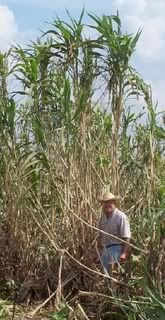
Energy crop company Ceres, Inc. and the Texas Agricultural Experiment Station (TAES) of The Texas A&M University System announced today that they have entered into an exclusive, multi-year joint research and commercialization agreement for high-biomass sorghum. The plants are not designed to produce grain, but rather vast amounts of biomass - the raw material for a new generation of biofuels made from stems, stalks and leaves. the precursors to hybrids - can approach 20 feet (6 meters) under favorable conditions, and could produce more than 2,000 gallons of ethanol per acre (18,800 liters per hectare) - more than four times the current starch-to-ethanol process

Today, sorghum-to-ethanol production uses the grain, like corn, but the plants themselves hold the greatest potential for biofuel production. New thermochemical and biochemical conversion technologies are making it possible to utilize the entire plant, including its carbohydrates that comprise plant cell walls, namely cellulose.

Sorghum produces high yields, is naturally drought tolerant and can thrive in places that do not support corn and other food crops. Sorghum also fits into established production systems and is harvested the year it is planted, unlike perennial grasses, so it fits well in a crop mix with perennial species and existing crops, like cotton.
 
- Dr. Bill Rooney, Plant scientist of the A&M System's Texas Agricultural Experiment Station (TAES)
 
As next-generation bioconversion technologies mature, farmers will transition from growing as much grain per hectare to producing as much biomass as they can per hectare, with as little energy and agronomic inputs as possible. This means new crops and specialized hybrids like high-biomass sorghum types will be needed.

A pioneer in developing high-biomass sorghum, Dr. Bill Rooney's first breeding lines -
 
http://biopact.com/2007/10/ceres-and-taes-team-up-to-develop-high.html
 

Fred Krupp, head honcho at Environmental Defense:

When asked if he's helping corporations "greenwash,"
"It's true a CEO might have a combination of motives, including improving their reputation, including making money, including doing the right thing," he says. "And it may be that doing the right thing is the least important motivation. We don't really care about that. What we care about is, are we putting them on track to do big and important things?"

Ontario warned of new chemicals in water

Ontario must do more to investigate whether potentially dangerous chemicals in the water supply coming from everyday shampoos, soaps and pharmaceuticals pose a threat to people's health and the ecosystem, the province's environmental commissioner says. There is a pressing need for the province not just to monitor the spread of such chemicals, but to spend millions on research and get on top of the threat posed by pharmaceuticals and personal care products (PPCPs), Environmental Commissioner Gord Miller said. Source: Toronto Globe


SERIOUS SIDE EFFECTS NOT MENTIONED ON DRUG LABELS UP 87% SINCE 1998

MARCY E. MULLINS, USA TODAY The Food and Drug Administration received 2 and 1/2 times more reports of serious health problems linked to medication in 2005 than it did in 1998, a study reports. . . Reports of serious problems grew four times faster than the total number of U.S. outpatient prescriptions, the authors write in the Archives of Internal Medicine. Such medication-related health problems account for an estimated 3% to 6% of hospital admissions, they write.

"The overall message is that the drug-safety evaluation system is not working," says co-author Curt Furberg, a medical epidemiologist at Wake Forest University in Winston-Salem, N.C., and former member of the FDA's drug safety and risk management advisory panel. "Harmful drugs are getting into the marketplace."

Another possible explanation: Doctors and patients simply have become more likely to submit the voluntary adverse-event reports, especially in light of high-profile safety withdrawals and lawsuits, the study's authors write. But if that were true, they say, reports would have increased for all medications, which was not the case. . .

In addition, reports of serious reactions not mentioned on a label represented 87% of the increase from 1998 to 2005, the authors write.
 

SPECIES EXTINCTION OCCURRING 1,000 TO 10,000 TIMES FASTER THAN EXPECTED

Oct 1, 2007

Brownfield Site Assessment Grants available to investigate contaminated properties

MADISON – State grants are now available to help Wisconsin communities with properties that have known or suspected environmental contamination.

Brownfield Site Assessment Grants (SAG) are available to help municipalities jump start investigation activities at brownfields, which are abandoned, idle or underused industrial or commercial properties where redevelopment is hindered by real or perceived contamination.

Applications and instructions for the grants, which are administered by the Department of Natural Resources, are available on the DNR Web site.

Applications for both large and small grants are due Nov. 2, 2007. Small grants range from $2,000 up to $30,000 and large grants range from $30,000 up to $100,000.

Brownfield properties are located in every type of community across Wisconsin. During the last round of grants, more than half of the awards were to rural communities or counties.

The DNR expects $1.7 million in SAG funding available for the current round of grants, depending on the final amount approved in the state budget. Once the state budget is signed by Gov. Jim Doyle, the DNR will allocate 60 percent of the SAG funds for small grants and 40 percent for large grants.

Any local government (city, village, town, county, redevelopment authority, community development authority or housing authority) or tribe is eligible to complete an application for a grant. While SAGs do not fund cleanups, the grants do fund the following activities:

  • Environmental site assessments.
  • Site investigations.
  • Demolition.
  • Asbestos removal associated with demolition.
  • Removal of tanks and drums.

Since 2000, the DNR has awarded $11.6 million in 352 grants to 180 communities around the state for work on 1,185 acres of land. The State Legislature first authorized $1.45 million for the SAG program in 1999 after the Brownfields Study Group, a state-wide advisory task force, recommended the program in their 1998 final report.

More information about Site Assessment Grants, including handy tips on whether a property is eligible for a grant, is available on the DNR Remediation and Redevelopment (RR) Program web site

Don't Blow It: Rake Instead

Shelley Muttart/ Istock

Tip of the Day

Don't Blow It: Rake Instead

A single leaf blower pollutes as much as 80 cars do. Why not get some exercise and fresh air instead?
 

THINGS YOU DIDN'T KNOW YOU CAN RECYCLE-AND MAKE $$$

[From Coop America]

1. Appliances: Goodwill accepts working appliances, www.goodwill.org
, or you can contact the Steel Recycling Institute to recycle them. 800/YES-1-CAN, www.recycle-steel.org.

2. Batteries: Rechargeables and single-use: Battery Solutions, 734/467-9110, www.batteryrecycling.com
.

3. Cardboard boxes: Contact local nonprofits and women's shelters to see if they Boxcan use them. Or, offer up used cardboard boxes at your local www.Freecycle.org
 listserv or on www.Craigslist.org for others who may need them for moving or storage. If your workplace collects at least 100 boxes or more each month, www.UsedCardboardBoxes.com accepts them for resale.

4. CDs/DVDs/Game Disks: Send scratched music or computer CDs, DVDs, and PlayStation or Nintendo video game disks to AuralTech for refinishing, and they'll work like new: 888/454-3223, www.auraltech.com
.

5. Clothes: Wearable clothes can go to your local Goodwill outlet or shelter. Donate wearable women's business clothing to Dress for Success, which gives them to low-income women as they search for jobs, 212/532-1922, www.dressforsuccess.org
. Offer unwearable clothes and towels to local animal boarding and shelter facilities, which often use them as pet bedding. Consider holding a clothes swap at your office, school, faith congregation or community center. Swap clothes with friends and colleagues, and save money on a new fall wardrobe and back-to-school clothes.

6. Compact fluorescent bulbs: Take them to your local IKEA store for recycling: www.ikea.com
.

7. Compostable bio-plastics: You probably won't be able to compost these in your home compost bin or pile. Find a municipal composter to take them to at www.findacomposter.com
.

8. Computers and electronics: Find the most responsible recyclers, local and national, at www.ban.org/pledge/Locations.html
.

9. Exercise videos: Swap them with others at www.videofitness.com
.

10. Eyeglasses: Your local Lion's Club or eye care chain may collect these. Lenses Glassesare reground and given to people in need.

11. Foam packing: Your local pack-and-ship store will likely accept foam peanuts for reuse. Or, call the Plastic Loose Fill Producers Council to find a drop-off site: 800/828-2214. For places to drop off foam blocks for recycling, contact the Alliance of Foam Packaging Recyclers, 410/451-8340, www.epspackaging.org/info.html


12. Ink/toner cartridges: www.Recycleplace.com
 pays $1/each.

13. Miscellaneous: Get your unwanted items into the hands of people who can use them. Offer them up on your local www.Freecycle.org listserv or on www.Craigslist.org listserv, or try giving them away at www.Throwplace.com
 or giving or selling them at www.iReuse.com. iReuse.com will also help you find a recycler, if possible, when your items have reached the end of their useful lifecycle.

14. Oil: Find Used Motor Oil Hotlines for each state: 202/682-8000, www.recycleoil.org
.

15. Phones: Donate cell phones: Collective Good will refurbish your phone and sell Cellphoneit to someone in a developing country: 770/856-9021, www.collectivegood.com
. Call to Protect reprograms cell phones to dial 911 and gives them to domestic violence victims: www.donateaphone.com. Recycle single-line phones: Reclamere, 814/386-2927, www.reclamere.com.

16. Sports equipment: Resell or trade it at your local Play It Again Sports outlet, 800/476-9249, www.playitagainsports.com
.

17. "Technotrash": Easily recycle all of your CDs, jewel cases, DVDs, audio and video tapes, cell phones, pagers, rechargeable and single-use batteries, PDAs, and ink/toner cartridges with GreenDisk's Technotrash program. For $30, GreenDisk will send you a cardboard box in which you can ship them up to 70 pounds of any of the above. Your fee covers the box as well as shipping and recycling fees. 800/305-GREENDISK, www.greendisk.com
.

18. Tennis shoes: Nike's Reuse-a-Shoe program turns old shoes into playground and athletic flooring. www.nikereuseashoe.com
. One World Running will send still-wearable shoes to athletes in need in Africa, Latin America, and Haiti. www.oneworldrunning.com.

19. Toothbrushes and razors: Buy a recycled plastic toothbrush or razor from ToothbrushRecycline, and the company will take it back to be recycled again into plastic lumber. Recycline products are made from used Stonyfield Farms' yogurt cups. 888/354-7296, www.recycline.com
.

20. Tyvek envelopes: Quantities less than 25: Send to Shirley Cimburke, Tyvek Recycling Specialist, 5401 Jefferson Davis Hwy., Spot 197, Room 231, Richmond, VA 23234. Quantities larger than 25, call 866/33-TYVEK.

Sep 29, 2007

Protect Yourself from China's tainted seafood, toxic toothpaste, defective tires, more...

Recent recalls of imports from China have mounted to include millions of defective or tainted items, including seafood, toothpaste, pet food, tires and toys. The recalls have focused attention on just how dependent the US is on China for an array of goods -- about 80% of all toys we buy and nearly 22% of all seafood -- as well as on how risky those goods can be.

Recalls also have highlighted the inadequacy of our inspection system. The US Food & Drug Administration (FDA) has only 450 inspectors to inspect the nearly 20 million shipments of food that enter the country each year. That means each consumer has to be extra vigilant.

To explore ways to protect ourselves, Bottom Line/Personal interviewed two leading consumer advocates -- food and drug safety adviser William Hubbard and product safety authority Donald L. Mays. Both testified recently at congressional hearings and shared insights into how to guard against dangerous items from China...

Food and drugs. Federal rules requiring retailers to label country of origin for a wide range of foods were supposed to take effect in 2004 but were postponed for most types of food until September 30, 2008. Those rules are in effect for seafood but are widely ignored. Also, if you buy a prepared seafood product, such as shrimp scampi in a package, as long as the processing occurred here, it is labeled "Made in USA" no matter where the seafood and other ingredients originated.


Seafood Problem: Toxic contaminants.

Recall: In July, the FDA declared an import alert for five types of seafood from China -- catfish, shrimp, eel, dace (a carplike fish) and basa (similar to catfish). Contaminants -- including residues of nitrofuran, an antibiotic drug used to keep fish free from certain bacteria... the toxic chemicals malachite green and gentian violet... and the antibiotic fluoroquinolone -- were found in more than 15% of the tested fish. The first three substances are carcinogens, and the fourth may increase resistance to important antibiotics, such as Cipro.

Under the alert, seafood shipments are held at the US border until importers conduct independent testing to show that the seafood is safe. Despite the import alert, at least one million pounds of suspect Chinese seafood has slipped past the inspectors.

Self-defense: Avoid seafood from China. Whenever possible, buy local freshwater fish, such as rainbow trout. Buy prepared products only at stores and from companies that you trust and that assure you that they do not buy seafood from China.

Check on seafood recalls with your state agricultural department. State agencies often do more extensive testing on food than the federal government does. To find the Web site of your state agricultural department, go to www.statelocalgov.net and click on "Agriculture."


Toothpaste Problem: Contains diethylene glycol (DEG),

DEG is a chemical used in antifreeze and as an industrial solvent. It can damage the kidneys as well as the central nervous system. DEG tastes sweet and is used as a cheaper substitute for pharmaceutical-grade glycerin, a sweetening thickener.

Recalls: In June, the FDA warned consumers to discard all toothpaste that was labeled as made in China after DEG was discovered in some tubes. In August, the manufacturer Gilchrest & Soames recalled complimentary tubes distributed to hotels in more than a dozen countries. To date, there have been no reports of poisoning.

Self-defense: Buy major brands at local drugstores and supermarkets. Don't buy toothpaste at flea markets or 99-cent stores, where most of the questionable products were distributed. Counterfeit toothpastes may have a foreign language instead of English on the packaging.


Pharmaceuticals Problem: DEG contamination.

 Cough syrups and an acetaminophen syrup from China that contained DEG have caused a number of deaths among children in Panama and Haiti. So far, there have been no problems with Chinese-made drugs and herbal supplements in the US.

Self-defense: Make sure that any medicine you use is a known and trusted brand name and that it has an English-language label.


Pet Food Problem: Contains melamine

Melamine is a chemical used to make plastics and fertilizer. Pet food contaminated with melamine resulted in the illness or death of at least 4,000 cats and dogs.

Recalls: More than 150 brands of pet food tainted with melamine have been recalled this year.

Self-defense: Look for protein sources, such as chicken, chicken meal, beef and lamb meal -- rather than cheap fillers, such as cornmeal, wheat, oatmeal or millet -- as the main ingredient in the pet food you buy. Visit www.fda.gov/
oc/opacom/hottopics/petfood.html
to get the latest information on pet food recalls.


Recall updates

Stay alert to future dangers by monitoring recalls listed on the FDA Web site, www.recalls.gov.

Consumer products. In 2006, three out of every four US recalls of imported products involved imports from China. The Consumer Products Safety Commission (CPSC), which handles product safety inspections, has suffered severe staff and budget cuts. Also, it is not legally allowed to alert the public to a hazard until the case against the manufacturer is resolved.


Tires Problem: A missing safety feature called a "gum strip" that binds belts of a tire together so the tread does not separate from the tire... or gum strips that were not large enough. Tread separation can cause loss of vehicle control.

Recalls: The National Highway Traffic Safety Administration (NHTSA) ordered the distributor Foreign Tire Sales Inc. to recall defective tires intended for pickups, sport-utility vehicles and light trucks. The distributor has recalled 255,000 tires, with the brand names Westlake, Compass and YKS.

Self-defense: US Customs requires country-of-origin labels on all tires made outside the US. Avoid tires from China.


Children's Toys Problem: Lead.

Recalls: This summer, Mattel announced worldwide recalls of 2.7 million toys with paint that had high levels of lead. Since 2003, the CPSC has announced recalls of more than 165 million pieces of children's jewelry with high levels of lead, many of them sold in vending machines.

Self-defense: Buy toys labeled "Made in USA" or those made by European companies with good reputations for safety, such as Lego of Denmark and Haba of Germany. Avoid cheap children's jewelry found in vending machines and discount stores and all children's metal jewelry. Favor brand-name retailers. Example: Toys "R" Us has stepped up third-party testing for lead in toys it sells and increased its quality-assurance budget by 25%.

Get recall updates. Sign up for CPSC alerts at www.cpsc.gov/cpsclist.aspx so that when a product is recalled, you will get an E-mail.


Sources: Donald L. Mays is senior director of product safety planning and technical administration at Consumers Union, publisher of Consumer Reports, Yonkers, New York. Mays serves on the boards of directors of the American National Standards Institute and the International Consumer Products Health and Safety Organization. www.consumerreports.org (From www.bottomlinesecrets.com)

SUBSIDIES: FARMERS GET FAT WHILE LIVESTOCK GO HUNGRY

The price of corn is the highest in a decade.  Ethanol plants are sprouting up in the corn fields.  Land prices are turning farmers with 200 acres into millionaires.  And yet, they still get direct government subsidy checks to "save the family farm."  "We're harvesting the sun," one of the new breed of business-man farmers boasts to Dan Morgan in today's Wash Post.  Maybe "harvesting moonshine" would be more accurate.  There is no credible study showing that ethanol is saving one drop of oil.

Source: WHAT'S NEW   Robert L. Park
http://bobpark.physics.umd.edu
 

BALANCE: CLIMATE FEEDBACK MAY NOT BE AS BAD AS THOUGHT.

One of the global warming nightmares is that thawing permafrost might  release methane, a potent greenhouse gas.  This positive feedback would  accelerate warming.  A group led by M. Turetsky of Michigan State found  that new plant growth in thawing Canadian peat bogs more than offset the release of methane.

Sep 28, 2007

'Green Fuel' Harming Rainforests

A Sky News investigation has revealed that filling up with bio diesel containing palm oil is helping to destroy some of the world's most precious rainforests.
With forecourts across Europe and the United States now offering the so-called "green fuel", demand for palm oil has boomed.
But the well-intentioned switch to biofuels in the West is destroying Borneo's rainforests - one of the greenest places on Earth.
Environmentalists claim that an area of forest the size of Wales was cleared last year as Indonesia cashes in on the new "green gold" and plants miles of palm oil trees to meet surging demand.

The UN says the entire rainforest will be gone in 15 years, and the native wild orang-utan extinct in just 10.
Nine hundred of the apes are now caged refugees. Others are found shot or macheted after being killed trying to eat the palm saplings that have replaced their homes.
It is not only the drive for palm oil that is destroying the jungle. China is the main buyer of illegal logs and minerals from here.


I found a zircon mine that had turned the forest into a desert. How on earth could the authorities not have noticed the moonscape left behind?
Groups trying to highlight the destruction are being threatened by the developers.

Lone Droscher, from the Borneo Orang-utan Survival Group, said: "If they cannot buy you off, they try to threaten you. This has happened to us a lot."
Indonesia says it has banned the burning and cutting of jungle for palm oil - but our investigation found mile after mile of freshly cut and burned rainforest.
Ninety new biodiesel factories are under construction here - the developers encouraged by far-away countries "going green".
The palm oil saplings here are planted. Those believing it to be a green fuel will never see the beauty of what it replaced.

DOE to Invest up to $20 Million for Plug-In Hybrid Research

DOE announced on Tuesday that it will invest nearly $20 million in plug-in hybrid electric vehicle (PHEV) research. PHEVs have the potential to displace a large amount of gasoline by delivering up to 40 miles of electric range without recharging—a distance that includes most daily roundtrip commutes. Five projects will be cost-shared with the United States Advanced Battery Consortium (USABC), allowing up to $38 million for battery research and development. The companies selected for the projects include EnerDel, Inc. in Indiana; A123Systems in Massachusetts; Compact Power Inc. in Michigan; 3M in Minnesota; and Johnson Controls – Saft Advanced Power Solutions in Wisconsin. The projects will focus on developing batteries and cells for 10- and 40-mile range PHEVs and building small cells to test new cathode materials.
 

Air Pollution Triggers Blood Clots - Reuters

US Study: September 21, 2007

CHICAGO - Tiny particles of air pollution -- less than one tenth the width of a human hair -- can trigger clotting in the blood, US researchers said on Thursday in a finding that helps explain how air pollution causes heart attacks and strokes.

Large population studies have shown pollution from the exhaust of trucks, buses and coal-burning factories increases the risk of fatal heart attacks and strokes.
But researchers have not understood how these microscopic particles actually kill people.

"We now know how the inflammation in the lungs caused by air pollutants leads to death from cardiovascular disease," said Dr. Gokhan Mutlu of Northwestern University in Chicago, who studied the effects of air pollution in mice.

Lungs inflamed by pollution secrete interleukin-6, an immune system compound that sparks inflammation and has been shown to make blood more likely to clot.

The research appears in the Journal of Clinical Investigation. It follows a study last week in the New England Journal of Medicine that found breathing diesel fumes interfered with heart attack survivors' ability to break down blood clots.

Mutlu got a clue about the clotting issue two years ago when he was studying the effects of air pollution on heart failure in mice. Mice who had been exposed to pollution bled significantly less.
"They were forming blood clots," he said in a telephone interview.

In the latest study, he and colleagues exposed mice to particles of air pollution collected by the US Environmental Protection Agency. These were mixed with a saline solution and injected into the lungs of mice.

Mice exposed to pollution showed a 15-fold increase in interleukin-6 just 24 hours later. That time frame is important because some studies have shown a spike in air pollution can boost heart attacks with 24 hours. "This suggested that interleukin-6 was the driving force," Mutlu said.
 
REUTERS NEWS SERVICE

Reuters first Global Environment Summit

Is being held on October 1-3, will generate a series of exclusive interviews and articles which will be available by clicking on the following link:
http://www.reuters.com/summit
 

Sep 27, 2007

Additives: Diabetes, obesity, and cardiovascular disease have become the big killers.

"There is good reason to think that certain additives create harm well beyond hyperactivity in children -- they may also play an important role in disease and mental illness in adults.... these dangerous chemicals have remained legal for use in food.
It is true that some additives are required for food production.

Nonetheless, we must demand that our government adopts the precautionary principle.

This was described by the Guardian as "an embarrassment" to the Food Standards Agency (FSA), which approved the use of the following chemicals, well known for their adverse effects on many children: sunset yellow (E110), quinoline yellow (E104), carmoisine (E122), allura red (E129), tartrazine (E102) ponceau 4R (E124), and sodium benzoate (E211).

All but sodium benzoate, an antibacterial preservative, are colours with natural replacements available. The purity of the chemicals involved is controlled for industrial use but not for their use in foods.

The issue now is connected with the scapegoating of young people -- the FSA's response to the University of Southampton
report which was the basis for the recent newspaper scares was called "Hyperactivity And Colours: Advice To Parents".

Read more from Rachel's

Sep 26, 2007

Frog Deformities Blamed on Farm and Ranch Runoff

WASHINGTON - Horrific deformities in frogs are the result of a cascade of events that starts when nitrogen and phosphorus from farming and ranching bleed into lakes and ponds, researchers said on Monday.

To examine the role of nitrogen and phosphorus runoff on the process, the researchers created 36 ponds in Wisconsin and stocked them with snails and frog tadpoles. They added nitrogen and phosphorus and observed the consequences.

The ponds with added nitrogen and phosphorus had their snail population, parasitic worm egg production and infection rate of frogs increase greatly, according to the study in the Proceedings of the National Academy of Sciences. 
 
Read full here

Sep 17, 2007

Joel Makower-What's Behind the Green Consumer Research?

I've seen enough research data on Americans' green buying habits over nearly twenty years that I've become immune to much of it. It's not that I think such research is shoddy; it's just that I've found consumers' credibility on the issue wanting, as I've noted in several . . . previous . . . posts.

Consider: A 1989 survey by the Michael Peters Group, a now-defunct consulting firm based in New York and London, found 89% of Americans saying they were concerned...

Click here for more from Joel Here . »

Sep 12, 2007

Biofuels Offer Cure Worse Than the Disease - OECD

 Biofuels, championed for reducing energy reliance, boosting farm revenues and helping fight climate change, may in fact hurt the environment and push up food prices, a study suggested on Tuesday.
"The current push to expand the use of biofuels is creating unsustainable tensions that will disrupt markets without generating significant environmental benefits," the OECD said.
"When acidification, fertiliser use, biodiversity loss and toxicity of agricultural pesticides are taken into account, the overall environmental impacts of ethanol and biodiesel can very easily exceed those of petrol and mineral diesel," it added.
The OECD therefore called on governments to cut their subsidies for the sector and instead encourage research into technologies that would avoid competing for land use with food production.
"Governments should cease to create new mandates for biofuels and investigate ways to phase them out," it said.
The OECD said tax incentives put in place in many regions, including the European Union and the United States, to encourage biofuel output could hide other objectives.
"Biofuel policies may appear to be an easy way to support domestic agriculture against the backdrop of international negotiations to liberalise agricultural trade," it said.
"A litre of gasoline or diesel conserved because a person walks, rides a bicycles, carpools or tunes up his or her vehicle's engine more often is a full litre of gasoline or diesel saved at a much lower cost to the economy than subsidising inefficient new sources of supply," it said.
Biofuels, made mainly from grains, oilseeds and sugar, have been accused of being responsible for a recent surge in farm commodities prices, along with other factors such as lower output and tight stocks.
The OECD, which said in July that it saw biofuels keeping prices at high levels into the next decade, said it would lead to an unavoidable "food-versus-fuel" debate.
"Any diversion of land from food or feed production to production of energy biomass will influence food prices from the start, as both compete for the same input," it said.

Story by Sybille de La Hamaide REUTERS NEWS SERVICE

Sep 11, 2007

ETHANOL REDUCING FOOD FASTER THAN GLOBAL WARMING

Land that was once used to grow food is increasingly being turned over to biofuels. This may help us to fight global warming - but it is driving up food prices throughout the world and making life increasingly hard in developing countries. Add in water shortages, natural disasters and an ever-rising population, and what you have is a recipe for disaster. . .
 
The era of "agrofuels" has arrived, and the scale of the changes it is already forcing on farming and markets around the world is immense. In Nebraska alone, an extra million acres of maize have been planted this year, and the state boasts it will produce 1bn gallons of ethanol. Across the US, 20% of the whole maize crop went to ethanol last year. How much is that? Just 2% of US automobile use. . .
 
The Indian government says it wants to plant 35m acres (140,000 sq km) of biofuel crops, Brazil as much as 300m acres (1.2m sq km). Southern Africa is being touted as the future Middle East of biofuels, with as much as 1bn acres (4m sq km) of land ready to be converted to crops such as Jatropha curcas (physic nut), a tough shrub that can be grown on poor land. Indonesia has said it intends to overtake Malaysia and increase its palm oil production from 16m acres (64,000 sq km) now to 65m acres (260,000 sq km) in 2025. . . JOHN VIDAL, GUARDIAN

ARTIFICIAL ADDITIVES FOUND TO CAUSE DISRUPTIVE BEHAVIOR IN YOUNG

New research made public for the first time confirming the link between artificial additives and disruptive behavior in children is splashed across many of the front pages. The study, the biggest of its kind, found that after consuming a drink containing a mix of additives that reflected the daily intake of a British child, the children in the study became more boisterous and lost concentration.

The government's Food Standards Agency has responded by issuing revised guidance to consumers, recommending that they steer clear of products containing certain E-numbers if their children show signs of hyperactivity.

The Guardian says this move has "confounded" experts who believe the government has missed an opportunity to take a tougher line by banning the additives completely, instead of placing the burden on parents. . . .
 
Source VIA-GUARDIAN

HOW NEIGHBORHOOD WALKABILITY AFFECTS WEIGHT

MIKE STOBBE, ASSOCIATED PRESS - [A] study examined whether a community's walkability affected obesity rates. The research showed that exercisers had a similarly low obesity rate whether they lived in walkable neighborhoods or not. It was 12 percent for those in walkable areas versus 15 percent in non-walkable neighborhoods, a difference that was not statistically significant.

Among those who prefer to drive, however, about 21.5 percent were obese, and it also didn't matter whether they lived in walkable or non-walkable neighborhoods.

The distances driven were also noted. Exercisers in walkable neighborhoods drove 26 miles a day, while those in non-walkable neighborhoods drove about 37 miles.

Among non-exercisers, those in walkable neighborhoods drove 26 miles, and compared to 43 miles in areas that were mostly car-friendly.

POLLUTION CONTRIBUTES TO 40% OF GLOBAL DEATHS

ANDREA THOMPSON, LIVE - Water, air and soil pollution, along with other environmental factors, contribute to 40 percent of deaths worldwide each year, a new study concludes. In a review of research into the effects of environmental pollutants and other sources of environmental degradation, Cornell University ecologist David Pimentel estimates that 62 million deaths per year (40 percent of all that occur) can be attributed to environmental factors, particularly organic and chemical pollutants that accumulate in the air we breathe and the water we drink. . . With an estimated 1.1 billion people in the world lacking access to clean water (according to WHO estimates), it is little wonder that waterborne infections account for 80 percent of all infectious diseases in the world. . .

Water contaminated with untreated sewage and fecal matter can facilitate the transmission of diarrheal diseases such as cholera (bacteria that live in feces), intestinal infections (which can compound health issues by causing malnutrition) and other diseases—all of which kill millions every year, especially children. A 2004 study by the Population Resource Center found that 2.2 million infants and children die each year from diarrhea, caused largely by contaminated water and food.

Sep 5, 2007

Coke Launches Lighter Bottles That Use Less Plastic

Coca-Cola Co said Tuesday it launched a new 20-ounce plastic bottle for its cola drinks that uses 5 percent less plastic, in a bid to please some critics of the beverage industry who claim its reliance on plastic aides global warming.
Last week the Wall Street Journal reported that Coke was planning to build a plant that will be able to recycle as many as 2 billion 20-ounce bottles a year, but that Coke declined to say exactly where the plant would be or when it would open.
 
REUTERS NEWS SERVICE

Haase Comments: Better late than never... Now what do you think Coke will do about the millions of tons of CO2 pumped into bottling soda ;-)

A Bar-Ilan professor's invention may revolutionize the use of solar energy.

A Bar-Ilan nanotechnology expert has invented a photovoltaic cell - which produces electricity from the sun's rays - that could be dramatically cheaper to produce.

"Initially, we created linked arrays of very small cells, which led to a loss of efficiency because the sunlight hitting the space between the cells was not converted to electricity," Zaban explained. With much more surface area, the new array actively captures the sun's energy and becomes "a practical choice for solar energy production," he said.

Zaban's cells feature a sponge-like array of microscopic "nanodots" arranged on flexible plastic sheets. The key to his system is the use of standard semiconductor material injected with an organic dye, which makes it become energy absorbent.

Orionsolar, a Jerusalem-based company that has entered into a partnership with Bar-Ilan, is developing commercial applications for inexpensive, dye-based photovoltaics based on Zaban's work.

"Given the state of the technology, I believe that the new solar cells will be available commercially within the next five years," he said. "This will mark the beginning of a whole new path that combines independence from fossil fuels with a greener, more sustainable future."

Another of his recent discoveries involves reducing the amount of platinum used in photovoltaic cells, another important step towards reducing production costs. "We've found a way to produce platinum nanodots ... [which] reduce the amount of platinum needed by a factor of 40," he said.

Read full here