Apr 14, 2008

Where did you think we got oil - Wrong...

Total Imports of Petroleum (Top 15 Countries) (Thousand Barrels per Day)
Excludes oil imports into the U.S. territories. (source: DOE.gov)
Country Jan-08 Dec-07 YTD 2008 Jan-07 YTD 2007
CANADA
SAUDI ARABIA
VENEZUELA
MEXICO
NIGERIA
ALGERIA
ANGOLA
VIRGIN ISLANDS
IRAQ
RUSSIA
UNITED KINGDOM
ECUADOR
BRAZIL
KUWAIT
NETHERLANDS

Wisconsin close to a surrender on compact

The 'compromise' leading to expected Wisconsin legislative approval of the Great Lakes compact is starting to appear to be the demise of the Lakes, punching more loopholes in an already frayed agreement that can be exploited not only by cities outside the Great Lakes Basin, but also by commercial water barons... described, Jim Rowen.

Since the Compact is essentially a water management agreement to conserve and protect the Great Lakes, substituting voluntary conservation measures statewide for mandatory conservation requirements is a huge, material change, and is certainly not in the state, or region, or Great Lakes' interest.

But if the federal law is followed as the guiding standard until Congressional approval - - which could be years away, or never happen - - then there is no requirement in Wisconsin that return flow accompany a diversion.

Even if that was not anyone's intention, it is a huge loophole that again defeats the conservation intent of the Compact, so should be buttoned up with tight, unambiguous language.

If exploited, the loophole could considerably change what the Governors signed in December, 2005, and intended for the health of the Great Lakes, when they launched the Compact into their state legislatures for approval. Read more here by David Dempsey

Cut Out Preservatives, Curb Hyperactivity

The European Union is being strongly urged to ban several types of common food colors used primarily for candy and soft drinks. The proposed ban is based on the findings of a scientific study that links their use to significant hyperactivity in children. (Is that why my kid always does the Watusi at the end of snack time?) "Taste the rainbow" takes on whole new meaning in a groundbreaking study, published last fall in The Lancet (the United Kingdom's equivalent of The New England Journal of Medicine). In it, scientists document how "normal" kids turn hyperactive, exhibiting Attention Deficit Disorder (ADD) and Attention Deficit Hyperactivity Disorder (ADHD) symptoms after ingesting relatively small amounts of common food additives, specifically food colorings and preservatives composed of synthetic ingredients, like those found in many candies and "fruit" drinks.
 
In a terrific Time piece last year titled "Hyper Kids? Cut Out Preservatives," researchers noted that "a variety of common food dyes and the preservative sodium benzoate—an ingredient in many soft drinks, fruit juices and salad dressings—do cause some kids to become measurably more hyperactive and distractible." The study looked at three hundred kids, each of whom was given a fruit drink once per day. The drinks were either 1) a typical juice drink with sodium benzoate and synthetic color, 2) one with lesser amounts than the average of each of the above, or 3) a totally natural fruit drink. For three weeks, the kids were independently evaluated by observers who did not know which drink a child was getting. The results? Many kid—none of whom had ever exhibited hyperactivity prior to taking part in the study—became noticeably hyperactive after drinking the beverage with higher levels of additives. In the United States, most doctors prescribe powerful mind altering drugs putting one out of three U.S. kids on some kind of daily prescription medicine. But what if it were the blue juice box after soccer practice, or the treats sprinkled on the birthday cupcakes? Please look at the ingredients in the stuff for our kids. For safer choices, check out the Feingold Association of the United States. They've been noting this food fidget-connection for years. 
 
Source planetgreen (Image from the timeinc. article)

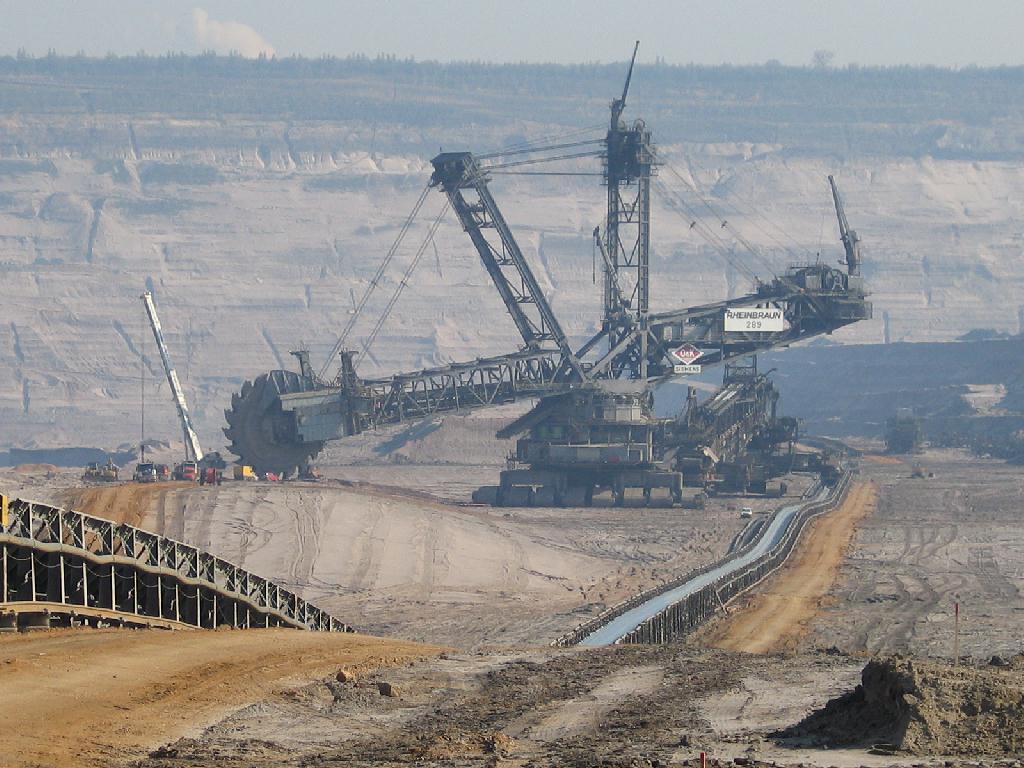
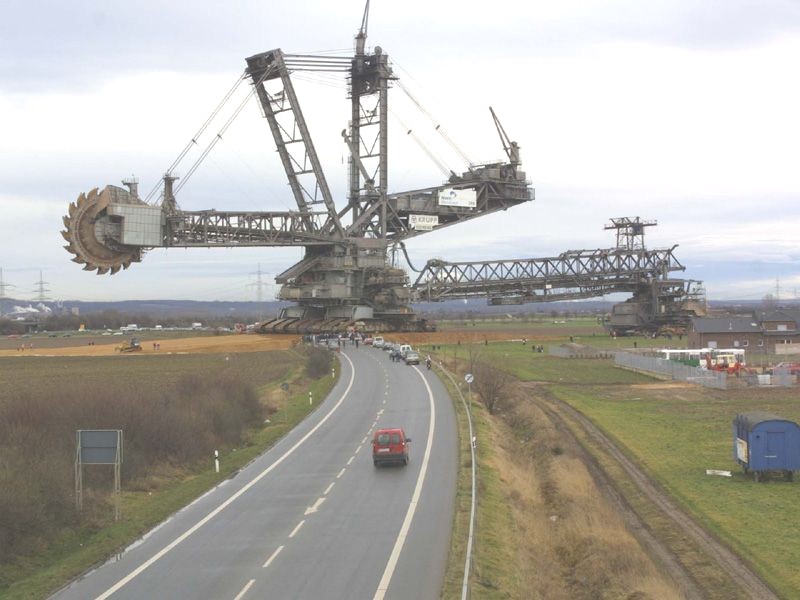
What big "brown" coal looks like (Dirty Picture)

Most coal mines aren't the "lop the top off the mountain"... instead they tend to have large open cut mines where vast amounts of coal are stripped out of the ground.


The monster in the pictures is from Australia and has some quite impressive statistics - you certainly wouldn't want to have a collision with it one the freeway. It weighs over 45,500 tons and cost US$100 million removing over 76,455 cubic meters a day .
 
Coal quality around the world tends to vary - the mine this monster is working is a "brown" coal field - brown coal is lowest quality and particularly polluting. As you go north up the east coast of Australia, the quality of coal tends to get better and better, with most of the top quality black coal destined for export, particularly to China, which has a voracious appetite for the stuff - they are estimated to be consuming 2.2 billion tones a year of coal by 2010.

Coal is Australia's largest export, which may give you a clue as to why Australia refuses to sign the Kyoto agreement - there is also a lot of money riding on the decision.

Because brown coal is a noxious crap, it tends to be much cheaper than the better quality black coal. As a result, those electricity generators who burn the brown coal have a financial advantage over those who burn the less bad stuff. So reducing greenhouse gas emissions using any sort of market based solution is a pipe dream.
 
Read full from: peakenergy

Apr 13, 2008

ABC See's $Green$ in programing

ABC is promoting it?
Do people think the same ABC that ran "Anti-Gore global warming debate" last November has changed their mind 180' in a few months?
The NGC ran this back in 2002, but I think there is a little more $green$ in it for their sponsors like ABC this time around ;-)
Regardless of ABC's $greedwashing" to promote this... it is a good show to watch.

"Voice of Choice" on prevention of deaths

According to the FBI, in 2006 there were 17,000 murders and non-negligent manslaughters in the United States. According to the Institute of Medicine, "Lack of health insurance causes roughly 18,000 unnecessary deaths every year."

Reforesting Planet Earth for the sake of Human Survival

Respect the Need for Air: try holding your breath. This is a Green Paper™ on how we can protect the Atmosphere's oxygen and gas balances in such a way as insures the Earth's ability to support human existence.Read it here at: 10 Billion Acres

Recall list: Lead Toys & Nuclear reactor parts

Rebecca Smith reports today in the WSJ (sub reqd.) on a new hurdle for the U.S. nuclear-power sector: The U.S. Nuclear Regulatory Commission warned this week that some parts used in reactors are defective or counterfeit. While no parts caused any accidents, many have been recalled.

What's behind the supply-chain hiccups? Basically, the shrinkage of the domestic nuclear industry after it went walkabout in the late 1970s, the paper says. To fill the gap, foreign or inexperienced firms have started making small but critical components for reactors. Says the WSJ:

NRC Chairman Dale Klein has expressed concern about the supply chain, noting that 1,350 American companies were members of the American Nuclear Society, the key professional association for the industry, in 1977. Today, there are only about 700, and many of them are foreign owned. "This dramatic decline in the domestic supply chain is clearly having an effect," said Mr. Klein. "The global supply chain is stretched, if not to the breaking point, at least to the tipping point."

Supply-chain woes are familiar to most energy sectors these days. Oil companies struggle to get rigs and other equipment for exploration. Wind turbine makers have been wracked by component shortages for years. Solar power makers are still struggling with a shortage of pure polysilicon.

But for the nuclear industry, the problem is more dire. Long lead times for plant construction can grow even longer thanks to bottlenecks of key components, while the safety issue is of more concern than, say, a faulty wind turbine. The nuclear industry in particular, after hitting the pause button after Three Mile Island, faces an uphill struggle to get back up to speed. Michael Wallace, president of Constellation Generation Group, has been warning about infrastructure problems. He told the U.S. Senate in 2005:

The U.S. electricity business and our nation are paying the price today for our inability to strike an appropriate balance between what was expedient and easy in the short-term, and what was prudent and more difficult in the long-term. We are paying the price today for 10 to 15 years of neglect of longer-term imperatives and the oversupply of base-load generation in the 1990's

The NRC has sent inspectors abroad to inspect components. But that's not a slam-dunk, either. - Inspections are "expensive and not everything is in English, which complicates our task," said Glenn Tracy, director in the NRC Division of Construction Inspection and Operational Programs.  Read more by By Keith Johnson WSJ

Stop forest fires = Stop global warming fears...

From treehugger

forest%20carbon%20storage%20totals%20by%20state.jpgA report released today by The Wilderness Society emphasizes the enormous carbon reserves held by forests in the contiguous states - roughly equivalent to more than 20 years of current United States greenhouse gas emissions from industrial and other sources. Across the U.S., public and protected forests generally store the most carbon. The analysis also cautions that existing carbon measurement tools have significant limitations due to gaps in the underlying data: old growth forests, in particular, may be undervalued.
The executive summary of "Measuring Forest Carbon: Strengths and Weaknesses of Available Tools" is available here, and the full report may be downloaded as a pdf file here. 
 
 "Analysis Shows American Forests Contain Enormous Carbon Reserves, But Available Measuring Tools Reflect Gaps in Underlying Data" Image credit::The Wilderness Society, Full Report here

GreenWashing-See the joke here (selling hotair)?

From tree hugger: How To Spot Greenwashing

greenwash.jpgHow do you spot greenwashing? We had a few suggestions over at Planet Green, but Keith at Unsuitablog makes a few more:

-Be suspicious of all environmental claims. Don't trust anything unless you have verified them yourself.

-Look out for poor use of scientific facts, especially when listening to politicians: "Reducing carbon emissions will protect the ozone layer", "this technology is sustainable", "emissions can be offset", "the greenhouse effect is not certain" etc.

To Profit from "hot air",The Carbon Offsetting Debate... TomArnold_TerraPass_ManurePit.jpg

TerraPass, an profit carbon offset (money from hot air), is no stranger to media attention. TerraPass co-founder Tom Arnold here. Today, is defending its position as a for-profit carbon offset provider. GREEN WASHERS - Beware (new FTC laws coming soon) The Federal Trade Commission held a public hearing on Jan. 8th on how to regulate "green" advertising with details on how to file a comment electronically, by paper or even confidentially can be found at the FTC website here. As the New York Times reports, the FTC has not updated their green advertising guidelines or "green guides" since 1998. More than $54m was spent last year on carbon offsets, the Times writes, and there are growing concerns about about the level of "green washing" in paid media (i.e advertising that claims to be green or environmental but really isn't).

Apr 12, 2008

Do you really feel qualified to discuss nuclear power?

A stranger was seated next to a little girl on the airplane when the stranger turned to her and said, Let's talk. I've heard that flights go quicker if you strike up a conversation with one of your fellow passengers. The little girl, who had just opened her book, closed it slowly and said to the stranger, What would you like to talk about?

Oh, I don't know, said the stranger. How about nuclear power? and he smiles.

OK, she said. That could be an interesting topic. But let me ask you a question first. A horse, a cow, and a deer all eat the same stuff "grass"  Yet a deer excretes little pellets, while a cow turns out a big flat patty, and a horse produces large clumps of dried grass. Why do you suppose that is?

The stranger, visibly surprised by the little girl's intelligence, thinks about it and says, Hmmm, I have no idea.

To which the little girl replies, Do you really feel qualified to discuss nuclear power when you don't know shit?

Hard to read knowing all 3 candidates support nuc expansion

from wickedlocal news - Chris Nord, of Newburyport's C-10 Research and Education Foundation, a nuclear power industry watchdog, says many residents within the 10-mile radius of the Seabrook plant are not aware that they live within the "sacrifice zone," an official term given the area by the Nuclear Regulatory Commission.

Additionally, he says, they may not be aware that the 2006 Biological Effects of Ionizing Radiation (BEIR) study conducted by the National Academy of Science determined there are no safe levels of radiation exposure, and that women and children are more vulnerable than men to health problems associated with exposure.

Nord, a 30-year resident of the region, will discuss the nuclear power industry within the timely context of climate change. He perceives the need to find "truly sustainable energy solutions to the growing ecological crisis of climate change."

"We are living through one of the most extraordinary ecological transitions of all time. We have outstripped our environmental underpinnings and with our present global economy we need to face the possibility of environmental collapse," Nord says.

Nord has been an outspoken critic of nuclear power due to the unresolved long-term health dangers and homeland security issues associated with the industry. He says that in addition to the findings of increased risks of exposure, there is the unsolved issue of waste disposal and security. He questions whether nuclear power should continue to be part of the sustainable energy constellation.

"The nation has still never figured out what to do with nuclear waste, the toxic poisons that are still being stored onsite," ...current administration is in a push to include nuclear power as part of the energy plan for the future and yet we have 300,000 years that we need to keep this toxic waste safe."

C-10's primary role as an agency is to conduct "real time" monitoring of the radiation levels emanating from Seabrook Station. They have posted 17 stations within the neighboring Massachusetts area that have been collecting data since Seabrook opened in 1990. They also monitor security and safety at the plant.

The foundation receives its funding through a 10 percent assessment from the Massachusetts Emergency Management Agency, or MEMA.

For information visit www.c-10.org.


HAASE COMMENT: time to recycle spent fuel

wE

Burying spent fuel is "an outdated strategy" Domenici...the Yucca Mountain project "foolhardy." He said reprocessing spent nuclear fuel makes a lot more sense than burying it underground.

Domenici went a lot further saying that the "strategy for spent nuclear fuel has become badly outdated in light of advances that could reprocess the fuel and leave only a very small percentage of the original material behind as waste." He said this material could be stored in salt formations in New Mexico, presumably at WIPP.

He said the U.S. no longer needs Yucca Mountain to manage spent nuclear fuel. His bill would divert the money going into the nuclear waste fund to be used to develop reprocessing sites and temporary storage of spent nuclear fuel nearby. The legislation would direct DOE to find the sites. This sounds like son of GNEP, with its emphasis on reliable fuel services, but with more political clout.

There is a lot of support for his view in Congress which is deeply frustrated over years of delays in developing the geologic repository located about 100 miles northwest of Las Vegas. It is also a signal that Congress is finally going to grapple with spent fuel reprocessing because of the energy and financial value of irradiated fuel that comes out of a reactor.


Costa Rica Is 99% Powered By Renewable Energy

Costa Rica is a country rich with renewable energy. In fact, it gets about 99% of all its electrical energy from clean sources, and it's aiming to be the first country to become carbon neutral (more about that below). Some of Costa Rica's energy sources include geothermal energy, the burning of sugarcane waste and other biomass, solar and wind energy. However, the largest source of energy is hydroelectricity — its hydroelectric dams provide more than 82% of the country's electricity.costa_rica_wind_turbines_renewable_power.jpg

But the electric needs of Costa Rica are increasing, and the government now wants to build new dams that would displace indigenous villages and flood valuable habitats. Local environmental groups are opposing the construction of new hydroelectric dams.

Also, Costa Rica's efforts to minimize its own contributions to global warming have made it especially vulnerable to climate changes caused by other countries. The reason is rain. Even a tiny shift in rainfall patterns could leave the country without enough water to meet its growing demand for electricity. And scientists say climate change is likely to have a significant effect on rainfall.

But Costa Rica is working to become the world's first carbon-neutral country (other countries vying to be first are Monaco, Norway, New Zealand and Iceland). Costa Rica wants to become carbon neutral in time to celebrate 200 years of independence in 2021, says environment and energy minister Roberto Dobles.

Wind power might come to forefront in Costa Rica — a large wind farm with 22 turbines has been working in Tilarán, Guanacaste since 2002 and more are scheduled to be installed in the mountains of Escazú and Santa Ana. A new geothermal plant, using naturally-existing superheated water to power steam turbines, is also scheduled to be producing electricity in 2010 near Rincón de la Vieja Volcano, in the province of Guanacaste.

Via:  metaefficient

The NO SCIENCE DEBATE... social instead

The National Academies, the Council for Competitiveness and the AAAS had agreed to serve as official cosponsors; the plan was endorsed by all major research universities and scientific societies. However, in a world faced with the threat of global warming, dwindling fossil fuel, continuous warfare, disease and starvation on the rise in Africa, spiraling food prices world wide, the candidates must focus on "solutions."


Instead, t
hey have chosen to attend "The Compassion Forum" with "wide ranging and probing discussion of policies related to moral issues." INCLUDING CANDIDATES THAT WILL DEBATE JESUS.
Yikes.

Apr 11, 2008

WasteCap Wisconsin Update

Save money by recycling: There has been a lot of talk lately about construction waste recycling. The City of Chicago requires it and LEED (Leadership in Energy and Environmental Design) building standards provide points for it. The State of Wisconsin will soon require it on all its projects. Several leading Wisconsin contractors now routinely recycle on their projects. But many builders want to know – will it cost more to recycle on a project than the normal way of dealing with waste? Read more, By: Ralph McCall, here


Sustainable Solutions: The impact of the green building movement: There are many reasons to build and operate your facilities in an energy-efficient manner, and as the costs of building green decreases, these are appearing more commonly in news reports and the public dialogue. Often the number one motivation, reduced energy costs are a major benefit. Measuring, monitoring, and automating your building systems ensure equipment is only in use when it is needed and that all operations are at peak efficiency. Read more here


Green building is best bet for CO2 cuts in North America: Report Green building practices could cut greenhouse gases in North America more effectively than any other action, according to research from Canada, Mexico and the United States. The three-nation Commission for Environmental Cooperation says buildings in North America release about 35 percent of the continent's total carbon dioxide, but with widespread adoption of green building measures, that amount can be drastically reduced quickly and cheaply. The report

also looks at other environmental benefits to green building and its potential to improve worker health and productivity. Read more at greenerbuildings  


EPA helps small businesses bring green technologies to market: The U.S. Environmental Protection Agency will award $1.75 million to 25 small businesses to spur development of new environmental technologies. The Small Business Innovation Research program focuses on technologies within the areas of nanotechnology and pollution prevention, biodiesel and ethanol, solid and hazardous waste, air pollution control and homeland security. To read more, visit greenbiz.


Read full at wastecapwi.org


EPA Great Lakes Challenge - STOP Ewaste & MedWaste from entering largest source of fresh drinking water on earth

Great Lakes = Great Ideas
Great Lakes Earth Day Challenge 2008: Go green and head to a drop-off in your area for e-waste and old meds
So far, more than 70 organizations, communities and businesses across the Great Lakes basin have stepped up and responded to EPA's Great Lakes Earth Day Challenge to collect and properly dispose of old electronics or "e-waste" and unused, expired or unwanted medicine.
 
EPA's goal is to collect at least 1 million pounds of electronic waste and 1 million pills to keep contaminants out of the Great Lakes.
 
"It's a win-win situation for the public and for the Great Lakes ecosystem. This is an easy way for everyone to take part in protecting the Great Lakes."
 
The Great Lakes are an irreplaceable treasure. They are the largest source of fresh drinking water on earth and vital to commerce and recreation in the upper Midwest. Responsible recycling and disposal of  unwanted electronics and medicine will prevent contaminants from polluting the Great Lakes basin.

  To find a collection event, go to the Great Lakes Earth Day Challenge
  Web site epa.gov/greatlakes/earthday2008

  Also, anyone can go to EPA's blog and share ideas: flowoftheriverepa.gov/greatlakeschallenge
                               

Goodbye toxic CFL - LED & OLED now in market

Below - A streetlight, by Beta LED, which is being used around the country.
 
POWER SAVER Cree's recessed L.E.D. unit uses 12 watts of energy but is comparable to a 75-watt bulb.

Among the glitches overlooked with the introduction of compact fluorescents (Hello - Mercury Disposal?), Mr. Karsner said, was the color of light they produced. Compared with traditional bulbs, some compact fluorescents emitted a cold, bluish light that gave homes all the coziness of a hospital hallway.

That may be changing. Attracted by the low power demands of solid-state lights, which use semiconductor materials, the Department of Energy is financing projects to overcome technical and marketing problems that have prevented the technology from successfully challenging more conventional incandescent and fluorescent lighting. "It will involve multiple paths of attack," said Alexander Karsner, the assistant secretary in the department's office of energy efficiency and renewable energy. "It's not any one thing, but it certainly starts with the technology itself."

Solid-state lights, allow manufacturers to fine-tune the tint of their output to better suit consumers' tastes.

OLEDs can be produced using inexpensive methods. Add-Vision, a company that has received federal financing, plans to use printing presses similar to those that churn out high-quality magazines. Last month, General Electric produced OLEDs at a laboratory in Niskayuna, N.Y., using what the company called "a newspaper printing-like roll-to-roll process."

It should also be possible to make very large light panels using OLED technology. Thin and lightweight, such panels could be slid into suspended ceilings to replace the familiar fluorescent light box. Read full VIA NY-Times

"With rubber prices rising like crazy, any tree that can be cut down has been cut down to make way for rubber,"

A report that growing rubber trees for the tire industry is responsible for shrinking Chinese rainforests.
Three decades ago, jungles and high mountain forests covered about 70 percent of Xishuangbanna, tucked between China's borders with Laos and Myanmar. By 2003, that proportion had shrunk to less than 50 percent.

"With rubber prices rising like crazy, any tree that can be cut down has been cut down to make way for rubber," said Liu, a professor at the Xishuangbanna Tropical Botanical Garden, run by the Chinese Academy of Science.

Rainforests have been reduced to patches of protected zones in Xishuangbanna, one of the top rubber producing regions in China, as double-digit economic growth has caused increasing encroachment on China's last remnants of uncultivated land.

The official figure for Yunnan Province's rubber acreage is 334,000 hectares, about 43 percent of the country's total acreage, but the real figure may be much higher.

China consumed 2.35 million tonnes of natural rubber in 2007. About 70 percent of that was imported from abroad, mainly from Thailand, Malaysia and Indonesia, Southeast Asian countries that are also facing deforestation from expanding rubber plantations.
Read more by Big Gav at peakenergy

ANOTHER ETHANOL VICTIM: DUCKS & PHEASANTS

COMMON DREAMS Out on the farm, the ducks and pheasants are losing ground. Thousands of farmers are taking their fields out of the government's biggest conservation program, which pays them not to cultivate. They are spurning guaranteed annual payments for a chance to cash in on the boom in wheat, soybeans, corn and other crops. Last fall, they took back as many acres as are in and combined.

Environmental and hunting groups are warning that years of progress could soon be lost, particularly with the native prairie in the. But a broad coalition of baking, poultry, snack food, ethanol and livestock groups say bigger harvests are a more important priority than habitats for waterfowl and other wildlife. They want the government to ease restrictions on the preserved land, which would encourage many more farmers to think beyond conservation. . . Born nearly 25 years ago in an era of abundance, the Conservation Reserve Program is having a rough transition to the age of scarcity. Its 35 million acres - about 8 percent of the cropland in the country - are the big prize in this brawl.

Apr 10, 2008

Great Quote -

"Legislation based on newspaper headlines rarely makes for sound policy."

U.S. Rep. Howard "Buck" McKeon, R-Calif., regarding a bill that would force Fed-OSHA to issue combustible dust regs within three months

Apr 8, 2008

Eleven Wisconsin Schools Heated with Biomass

Eleven schools in Wisconsin currently heat with biomass materials, and the state Secretary of Agriculture, Rod Nilsestuen, wants to see that number increase. He believes about one-third of the schools in the state would save money if they switched to biomass heating systems.

School districts that need to replace boilers should look at biomass options. Implementing a biomass system would cost $500,000 to $1.5 million, which is comparable to a fuel boiler, stated Nilsestuen. 

A Feasibility Study of Wisconsin Schools Heated with Wood, burning wood, switchgrass, or cornstalks creates less carbon dioxide and nitrous oxide than other options such as burning coal (PDF 1.96 MB) Download Adobe Reader .

The report found that 200 to 300 Wisconsin schools that currently use natural gas would see an economic benefit in the first year by switching to biomass boilers. Each of these schools currently purchases more than 75,000 therms of natural gas at a rate of $0.90 per therm. Wood chips cost about $32 a ton, she said. Pellets are a bit more expensive, generally $100 to $140 per ton. About 500 tons of wood chips are needed to heat a school for a year.

Read full via DOE

Blood & Gore Cap-and-Trade schemes could mean Billion$ in Windfall $$ for Utilities

Another cautionary tale about how not to fight climate change: "Cap-and-Trade" could give power companies windfall profits of up to $100 billion and undermine the fight to curb emissions.

That's the conclusion of a new study carried out by carbon-market analysts Point Carbon and commissioned by environmental group WWF, a long-time supporter now critical of emission-trading scheme. More coverage here, here, and here.

When utilities have to pay the government for permits to emit greenhouse gases, their cost of generating electricity rises, and they pass the cost along to their customers. In Europe, utilities have gotten almost all their emission permits for free, yet electricity rates have risen as if utilities had to pay for their permits. Utilities say that's only natural, reflecting the "opportunity cost" they incur in not being able to sell their permits into the market. Critics, including some investigators, allege the utilities are grabbing "windfall profits."

In Germany, for example, where coal makes up 70% of generation, and utilities pass on prices to consumers while lobbying for free permits, the windfall over the next four years could be between 15 billion euros and 34 billion euros.

That's why Europe plans to sell the permits starting in 2013 though several countries and many utilities are screaming to keep the free handouts.

Read full from WSJ Blog

Luxim140 lumens per watt

Luxim plasma bulb

Luxim Plasma Light Bulb Kicks Some Serious LED Butt

At 140 lumens/watt, these pill-sized plasma light bulbs by Luxim are a pretty awesome contender for "light of the future". They are almost 10 times more efficient than traditional incandescent light bulbs, twice as efficient as current high-end LEDs, and they also beat CFLs, most of which are around 50-80 lumens/watt. Only the prototype 300 lumens/watt nanocrystal-coated LEDs can hold a candle to them.

And the light from Luxim's LIFI bulb is not ugly either: color rendering index (CRI) is 91. Lifetime for a bulb is estimated at 20,000 hours, and a relatively large amount of power can be pumped through them, allowing a tiny bulb to produce 30,000+ lumens (not something LEDs can do).

An RF (radio-frequency) signal is generated by the solid-state power amplifier and is guided into an electric field about the bulb. The high concentration of energy in the electric field vaporizes the contents of the bulb to a plasma state at the bulb's center; this controlled plasma generates an intense source of light. Read more at treehugger.

Fossil fuels will run out before you need to panic about CO2 limits

Oppss.... we will be out of fossil fuel before we need to implement Carbon Trade scams

Quote - "(Hassen) grossly underestimated the scale of the problem." But please give him more funding, media attention and credit for this gross error in data

A renowned global-warming scientist says the problem of global warming is much more serious than previously estimated. However, he also hints that there may be no need to fear catastrophic carbon-driven climate upheaval, as mankind will run out fossil fuels much sooner than presently estimated.

James Hansen, chief of NASA's Goddard Institute for Space Studies, was one of the first to warn about global warming decades ago. What we have found is that the target we have all been aiming for is a disaster - a guaranteed disaster," Hansen told the Guardian over the weekend.

But Hansen said his findings were not a recipe for despair. The good news, he said, is that reserves of fossil fuels have been exaggerated, so an alternative source of energy will have to be rapidly put in place in any case. Other measure could include a moratorium on coal power stations which would bring the C02 levels to below 400ppm.

Regarding solutions, Hansen himself has said "a 350ppm target is only achievable by phasing out coal use", at present one of humanity's main power sources. He believes the missing coal energy could be easily replaced by better-insulated buildings, more efficient transport, etc. . Read more VIA - REGISTER, UK  

Apr 7, 2008

The Blood and Gore of Global Warming Money...

"Sure sound like they plan to make a lot of money off global warming" ...

Al Gore's nonprofit Alliance for Climate Protection plans to spend $300 million on an advertising campaign aimed at convincing the American public that they urgently need to embrace (economy-crippling) controls on carbon emissions and press politicians to act. Gore happens to be chairman and founder of GIM, a firm that invests money from institutions and wealthy investors in companies that are becoming environmentally-friendly, to use green parlance.  

In this post, GIM spokesman Richard Campbell responses saying that the statements were a "nonsense story" on chairman Gore, who now has a net worth greater than $100 million.

As Fast Company notes  (Gore): has made an enormous amount of money and achieved positions of influence from technology to financial services to media. He and Tipper are even setting themselves up as angel investors for "a new type of capitalism in which there is more than one bottom line to consider, more than one master to serve."

Gore's partner at GIM, David Blood, article also states that (Blood): sees climate change creating an entirely new business stratum, he said, similar to that surrounding the so-called Internet economy...

Gore is also America's most prominent advocate for legislated carbon emissions controls in the form of the so-called cap-and-trade system. In a cap-and-trade system, the government creates by fiat an artificial scarcity in the right to generate carbon emissions. The idea is that there would be a fixed quantity of carbon dioxide (CO2) production allowed and that businesses or industries that wanted to exceed their allowance (in order to do the things that make them money) would have to buy the unused portions of others' allowances. These carbon credits are then traded on an exchange, as is currently done in Europe.

When a financial instrument is traded in a market, people make money off it, whether directly or indirectly – investors, sellers, brokers, dealers, financial advisors – even investment executives like Al Gore. As for carbon offsets, the U.S. market for such products and its attendant "feel-good hype" could be "as high as $100 million…up from next to nothing just a couple of years ago," reports Business Week.

If CO2 limits become the law of the land --as John McCain, Hillary Clinton, and Barack Obama have all promised on the campaign trail-- the market for carbon emission offsets and "Blood and Gore" profits would probably grow exponentially.  

Read more by Matthew Vadum

Corn ethanol rates up 37% with worldwide food prices and starvation leaves at record highs -

Food or fuel - Update

Decision 2008 - Is it our "decision" to kill potentially 100 million through lack of food meal and animal feed in 2008? 

The US ethanol plant fleet has produced 1.9 billion gallons of ethanol through the first quarter of 2008 (up 37% from 2007) 

Latest USDA report indicates approximately 79 million harvested acres in first qt of 08. If the average trend yield of 155.5 bushels per acre is realized, corn producers would be on track to produce approximately 12.3 billion bushels in 2008 - the second-highest production ever, according to the RFA.

Most look at a scenario in the year 2015 where the American farmer will NEED to produce over 5 billion bushels of corn,  just to make 15 billion gallons of ethanol as mandated by the Renewable Fuel Standard in the Energy Independence and Security Act of 2007 (EISA). (source)

Similar mandates across the developed world will see that at least 10 per cent of the world's grain is mandated for ethanol production.

It takes 450 pounds of corn ethanol to fill a 25-gallon gas tank or the SAME about of corn supplies enough calories to feed a person for one year. The USDA projects that in 2008 the ethanol industry will consume 2.6 billion bushels of corn. A bushel weighs 56 pounds, so a quick calculation yields the result that 2.6 billion bushels of corn could supply enough calories to feed nearly 325 million people for a year. Of that a third are projected to die of starvation....

As one bushel of corn one bushel converts to about 5.6 pounds of retail beef, 13 pounds of retail pork, 28 pounds of catfish, or 32 pounds of chicken as (source) one-third of the world's grain is fed to animals to produce meat.

There is NOT a current option for cellulosic ethanol so the price of corn will increase 41 percent, wheat, 30 percent, cassava, 135 percent, and sugar cane, 66 percent. As there is NOT a current option for cellulosic ethanol the price of corn will increase 41 percent, wheat, 30 percent, cassava, 135 percent, and sugar cane, 66 percent. This calculates to 600 million additional hungry people by 2025, rising to a total of 1.2 billion (source).

For the billions of people who spend a large percentage of their income on food, mostly the urban poor in developing countries, this is/will be a disaster. Starvation and misery, civil unrest, wars spilling across borders and environmental degradation as marginal land is forced into food production will result from this increase in grain prices.

In summary, the potential disaster of food shortages for the world's poorest far outweigh the marginal benefits of converting food to offset 1-3% of the fuel markets.

As we have warned of this for nearly a decade, I pray our new presidential candidates have better options

But then, the world's poor do not participate in caucuses.

Death by blogging - Stress, Writers Blog Till They Drop (NYT)

 They work long hours, often to exhaustion. Many are paid by the piece — not garments, but blog posts. This is the digital-era sweatshop. You may know it by a different name: home.

A growing work force of home-office laborers and entrepreneurs, armed with computers and smartphones and wired to the hilt, are toiling under great physical and emotional stress created by the around-the-clock Internet economy that demands a constant stream of news and comment.

Of course, the bloggers can work elsewhere, and they profess a love of the nonstop action and perhaps the chance to create a global media outlet without a major up-front investment. At the same time, some are starting to wonder if something has gone very wrong. In the last few months, two among their ranks have died suddenly.

Two weeks ago in North Lauderdale, Fla., funeral services were held for Russell Shaw, a prolific blogger on technology subjects who died at 60 of a heart attack. In December, another tech blogger, Marc Orchant, died at 50 of a massive coronary. A third, Om Malik, 41, survived a heart attack in December.

Other bloggers complain of weight loss or gain, sleep disorders, exhaustion and other maladies born of the nonstop strain of producing for a news and information cycle that is as always-on as the Internet.

To be sure, there is no official diagnosis of death by blogging, and the premature demise of two people obviously does not qualify as an epidemic. There is also no certainty that the stress of the work contributed to their deaths. But friends and family of the deceased, and fellow information workers, say those deaths have them thinking about the dangers of their work style.

The pressure even gets to those who work for themselves — blogging burning out, but face tremendous pressure — external, internal and financial.

...the evolution of the "pay-per-click" economy has put the emphasis on reader traffic and financial return, not journalism.

Read more from NYT

Whatever we do to the air we do to ourselves...

David Suzuki interview about air pollution.
Our lungs are made up of about 300 million capsules, or alveoli, and they are clustered around an alveolar stem like grapes. We have lots of these clusters in our lungs and we need them all to provide the surface area needed to come into contact with the air. If you flatten the alveoli of our lungs out into two dimensions, they would cover a tennis court. That is about how much surface area is wrinkled up in our lungs. Each alveolus is lined by a surfactant that reduces surface tension so that the air sticks to it. Immediately carbon dioxide rushes out of our bodies, oxygen and whatever else is in the air rushes in, and hemoglobin molecules in red blood cells grab on to the oxygen so that each beat of our heart can transfer that oxygen to every part of our bodies. And when you exhale you do not exhale all the air in your lungs. If you did that your lungs would collapse. About half of the air stays in your lungs even when you exhale.

The point I am trying to make is that you cannot draw a line that marks where the air ends and I begin. There is no line. The air is stuck to us and circulating through our bodies. We are air. It is a part of us and it is in us…

We think we are an intelligent creature, but what intelligent creature, knowing the role that air plays in our lives keeping us alive and connecting us to the past and into the future, would then proceed to use air as a garbage can and refuse to pay for putting carbon and all our pollutants into the atmosphere? We have much to reflect on the way that we use this sacred substance. It hurts me when I see young couples walking with a baby in a stroller and the baby's nose is right at the level of the exhaust pipes of our cars. You might as well put a hose on the exhaust pipe and pump that stuff right into the baby's body. Why are 15% of children in now suffering with asthma? We are using the air as a toxic dump. We are air. Whatever we do to the air we do to ourselves.

Crazy Corp High on Coal

Emphasis sharpens on coal in global warming crisis Washington Post: James Hansen -- perhaps the best-known scientific advocate for curbing greenhouse gas emissions -- sent a letter recently to the head of one of the nation's largest power companies calling on him to confront the role that his coal-fired plants play in global warming. Hansen proposed they meet. On Wednesday, James Rogers of Duke Energy accepted Hansen's invitation, though he made clear he does not foresee calling off plans to build more of the power plants that Hansen considers a main ... Link

Haase - The idea of building more coal to "cap it" and sell and trade "hot air" carbon credits is a dumb as the direction our nation took in the 70's when we had the technology, resources and capital to build solar farms, electric cars and 50 MPG trucks. We failed then due to "financial redirected interests", how does this sound any different. Seriously, have we learned nothing from history or markets in 30 years? At this point we would be selling clean energy to third world polluters and not buying it from them had we stuck with the program.

Apr 6, 2008

Not Global Warming Silly... it' our wastefulness

The charged and complex debate over how to slow down global warming has become a lot more complicated.
Wasted Energy


Most of the focus in the last few years has centered on imposing caps on greenhouse gas emissions to prod energy users to conserve or switch to nonpolluting technologies.

Leaders of the Intergovernment Panel on Climate Change — the scientists awarded the Nobel Peace Prize last year with former Vice President Al Gore — have emphasized that market-based approach. All three presidential candidates are behind it. And it has framed international talks over a new climate treaty and debate within the United States over climate legislation

But now, with recent data showing an unexpected rise in global emissions and a decline in energy efficiency, a growing chorus of economists, scientists and students of energy policy are saying that whatever benefits the cap approach yields, it will be too little and come too late.

The economist Jeffrey D. Sachs, head of the Earth Institute at Columbia University, stated the case bluntly in a recent article in Scientific American: "Even with a cutback in wasteful energy spending, our current technologies cannot support both a decline in carbon dioxide emissions and an expanding global economy. If we try to restrain emissions without a fundamentally new set of technologies, we will end up stifling economic growth, including the development prospects for billions of people."

What is needed, Mr. Sachs and others say, is the development of radically advanced low-carbon technologies, which they say will only come about with greatly increased spending by determined governments on what has so far been an anemic commitment to research and development. A Manhattan-like Project, so to speak.

And time is critical, they say, as China, India and other developing nations march headlong into the modern world of cars and electric consumption on their way to becoming the dominant producer of greenhouse gases for decades to come. Indeed, China is building, on average, one large coal-burning power plant a week.

In an article in the journal Nature last week, researchers concerned with the economics, politics, and science of climate also argued that technology policy, not emissions policy, must dominate.

Mr. Sachs pointed to several promising technologies — capturing and burying carbon dioxide, plug-in hybrid cars and solar-thermal electric plants. "Each will require a combination of factors to succeed: more applied scientific research, important regulatory changes, appropriate infrastructure, public acceptance and early high-cost investments," he said. "A failure on one or more of these points could kill the technologies."

In short, what is needed, he said, is a "major overhaul of energy technology" financed by "large-scale public funding of research, development and demonstration projects."

Apr 4, 2008

Healthy Schools Brochure Delivers Info on Healthy Educational Environments


WSJ - "Earth Month" GreenWashing Concerts (carbon credits=scam)

Green "GREED" Concerts: Hot Music & Hot Air  The music industry is jumping on the green bandwagon, offering environmentally friendly packaging and even low-carbon tours.

Another trend is buying carbon offsets. But its effect is, well, up in the air.

Rocker Jack Johnson is offering concert-goers the opportunity to buy carbon offsets to negate the environmental impact of their travels to his shows this summer. The arenas he plays will have to meet certain standards, including the use of energy-efficient lightbulbs. "When you look at the carbon footprint of a tour, at least 75% of it is from fans traveling to and from the shows," says Brian Allenby of Reverb,

The Dave Matthews Band, Mr. Allenby says, bought offsets to counteract the 1,000 tons of carbon-dioxide emissions that it estimates the band itself produced through its buses (When not dumping crap on peoples heads), flights, venue energy use and hotel accommodations while on tour. Mr. Allenby won't say how much the band paid for those offsets.

Beyond the band, fans produce carbon emissions, largely through their travel to and from the concert. Reverb says 8,000 fans who attended the Dave Matthews Band's summer tour bought stickers, at $5 apiece, to offset emissions. Each sticker is said to offset the emission of 150 pounds of carbon dioxide, meaning the fans collectively are offsetting 650 tons of emissions.

But some of the $5 goes to produce the stickers and to support the nonprofit; Mr. Allenby won't say how much. He also says he doesn't know how many emissions the tour's fans are producing, so it's not clear how far those 650 tons will really go in greening the tour.

Would you be likelier to pay to see a band that claims to be greening its concerts? And, after you've paid for the ticket, the parking and the beer, would you pay extra for carbon offsets?

Read full with comments at the Wall Street Jornual


Obama "playing the Gore green card" (GreenWash the vote)

"Obama: I'd Hire Gore"- Democrat B. Obama Hussein , Jr. (pronounced /bəˈɹɑːk oʊˈbɑːmə/) said Wednesday he talks regularly with former vice president Al Gore and would consider putting him in a Cabinet-level position or higher.,.. to address global warming. 'I would,' Obama said. 'Not only will I, but I will make a commitment that Al Gore will be at the table and play a central part in us figuring out how we solve this problem. He's somebody I talk to on a regular basis. I'm already consulting with him in terms of these issues, but climate change is real. It is something we have to deal with now, not 10 years from now, not 20 years from now.' The only position higher than a Cabinet post is vice president. While Obama seemed to dangle that possibility in his answer Wednesday, " Devlin Barrett reports for the Associated Press April 3, 2008.  You'll recall we've heard this Obama flirty flirty before when, Gore said he wouldn't return to government...
 
 "Nobody speaks the truth when there's something they must have." Elizabeth Bowen

Apr 1, 2008

No April foolin unsustainable biofuel scam

Guardian: Just in time for April Fool's Day comes news of the latest scam in the biofuels industry. As we report today, cargo loads of biofuel are being shipped from Europe to the US where they are topped up, allowing traders to claim a subsidy from Washington, and then shipped back. Despite the dateline, this is no prank - it accounts for up to 10% of all biofuel exports from America to Europe - even though it makes a mockery of the notion of a green fuel. The attraction of biofuels is ... Link 
 

Land Once Preserved Now Being Farmed

US News and World Report: Since the mid-1980s, the U.S. government, in an attempt to reduce the environmental fallout from large-scale farming, has been paying farmers to set aside less-than-ideal land for conservation. The results have been overwhelmingly positive: Soil erosion has been reduced; chemical and fertilizer runoff has eased; habitats for game birds and endangered species have been created and enlarged. The pushback to climate change has been equally noteworthy: In 2007, the lands trapped 50 million ... Link