Oct 8, 2013

#MKE Volunteers for @mkeriverkeeper clean up KK River via @milwaukeenns

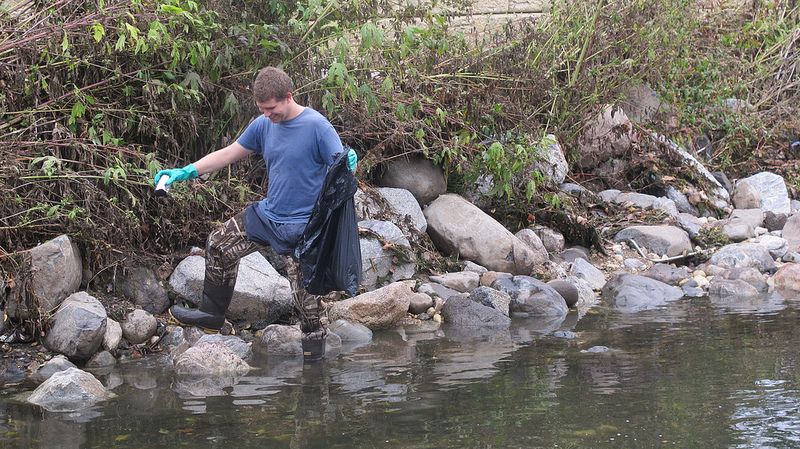
Kyle Puckhaber helped remove trash from the Kinnickinnic River during a clean-up event. (Photo by Scottie Lee Meyers)

Kyle Puckhaber helped remove trash from the Kinnickinnic River during a clean-up event. (Photo by Scottie Lee Meyers)

Milwaukee Neighborhood News : Jerry Zaren lays out the 25-pound salmon he and his buddies reeled in Saturday morning from the Kinnickinnic River near the Sixth Street bridge. Zaren, 46, doesn't plan to eat the fish because he fears it's not safe. Nevertheless, he said, "The river is a lot better now than when I was a kid, I can tell you that."

The Milwaukee Metropolitan Sewerage District launched the River Rehabilitation and Flood Control Project in 2008 to help revive the river. The plan calls for removing more of the concrete-lined channels, installing natural landscaping and demolishing 82 houses that are susceptible to flooding. More than 40 houses already have been demolished.

The physical and ecological transformation is in part a product of partnerships between river and public health advocacy groups with governmental agencies, which have begun a series of projects to control flooding and rehabilitate the river, called the KK River for short.

"The health of the environment directly improves the health of the community," said Amanda Milford, a community health organizer for Sixteenth Street Community Health Centers.

The health center, along with Milwaukee Riverkeeper, hosted the biannual river cleanup near the Sixth Street bridge.

Caption: Volunteers work to clean up the Kinnickinnic River. (Photo by Scottie Lee Meyers)

Volunteers work to clean up the Kinnickinnic River. (Photo by Scottie Lee Meyers)

- See more at: http://www.milwaukeenns.org/2013/10/07/volunteers-clean-up-kk-river-in-advance-of-trail-grand-opening/?pcat=211#sthash.OreIuGMA.dpuf

Please read full and follow at:

#Agriculture, #environment and natural resources: Aquaculture in Canada #GREEN

Aquaculture in Canada
Source: Library of Parliament

In just 50 years, global aquaculture has grown from an almost negligible industry to rival the production of wild capture fisheries. While the latter has stagnated over the last 25 years, aquaculture production has expanded about five times, which has enabled the food fish supply per capita to grow.1 Canada's aquaculture industry is relatively small compared with that of other countries, but it has a strong niche market in some species, particularly Atlantic salmon, and it is important economically to a number of coastal communities. However, the aquaculture industry in Canada faces economic and environmental challenges. This paper describes the Canadian aquaculture industry, current issues it faces and options for its growth.

Oct 7, 2013

US Now Produces More Oil and Gas Than Russia and Saudi Arabia #Energy

Claudia Assis writes that the US will end 2013 as the world's largest producer of petroleum and natural gas, surpassing Russia and Saudi Arabia with the Energy Information Administration estimating that combined US petroleum and gas production this year will hit 50 quadrillion British thermal units, or 25 million barrels of oil equivalent a day, outproducing Russia by 5 quadrillion Btu. Most of the new oil was coming from the western states. Oil production in Texas has more than doubled since 2010. In North Dakota, it has tripled, and Oklahoma, New Mexico, Wyoming, Colorado and Utah have also shown steep rises in oil production over the same three years, according to EIA data. Tapping shale rock for oil and gas has fueled the US boom, while Russia has struggled to keep up its output. 'This is a remarkable turn of events,' says Adam Sieminski, head of the US Energy Information Administration. 'This is a new era of thinking about market conditions, and opportunities created by these conditions, that you wouldn't in a million years have dreamed about.' But even optimists in the US concede that the shale boom's longevity could hinge on commodity prices, government regulations and public support, the last of which could be problematic. A poll last month by the Pew Research Center for the People and the Press found that opposition to increased use of fracking rose to 49% from 38% in the previous six months. 'It is not a supply question anymore,' says Ken Hersh. 'It is about demand and the cost of production. Those are the two drivers."'
Shared via feedly // published on Slashdot // visit site

Fusion Reactor Breaks Even #Energy #News

The BBC is reporting the National Ignition Facility (NIF), based at Livermore in California, has succeeded in breaking even — 'During an experiment in late September, the amount of energy released through the fusion reaction exceeded the amount of energy being absorbed by the fuel — the first time this had been achieved at any fusion facility in the world.'
Shared via feedly // published on Slashdot // visit site

The canary in the global mineshaft [feedly]

International Union for Conservation of Nature - Declines in birds across the globe are providing evidence of a rapid deterioration in the global environment that is affecting all life on earth – including people. However, birds also tell us that saving the planet comes at a relatively small price – an investment that's vital to secure our own future.

The status of the world's birds continues to get worse with many species slipping towards extinction and others in steep decline. Birds are facing threats on many fronts but habitat destruction and degradation, owing to changes in agriculture, as well as direct impacts from invasive species are the major causes. However, birds also provide a lens through which we can view all nature.

"Birds provide an accurate and easy to read environmental barometer that allows us to see clearly the pressures our current way of life are putting on the world's biodiversity", said Dr Leon Bennun, BirdLife's Director of Science, Information and Policy. ...


The positive message from the report is that conservation works. Where threats are tackled through focused interventions, conservation can succeed. Some species have been brought back from the brink of extinction in spectacular fashion and degraded habitats can be restored.

"Effective nature conservation is affordable and it works. It's time to make it happen. The result will be a world that is in every way wealthier and healthier – and that remains diverse and beautiful too," concluded Dr Bennun.

Please continue reading at:

Water 6,700 times more radioactive than legal limit spills from Fukushima

Kyodo News via AP

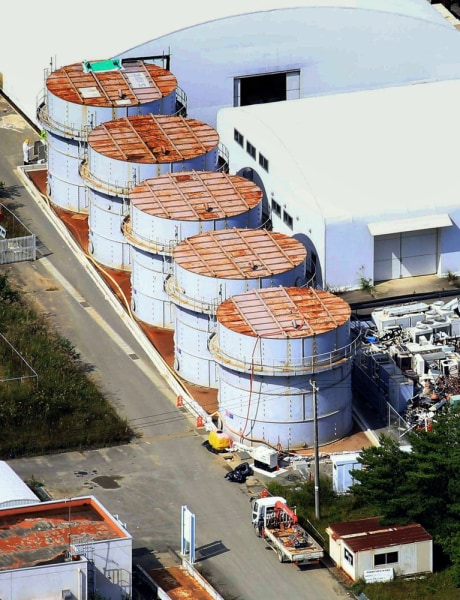
The storage tank (bottom) from which workers detected water dripping late Wednesday at the Fukushima nuclear plant in northeastern Japan.

TOKYO -- Japan's crippled Fukushima nuclear plant has suffered yet another leak, spilling out 430 liters of contaminated water thousands of times more radioactive than legal limits, its operator said Thursday.

Tokyo Electric Power Company, or TEPCO, said the water which spilled from the storage tanks had radiation readings as high as 200,000 becquerels per liter -- almost 6,700 times higher than the legal limit of 30 becquerels.

Please read full and follow at:
http://worldnews.nbcnews.com/_news/2013/10/03/20797895-water-6700-times-more-radioactive-than-legal-limit-spills-from-fukushima

US SOCIAL SECURITY DISABILITY INSURANCE COSTS ESCALATING TO DANGEROUS LEVELS

This ongoing story about US SSDI costs hit CBS' "60 MINUTES" last night as some of you might have seen.

Apparently Senate hearings are being held today and here is the Government cite for this benefit which some are calling a "disability insurance industry" http://www.ssa.gov/disability/

Wonder what we will pay for Social Security or war?
"Choosing whether you pay Social Security beneficiaries, or combat troops in Afghanistan, or veterans who depend on the VA for benefits, or bond holders -- these are choices about default," White House press secretary Jay Carney said on Thursday.

Treasury didn't offer a response, but referred CNNMoney to comments Treasury Secretary Tim Geithner made in 2011 in response to a proposal to prioritize interest payments on U.S. debt.

"This 'prioritization' proposal advocates a radical and deeply irresponsible departure from the commitment of Presidents of both parties throughout American history, to honor all commitments our nation has made," Geithner wrote in a letter to a senator.

See full at:

Join Office of #MKE Environmental Sustainability at The Urban Ecology Center (Menomonee Valley) from 5-7pm for a celebration of community, sustainability, and an interactive look at Milwaukee's current efforts in the "green" sphere.

Tuesday, 10/8: Discover ReFreshMKE, Discover The Valley!
Join us at The Urban Ecology Center (Menomonee Valley) from 5-7pm for a celebration of community, sustainability, and an interactive look at Milwaukee's current efforts in the "green" sphere.

This event will feature:
-tours and hands-on experiences at the Urban Ecology Center's newest branch (Menomonee Valley)
-Central Waters Brewery tastings
-building tours 5:30 and 6:30 with a presentation at 6pm
-bee informed... learn about urban beekeeping from Transition Milwaukee (http://transitionmilwauk…)
-a tour of Milwaukee's newest park, Three Bridges Park, at 6:30pm
-how to care for your trees from City of Milwaukee's Forestry experts
-make your own recycled greeting cards
-try out Urban Ecology Center's free bikes and ride through the Valley
-plan your next bike outing with the City's bike/Pedestrian coordinator
-explore Urban Ecology Center's animal room and see Wisconsin reptiles, amphibians and fish up close!
-meet the Wisconsin Bike Federation
-meet the Friends of the Hank Aaron State Trail
-Meet Menomonee Valley Partners & help #PlanTheValley: http://www.renewthevalle…
-delicious local food (more info here soon!)

Please be sure to RSVP at 
 http://www.yelp.com/events/milwaukee-refreshmke-with-yelp-discover-refreshmke-discover-the-valley

World record solar #energy cell with 44.7% efficiency

PhysOrg has an article on the latest solar cell efficiency record - World record solar cell with 44.7% efficiency.
German Fraunhofer Institute for Solar Energy Systems, Soitec, CEA-Leti and the Helmholtz Center Berlin announced today that they have achieved a new world record for the conversion of sunlight into electricity using a new solar cell structure with four solar subcells. Surpassing competition after only over three years of research, and entering the roadmap at world class level, a new record efficiency of 44.7% was measured at a concentration of 297 suns. This indicates that 44.7% of the solar spectrum's energy, from ultraviolet through to the infrared, is converted into electrical energy. This is a major step towards reducing further the costs of solar electricity and continues to pave the way to the 50% efficiency roadmap.

Shared via feedly // published on Peak Energy // visit site

Even if the solar industry stays flat based on dollar volume, lower costs should triple installations by 2020 [feedly]

Annual solar installations are predicted to expand at a rate of 18 percent in 2014, reaching 41 GW and firmly marking the end of the solar industry's two-year slowdown. IHS reaffirms its prediction made in early 2013 that installations this year will amount to 35 . Global photovoltaic (PV) installations are forecast to rise at the fastest pace in three years in 2014, exceeding 40 gigawatts (GW) for this first time and generating installation revenue of more than $86 billion, according to IHS.

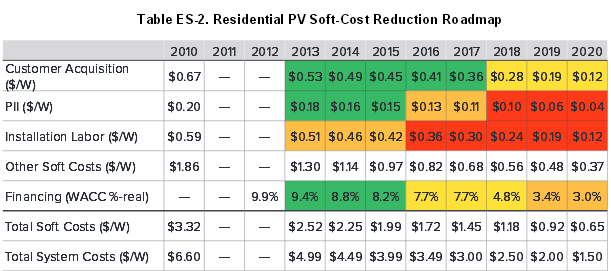
The Energy Department's (DOE) National Renewable Energy Laboratory (NREL) recently issued a new report, "Non-Hardware ('Soft') Cost-Reduction Roadmap for Residential and Small Commercial Solar Photovoltaics, 2013–2020,"PDF funded by DOE's SunShot Initiative and written by NREL and Rocky Mountain Institute (RMI). The report builds off NREL's ongoing soft-cost benchmarking analysis and charts a path to achieve SunShot soft-cost targets of $0.65/W for residential systems and $0.44/W for commercial systems by 2020.


Shared via feedly // published on Next Big Future // visit site

89% of Americans do not bother to save 15-30% on their home heating bill [feedly]

89% of Americans do not bother to save 15-30% on their home heating bill
A study from Lawrence Berkley National Laboratory [PDF] found that 89 percent of survey respondents rarely or never used the thermostat to set a weekday or weekend program. Seventy percent were not set at all.

The energy savings for software-based, digital thermostats range from about 15 to 30 percent.

The first generation of two-way digital smart thermostats was often sold through utility channels and the cost was too high. But with the proliferation of smartphones and lower costs, smart thermostats have started to catch on.

The recent popularity has also come from smart-thermostats makers partnering with other players, particularly home security companies and service providers, both of which want to provide end-to-end home automation services for a monthly fee.

Shared via feedly // published on Next Big Future // visit site

Coal high in fluorine and iron pyrite makes hydroflouric acid to mess up bones and teeth of people in Guizhou, China

Some coal is high in fluorine and also has iron pyrite. The combination is deadly - when burned it make hydrofluoric acid. (H/T Chris Phoenix

Excess fluorine consumption can often cause dental fluorinosis, a condition in which excess fluorine is deposited in the teeth, discoloring them. In more severe cases, fluorine deposition in the bones can lead to osteofluorosis, which can cause disfigurement, deformity, and chronic pain.

One area in which osteofluorosis is distressingly common is Guizhou, China. Over the past decade, this disease here was linked to the combustion of high Fluorine coal. Studies showed that the clay that was intermixed with the coal was high in F, and a steady stream of recommendations has come along describing how this must be getting aerosolized in smoke ,and adhering to food, particularly corn and chilies hung up in houses to dry.

Flourine appeared inside uncut chilies, and sometimes was associated with silica- particulate matter which should not be able to penetrate food and is biologically inactive.


An adult suffering osteofluorosis in Majiazhuang village in Zhijin County.

Chinese Science Bulletin - Potential release of hydrogen fluoride from domestic coal in endemic fluorosis area in Guizhou, China
Read more Shared via feedly // published on Next Big Future // visit site

Solar grids for rural communities in Africa

The University of Southampton is leading an international project to provide sustainable electricity supplies to rural communities in Africa.

It is a 2.6 million euro (US$3.54 million) five year project.

The E4D project will develop a community-based mini-grid solar electrification system aimed at invigorating village trading centres (TC) by providing electricity directly to businesses, which in turn, provide charging for electrical appliances, such as LED lanterns for lighting and for mobile phones, to the rest of the community.

This is the concept of the Kitonyoni village market solar project established in 2012 in Makueni County, Kenya. The project displaced the use of candles or kerosene used for lighting within community households and businesses, which is expensive and has negative health effects. By working closely with the villagers, the E4D team established an economically sustainable approach, whereby the community is responsible for the operation and maintenance of the plant.

Read more published on Next Big Future // visit site

Oct 6, 2013

TV: 70% of children tested are contaminated with radioactive cesium — All of them from outside Fukushima Prefecture

TV: 70% of children tested are contaminated with radioactive cesium — All of them from outside Fukushima Prefecture  (ENENews, Oct 3, 2013):

Arirang News, Oct. 3, 2013: Over in Japan, new reports are adding to concerns about the radiation leaking from the Fukushima power plant. [...] In a related development, a recent report says cesium has been detected in 70 percent of children living near the capital of Ibaraki Prefecture, which borders Fukushima. The Ibaraki Prefecture Cooperative Association says cesium had been detected in 58 of the 85 children [...]

Arirang News, Oct. 3, 2013: [...] a recent report by the Ibaraki Prefecture Cooperative Association shows cesium has been detected in urine samples of 70 percent of children living near the capital of Ibaraki [...]

Weekly Asahi, Oct. 4, 2013 (Google Translation): [...] First, let's introduce the shocking data that was available [...] the result of a urine test that was conducted for children from 0 to 18 years who live in [15] cities and towns [including] Chiba, Ibaraki Matsudo, Kashiwa [a Tokyo suburb], Tsukuba [...]

Watch Arirang's report here


Radio: Health physicist in U.S. worried about inhaling hot particle from Fukushima — Either uranium, plutonium, etc.

Radio: Health physicist in U.S. worried about inhaling hot particle from Fukushima — Either uranium, plutonium, etc. (ENENews, Oct 4, 2013):

Title: Chris Harris – Nuclear Update on Fukushima
Source: Nutrimedical Report
Date: Oct. 3, 2013

At 43:00 in

Chris Harris, former licensed Senior Reactor Operator and engineer: Let me relay just one more thought from my health physicist friend. Even here in the U.S., he's worried about inhaling a hot particle; I'm just letting you know — and so am I. […]

Either uranium, plutonium, or something bad — remember they're not even monitoring for strontium and uranium, so it's very difficult to monitor what we're getting and not getting. […]

This is real; we don't want this to happen here. It's upsetting other people too.


Man Refused to Evacuate Fukushima to Save 500 Abandoned Animals #Humanity must #Love #Dogs


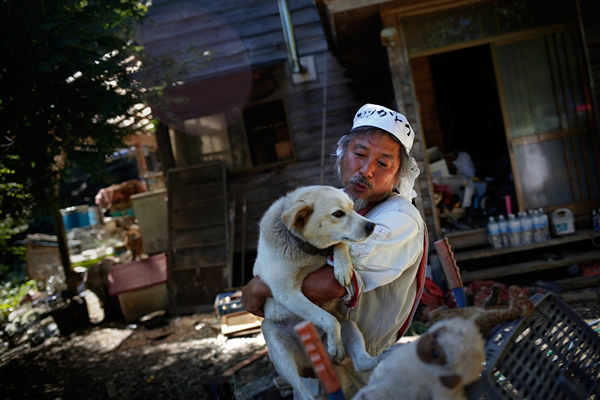
Keigo Sakamoto, 58, kept over 500 animals at his home in the Fukushima exclusion zone. Image: Damir Sagolj

Reuters photographer Damir Sagolj went to the exclusion zone that surrounds Japan's stricken Fukushima nuclear power plant and discovered an eerie scene he described as "a silent horror movie":

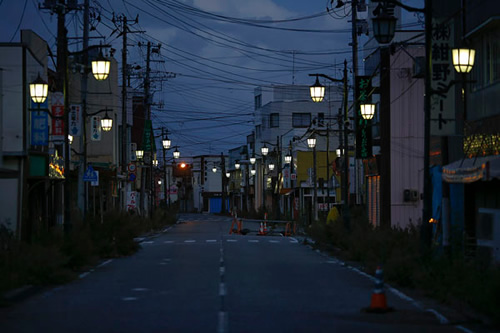
In Chernobyl's exclusion zone, a zombie-like creature bewildered by cheap vodka and loneliness might jump out from behind a bush. But here in Fukushima everything was in almost perfect order. In abandoned towns, traffic lights worked and a rare car would stop on red. Near the train station of a ghost town called Namie, sitting outside a shop whose window was stacked with undistributed copies of March 12, 2011 newspapers, a vending machine blinked. I dropped in a coin. The thing made the usual sound and gave me back a hot can of coffee! I tried to calculate how much energy the machine had consumed over these two and half years to heat my coffee in a ghost town with a population of zero.

But amidst the towns and villages that had been abandoned since the nuclear disaster in 2011, Sagolj met one man who refused to leave his house.

That man, Keigo Sakamoto, a farmer and former caregiver to the mentally disabled, is considered a lunatic by some and a hero by others. Sakamoto defied orders by the Japanese government to leave, and made it his mission to rescue abandoned animals instead.

Sagolj wrote:

Sakamoto said no to evacuation, stayed inside the zone and made animals his mission. He ventured into empty towns and villages and collected all the dogs and cats and rabbits and chocolate marmots abandoned by former owners when they left carrying sometimes as little as their wallets.

Now, Sakamoto lives with more than 500 animals in his mountain ranch near Naraha town in a scene reminiscent of experimental theater rather than modern Japan. It's a very noisy theater too, because many of his dogs have gone wild from the time they spent alone before Sakamoto rescued them. As if to confirm this observation, one dog bit me hard as I passed his little house.

"There are no neighbors," said Sakamoto. "I'm the only one here but I'm here to stay." Of his more than 20 dogs, only two are friendly to man. One is called Atom, a super-cute white mutt, named because it was born just before the disaster at Fukushima.

Read more over at The Samurai and survivors of Fukushima by Damir Sagolj over at Reuter's Photographers Blog

World must act to stop #Fukushima nuclear discharge

World must act to stop Fukushima nuclear discharge (China Daily, Oct 5, 2013):

The devastating earthquake in northeastern Japan two years ago caused a nuclear leak at Fukushima Daiichi Nuclear Power Station. In July 2012,Alaskan seals exhibited inexplicable hemorrhage phenomena and signs of immunity deficiency. Scientists suspected the condition had something to do with Japan's discharge of nuclear sewage, or radioactive water, into the Pacific Ocean. However, no evidence has yet confirmed that suspicion. The Japanese government has proposed to take measures to clean up the post-disaster nuclear waste by the end of March 2014. To this point, they have been simply dumping it into the sea.

On Aug 7, 2013, Japan's Nuclear Disaster Countermeasures Headquarters said the daily discharge into the sea was nearly 300 tons. Research analysis shows that underground water is polluted and therefore radioactive discharge cannot be avoided. Currently, the Japanese government and Tokyo Electric Power Company (TEPCO) are considering pumping underground water into the area to reduce the discharge. By September 2014, the volume of pumped sewage will be 40,000 tons.

Estimates show that the daily outflow of underground water around Fukushima's four nuclear units is 1,000 tons, of which 400 tons flows under the reactors. Of the other 600 tons, 300 tons flows through tunnels between the plants, polluted by the highly concentrated sewage, and then flows into the sea. The remaining 300 tons runs into the sea without pollution. TEPCO is trying to prevent more polluted water reaching the sea, via a new relief project, to reduce daily discharge to 60 tons.

Since the severity of the issue continues, China, along with the international community, must propose the strongest opposition to the Japanese government's irresponsible activities. At the same time, they must take positive measures to prevent pollution. Here are three suggestions.

First, China and other neighboring countries must request the Japanese government take effective measures to stop the continuing discharge, and thus reduce the likelihood of oceanic environmental damage. The Pacific Ocean doesn't belong to Japan, but is commonly owned by the international community, the environmental protection of which is fundamental to the safety and reproduction of human beings. Japan should ensure that not all the fiscal budget goes to military expansion and weaponry. Much should be diverted to solving the post-Fukushima horror.

Second, radioactive sewage discharge results must be published. China and the international community should demand that Japan reveal the results of objective scientific monitoring of the 11,500 tons of radioactive discharge over the past two years, and publish its scale, damage level, as well as a prevention and cure strategy. If the discharge cannot be suspended immediately because of technical limitations, scientific evaluation and projection must be done, followed by agreed measures thereafter. A 12-expert delegation, from Canada, China, Japan, Korea, Russia and the US, was created as the Northern Pacific Radioactive Environmental Quality Assessment Group, whose job is to monitor the resolution of these issues. Chinese experts can particularly take advantage of their strength and lead the group.

Third, regulations must be set up to limit illegal actions. Currently, the oceanic environment is facing significant damage. China and the international community will jointly set up regulations on protecting the oceanic environment from radioactive pollution, after Fukushima. TEPCO must not only compensate the loss of its domestic victims, but also provide the international community with a clear commitment. For the sake of safety, an international agreement banning shipping, fishing or even entering the highly polluted area off the coast of Fukushima Daiichi Nuclear Power Station needs to be formed.

The safety of the Pacific Ocean is one of the most important issues internationally. Conventional maritime security focus on ensuring maritime navigation safety, combating pirate attacks, preventing collisions and natural disaster. Now, preventing radioactive pollution becomes another issue. The polluted discharge has severe impacts on the oceanic environment; its damage is also unpredictable, and severer than an oceanic conflict or regional war. China's Ministry of Foreign Affairs should negotiate with its Japanese counterpart. China's marine authorities should communicate and negotiate with Japan's related authorities over administrative and technical issues. And the international community should keep on pushing the Japanese government to make more progress on this problem.

The author is a researcher from the Shanghai Center for Japanese Studies.

Please continue reading at:

FlameStower uses fire to charge devices

The FlameStower – where there's fire, there's electricity

We're constantly seeing inventors attempt to create new and interesting ways to charge our cell phones. VOTO is one product we've seen that uses fire to charge our smart devices, and now a new take on the idea is hitting the scene. Called FlameStower, it utilizes very similar technology, but with a few twists. .. Continue ReadingFlameStower uses fire to charge devices published on Gizmag Emerging Technology Magazine // visit site

What happened to bio-butanol ?

While pondering what happened to advanced biofuels I found myself wondering what happened to another widely touted biofuel option - bio-butanol.

Bio-butanol was heavily promoted back in 2007 and 2008 as a biofuel option that had many advantages over ethanol.

The key way [butanol is better than ethanol] is higher energy density. Whereas ethanol is around about two-thirds the energy density [of gasoline], with butanol we're in the high eighties [in terms of percent].

It's less volatile [than ethanol]. It isn't as corrosive, so we don't have issues with it at higher concentrations beginning to eat at aluminum or polymer components in fuel systems and dispensing systems. And it's not as hydroscopic–it doesn't pick up water, which is what ethanol can do if you put it in relatively low concentrations. So we can put it through pipelines.

A range of companies are still pursuing the bio-butanol dream, with one (Optinol) recently declaring it had achieved "energy cost parity" with ethanol for its for (sugar derived) bio-butanol. Another company (Cobalt) is now producing reasonably large volumes of fuel at a pilot plant. BP and Dupont also have a joint venture that they hope will produce butanol at a price competitive with petrol.

There are also attempts underway to produce jet fuel using butanol produced at a converted ethanol facility.

As with ethanol, a number of organisations are looking at producing butanol from cellulosic material, with the University of Michigan and UCLA leading research in the area.

Please read full and follow published on Peak Energy // visit site

Nuclear scare at Navy submarine base after 'unbelievable' failures - major nuclear incident narrowly averted

The Independent: A major nuclear incident was narrowly averted at the heart of Britain's Royal Navy submarine fleet,The Independent on Sunday can reveal. The failure of both the primary and secondary power sources of coolant for nuclear reactors at the Devonport dockyard in Plymouth on 29 July last year followed warnings in previous years of just such a situation.

Experts yesterday compared the crisis at the naval base, operated by the Ministry of Defence and government engineering contractors Babcock Marine, with the Fukushima Daiichi power-station meltdown in Japan in 2011.

It came just four months after the Defence Secretary, Philip Hammond, announced that the base would "remain vital in the future".

The failure of the electric-power source for coolant to nuclear reactors and then the diesel back-up generators was revealed in a heavily redacted report from the Ministry of Defence's Site Event Report Committee (Serc).

Once a submarine arrives at the Devon base's specially designed Tidal X-Berths, it must be connected to coolant supplies to prevent its nuclear reactor overheating.

But last July a series of what were described as "unidentified defects" triggered the failures which meant that for more than 90 minutes, submarines were left without their main sources of coolant.

Please read full and follow at:

Oct 5, 2013

Investigating Suspected Cancer Clusters and Responding to Community Concerns: Guidelines from CDC and the Council of State and Territorial Epidemiologists

Investigating Suspected Cancer Clusters and Responding to Community Concerns: Guidelines from CDC and the Council of State and Territorial Epidemiologists
Source: Morbidity and Mortality Weekly Report (CDC)

This report augments guidelines published in 1990 for investigating clusters of health events (CDC. Guidelines for investigating clusters of health events. MMWR 1990;39[No. RR-11]). The 1990 Guidelines considered any noninfectious disease cluster, injuries, birth defects, and previously unrecognized syndromes or illnesses. These new guidelines focus on cancer clusters. State and local health departments can use these guidelines to develop a systematic approach to responding to community concerns regarding cancer clusters. The guidelines are intended to apply to situations in which a health department responds to an inquiry about a suspected cancer cluster in a residential or community setting only. Occupational or medical treatment-related clusters are not included in this report. Since 1990, many improvements have occurred in data resources, investigative techniques, and analytic/statistical methods, and much has been learned from both large- and small-scale cancer cluster investigations. These improvements and lessons have informed these updated guidelines.

These guidelines utilize a four-step approach (initial response, assessment, major feasibility study, and etiologic investigation) as a tool for managing a reported cluster. Even if a cancer cluster is identified, there is no guarantee that a common cause or an environmental contaminant will be implicated. Identification of a common cause or an implicated contaminant might be an expected outcome for the concerned community. Therefore, during all parts of an inquiry, responders should be transparent, communicate clearly, and explain their decisions to the community.

World Solar Challenge About To Start #Solar #Energy

On Sunday morning (Australian time), October 6th, 40 solar-powered vehiclesfrom 24 countries will depart from Darwin and make their way south along the 3000km Stuart Highway towards Adelaide in the 2013 World Solar Challenge. About half of the vehicles compete in the Challenger class, the class which features what many people will recognize as typical solar racing cars: flat, UFO-like vehicles, built exclusively for efficiency and speed. For the first time, however, much more practical vehicles will race each other in the new Cruiser class. These vehicles will seat two, three of four people and be road legal. In both 2009 and 2011, the University of Michigan Solar Car Team finished third,Nuon Solar Team finished second and Tokai University finished first. The fastest vehicles will be expected to reach Adelaide on Thursday or Friday, depending on the weather.
Shared via feedly // published on Slashdot // Read more of this story at Slashdot.

Charged Superhydrophobic Condenser Surface May Make Power Plants More Efficient

"The activities of bantam water droplets in just one region of a power plantcould make a significant difference in the output of power plants, scientists say. ... When a water droplet forms on a sheet of metal coated with a superhydrophobe, the droplet can camp there only so long as it does not merge with another droplet. As soon as it weds with another droplet, the energy produced is so great that the two will 'jump' away from that surface, as if in urgent deference to the surface's severe water phobia. Scientists have proposed that this 'jumping' could be incorporated into power plant design. ... 'To have the most efficient condensing surface, you want to remove the droplets as early as possible,' says Dr. Nenad Miljkovic, [postdoctoral associate at MIT and co-author on 'Electrostatic charging of jumping droplets']. But, in prototypes, this 'jumping' design is not as efficient as engineers believe it could be. Some of the droplets will just fall back to the condenser's surface, recoating it and slowing the process down. ... But a newly discovered component to the 'jumping' process might allow scientists to eliminate this fall back. In an accidental find, the MIT team found that droplets don't just spring from the surface — they also rebound from each other ... because an electrical charge forms on the droplets as they flee the hydrophobic surface. So, if a charge is applied to the condenser system, the water droplets can be electrically prevented from returning to the surface, he said.
Shared via feedly // published on Slashdot // Read more of this story at Slashdot.

#Monsanto Buys Climate Corp For $930 Million to control the weather data

Who knew betting on the weather could make a billion dollars? It just did for The Climate Corporation, which underwrites weather insurance for farmers. Monsanto broke the news this morning that it was buying Climate for approximately $930 million. The idea is to sell more data and services to the farmers who already buy Monsanto's seed and chemicals. Climate (formerly known as Weatherbill) has raised $107 million from a plethora of backers since it began fund raising in 2007. Its biggest investors include Khosla Ventures, New Enterprise Associates, Google Ventures, Index Ventures and Founders Fund.

Climate's cofounders were early Google employees who saw a self-service approach to weather insurance, which had previously been sold in custom, over-the-counter negotiations. Clients go to its site and outline what range of temperatures and/or rainfall they want protection from, for a set period of time. In 100 milliseconds Weatherbill crunches forecasts and 30 years of National Weather Service and geological survey data for the user's location. After adjusting–minutely–for climate change, Weatherbill names a price and acts as the underwriter. Policy holders get their checks automatically if the weather doesn't go their way. Originally Climate pitched its insurance to any weather-dependent businesses (farmers, housepainters, golf ranges), but it soon realized its biggest market was in agriculture. "It had the most significant opportunity, the most significant product, and had the greatest impact," cofounder David Friedberg told Forbes in a 2011 post.

Milwaukee's Office of Environmental Sustainability will be featured all week long in Milwaukee’s social media

Environmental Sustainability Initiatives 
Office of Environmental Sustainability is teaming up with Yelp to bring you a week's worth of great events and an accompanying social campaign that will get you in-the-know on how to make a real difference! Explore and connect with the City's new sustainability plan, ReFresh Milwaukee. From urban agriculture to solar to smart water usage, we're all about helping you make a positive impact in a tangible way. Join us October 7-11! Full event listing: http://bit.ly/15CM7fe Sustainability will be featured all week long in Milwaukee's social media! Follow us for interesting facts and ways in which you can make a difference: @ReFreshMKE @YelpMKE #ReFreshMKE 
SCHEDULE OF EVENTS 
Monday, October 7: Telling Milwaukee's Story in a Sustainable Way. 8:30-10 am at Stone Creek Coffee, 158 S. Barclay St. 
Tuesday, October 8:  Discover the Valley! Discover ReFresh MKE! 5-7 pm at Urban Ecology Center – Menomonee Valley Branch, 3739 W. Pierce St. 
Wednesday, October 9:  Celebrating our Great Lakes at Great Lakes Distillery. 5:30-8 pm at Great Lakes Distillery, 616 W. Virginia St. 
Thursday, October 10: What's In Your Beer? Coffee, Tea, and Sunshine! 5:30 – 7:30 pm at Milwaukee Brewing Company, 613 S. 2nd St 
Friday, October 11:  Revitalize & ReFresh: Cultural Sustainability and Milwaukee's Future. 4-6 pm at Jackson's Pub at The Brewery Redevelopment, 1203 N. 10th Street. Join Mayor Barrett as we wrap up our sustainability week, and commit to our future!
ReFresh Milwaukee Sustainability Plan

ReFreshMKE with Yelp!

Oct 4, 2013

Subsidizing Farmers and Biofuels in Rich Countries: An Incoherent Agenda for Food Security

At the beginning of the new millennium, a key development concern was the impact of agricultural policies in high-income countries on poor farmers in the rest of the world. Over the ensuing decade, the focus swung from the role of price-suppressing farm subsidies to the role biofuel policies play in driving food prices up. While development advocates are right to criticize the trade-distorting costs and environmental risks of current biofuel policies, agricultural subsidies and trade barriers in rich countries remain in place and the distorting impact of those policies will rise again when prices decline. These traditional policies increase uncertainty and still distort what crops are grown where, so disciplines on them are still useful. American food aid practices are also stuck in the past and reforming them could mean millions more people fed on a limited budget.

The spread of biofuel support policies is also costly and inefficient, though in different ways. The precise impact of these policies on the level of food prices is still being debated, but there is little question that they are contributing to increased price volatility. While some upward adjustment in the level of prices was needed to encourage investment in agriculture, volatility is harmful to poor consumers and producers alike. These policies are also increasingly becoming a source of new trade disputes and the utility of the current generation of biofuels in reducing greenhouse gas emissions is questionable at best. With budgets tight and food prices high, both traditional agricultural and new biofuel support policies are increasingly under attack, and now is the time to reform them.

The paper highlights a few areas where policies seem particularly incoherent and concludes with recommendations for international agreements to support and lock in policy reforms in both the short and longer runs.


Overflowing tank cause of new leak at Fukushima - "We could have, and should have, prevented the overflow," he said.

TOKYO (AP) — Another day, another radioactive-water spill. The operator of the crippled Fukushima Dai-ichi nuclear plant says at least 430 liters (110 gallons) spilled when workers overfilled a storage tank without a gauge that could have warned them of the danger.

The amount is tiny compared to the untold thousands of tons of radioactive water that have leaked, much of it into the Pacific Ocean, since a massive earthquake and tsunami wrecked the plant and sent it into meltdown in 2011. But the error is one of many the operator has committed as it struggles to manage a seemingly endless, tainted flow.

Plant operator Tokyo Electric Power Co. said Thursday workers detected the water spilling from the top of one large tank when they were patrolling the site the night before. The tank is one of about 1,000 erected on the grounds around the plant to hold water used to cool the melted nuclear fuel in the broken reactors.

TEPCO said the water then spilled out of a concrete barrier surrounding the tank and believed that most of it reached the sea via a ditch next to the river. The company later said, however, radiation levels in sea water samples taken just off the plant's coast remained below detectable levels.

The overspill, the latest of several mishaps in less than a month, prompted the Nuclear Regulation Authority to summon the utility president and reprimand him in public.Katsuhiko Ikeda, administrative head of the agency, ordered TEPCO President Naomi Hirose on Friday to ensure better on-site management and prevent human error, and submit improvement plans in a report.

"It is extremely regrettable that contaminated water leaked because of human error," Ikeda said. "We must say on-site management is extremely poor."

The new leak is sure to add to public concern and criticism of TEPCO and the government for their handling of the nuclear crisis. In August, the utility reported a 300-ton leak from another storage tank, one of a string of leaks in recent months.

That came after the utility and the government acknowledged that contaminated groundwater was seeping into ocean at a rate of 300 tons a day for some time.

TEPCO spokesman Masayuki Ono told an urgent news conference Thursday that the overflow occurred at a 450-ton tank without a water gauge and standing on an unlevel ground, slightly tilting toward the sea. The tank was already nearly full, but workers pumped in more contaminated water into it to maximize capacity as the plant was facing a serious storage crunch. Recent rainstorms that flooded tank yards and the subsequent need to pump up and store contaminated rainwater also added to the shortage, he said.

"We could have, and should have, prevented the overflow," he said.

Jellyfish force nuclear plant shutdown in Sweden

It wasn't a tsunami but it had the same effect: A huge cluster of jellyfish forced one of the world's largest nuclear reactors to shut down — a phenomenon that marine biologists say could become more common.

Operators of the Oskarshamn nuclear plant in southeastern Sweden had to scramble reactor number three on Sunday after tonnes of jellyfish clogged the pipes that bring in cool water to the plant's turbines.

By Tuesday, the pipes had been cleaned of the jellyfish and engineers were preparing to restart the reactor, which at 1,400 megawatts of output is the largest boiling-water reactor in the world, said Anders Osterberg, a spokesman for OKG, the plant operator.

All three Oskharshamn reactors are boiling-water types, the same technology at Japan's Fukushima Daiichi plant that suffered a catastrophic failure in 2011 after a tsunami breached the facility's walls and flooded its equipment.

Jellyfish are not a new problem for nuclear power plants. Last year the California-based Diablo Canyon facility had to shut its reactor two after gobs of sea salp — a gelatinous, jellyfish-like organism — clogged intake pipes. In 2005, the first unit at Oskarshamn was temporarily turned off due to a sudden jellyfish influx.

U.S. Carbon Dioxide Emissions Down 11 Percent Since 2007

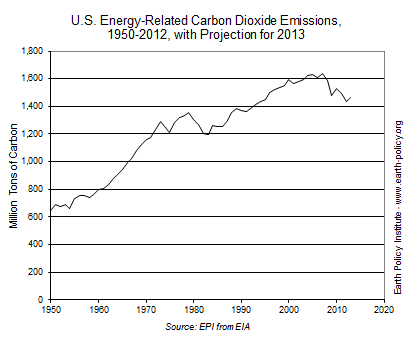
Earth Policy Institute - Carbon dioxide emissions from burning fossil fuels in the United States peaked at more than 1.6 billion tons of carbon in 2007. Since then they have fallen 11 percent, dropping to over 1.4 billion tons in 2013, according to estimates from the U.S. Energy Information Administration. Emissions shrank rapidly during the recession, then bounced back slightly as the economy recovered. But shifting market conditions, pollution regulations, and changing behaviors are also behind the decline.

Graph on U.S. Energy-Related Carbon Dioxide Emissions, 1950-2012, with Projection for 2013
Oil is the largest source of carbon emissions in the United States. After a steep drop following the 1979 oil crisis, emissions from oil climbed steadily until 2005, when they peaked at 715 million tons of carbon. Since then, these emissions have fallen by 14 percent, or 101 million tons of carbon—the equivalent of taking 77 million cars off the road

Oct 3, 2013

Sustainability Seminar Reminders (#GreatLakes, #Green, #P2Tech, #Sustainable)

Green Seminar Reminders


October 3, 2013  12 – 1 pm CDT

At Mechanical Engineering Building, Rm. 218 (1206 W Green St. in Urbana, IL)

"Fields of Gold, Deckles, and Moulds: Fresh Press and Agri-Fiber Papers"

Eric Benson - Chair of the Graphic Design Program and Associate Professor of Graphic Design and Faculty Fellow at University of Illinois at Urbana-Champaign

Fresh Press is an agri-fiber and agri-fiber waste paper-making lab on the Illinois campus that explores how a collaboration of farmers, artists, designers, and academics can revitalize a slowly dying manufacturing industry in the Midwest.

This webinar will be broadcast live and also archived on our website www.istc.illinois.edu for later viewing. If you cannot attend the event at ISTC, you may view the webinar live by registering at: https://www4.gotomeeting.com/register/440998327.


October 10, 2013  12 – 1 pm CDT

At ISTC (1 E Hazelwood Dr. in Champaign, IL)

"Mud-to-Parks: Beneficial Use of Sediment as Reclaimed Topsoil in Illinois"

Dr. John Marlin - Research Affiliate at the Illinois Sustainable Technology Center, a division of the Prairie Research Institute at the University of Illinois Urbana-Champaign

The beneficial reuse of sediment generated by various recreational, environmental and navigation projects is a priority with several state and federal agencies.  Illinois has completed several projects using topsoil reclaimed from water bodies over the past decade.   The Illinois Department of Natural Resources has funded several projects under its Mud to Parks program. 

The presentation will highlight current and past projects where dredged material is being used as reclaimed topsoil including Walton Lake at Litchfield, the Fox Waterway Agency, East Peoria, Decatur, and the Chicago area.   Equipment types, and issues related to planning and implementation will also be discussed. 

Publications, videos and photos related to the ISTC sediment project are located at http://www.istc.illinois.edu/special_projects/il_river/

This webinar will be broadcast live and also archived on our website www.istc.illinois.edu for later viewing. If you cannot attend the event at ISTC, you may view the webinar live by registering at: https://www4.gotomeeting.com/register/443396943 


October 24, 2013  12 – 1 pm CDT

At ISTC (1 E Hazelwood Dr. in Champaign, IL)

"Powering a Clean Tomorrow: Cheap Hydrogen from Biomass"

Dr. Sam C Weaver - President of Proton Power, Inc.

Proton Power, Inc. (PPI) has developed a renewable energy system for producing inexpensive hydrogen on demand from biomass and waste sources. The core technology is referred to as Cellulose to Hydrogen Power (CHyP). This core technology is ideal for clean energy applications such as distributed or central-station electrical power generation, hydrogen fueling, or producing liquid fuels such as gasoline, diesel and jet fuel.  Co-products are water and biochar, a highly effective soil supplement.

This webinar will be broadcast live and also archived on our website www.istc.illinois.edu for later viewing. If you cannot attend the event at ISTC, you may view the webinar live by registering at: https://www4.gotomeeting.com/register/180479423.