How important can it be when giant companies that consume vast amounts of energy commit to buying renewables?Well, the 110-megawatt Keechi wind power project in Texas, which Microsoft on Monday said it would get behind through a power purchase agreement, "would not have happened otherwise," according to Susan Reilly, president and CEO of project developer RES Americas.
This is an interesting project for a variety of reasons. First, for the Microsofties it moves them beyond greening their energy profile through the purchase of renewable energy credits, according to company chief environmental strategist Rob Bernard, "to actually investing directly in green energy."
Nov 10, 2013
#Microsoft invests in #Texas wind #energy project
Nov 9, 2013
Underground Heat From Cities Could Help Power Them, Study Says
No batteries needed! Future EcoBots may run on urine and re-charge from urinals in public lavatories,
Researchers at the University of the West of England, Bristol and the University of Bristol worked together to build a system that will enable robots to function without batteries or being plugged into an electrical outlet.
Based on the functioning of the human heart, the system is designed to pump urine into the robot's "engine room," converting the waste into electricity and enabling the robot to function completely on its own.
Scientists are hoping the system, which can hold 24.5 ml of urine, could be used to power future generations of robots, or what they're calling EcoBots.
"In the city environment, they could re-charge using urine from urinals in public lavatories," said Peter Walters, a researcher with the University of the West of England. "In rural environments, liquid waste effluent could be collected from farms."
In the past 10 years, researchers have built four generations of EcoBots, each able to use microorganisms to digest the waste material and generate electricity from it, the university said.
Mysterious disease, Compared to medieval ‘Black Death’ turning starfish to 'slime' on U.S. West Coast
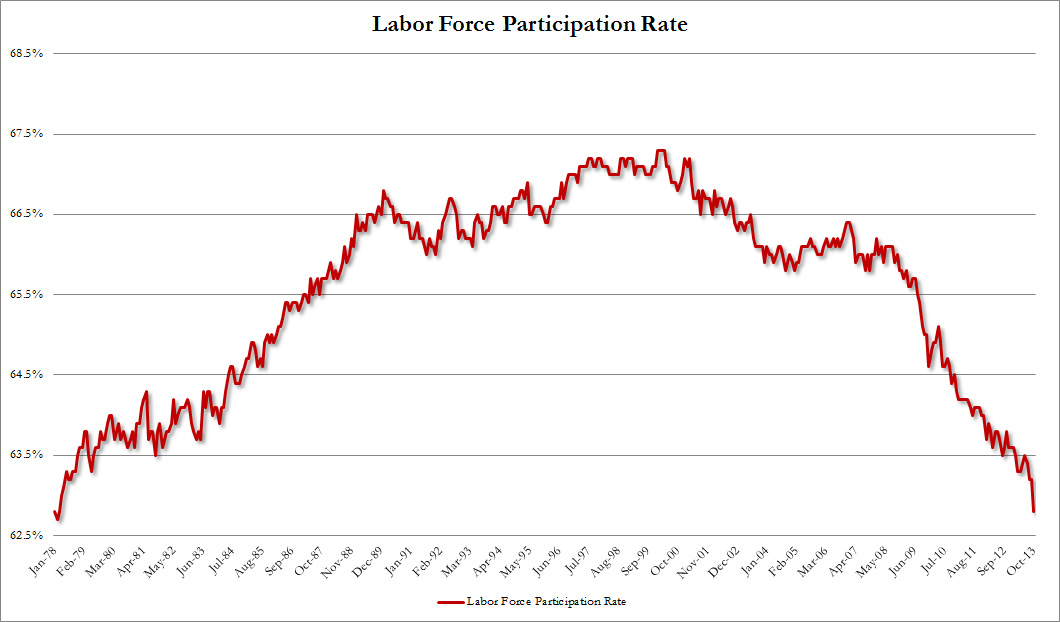
'We're Talking About A Loss Of Millions And Millions' – 'We Have Reached The Crossroads Of Life And The End Of Our Existence' - Mystery: Starfish turn to 'slime' along Pacific coast — "We're talking about a loss of millions and millions" — Compared to medieval 'Black Death'Whopping 932,000 Americans Drop Out Of Labor Force In October; Participation Rate Drops To Fresh 35 Year Low

Emerging Cyberthreats Report 2014 #Tech #Security
Source: Georgia Institute of Technology | shared via feedly mobile
From press release:
As more businesses find their way into the cloud, few engage in security measures beyond those provided by the associated cloud storage firm, a new report from Georgia Tech notes. Even fewer seek heightened data protection because of concerns that usability and access to remote data would be significantly reduced.
These concerns are among findings made by the Georgia Tech Information Security Center (GTISC) and the Georgia Tech Research Institute (GTRI) in today's release of the Georgia Tech Emerging Cyber Threats Report for 2014. The report was released at the annual Georgia Tech Cyber Security Summit, a gathering of industry and academic leaders who have distinguished themselves in the field of cyber security.
…
In related findings, the report reveals security issues involving the "Internet of Things," referring to the notion that the increase of Internet-capable devices could create opportunities remote hacking and data leakage. With everything from home automation to smartphones and other personal devices becoming connected to the Internet, these devices will capture more real-world information and could permit outside parties, companies, and governments to misuse that information.In the mobile space, even though designers of mobile devices and tablets have developed a robust ecosystem to prevent large-scale device compromises, the report finds that the threat of malicious and potentially targeted use remains. Earlier this year, researchers at Georgia Tech reported that they found ways to bypass the vetting process of Apple's App Store and subsequently showed how malicious USB chargers can be used to infect Apple iOS devices.
OSHA Wants To Post All Workplace Injury Reports Online
The $100,000 Battery That Could Help Hotels Save Bundles of Money
Todd Woody - The Atlantic.... To avoid these so-called demand charges—which can account for half of a monthly power bill—businesses can participate in programs that cut their bills if they allow their local utility take control of their air conditioners or lighting to reduce electricity use when the grid is overloaded.
Letting hotel guests who pay $300 a night sweat, however, is not an option. So Hobbs has pulled the plug on his utility by storing electricity in lithium-ion battery packs when rates are low for use when demand and prices rise. The battery and sophisticated software was built by a Silicon Valley startup called Stem and is another example of how technological innovation is upending utilities' century-old stranglehold on power.
"We measure a business' electricity usage and predict when there will be spikes in usage and make decisions on whether to charge or discharge batteries," says Prakesh Patel, Stem's vice president of capital markets and strategy, who notes that demand charges have risen 30 percent in the San Francisco Bay Area over the past three years.
That means Stem's algorithms are constantly analyzing a customer's power demand as well as other factors, such as weather patterns and past energy use, and then charging and discharging the batteries in tiny increments. Such fine-tuning keeps a customer's utility bills down while minimizing wear and tear on the expensive lithium ion battery packs, which are similar to those found in electric cars.
Please continue reading from The $100,000 Battery That Could Help Hotels Save Bundles of Money - Todd Woody - The Atlantic | shared via feedly mobile
Nov 8, 2013
We All Start Out as Scientists, But Some of Us Forget
Up until fairly recently, scientists, writers and philosophers alike have viewed human babies as little more than primitive adults. Through love and attention, babies were to be shaped into autonomous thinkers—like us. It was almost as if their brains were like new computers, whose software we needed to install over time.
But in the past few decades, explains University of California-Berkeley psychologist Alison Gopnik, science has turned this view on its head. Not only are babies' brains structurally quite different from those of adults, but they also function in a way that makes them better than adults at learning new things. In other words, babies seem to be specially designed for exploration and finding out how things work. They're little scientists...at least, that is, until those exploratory habits get replaced over time by less flexible thinking styles.
"Babies have many, many more neural connections being formed, many more synapses being formed, than we adults do," says Gopnik. "So it's as if early on, we have this brain that is really designed for learning, a brain that's very flexible and plastic and responds a lot to experiences. And then later on, as we get older, we have a brain that's more sort of a lean, mean machine, really designed to do things well, but not nearly as flexible, not nearly as good at learning something new."
Gopnik spoke with Inquiring Minds last weekend at the Bay Area Science Festival. You can listen to the interview above.
An internationally recognized leader in the study of children's development, Gopnik was the first to argue that children's minds could help us understand deep philosophical questions. She's written more than 100 journal articles and several books, including "The Scientist in the Crib" and "The Philosophical Baby," and her 2011 TED talk has generated over a million views.

"Babies and young children are like the research and development division of the human species, and we grownups are production and marketing," Gopnik says. What this means is that in many ways, babies are very good at thinking scientifically—as a number of experiments have shown–while many adults are not.
Understanding statistics and probabilities, for instance, is something that is difficult for most adults. So it's striking that young children are actually quite good at solving problems using an intuitive understanding of probability.
Take one study of babies' statistical prowess by Cornell psychologist Tamar Kushnir and her colleagues, who had 20-month-old infants watch while an experimenter pulled either yellow rubber ducks or green rubber frogs from a clear plastic box. Sometimes the box contained mostly ducks, and other times mostly frogs—meaning that if the experimenter pulled five frogs in a row from a duck box, she was doing something statistically improbable, something that could only have been done by choice.
Infants knew that too: When their turn came to choose either a frog or a duck for the experimenter to play with, they often chose the statistically unlikely option when the experimenter herself had done so. If the experimenter had pulled frogs from the duck box, then the infants tended to choose a frog as well. However, in scenarios where the experimenter had done nothing improbable—e.g., simply pulling ducks from the duck box—the infants' choices were less clear, as presumably they were inferring that since the experimenters' choice wasn't improbable, she didn't much care what kind of animal she got. In other words, even 20-months-olds can figure out that by defying probabilities, the experimenter was showing a preference for a particular kind of toy.
"To a striking extent, children use data to formulate and test hypotheses and theories in much the same way that scientists do," writes Gopnik in the journal Science. "Scientists learn about the world in three ways: They analyze statistical patterns in the data, they do experiments, and they learn from the data and ideas of other scientists. The recent studies show that children also learn in these ways."
Shared via feedly // published on MoJo Articles | Mother Jones // visit site
Power-harvesting device converts microwave signals into #energy

Persistent Organic Pollutants (POPs): Fact Sheet on Three International Agreements
Source: Congressional Research Service (via National Agricultural Law Center)
Persistent organic pollutants (POPs) are chemicals that do not break down easily in the environment, tend to accumulate as they move up the food chain, and may be harmful to people and wildlife. Between 1998 and 2001, the United States signed two international treaties and one executive agreement to reduce the production and use of POPs and to regulate the trade and disposal of them. President Bush signed and submitted the two treaties to the Senate for advice and consent. If the Senate consents by a two-thirds majority, and if Congress passes legislation that would be needed to implement the treaties and the executive agreement in the United States, then the treaties could be ratified and the agreements would become binding U.S. law. Two U.S. statutes are inconsistent with the agreements: the Toxic Substances Control Act (TSCA), which governs production and use of chemicals in U.S. commerce, and the Federal Insecticide, Fungicide, and Rodenticide Act (FIFRA), which regulates the sale and use of pesticides within the United States. Proposals to amend these statutes were considered but not enacted in the 107th, 108th, 109th, 111th, and 112th Congresses. In the 113th Congress, S. 696 would amend TSCA to allow implementation of the three international agreements, while S. 1009 would provide more limited authority for regulating exported chemicals. There currently are no legislative proposals in the 113th Congress to amend FIFRA.
FDA Updates > Why Are Jerky Treats Making Pets Sick?
Source: U.S. Food and Drug Administration
If you have a dog or cat that became ill after eating jerky pet treats, the Food and Drug Administration (FDA) would like to hear from you or your veterinarian.
The agency has repeatedly issued alerts to consumers about reports it has received concerning jerky pet treat-related illnesses involving 3,600 dogs and 10 cats in the U.S. since 2007. Approximately 580 of those pets have died.
To date, FDA's Center for Veterinary Medicine (CVM) has conducted more than 1,200 tests, visited jerky pet treat manufacturers in China and collaborated with colleagues in academia, industry, state labs and foreign governments. Yet the exact cause of the illnesses remains elusive.
Forbes Billionaires Reaped Millions In Farm Subsidies; Founders of Microsoft, Chick-fil-A, DISH Network, and Charles Schwab Corp., among recipients
Source: Environmental Working Group
At least 50 billionaires or farm businesses in which they had a financial interest benefited from $11.3 million in traditional farm subsidies between 1995 and 2012, according to a new analysis released today by the Environmental Working Group (EWG). Congress, meanwhile, has proposed changes to the federal farm bill that could well increase their haul of taxpayer dollars.
The billionaires profiting from farm subsidies were identified by matching the September 2013 Forbes 400 list, which ranks the richest Americans by their net worth, with EWG's Farm Subsidy Database, which tracks farm subsidy spending by the U.S. Department of Agriculture.
The list of billionaires who cashed in on farm subsidies includes:
- Paul Allen (Net worth: $15.8 billion), co-founder of Microsoft
- Charles Ergen (Net worth: $12.5 billion), co-founder of DISH Network
- Philip Anschutz (Net worth: $10 billion), owner of Anschutz Entertainment Group and co-founder of Major League Soccer
- Leonard Lauder (Net worth: $7.6 billion), former CEO of the Estee Lauder Companies Inc.
- Richard DeVos (Net worth: $6.8 billion), co-founder of Amway and a former candidate for governor of Michigan
- Jim Kennedy (Net worth: $6.7 billion), chairman of Cox Enterprises
- S. Truett Cathy (Net worth: $6 billion), founder of Chick-fil-A
- Leslie Wexner (Net worth: $5.7 billion), CEO of L Brands Inc., which owns Victoria's Secret
- Charles Schwab (Net worth: $5.1 billion), founder of brokerage firm Charles Schwab Corporation
- Penny Pritzker (Net worth: $2.2 billion), U.S. Secretary of Commerce
US FDA Moves To Ban Trans Fat "no safe level of consumption and no health benefits"
Read more of this story at Slashdot
Federal Debt Jumped $409 Billion in October; $3,567 Per Household | second-largest in history
(CNSNews.com) - The debt of the federal government, which is normally subject to a legal limit, jumped by $409 billion in the month of October, according to the U.S. Treasury.
That equals approximately $3,567 for each household in the United States, and is the second-largest one month jump in the debt in the history of the country.
EPA is now accepting abstracts for the 2014 National Training Conference on the Toxics Release Inventory and Environmental Conditions in Communities
The event, which will be co-sponsored by EPA and Dillard University's Deep South Center for Environmental Justice, serves as the main public outreach and training event for EPA's flagship community right-to-know regulatory program - the Toxics Release Inventory. The conference augments existing online training provided throughout the year and fosters the exchange of information between US EPA, federal, state, and local agencies, tribes, industry, community groups, researchers, and non-governmental organizations. It is also a great opportunity to present research, share knowledge, and interact with attendees.
Additional conference and abstract submission information is available at the following URL:
www2.epa.gov/toxics-release-inventory-tri-program/2014-national-training-conference
Nov 7, 2013
Grass carp in Lake Erie system 'ominous' sign that more damaging species could invade Great Lakes
Researchers with the U.S. Geological Survey and Bowling Green State University analyzed four small grass carp caught last year in Ohio's Sandusky River, which runs into Lake Erie, and determined that they had spent their entire lives in the water, "were not introduced through means such as stocking" and "could become spawning adults."
The grass carp "are less worrisome because they eat larger plants instead of plankton and don't compete with native species, although they could harm valuable wetland vegetation where some fish spawn," AP reports. "Of greatest concern in the Great Lakes region are bighead and silver carp, prolific breeders that gobble huge amounts of plankton — tiny plants and animals that are vital to aquatic food chains. Scientists say if they gain a foothold in the lakes, they could spread widely and destabilize a fishing industry valued at $7 billion." (Read more)
Grass carp, which are used to keep ponds clean, cannot be legally sold unless they are sterile. There are several ways fertile grass carp could have been introduced into the Sandusky River, but the only one that is really worrisome when it comes to silver and bighead carp is that an angler who bought minnows for bait in the Mississippi-Ohio River system got some carp minnows (which look like minnows of other fish) and released them into the river or Lake Erie, Duane Chapman, a USGS biologist on the project, told The Rural Blog. "These findings are significant because they confirm recent USGS research indicating that shorter rivers, like the Sandusky, are potential spawning sites for grass carp and other Asian carps as well," Chapman told Matt Markey, outdoors editor of The Toledo Blade. (Read more) Read more on Asian carp here, here, here, and here.
The ocean is broken

It was the silence that made this voyage different from all of those before it.Not the absence of sound, exactly. The wind still whipped the sails and whistled in the rigging. The waves sloshed against the fibreglass hull. And there were plenty of other noises: muffled thuds and bumps and scrapes as the boat knocked against pieces of debris.
What was missing were the cries of seabirds that surrounded the boat on previous voyages across the same seas. The birds were missing because the fish were missing. ...
''After we left Japan it felt as if the ocean itself was dead,'' Macfadyen says. ''We saw one whale, sort of rolling helplessly on the surface with what looked like a big tumour on its head. I've done a lot of miles on the ocean in my life and I'm used to seeing turtles, dolphins, sharks and big flurries of feeding birds. But this time, for 3000 nautical miles, there was nothing alive to be seen.''
But garbage was everywhere. ''Part of it was the aftermath of the tsunami that hit Japan a couple of years ago. The wave came in over the land, picked up an unbelievable load of stuff and carried it out to sea. And it's still out there, everywhere you look,'' Macfadyen says.
His brother Glenn, who boarded at Hawaii for the run into the US, marvelled at the ''thousands on thousands'' of yellow plastic buoys. The huge tangles of synthetic rope, fishing lines and nets. Pieces of polystyrene foam by the million. And slicks of oil and petrol, everywhere. Countless hundreds of wooden power poles are out there, snapped off by the killer wave and still trailing wires in the middle of the sea.
On other voyages, when their boat was becalmed, the Macfadyens would just crank the motor and chug off. Not this time. ''In a lot of places we couldn't start our motor for fear of entangling the propeller in the mass of pieces of rope and cable. That's an unheard of situation out in the ocean,'' Ivan Macfadyen recalls. ''If we did motor we couldn't do it at night, only in the daytime with a lookout on the bow, watching for rubbish. In the waters above Hawaii, you could see right down into the depths. I could see that the debris isn't just on the surface, it's all the way down. And it's all sizes, from a soft-drink bottle to pieces the size of a big car or truck. We saw a factory chimney sticking out of the water. ''We were weaving around these pieces of debris. It was like sailing through a garbage tip.''
3 Reasons Germans are Going Renewable 'At All Costs'
Germany is racing past 20 percent renewable energy on its electricity grid, but news stories stridently warn that this new wind and solar power is costing "billions." But often left out (or buried far from the lede) is the overwhelming popularity of the country's relentless focus on energy change (energiewende).How can a supposedly expensive effort to clean up the energy supply be so popular?
1. It's about the cost, not the price
Most news stories focus on the cost of electricity in Germany, which has some of the highest rates per kilowatt-hour in the world. But they don't note that the average German electricity bill – about $100 a month – is the same as for most Americans. Germans are much more efficient users of energy than most, so they can afford higher rates without having higher bills. ...
2. It's about vision
Germany doesn't just have an incremental approach to renewable energy, but a commitment supported by 84 percent of residents to get to 100% renewable energy "as quickly as possible." ...
3. It's about ownership
I lied in #1. Support for Germany's renewable energy quest isn't about cost of energy, but about the opportunity to own a slice of the energy system. Millions of Germans are building their retirement nest egg by individually or collectively owning a share of wind and solar power plants supplying clean energy to their communities. Nearly half of the country's 63,000 megawatts of wind and solar power is owned locally, and these energy owners care as much about the persistence of renewable energy they own as they do about the energy bill they pay. Not only do these German energy owners reduce their own net cost of energy, every dollar diverted from a distant multinational utility company multiplies throughout their local economy.
Not only does local ownership flip the notion of energy costs as consumers become producers, it also flips the notion of political ownership. Three-quarters of Germans want to maintain a focus on "citizen-managed, decentralized renewable energy."
The tunnel vision on cost so prevalent in the press reflects the perspective of incumbent utilities, whose market share declines as their former customers produce their own power. It's a story that plays out in the U.S., when debates over new power plants focus narrowly on the cost per kilowatt-hour rather than how an individual or community can retain more of their energy dollar.
It may seem that Germany is going renewable "at all costs," but only if we are resigned to being energy consumers. Because their and our energy transition is a once-in-a-lifetime opportunity to take charge of our energy future. That's priceless.
Chemical Regulation in the European Union: Registration, Evaluation, and Authorization of Chemicals
Chemical Regulation in the European Union: Registration, Evaluation, and Authorization of Chemicals (PDF)
Source: Congressional Research Service (via Federation of American Scientists)
On June 1, 2007, the European Union (EU) began to implement a new law governing chemicals in EU commerce: Registration, Evaluation, Authorization, and Restriction of Chemicals (REACH). It is intended to protect human health and the environment from hazardous chemicals while at the same time protecting the competitiveness of European industry. REACH evolved over eight years and reflects compromises reached among EU stakeholders. The final regulation reduces and coordinates EU regulatory requirements for chemicals new to the EU market and increases collection of such information for chemicals already in the EU market, thus potentially removing disincentives to innovation that existed under the former law. It also shifts responsibility for safety assessments from government to industry and encourages substitution of less toxic for more toxic chemicals in various chemical applications. Some U.S. chemical industry representatives believe that REACH is "impractical," in part due to the large number of chemicals and difficulties of identifying end uses of chemicals in many products. In contrast, some public-interest groups are urging U.S. legislators to adopt a similar legislative approach.
Economist: $29 Trillion given to banks since 2008?
Nov 6, 2013
Comments sought on economic impact of proposed wastewater rule changes to resolve inconsistencies identified by EPA
MADISON – State environmental officials are in the early stage of proposing changes to how the state processes and issues wastewater discharge permits and are seeking comments on potential economic impacts.
The Department of Natural Resources is beginning the process of making major revisions to a dozen administrative rules governing the permits that set conditions and limits for the wastewater discharges allowed to lakes and rivers and groundwater.
The first set of changes, known as rule package 6, is underway and the public can comment on possible economic impacts of these changes through Dec. 4, 2013.
The overall effort addresses issues the U.S. Environmental Protection Agency raised in a July 2011 letter to the about inconsistencies in Wisconsin's rules, statutes and policies with federal wastewater regulations and the Clean Water Act, according to Tom Mugan, who leads DNR's wastewater section.
"We are committed to updating rule language to be consistent with the federal requirements and tackling the other housekeeping issues EPA identified," says Mugan. "Those issues have only minor or no environmental impact, but it's important for us to address them as we carry out our responsibility to protect Wisconsin lakes, rivers and groundwater."
Dischargers including municipal and industrial wastewater treatment plants, as well as large-scale livestock operations, must get wastewater discharge permits, known as Wisconsin Pollutant Discharge Elimination System (WPDES) permits. DNR was among the first states to receive authority from the federal government to issue permits in 1974, and was the first state to meet the interim goals of the Clean Water Act in 1983. Wisconsin has made significant progress in cleaning up and restoring lakes and rivers in the last 40 years and remains in the forefront in carrying out the national wastewater permit system, Mugan says.
To address other issues identified by EPA, seven other rule packages are in various stages of development under the state's administrative rule process, which takes about two-and-a-half years from start to finish.
One rule package already has been adopted and took effect this August governing overflows from sanitary sewers and preventative maintenance for wastewater systems; work on that particular package, however, was well underway before the 2011 letter from EPA.
Continue reading at: http://dnr.wi.gov/news/weekly/#art5
Commit to #recycle more with 10 tips for America Recycles Day November 15 #Green #DoGood
MADISON – Recycling has long been a daily habit and a state law for Wisconsinites, and for good reason – recycling works! Every can, bottle and newspaper we recycle saves resources and energy, reduces the amount of waste in landfills, supplies raw materials to industry and creates jobs.
To celebrate all the great benefits of recycling, the Department of Natural Resources is encouraging people across the state to participate in national America Recycles Day on November 15.
"This annual event encourages Americans to waste less, recycle more and purchase recycled products," said Ann Coakley, DNR Waste and Materials Management Program Director. "There are lots of ways you can make a difference!"
In honor of America Recycles Day, here are 10 ways to boost the amount you and your family recycle. Try one, try several or try them all!
- Reacquaint – Take time to reacquaint yourself with your community's recycling program. Many recycling programs have changed in recent years and now collect a wider range of recyclables, and have also simplified the recycling process.
- Donate – Donate clothing, furniture or other household items you no longer use to a local nonprofit or resale store. By donating reusable items, you're reducing waste while helping others in your community.
- Recycle more – In addition to standard materials, find out what other products your recycling program accepts. Many communities have special programs to collect plastic bags, prescription medicines, electronics, scrap metal, household hazardous wastes and other materials – even athletic shoes!
- Find recycled products – Look for products labeled with a high recycled content or ones that use "post-consumer" recycled materials, or for products with minimal packaging or packaging that is easily recyclable.
- Talk to your kids – There are many ways children can recycle at home and at school. For ideas on simple activities to teach your kids about recycling, visit DNR's EEK! Environmental Education for Kids recycling web page.
- Recycle your old electronics – E-Cycle Wisconsin, a program funded by electronics manufacturers, is making it easier to recycle electronics like TVs, computers and computer accessories. See DNR's E-Cycle Wisconsin program to find a recycler near you.
- Compost – Start a compost pile with food scraps and fall yard debris. For suggestions on how to construct and maintain your own bin, see the DNR's home composting Web page.
- Ask for recycling – In places you visit frequently – your workplace, the grocery store or the gas station, for example – ask whether they provide an opportunity for recycling. If not, ask them to put out a recycling bin for customers and employees.
- Recycle/Reuse project waste – Recycle the debris from home construction, demolition or renovation projects. Several businesses across the state recycle or reuse shingles, construction lumber, lighting fixtures, drywall, concrete, glass and other construction materials.
- Be a recycling-friendly business – If you operate a business in Wisconsin, make sure your business is following the law and saving money by reducing waste and recycling as much as it can. Search the Wisconsin Recycling Markets Directory (exit DNR) to connect with recyclers across the state.
Recycling is easy, and with 5 million Wisconsinites taking part, it makes a big difference to the economy and the environment. For more information on America Recycles Day, including a listing of events or to list your own local event, visit americarecyclesday.org
Energy Policy - Hybrid systems to address seasonal mismatches between electricity production and demand in nuclear renewable electrical grids
.png)
Energy Policy - Hybrid systems to address seasonal mismatches between electricity production and demand in nuclear renewable electrical grids
The last of these ideas would locate a nuclear plant near a deposit of oil shale — a type of deposit, technically known as kerogen, that has not been used to date as a source of petroleum. Heated steam from a nuclear plant, in enclosed pipes, heats the shale; the resulting oil can be pumped out by conventional means.
At first glance, that might sound like a "dirty" solution, enabling the use of more carbon-emitting fuel. But Forsberg suggests that it's quite the opposite: "When you heat it up, it decomposes into a very nice light crude oil, and natural gas, and char," he explains. The char — the tarlike residue that needs to be refined out from heavy crude oils — stays underground, he says.
Today, the heating of the rock is usually accomplished by burning fossil fuels, making the process less efficient. That's where the excess heat from a nuclear plant comes in: By coupling the plant's steam output with a shale-oil well, the oil can be recovered without generating extra emissions. The process also does not need regular heat input: The nuclear plant can operate at a steady rate, providing electricity to the grid when needed, and heating oil shale at times of low electricity demand. This enables the nuclear plant to replace the burning of fossil fuels in producing electricity, further reducing the release of greenhouse gas.
The world's largest oil-shale deposits are concentrated in the western United States. "We lucked out," Forsberg says. "This has the lowest carbon footprint of any source of liquid fossil fuel."
The resource that could be unlocked is enormous, he says: "Some of these deposits would yield a million barrels per acre. There's no place else on Earth like it."
Steven Aumeier, director of the Center for Advanced Energy Studies at the Idaho National Laboratory, says, "Many times the most formative game-changing approaches are not single new technologies, but rather novel ways of combining technologies. Hybrid energy systems could be a game-changing approach in enabling the cost-effective, secure, and high penetration of low-carbon energy into the economy." Aumeier adds that such systems would "afford a practical and regionally scalable means of using an 'all of the above' approach to energy security."
Study of women's breast cancer risk and occupational factors wins award #OHS #Pink #Cancer
Driblet smart water meter harvests its own #energy

Washington DC's first family in a "Passive House" see a brighter future

Nov 3, 2013
World uranium production about 5% ahead of last year
Kazakhstan produced 5,590 tons of Uranium in the second quarter that is 9 % more than Q2 2012. First quarter uranium production in Kazakhstan was 4 979 tons.
Total production is 16,331 tons for the first three quarters.
Kazakhstan produced 21317 tons of uranium in 2012.
Kazakhstan is on track to produce about 700-1000 tons more than in 2012. Kazakhstan is the largest producer of uranium.
Read more »
Nov 2, 2013
UCSB breakthrough puts LEDs on track for 300 lumens per watt or 90% efficiency vs 5% efficiency for incandescent light bulbs
"These guidelines should permit the discovery of new and improved phosphors in a rational rather than trial-and-error manner," said Ram Seshadri, a professor in the university's Department of Materials as well as in its Department of Chemistry and Biochemistry, of the breakthrough contribution to solid-state lighting research.
This breakthrough puts efforts for high-efficiency, high-brightness, solid-state lighting on a fast track. Lower-efficiency incandescent and fluorescent bulbs –– which use relatively more energy to produce light –– could become antiquated fixtures of the past.
"Our target is to get to 90 percent efficiency, or 300 lumens per watt," said DenBaars, who also is a professor of electrical and computer engineering and co-director of the SSLEC. Current incandescent light bulbs, by comparison, are at roughly 5 percent efficiency, and fluorescent lamps are a little more efficient at about 20 percent.
"We have already demonstrated up to 60 percent efficiency in labdemos," DenBaars said.
North Dakota Health Department to begin publishing oil spill information on its website
Glatt said the department was planning to make the data more accessible even before the spill, which "left 20,600 barrels soaked into a wheat field outside Tioga in the northwest corner of the state," Lee writes. The spill was the state's biggest "since the beginning of the Bakken Shale oil boom, which has turned North Dakota into the second-biggest oil-producing state in the United States." (Please read more from The Rural Blog // visit site)
Gold Mining in the Amazon #Rainforest Surges 400% - devastating #environment
The assessment, led by Greg Asner of the Carnegie Institution for Science, is based on a combination of satellite imagery, on-the-ground field surveys, and an advanced airplane-based sensor that can accurately measure the rainforest canopy and sub-canopy vegetation at a resolution of 1.1 meters (42 inches). The approach enabled the researchers to detect changes in forest cover in areas as small as 10 square meters, roughly 100 square feet, allowing them to map thousands of small, clandestine mines that had never before been detected at scale.
The results are sobering: the extent of gold mines in the Madre de Dios region of Peru increased from less than 10,000 hectares in 1999 to more than 50,000 ha as of September 2012. The rate of expansion jumped from 5,350 acres (2,166 ha) per year before 2008 to 15,180 acres (6,145 ha) per year thereafter. Surging gold prices, combined with increased access to the region granted by new roads, are thought to be driving the spike in mining activity.
Graph of the Day: Nuclear #energy prices itself out of market
The extent to which nuclear is being priced out of electricity markets has finally been revealed by the pricing mechanism unveiled by the British government in the deal to subsidise the Hinkley C nuclear.The UK government will pay £92.5 for each megawatt hour produced from hinkley ($A154/MWh), around double the prevailing market price. This is after the UK supplied a loan guarantee for 65 per cent of the estimated $24 billion capital cost. The "strike price" – a fancy name for a feed in tariff – also has an escalator to take into account the impact of inflation, so the cost will rise in coming years.
So how does this compare with rival clean energy technologies? Pretty badly as it turns out.
This graph below, published by Craig Morris in Renewable Energy World reveals that the rates that will be offered for new nuclear from 2023 in the UK are far above what solar and wind currently cost. And, as Morris points out, the rates for solar and wind will go down by then, not up! Even offshore wind is getting £95/MWh from 2018 in the UK, but only for 15 years and without any loan guarantees.
Nov 1, 2013
Meet “badBIOS,” the mysterious Mac and PC malware that jumps airgaps | Ars Technica

Three years ago, security consultant Dragos Ruiu was in his lab when he noticed something highly unusual: his MacBook Air, on which he had just installed a fresh copy of OS X, spontaneously updated the firmware that helps it boot. Stranger still, when Ruiu then tried to boot the machine off a CD ROM, it refused. He also found that the machine could delete data and undo configuration changes with no prompting. He didn't know it then, but that odd firmware update would become a high-stakes malware mystery that would consume most of his waking hours.
In the following months, Ruiu observed more odd phenomena that seemed straight out of a science-fiction thriller. A computer running the Open BSD operating system also began to modify its settings and delete its data without explanation or prompting. His network transmitted data specific to the Internet's next-generation IPv6 networking protocol, even from computers that were supposed to have IPv6 completely disabled. Strangest of all was the ability of infected machines to transmit small amounts of network data with other infected machines even when their power cords and Ethernet cables were unplugged and their Wi-Fi and Bluetooth cards were removed. Further investigation soon showed that the list of affected operating systems also included multiple variants of Windows and Linux.
"We were like, 'Okay, we're totally owned,'" Ruiu told Ars. "'We have to erase all our systems and start from scratch,' which we did. It was a very painful exercise. I've been suspicious of stuff around here ever since."
In the intervening three years, Ruiu said, the infections have persisted, almost like a strain of bacteria that's able to survive extreme antibiotic therapies. Within hours or weeks of wiping an infected computer clean, the odd behavior would return. The most visible sign of contamination is a machine's inability to boot off a CD, but other, more subtle behaviors can be observed when using tools such asProcess Monitor, which is designed for troubleshooting and forensic investigations.
Another intriguing characteristic: in addition to jumping "airgaps" designed to isolate infected or sensitive machines from all other networked computers, the malware seems to have self-healing capabilities.
"We had an air-gapped computer that just had its [firmware] BIOS reflashed, a fresh disk drive installed, and zero data on it, installed from a Windows system CD," Ruiu said. "At one point, we were editing some of the components and our registry editor got disabled. It was like: wait a minute, how can that happen? How can the machine react and attack the software that we're using to attack it? This is an air-gapped machine and all of a sudden the search function in the registry editor stopped working when we were using it to search for their keys."