Mar 20, 2015

Overpumping of wells in San Joaquin Valley depletes water supplies, collapses land surface

Overpumping of water wells in drought-plagued California is making the earth in the San Joaquin Valley fall a half-inch each month as groundwater supplies are depleted, Bettina Boxall reports for the Los Angeles Times. "The land subsidence is cracking irrigation canals, buckling roads and permanently depleting storage space in the vast aquifer that underlies California's heartland."

While overuse has escalated during the drought, "growers have been sucking more water from its sands and clays than nature or man puts back for going on a century," Boxall writes. "They are eroding their buffer against future droughts and hastening the day, experts warn, when they will be forced to let more than a million acres of cropland turn to dust because they have exhausted their supplies of readily available groundwater." (Times graphic)
The main problem is that the Central Valley aquifer, which extends for about 400 miles under the Sacramento and San Joaquin valleys, has for years been largely unregulated and unmonitored, allowing landowners of the more than 100,000 wells to take as much water as they want, Boxall writes. "Scientists estimate that since the first wells were drilled by settlers more than a century ago, pumping has depleted Central Valley groundwater reserves by 125 million acre-feet. That is about four and a half times the capacity of Lake Mead, the biggest surface reservoir in the country. About 20 million acre-feet of that loss occurred in the last decade."

Legislation, which is strongly opposed by agricultural groups, calls "for the creation of local groundwater agencies that have more than two decades to fully comply," Boxall reports.

Mar 19, 2015

Biodegradable Plastics Are as Persistent as Regular Plastics, Research Finds

Yale Environment 360
Plastics designed to degrade don't break down any faster than their conventional counterparts, according to research
Plastic accumulated along the Los Angeles River.
published in the journal Environmental Science and Technology. Because most plastics accumulate in landfills and remain intact for decades or longer, some manufacturers have begun producing plastics with proprietary blends of additives that are supposed to make the materials biodegradable, and a number of countries have adopted legislation promoting the use of those additives. But in laboratory tests, researchers found the plastics with biodegradation-promoting additives fared no better than conventional plastics in any of three different disposal scenarios — simulated landfill conditions, compost, and soil burial for three years. Previous research looked at plastics buried in soil for 10 years, the authors note, and found that only 5 percent of the so-called biodegradable plastic decomposed. 

China will spend $370 billion building nuclear reactors over the next decade

China approved two reactors this month as it vowed to cut coal use to meet terms of a carbon-emissions agreement reached in November between President Xi Jinping and U.S. counterpart Barack Obama. About $370 billion will be spent on atomic power over the next decade, Bloomberg New Energy Finance estimates. Plans to triple nuclear capacity by 2020 to as much as 58 gigawatts.

"China is in a race with itself to reach a nuclear-power goal set for 2020 that's concurrent with a coal-reduction plan," Tian Miao, an analyst at North Square Blue Oak Ltd., a London-based researcher, said in Beijing. "Because it normally takes five years to build one reactor, the program needs to be ramped up from now on."

China has 24 reactors in operation and another 25 under construction, according to the World Nuclear Association. France gets about 75 percent of its electricity generated by nuclear, making it the world leader, while the global average is about 11 percent, WNA data show. Whatever money is spent will only put a dent in the importance of coal, which is still expected to make up almost two-thirds of the nation's power mix in 2030, said Wood Mackenzie Ltd., an Edinburgh-based energy consultant.

Read more » at Next Big Future

Costs of China's air pollution and cost to greatly reduce the problem

The cost of air pollution in China has been estimated at 6.5 percent of GDP. Applying that figure to China's GDP of $8,227 trillion dollars in 2012, the year on which we base much of our analysis, implies that reducing air pollution in China to levels considered acceptable by WHO would yield annual benefits of $535 billion. As incomes rise and China becomes more urbanized, these costs are rising.

China's GDP including Hong Kong and Macau will be about $11.6 trillion in 2015. This would mean the cost of the air pollution would be $750 billion.

Rand estimates the costs of three measures to reduce air pollution in China:
1. substituting natural gas or propane for coal for residential and commercial use
2. replacing coal with renewable and nuclear fuels to generate electricity
3. scrapping older vehicles. 

Replacing coal used for residential and commercial use and about half of all coal used to generate electricity in 2012 would have resulted in a decline in coal use of 1.009 million metric tons, representing 27 percent of Chinese coal consumption that year.

The cost of replacing half of coal-fired power with water, wind, and nuclear power at $184 billion.

Read more »at Next Big Future

Mar 13, 2015

California has about one year of water left. Will you ration now? - LA Times

LA Times : Data from NASA satellites show that the total amount of water stored in the Sacramento and San Joaquin river basins — that is, all of the snow, river and reservoir water, water in soils and groundwater combined — was 34 million acre-feet below normal in 2014. That loss is nearly 1.5 times the capacity of Lake Mead, America's largest reservoir.

Statewide, we've been dropping more than 12 million acre-feet of total water yearly since 2011. Roughly two-thirds of these losses are attributable to groundwater pumping for agricultural irrigation in the Central Valley. Farmers have little choice but to pump more groundwater during droughts, especially when their surface water allocations have been slashed 80% to 100%. But these pumping rates are excessive and unsustainable. Wells are running dry. In some areas of the Central Valley, the land is sinking by one foot or more per year.

As difficult as it may be to face, the simple fact is that California is running out of water — and the problem started before our current drought. NASA data reveal that total water storage in California has been in steady decline since at least 2002, when satellite-based monitoring began, although groundwater depletion has been going on since the early 20th century.
Right now the state has only about one year of water supply left in its reservoirs, and our strategic backup supply, groundwater, is rapidly disappearing. California has no contingency plan for a persistent drought like this one (let alone a 20-plus-year mega-drought), except, apparently, staying in emergency mode and praying for rain.

In short, we have no paddle to navigate this crisis.

Several steps need be taken right now. First, immediate mandatory water rationing should be authorized across all of the state's water sectors, from domestic and municipal through agricultural and industrial. The Metropolitan Water District of Southern California is already considering water rationing by the summer unless conditions improve. There is no need for the rest of the state to hesitate. The public is ready. A recent Field Poll showed that 94% of Californians surveyed believe that the drought is serious, and that one-third support mandatory rationing.

Please continue reading from: LA Times

Mar 12, 2015

60,000 veterans may lose their food stamps

Off the Charts - An estimated 60,000 veterans may lose SNAP (food stamp) benefits over the course of 2016 as a three-month limit on benefits for unemployed, nondisabled adults without children returns in many areas.  

One of the harshest pieces of the 1996 welfare law, the provision limits childless adults to three months of SNAP benefits in any 36-month period unless they are working half time or participating in a training program.  It doesn't require states and localities to help the affected people find jobs or provide a place in a job training program that would allow them to keep benefits — and very few do so.

Many states have temporarily waived the three-month limit in recent years due to high unemployment.  But as the economy continues to recover and unemployment falls, the waivers will end and more people will face the limit.

Low-income veterans are especially vulnerable to the time limit.  Unemployment for veterans serving since September 2001 remains high, averaging 9 percent in 2013 (the most recent year available).

The loss of SNAP benefits can have a serious impact on veteran and other low-income households.  People subject to the three-month limit have average monthly income of only about 19 percent of the poverty line — about $2,200 per year for a household of one in 2014 — and typically don't qualify for other income support.
Please continue reading from: http://www.offthechartsblog.org/60000-jobless-veterans-may-lose-food-assistance-due-to-time-limit/

NASA Can Make 3 More Nuclear Batteries, And That's It

From popsci: Plutonium-238 is an artifact of the Cold War, a byproduct of the process used to make nuclear weapons. Since nuclear non-proliferation became popular, the flow of plutonium-238 has ceased and left limited stockpiles of this incredibly useful and relatively long-lived fuel. Plutonium-238 continues to power deep-space missions such as Voyager, Curiosity, and New Horizons, but according to a new report by Space News, there's only enough left to make three more nuclear batteries.

The batteries in question are called the Multi-Mission Radioisotope Thermoelectric Generators, or MMRTGs, which the Department of Energy makes for NASA. When a spacecraft launches with an MMRTG, it puts out about 125 watts of power at the start but fades to about 100 watts after 14 years. (As the Pu-238 decays, it releases less and less heat to for the battery to convert into electricity.)There's another nuclear battery design, however, that could stretch NASA's shrinking stockpile: the Advance Stirling Radioisotope Generator (ASRG). This model uses less than one-fourth the plutonium-238 to produce the same amount of power as an MMRTG. Among it's potential missions? Powering a nuclear submarine on Saturn's moon Titan. Unfortunately, it doesn't look like that's going to happen anytime soon. Last year, NASA closed down the ASRG team, ending that particular avenue of escape--for now.

NASA intends to use the first of the three MMRTGs to power the Mars 2020 mission, which will use a spacecraft almost identical to the Mars Curiosity Rover. The other two nuclear batteries have unknown fates. The Department of Energy just restarted domestic production of plutonium-238, but making it in large enough quantities to help the space program is an ongoing challenge.


Please continue reading from:

Mar 11, 2015

Solar and Wind on Track to Dominate New U.S. Power Capacity in 2015

U.S. electric companies expect to install more than 20 gigawatts (GW) of utility-scale generating capacity this year and

Enlarge
generating capacity additions

Power generating capacity set to come online in 2015.
60 percent of that will be wind and solar power, according to a U.S. Energy Information Administration analysis. Energy companies plan to retire 16 GW of generating capacity this year, EIA numbers show, and 81 percent of that will be coal-fired power plants. The large number of coal plant retirements can be attributed to the EPA's Mercury and Air Toxics Standards, which are slated to go into effect this year. Many companies decided that shuttering coal generators would be more cost effective than retrofitting them to meet the new standards, the EIA said. Natural gas power plants — which, although they burn fossil fuels, emit significantly less carbon than coal-fired plants — will make up roughly 32 percent of the additional capacity.

California is pumping water that fell to Earth 20,000 years ago.

Environmental Health News
As California farms and cities drill deeper for groundwater in a time of drought and climate change, they are tapping reserves from the prehistoric era, and scientists are worried about the long-term environmental consequences.

Microsoft gets its FREAK on fast, patches encryption bug in Windows

Computerworld

Microsoft today patched Windows to prevent possible FREAK attacks against users of Internet Explorer (IE).

MS15-031 patches Schannel, the set of Windows protocols that, among other things, accesses the OS's cryptographic features to encrypt traffic between browsers and website servers using SSL (Secure Sockets Layer) and its successor, TLS (Transport Layer Security).

Even though Microsoft acknowledged last week that Windows was susceptible to FREAK attacks -- adding millions more potential victims -- the company reminded everyone today that the flaw wasn't exclusive to Windows, using boilerplate that it typically trots out in such instances.

To read this article in full or to leave a comment, please click here

EPA recognizes top performing Energy Star certified manufacturing plants in Idaho, Washington

U.S. EPA News
Energy Star manufacturing plants are leading their industries by saving energy and money, combating climate change(Seattle—March 9, 2015) The U.S. Environmental Protection Agency announced today that 70 manufacturing plants have achieved Energy Star certification for their superior energy performan...

Gizmag rides the electric Lightning LS-218: The world's fastest production motorcycle

The Lightning LS-218: fat bump-stop behind the Corbin seat holds the rider in place under ...

Last May, when Gizmag first featured the "truly, horrifyingly fast" Lightning LS-218, I ended by saying: "If I could take any bike in the world out for a test today, this would be the top of the list." Well, after a 17-hour flight halfway around the globe, I have now ridden the Lightning. I have also nearly fallen off it, twice, like a complete idiot. With three times the horsepower and some 70 percent more torque than the Zero SR, which is in itself an extraordinary motorcycle, the LS-218 is the king of a new breed of electric motorcycles – one designed to take on the world's best petrol bikes and beat them on performance, not just emissions figures. Riding it was one of the most extreme experiences of my young life... Continue Reading Gizmag rides the electric Lightning LS-218: The world's fastest production motorcycle 

Section: Motorcycles 

Tags: , ,  

Hickory, N.C., Receives $200,000 EPA Brownfield Grants to Revitalize, Strengthen Local Economy (NC)

 U.S. EPA News
ATLANTA – At a press conference in Huntington, W.Va., today, the U.S. Environmental Protection Agency (EPA) announced a $200,000 Brownfields Area-Wide Planning (AWP) grant to the City of Hickory, N.C., for reuse planning that includes residential and commercial projects to connect an industrial area...

Total Petroleum Puerto Rico Corp. Agrees to Spend $1.6 Million to Improve Leak Detection in At Least 125 Gas Stations Across Puerto Rico and U.S. Virgin Islands

 U.S. EPA News
(New York, N.Y.) A settlement announced today between the United States and Total Petroleum Puerto Rico Corp. (Total Puerto Rico) resolves Resource Conservation Recovery Act (RCRA) violations alleged at 31 gas stations in Puerto Rico and four gas stations in the U.S. Virgin Islands that contai...

Mar 10, 2015

Within 15 years, solar will be a dominant energy source

Computerworld: Solar electricity is expected to become competitive with other forms of electricity in an increasing number of markets globally due to declining solar panel and installation costs, according to a new report.

By 2030, solar power will generate $5 trillion in revenue worldwide, a 10-fold increase over today, according to the report from Deutsche Bank (PDF).

Costs for deploying solar Deutsche Bank

Nearly every cost for installing solar, from panels to inverters, is on the decline. 

To read this article in full or to leave a comment, please click here

Mar 9, 2015

Sewage Bacteria Reveal Cities' Obesity Rates

A new frontier in data mining: Researchers at the University of Wisconsin-Milwaukee and the Marine Biological Laboratory in Woods Hole, Massachusetts surveyed bacteria from human waste in the municipal sewage systems. Surprisingly they found different proportions of bacterial species in cities that correlated with obesity rates in those municipal areas. The researchers believe that these bacterial samples can yield city-level information on other diseases as well.Hopefully this isn't just a messy case of spurious correlation.

Read more of this story at Slashdot.

Mar 6, 2015

EPA Awards 15 Great Lakes Restoration Initiative Grants Totaling Over $8 Million to Combat Invasive Species (IL, IN, MI, MN, NY, OH, PA, WI)

EPA -- The U.S. Environmental Protection Agency today announced the award of 15 Great Lakes Restoration Initiative grants totaling more than $8 million for projects to combat invasive species in the Great Lakes basin. "These Great Lakes Restoration Initiative grants will be used... Please continue reading from: U.S. EPA News

Mar 5, 2015

Inventor of the K Cup,style coffee capsule prefers to use filters.

His idea revolutionized beverage preparation and spawned a multibillion-pound industry, but the inventor of the American version of the coffee capsule has admitted he "sometimes feels bad" about what he did and what it's doing to the environment. Please continue reading from: Environmental Health News

San Franciso becomes first city to ban plastic bottles

Global Flare San Francisco has just become the first city in America to ban the sale of plastic water bottles, a move that is building on a global movement to reduce the huge amount of waste from the billion-dollar plastic bottle industry. Over the next four years, the ban will phase out the sales of plastic water bottles that hold 21 ounces or less in public places. Waivers are permissible if an adequate alternative water source is not available. 
Please continue reading from: 

Mar 4, 2015

California to try again to add styrene to proposition 65 list of carcinogens.

The notice of intent follows two earlier efforts, one of which a state appeals court blocked after deciding the agency lacked sufficient evidence that styrene is "known" to cause cancer. 
Please continue reading from:   Environmental Health News

DNR awards grants for lake and river projects

MADISON -- Statewide lake and river groups as well as community organizations will receive $2.3 million in grants from the Wisconsin Department of Natural Resources to develop management plans and improve water quality. 
Please continue reading from: Wisconsin DNR Weekly News

World Wind Industry Grows 44% in 2014

2014 was a record-breaking year for the wind industry as it grew 44% worldwide, says the Global Wind Energy Council.

The industry added 51.5 gigawatts (GW) bringing the world cumulative total to 369.6 GW. 

China, still the leader, set its own record by installing 23.4 GW - almost half the world's new capacity, and more than any country has added in one year. China has 115 GW of wind farms.

Europe added 12.8 GW, and Germany installed almost half of that with 5.3 GW of new wind, growing 58% from 2013. Germany now has 38 GW of onshore wind and 2.4 GW of offshore wind. Renewable energy currently supplies 25.8% of the country's electricity.

European countries are now connected to nearly 2,500 turbines as part of 74 different offshore wind farms, reports the European Wind Energy Association. Total installed capacity there reached 8,045.3 MW in 2014.

Other notable additions:

  • US added 4.9 GW
  • Latin America added 3.7 GW, mostly in Brazil (2.8 GW) - the significant newcomer
  • India added 2.3 GW

Denmark had a watershed year, with wind producing 39% of its electricity, as did Scotland at 32%, and the UK, Spain, Portugal, and Germany get at least 10% from wind. 

Wind energy now accounts for about 5% of global electricity demand. 

Wind Industry 2014


Please continue reading from: 
http://www.sustainablebusiness.com/index.cfm/go/news.display/id/26180

Mar 3, 2015

China’s biggest viral video right now is this two-hour-long documentary on pollution

The Washington Post: 

The most popular viral phenomenon on Chinese Internet right now has nothing to do with thecolor of a dress or a baby weasel riding a woodpecker. It's a 104-minute-long documentary about the environment.

Produced and narrated by Chai Jing, a former investigative reporter for Chinese state television, the film "Under the Dome" is in the style of a TED talk or an activist Al Gore documentary, looking at the grim state of air pollution in China and what can be done to remedy it.

The film takes aim at the lax practices and individual poor habits that lead to smog blanketing China's cities. After being uploaded on the weekend, it has generated hundreds of millions of views and social media posts by Chinese netizens.

....The film generated a huge, emotional response online, including angry comments directed at China's political authorities.

Please continue reading from: 
http://www.washingtonpost.com/blogs/worldviews/wp/2015/03/03/chinas-biggest-viral-video-right-now-is-this-two-hour-long-documentary-on-pollution/
----
Shared via my feedly reader

Mar 2, 2015

Gates Foundation ditches McDonald’s, Coca-Cola, Exxon/Mobil stock.

The Gates Foundation Asset Trust, which manages the investments for the $42.3 billion Bill & Melinda Gates Foundation, liquidated its positions of McDonald's Corp., Coca-Cola Co. and Exxon Mobil Corp. in the fourth quarter. Please continue reading from: Environmental Health News

Rossi states that 1 megawatt energy catalyzer is being used for commercial heat production

E-catworld reports that Rossi has stated that the 1 megawatt energy catalyzer (ecat) has a unit that is being used by a customer for production heat.

There has been constant assertions that Rossi is a fraud and scam artist.

Russian Prof Parkhomov has recently claimed to have replicated the Rossi E-Cat. Parkhomov and published fully open research. Others are racing to replicate and extend the work.


JC Renoir posted these questions, and Rossi provided the answers.

Q: Can you say now if the 1 MW plant is working? A: Yes

Q: Is it already producing heat in the factory of the Customer? A: Yes

Q: Is the Customer making its production using the heat made by the 1 MW plant? A: Yes

There is an andrea rossi website with newer pictures of the newer 1 MW plants. (H/T NBF reader Alainco)


Read more » at Next Big Future

Feb 28, 2015

In 2013, measles killed more kids than car accidents or AIDS - The Washington Post

Please continue reading from: 

Measles killed 82,100 children under age 5 in 2013, ranking the disease at No. 7 on the list of the top causes of child death, according to recent statistics from the Global Burden of Disease study published in the Lancet. Lower respiratory infections like pneumonia were the number one killer, followed by malaria, diarrhea, nutritional deficiencies, congenital defects and meningitis. More small children died from measles in 2013 than died from drowning, road injuries or aids.

Here in the United States, we have the luxury of signing up for "personal belief exemptions" from vaccine requirements and indulging vaccine skeptics in their unfounded beliefs about the "dangers" posed by measles vaccines. Currently there are 113 countries that can boast better measles vaccination rates than the United States. The only reason this is possible, of course, is the incredible effectiveness of vaccines at eradicating diseases like measles.

But these numbers serve as a stark reminder that in the developing world, where measles kills roughly 225 children each day, the situation is quite different. Children under 5 make up more than half of the 145,000 deaths attributed to the disease annually. In some particularly impoverished and malnourished areas, the disease has a fatality rate of 10 percent.

According to the World Health Organization, it costs about a dollar to immunize a child against measles. But a single case of the disease here in the United States costs about $11,000 to treat. Not a bad return on investment.


Green Chemistry Guide released

The City of Los Angeles and NPPR announce the availability of the Green Chemistry Guide collaborated on by renowned university professors, industry professionals, and the City of Los Angeles' engineers. This manual provides state agencies and technical assistance providers with tools and resources to better serve their clients who are looking for information and to […] 
Please continue reading: Green Chemistry Guide

Tesla Vs. Hydrogen .... Hydrogen is Silly

By Jeff Siegel of Alternative Energy Stocks

One of Governor Arnold Schwarzenegger's dreams may soon be coming to fruition.

During his time as governor, while singing the praises of renewable energy progress in the Golden State, the Terminator would often tell tree-hugging Californians about his dream of building a hydrogen highway that would enable hydrogen-powered vehicles to run from Mexico to Canada — via California.

Not only did Prius drivers and vegans applaud the governor's dream, but it even got a decent amount of support from former GM Chairman Bob Lutz and President George W. Bush.

Since that time, California has managed to build only 10 hydrogen fueling stations in Los Angeles and San Francisco. But we got word over the weekend that the California Energy Commission is about to spend $20 million to build about 50 new hydrogen fueling stations.

According to the LA Times...

Starting in October with a new fuel station in the city of Coalinga, near I-5 in the San Joaquin Valley, hydrogen cars will be able to get from Los Angeles to San Francisco. Such vehicles can go about 300 miles on a fill up.

Hydrogen is Silly

Those who believe hydrogen represents the future of personal transportation have been quick to applaud this news.

Certainly it represents a small but meaningful step in instigating some early growth in the hydrogen vehicle market.

But here's the problem...

No one really cares now that Elon Musk has shown the world a much better mousetrap... and in the process, has been quite vocal about why he actually thinks hydrogen is "silly."

Sure, the guy's got plenty of reasons to criticize potential competitors. But hydrogen isn't really much of a competitor, as Musk pointed out recently:

Hydrogen is an energy storage mechanism. It is not a source of energy. So you have to get that hydrogen from somewhere. if you get that hydrogen from water, so you're splitting H20, electrolysis is extremely inefficient as an energy process…. if you say took a solar panel and use the energy from that to just charge a battery pack directly, compared to try to split water, take the hydrogen, dump the oxygen, compress the hydrogen to an extremely high pressure (or liquefy it) and then put it in a car and run a fuel-cell, it is about half the efficiency, it's terrible. Why would you do that? It makes no sense.

If you're going to pick an energy storage mechanism, hydrogen is an incredibly dumb one to pick. You should just use methane, that's much, much easier. Or propane. The best case hydrogen fuel cell doesn't win against the current case batteries, so then obviously it doesn't make sense. That will become apparent in the next few years.

Too Late

Although I agree with Musk, there's no doubt that plenty of automakers are still getting quite aggressive on hydrogen.

Hyundai, Toyota, Honda, and Volkswagen don't really seem to be too interested in what Musk has to say about the issue. Of course, they also weren't too interested back when he first came on the scene with a silly dream of mass-producing a quality electric car.

You know how that dream turned out...

tslaa1

In any event, while there will likely be a few more opportunities to profit in the fuel cell space with companies like Plug Power (NASDAQ: PLUG) and Hydrogenics Corp. (NASDAQ: HYGS), over the long term, I wouldn't put too much faith in hydrogen vehicles getting as much love as electric vehicles.

In terms of price, performance, ease-of-use, and infrastructure demands, by the time the few automakers pursuing hydrogen actually have a decent number of these cars in the showrooms, electric cars will be even further advanced. Prices will have fallen further, driving ranges will have doubled (if not tripled), and high-speed charging infrastructure will be nearly as common as the infrastructure in existence today for internal combustion vehicles.

In other words, it's too late for hydrogen, because no one can put the electric vehicle genie back in its bottle.

...Please continue reading from Jeff Siegel, Editor of Energy and Capital, where this article was first published.

Despite Spending Billions on Wind and Solar, German Coal Use at Highest Level Since 1990

According to the Financial Times, Germany coal use is at its highest levels since 1990. This is despite the fact that renewables (including solar and wind) have ramped up significantly in the past decade. On June 9, 2014, Germany generated for the first time over %50 of the electricity demand from solar. In the past year, 147bn kWh was generated from renewable sources. The argument for the increase in coal use stems from the fact that German chancellor Angele Merkel decided to phase out nuclear power which left an energy gap that only coal or fossil fuels could quickly meet. It was announced on May 30,2011 that Germany would close all nuclear plants by 2022 per the New York Times in an anti-nuclear response to the Fukushima disaster.

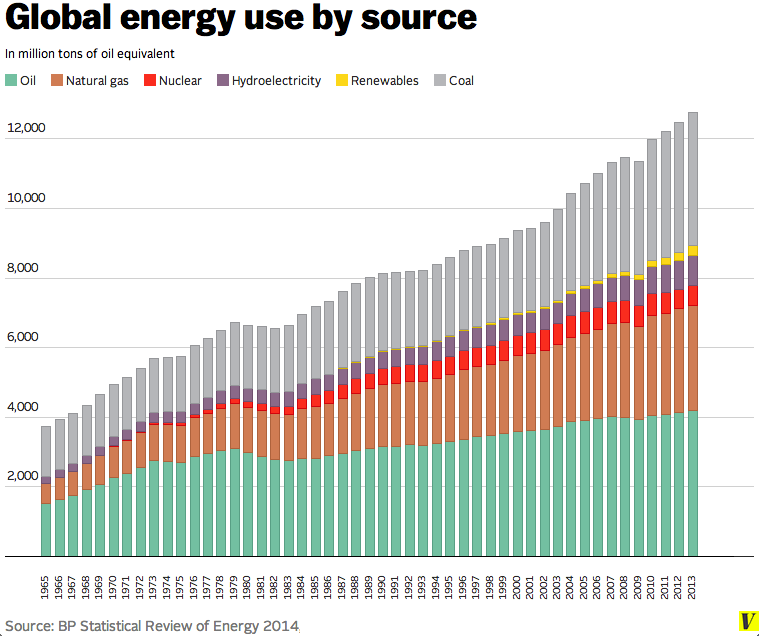
A global look at energy sources  indicates the energy load has been rising worldwide since 1965 along with corresponding increases in energy for coal and all other sources. Use of fossil fuels including coal has grown fastest worldwide.


Please continue reading from: 
http://www.rawscience.tv/german-coal-use-at-highest-level-since-1990-despite-rise-in-solar/

Feb 27, 2015

U.S. wastes $162 billion worth of food every year

About 60 million metric tons of food worth about $162 billion is wasted each year in the U.S., says a report by Resources Action Program, an antiwaste organization in Britain, Ron Nixon reports for The New York Times. "About 32 million metric tons of it end up in municipal landfills, at a cost of about $1.5 billion a year to local governments." 

That's particularly troubling, considering a report released in January by the Southern Education Foundation said that for the first time in at least 50 years, more than 50 percent of U.S. public school students are from low-income families, and some of the highest concentrations of poverty are located in states with large rural populations.

The U.S. isn't the only country wasting food. "The report estimates that a third of all the food produced in the world is never consumed, and the total cost of that food waste could be as high as $400 billion a year," Nixon writes. "Reducing food waste from 20 to 50 percent globally could save $120 billion to $300 billion a year by 2030, the report found." (Read more) 

More than two-thirds of smokers die from smoking-related deaths, study says

Smokers are dying at increasingly high rates, and 67 percent of smokers die from smoking related illnesses, says a study published this week in BMC Medicine, Danielle Paquette reports for The Washington Post. Smoking rates are especially high in non-metro areas, where 26.9 percent of adults were smokers in 2010, according to a 2014 study by researchers at the University of Washington and in Germany. And recent reports have linked more diseases than previously thought to smoking. (Age standardized rates of all-cause mortality in current smokers and never-smokers, by smoking intensity)

The study, which consisted of 200,000 Australians, found that smoking 10 cigarettes a day doubled the risk of death, and smoking one pack a day quadrupled the risk of death, Paquette writes. Cigarette smoking is the top cause of preventable disease and death in the U.S., accounting for more than 480,000 deaths every year—or one in every five deaths—says the Centers for Disease Control. 

"An Ohio State University study found employees who smoke tobacco cost employers roughly $6,000 more annually in health care and productivity than nonsmokers," Paquette writes. "Another study, from the New England Journal of Medicine, shows health-care costs for smokers tend to be, on average, 40 percent higher." 

Feb 26, 2015

EPA to investigate North Carolina for civil rights violations.

The U.S. Environmental Protection Agency has accepted a civil rights complaint filed against the North Carolina Department of Environment and Natural Resources and will investigate whether lax regulation of industrial pig farms disproportionately impacts communities of color. Please continue reading from: Environmental Health News

Tesla gearing up for release of batteries for the home

Gizmag 
Tesla home battery, which is currently produced for SolarCity's home energy storage system...
The same lithium-ion battery technology that powers Tesla's electric vehicles will be used to develop a battery for the home, according to a statement by CEO Elon Musk during a recent conference call with analysts. The batteries would be used by homes and businesses to store excess energy generated from solar panels during the day, and drawn from at night when panels sit idle. .. Continue Reading Tesla gearing up for release of batteries for the home 

Section: Environment 

Tags: , , , , ,  

Related Articles:

Feb 25, 2015

Green Chemistry Connection, An Online Community for Green Chemistry Practitioners, Launched Nationwide

​

Green Chemistry Connection,

An Online Community for Green Chemistry Practitioners,

Launched Nationwide


NATIONAL – The Northeast Waste Management Officials' Association (NEWMOA) announces the national launch of the "Green Chemistry Connection," an online community of green chemistry practitioners and an information clearinghouse now available at www.GreenChemConnect.org.  


NEWMOA created the Green Chemistry Connection in order to facilitate the exchange of information, ideas, and expertise on one easy-to-access and use web platform. NEWMOA conducted a "soft-launch" of the website in 2014 in the northeast with more than 115 members. With the re-launch of the website for a national audience, NEWMOA hopes to expand the conversation on green chemistry and further enhance the quantity and quality of information available on the Network.


"Perhaps there is nothing more important when attempting to change the status quo than effective communication. Green chemistry seeks to change the status quo to a more sustainable society and economy through innovation... [GreenChemConnect.org] will allow everyone interested in designing a thriving, prospering, sustainable world in discovering the power and potential of green chemistry to meet environment/health goals at the same time as meeting economic and job creation goals." Paul Anastas, Yale University


GreenChemConnect.org brings together federal, state, and local programs, academic institutions, non-governmental organizations, and private companies that are working on green chemistry initiatives. The goal for the Green Chemistry Connection is to broaden the understanding and adoption of green chemistry practices and principles in business, education, government, health care, and society as a catalyst to growing a sustainable economy.


Through www.GreenChemConnect.org, members can network and share information. Some of its features include:

          ●          Discussion forums for sharing ideas or posting questions

          ●          Blogs for sharing views, expertise, and experience

          ●          News complied from multiple sources

          ●          Announcements about upcoming events and activities

          ●          Notices about jobs

          ●          Groups for connecting with members interested in a particular topic

          ●          Library of links to green chemistry websites, publications, videos, case studies, curriculum and training materials, promotional materials, and resource lists

          ●          A Member Directory of organizations, companies, and academic researchers Social media sharing through other social networking sites, such as LinkedIn


According to John Warner, President of the Warner Babcock Institute of Green Chemistry, "This portal has an excellent potential to bring green chemistry community together in an effective way. I look forward to watching this grow."


NEWMOA developed this website using Word Press and administers and maintains the Network. It is funded in part by the U.S. Environmental Protection Agency through the Pollution Prevention Resource Exchange (P2Rx™). NEWMOA thanks the New England Green Chemistry Initiative (NEGCI) Steering Committee and Government Programs and Strategies Workgroup for their involvement and support with developing this Network.

Turning smartphones into personal, real-time pollution monitors

Source: American Chemical Society (ACS),

As urban residents know, air quality is a big deal. When local pollution levels go up, the associated health risks also increase, especially for children and seniors. But air pollution varies widely over the course of a day and by location, even within the same city. Now scientists, reporting in the ACS journal Environmental Science & Technology, have used smartphone and sensing technology to better pinpoint where and when pollution is at its worst. Please continue reading from: (GLRPPR) Environmental News