Apr 22, 2015

This Arbor Day, plant a tree and help the urban forest canopy grow

WI-DNR: The public is invited to attend the planting of a large red oak tree near the corner of Main Street and Pinckney Street on the capitol square in Madison at noon on April 24, 2015 to mark the 132nd celebration of Arbor Day in Wisconsin.

"People often ask when is the best time to plant a tree?" said Jeff Roe, urban forestry team leader with the Department of Natural Resources. "My standard answer is 'yesterday,' but if you didn't plant one yesterday, plant one on Arbor Day."

Wisconsin celebrates Arbor Day on the last Friday in April, the same day Arbor Day is celebrated nationally. The first Arbor Day was declared in 1872, when Nebraska newspaper editor J. Sterling Morton convinced the Nebraska State Board of Agriculture to accept a resolution by him "to set aside one day to plant trees, both forest and fruit." Today, Arbor Day is celebrated in all 50 states and around the world.

"Wisconsinites take pride in the forests where we live and play--from the majestic white oak in your backyard to the vast pines of the Northwoods. The tree canopy where we live provides many benefits, including reducing storm water runoff, lowering air temperatures, reducing air pollution, enhancing property values, improving health and wellbeing and the aesthetic benefits," Roe said.

"Threats to the urban forest posed by the emerald ash borer mean that the urgency to plant trees and continue to receive all of these benefits is exponentially increasing," Roe said. "The management of this pest is resulting in the removal of many ash trees in urban and rural environments."

State Forester Paul DeLong and other special guests will be on hand at the Capitol as The Bruce Company uses a tree spade truck to plant the large red oak. Smokey Bear will make an appearance to remind school children and other event participants that "Only YOU Can Prevent Wildfires!" Madison musician Ken Lonnquist will also be on hand to lead the crowd in songs celebrating the benefits of trees.

The public is invited to join in celebrating Arbor Day by participating in a tree planting ceremony--either at the state capitol or at one of the hundreds of local Arbor Day ceremonies that will be taking place throughout the state on April 24 -- or by planting a tree on their own property.

  Arbor Day tree planting  Arbor Day tree planting
Arbor Day is a worldwide tree-planting holiday that has been celebrated in Wisconsin since 1883. Though the holiday is observed on different dates according to planting conditions and local custom, Wisconsin’s official Arbor Day is the last Friday in April.

Four easy steps for a happy Arbor Day

  1. Celebrate Arbor Day by planting a tree and committing yourself to its care.
    Use this family-based activity [PDF] to learn how to properly plant and care for your seedling or learn how to plant and care for your landscape tree [PDF]
  2. Catch the Arbor Day spirit.

Please read on at:
http://dnr.wi.gov/news/weekly/#art4

Never Forget EarthDay is EveryDay... Even when is seems like everyone else hase

Protein Converts Pancreatic Cancer Cells Back Into Healthy Cells

Scientists working in the area of pancreatic cancer research have uncovered a technique that sees cancerous cells transform back into normal healthy cells. The method relies in the introduction of a protein called E47, which bonds with particular DNA sequences and reverts the cells back to their original state. The study (abstract) was a collaboration between researchers at the Sanford-Burnham Medical Research Institute, University of California San Diego and Purdue University. The scientists are hopeful that it could help combat the deadly disease in humans
Please continue reading from: 

EPA Awards $5 million in Clean Diesel Grants to Protect Health of Communities near Ports (HQ, CA, NJ, OR, TX)

WASHINGTON -- The U.S. Environmental Protection Agency (EPA) today awarded $5 million in grant funding for clean diesel projects at U.S. ports. The selected projects in California, Oregon, New Jersey and Texas will improve the air quality for people who live and work near the ports, and significantl... Please continue reading from: EPA News

Apr 21, 2015

William Shatner Proposes $30 Billion Water Pipeline To California

The 84-year-old Star Trek star wants to build a water pipeline to California. All it'll cost, according to Mr. Shatner, is $30 billion, and he wants to KickStarter the funding campaign. According to Mr. Shatner, if the KickStarter campaign doesn't raise enough money then he will donate whatever that has been collected to a politician who promise to build that water pipe. Where does he wants to get the water? Seattle, "A place where there's a lot of water. There's too much water," says Mr. Shatner.

Read more of this story at Slashdot.

Record Amount of E-Waste Generated Globally in 2014, Report Finds

A record amount of electronic waste was discarded in 2014, with a total of 41.8 million tons of personal electronics and household 2014 saw a record amount of e-waste.
appliances hitting landfills worldwide, a new report from the United Nations University found. The highest per-capita totals of so-called "e-waste" came from Scandinavian and European countries — Norway topped the list, followed by Switzerland, Iceland, and Denmark — and China and the U.S. were responsible for the largest volumes overall. Nearly 60 percent of e-waste by weight came from electronic components and wiring in large and small kitchen, bathroom, and laundry appliances, and 7 percent was discarded mobile phones, calculators, personal computers, and printers, the report said. It also found that less than one-sixth of all discarded electronics were properly recycled, and an estimated $52 billion in gold, copper, silver, and recoverable materials went to waste. Please continue reading from: Yale Environment 360

Exemplary Clean Air and Climate Initiatives Win EPA Honors

WASHINGTON – This week, the U.S. Environmental Protection Agency (EPA) is honoring seven projects for their work on clean air and climate initiatives, including investment in alternative fuel vehicle fleets, business partnerships to reduce pollutants, and air quality education and outreach. The 2015... 
Please continue reading from: EPA News

Wisconsin Declares Bird Flu Emergency - NBC News

Wisconsin Governor Scott Walker declared a state of emergency Monday because of an outbreak of H5N2 bird flu that kills poultry, activating the state's National Guard to help fight the infection.

Wisconsin is one of about a dozen U.S. states to be hit by the highly pathogenic strain of H5N2, which experts believe is spread by migrating waterfowl. Canada has been affected, also.

The virus has been found in three Wisconsin poultry flocks, affecting tens of thousands of chickens and turkeys. It can sweep through commercial flocks, wiping them out in days.

"We must act quickly and efficiently to contain the outbreak and protect domestic poultry," Walker said in a statement. "It is important to note, however, there is no threat to humans with the avian flu outbreak."

"There is no threat to humans with the avian flu outbreak."

There are dozens of strains of avian influenza, many of which don't cause severe symptoms in birds. But highly pathogenic strains can wipe out flocks of valuable commercial poultry and spread quickly, so outbreaks mean flocks must be destroyed.

Protein converts pancreatic cancer cells back into healthy cells

GizmagScientists working in the area of pancreatic cancer research have uncovered a technique that sees cancerous cells transform back into normal healthy cells. The method relies in the introduction of a protein called E47, which bonds with particular DNA sequences and reverts the cells back to their original state. .. Continue Reading Protein converts pancreatic cancer cells back into healthy cells 

Apr 20, 2015

He Holds the Patent that Could Destroy Monsanto and Change the World

Image

He Holds The Patent That Could DESTROY Monsanto And Change The World!

March 9th, 2015

If there's anything you read – or share – let this be it. The content of this article has potential to radically shift the world in a variety of positive ways.

And as Monsanto would love for this article to not go viral, all we can ask is that you share, share, share the information being presented so that it can reach as many people as possible.

In 2006, a patent was granted to a man named Paul Stamets. Though Paul is the world's leading mycologist, his patent has received very little attention and exposure. Why is that? Stated by executives in the pesticide industry, this patent represents “the most disruptive technology we have ever witnessed.” And when the executives say disruptive, they are referring to it being disruptive to the chemical pesticides industry.  

What has Paul discovered? The mycologist has figured out how to use mother nature's own creations to keep insects from destroying crops. It's what is being called SMART pesticides. These pesticides provide safe & nearly permanent solution for controlling over 200,000 species of insects - and all thanks to the 'magic' of mushrooms.

Paul does this by taking entomopathogenic Fungi (fungi that destroys insects) and morphs it so it does not produce spores. In turn, this actually attracts the insects who then eat and turn into fungi from the inside out!


This patent has potential to revolutionize the way humans grow crops – if it can be allowed to reach mass exposure.

To tolerate the use of pesticides in modern agriculture is to deny evidence proving its detrimental effects against the environment. Such ignorance really can no longer be tolerated. For example, can you imagine a world without bees? Monsanto's chemical concoctions which are being sprayed all over farmers' fields around the world are attributed to the large-scale bee die off. While a growing number of countries are banning Monsanto, it's still being used in  in nations who should  be aware of its dangers. To say that  new methods  need to be implemented before it is too late is an understatement.  

Monsanto presently generates $16 billion dollars per year (as reported in 2014), therefore you can be certain they do not want anything interrupting that flow of revenue. Such income gives them nearly limitless resources and abilities to suppress information that may be damaging their reputation.

Read more

New device combines the advantages of batteries and supercapacitors

GizmagScientists at UCLA's California NanoSystems Institute have developed a new device that combines the high energy densities of batteries and the quick charge and discharge rates of supercapacitors. The hybrid supercapacitor is reportedly six times as energy-dense as a commercially available supercapacitor and packs nearly as much energy per unit volume as a lead-acid battery. .. Continue Reading New device combines the advantages of batteries and supercapacitors 

Section: Science 

Tags:  

Related Articles:

Apr 16, 2015

Where 3000MPG+ Cars Come To Compete: The Ecomarathon

The Ecomarathon
Every year teams from around the world come together for the Ecomarathon, an event (ironically put on by Shell) that tasks teams from high schools and universities with creating energy-efficient electric, gas, and hybrid vehicles. This year's competition was held in Detroit, so I headed over to check it out.

vehicle-blurThe event has two categories that vehicles compete in: prototype vehicles that compete for the highest fuel efficiency and "urban concept" vehicles that are more focused on normal driving environments and look slightly closer to street-legal vehicles. Cars in both categories can be fully electric or powered by gas, diesel, compressed natural gas, or other alternative fuels. Vehicles drive around a 0.9 mile track that weaves through downtown Detroit and the efficiency of each vehicle is measured as they complete a fixed number of laps around the track.
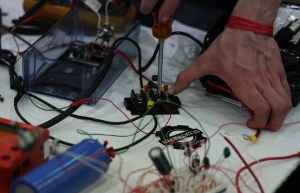
supermileage-workingEven though many of these teams are backed by universities with hefty amounts of funding, the skill sets of individual team members have a huge impact on a team's success. I talked to a team from Ohio whose electric vehicle team was made up entirely of mechanical engineers — and they were actually able to put together a fully functional vehicle.
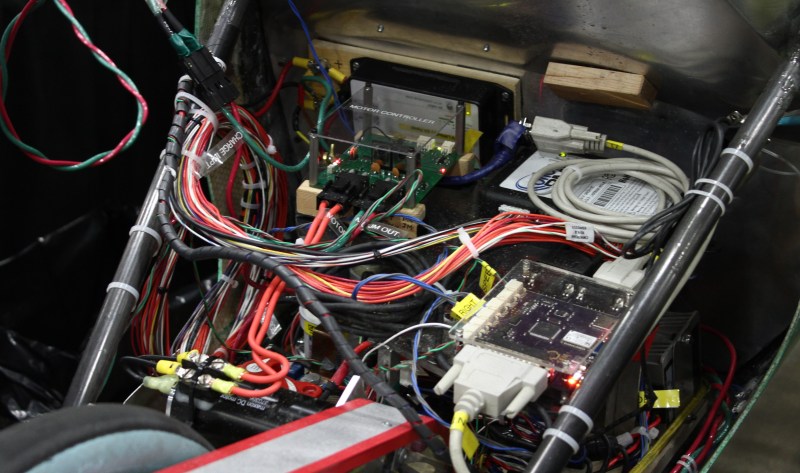

The Ecomarathon requires each electric vehicle to have a custom-designed motor controller, which was a big challenge to a group with both limited time and little electrical experience. To get something up and running as quickly as possible, the team took an Arduino and hooked it up to a bunch of parallel FETs which are PWMed to control their drive motor. Unfortunately their simple design ended up frying a bunch of FETs during competition, probably due to inadequate gate drive. Nevertheless, the team was able to get their car working before the end of the competition and ended up in 11th place with a power consumption of 109km/kWh.

vehicle-inside

In contrast, some other teams had pretty impressive electronics; custom vehicle controllers built around microcontrollers, and quite a few that interfaced to phones or Android tablets to display live data over Bluetooth or USB. A couple of teams even had web interfaces that displayed live telemetry from their vehicle.

Despite all of the fairly sophisticated electronics, most of the vehicles are based around single-cylinder gasoline internal combustion engines, and most use a commercial engine controller.

steering-columnMost teams start out with an off-the-shelf lawnmower engine or something similar in size. Some teams just run the engines stock, while others add mechanical or electronic fuel injection and fabricate their own cylinders and pistons. Teams with stock engines often perform surprisingly well, since a ton of efficiency is gained and lost in the aerodynamics of the car alone.
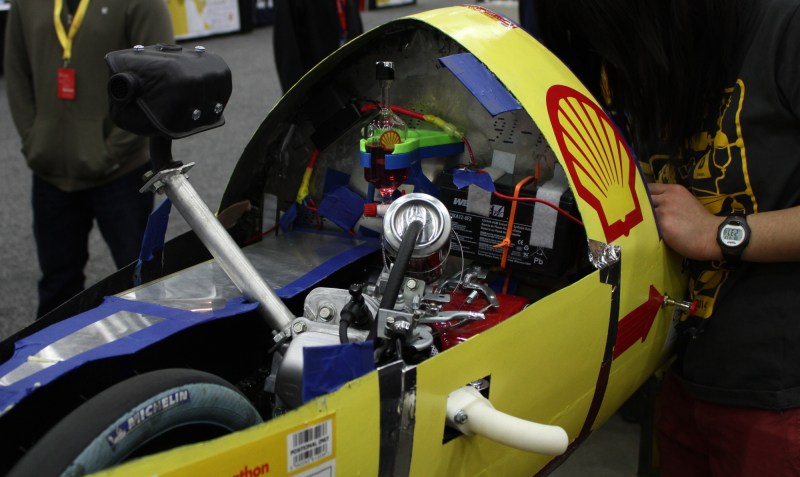
The construction of each car varies quite a bit: some cars have simple designs around tubular metal frames, while other designs are elaborate composite layups with carbon-fiber roll cages and supports. Some cars have automotive-quality paint jobs, while others have a pretty rough finish. Regardless of the outside appearance, nearly every car I looked at had some sort of awesome hacked-together last-minute fix (note the pop can in the image below).

um-engine-sc

Most of the prototype cars have extremely aerodynamic body shapes, which the students spend a ton of time simulating to make sure they are as efficient as possible. One of the biggest sources of drag for the vehicles is the wheels, so many of the vehicles have aerodynamic covers over the wheels, or actually move the wheels inside the car. Each team had their own take on body design, and most designs were really unique.

Even though these prototype cars aren't anything close to what you might see on the road, this competition brings students together to research and create energy-efficient mechanical and electrical designs. The designs might not directly translate to vehicles on the road in the near-term, but I'm sure the students will use their the skill and passion for engineering and hacking to make the vehicles of the future even more awesome.

Want to check out the scores from the event and see what schools competed? Head on over to the results page.


Filed under: car hacksFeaturedslider  

High School Students and Professionals Join Forces to a Construct Homeless Village

Jetson Green

ext

The Seattle-based non-profit organization Sawhorse Revolution is currently raising funds to sponsor the building of a "moveable eco-village" to house the city's homeless. They are calling the project the Impossible City, and with the help of volunteers from among the local high school students and building professionals they home to start building it soon. Currently they are trying to raise the funds via an Indiegogo crowdfunding campaign.

shleters

Once built, Impossible City will house anywhere from 40 to 100 homeless people at a time, with the aim of helping them get back on their feet. This city will also move every 3 to 12 months so the shelters need to be mostly off-grid. Sawhorse Revolution has already built a few portable, small shelters using recycled materials. These include salvaged aluminum panels for the roof, disused street signs for the façade, reused windows, and a "slab" made of industrial plastic pallets. They hope to build six more housing units using tensile or folding materials, since the homes are designed to be collapsible and easy to move. One of their goals is to also add a solar-powered charging station, a community cooking space and latrines equipped with composting toilets.

kitchen

latrine

shelter1

The interior of the homes will be quite cozy, with a lofted bed walled off from the rest of the home for privacy, ample storage, large windows to let in plenty of light and offer good ventilation, as well as a lounging area with a window seat and lots of shelving.

shelter int

The shelters are to be designed and built by local high school students, who will be working under the supervision of architects, engineers and builders. This will give the teens real world skills and community service experience, which is also the main goal of the Sawhorse Revolution organization. The campaign is just shy of reaching it's funding goal with about 2 weeks left.

EIA predicts energy to 2040 with more a bit more oil, gas and renewables and moderate prices

Next Big Future
The Annual Energy Outlook 2015 (AEO2015), prepared by the U.S. Energy Information Administration (EIA), presents long-term annual projections of energy supply, demand, and prices through 2040. The projections, focused on U.S. energy markets, are based on results from EIA's National Energy Modeling System (NEMS). NEMS enables EIA to make projections under alternative, internally-consistent sets of assumptions, the results of which are presented as cases. The analysis in AEO2015 focuses on six cases: Reference case, Low and High Economic Growth cases, Low and High Oil Price cases, and High Oil and Gas Resource case.

• Through 2020, strong growth in domestic crude oil production from tight formations leads to a decline in net petroleum imports and growth in net petroleum product exports in all AEO2015 cases. In the High Oil and Gas Resource case, increased crude production before 2020 results in increased processed condensate exports. Slowing growth in domestic production after 2020 is offset by increased vehicle fuel economy standards that limit growth in domestic demand. The net import share of crude oil and petroleum products supplied falls from 33% of total supply in 2013 to 17% of total supply in 2040 in the Reference case. The United States becomes a net exporter of petroleum and other liquids after 2020 in the High Oil Price and High Oil and Gas Resource cases because of greater U.S. crude oil production.

• The United States transitions from being a modest net importer of natural gas to a net exporter by 2017. U.S. export growth continues after 2017, with net exports in 2040 ranging from 3.0 trillion cubic feet (Tcf) in the Low Oil Price case to 13.1 Tcf in the High Oil and Gas Resource case.

• Rising costs for electric power generation, transmission, and distribution, coupled with relatively slow growth of electricity demand, produce an 18% increase in the average retail price of electricity over the period from 2013 to 2040 in the AEO2015 Reference case. The AEO2015 cases do not include the proposed Clean Power Plan


Read more »

EIA predicts little change in US carbon emissions to 2040

Next Big Future
The US energy information administration has a prediction of energy production and usage to 2040.

Here is the predictions around electricity and renewables.


Read more »

EPA Mobile Lab Screens Austin Residents’ Soil (TX)

DALLAS – (April 15, 2015) Scientists from the U.S. Environmental Protection Agency (EPA) used a mobile lab facility to screen soil samples from Austin residences recently. Participants were able to bring soil from their garden or yard and have it assessed for heavy metals. Scientists from ... 
---- Please continue reading from: U.S. EPA News

Apr 15, 2015

EPA Holds National Sustainable Design Expo

U.S. EPA News, Environmental Protection Agency (EPA) Deputy Administrator Stan Meiburg will open the 11th Annual National Sustainable Design Expo Saturday morning in Alexandria, Va. The expo will host student teams from colleges and universities across the country who exhibit sustainable projects ... 

Windows vulnerability can compromise credentials

ComputerworldA vulnerability found in the late 1990s in Microsoft Windows can still be used to steal login credentials, according to a security advisory released Monday.

A researcher with security vendor Cylance, Brian Wallace, found a new way to exploit a flaw originally found in 1997. Wallace wrote on Monday the flaw affects any PC, tablet or server running Windows and could compromise as many as 31 software programs.

He wrote the flaw was not resolved long ago, but that "we hope that our research will compel Microsoft to reconsider the vulnerabilities."

The vulnerability, called Redirect to SMB, can be exploited if an attacker can intercept communications with a Web server using a man-in-the-middle attack.

To read this article in full or to leave a comment, please click here

Kitegen announces their 3 megawatt wind kite power system

Next Big FutureKiteGenVenture LLC announces the launch of the KiteGen Stem, a massive, 3 MW generator capable of providing affordable clean energy on a massive scale. Using large Power Kites, KiteGen's generators harnesses freely available kinetic energy from wind, and converts that energy into electricity that is accessible via the grid. Each KiteGen Stem Generator is capable of providing enough clean energy to support the energy needs of up to 10000 families. The energy KiteGen produces boasts no environmental impact, and zero CO2 emissions. KiteGen Stem does not need to be installed in especially windy areas - they can be installed and provide electricity anywhere clean energy is needed.f

Nextbigfuture has over a dozen Kitegen articles going back to 2006. Kitegen has been working on the 3MW system since about 2010.

Next steps​. KiteGen has finished designing and testing the Power Kites - all that remains is to identify where these generators can make the most impact, and to install them there. In an effort to make the greatest positive impact on our environment, KiteGen has partnered with like-minded nonprofits to help transform the world's energy use. They have committed to sharing revenue created from the first line of installed generators with these groups, which include Bridge for Good, which focuses on reforestation, Source International, which combats pollution, and Amnesty International, defender of human rights.

Highlights

* 3MW generator harnesses kinetic energy from the wind using Kites
* Harnessing, Converting, and Using Energy has no impact on environment, zero CO2 emissions
* Can be installed anywhere, provide energy for up to 10K families


The Campaign: ​KiteGen is running an Indiegogo campaign in support of the launch of their PowerKite Project. Backers can help make Power Kite technology a reality for as low as a $20 contribution. The campaign, which launches April 14, 2015, will run through June 13, 2015. Backers can expect to receive rewards by July 2015.

Read more »

Modified Salmonella eats away at cancer, without a side order of food poisoning

Gizmag : Though generally a bacteria we'd associate with a severe bout of food poisoning, previous research has suggested that Salmonella needn't always bring bad news and stomach cramps. Certain strains have been shown to kill off cancer cells, but to use them as a form of treatment for humans without inducing any nasty side effects has so far proven difficult. But now, researchers have developed genetically modified salmonella that turns toxic only after it enters a tumor... Continue Reading Modified Salmonella eats away at cancer, without a side order of food poisoning

Section: Medical 

Tags:  

Related Articles:

Apr 13, 2015

Seminar: Reducing Air Pollution Exposure in Passenger Vehicles and School Buses

Seminar: Reducing Air Pollution Exposure in Passenger Vehicles and School Buses

Presented by: Yifang Zhu, Ph.D., UCLA Fielding School of Public Health, University of California, Los Angeles

Tuesday, April 14, 2015, 1:00 p.m., PDT
Sierra Hearing Room, Second Floor, Cal EPA Headquarters, 1001 "I" Street, Sacramento, CA

WEBCAST
Webcast viewers: Please send your questions during broadcast to: sierrarm@calepa.ca.gov

Presentation
Research Project

Overview

Exposures to vehicle-emitted PM₂.₅, black carbon (BC), and ultrafine particles (UFPs), have been associated with adverse health effects. As a potential strategy to mitigate in-cabin exposure, we developed a novel high efficiency cabin air (HECA) filter for passenger vehicles and an on-board HECA filtration system for school buses.

Their performance was evaluated in 12 passenger vehicles and 6 school buses, respectively. UFP number concentration and size distribution as well as BC and PM₂.₅ levels were concurrently monitored inside and outside of each vehicle under three driving conditions: stationary, on local roadways, and on freeways. For passenger vehicles, data were collected with no filter, the in-use original equipment manufacturer (OEM) filter, and two prototypes of HECA filters (i.e., HECA A and B filters). For school buses, data were collected with and without operating the filtration system equipped with HECA B filters. For passenger vehicles, the HECA B filters offered in-cabin concentration reductions of 90 ± 8% for UFPs on average across all driving conditions, which is much higher than the reductions seen with (or achieved by) the OEM filters (50 ± 11% on average). Similarly, the HECA B filters offered an 81 ± 15% reduction for BC and 66 ± 28% for PM₂.₅ across all driving conditions. In comparison, across all driving conditions, the in-use OEM filters only provided 31 ± 17% and 29 ± 20% reduction for BC and PM₂.₅, respectively. For school buses, across all driving conditions, in-cabin UFP and BC levels were reduced by 88 ± 6% and 84 ± 5% on average, respectively, when the on-board HECA filtration system was operating. The application of this technology in passenger vehicles also kept in-cabin CO2 concentration below 1,000 ppm under outdoor air mode. In-cabin PM₂.₅ was also reduced from approximately 35 μg/m³ to 10 μg/m³.

This proof-of-concept study concludes that the HECA technology can significantly reduce human exposures to UFPs, BC, and PM₂.₅ in passenger vehicles and school buses. Practical application of the HECA filter, however, requires long-term evaluations under a broader range of vehicle models and driving conditions.

Speaker Biography

Yifang Zhu, Ph.D., is an Associate Professor of the Environmental Health Sciences Department, UCLA Fielding School of Public Health, University of California, Los Angeles (UCLA). Dr. Zhu's research interest is primarily in the field of air pollution, environmental exposure assessment, and aerosol science and technology. Specifically, she is interested in quantitative exposure/risk assessments on ultrafine particles from various indoor and outdoor sources. Dr. Zhu's current research focuses on measuring and modeling ultrafine particle emissions, transport, and transformation on and near roadways as well as in various indoor environments. Dr. Zhu's scholarship and creativity has been recognized by several national awards, including the Walter A. Rosenblith New Investigator Award from the Health Effects Institute in 2007, the Faculty Early Career Development (CAREER) Award from the National Science Foundation in 2009, and the Haagen-Smit Prize from Atmosphere Environment in 2011. Dr. Zhu was appointed to the California Air Resource Board's Research Screening Committee in January 2014. Dr. Zhu received her Ph.D. in Environmental Health Sciences from UCLA in 2003.

Report: Chinese Government Plans To Put 3D Printers In All Elementary Schools

The Chinese government has a new plan to install a 3D printer in each of its approximately 400,000 elementary schools over the next two years. Education is probably one of the areas that will benefit the most from 3D printers in the long run. The problem though is getting the machines into the schools in the first place. With prices generally ranging from $400 to $3,000 for typical desktop 3D printers, they are not cheap, and with budgets within many school districts running dry, both in the United States and overseas, the unfortunate fact is that many schools simply can't afford them, not to mention the materials and time it takes to train teachers to use them.

Read more of this story at Slashdot.

Apr 10, 2015

Another Electric Car Bites The Dust: Current Chevy Volt To Go The Way Of The Aztek Due To Plunging Sales

zero hedge - A week ago when observing the latest GM deliveries, we noticed something troubling:

Here is the unpleasant detail for a car that five years ago was among the biggest hopes for the recently bankrupt auto maker:


It was thus inevitable that the car which first went on sale in 2010 amid very high expectations, and whose lackluster sales of 70,000 to date, far below initial company forecasts amid low gasoline prices and the release of more capable electric models from competitors, was about to be mothballed. Today Reuters confirmed as much when it reported that GM will "halt production of the Chevrolet Volt electric car for the summer to whittle down about seven months of unsold inventory and smooth the way for the next generation of the plug-in hybrid sedan."

Production of the current model, which costs $34,000 and up before federal tax credits, will halt early next month, the Detroit auto maker has said. It will be replaced by a 2016 model with a sleeker design and up to 50 miles range on an electric charge. That second generation Volt will go into production at the end of the summer.

Alas, absent a surge in the price of gasoline back into the high $3 range, the prospects of this "upgrade" will hardly be any better.

From Reuters:

The production hiatus comes after a first quarter in which sales fell well behind Nissan Motor Co.'s Leaf electric car in the U.S. GM sold 1,874 Volts during the three-month period, equivalent to the number of Silverado pickups sold in a day, and in contrast to Nissan's 4,085 Leaf sales. Volt stocks are enough to last 210 days, or until November, at their March sales pace, according to researcher Autodata Corp. Car makers generally like to have about 60 days of inventory at dealers.

Reinvigorating consumer interest in the Volt, a car that has a battery and a small gasoline motor, is a top priority for GM as it prepares to release its fully-electric Bolt sedan, say analysts. Volt development consumed more than a billion dollars but has failed to generate a fraction of the buzz that Tesla Motors Inc. has with its pricier Model S luxury electric car or Toyota Motor Corp. with its Prius family.

According to Pam Fletcher, GM's chief electric-vehicle engineer, Chevrolet executives have kept in close contact with initial Volt buyers, polling them on issues spanning quality to performance to design. One key thing it learned, "People said they didn't want a science experiment," Ms. Fletcher said.

That's odd because the buyers of Tesla's own electric car have no problem with that particular science experiment. Then again, when it comes to electric cars, the Apple marketing scheme is far more applicable: the price should be higher, not lower, because a "science experiment" is acceptable as long as it also happens to be a status symbol, A very expensive one preferably, which is the primary reason why there is still any demand for Teslas around the globe.

That, however, has not dawned on GM's marketing department just yet, although there is hope: according to Reuters, the marketing plan for the next generation Volt is still coming together said Chevrolet Car Marketing Director Steve Majoros. GM plans to address the confusion around a battery-powered car that has a gasoline engine. Dealers will get "significant marketing support" for the 2016 model. "We will be out publicly and big," he added.

Brett Hedrick, owner of Hedrick's Chevrolet in Clovis, Calif., said he is in favor of greater support from GM for Volt sales, but said electric cars won't catch on until they make financial sense. When gas prices went down consumers weren't "as conscious about conserving," he said. 

Mr. Hedrick said his current challenge is selling the Volt inventory on his lot before the new model arrives—something he hopes GM will support.

Chelsea Sexton, a Los Angeles-based electric car advocate, said while GM made a lot of waves when it first launched Volt, it lost soon ground to other auto makers who released fully electric vehicles.

She said GM lately has reached out less often to enthusiasts, noting talks with herself and others "have largely fallen off…as those conversations fall off, it's hard to tell where they stand in the long term."

Dealers say GM has to regain mind share in electric cars. "We just don't have presence in the space currently," said Jamaal McCoy, general manager of Findlay Chevrolet in Las Vegas. "When someone thinks of an electric vehicle they don't think of Chevrolet; they think Toyota or Tesla."

... For now. Because Tesla's electric "supremacy" days may well be numbered with the arrival of the BMW i8 and other ultra high-end competition. Because when it comes to novelty electric cars which despite the best intentions and efforts of their makers simply refuse to become mainstream, one has to differentiate in other ways. For Tesla that something is appealing to the buyer's vanity and desire to show off their wallet. However, that success of such a strategy is limited as the recent drop in Tesla sales in China is confirming.

As for the current iteration of Chevy Volt, it has finally met its fate on the recycling lot, which as many had predicted long ago, will be right next to that other GM "shock and awe" concept: the infamous Pontiac Aztek.


Apr 9, 2015

Nation’s first federal combined solar power purchase launched by EPA, Forest Service, Energy Department and GSA (CA, NV)

U.S. EPA News – The U.S. Environmental Protection Agency, U.S. Forest Service, Department of Energy and General Services Administration announced the first ever federal partnership to purchase solar power. This action follows President Obama's order last month requiring federal agencies to cut their... 

Apr 8, 2015

OSHA Updates Workplace Violence Guidance for Protecting Healthcare and Social Service Workers

Environmental & Safety Law UpdateIn its announcement last week, OSHA noted that the Bureau of Labor Statistics reported for 2013 that over 23,000 significant injuries were due to violent assault at work, with more than seventy percent of these assaults being in the healthcare and social service settings.

OSHA concluded that healthcare and social service workers are almost "four times as likely to be injured as a result of violence than the average private sector worker." To bring a reduction to this risk, OSHA has just released an update to its Guidelines for Preventing Workplace Violence for Healthcare and Social Service Workers. The Guidelines include what OSHA believes to be "industry best practices," and provides direction on ways to reduce the risk of violence in various healthcare and social service settings.

These revised Guidelines, that update and broaden the reach of OSHA's previous 1996 and 2004 Guidelines, incorporate "research in the last decade into the causes of workplace violence on healthcare and social service settings, risk factors that accompany working with patients or clients who display violent behavior, and the appropriate preventive measures that can be taken, amid the variety of settings in which health care and social service employees work."

Importantly for employers in these industries is that the Guidelines also stress the importance of developing a written workplace violence prevention program. The Guidelines require that a workplace program should include management commitment and employee participation, worksite analysis, hazard prevention and control, safety and health training, and recordkeeping and program evaluation.

Please continue reading from: Brent I. ClarkJames L. CurtisMark A. LiesMeagan Newman, and Craig B. Simonsen

Apr 7, 2015

America's Poor Spend 60% Of Their Income On Food & Housing Proving CPI Is Meaningless

From WSJ:

For many Americans, the rise in food and housing prices is a tough squeeze. That’s because—even in an era with low overall inflation—low-income Americans spend a disproportionate share of their money on food and housing.


New data from the Labor Department show the extent of the discrepancy. The bottom 10% of Americans, by income, devote 42% of their spending to housing and an additional 17% to food–nearly 60% of their total spending, according to the Consumer Expenditures Survey. By contrast, the wealthiest 10% of Americans dedicate only 31% of their spending to housing and 11% to food–closer to 40% of total spending…


This underscores one reason that inflation feels different household to household: People spend their money in such different ways. A parent with children in college or daycare might scoff at the notion that inflation has been low for the last five years. Conversely, someone with no car payment and no mortgage but who does a lot of driving may be feeling flush from the plunge in gas prices.

Yes, “different from household to household.” So what you’re saying is that if things like your child’s education actually have to be paid for with real wages, you may think differently about your economic circumstances than someone who has no mortgage and who “does a lot of driving” in a Bentley that was paid for in cash but which ends up sucking a lot of gas because its V-8 churns out 500 horsepower. Got it. And as it turns out, the poorest 10% of US households foolishly and habitually choose to spend 60% of their meager earnings on housing and food whereas the top 10% of earners apparently understand that, while necessary, putting a roof over one’s head and eating shouldn’t be allowed to take up too much of one’s earnings because if left unchecked, such expenditures can eat into resources that should by all rights be reserved for vacation home purchases.


Curiously, WSJ also notes that the poorer you are, the more you depend on the government and incredibly, it turns out that there’s a correlation between being rich and spending money:

The poorest 10% receive more public assistance than any other group. The second 10% receive more than half their income from Social Security and retirement programs. The third and fourth 10% also receive large shares of their income from retirement programs, suggesting that retirees make up a large share of the lower-middle part of the income distribution…


As consumers become wealthier, their spending patterns change, sometimes dramatically.

And while this certainly appears to paint a rather vivid picture of wealth inequality in America, WSJ does note that “the consumer expenditures survey is not perfect” — and neither is a system where the bottom rung of society spends 20% more of their vastly lower income on staying alive than the country’s elite.

Link and source from zerohedge

70% of People on Antidepressants Don't Have Depression: Study

globalresearch: If sales for antidepressants such as Zoloft, Lexapro, or Prozac tell us anything, it’s that depression is sweeping the nation. But a new study questions the validity of most of these sales. The study has found that the majority of individuals on antidepressants – a whopping 69% – do not even meet the criteria for clinical depression. These individuals are likely just experiencing normal sadness and hardships that most of us experience.

In addition to finding that nearly two-thirds of antidepressant-takers don’t meet criteria for depression, the researchers also note how 38% of those taking antidepressants for other psychiatric disorders do not meet the criteria. These include panic disorder, obsessive compulsive disorder, social phobio, general anxiety, and a number of other arguably fabricated mental disorders.

The study, published in The Journal of Clinical Psychiatryreads:

Objective: Past studies have shown that many individuals who use antidepressants have no current or lifetime history of mental disorders. However, recent studies suggest that the one-time retrospective evaluation of mental disorders commonly used in such studies may substantially underestimate the true lifetime prevalence of mental disorders. We examined the prevalence of mental disorders, assessed prospectively over multiple interviews, among individuals currently using antidepressants in a community sample.

Conclusions: Many individuals who are prescribed and use antidepressant medications may not have met criteria for mental disorders. Our data indicate that antidepressants are commonly used in the absence of clear evidence-based indications.”

Prescriptions for anti-depressants have skyrocketed over the past several decades.In 1998, 11.2 million Americans used these drugs. By 2010, it was 23.3 million.

A few years back, Harvard conducted a study to reiterate what many in the psych professionals already know – Americans are addicted to anti-depression meds. We collectively pop Prozac, Celexa, Effexor, Paxil, and Zoloft pills like they are candy in an attempt to boost mood and feel better. The increase in sales of anti-depressants is up a startling 400%. This pill-popping became the norm, even though clinical studies suggest there are numerous natural remedies that can help us feel better, without the pricey and life altering side-effects that many of these drugs can cause.

Unfortunately, we are fighting a partnership between the psychiatric community and doctors that exists in the background. An astonishing 70 percent of the panel members of psychiatric bible, known as the Diagnostic and Statistical Manual of Mental Disorders, reported having financial relationships with pharmaceutical companies. About 57 percent reported ties in the previous edition. This is just one reason pharmaceuticals are sweeping the nation.

Are radioactivity levels from Fukushima dangerous to British Columbians?

Famous last words.... 
After calling on the public to help gather samples, scientists at the Massachusetts-based Woods Hole Oceanographic Institution says traces of radioactivity from the meltdown 2011 meltdown of Japan’s Fukushima Daiichi nuclear plan are showing up in B.C. waters.

But researchers says there is good news: the levels of radioactivity likely pose no threat.

“Radioactivity can be dangerous, and we should be carefully monitoring the oceans after what is certainly the largest accidental release of radioactive contaminants to the oceans in history,” said marine chemist Ken Buesseler. “However, the levels we detected in Ucluelet are extremely low.”

A sample collected on February 19 in Ucluelet, says Woods Hole, contained trace amounts of cesium (Cs) -134 and -137, which the institute says is “well below internationally established levels of concern to humans and marine life”.

Scientists from Woods Hole have gathered samples from more than 60 sites along the U.S. and Canadian coasts and say there is simply no cause for alarm.

“If someone were to swim for 6 hours a day every day of the year in water that contained levels of cesium twice as high as the Ucluelet sample, the radiation dose they would receive would still be more than one thousand times less than that of a single dental x-ray,” said a report from Woods Hole.

Please read full at: http://www.cantechletter.com/2015/04/is-radioactivity-from-fukushima-dangerous-to-british-columbians/

The battery that lasted 175 years, manufactured by London instrument makers Watkin and Hill

Mother Jones -  There sits, in the Clarendon Laboratory at Oxford University, a bell that has been ringing, nonstop, for at least 175 years. It's powered by a single battery that was installed in 1840. Researchers would love to know what the battery is made of, but they are afraid that opening the bell would ruin an experiment to see how long it will last.

The bell's clapper oscillates back and forth constantly and quickly, ?meaning the Oxford Electric Bell, as it's called, has rung roughly 10 billion times, according to the university. It's made of what's called a "dry pile," which is one of the first electric batteries. Dry piles were invented by a guy named Giuseppe Zamboni (no relation to the ice resurfacing company) in the early 1800s. They use alternating discs of silver, zinc, sulfur, and other materials to generate low currents of electricity.

"What the piles are made of is not known with certainty, but it is clear that the outer coating is of sulphur, and this seals in the cells and the electrolyte," AJ Croft, a former researcher at the Clarendon Laboratory, wrote in a 1984 paper ?describing the bell in the European Journal of Physics. "Piles similar to this were made by Zamboni, whose batteries were constituted of about 2,000 pairs of discs of tin foil glued to paper impregnated with zinc sulphate and coated on the other side with manganese dioxide."

The bell didn't necessarily start as an experiment. It was manufactured by London instrument makers Watkin and Hill, and has a handwritten note that says "set up in 1840" displayed alongside it. It was eventually purchased by a researcher, who continued to allow it to ring (Oxford University suggests there's evidence that it may have actually been set up as early as 1825). The Guinness Book of World Records has named its power source the "world's most durable battery."

Algae could both provide biofuel and clean up wastewater

Algae grows in pools of wastewater in Houston, Texas (Photo: Rice University)

GizmagAlgae may indeed be a potential source of biofuel, but it can also find use in things like nutritional supplements and cosmetics. When it's grown commercially, its growth is usually aided with chemical fertilizers. The cost of those chemicals cuts into the profits, however, plus the fertilizers are also needed for more traditional crops. That's why scientists from Houston's Rice University are looking into growing algae in municipal wastewater – the water would already contain its own free fertilizer, plus the algae would help clean it up. .. Continue Reading Algae could both provide biofuel and clean up wastewater 

Section: Environment 

Tags:  

Related Articles:

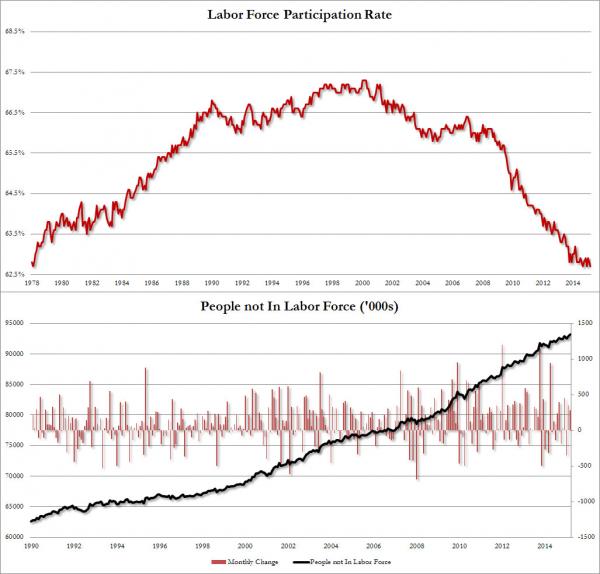
Record 93.2 million Americans now not in the labor force: The not in the labor force rebound added 277,000 Americans in March alone.

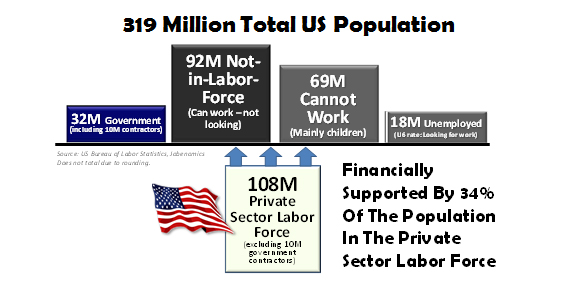
mybudget360...In the last year alone we have added 2.1 million Americans to the "not in the labor force" category.  This mysterious category continues to grow and is having a field day with the employment data.  It is hard to ignore this number because it represents a large portion of our population that is simply not counted in the labor force data.  You have older Americans in this category but you also have a large number of people wanting work and simply not being able to find it.  You also have many relenting and taking up work in the low wage segment of our economy.  The unemployment rate would have you believe that this is a fantastic recovery but in March alone we added 277,000 to the not in the labor force category while only 126,000 jobs were created.  It is becoming more apparent there will be a strain on the one-third of Americans supporting the other two-thirds.

Non-working America

There seems to be this selective blindness to this group.  The narrative that tries to explain this growth away is that older Americans are simply retiring.  This is more myth than fact.  First, retirement assumes that many older Americans have the means to retire.  The reality is, half of older Americans on Social Security would be in poverty if it were not for that monthly check.  Many older Americans are working into old age because they have to.  Another segment is the group of people meandering in college. Most are there to gain an education and grow.  Many are there going into deep debt with a degree that will probably yield very little in the marketplace.

We have some significant structural issues to confront here.  Take a look at this growth:

LFP_0

93.2 million Americans are now not in the labor force.  In the last year alone we've added 2.1 million to this category.  This is a staggering amount to an already large group.  What makes it more difficult is that you have a larger burden of production being placed on those in the private sector.  One-third of Americans are supporting two-thirds of the population:

319-Million2

"Those in the private workforce are basically keeping things rolling for the rest.  Now in this category of non-workers you have retirees and children but a big number is coming from people that should be working if this was truly some broad based recovery."


Please continue reading from: 

Stanford: New Aluminum-Ion Battery, “7,500 Cycles Without Any Loss of Capacity”

Via: Stanford University:

Stanford University scientists have invented the first high-performance aluminum battery that's fast-charging, long-lasting and inexpensive. Researchers say the new technology offers a safe alternative to many commercial batteries in wide use today.

"We have developed a rechargeable aluminum battery that may replace existing storage devices, such as alkaline batteries, which are bad for the environment, and lithium-ion batteries, which occasionally burst into flames," said Hongjie Dai, a professor of chemistry at Stanford. "Our new battery won't catch fire, even if you drill through it."

Dai and his colleagues describe their novel aluminum-ion battery in "An ultrafast rechargeable aluminum-ion battery," which will be published in the April 6 advance online edition of the journal Nature.

In addition to small electronic devices, aluminum batteries could be used to store renewable energy on the electrical grid, Dai said.

"The grid needs a battery with a long cycle life that can rapidly store and release energy," he explained. "Our latest unpublished data suggest that an aluminum battery can be recharged tens of thousands of times. It's hard to imagine building a huge lithium-ion battery for grid storage."

Aluminum-ion technology also offers an environmentally friendly alternative to disposable alkaline batteries, Dai said.


Apr 6, 2015

No Country For Young Workers: Only Americans 55 And Older Found Jobs In March

Zero Hedge [feedly]...America continues to be a country where there are only jobs for old men, those 55 and older, who saw a 329,000 increase in jobs in the past month. Every other age group saw job losses!


And the real kicker: since the start of the Second Great Depression, only the 55 and older age group has seen job increases. Those 55 and younger are still 1.2 million jobs below the level they were are on December 2007.


And just in case there is any confusion, here is just the number of workers aged 55 and older. At 33.1 million they just hit a new all time high.


Oh, and finally, for those who may be wondering. It isn't because of early retirement. Unless of course, those retiring early are workers aged 25 to 54.

Source: BLS

Please read full and follow at:

A Return To Nuclear May Be Japan’s Only Option

Four years after the Fukushima meltdown, Japan is finally eyeing a return to nuclear power.

To be sure, some, if not most of Japan's 54 nuclear reactors will remain offline permanently. But the ruling Liberal Democratic Party is crafting a proposal that could lead to nuclear power reclaiming about 20 percent of Japan's electricity market.

It is hard to imagine such a revival. Nuclear power made up just under 30 percent of the country's electricity generation before the catastrophic tsunami hit in 2011. Now it is at zero percent. Strict new safety standards and strong public opposition will likely keep many of the reactors on the sidelines.

But the ruling party is pressing ahead. In mid-March the Nuclear Regulatory Authority (NRA) gave the go-ahead to Kyushu Electric Power for upgrades to its Sendai nuclear power plant, removing a hurdle for the plant's return to service. Kyushu hopes to power up the reactor by June. More approvals could be forthcoming, particularly if the Liberal Democratic Party gets its way.

Related: The $6.8 Billion Great Wall Of Japan: Fukushima Cleanup Takes On Epic Proportion

Assuming that Prime Minister Shinzo Abe is able to muscle through his proposal to bring nuclear back, what would that mean for Japan?

Please continue reading from: