Mar 26, 2016

Maryland’s honeybees are being massacred, and the weapon might be in your house - The Washington Post

In the end, Maryland lawmakers couldn't ignore the same haunting story from beekeepers. "I go into winter with a really strong population, managed them to be fat and healthy, treated for mites, with plenty of food," said Bonnie Raindrop, a keeper in Baltimore County. "But at the end of winter, you open your hives and they're all dead." 

The keepers joined academics and conservationists in convincing the state General Assembly that the mass deaths over the past four years are likely tied to widespread use of household pesticides linked to honeybee mortality. Both chambers recently passed bills that would ban stores from selling products laced with neonicotinoids to homeowners who tend to lather too much on trees and gardens.

The similar bills  are expected to be forged into a single piece of legislation for Gov. Larry Hogan (R) to sign within two weeks. Hogan's signature would make Maryland the first state to take the harmful pesticides away from amateurs. Farmers and professionals who better understand how to apply them in a way that poses a lesser threat to bees would be exempted by the law when it takes effect in 2018.

Maryland lost more than 60 percent of its hives last year, each with up to 20,000 honeybees. About a dozen other states are considering taking similar steps as bees die and honey production declines. Last year, honey production fell  12 percent among producers with five or more colonies, according to a U.S. Department of Agriculture survey.

Neonicotinoids were introduced to agriculture in the 1990s and made available to the general public more recently because it was thought to be safer for bees than other pesticides. They seep into plants rather than simply coating the surface. Although some researchers insist the chemical doesn't cause bee mortality, other scientists are gathering evidence that it does. The Environmental Protection Agency launched a review to determine if several varieties of the insecticide have contributed to the collapse of bee colonies. Its findings are due in 2018.


Mar 23, 2016

Happy WorldWater Day! 1 Burger takes 660 gallons of water

​California's severe drought has probably made a lot of us more aware of our water footprint, which is the amount of fresh water we use plus the amount used for the goods and services we consume every day.

The obvious contributors to our water footprint are washing clothes and dishes, cooking and bathing. But the biggest contributor to our water footprint is our diet. 

On average, the water we use in our households is about 98 gallons a day, says a U.S. Geological Survey. The industrial goods we use -- paper, cotton, clothes -- that's about another 44 gallons a day. But it takes more than 1,000 gallons of water a day per person to produce the food (and drinks) in the average U.S. diet, according to several sources. More than 53 gallons of water go into making 1 cup of orange juice, for example.   

Just to get a sense of how much water goes into growing and processing what we eat, here's a list of the water footprint for some common foods, via National Geographic:

A 1/3-pound burger requires 660 gallons of water. Most of this water is for producing beef (see below).

1 pound of beef requires 1,799 gallons of water, which includes irrigation of the grains and grasses in feed, plus water for drinking and processing.

1 slice of bread requires 11 gallons of water. Most of this water is for producing wheat (see below).

1 pound of wheat requires 132 gallons of water.

1 gallon of beer requires 68 gallons of water, or 19.8 gallons of water for 1 cup. Most of that water is for growing barley (see below).

1 pound of barley requires 198 gallons of water.

1 gallon of wine requires 1,008 gallons of water (mostly for growing the grapes), or 63.4 gallons of water for 1 cup. 

1 apple requires 18 gallons of water. It takes 59.4 gallons of water to produce 1 cup of apple juice.

1 orange requires 13 gallons of water. It takes 53.1 gallons of water for 1 cup of orange juice.

1 pound of chicken requires 468 gallons of water.

1 pound of pork requires 576 gallons of water.

1 pound of sheep requires 731 gallons of water.

1 pound of goat requires 127 gallons of water. 

1 pound of rice requires 449 gallons of water.

 1 pound of corn requires 108 gallons of water.

1 pound of soybeans requires 216 gallons of water.

1 pound of potatoes requires 119 gallons of water. 

1 egg requires 53 gallons of water.

1 gallon of milk requires 880 gallons of water, or 54.9 gallons of water for 1 cup. That includes water for raising and grazing cattle, and bottling and processing.

1 pound of cheese requires 600 gallons of water. On average it requires 1.2 gallons of milk to make 1 pound of cheese.

1 pound of chocolate requires 3,170 gallons of water.

1 pound of refined sugar requires 198 gallons of water.

1 gallon of tea requires 128 gallons of water, or 7.9 gallons of water for 1 cup.

1 gallon of coffee requires 880 gallons of water, or 37 gallons of water for 1 cup. "If everyone in the world drank a cup of coffee each morning, it would 'cost' about 32 trillion gallons of water a year," National Geographic notes.

Source:  Betty Hallock

http://www.latimes.com/food/dailydish/la-dd-gallons-of-water-to-make-a-burger-20140124-story.html

Mar 21, 2016

Not For Sale: Indigenous Peoples Protect Their Lands—Sometimes with their Lives @burness


There are few people who would refuse to sell their home—if the price were right.

So investors might assume that money would mollify indigenous and other rural peoples who resist plans to mine for gold, dam local rivers, fell tropical forests to raise cattle, or plant soy or palm oil for export.

But new findings released last month in London by the Rights and Resources Initiative and by TMP Systems revealed the opposite: for indigenous peoples and many local communities in developing countries, land is not a commodity, and money will not compensate them for the loss of that land.

The report targeted investors with the news that weak tenure for local peoples causes costly conflict and imposes risk on investors, and RRI hopes this new evidence will lead powerful economic actors to join other voices in pushing for strong land rights for indigenous peoples and local communities.

Too often, this message falls on deaf ears, and the outcome is conflict and violence. Most recently, Indigenous leader Bertha Cáceres of Honduras was murdered, after years of fighting to stop the construction of a hydropower project that would have destroyed the sacred Gualcarque River of her Lenca people.

Cáceres had received enough death threats to know that her life was in danger, but she continued in "la lucha." She paid with her life when assailants broke into her home, and shot her while she lay sleeping.

According to the RRI and TMP study, more than 93% of conflicts between indigenous and rural communities and operators of projects in agriculture, infrastructure, energy and forestry can be traced back to government failures to recognize the rights of local peoples to their traditional lands.

Indigenous Peoples and local communities in the forests of the Congo Basin, the Amazon, Mesoamerica and Indonesia don't require evidence that they are the best managers of their lands and forests. And they continue to stand their ground in the face of threats and continued violence.

But social change requires such evidence, and advocates must continue to demonstrate the benefits of granting local communities strong rights to their lands—with benefits that accrue to the struggles against both poverty and climate change.

Berta Cáceres stood up to those who saw the river that runs through the land of the Lenca only as a source of wealth. Her death says clearly that compensation is not the solution to avoiding conflict.

What price can you possibly pay someone who is willing to risk everything to keep her ancestral home—not only for her own community, but for generations to come?

Source: http://www.burness.com/not-for-sale

By Coimbra Sirica, March 8, 2016

Mar 18, 2016

Rail Hazmat Enforcement Lax in the U.S.

The Inspector General for the U.S. Department of Transportation recently issued a report critical of the U.S. Federal Railroad Administration (FRA).  In the report, the Inspector General calls out the FRA for failing to criminally prosecute serious safety violations involving…

The post Rail Hazmat Enforcement Lax in the U.S. appeared first on HazMat Management.

U.S. EPA Proposes Revisions to its Risk Management Program Regulations

The U.S. Environmental Protection Agency (U.S. EPA) recently proposed revisions to the U.S. Accidental Release Prevention Regulations under section 112(r) of the U.S. Clean Air Act (CAA).  The regulations are also referred to as the Risk Management Program (RMP) regulations. …

The post U.S. EPA Proposes Revisions to its Risk Management Program Regulations appeared first on HazMat Management.

Mar 16, 2016

CDC Advises Against Prescribing Opioids For Chronic Pain

After months of controversy

Today, the Centers for Disease Control and Prevention issued new guidelines for prescribing opioids, the highly addictive prescription drugs often prescribed for chronic pain.


Please continue reading from: Popular Science

Mar 14, 2016

Wisconsin bill would create ban on plastic bag bans

The plastic bag — popular, handy and readily available — has suffered a bit of a backlash, with some communities across the country looking for ways to clamp down on them.

GOP lawmakers in Madison have watched developments in other states and are trying to head off any future local initiatives that would restrict the use of the bags and a variety of other "single-use" containers.

A bill likely to be taken up this week by the state Senate would prohibit communities from banning plastic bags.

There are no restrictions on them now in Wisconsin.

The bill has already been approved by the Assembly, by a 63-35 vote.

The Senate will meet for what is expected to be its final time of the year on Tuesday. Leaders have not yet said what measures they plan to take up, but final session days tend to be long as legislators seek to put their favored bills — some controversial, some mundane — into law.

Among the issues that could come up are proposals by Gov. Scott Walker to address college affordability. But Senate Majority Leader Scott Fitzgerald (R-Juneau) has said on WKOW-TV in Madison that senators are unlikely to take up one Walker idea that would make more interest on college debt tax deductible.

Senators are also debating whether to take up legislation to help people with dementia and penalize local governments if they adopt so-called sanctuary city policies for illegal immigrants.

Plastic bags and other containers have attracted attention in recent years because of their potential to be a source of litter, pollute water and harm wildlife.

Retailers and business groups, however, are concerned that bans on bags in individual communities would lead to a patchwork of regulation and higher business costs.

Senate Bill 601 would restrict a town, village, city or county from regulating "containers" made of plastic, paper, cardboard, metal and glass.

This would prohibit a community from regulating single use bags at retail locations, including restaurants. Communities also could not impose fees or surcharges on plastic bags and containers.

"Most of the time, government is reactive and we are trying to be proactive," said Sen. Roger Roth (R-Appleton), the chief sponsor in the Senate. "This could be very burdensome."

Bill G. Smith, state director of the Wisconsin chapter the National Federation of Independent Business, agreed.


Please continue reading from: 
http://www.jsonline.com/news/statepolitics/wisconsin-bill-would-create-ban-on-plastic-bag-bans-wisconsin-bill-would-create-ban-on-plastic-bag-b-371941231.html?ipad=y

Mar 11, 2016

The hungry little bacterium that could hold the key to the world's plastic waste problem

The discovery of a bacterium with the ability to completely break down PET plastic could be ...

Hundreds of millions of tons of PET (polyethylene terephthalate) plastic are produced each year to package everything from sodas to shampoo. That only a fraction of this is recycled leaves much of it to rest in landfills and the ocean. But efforts to deal with this monumental mess may soon receive a much-needed boost, with scientists in Japan discovering a new bacterium with the ability to completely break down PET plastics in a relatively short space of time.

.. Continue Reading The hungry little bacterium that could hold the key to the world's plastic waste problem

Mar 10, 2016

Number of children prescribed anti-depressants increases by 50% in seven years

The number of children in the UK prescribed anti-depressants increased
by more than 50 per cent between 2005 and 2012, according to a new
study.

The World Health Organisation (WHO) said the use of the drugs to treat
young people was a concern, the BBC said.

After fears that anti-depressants could lead to suicidal behaviour in
young people, usage in Britain fell, but the study suggests there has
been a resurgence in the UK as well as in other Western countries.

Commenting on the results, WHO director of mental health Dr Shekhar
Saxena said: "Anti-depressant use amongst young people is and has been
a matter of concern because of two reasons.

"One, are more people being prescribed anti-depressants without
sufficient reason? And second, can anti-depressants do any major
harm?"

He also said that the organisation was worried that young people were
being given drugs not licensed for under-18s.

The study, "Trends and patterns of antidepressant use in children and
adolescents from five western countries, 2005-2012", is published in
the European Journal of Neuropsychopharmacology.

In the period examined, there was a 54% increase in the number of
young people prescribed anti-depressants in the UK.

This is compared with rises of 60% in Denmark, 49 per cent in Germany
and just 26 per cent in the US and 17 per cent in the Netherlands, the
BBC said.

The Independent
http://www.independent.co.uk/life-style/health-and-families/health-news/number-of-children-prescribed-anti-depressants-increases-by-50-in-seven-years-a6920576.html

Japanese court orders shutdown of nuclear reactor

(CNN) ​​A district court in Japan ordered a nuclear plant to stop operations on
Wednesday, the first time an injunction has been issued to halt an
operational nuclear reactor.

The order, granted after residents in the area filed a complaint with the
court, comes just one day before the five-year anniversary of the Tohoku
Earthquake that triggered the Fukushima nuclear disaster.

Kansai Electric Power Company's Takahama nuclear plant in western Japan.

Plant operator Kansai Electric Power Co. (KEPCO) suspended the operation of
the No. 3 reactor at the Takahama nuclear plant immediately after the Ohtsu
district court issued its order, the company said in a statement.

The Takahama No. 3 reactor is one of two nuclear reactors running under new
safety standards adopted by the government after the 2011 Fukushima nuclear
incident, KEPCO said. It added that it will appeal the decision immediately.

The No. 3 reactor had just restarted operations in January and is the
second reactor at the Takahama plant to suspend operations in two months.
Operations at the No. 4 nuclear reactor were suspended in February, right
after it had restarted, due to technical problems.
Japan's energy struggles 5 years after Fukushima disaster
japan fukushima energy future ripley pkg_00015522

Japan's energy struggles 5 years after Fukushima disaster 02:39

Japan allowed nuclear reactors to restart last August after a nationwide
moratorium implemented in 2011, hoping to reduce energy imports that had
led to skyrocketing utility bills. However, the decision has generated much
controversy over safety regulations.

Japanese media polls show that as much as 70% of the public oppose the
expansion of nuclear power in the country.

Prior to the Fukushima nuclear disaster, reactors generated about 30% of
Japan's total energy.

Read full at:
http://www.cnn.com/2016/03/09/asia/japan-takahama-shut/index.html
​​

​​

Mar 8, 2016

Chinese exports plunge 25% in February - BBC News

Chinese exports have seen their sharpest drop in almost seven years, adding to concerns over the health of the world's second largest economy.

Exports dropped sharply by 25.4% from a year earlier, while imports fell 13.8%.

The weak data comes on the heels of Beijing registering the slowest economic growth in 25 years.

China's National People's Congress, currently underway in the capital, has just revised the 2016 growth target down, predicting a "battle for growth".

The February trade figures are likely to raise new fears over China struggling to maintain economic growth while implementing reforms and trying to shift towards more services and domestic spending.

Please continue reading from: 

http://www.bbc.com/news/business-35751586

US Nuclear industry increased safety equipment

The US nuclear industry has developed a three-phased approach to mitigating beyond-design-basis events. 

More on-site portable equipment has been acquired to help ensure that every U.S. nuclear energy facility can respond safely to extreme events, no matter what the cause. The equipment ranges from diesel-driven pumps and electric generators to ventilation fans, hoses, fittings, cables and satellite communications gear. It also includes support materials for emergency responders. There is equipment sharing agreements between plants.

There is more equipment at centralized regional rapid response centers.

Nextbigfuture thinks that having inflatable containment structures that could be airlifted from the regional centers would be useful for situations like Fukushima where there was an ongoing radiation event. This would be like the pipe covers that have been created for any future deep water oil spill. Fukushima went on for months leaking radioactive material from the cooling ponds and the damaged reactor. Being able to created a larger cover over a breached containment building would localize the radiation problem. A localized problem then makes it more like any other industrial accident where the site ends up being a writeoff but it does not impact cities and people around it.

Phase 1

Companies would use permanently installed equipment as an initial means of responding to a serious event.

Phase 2
The phase two concept drove the acquisition and storage of portable equipment at each nuclear plant site to enhance the station's coping strategies. Finally, phase three drove the enhancement of existing inter-utility support agreements and the development of independent, national response centers that house portable safety equipment that can be delivered to any nuclear plant site in America within 24 hours.


Phase 3

The nuclear industry jointly established an implementation plan for phase three. Led by the Institute for Nuclear Power Operations, inter-utility memorandums of understanding were updated to reflect the need to maintain an inventory of on-site, portable equipment that could be moved from site to site as required. The memorandums also re-enforced personnel support among utilities in need of specific expertise.

Read more »// Next Big Future

Mar 1, 2016

Type 1 diabetes is associated with increased risk of several cancers

People with type 1 diabetes have a higher incidence of cancer of the liver, pancreas, kidney, endometrium, and ovary and a lower incidence of prostate cancer than the general population, an analysis of diabetes registers across five countries has shown.1

Previous research has found that people with diabetes have a 20-25% higher incidence of cancer than people without diabetes, but most studies have looked at type 2 diabetes.

Researchers analysed data from nationwide diabetes registers in Australia (2000-08), Denmark (1995-2014), Finland (1972-2012), Scotland (1995-2012), and Sweden (1987-2012). They found 9149 cases of …

Please continue reading from: The BMJ
http://www.bmj.com/content/352/bmj.i1210

Feb 29, 2016

Scientists successfully test ‘biological supercomputer’ performing complex tasks

Researchers have taken on the problem of reducing a super computer the size of a basketball field to that of a book. The answer is "biocomputers" – incredibly powerful machines capable of performing multiple calculations with a fraction of energy.

According to study coordinator Heiner Linke, who heads nanoscience at Lund University in Sweden, "a biocomputer requires less than one percent of the energy an electronic transistor needs to carry out one calculation step." 

A biocomputer is useful because ordinary computers are incapable of solving combinational problems, such as those dealing with cryptography or other tasks requiring that a multitude of possible solutions be considered before deciding on the optimal one. These already exist, but the new research from Lund tackles the key problems of scalability and energy efficiency.

Please continue reading from: 
https://www.rt.com/news/333912-biocomputers-perform-complex-calculations/

Feb 18, 2016

Consumer Safety Proposition 65 Regulatory Update

On Jan. 25, 2016, California's Office of Environmental Health Hazard Assessment (OEHHA) released a final regulation introducing a New Section 2 into the Safe Drinking Water and Toxic Enforcement Act of 1986 (Prop 65) regulations.  The new section 2 gives OEHHA the authority to develop a website to provide information regarding chemical exposure from Prop 65 listed chemicals to the public.  The regulations require OEHHA to populate the website with information on how consumers can be exposed to chemicals, information on how to reduce exposures to chemicals, links to other regulatory bodies, and any other public information OEHHA determines is relevant.

The regulations also give OEHHA the authority to mandate that chemical manufacturers, selling products containing Prop 65 chemicals, provide information to be posted on the website.  OEHHA can request a variety of exposure related information, including:  location of the chemical, the chemical concentration, and an estimated level of exposure. The regulations do not require manufacturers to conduct testing and manufacturers are only required to provide information that is reasonably available.  Importantly, the website regulations are not required under Section 6 – Clear and Reasonable Warnings and therefore are cannot be enforced under the civil penalty provisions of Prop 65.

Prop 65 prohibits a person in the course of doing business from knowingly or intentionally exposing any individual to a chemical known to the state of California to cause cancer or reproductive toxicity without first giving "clear and reasonable" warning to the individual.
For more information about the website regulation, visit OEHHA's website: http://oehha.ca.gov/prop65/CRNR_notices/WarningWeb/pdf/LeadAgencyWebsiteFinalRegText012516.pdf

Source: http://www.paint.org/proposition-65-regulatory-update/
​​

​​
​​
​​
​​
​​
​​
​​
​​


​​

CDC Issues Report on Possible Health Implications from Exposure to Formaldehyde Emitted from Laminate Flooring

​​
The Center for Disease Control and Prevention (CDC) issued a joint report titled, "Possible Health Implications from Exposure to Formaldehyde Emitted from Laminate Flooring Samples Tested by the Consumer Product Safety Commission."

The Consumer Product Safety Commission (CPSC) testing indicated excessive levels of formaldehyde from laminated wood flooring manufactured in China; and the CDC and Agency for Toxic Substances and Disease Registry (ATSDR) evaluated possible health effects from formaldehyde released into indoor air from this laminate flooring.

On March 1, 2015, 60 Minutes reported that Lumber Liquidators®, was selling a Chinese-produced laminate wood flooring product that released high levels of formaldehyde. 60 Minutes tested formaldehyde levels in 31 boxes of commercially available laminate flooring products purchased from Lumber Liquidator® stores in five states (Florida, Illinois, New York, Texas, and Virginia). 60 Minutes reported that some test results were higher than the California Air Resources Board (CARB) emission standards. Because of concerns raised by the 60 Minutes report, CPSC conducted an in-depth test of laminate flooring samples manufactured in China during 2012-2014 that were sold at Lumber Liquidators® stores. CPSC subsequently requested that CDC/ATSDR evaluate the test results for possible health effects.

In general, the report did not raise a cancer concern; it did, however, conclude that exposure to formaldehyde in the CPSC-tested laminate flooring sold at Lumber Liquidators® could cause irritation and breathing problems in children, older adults, and in people with asthma or other breathing problems.

In addition to the possibility that CPSC may take further action, the U.S. Environmental Protection Agency  will be releasing a composite wood rulemaking, similar to the CARB composite wood rule that regulates the formaldehyde emissions from composite wood.

​​
http://www.paint.org/cdc-issues-report-on-possible-health-implications-from-exposure-to-formaldehyde-emitted-from-laminate-flooring/

Sad goodbye to, Ralph McCall of @WasteCap Thanks Ralph!!!

WasteCap is saying goodbye to one of ours. Ralph McCall is retiring and it is a sad goodbye. Ralph has been with WasteCap since day one. He has weathered every storm. He has innovated. He has succeeded. If there is one thing that is indisputable it is that WasteCap would not be what it is today without him. It would be much less.
 
We wish every person could have the opportunity to hear Ralph talk about his time with WasteCap. The stories he can share from first walking on job sites and working with Project Managers telling them about this idea of "recycling" on a construction project. Hearing how he was told to get off the job site. Or how this idea would be dead within a month.
 
"It costs too much!"
 
"It takes too much time and room!"
 
"No one wants this!"
 
Well, Ralph was persistent. Ralph taught what WasteCap to this day preaches. You can save money, time and make a safer job site through recycling.
 
Over the years, we have recycled 693,713 tons of material. We have worked on projects with over $5 billion budgets. We have saved more than an estimated $27 million through recycling, and that is just on half of our projects.
 
That is the legacy of Ralph McCall. He changed perceptions. He helped Wisconsin. He helped our environment.
 
Ralph was also a mentor. He did not hold back. He made sure that you did the right things the right way. If he saw potential he made sure it was realized. While WasteCap will continue doing great work. We will have to do it without one of the best people and a great friend.
 
Every end is a new beginning. Ralph now can enjoy time with the people and in places he loves. He can enjoy time with his family and being in the outdoors.
 
This goodbye started WasteCap on a new journey. As you can see in the photo below, we redesigned and painted a salvaged church pew as a going away present. This is something we are going to be doing more on in the future. We will be refinishing, re-crafting and re-imagining furniture. Keep an eye out for these products coming soon to our Salvage Warehouse. Or if you have a specific want let us know and we can create it!

So Ralph even in his retirement created a new path for WasteCap. Instead of goodbye we say thank you and onward!
 
All the best,
The WasteCap Team
​​
http://wastecap.org/blog/general/looking-back-towards-a-new-beginning

Feb 17, 2016

President Obama’s FY2017 Budget | Downsizing the Federal Government

President Obama has released his budget for fiscal year 2017. The president's spending and revenue proposals will be mainly dead on arrival on Capitol Hill, including his $3 trillion in proposed tax hikes.

So it is more interesting to look at the budget baseline, which presents projections assuming no changes in law going forward. Since Obama's proposals will go nowhere in Congress, the baseline gives us a better picture of what the next president will face when he or she comes into office next year.

Under the baseline, fast-growing spending inflates the deficit from $616 billion this year to $1.4 trillion by 2026. As the deficits accumulate, federal debt held by the public will soar from $14 trillion this year to about $24 trillion by 2026.

If you stacked $24 trillion in $100 bills in a pile, it would stretch 16,000 miles high, or about the height of 150,000 Washington Monuments. Government debt—driven by deficit spending—is by far Washington's largest monument.

Please continue reading from:  Downsizing the Federal Government

The Return Of Crisis | Peak Prosperity

Peak Prosperity
...Our diagnosis of the fatal flaw facing the global economy and its financial systems has remained unchanged since before 2008. We can sum it up with these three simple words: Too much debt.

The chart below visualizes our predicament plainly. It has always been mathematically impossible (not to mention intellectually bankrupt) to expect to grow one's debt at twice the rate of one's income in perpetuity:

All but the most blinkered can rapidly work out the fallacy captured in the above chart. Sooner or later, borrowing at a faster rate than income growth was going to end because it has to.  Again, it's just math. Math that our central planners seem blind to, by the way -- all of whom embrace "More debt!" as a solution, not a problem.

Despite being given the opportunity to re-think their strategy in the wake of the 2008 credit crisis, the world's central banks instead did everything in their considerable power to create conditions for the most rapid period of credit accumulation in all of history:
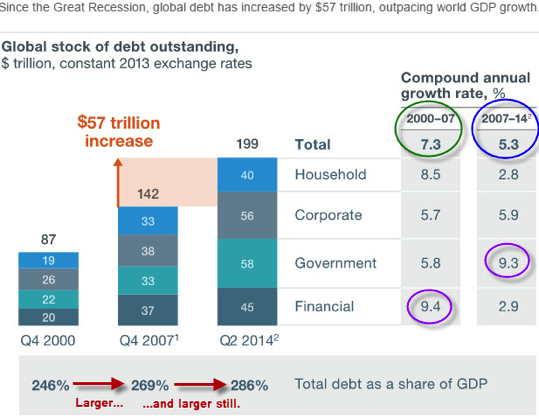
Lesson not learned!

The chart's global debt number is only larger now, somewhere well north of $200 trillion here in Q1 2016.  But consider, if you will, that entire world had 'only' managed to accumulate $87 trillion in total debt by 2000 (this is just debt, mind you, it does not include the larger amount of unfunded liabilities). Yet governments then managed to pour on an additional $57 trillion just between the end of 2007 and the half way point of 2014, just seven and half short years later. 

Was this a good idea? Or monumental stupidity? We're about to find out.

My vote is on stupidity.

Banks In Trouble

In just the first few weeks of 2016, the prices of many bank stocks have suddenly dropped to deeply distressed territory. And the price of insurance against default on the bonds of those banks is now spiking.

While we don't know exactly what ails these banks -- and, if history is any guide, we probably won't find out until after this next crisis is well underway -- but we can tell from the outside looking in that something is very wrong.

In today's hyper-interconnected world of global banking, if one domino falls, it will topple any number of others. The points of connectivity are so numerous and tangled that literally no human is able to predict with certainty what will happen.  Which is why the action now occurring in the banking sector is beginning to smell like 2008 all over again:

Gundlach Says 'Frightening' Seeing Financial Stocks Below Crisis

Feb 5, 2016

DoubleLine Capital's Jeffrey Gundlach said it's "frightening" to see major financial stockstrading at prices below their financial crisis levels.

He cited Deutsche Bank AG and Credit Suisse Group AG as examples in a talk outlining bearish views at a conference in Beverly Hills, California, on Friday. Both banks fell this week to their lowest levels since the early 1990s in European trading.

"We see the price of major financial stocks, particularly in Europe, which are truly frightening," Gundlach said. "Do you know that Credit Suisse, which is a powerhouse bank, their stock price is lower than it was in the depths of the financial crisis in 2009? Do you know that Deutsche Bank is at a lower price today than it was in 2009 when we were talking about the potential implosion of the entire global banking system?"

(Source)

This time it looks like the trouble is likely to begin in Europe, where we've been tracking the woes of Deutsche Bank (DB) for a while. But in Italy, banks are carrying 18% non-performing loans and an additional double digit percentage of 'marginally performing' or impaired loans. Taken together, these loans represent more than 20% of Italy's GDP, which is hugely problematic.

The Italian banking sector may have upwards of 25% to 30% bad or impaired loans on the books. That means the entire banking sector is kaput. Finis. Insolvent and ready for the restructuring vultures to take over.

On average, in a fractional reserve banking system operating at a 10% reserve ratio, when a bank's bad loans approach its reserve ratio, it's pretty much toast. By 15% that's pretty much a certainty. By 20% you just need to figure out which resolution specialist to call. At 25% or 30%, you probably should pack a bag and skip town in the dead of night.

This handy chart provides some of the context for Europe more broadly. I've highlighted everything from Europe in yellow, showing how the banks there currently top the list of awfulness:

(Source)

The extreme weakness in European financial shares, combined with other factors, is dragging down Europe's stock market dramatically. The decline has now wiped out all of 2015's market gains and has broken convincingly below the neckline (yellow line, below) of a typical "Head & Shoulders" formation: 
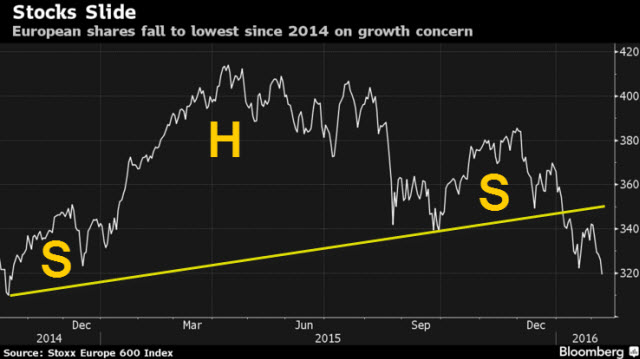
Since the beginning of the year, the stock prices of these select banks are down (as of COB Friday 2/5/16):

  • DB -28.3%
  • Credit Swiss -29.9%
  • MS -22.6%
  • C -22.0%
  • Barclays -21.7%
  • BAC -21.2%
  • UBS -20.3%
  • RBS -19.6%

Those are pretty hefty losses over a short period of time, and that's meaningful. While the headline equity indexes are managing to keep their losses minimized, these bellwether stocks from the critical finance sector are stampeding out the back door.

And when I say 'critical', I mean in the sense that a hefty amount of the overall earnings within the S&P 500 and other major stock indexes were fraudulent profits were derived from the banks feeding on central bank thin-air money and front-running central bank policy.

What's there to worry about? Well, just pick something. It could be a combination of headwinds conspiring to drag down bank earnings from here. Take your pick: reduced trading and M&A revenue, and lower profits from ridiculously flat yield curves and negative interest rates.

However, we have to include the possibility that No more bailouts are coming. Why not? Mainly because it would be politically incendiary at this moment to even try such a thing. Public resentment of the banks is high all over the world, and in the US specifically, there's an election primary that is hinging for the Democrats on Wall Street coziness. Maybe the markets are pricing that in? 

Please continue reading from: 
http://www.peakprosperity.com/blog/96701/return-crisis

Feb 15, 2016

More than 5.5 million people worldwide are dying prematurely every year as a result of air pollution, according to new research.

World War II was the deadliest military conflict in history in absolute terms of total dead. Over 60 million people were killed. The 5.5 million premature deaths from air pollution means over 60 million die prematurely every 11 years.

Allowing global air pollution to continue at current levels is like allowing a world war to continue uncontested against the global population and economy. There is also additional economic costs in the trillions.

Airborne pollution doesn't necessarily (or even often) stay in the country of origin. About one third of China's air pollution is carried to other countries like Japan and even crosses over to North America.

China's (in particular) prodigious output of airborne nano-pollution is the chief factor which has lead to Arctic ice-cover loss. 

Soot pollution (i.e. dark stuff) reduces albedo. Which necessarily increases solar absorption. Which deposits more joules to the surface. Which MELTS ice faster. This effect is currently estimated to be about as large as any carbon dioxide effect for overall global climate warming. This effect may be larger for ice melting.

Sulfur Dioxide (smog) condenses in atmosphere (with help from ultraviolet) to sulfur trioxide aerosols. These bright white aerosols stay aloft for years, and act as a mutual reflective blanket: reflecting a small amount of sunlight outward (nominally cooling.) but retaining a higher fraction of infrared ground emissions (blanketing, warming), which impacts the outflow of infrared, which is what normally powers the consolidation of sea ice. 

Most of these deaths are occurring in the rapidly developing economies of China and India.

The main culprit is the emission of small particles from power plants, factories, vehicle exhausts and from the burning of coal and wood.

The data was compiled as part of the Global Burden of Disease project.

"Air pollution is the fourth highest risk factor for death globally and by far the leading environmental risk factor for disease," said Michael Brauer, a professor at the University of British Columbia's School of Population and Public Health in Vancouver, Canada. "Reducing air pollution is an incredibly efficient way to improve the health of a population."


Analysis shows that the two countries account for 55 per cent of the deaths caused by air pollution worldwide. About 1.6 million people died of air pollution in China and 1.4 million died in India in 2013.

In China, burning coal is the biggest contributor to poor air quality. Qiao Ma, a PhD student at the School of Environment, Tsinghua University in Beijing, China, found that outdoor air pollution from coal alone caused an estimated 366,000 deaths in China in 2013.


The expected number of premature deaths in China in the future if the country meets its current targets to restrict coal combustion and emissions through a combination of energy policies and pollution controls. She found that air pollution will cause anywhere from 990,000 to 1.3 million premature deaths in 2030 unless even more ambitious targets are introduced.

Read more »from Next Big Future

Feb 12, 2016

Boeing Installs World's Largest 'Reversible' Renewable Energy Storage System

Boeing announced that it has installed a first-of-its-kind 50MW Solid Oxide Fuel Cell (SOFC) system on a naval base in Port Hueneme, Calif. The fuel cell system, which can scale to 400KW, is unique in that it uses solar power to generate hydrogen gas from seawater, which it then stores until power and it releases the gas into a fuel cell stack to produce electricity, heat and water. Because the system can both store energy and produce electricity, Boeing is calling the fuel cell system "reversible." The Navy's Engineering and Expeditionary Warfare Center is testing the fuel cell system on a microgrid to determine its viability for use at both remote bases and during overseas military missions.

Read more of this story at Slashdot.

Feb 11, 2016

Argentine and Brazilian doctors suspect mosquito insecticide as cause of microcephaly

With the proposed connection between the Zika virus and Brazil's outbreak of microcephaly in new born babies looking increasingly tenuous, Latin American doctors are proposing another possible cause: Pyriproxyfen, a pesticide used in Brazil since 2014 to arrest the development of mosquito larvae in drinking water tanks. 

Might the 'cure' in fact be the poison?
Malformations detected in thousands of children from pregnant women living in areas where the Brazilian state added Pyriproxyfen to drinking water are not a coincidence, even though the Ministry of Health places direct blame on the Zika virus.

The World Health Organization view that the microcephaly outbreak in Brazil's impoverished northeast is caused by the Zika virus has, so far, received few challenges.

Brazil's Health Minister, Marcelo Castro, has gone so far as to say that he has "100% certainty" that there is a link between Zika and microcephaly, a birth defect in which babies are born with small heads.

The view is widely supported in the medical community worldwide, including by the US's influential Center for Disease Control. But there is no hard evidence of the link, rather a mixture of epidemiological indications and circumstantial evidence.

One of the key scientific papers, by A S Oliveira Melo et al in the journal Ultrasound in Obstetrics & Gynecology, found Zika virus in the amniotic fluids and other tissues of the affected babies and their mothers. But only two women were examined, far too small a number to establish a statistically significant link.

The New York Times also reported on 3rd February on the outcome of analyses by Brazil's Health Ministry: "Of the cases examined so far, 404 have been confirmed as having microcephaly. Only 17 of them tested positive for the Zika virus. But the government and many researchers say that number may be largely irrelevant, because their tests would find the presence of the virus in only a tiny percentage of cases."

And last weekend, the most powerful indicator yet that the microcephaly may have another cause altogether was announced by Colombia's president, Juan Manuel Santos, as reported by the Washington Post. Colombian public health officials, stated Santos, have so far diagnosed 3,177 pregnant women with the Zika virus- but in no case had microcephaly been observed in the foetus.

Read full at: Argentine doctors: it's the insecticide

Obama Budget Would Add Another $9.3 Trillion to the Debt

President Barack Obama presented a budget to Congress on Tuesday that if enacted would add nearly $10 trillion to the national debt, according to the White House's projections.

The president's final budget, widely considered to be dead on arrival due to the Republican-controlled Congress, projects the nation would face a $27.4 trillion debt in 2026.

The budget set the actual total debt for 2015 at $18.1 trillion, projecting an increase of $9.3 trillion. When President Obama took office the debt stood at $10.6 trillion.

Feb 9, 2016

World's largest solar plant goes live; will provide power for 1.1M people

ComputerworldThe world's largest solar power plant, now live in Morocco, will eventually provide 1.1 million people with power and cut carbon emissions by 760,000 tons a year.

The $9 billion Noor Concentrated Solar Power (CSP) plant could eventually start exporting energy to the European market.

The Noor Concentrated Solar Power (CSP), paid for with funds approved by The World Bank, is located in the Souss-Massa-Drâa area in Morocco, about 6 miles from Ouarzazate town. It began operation on Thursday. While the World Bank and other development partners provided financial support, the Noor solar plant is a wholly Moroccan project.

To read this article in full or to leave a comment, please click here

Starcore Nuclear high temperature gas reactor and Northern nuclear pebble bed

Next Big FutureCanada has several projects for small modular nuclear reactors (SMRs) and very small modular nuclear reactors (VSMRs). VSMRs are typically of capacity below 15 MW while SMRs are usually up to 300 MW.

Remote communities, mining and oil/gas production sites, and government facilities are the three most likely customers of remotely-deployed VSMRs.

Canada has over 200,000 people in over 200 remote communities and 80% of energy comes from diesel powered generators, he said. "It's getting increasingly difficult year by year to bring [diesel] in," Humphries said.

The ice roads of northern Canada are crucial supply routes for providing fuel and resources to remote communities and mining operations in the winter.

The ice roads were late to freeze this winter and some reports suggested climate change was having an impact on the seasonal cycle. Other fuel transport measures include road train, special flights and ice breaker ships.

"You're talking up to C$2/kWh [to supply electricity] in those regions," Humphries said.

Many nuclear vendors are targeting initial Levelised Cost of Energy (LCOE) in the range of C$0.30-0.40/kWh with a long-term goal of reducing costs to a level that would compete economically with the cost of power in an urban area, Humphries added.

StarCore Nuclear is developing a 30 MWe high temperature gas nuclear reactor. It is safe, reliable and operated remotely. This makes it ideal for two types of frontier customers in Canada – mines and villages. These customers currently rely on diesel generation and propane, which are expensive and increasingly unreliable due to shrinking ice road capacity. Starcore has identified two dozen mines where they can offer electricity and heat at prices well below the mine's alternative cost and still be highly profitable. Villages are currently heavily subsidized by governments and utilities. For the larger villages, or those near mines, we can offer retail customers electricity at attractive prices, enable community development, substantially reduce the subsidies, and earn strong profits.

Beyond Canada, there are 1.3 billion people worldwide who have no access to electricity, and another billion relying on expensive diesel generation. Using the experience gained in Canada, we will offer affordable electricity and clean water to customers in this huge market, significantly improving their living standards and health, while earning attractive profits.


LEADIR-PS100

This is a new design from Northern Nuclear Industries in Canada, combining a number of features in unique combination. The 100 MWt, 36 MWe reactor has a graphite moderator, TRISO fuel in pebbles, lead (Pb-208) as primary coolant, all as integral pool-type arrangement at near atmospheric pressure. It delivers steam at 370°C, and is also envisaged as an industrial heat plant. The fuel pebbles are in four cells, each with graphite reflectors, and capacity can be increased by adding cells. Shutdown rods are similar to those in CANDU reactors. Passive decay heat removal is by air convection. The company present it as a Gen IV design

Read more »

China's experimental fusion reactor maintains superheated hydrogen plasma for 102 seconds

China's Experimental Advanced Superconducting Tokamak reactor

GizmagA bit of friendly competition never hurt anyone. China's EAST tokamak and Germany's Wendelstein 7-X aren't exactly fusion energy's answer to Messi and Ronaldo, but through their own flashes of individual brilliance the reactors might one day command the world's attention in a much more important way. Wendelstein 7-X made headlines last week after generating a quarter-of-a-second pulse of hydrogen plasma, and now scientists at China's Institute of Physical Science have flexed their fusion muscle to sustain the gas for an impressive 102 seconds.

.. Continue Reading China's experimental fusion reactor maintains superheated hydrogen plasma for 102 seconds 
Related Articles:

Feb 8, 2016

Pope Francis, Environmental Anthropologist...our responsibilities to each other and the natural world that we share.

Abstract:  In June 2015, after much anticipation and a few leaks, Pope Francis released his encyclical entitled "Laudato Si': On Care for Our Common Home." "Laudato si'" means "praise be to you," a phrase that appears repeatedly in Saint Francis' Canticle of the Sun poem. The encyclical itself has been widely praised and widely reported, far more than one would expect from an explicitly religious document. The encyclical is breathtakingly ambitious. Much of it is addressed to "every person living on this planet," while specific parts speak to Catholics and others to religious believers generally. It surveys a sweeping range of environmental and social problems. Along the way, it relies on anthropology, theology, science, economic, politics, law, and numerous other disciplines. 
 
Especially anthropology. The popular response often described Laudato Si' as a "climate change" encyclical. It's not: only five of the 180 pages specifically address climate change, about the same as the discussion of the noise and ugliness, crime, housing, and transportation that affect the "ecology of daily life." It is not really even an environmental encyclical, for the natural environment does not play the starring role. Rather, it is an encyclical about us. Francis contends that the natural environment suffers because we misunderstand humanity.
 
This Article examines the encyclical from the perspective of Christian environmental thought more generally. It begins by outlining the development of such thought, and then it turns to the contributions of the encyclical with respect to environmental anthropology, environmental connectedness, environmental morality, and environmental governance. As the article explains, Pope Francis is a powerful advocate for a Christian environmental morality but a less convincing advocate for specific regulatory reforms. His greatest contribution is to encourage more people, religious believers and non-believers alike, to engage in a respectful dialogue about how we can better fulfill our responsibilities to each other and the natural world that we share.

Notre Dame Legal Studies Paper No. 1526 

John Copeland Nagle 
Notre Dame Law School

Research says BPA replacement in plastics not safer

The BPA-free trend started after studies found a link between bisphenol A (BPA) and health issues such as early puberty and prostate cancers. After that, products with bisphenol S (BPS) started cropping up as a safer alternative. But now a UCLA-led study suggests that BPS can be just as harmful as BPA, causing faster embryonic development and disruption of the reproductive system in animals.

Gizmag.. Continue Reading Research says BPA replacement in plastics not safer 

Feb 6, 2016

EU-US Privacy Shield Agreement Announced

Michael Best & Friedrich LLP | Newsroom |

On February 2, 2016, the United States and European Union Commission announced the EU-US Privacy Shield Agreement. The Agreement will govern regulation of data flows between the United States and the European Union (EU) and, as one of the EU Commissioners stated, the agreement addresses concerns by EU members regarding use of European citizens' data and personal information by U.S. companies and the U.S. government. 


The full text of the Agreement will not be released for a number of weeks, but the dual announcements highlight the Agreement's major points:


  • The Agreement will impose strong requirements on U.S. companies with respect to the collection and use of personal data.
  • The limitations and oversight requirements will also be imposed on collection and use of Europeans' personal information and data by the United States government.
  • Aggrieved Europeans will have a number of affordable and accessible dispute resolution options.


While awaiting the specifics of the Agreement, a consensus has emerged that companies might still be able to rely on the EU Model Clauses and Binding Corporate Rules for data transfers, but whether those protocols survive after the terms of the Agreement are released remains to be seen. Companies relying on the U.S. Safe Harbor provisions may face enforcement action since that scheme was invalidated by the Court of Justice of the European Union in the Schrems decision late last year.


Feb 4, 2016

Nuclear fusion device's 1st test with hydrogen declared a success - CBC News

Scientists in Germany flipped the switch Wednesday on an experiment they hope will advance the quest for nuclear fusion, considered a clean and safe form of nuclear power.

Following nine years of construction and testing, researchers at the Max Planck Institute for Plasma Physics in Greifswald injected a tiny amount of hydrogen into a doughnut-shaped device — then zapped it with the equivalent of 6,000 microwave ovens.

Germany Nuclear FusionGerman Chancellor Angela Merkel , center, who holds a doctorate in physics, personally pressed the button at Wednesday's launch of an experiment they hope will advance the quest for nuclear fusion, considered a clean and safe form of nuclear power. (Bernd Wuestneck/dpa via Associated Press)

The resulting super-hot gas, known as plasma, lasted just a fraction of a second before cooling down again, long enough for scientists to confidently declare the start of their experiment a success.

"Everything went well today," said Robert Wolf, a senior scientist involved with the project. "With a system as complex as this you have to make sure everything works perfectly and there's always a risk."

Among the difficulties is how to cool the complex arrangement of magnets required to keep the plasma floating inside the device, Wolf said. Scientists looked closely at the hiccups experienced during the start-up of the Large Hadron Collider in Switzerland more than five years ago to avoid similar mistakes, he said.

World-wide effort

The experiment in Greifswald is part of a world-wide effort to harness nuclear fusion, a process in which atoms join at extremely high temperatures and release large amounts of energy that's similar to what occurs inside the sun.

Advocates acknowledge that the technology is probably many decades away, but argue that — once achieved — it could replace fossil fuels and conventional nuclear fission reactors.

Construction has already begun in southern France on ITER, a huge international research reactor that uses a strong electric current to trap plasma inside a doughnut-shaped device long enough for fusion to take place. The device, known as a tokamak, was conceived by Soviet physicists in the 1950s and is considered fairly easy to build, but extremely difficult to operate.

The team in Greifswald, a port city on Germany's Baltic coast, is focused on a rival technology invented by the American physicist Lyman Spitzer in 1950. Called a stellarator, the device has the same doughnut shape as a tokamak but uses a complicated system of magnetic coils instead of a current to achieve the same result.


Please continue reading from: 

Feb 2, 2016

CDC: 4 out of 5 Americans prescribed antibiotics each year - CBS News

Via: CBS:

Skyrocking rates of antibiotic prescriptions now suggest that as many as four out of five Americans may be getting antibiotics annually, according to a new study by the Centers for Disease Control and Prevention.

It's is concerning officials, especially because overuse is one reason antibiotics are losing their punch and making infections harder to treat.

The report released Wednesday gives the first detailed look at usage of these medicines in every state and finds it highest in the South and Appalachia. West Virginia had the highest rates at 1.237 prescriptions per person, followed by Kentucky at 1.232 and Tennessee at 1.199. The lowest rates were found in California (0.6 per person), Oregon (0.595) and Alaska (0.529).


GE turns out the lights on CFLs

GE will cease production of CFLs (left) in favor of LEDs (right)

Compact fluorescent lamps (CFLs) that could fit into standard light sockets only hit the market in the 1980s, but the signs are their days may be numbered. GE has announced it will cease production of CFLs this year and instead switch its focus to producing LEDs.

.. Continue Reading GE turns out the lights on CFLs 
// Gizmag