How will sustainability professionals change the world? With these sorts of initiatives: Integrating sustainability in any size entity; Community sustainability initiatives; Corporate responses to climate adaptation and eco-system services; Green architecture; Integrated reporting, Driving sustainability through industry collaboration. You too can learn how at the ISSP Chicago 2013 Conference. ISSP is hosting its next face-to-face summit of ISSP members and other sustainability professionals from May 8--10, 2013 at the Millennium Knickerbocker Hotel in Chicago, Illinois. Speakers from GRI, Alaska Airlines, The Nature Conservancy, Presidio Graduate School and other top flight organizations will address conference attendees.
View more information on this Conference:
at International Society of Sustainability Professionals (ISSP) 2013 Conference
Apr 25, 2013
Are you Farm Smart? Farm Smart provides dairy producers with their farm's environmental footprint. #green #farming
Farm Smart 1.5 provides dairy producers with their farm's environmental footprint.
It also allows them to compare energy use, greenhouse gas (GHG) emissions and water use against regional and national averages compiled by the U.S. dairy industry's Comprehensive Life Cycle Assessment for Fluid Milk.
View more information on this resource:
http://www.usdairy.com/farmsmart/Pages/Home.aspx
It also allows them to compare energy use, greenhouse gas (GHG) emissions and water use against regional and national averages compiled by the U.S. dairy industry's Comprehensive Life Cycle Assessment for Fluid Milk.
View more information on this resource:
http://www.usdairy.com/farmsmart/Pages/Home.aspx

Tracking YOUR companies "chemical footprint" of the 61 million registered chemicals #nontoxic #green
What is your company's chemical footprint?
You may think this question does not apply to your organization because it doesn't use chemicals. Yet all products are made from chemicals. Chemicals are the building blocks of matter, which is what we make products from. Thus all companies use chemicals by virtue of the products they purchase, use and sell. Buildings are also part of the "products" that organizations buy, from the shell to the interior components, such as flooring, wall coverings and chairs.
Concerns about chemicals in products and supply chains are increasingly capturing the attention of business leaders as exemplified by three of GreenBiz's Top 12 stories in 2012:
• No. 1: "McDonald's launches pilot program to drop polystyrene coffee cups"
• No. 5: "Will the Plastics Industry Kill LEED?"
• No. 10: "How Toxic is the iPhone 5?"
This growing concern with chemicals underscores the need for a metric -- a "chemical footprint" -- that will enable businesses to evaluate chemicals just as they evaluate their water, carbon, energy and waste footprints.
Chemical footprinting is in its infancy. Richard Liroff's pioneering work on chemical footprinting at GreenBiz has highlighted the need for companies to know the chemicals in their products, to assess the hazards of those chemicals and to work with suppliers to avoid toxic chemicals and select safer alternatives.
Read on at:
http://www.greenbiz.com/blog/2013/04/19/why-every-company-has-chemical-footprint
Another death that could have been avoided if safety standards were observed #WACO #OHS #OSHA #SAFETY
Authorities with the Jefferson County Sheriff's Office said they aren't pursuing criminal charges in a Monday accident that killed a worker near China, Texas. Sheriff's office spokesman Deputy Rod Carroll said the identity of... read on at:

Haase Comment:
RE: "Another death that could have been avoided if all involved observed the applicable safety standards." I cross posted link on EHS News network.
If there is anything positive we can learn from Boston/WACO, is that we should be diligent in protecting human life and bringing those who want to harm others to justice.
And in times of major incidents many people feel scared and helpless that there is nothing they can do to prevent or protect others from harm.
We often forget that "Every day in America, 12 people go to work & never come home" and "10'000s around the world die in preventable occupational deaths everyday".
It is important that everyone knows that they can always help prevent and protect others by simply discussing basic occupational health/life safety programs and where to find help.
Farms, schools, stores, churches and small businesses … wherever there are people who care to help, there should be a discussion of how they can.
Thanks for sharing this John.
It is appreciated.
-Chris

Fukushima Nuclear Plant Cleanup May Take More Than 40 Years
'A U.N. nuclear watchdog team said Japan may needlonger than the projected 40 years to decommission the Fukushima power plant and urged Tepco to improve stability at the facility. The head of the International Atomic Energy Agency team, Juan Carlos Lentijo, said Monday that damage at the nuclear plant is so complex that it is impossible to predict how long the cleanup may last.' Meanwhile, Gregory B. Jaczko, former Chair of the Nuclear Regulatory Commission has said that all 104 nuclear power reactors now in operation in the United States have a safety problem that cannot be fixed and they should be replaced with newer technology.
Read more of this story at Slashdot.
Tweet From Hacked AP Account Causes High Freq. Traders To Drop DOW 150 Points
Stocks plunged and recovered within minutes after thehacked AP Twitter account sent out a tweet that indicated that the White House had been the victim of an explosion and that President Obama had been injured. '...the Dow Jones Industrial Average took a quick 143-point plunge, before recovering most of its losses within minutes. The three-minute plunge triggered by the tweet briefly wiped out $136.5 billion of the S&P 500 index's value, according to Reuters data. Interestingly, Tuesday has been the best day of the week for the blue-chip this year with an average return of 0.46 percent. If the index closes in the black today, it will have been up for the 15th consecutive Tuesday. The last time the Dow rose for 15 straight Tuesdays was in 1927.' An analyst said, 'That goes to show you how algorithms read headlines and create these automatic orders – you don't even have time to react as a human being.'
Read more of this story at Slashdot.
Apr 24, 2013
Switchgrass #Biomass pellets for #Renewable Home Heating = More energy and Cost Savings
EP Online: USDA scientists have been studying the use of switchgrass pellets for heating purposes. According to their research, the pellets could potentially become a cheaper energy source to replace fuel oil used to heat homes and businesses in the Northeast.
Paul Adler, a researcher for the USDA's lab, the Agricultural Research Service (ARS) let the studies on a lifecycle analysis that compared the cost of energy consumption from fuel oil, natural gas, coal, and switchgrass in the form of energy-dense cubes, briquettes, and pellets.
Analysis indicated that 192 pounds of "carbon dioxide equivalent," or CO2e, was emitted for every ton of switchgrass dry matter that was sown, harvested, and delivered to densification plants for processing into pellets. CO2e is a measurement used to compare the emissions from various greenhouse gases based on their global warming potential.
The researchers calculated that using switchgrass pellets instead of petroleum fuel oil to generate one gigajoule of heat in residences would reduce greenhouse gas emissions by 146 pounds of CO2e. Totaling all costs associated with installing an appropriate residential heating system and fuel consumption, the team concluded that each gigajoule of heat produced using switchgrass pellets would cost $21.36. Using fuel oil to produce the same amount of heat would cost $28.22.
For more information, please click here.
Haase Note:This is a important topic that should be revisited annual for cost feasibility Here is a nice home study with a quality heater: http://forages.org/bioenergy/page.php?pid=177
Study shows 22% increase in natural gas reserves #NatGas #Energy
The Potential Gas Agency, headquartered at the Colorado School of Mines, has issued its latest biennial analysis of national natural gas reserves.
The report quantifies probable, possible and speculative resources for both traditional gas resources and coalbed gas resources, and identifies nearly 2,400 trillion cubic feet of potential resources, together with more than 304 trillion cubic feet of proven reserves. Overall, from 2010 to 2012, the identified potential resources increased by more than 25 percent, and the total, including proven reserves, increased by more than 22 percent.
See Potential Gas Committee News Release:
EIA carbon dioxide emissions in the United States lowest they have been since 1994 #Green #Globalwarming
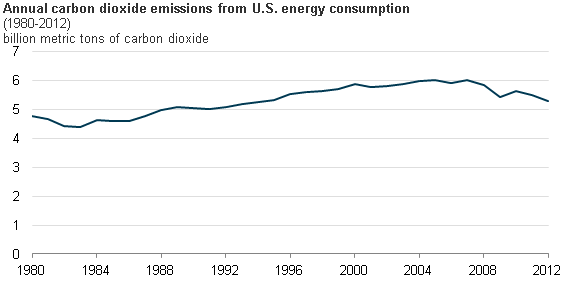
According to a U.S. Energy Information Administration (EIA) report, total energy-related carbon dioxide emissions in the United States in 2012 were the lowest they have been since 1994, at 5.3 billion metric tons. The report also noted that since 2007, carbon dioxide emissions in the United States have fallen every year except in 2010.
Energy-related carbon dioxide emissions declined in 2012
Source: U.S. Energy Information Administration, Monthly Energy Review
Download CSV Data
Download CSV Data
Energy-related carbon dioxide (CO2) emissions in 2012 were the lowest in the United States since 1994, at 5.3 billion metric tons of CO2 (see figure above). With the exception of 2010, emissions have declined every year since 2007.
Please read full at: http://www.eia.gov/todayinenergy/detail.cfm?id=10691
MAKING LIFE WORK FOR AMERICAN FAMILIES via @herrerabeutler - Cut the fat, not services to military families, airports or security at parks.
Below is a speech in Congress by Rep. Jaime Herrera Beutler (R-WA), on Apr 23, 2013
"I think this is one of the challenges we're facing is all Americans are looking at Congress saying why is it that we're sending all this money to Washington, D.C. Why are we having to live within our means and the Federal Government doesn't. In fact, what they see is the Federal Government cutting direct services, whether it's to military families, whether it's services in airports, whether it's security at parks. They're not cutting fat.
See, this is what's frustrating to me; the IRS operates a 24/7 satellite TV studio in their building. Across the street from the IRS, the EPA operates its own 24/7 satellite studio to the tune of $4 million a year. Rather than maybe combine those two or share that one studio and save the taxpayer dollars, it seems like the administration is cutting those services that Americans expect and have already paid for. It's really time that the Federal Government learn to live within its means because it's going to help us grow jobs."
MAKE IT IN AMERICA: MANUFACTURING MATTERS from @RepGaramendi - Repair our nations sanitation & drinking systems while getting 10,000's back to work
John Garamendi, D-CA
"The American Public Works Association--these are people with the sanitation systems, the water systems and the like--estimate that 25 percent of all of the fresh-treated water in our municipal water systems is lost to leakage, and they estimate, together with the EPA, that we need to spend over $300 billion immediately to deal with sanitation systems in the United States that are inadequate and $335 billion in drinking water so that we have clean, available drinking water.
One more point here: for every billion dollars we spend, you put 28,000 people to work immediately. Those are the engineers, the draftsmen, the architects, the men and women who are operating the equipment, who are back-filling the ditches, laying the pipe. And if we use another strategy that we've developed on the Democratic side called Make It in America--if you use our taxpayer money to buy American-made equipment--then in your district, the steel mills begin once again to produce American-made steel, and all of the pipe and other equipment that's needed can be produced in America, using our money."
Read on by:
Trash Reduction Act of 2013 speech by @Jim_Moran stop using 12 million barrels of oil to make plastic bags #green
Mr. Speaker, our 315 million American citizens throw away nearly 496 billion pounds of trash each year, a staggering amount by any analysis. And a sizable contribution is from disposable items, including plastic and paper bags. That's why today, one day after Earth Day, I am introducing the ``Trash Reduction Act of 2013'' along with my colleagues Representatives Eleanor Holmes Norton, Earl Blumenauer and John Garamendi.
The legislation is modeled after the District of Columbia's ``bag tax.'' Five cents would be levied on each disposable paper or plastic bag. Revenue from the tax would support the Land and Water Conservation Fund.
Just how bad is the trash problem? According to the U.S. EPA, the average American throws away about 4.4 pounds of trash each day or 1,600 pounds per year. That's nearly 248 million tons of American garbage each year. To put that in perspective, it's enough trash to fill a football-field-sized hole over 93 miles deep. Or create a similar-sized stack of garbage that reaches low earth orbit. This amount of trash could cover the state of Texas two and a half times or fill enough trash trucks to form a line to the moon.
We consume an estimated 12 million barrels of oil and copious amounts of natural gas annually to make plastic bags that are used once or twice, then tossed into the garbage. The U.S. International Trade Commission reported in 2009 that 102 billion plastic bags were used in the U.S. Much of the oil and natural gas used in those bags comes from foreign countries and it's all non-renewable. Once it's used for plastic bags and thrown away, that energy is gone forever.
Disposable paper bags are no better. In 1999, 14 million trees were cut to produce the 10 billion paper grocery bags used by Americans that year alone. Paper and paperboard products made up 28.5 percent of the municipal waste discarded in 2010--more than any other type of refuse measured by tonnage. According to the Environmental Paper Network, the pulp and paper industry is the fourth largest emitter of greenhouse gases among manufacturing industries, contributing 9 percent of total manufacturing-related carbon dioxide emissions. Most of energy use comes from powering paper mills.
There is no doubt that disposable retail plastic and paper bags are bad for the environment. Both paper and plastic bags consume valuable natural resources, generate profuse waste, and pollute the environment. They keep us dependent on nonrenewable resources like foreign oil and impose burdens that Americans bear in the form of higher garbage costs, visual blight, and the destruction of wildlife. Millions of animals are entangled in or ingest plastic waste. That same waste leaches toxins into the ground and our drinking water.
While recycling efforts should be applauded, recycling rates are dismally low. Only between one and three percent of all plastic bags are recycled, with a slightly higher ten to 15 percent paper-bag-recycling rate. Plus, the recycling process uses energy, water, and generates additional greenhouse gasses.
But we can do something about this gargantuan garbage nightmare. We can reduce the number of bags we use with market-based incentives. Requiring shoppers to internalize the costs of disposable bags has been shown to dramatically reduce their use and substantially increase reusable bag utilization. For example, after placing a fee on plastic bags, Ireland reportedly reduced consumption by 90 percent. China, after banning the use of ultra-thin plastic bags, is estimated to have eliminated 40 billion bags in the first year.
Critics have called this a regressive tax that falls on poor communities. This is simply untrue. Wealthy Americans consume substantially more resources and disposable shopping bags than the poor. Additionally, Americans of all incomes can purchase or be given a reusable bag and avoid this fee altogether. Plus, this fee is good for business. Business will be able to recoup their investment of time and effort through a tax credit and profits from reusable bag sales.
One need look no further than the District of Columbia to measure success. In 2009 the District imposed a five-cent tax on plastic bags that led to spectacular reductions in disposable bag use. The number of plastic bags dropped from the 2009 monthly average of 22.5 million to just 3 million per month by the end of 2010. River cleanup volunteers reported over a 60 percent decrease in the volume of plastic bags they collected during cleanup activities--and this was only three months after the fee took effect.
D.C. businesses approve of the fee as well. 78 percent of businesses interviewed report either a positive or neutral impact on their business. People keep shopping and keep buying. 58 percent of D.C. business owners say the law has not affected their sales. And it's those dire predictions of falling sales that were used to scare business owners into opposing the fee. It's one of the many false predictions of bag-fee opponents like the American Chemistry Council.
The public and many elected officials are not always in sync with what we need to do to improve this great country. High-pressure lobbying by powerful chemical interests sometimes stops us from doing what's right. While we can be proud of our environmental achievements and landmark laws, we need to do more to reduce our mountains of trash madness. Nothing is more fitting for this year's Earth Day celebration than helping reduce garbage.
This small disposable bag charge helps people understand that paper and plastic bags are not without cost. They impact the environment, support foreign dictators, and make Everest's of trash. Our bill begins to shift America away from its current disposable culture back to a simpler time when Americans understood the value of reusing what they bought.
Free Webinar Series: A Look at The @HomeDepot ’s Most #Energy Efficient Store via @energy #Renewable #News
Commercial Building Partnership Success Story Webinar Series: A Look at The Home Depot's Most Energy Efficient Store
The U.S. Department of Energy (DOE) partnered with The Home Depot, one of America's largest home improvement retailers, to develop and implement solutions to build new, low-energy buildings that are at least 50% below Standard 90.1-2007. The effort was part of the Commercial Building Partnerships (CBP) initiative, a DOE initiative that accelerates the transformation of America's energy landscape by demonstrating innovative low-energy technologies and strategies in commercial buildings.
DOE is hosting a webinar outlining CPD's work with The Home Depot, focusing on a specific store in Lodi, California. This is the first Home Depot store built using a new prototype design and is the most energy efficient Home Depot store in the country. DOE hopes that interested parties that attend the webinar will gain a clear understanding of the results of successfully implemented energy savings project, how the featured project met its energy savings goals, unique features of the case study, and how these strategies can be replicated in other projects.
Webinar information
- Title: Commercial Building Partnership Success Story Webinar Series: A Look at The Home Depot's Most Energy Efficient Store
- Date: Thursday, May 9, 2013
- Time: 2:00pm-3:00pm EST
- Registration: https://www1.gotomeeting.com/register/483085801
The first 30 minutes of the webinar will be reserved for the presentation, and the remaining 30 minutes are allotted for a Q&A discussion.
Air Quality Implementation Plans for Wisconsin; Vehicle Inspection & Maintenance Program; proposing to approve revisions submitted by @WDNR
Apr 24, 2013 — Pre-release — Proposed Rule — Environmental Protection Agency
Environmental Protection Agency Proposed Rule filed for public inspection on Apr 24, 2013
Part 52 [EPA-R05-OAR-2012-0465; FRL-9805-6] Approval and Promulgation of Air Quality Implementation Plans; Wisconsin; Amendments to Vehicle Inspection and Maintenance Program for Wisconsin.
AGENCY: Environmental Protection Agency (EPA).
ACTION: Proposed rule.
SUMMARY: EPA is proposing to approve a state implementation plan (SIP) revision submitted by the Wisconsin Department of Natural Resources (WDNR) on June 7, 2012, concerning the State's vehicle inspection and maintenance (I/M) program in southeast Wisconsin. The revision amends I/M program requirements in the active control measures portion of the ozone SIP to reflect changes that have been implemented at the state level since EPA fully approved the I/M program on August 16, 2001. The submittal also includes a demonstration under section 110(l) of the Clean Air Act (CAA) addressing lost emission reductions associated with the program changes.
See full Pre-release of Proposed Rule Here:
Necco faces $133G fine for OSHA violations at Revere plant in connection with the release of 8,000 pounds of ammonia
The New England Confectionery Company Inc. has been cited for 19 alleged serious violations of workplace health and safety standards at its Revere, Mass. production plant. It faces proposed penalties of $133,000 in connection with the release of 8,000 pounds of ammonia from the plant's refrigeration system in October of last year.
Go to the Full Story at Boston Herald:
Workplace safety in 1911, N.Y.C. vs now in West, Texas “Every day in America, 12 people go to work & never come home" #OHS
The horrifying explosion at a fertilizer plant in West, Texas is a painful reminder that workplace safety is a crucial part of public health. As former U.S. Labor Secretary Hilda Solis noted in a Memorial Day speech in 2012 "Every day in America, 12 people go to work and never come home. Every year in America, nearly 4 million people suffer a workplace injury from which some may never recover. These are preventable tragedies that disable our workers, devastate our families, and damage our economy."
In 1911, a fire at the Triangle Waist Factory in New York City, took the lives of 146 people in a mere 18 minutes, a horrific tragedy that is documented in news reports, survivor interviews, photos and documents compiled by Cornell University.. The victims suffocated or burned inside or jumped to their deaths to escape the flames. "They hit the pavement like rain" recalled a fire chief. In the wake of this tragedy, New York State created a Factory Investigating Commission. The owners of the factory were charged in criminal court. The full transcript of the trial is here. But rather than read it, why not listen to poet Robert Pinsky read his moving poem about the fire, "Shirt."
Please read more from Janet Golden, a Rutgers University history professor, specializes in the histories of medicine, childhood and women at:
OSHA seeks $70k fine against Hawthorne Pacific Corp. in Maui crane death, cited for 13 safety violations after #OHS
The U.S. Department of Labor'sOccupational Safety and Health Administration are seeking to fine heavy equipment company Hawthorne Pacific Corp. $70,000 for safety violations following the death last fall of a worker on Maui.
The Associated Press reports Hawthorne Pacific was cited for 13 safety violations after
Read on at: http://www.bizjournals.com/pacific/blog/morning_call/2013/04/osha-seeks-70k-fine-against-hawthorne.html
H.R. 1482, Introduced to amend the Clean Air Act to eliminate certain requirements under the renewable fuel program
RENEWABLE FUEL STANDARD AMENDMENTS ACT
To amend the Clean Air Act to eliminate certain requirements under the renewable fuel program, and for other purposes.
IN THE HOUSE OF REPRESENTATIVES
H.R. 1482, Introduced in House on Apr 10, 2013 by Rep. Steve Womack (R-AR) introduced the following bill; which was referred to the Committee on Energy and Commerce
A BILL
To amend the Clean Air Act to eliminate certain requirements under the renewable fuel program, and for other purposes.
Be it enacted by the Senate and House of Representatives of the United States of America in Congress assembled,
SECTION 1. SHORT TITLE.
This Act may be cited as the "Renewable Fuel Standard Amendments Act".
SEC. 2. AMENDMENTS TO THE CLEAN AIR ACT.
(a) Revised Definition Of Renewable Fuel.—Section 211(o)(1)(J) of the Clean Air Act (42 U.S.C. 7545(o)(1)(J)) is amended to read as follows:
"(J) RENEWABLE FUEL.—The term 'renewable fuel' means fuel that—
"(i) is produced from renewable biomass;
"(ii) is used to replace or reduce the quantity of fossil fuel present in a transportation fuel; and
"(iii) beginning on January 1, 2014, is advanced biofuel.".
S. 696, BILL TO AMEND THE TOXIC SUBSTANCES CONTROL ACT TO ENSURE THAT RISKS FROM CHEMICALS ARE ADEQUATELY UNDERSTOOD AND MANAGED, AND FOR OTHER PURPOSES.
S. 696, Introduced in Senate by Sen. Frank Lautenberg (D-NJ)
Committee on Environment and Public Works.
Full Text Below is a simple rendition of Congress' official bill text here:
1.Short title
This Act may be cited as the Safe Chemicals Act of 2013.
2.Purposes
The purpose of this Act is to ensure that risks from chemicals are adequately understood and managed.
3.Findings,
policy, and goalSection 2 of the Toxic Substances Control Act (15 U.S.C. 2601) is amended—
(1)in the heading, by striking Intent and inserting Goal; and
(2)by striking subsections (a) through (c) and inserting the following:
(a)FindingsCongress finds that—
(1)each year human beings and the environment are exposed to a large number of chemical substances;
(2)the chemical industry, an important part of the United States economy, provides valuable products that are used in diverse manufacturing industries and other commercial, institutional, and consumer applications;
(3)more than 3 decades after the enactment of this Act, people and the environment in the United States are still exposed to thousands of chemicals whose safety has not been adequately reviewed and may harm health and the environment;
(4)the incidence of some diseases and disorders linked to chemical substance exposures is on the rise;
(5)biomonitoring of chemical substances in humans reveals that people in the United States carry hundreds of hazardous chemicals in their bodies;
(6)the concentrations of certain chemical substances that persist and accumulate are increasing in the environment and in human bodies and are found across the world, including in the remote Arctic in which Native Americans face increasing contamination of traditional foods;
(7)differences in metabolism and physiology at certain stages of development can make infants and children more vulnerable than adults to the effects of chemical exposure, especially exposure that occurs in utero, during infancy, and during other critical periods of development;
(8)manufacturers and processors of chemicals should supply sufficient health and environmental information before distributing products in commerce;
(9)the Administrator must have and exercise the authority to develop sufficient information to assess chemical safety, and to act effectively when the Administrator obtains information that indicates there are risks of harmful exposure to chemical substances;
(10)there is significant global trade in the chemical sector and many of the companies that conduct business in the United States must also comply with chemical safety regulatory programs in other countries, and the data that is generated to comply with those other regulatory programs may be useful in understanding hazards and exposures of chemical substances presented in the United States; and
(11)a revised policy on the safety of chemical substances will assist in renewing the manufacturing sector of the United States, create new and safer jobs, spur innovations in green chemistry, restore confidence domestically and internationally in the safety of products of the United States, and ensure that products of the United States remain competitive in the global market.
Read full at:
Viruses From Sewage Contaminate Deep Well Water | via @cenmag
Chemical & Engineering News: Scientists once thought that pathogens could not reach drinking water wells sunk into deep, protected groundwater aquifers. Nevertheless, over the past decade, researchers have identified diarrhea-causing viruses at a handful of deep bedrock well sites in the U.S. and Europe. Now, researchers in Madison, Wis., report where these pathogenic viruses may have originated. The viruses appear to seep from sewer pipes and then swiftly penetrate drinking water wells (Environ. Sci. Technol., DOI: 10.1021/es400509b).
The U.S. Environmental Protection Agency does not regulate the presence of viruses in drinking water, so many public water systems do not routinely test for them. In a 2007 study, a team of researchers, including Mark Borchardt, a microbiologist with the U.S. Department of Agriculture, and Kenneth Bradbury, a hydrogeologist at the University of Wisconsin-Extension, in Madison, investigated the integrity of aquifers confined beneath a thick layer of clay or shale (Environ. Sci. Technol., DOI: 10.1021/es071110+). Groundwater models predicted that surface contaminants would require tens to hundreds of years to reach wells in these aquifers, which typically sit more than 700 feet underground. Even if pathogens did find their way to the groundwater, they should be dead after that amount of time. "But we were shocked to find human-specific viruses—some of which were still infectious—in every well we sampled in Madison," Bradbury says.
Please read full and follow at:
Terrorist Hunt Sends America Over the Edge... Instead we need to refuse terrorism to change our way of life.
John Cassidy, New Yorker - One of those affected was Yaakov Katz, a Jerusalem Post reporter who has covered many terrorist attacks and who is now on sabbatical at Harvard. In an article posted on his newspaper's Web site on Friday titled "What message is the U.S. sending with a Boston lockdown?," Katz contrasted his experience at home with what he was witnessing in Cambridge, Massachusetts.
There was no lockdown in Israel and there was no order by the mayor to seek shelter. Instead, people were out in the streets, filling up coffee shops right next to the one that had been bombed or standing at bus stops waiting for the next bus from the same line that had just exploded. This has always impressed me as a sign of true resilience, of a refusal to allow terrorism to change our way of life."Surrender" is a strong word that suggests a failure of will on the part of the American people at large. The real culprit was a near-hysterical overreaction by the authorities (and by large parts of the media, which virtually stopped covering anything else).
I am not judging the people of Boston and their leaders and yes, there is something to be said about being safe than sorry. But, I wonder about the long-term strategic ramifications and if this won't be viewed as a near-surrender to terrorism.
Please continue reading at:
Texas Explosion Seen as Sign of Weak U.S. Oversight - via @Bloomberg
Bloomberg - The Texas plant that was the scene of a deadly explosion this week was last inspected by the Occupational Safety and Health Administration in 1985. The risk plan it filed with regulators listed no flammable chemicals. And it was cleared to hold many times the ammonium nitrate that was used in the Oklahoma City bombing.
15% More Cancers than Expected in WTC Responders: esp thyroid & soft-tissue #HazMat #Heros
Incidence rates of all cancers -- and some in particular -- were higher among World Trade Center rescue workers than expected, researchers reported.
In an ongoing registry study, incidence rates of all cancers combined were 15% higher than expected (Standardized Incidence Ratio [SIR]: 1.15, 95% CI 1.06 to 1.25), Samara Solan, MD, of the Icahn School of Medicine at Mount Sinai Medical Center in New York, and colleagues reported in Environmental Health Perspectives.
Incidence rates were also higher for thyroid, prostate, hematopoietic/lymphoid, and soft-tissue cancers, they found.
Solan acknowledged in a statement that the "findings of this study, while significant, should be interpreted with caution given the short follow-up and long latency period for most cancers; the intensive medical surveillance of this cohort by Mount Sinai researchers and our partners; and the small numbers of cancers at specific sites.
"However," she added, "our findings strongly highlight the need for continued follow-up and medical surveillance of WTC responders."
Solan and her colleagues analyzed data from their ongoing WTC Health Program, which has enrolled 20,984 workers who were involved in rescue efforts on and after Sept. 11. Overall, 575 cancers were diagnosed in 552 patients.
They found increases in incidence rates for several types of cancers that were higher than expectations:
- All cancer sites combined SIR 1.15, 95% CI 1.06 to 1.25
- Thyroid cancer: SIR 2.39, 95% CI 1.70 to 3.27
- Prostate cancer: SIR 1.21, 95% CI 1.01 to 1.44
- Combined hematopoietic and lymphoid cancers: SIR 1.36, 95% CI 1.07 to 1.71
- Soft tissue cancers: SIR 2.26, 95% CI 1.13 to 4.05
- They also saw positive associations for non-Hodgkin lymphoma and kidney cancer, but those weren't significant.
When the study was restricted to the 302 cancers diagnosed 6 or more months after enrollment, the incidence rates for all cancers combined and for hematopoietic/lymphoid cancers became nonsignificant, falling to SIR 1.06 (95% CI 0.94 to 1.18) and to SIR 0.77 (95% CI 0.49 to 1.16), respectively.
But thyroid and prostate cancer diagnoses still remained greater than expected, they wrote.
Lung cancer incidence rates were significantly lower than expected in both the initial and restricted analyses (SIR 0.89 and SIR 0.62, respectively), but it's not clear why this may be.
The researchers cautioned that the observation about thyroid cancer may be an artifact due to increased medical surveillance, particularly because there was no evidence of Iodine-131 -- which has a strong causal link to thyroid cancer -- at Ground Zero.
Please read full and follow Kristina Fiore, Staff Writer, at MedPage Today:
Apr 23, 2013
EPA Hopes Work Plan Assessments Will Generate Data for More Chemicals
This article is brought to you by Bloomberg BNA.
The Environmental Protection Agency's chemicals office will use the risk assessments it is developing for an initial group of 14 chemicals to evaluate, reduce, and manage risks in these and similar compounds that may already be in commerce or which companies would like to make or import, a senior chemicals official said April 18.
EPA has launched risk assessments on specific uses of 14 chemicals. The 14 are among a larger group of 83 "work plan" chemicals the agency announced in March 2012 it would gradually evaluate, Morris said (36 CRR 269, 3/5/12).
The conundrum of having identified chemicals that may pose a risk coupled with the inability to require manufacturers to provide data needed to determine whether the compounds actually pose a health or environmental risk "points out a gap in our information database about chemicals" and a challenge posed by the limited authorities the agency has under the Toxic Substances Control Act, Morris said.
Similarly, when the agency announces a chemical that is on the market poses a health or environmental concern, it frequently receives premanufacture notices (PMNs) from companies that would like to make or import a new chemical that may be slightly different from the existing one, Morris said.
OPPT hopes the data companies and other interested parties will provide due to the release of draft risk assessments will be helpful in analyzing the PMNs, he said. "Maybe, maybe not."
The agency has scarce exposure data, however, Morris said. EPA is working with the Occupational Safety and Health Administration, with the goal of making the information obtained as a result of the draft risk assessment as useful as possible not only to consumer uses of NMP but also to workplace exposures, he said.
When other committee members said EPA should be able to act on the basis of hazard information combined with market use and other exposure information it can estimate, Morris said "putting forward a [regulatory] case based heavily on hazard and little exposure data has not proved successful."
For more information and the full article please refer to the Bloomberg BNA link above.
Wisconsin @WDNR keep #Earthday going next two weeks!
Most opportunities for Work*Play*Earth Day events over next two Saturdays
MADISON -- The next two Saturdays will offer people the greatest number of opportunities to participate in a Work*Play*Earth Day event as a dozen state park properties hosting the activities.

About 30 people showed up for Mirror Lake State Park's Work*Play*Earth Day event April 13 despite cold rain. Here volunteers painted and assembled picnic chairs.
Photo courtesy of Friends of Mirror Lake State Park
Activities planned this year include planting trees and shrubs, making memorial benches, removing invasive plants, painting picnic tables and other structures, trail repair, raking and cleaning up leaves, picking up litter and getting campgrounds ready for the camping season.
Each work day will run from approximately 9 a.m. to 3 p.m. The schedule may vary slightly at each location. Volunteers should wear work boots or athletic shoes, long pants and bring their own work gloves. Advanced registration is free and encouraged. People can register through the park, forest, trail or recreation area where they would like to volunteer.
When the work is done, volunteers join staff in hiking or biking park trails, visiting nature centers or interpretive displays, or enjoying any of the recreational opportunities available at the different parks. The events are sponsored by the Friends of Wisconsin State Parks and individual friends groups for the properties.
"The weather is supposed to be wonderful this coming weekend and we hope that holds true for the following weekend too," says Patty Loosen, state parks friends group coordinator.
The following park properties will be holding events:
Saturday – April 27
- Harrington Beach State Park - Belgium
- Hartman Creek State Park – Waupaca
- High Cliff State Park – Sherwood
- Kettle Moraine State Forest - Northern Unit - Campbellsport
- Perrot State Park - Trempealeau
- Pike Lake Unit - Kettle Moraine State Forest – Hartford
- Kettle Moraine State Forest - Southern Unit - Eagle
Saturday - May 4
- Devil's Lake State Park - Baraboo
- Roche –A-Cri State Park - Friendship
- Stower Seven Lakes State Trail – Amery
- Whitefish Dunes State Park – Sturgeon Bay
- 400 State Trail - Reedsburg
National Parks Reduce Waste by Nearly 1/3 and Promote Tap Water for #EarthDay
For Earth Day, the National Park Service (NPS) released a status report on its Green Parks Plan. The report found parks have diverted 28 percent of municipal solid waste since 2007 thanks in part to a growing number of parks halting the sale of bottled water.
Parks are celebrating their progress with clean-ups and a "tap water challenge" at the Grand Canyon - a blind taste test for park-goers pitting bottled water against the tap. Volunteers organized additional challenges today at Liberty Bell Center, Golden Gate National Recreation Center, and in Seattle. The challenge helps to educate the public that the tap is more highly regulated than bottled water and far more eco-friendly.
The NPS Branch Chief of Sustainable Operations and Climate Change has noted how parks are forced to deal with the burden of bottled water waste with taxpayer dollars. And prior to phasing out bottled water last year, the Grand Canyon found plastic bottles accounted for 20 percent of its overall waste stream, or more than 500 tons of waste annually in just one of our national parks.
"Eliminating the sale of water in disposable packaging within Grand Canyon National Park is in the best interests of both park resources and park visitors," said Dave Uberuaga, superintendent, Grand Canyon National Park. "Grand Canyon's decision to think outside the bottle has helped clear a trail for fellow parks to follow."
Read on at:
http://eponline.com/articles/2013/04/22/national-parks-reduce-waste.aspx
Parks are celebrating their progress with clean-ups and a "tap water challenge" at the Grand Canyon - a blind taste test for park-goers pitting bottled water against the tap. Volunteers organized additional challenges today at Liberty Bell Center, Golden Gate National Recreation Center, and in Seattle. The challenge helps to educate the public that the tap is more highly regulated than bottled water and far more eco-friendly.
The NPS Branch Chief of Sustainable Operations and Climate Change has noted how parks are forced to deal with the burden of bottled water waste with taxpayer dollars. And prior to phasing out bottled water last year, the Grand Canyon found plastic bottles accounted for 20 percent of its overall waste stream, or more than 500 tons of waste annually in just one of our national parks.
"Eliminating the sale of water in disposable packaging within Grand Canyon National Park is in the best interests of both park resources and park visitors," said Dave Uberuaga, superintendent, Grand Canyon National Park. "Grand Canyon's decision to think outside the bottle has helped clear a trail for fellow parks to follow."
Read on at:
http://eponline.com/articles/2013/04/22/national-parks-reduce-waste.aspx
Wildfire Prevention Week reminder “check again!” - 13% of fires caused by people who HAD permits
MADISON -- Think your fire is out? State wildfire control officials would like to make sure you check again! Wildfire Prevention Week is April 21-27 and the theme is to encourage the public to double-check for hot coals left behind from debris piles, campfires, or ashes dumped from cleaning out woodstoves or fireplaces.
Yard clean-up is an annual tradition for many landowners this time of year and a common practice is to dispose of their leaves, brush, and pine needles by burning debris piles. Debris burning continues to be the number one cause of wildfires in Wisconsin.
"In 2012, we found that of the 345 reported debris fires, 13 percent of those were caused by individuals who obtained a proper permit, but then failed to extinguish their fire before leaving," says Catherine Koele, wildfire prevention specialist for the Wisconsin Department of Natural Resources. "Initially, these were legal debris fires, but overnight the embers, rekindled, escaped and caused a wildfire on the following day."
State Chemicals Policy: Trends and Profiles is state actions to address toxic chemical pollution released
The report, "State Chemicals Policy: Trends and Profiles," was released and reveals significant state actions to address toxic chemical pollution. The Report was produced by NPPR and reveals that almost all 50 states have either proposed or enacted legislation aimed to regulate chemicals. A press release for the report is attached. See report:
http://www.p2.org/wp-content/uploads/2013-state-toxics-policy-profiles-report-2.pdf.
Upcoming Safer Chemistry Challenge Program Series Webinars:
Safer Alternatives to Methylene Chloride Consumer Product Paint Strippers – Tuesday, February 23 at 9AM PT. Register:https://www2.gotomeeting.com/register/477986714.
State Profiles in Chemical Policy Implementation – Wednesday, May 15 at 11AM PDT. Register: https://attendee.gotowebinar.com/register/6320199893137107200.
http://www.p2.org/wp-content/uploads/2013-state-toxics-policy-profiles-report-2.pdf.
Upcoming Safer Chemistry Challenge Program Series Webinars:
Safer Alternatives to Methylene Chloride Consumer Product Paint Strippers – Tuesday, February 23 at 9AM PT. Register:https://www2.gotomeeting.com/register/477986714.
State Profiles in Chemical Policy Implementation – Wednesday, May 15 at 11AM PDT. Register: https://attendee.gotowebinar.com/register/6320199893137107200.
H.R. 875, comprehensive assessment of the scientific & technical research on the implications of the use of mid-level ethanol blends
H.R. 875 would require the Environmental Protection Agency (EPA) to coordinate with the National Academy of Sciences (NAS), to provide an assessment of the scientific and technical research associated with using mid-level ethanol blends (i.e., ethanol-gasoline blends containing 10 percent to 20 percent ethanol by volume) in gasoline. No later than 30 days after the assessment is completed, EPA would be required to submit a report to the Congress, indicating whether the agency agrees with the study's findings. The NAS and EPA would have 18 months from the time of enactment to complete the study. Mid-level ethanol blends could not be sold until after EPA issues its assessment report.
Section 3 of this legislation would require EPA to use $900,000 "from funds made available for science and technology" to cover the costs of the study. Whether the funds for this study were made available from amounts appropriated in 2013 or in future years, CBO estimates that implementing this legislation would cost about $1 million.
Read doc here:
H.R. 1422, EPA Science Advisory Board Reform Act of 2013 #Green #News
H.R. 1422 would require the Environmental Protection Agency (EPA) to make various changes related to the qualifications of members serving on the Science Advisory Board (SAB) and to expand disclosure requirements for members of the board. The SAB was established in 1978 by the Congress with a broad mandate to advise EPA on technical matters related to science. Some of the proposed changes under this bill include requiring EPA to solicit nominations from the public and from relevant federal agencies, such as the Departments of Agriculture, Defense, Energy, and Health and Human Services. Nominees also would be required to file a written report disclosing certain financial relationships and interests. Additionally, the bill would require EPA to make risk or hazard assessments available to the SAB and to publish the board's advice, comments, and views in the Federal Register.
Based on information from EPA, CBO estimates that implementing the changes proposed by this legislation would cost less than $500,000 annually or about $2 million over the 2014-2018 period, subject to the availability of appropriated funds. That funding would provide for additional personnel and related administrative expenses.
Read full at:
FTC Final Rule: LABELING REQUIREMENTS FOR ALTERNATIVE FUELS AND ALTERNATIVE FUELED VEHICLES
Below is the abstract of this Final Rule. The official text (PDF) is also available. The Commission amends the Alternative Fuels Rule (``Labeling Requirements for Alternative Fuels and Alternative Fueled Vehicles'') to consolidate the FTC's alternative fueled vehicle (AFV) labels with new fuel economy labels required by the Environmental Protection Agency (EPA) and the National Highway Traffic Safety Administration (NHTSA). The amendments also eliminate labeling requirements for used AFV labels.
Subscribe to:
Posts (Atom)