"Oil companies are sitting on 68 million acres of oil leases and refuse to drill."
"Record profits by big oil companies are the reason for soaring prices."

Reuter- WASHINGTON - The United States unveiled plans on Tuesday to bury climate-warming carbon dioxide emissions deep underground to keep the greenhouse gas from further heating up the atmosphere.
The burial process, known as carbon capture and storage or geologic sequestration, has long been part of the Bush administration's strategy to combat climate change without imposing any economy-wide limit on carbon emissions.
But this is the first time the US government has proposed requirements on how to do it. No federal rule is expected until late 2010 at the earliest, according to Benjamin Grumbles of the Environmental Protection Agency.
HAASE - Why is this insanity? This is a short term REACTIVE fix that will deplete economy and finite coal & oil reserves... It allows us to continue pushing off inevitable conservation and technology programs required for a sustainable future.
Steve Spence from green-trust.org returned from Enviroweek. One of the most promising solutions was presented by West Indies Power (WIP), and centers on installing high voltage undersea power lines from nearby volcanic geothermal plants on Nevis and Saba. This electricity, provided to local power companies at $0.12 / kWh, is less expensive than the current $0.19 / kWh fuel component, which is expected to spike to astronomical levels, before becoming unavailable due to larger economies outbidding the islands to feed their burgeoning growth.

the Enviro Week show in St. Maarten, we met Bruno Therond and his water makers. He kept us hydrated all weekend with these awesome machines:
The Air/Water Generator (AWG) Technology condenses moisture in the air “water from the atmosphere” and purify it into a superior grade of purified, potable water. While the principle & technology is well known as a refrigerated dehumidifier the application to AWGs are fairly new and the water collected is purified and stored instead of being disposed off.
The key challenge is to keep the clean drinking water purified until consumption.
The water produced remain purified through an elaborate system using 5 stages of filtration including ultra violet light to ensure complete sterilization of all water born bacteria.
These environmentally friendly, low voltage, chemical free, 100% independent automatic water supply can provide from 24 to 5000 liters of water per day for drinking water and additional purposes & water needs, (irrigation, cisterns, animals, etc.)
There is no connection to any water supply what so ever, no bottles to be delivered, no pipes.
The purified water quality is free of chemicals, chlorine, chalk or any other preservative agents.
It is a dehumidifier.
It also recycles and cleans the air you breathe. Find out more at: green-trust.org


"There are no turbines on my ranch, because I think they are ugly." Source
It's an addiction that threatens our economy, our environment and our national security. It touches every part of our daily lives and ties our hands as a nation and a people.
The addiction has worsened for decades and now it's reached a point of crisis.
As imports grow and world prices rise, the amount of money we send to foreign nations every year is soaring. At current oil prices, we will send $700 billion dollars out of the country this year alone — that's four times the annual cost of the Iraq war.
Projected over the next 10 years the cost will be $10 trillion — it will be the greatest transfer of wealth in the history of mankind.
America uses a lot of oil. Every day 85 million barrels of oil are produced around the world. And 21 million of those are used here in the United States.
That's 25% of the world's oil demand. Used by just 4% of the world's population.
Can't we just produce more oil?
World oil production peaked in 2005. Despite growing demand and an unprecedented increase in prices, oil production has fallen over the last three years. Oil is getting more expensive to produce, harder to find and there just isn't enough of it to keep up with demand.
The simple truth is that cheap and easy oil is gone.
What's the good news?

Studies from around the world show that the Great Plains states are home to the greatest wind energy potential in the world — by far.
The Department of Energy reports that 20% of America's electricity can come from wind. North Dakota alone has the potential to provide power for more than a quarter of the country.
Today's wind turbines stand up to 410 feet tall, with blades that stretch 148 feet in length. The blades collect the wind's kinetic energy. In one year, a 3-megawatt wind turbine produces as much energy as 12,000 barrels of imported oil.
Wind power currently accounts for 48 billion kWh of electricity a year in the United States — enough to serve more than 4.5 million households. That is still only about 1% of current demand, but the potential of wind is much greater.
A 2005 Stanford University study found that there is enough wind power worldwide to satisfy global demand 7 times over — even if only 20% of wind power could be captured.
Building wind facilities in the corridor that stretches from the Texas panhandle to North Dakota could produce 20% of the electricity for the United States at a cost of $1 trillion. It would take another $200 billion to build the capacity to transmit that energy to cities and towns.
That's a lot of money, but it's a one-time cost. And compared to the $700 billion we spend on foreign oil every year, it's a bargain.
Developing wind power is an investment in rural America.
To witness the economic promise of wind energy, look no further than Sweetwater, Texas.
Sweetwater was typical of many small towns in middle-America. With a shortage of good jobs, the youth of Sweetwater were leaving in search of greater opportunities. And the town's population dropped from 12,000 to under 10,000.
When a large wind power facility was built outside of town, Sweetwater experienced a revival. New economic opportunity brought the town back to life and the population has grown back up to 12,000.
In the Texas panhandle, just north of Sweetwater, is the town of Pampa, where T. Boone Pickens' Mesa Power is currently building the largest wind farm in the world.
At 4,000 megawatts — the equivalent combined output of four large coal-fire plants — the production of the completed Pampa facility will double the wind energy output of the United States.
In addition to creating new construction and maintenance jobs, thousands of Americans will be employed to manufacture the turbines and blades. These are high skill jobs that pay on a scale comparable to aerospace jobs.
Plus, wind turbines don't interfere with farming and grazing, so they don't threaten food production or existing local economies.

The Honda Civic GX Natural Gas Vehicle is the cleanest internal-combustion vehicle in the world according to the EPA.
Natural gas and bio-fuels are the only domestic energy sources used for transportation.
Natural gas is the cleanest transportation fuel available today.
According to the California Energy Commission, critical greenhouse gas emissions from natural gas are 23% lower than diesel and 30% lower than gasoline.
Natural gas vehicles (NGV) are already available and combine top performance with low emissions. The natural gas Honda Civic GX is rated as the cleanest production vehicle in the world.
According to NGVAmerica, there are more than 7 million NGVs in use worldwide, but only 150,000 of those are in the United States.
The EPA estimates that vehicles on the road account for 60% of carbon monoxide pollution and around one-third of hydrocarbon and nitrogen oxide emissions in the United States. As federal and state emissions laws become more stringent, many requirements will be unattainable with conventionally fueled vehicles.
Since natural gas is significantly cleaner than petroleum, NGVs are increasing in popularity. The Ports of Los Angeles and Long Beach recently announced that 16,800 old diesel trucks will be replaced, and half of the new vehicles will run on alternatives such as natural gas.
Natural gas is significantly less expensive than gasoline or diesel. In places like Utah and Oklahoma, prices are less than $1 a gallon. To see fueling stations and costs in your area, check out cngprices.com.
Natural gas is our country's second largest energy resource and a vital component of our energy supply. 98% of the natural gas used in the United States is from North America. But 70% of our oil is purchased from foreign nations.
Natural gas is one of the cleanest, safest and most useful forms of energy — residentially, commercially and industrially. The natural gas industry has existed in the United States for over 100 years and continues to grow.
Domestic natural gas reserves are twice that of petroleum. And new discoveries of natural gas and ongoing development of renewable biogas are continually adding to existing reserves.
While it is a cheap, effective and versatile fuel, less than 1% of natural gas is currently used for transportation.
 |  |  |
We currently use natural gas to produce 22% of our electricity. Harnessing the power of wind to generate electricity will give us the flexibility to shift natural gas away from electricity generation and put it to use as a transportation fuel — reducing our dependence on foreign oil by more than one-third.
The Pickens Plan is a bridge to the future — a blueprint to reduce foreign oil dependence by harnessing domestic energy alternatives, and buy us time to develop even greater new technologies.
Building new wind generation facilities and better utilizing our natural gas resources can replace more than one-third of our foreign oil imports in 10 years. But it will take leadership.
On January 20th, 2009, a new President will take office.
We're organizing behind the Pickens Plan now to ensure our voices will be heard by the next administration.
Together we can raise a call for change and set a new course for America's energy future in the first hundred days of the new presidency — breaking the hammerlock of foreign oil and building a new domestic energy future for America with a focus on sustainability.
You can start changing America's future today by supporting the Pickens Plan. Join now.
 Craig Vetter, the man behind the Windjammer fairing and the Triumph Hurricane, found out himself that by changing the aerodynamics of a motorcycle, very exciting achievements can be made. In 1980, Vetter created the Craig Vetter Fuel Economy Contest, which was won by a modified Harley Davidson which returned nearly 100 miles per gallon. The following year, Vetter entered his own streamliner which managed 108 miles per gallon and by the end of the run for the contest in 1985, a 125cc streamlined motorcycle won the event by posting over 470 miles per gallon.
Vetter has not been sitting idle since '85 either, with current projects in the works involving human powered transportation and even hovering scooter concepts.
Due to the growth in oil supply not keeping up with steadily growing demand around the world.
Oil is getting more expensive because surplus production capacity has diminished and continues to diminish, as shown in the chart on the next page. Oil industry volumes are of enormous scale (86 million barrels per day – a barrel is 159 litres), and the costs of supply infrastructure are in the billions and trillions of dollars.
Lead times for new industry infrastructure are typically 3 to 10 years. All new mega-projects on the production side are well known out as far as 2012, and few seem likely to boost global supply by enough to overcome declines in old oil fields. See the comprehensive listing of oil megaprojects at http://en.wikipedia.org/wiki
The balance between growing capacity from new infrastructure investments and declining output from old infrastructure has seen global production capacity climb at a slower rate than consumption for the past 25 years, as shown in the following chart.
The analysis by Goldman Sachs in the next chart below suggests that price rises to date have already destroyed demand amounting to about 5 million barrels/day or 6% of current world consumption. Any further price rises may be expected to cause further demand destruction and consequent hardship for those being priced out of the fuel market. 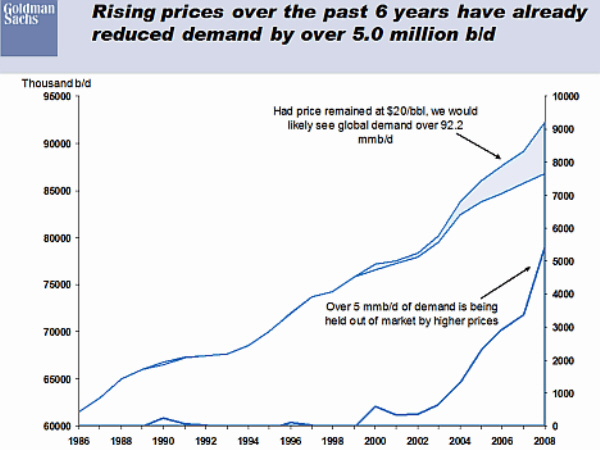
Why shouldn't we get back to the $20/barrel we enjoyed in the 1990's?
It's simple – the world has used up practically all the easy "light sweet" crude oil that used to pour out of desert sands for $3 – 4/barrel and be easily refined into saleable products. Discovery of oil peaked more than 40 years ago – see the chart below.
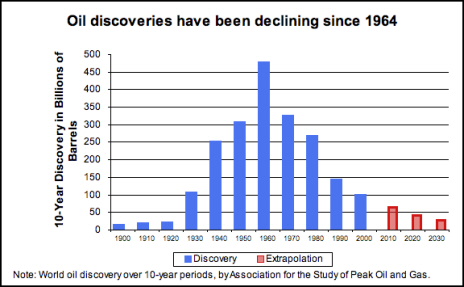
Not only is it costing much, much more to find and extract each new barrel of oil (typically $60/barrel for new deep offshore wells) but most of the oil we can now get is shifting towards "heavy" and/or "sour" grades that require billions of dollars of new investment in refineries to process them.
"The oil is getting harder to extract. Most oil comes from ageing, waning giant fields discovered long ago. There are no more giant fields to find, only lots of small ones, difficult ones or fields deep under the ocean. The remaining crude oil is heavier, thicker, dirtier, quite simply cruder! It's difficult to get out, expensive to get out, slower to get out. So, the rate of oil extraction will decrease." Michael Lardelli on Perspective, ABC Radio National, 26 June 2008
There is no going back to $20/barrel short of a world recession that shuts down demand for oil, and for everything else.
This year many refineries have been finding it harder to buy oil of a grade they can economically refine, especially the 50% of US refineries located in the Gulf of Mexico who are suffering steep declines in overseas supply from their
The table below shows, for oil exporting nations, net export declines accelerating from 2006 to 2007. Monthly data for 2008 shows that the overall downward trend is continuing. It is the declining volume of tradeable oil on global markets that is causing steep price rises this year when we are seeing only moderate abatement of growth in global demand.
If declines in the supply of tradeable oil were not enough to create a tight market, buyers are reacting nervously to talk of attacks on Iran by Israel or the USA, and it only takes a rumour to send oil prices on another upward jump.
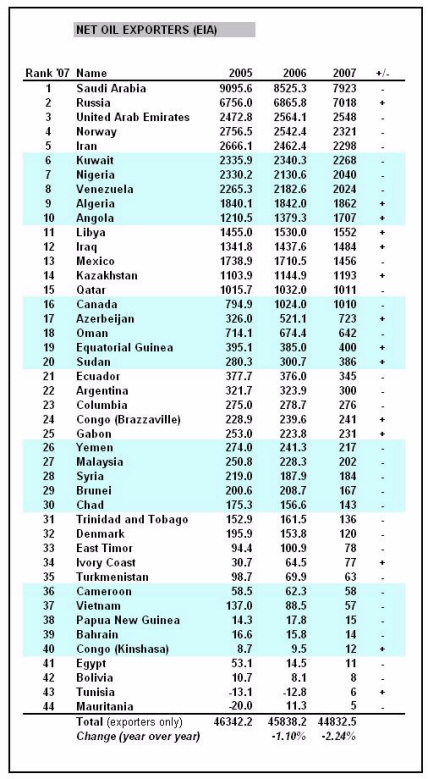
Critically, Saudi Arabia appears now unable to perform the role of market stabiliser that it played from the 1980's until the 2000's on the basis of its known ability to pump up to 20% extra volume at short notice. Depletion of Saudi Arabia's giant oil fields appears to have taken away its ability to help the world in this way, though the Saudis will not directly admit they no longer have this power.
It seems likely that since 2007 OPEC has lost effective cartel power because few of its members have the ability to pump more oil. This means the cartel as a whole can do practically nothing to bring down prices even though key members like Saudi Arabia have much of their wealth tied up in Western economies and are clearly concerned about damage to their own interests if oil prices go any higher – thus the Saudi conference held on the 22nd of June 2008.
So what happens next?
Price rises did indeed pause in mid-June after an astonishing $11 run-up on Friday 6th June. Traders may have been waiting for an outcome from the Saudi conference on 22nd June, which was soon seen to have provided little new knowledge or cause for optimism.
Game on. Futures topped $140 for the first time on 26th June.
So what will next week, next month and next year bring?
"Predictions are always difficult, especially about the future." Niels Bohr
There are essentially two patterns of oil price prediction being made by informed pundits:
"We are compelled to once again raise our target prices for oil. We are lifting our target for West Texas Intermediate by $20 per barrel to an average price of $150 next year and by $50 per barrel to an average price of $200 per barrel by 2010."
Pattern B – Price moves down then up on a rising trend
The other school of oil price projections makes the common-sense point that serious demand reduction and perhaps economic recession in some countries will be triggered when oil prices reach a critical level – when "demand destruction" becomes really destructive. Proponents suggest that such a free-fall in demand from one or more larger consuming countries such as the USA will be dramatic enough to drop price back to, say, US$100/barrel for a period of time.
Some writers guess that the critical price point to cause such sudden and significant demand destruction may be US$200 - 300/barrel, based on percentages of world GDP, but the accompanying analysis is weak and the arguments published to date do not convincingly pinpoint a critical price for oil above which it cannot go.
Conclusion: Stay awake, expect oil prices to be in dynamic movement.
Conservatively, plan for US$200/barrel by 2010, but don't be surprised if a recession somewhere drops price back to US$100, for a short while, or sudden war in the Middle East sends prices skyrocketing.
Expect the fundamentals of fading supply growth and growing demand to push prices ever higher in the 5 year horizon, perhaps well beyond US$300/barrel.
Finally, let's look on the bright side.
There is plenty to like about moderately higher oil prices, if communities, businesses and economies take heed and get time and help to adjust.
Less traffic, less congestion and less pollution would be a big plus for most of us.
New business opportunities should spring up in areas such as energy conservation, Natural Gas conversions, cleantech industries, electric vehicles and freight optimisation.
Having the world place a higher value on energy from oil will change a lot of business decisions, improving our resource efficiency and enhancing sustainability.
Read full guest post from anawhata at The oil drum
 Heading towards the market are potatoes with 33 per cent more protein content, modified tomatoes that could be capable of protecting against cancer and peanuts without the chemicals that cause deadly nut allergies.
 High fuel efficiency is a hot topic today, but people have been tinkering with miserly vehicles for a long time. Take GreenPeace, which started working on the "SmILE-Project" in the mid '90s. GreenPeace thought that if it was going to have to be cars that we use for transportation, they may as well be "Small, Intelligent, Light und Efficient" (hence, SmILE). Unveiled in 1996, the tweaked first generation Renault Twingo got dramatically better fuel economy and, had Renault followed up and put these into production, would undoubtedly be a huge seller today.
 "We cannot allow such a thing to happen," Bush said. "We must remove this oil now, before it's too late."
