Showing posts with label HybridHype. Show all posts

Feb 17, 2011

FAIL 2010 highest mpg's worst than 1985 mpg's

AutoBlogGreen presented the  "ACEEE Greenest Vehicles of 2011"
These are "Epic Fail" compared to 1985 - Think of consumer price and environmental impact to produce these... then the lifetime maintenance and gas - FAIL!
Greener Cars Greenest Vehicle list
I only noted these cars, because I drove them all over the years loaded with friends, family, pets and gear. Safely and reliably.

1985 CHEVROLET SPRINT    
City    39 mpg
Hwy    48 mpg 
Combined 43 mpg

1985 NISSAN SENTRA    
City    38 mpg
Hwy    45 mpg
Combined    40 mpg

1985 FORD ESCORT    
City    36 mpg
Hwy    47 mpg
Combined    40 mpg  

1985 TOYOTA COROLLA    
City    32 mpg
Hwy    43 mpg
Combined    36 mpg

Find out more MPG fail at fueleconomydb.com

Nov 1, 2009

Tesla Roadster Drives into the record books downunder

SlashDot
"The CEO of an Australian ISP has driven his Tesla Roadster into the record books, completing 501km on a single electric charge in the 2009 Global Green Challenge — beating the Roadster's official specifications, which rate the all-electric sports car as being capable of a maximum of 390km per charge.
The previous record was held by another Roadster in the 387km Rallye Monte Carlo d'Energies Alternatives in April this year.

In a race specifically designed for alternative energy vehicles (such as hydrogen and electricity),
the Roadster was the only vehicle to complete the entire course.

Oct 26, 2009

Will Electric Cars Strip The World Of Rare Earths?

Business Insider Government subsidies and promotion of electric cars could result in an abnormally large public conversion to them, which could put massive strains on the world supply of rare earths used in battery technology over the next twenty years.

MetalMiner: Dr Irving Mintzer principal of MEG LLC, an energy consulting firm, described a "nightmare scenario" at the Critical & Strategic Metals Summit in Washington DC this week...

But metal demands look challenging; by Dr Mintzer's estimations at current Cobalt (Co) and Neodymium (Nd) content levels in a typical Lithium ion battery (everyone agrees there is enough Lithium, it's the minor metals needed for the cathodes and for the braking regeneration units that will be the challenge) it's hard to see where the metal will come from. In current cars some 5kgs of Co and 2 kgs of Nd are needed in every car.

Even if improved technology reduced this to 0.5kgs of cobalt and 1 kg of Nd the world would need an additional 12,000 tons of cobalt and worse some 24,000 tons of Nd.

According to an informative presentation given by David Weight of the Cobalt Development Institute, the world currently produces about 55,000 tons of cobalt and is broadly in supply/demand balance. Some 50% of supply comes from the politically unstable Democratic Republic of the Congo (DRC), the world's richest source of cobalt.

Read more here.

Oct 21, 2009

VOLTS final fail "easier on the environment, but only if you don't mind paying a premium and drive fewer than 40 miles per day."

FORTUNE MAGAZINE's article for the VOLT appears to be a sales ad for Honda and Toyota.

At billions of tax payer dollars this 'Jokes on us'.

NEW YORK (Fortune) - Just what is GM is trying to achieve with the Volt, and how much value does it provide the customer?

Lots of questions remain, as I discovered when few a words about the Volt at the end of my last column drew a number of heated responses.

For one thing, the 40-mile range depends on ambient temperatures of 60 degrees to 65 degrees. When the temperature drops below 60, the batteries become less efficient. And if it gets hotter than 65, the air conditioner can impose an additional load on the Volt's batteries. Either way, the range diminishes.

Nor does the 40-mile range accommodate aggressive driving or sustained uphill climbs -- you don't have to be a budding drag racer or hill-climb contestant to get less than the full range on electricity.

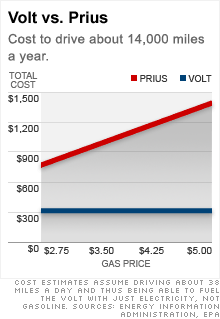
For instance, compare the Volt to the best selling gasoline-electric hybrid, the Toyota Prius. The goal of the Prius is to use less gasoline. Therefore, it carries 230 lbs of batteries that give an assist to the 1.8 liter gasoline engine to improve the car's fuel economy. The Prius has an all-electric range of only about a mile, but it gets 50 miles per gallon of gasoline.

And oh yes, the Prius starting price is $23,750.

The Volt, in contrast, wants to almost entirely do away with gasoline. Therefore, it carries a hefty 400 pounds of batteries that can propel the car up to 40 miles under ideal conditions. But once the batteries have been depleted, the Volt is powered by a conventional 1.4-liter gasoline engine that gets conventional fuel economy.

And the price for the Volt hasn't been set yet, but it will likely be a tad under $40,000, minus a $7,500 government rebate -- a good bit higher than the Prius.

Read full at Fortune

Oct 8, 2009

Nickel-Lithium Battery Has “Ultrahigh” Energy Storage Capacity

Researchers have found a way to create a battery out of Nickel and Lithium that can store more than 3.5 times the energy of lithium-ion batteries and are much safer to boot.

Lithium-ion batteries are great and all—having heralded in a new age of portable electronics and allowed for the possibility of mass-market electric cars—but they have a few major drawbacks. For instance, they have a propensity to catch fire and explode and, although they have a much better energy storage capacity than say lead-acid or nickel metal hydride (NiMH) batteries, they still weigh too much to pack more than a couple hundred miles of range into a passenger car.

Read more of this story at gas2.0

Oct 1, 2009

electric powered cars will make the Toyota Prius look like a fad...

"Battery 500 Project aims to use nanotechnology to extend the range of all-electric cars 200 miles beyond the 300-mile range of gasoline powered cars. IBM, the University of California at Berkeley and all five of our US National Labs are collaborating to make the 500-mile electric car battery. Within two years, they promise to have a new kind of battery technology in place for the 500-mile electric car. If that happens, then I predict a mass exodus from gasoline to electric powered cars that will make the Toyota Prius look like a fad." - Via SlashDot

Sep 29, 2009

GM to sell cheap electric cars in India???

Guess where your GM gov grants and bailout cash went to... to put a affordable electric on foreign soil.
Yep Europe gets 50mpg + GM vehicles, India gets a $5,000 electric and you get 30mpg and a $40,000 volt.
Wish I was kidding.

Guardian:

General Motors, one of the world's biggest carmakers, and the Bangalore-based company behind the G-Wiz electric car have announced a joint venture to produce "affordable" electric cars in India.

30fYDdp2a68.gif 

The new vehicle, which has been road-tested, will be based on GM's popular Spark hatchback, which in India costs a quarter of a million rupees (£3,000). Neither GM nor its partner, Reva, would be drawn on the electric version's price tag, though both said it would be "competitive and affordable"...read on here


Aug 22, 2009

"Cash for Foreign Cars" American Auto maker FAIL

Interestingly, there are 3 Hondas, 2 Fords, 2 Toyotas — but no General Motors or Chryslers on the list . . .

AP reports that most of the trade ins have been pickups/SUVs. And what are they driving ff the lots in exchange?

1. Toyota Corolla
2. Honda Civic
3. Ford Focus
4. Toyota Camry
5. Toyota Prius
6. Hyundai Elantra
7. Ford Escape (front-wheel-drive)
8. Honda Fit
9. Nissan Versa
10. Honda CR-V (four-wheel-drive)

Source: Top 10 vehicles bought by people trading clunkers

Aug 12, 2009

More G.M. VOLT dreams and hype from Bob Lutz

I find it interesting that "Mr. VOLT", Bob Lutz who publicly called global warming a "total crock of sh*t" has been the national campaign lead leader for the 'next green car' Chevy VOLT. Now GM is claiming that the VOLT will get 230 mpg in the slashdot article below. I wonder who is spilling a "total crock of sh*t". At $40,000 I do hope the volt can pull this off. That way it will only take 20 years for the MPG fuels saves to cover the upfront enormous $15K price over the competition.

Compare a VOLT to Prius over time at $5 a gallon
MPG Gallon Year 3 5 10 20
230 5.000 217 652 1087 2174 4348
60 5.000 833 2500 4167 8333 16667


-616 -1848 -3080 -6159 -12,319

slashdot - "General Motors, emerging from bankruptcy, today announced that its upcoming plug-in hybrid vehicle, the Volt, will have an EPA rating of 230 mpg for city driving (about 98 km/L). The unprecedented rating, the first in triple digits, is the result of a new (draft) methodology for calculating the 'gas' mileage for vehicles that operate primarily or extensively on electricity. The Volt, due out late next year, can drive approximately 40 miles on its Li-Ion battery pack, after which a gasoline engine kicks in to provide additional electricity to charge the battery. Running off the gasoline engine yields approximately 50 mpg. Of course, the devil's in the details, because the conversion of grid-based electricity to gasoline-mileage is imprecise."

Math hurts, as it is reality based- Haase


Update:
CNN agrees with Haase?
You won't save enough on fuel costs to compensate for the likely higher sticker price.


And then the truth comes out:
GM admits Volt doubts
General Motors has cast doubt over the long-term future of the Chevrolet Volt by claiming it may not be commercially viable and other rivals may overtake it with superior and more advanced technology.

GM submitted a regulatory filing report to the US Treasury yesterday and CEO Fritz Henderson claimed its “disclosures are consistent with our commitment to remain transparent and to keep the public informed of our progress”.

Aug 7, 2009

Obama Releases $2.4B for EVs, GM Is Big Winner

GM wins as Volt fails... bailout for more bad ideas and engineering.
Hey GM, look a Nissan for model hints not the old tech you got from Toyota

The Wall Street Journal reports, General Motors was the biggest winner (of 48 winners) of the Obama administration’s electric vehicle (EV) “battery sweepstakes” – a $2.4 billion plan to jump-start U.S. EV battery production. Government-controlled GM, creator of the Chevy Volt, won $240 million in direct grants. These funds will cover GM’s manufacture of battery packs; production of electric drive-trains for new vehicles; and the purchase of 625 Chevy Volts, which will be used to test the newly manufactured batteries. LG Chem was awarded $151 million to make the batteries for the Chevy Volts.

Other winning companies included A123 Systems (which won $249 million), Johnson Controls (which won $299 million), and several smaller state companies (which won awards ranging from $500,000 to $160 million).

WARNING: Video above is "Ha, Ha here is what we did with your money funny"


Aug 3, 2009

Nissan unveiled their all-electric LEAF - NOT YOURS!

Real electric, real range fast charging - NOT YOURS!

"Nissan unveiled their all-electric LEAF (Flash site). Slated to launch in late 2010 in Japan, the US, and Europe, this car will have a 100-mile range, seats 5, has an advanced computer system with remote control by IPhone, and promises to be competitively priced. While this car's range won't work for everyone, it could be a game changer as a commuter car." Recharge time is 8 hours with a 200-volt power source, and "just under 30 minutes with a quick charger" (no further details given) to charge to 80% of capacity.

Read full from slashdot


Jul 17, 2009

China's 65mph 600 mpg future.... e-scooters

Time Magazine has an update: There are 100 million electric bikes in China
Last year (2008) Chinese bought about 90% of the 23 million e-bikes sold worldwide. Experts say that next regions to likely embrace e-bikes are Southeast Asia, where gas-powered scooters are popular, and India, where rising incomes mean personal transportation is starting to be in reach of hundreds of millions. Japan has seen steady annual sales of about 300,000 for several years, and in the cycle-crazy Netherlands e-bikes are beginning to take off. In the U.S., where bikes are still overwhelmingly used for recreation rather than transportation, e-bike sales are expected to break 200,000 this year, or about 1% of China's sales.

Motorcycles are too dangerous, cars are too expensive, public transportation is too crowded and pedal bikes leave you too tired


Higher Power Nanocrystalline Core Electric Bike Motor from Texas
- The device is an electric motor with a nano-crystalline core. It is the size of a casserole dish, and more powerful than a 600cc motorcycle engine. Okonsky’s company, KLD Energy, is supplying the motor to the Vietnamese motorbike company Sufat and by the end of the year he expects to startle Hanoi with something it has never seen before — a clean, quiet electric scooter that can accelerate from zero to 60 miles per hour in under 10 seconds.


KLD Energy Technology's nanocrystalline core electric motor
E-165: Max Speed - 65 mph (100 km/h)
Range - 160 km (100 mi)

The high-performance motor system's technology innovates in several key areas to drive performance:
* With a high-frequency to low RPM ratio, the motor system does not require a transmission.
* Through the use of an innovative nano-crystalline composite material the motor conducts energy ten times more efficiently than traditional iron-core motors, eliminating the need for additional cooling mechanisms and enabling greater responsiveness.


Read more from nextbigfuture

Jul 7, 2009

VW Honest about new electric car hype

What's Worse: Electro-Hype or Electro-Apathy?
During a speech in Münich, Dr. Martin Winterkorn, the Chairman of the Board of Volkswagen AG, said that VW would introduce its first electric car in 2013 and that it will be based on the same as the Up! New Small Family concept that was unveiled in 2007 (see the pics below). He didn't talk too much about the technical specifications of that VW electric car, but rather warned people against the evils of "electroc-hype", estimating that electric vehicles would have a "global market share of 1 to 1.5% in 2020."


Dr. Martin Winterkorn - We are witnessing an electro-hype. Experts, consultants and politicians tumble over one another with forecasts. And the auto industry doesn’t hold back on announcements. The result is massively false expectations by the customer...More than eight percent of drivers in Germany are rock solid convinced that the electric car is already here.

I think this development is dangerous, because we lose not only potential customers, but we are also at risk of disappointing the.,.
The everyday, affordable and safe electric car for everyone is feasible. But it is also true that the way forward is long and tedious.
As I said before, this is not a sprint but a marathon.

Let's take a closer look at his arguments... at the hugger


Jul 3, 2009

ExxonMobil's 150 mile range electric car Maya 300

Today, the oil industry has become a player in the auto industry. ExxonMobil is launching the Maya 300, a lithium-ion battery powered car that can drive up to 120 miles on one charge yet has the look and feel of a gasoline-powered car.
 
http://www.foxnews.com/images/541777/2_61_062309_carsharing.jpgThe Maya 300 was developed in conjunction with Electrovaya, a pioneer in the development and manufacturing of Lithium Ion SuperPolymer battery systems. The two companies have worked together to, "develop the innovative urban vehicle that will be a 'game changer' in advancing transportation alternatives."
 
ExxonMobil actually developed the lithium-ion battery separator film and was the first company to introduce the lithium-ion battery in 1991.

The Maya 300 charges in 8-10 hours, plugs into a regular household 110 volt outlet and will be available to consumers for around $20-25,000 in 2011.

The car is being launched in a very cleaver way. ExxonMobil and Electrovaya have partnered with the Maryland Science Center on a program called Altcar, which will educate residents and visitors in Baltimore on the future of energy efficient transportation. But the coolest part is that people can rent the Maya 300 and take it for a spin to get the feel of driving an electric car. This is one of the first electric car share and rental programs in the country and I'm sure it is no coincidence that it is so close to Washington, D.C.

Read more from source gas2.org & greenoptions

Jun 29, 2009

Clean energy for plug-in cars not ready anytime soon...

The $787 billion stimulus spending bill enacted in February promotes plug-in electric cars for use by the federal government, and eventually, the public.

Purpose of these plug-in cars is to decrease greenhouse gas emissions and wean America off foreign energy sources.


That sounds good, except it won’t work.

America doesn’t have the electrical capacity to make it work, and a report from the Government Accountability Office (GAO) says the plug-in vehicles being pushed by the Obama administration won’t decrease greenhouse gas emissions.  

Regarding electricity, on June 16, Lloyd Yates, CEO of Progress Energy told directors and members of the County Economic Development Council at a lunch in the Crystal Coast Civic Center that while Progress Energy supports the push toward renewable, responsible and sustainable energy, goals must be realistic, measurable and at a minimum cost to end users of electricity.

“Don’t underestimate how this is going to change — the costs of energy go up,” he said, noting nuclear power will play a dominant role in the company’s federally mandated move toward cleaner energy alternatives.

We surmise, as does everyone, that this is doable.

We believe, however, that it’s only doable if Progress Energy is given the green light — no pun intended — to build more nuclear power plants.

Nuclear power plants cost money, tons, because meeting all the environmental safeguards is exorbitantly expensive.

Second, aside from the exorbitantly expensive environmental safeguards, which we know would be met with any new nuclear power plant construction, are the environmental roadblocks that will, if history is any lesson, be thrown up to halt or delay any nuclear power plant construction.

Mr. Yates said Progress Energy added 18,000 new customers in 2008, in a down economy.

Saying concerns over “global warming” and fuel market volatility require new alternatives, including improved efficiency, he said increased reliance on renewable energy sources and construction of nuclear power plants is absolutely necessary.


He added that Progress Energy’s goal of doubling efficiency over the next decade means convincing customers to conserve and alter their “electrically intense lifestyles.”

“We have to convince people to use less energy. Customers must change their behavior,” said Mr. Yates, adding, those “who need energy efficiency most can least afford it.”

.... the idea of plug-in electric cars comes from a scam driven by ideology and money.

Read full from News Times

Nissan to offer Electric Cars for the Middle Class Incomes

What will electric car companies consider affordable now that America’s economic turmoil continues to spiral downward.

It appears that companies are realizing that zero emission electric vehicles should not just be for the “rich”. In May, Nissan announced that it would begin electric cars in the U.S. to be available in 2010. This week, they announced they would mass produce a zero-emissions electric car by 2012 that would be affordable.

According to an AP Nissan , “If it’s not affordable, it’s not gonna work. We are not going to come with a very high price. We are gonna come with a reasonable price,” he said. “We are here to mass market them.”

Read more of this story at gas2.org

Jun 26, 2009

GM Volt FAIL - Will be made in China

I did not think GM could make more mistakes with the volt - I was wrong.

Just as Nissan and China announce they both have plans to invest billions in the U.S. and open massive plants in America...
The Detroit Free Press is reporting that GM will indeed build the Chevy Volt in China, but that all the Volts built in China will remain in China.

Ouch!
Track the demise of the volt on this blog.... just search gm, volt

Jun 6, 2009

Earth to EV's - Cost is not sustainable....

Mitsubishi has the same new delusional EV problem as GM... they both think $40,000 is affordable? 
 
Or how about a Tesla $60,000 two seater?
 
 
There is a strong and reality based EV market coming and I do not think $40,000 cars will be a part of it.
Nissan, several European and Chinese companies have full EV cars coming to market from $5,000-$15,000....
 
What killed the first GM electric car? Cost.
And it will continue to be the number one market killer.


May 31, 2009

Affordable, Real Electric Cars

The world is not short of electric car start-ups.   As Mike's round up of 23 Electric Cars Driving the Revolution showed, even the big players in the auto world are finally getting in on the act - though few are anywhere close to actually selling an affordable electric vehicle. but, in general, the smaller players in this market gravitate more toward flashy, sporty concepts like Dale Vince's electric sports car, and less toward vehicles that your or I would actually drive. Enter the UK's Quiet Electric Car Company, who have put together two affordable, real electric cars that won't break the bank. Click link for performance and pricing details, video of the car in action, and some thoughts from the founders on how government help could kick start the electric car market. Read more here

May 22, 2009

My comments on the 235 mpg VW... ouch.

It was hardly 'new news' as I reported it back in 2006 but a reality check regarding the viability of 35mpg standards...
 
Comments:

My fear is that the big two (Ford/GM) are so far behind Nissan (link) and China BYD motors in battery and electric tech. Miles behind VW and BMW in clean high MPG diesels that regardless of the billions we give them... they will be slaughtered unless they build partnerships or offer equally competitive vehicles.

Their foreign competition is not only offering superhigh mpg cars,
they are marketing full electric to the mass market for $1,000 and up (link).
It is NOT impossible,
both Ford and GM have 50+ mpg cars and minivans sold internationally (link), a first step to basic survival would be to unconditionally offer those cars here.
And yes, I know they may not meet ALL U.S. safety and emission standards... but how does a Harley or scooter? They don't.

A simple Obama addendum to existing laws could allow deregulation to 'micro car' and 'eco-mileage' classes (50mpg+) with a predetermined safety and emission standard date within a reasonable amount of time
(China has already done this-link). Do they understand that now China has the largest car market in the world (link)? In this depression they will need to have a viable product for that market JUST to compete, let alone meet their future 'sales dreams'.

Regardless of the hype and propaganda surrounding 'global warming and peakoil' this is a matter of national security and business prosperity that we actually make cars that conserve and are built for the future of declining resources... and not some 35mpg standard that was clearly obtainable two if not three decades ago.

Earth to U.S. automakers, America needs you.... evolve or face extinction.