Jul 17, 2008

FACT - "if drilling works, it'll take a decade or more for the oil to flow."

"Oil companies are sitting on 68 million acres of oil leases and refuse to drill."
"Record profits by big oil companies are the reason for soaring prices."

Insane - US Unveils Plan to Bury Carbon

Reuter- WASHINGTON - The United States unveiled plans on Tuesday to bury climate-warming carbon dioxide emissions deep underground to keep the greenhouse gas from further heating up the atmosphere.

The burial process, known as carbon capture and storage or geologic sequestration, has long been part of the Bush administration's strategy to combat climate change without imposing any economy-wide limit on carbon emissions.

But this is the first time the US government has proposed requirements on how to do it. No federal rule is expected until late 2010 at the earliest, according to Benjamin Grumbles of the Environmental Protection Agency.


HAASE - Why is this insanity? This is a short term REACTIVE fix that will deplete economy and finite coal & oil reserves... It allows us to continue pushing off inevitable conservation and technology programs required for a sustainable future. 

I have listed the top five "simple inarguable problems" with the (CCS) carbon capture and storage plans 
 
ONE - Raises the energy consumption of a coal plant by an average of 32 percent (together, CCS will probably raise energy consumption by as much as 50 percent).
FOUR -  A carbon capture and storage infrastructure requires HUGE infrastructure consisting of pipelines that rivals the existing oil and gas network.
 
While I already covered this in detail (link here), crap like this will make anyone a nuclear energy advocate... it's just nuts.
 
EPA and "policy" experts not buying it? Better read more about it here:
 
...it may be easy to read, many find it hard to understand.  Energy czars persuade the persuadable to continue a future built by destroying finite resources   "the greenest energy is that which you needn't ever produce


Jul 16, 2008

0.12 kw power unlimited sustainable power

Steve Spence from  green-trust.org returned from Enviroweek. One of the most promising solutions was presented by West Indies Power (WIP), and centers on installing high voltage undersea power lines from nearby volcanic geothermal plants on Nevis and Saba. This electricity, provided to local power companies at $0.12 / kWh, is less expensive than the current $0.19 / kWh fuel component, which is expected to spike to astronomical levels, before becoming unavailable due to larger economies outbidding the islands to feed their burgeoning growth.

dehumidifier creates purified water, free of chemicals, chlorine, chalk or any other preservative agents.

From Steve Spence... green-trust.org

the Enviro Week show in St. Maarten, we met Bruno Therond and his water makers. He kept us hydrated all weekend with these awesome machines:

The Air/Water Generator (AWG) Technology condenses moisture in the air “water from the atmosphere” and purify it into a superior grade of purified, potable water. While the principle & technology is well known as a refrigerated dehumidifier the application to AWGs are fairly new and the water collected is purified and stored instead of being disposed off.


The key challenge is to keep the clean drinking water purified until consumption.


The water produced remain purified through an elaborate system using 5 stages of filtration including ultra violet light to ensure complete sterilization of all water born bacteria.


These environmentally friendly, low voltage, chemical free, 100% independent automatic water supply can provide from 24 to 5000 liters of water per day for drinking water and additional purposes & water needs, (irrigation, cisterns, animals, etc.)


There is no connection to any water supply what so ever, no bottles to be delivered, no pipes.


The purified water quality is free of chemicals, chlorine, chalk or any other preservative agents.

It is a dehumidifier.


It also recycles and cleans the air you breathe. Find out more at: green-trust.org

nuke dump to top $90 billion

WASHINGTON (AP) — Turns out, it's going to cost taxpayers $32 billion more than first thought to open and operate the nation's first nuclear waste dump. — made public Tuesday — is that the facility will cost over $90 billion. It's the first official estimate since 2001, when the figure was $58 billion.
 
Already, some 64,000 tons of radioactive spent fuel rods are stored at commercial reactor sites in 33 states, according to the Nuclear Energy Institute. Most of it is stored in vault-like pools while some has been moved into dry-cask storage, where Nevada lawmakers, who oppose Yucca Mountain, would like it to stay.
 
Commercial nuclear power plants now produce some 20 percent of U.S. electricity, but concern about waste disposal has hampered the industry's growth.
 
Yucca Mountain was originally supposed to open in 1998 but has been beset by lawsuits and political and scientific controversies. The best-possible opening date is now 2020,  Sproat told lawmakers at an Energy and Commerce subcommittee hearing.
 
The Energy Department did succeed in submitting a required construction license application to the Nuclear Regulatory Commission last month. The commission has up to four years to decide whether to approve it — but that timeline, too, is dependent on congressionally approved budgets.
 
Read full By ERICA WERNER (AP)

06 Volkswagen's Polo 62 MPG of Diesel-Sipping Fun

Fast, fun, 62 mpg - NOT YOURS in the U.S.
 
:Edmunds.com  ...the Polo Blue Motion promises Toyota Prius -beating fuel economy at the low price of $19,990.
 
Its Lupo 3L, the advanced 78-mpg city car masterminded by former chairman Ferdinand PiĆ«ch, proved just what is capable if a carmaker is prepared to forgo profits. Unfortunately, the disappointing sales figures — only 28,000 units were sold in six years — meant the mileage champ was ultimately dropped from the German carmaker's lineup. That's a 8.3-mpg improvement over its standard sibling, made even more impressive by the car's 717-mile range.
 
 
What about the the Billion dollar prize at 100mpg posted by The L.A. Times? Time to pony up Dan... The VW Lupo 3l actually does close to 100 mpg not just the 78 mpg. The mathematics are really pretty simple. In the UK a gallon = 4.5 litres. The car goes 100km on 3 litres of diesel so it goes 150km on 4.5 litres or 1 gallon. 150km converts to 93 miles so the Lupo 3L does 93mpg. Even better, it can be simply converted to run on 100% rapeseed oil which is completely renewable and the only co2 emitted is that which was absorbed by the rapeseed plants when they were growing. Rapeseed oil can be bought for 50p a litre in the UK compared to diesel which is now approaching £1 per litre!
 
So, to conclude, we should all be buying up Lupo 3l cars and running them on rapeseed oil.  How does £9 to travel 372 miles sound? 

I as well fail to see how this is breathtaking. My parents used to drive a Toyota that got 50pmg from the 70's. Good Ol' Fashioned engineering maybe, but it is certainly not fascinating. If automotive technology had kept it's innovation at the same pace as CPU technology, we would be driving some amazing vehicles.
 
But US manufacturers are still using the same basic combustion engine design that was invented in the late 1800's. This is probably one of the few industries that have been manufacturing 100+ year old technology.

When they die... we die.

...clue to why the world's amphibians are disappearing faster than any class of species since the dinosaur.
 
American scientists are about to publish research showing that male toads on intensively farmed land are changing sex.
 
The researchers, from the University of Florida, studied one of the toughest and most aggressive of all amphibian species – the cane toad, Bufo marinus, whose indestructibility has caused it to become a plague over much of Australia – only to find that it is being, literally, unmanned.
 
As they will report in a forthcoming issue of Environmental Health Perspectives, 40 per cent of the males examined from a heavily farmed part of the state had become hermaphrodites, possessing both testes and ovaries, and taking on feminine colouring and body characteristics. Another 20 per cent, while outwardly male, had undergone some feminisation.
 
The results will be buttressed by a Canadian study – to be published in Aquatic Toxicology – which finds a similar link between farming and sex changes in local northern leopard frogs.
 
The Florida scientists conclude that the changes are likely to be "the result of multiple exposure to several chemicals at various concentrations over the lifetime of the toads". Previous, disputed, studies have suggested that some pesticides may have this effect on amphibians, while research at Yale University found that male green frogs were being feminised much more often in suburban gardens than on farmland.
 
Whatever the cause, the phenomenon may explain why amphibians are now the most endangered class of animal on the planet. More than 120 species are believed to have become extinct, and almost a third of those that are left are in danger.
 

Chicago reaching limit on fresh water supply

Planners, manufacturers look for ways to get water to 2.2 million more people from the same — or smaller — supplies
 
The EPA says at least 36 states are anticipating shortages by 2013 even under non-drought conditions.
 
With an estimated 2.2 million more people expected to live in Northeastern Illinois by 2030, the bottom-line question becomes not mortgage availability or zoning densities or commuting expenses but whether there will be enough water to go around and at what cost.
 
Perched on the edge of one of the world's great fresh water sources, the Chicago metro area, ironically, is reaching the upper limit of the water it can take from the lake by court order while at the same time discovering the deep water aquifers supplying outer suburbs are not replenishing as before.
 
"Most people don't think they waste water" but at the same time they are not eager for higher utility costs or added taxes, said Al Dietemann, acting resource conservation manager of the Seattle Public Utilities. Businesses and consumers respond when "the public is aware they can keep water bills down with more efficient water use," he said.
 
By 2007, the Seattle-area Saving Water Partnership, an 18-member utility consortium in Seattle and King County, reported the total billed water consumption had dropped 23 percent since 1990 and 13 percent since 2000.
 
The drop was the result of a public education program and through incentives to use more water-efficient (water-saving) equipment.
 
In addition to regional planning, Illinois eventually may have to come up with a state water plan. It is one of eight states that has approved the Great Lakes Compact, an effort to protect and restrict access to water in the five Great Lakes. Michigan, the last state bordering the Great Lakes to approve the agreement, signed on Wednesday. The Compact must be approved by Congress before it becomes law.
 
If the Compact goes forward, it "requires the state to pass a conservation plan with specific conservation goals and implementation steps," noted Joyce O'Keefe, deputy director of Openlands.
 
This planning dovetails with growing public awareness and understanding of natural resources limits, O'Keefe said. It's an awareness that is being heightened by the U.S. EPA's national WaterSense program, similar to the successful Energy Star label, to identify products that are 20 to 30 percent more water efficient, and local programs such as green roofs to promote water conservation and reduce storm-water runoff.
 
McHenry's underground aquifers can produce 120 million gallons of water a day, more than enough to supply the 34.6 million gallons a day drawn in 2000 and meet an anticipated need of 67.5 million gallons a day projected for 2030. Future usage, however, could reach 164 million gallons a day if all the towns in McHenry achieve their master plans, more than is now available.
 

Jul 15, 2008

Salvation if we want it... but we all fear change.

Word facts... Humanity stands on the threshold of a peaceful and prosperous future,
Tell people something they know already and they will thank you for it.
Tell them something new and they will hate you for it
- George Monbiot
 
Energy czars persuade the persuadable to continue a future built by destroying finite resources 
"the greenest energy is that which you needn't ever produce."
 
 
We've seen the future ... and we may not be doomed
UN report finds life is getting better for people worldwide – but that governments are failing to grasp the opportunities offered at 'a unique time'.
 
Humanity stands on the threshold of a peaceful and prosperous future, with an unprecedented ability to extend lifespans and increase the power of ordinary people – but is likely to blow it through inequality, violence and environmental degradation. And governments are not equipped to ensure that the opportunities are seized and disasters averted.
 
So says a massive new international report, due to be published late this month, and obtained by The Independent on Sunday. Backed by organisations ranging from Unesco to the US army, the World Bank to the Rockefeller Foundation, the 2008 State of the Future report runs to 6,300 pages and draws on contributions from 2,500 experts around the globe.
 
Its warning is all the more stark for eschewing doom and gloom. "The future continues to get better for most of the world," it concludes, "but a series of tipping points could drastically alter global prospects."
 
... "This is a unique time in history.  It is increasingly clear that the world has the resources to address our common challenges. Ours is the first generation with the means for many to know the world as a whole, identify global improvement systems, and seek to improve [them]."
 
What is more, say the authors of the report, produced by the Millennium Project of the World Federation of the United Nations Associations, many important things are already getting better. Life expectancy and literacy rates are increasing worldwide, while infant mortality and the number of armed conflicts have been falling fast. Per capita income has been growing strongly enough to cut poverty by more than half by 2015
 
Even better, it says, "advances in science, technology, education, economics and management seem capable of making the world work far better than it does today". "collective intelligence for just-in-time knowledge to inform decisions".
 
The report reserves its greatest enthusiasm for the internet, which it says is "already the most powerful force for globalisation, democratisation, economic growth and education in history.
 
Just over one-third of humanity still lives in the 43 countries with authoritarian regimes, but half of these people are in China.
 
On the other hand, the report warns "half the world is vulnerable to social instability and violence due to rising food and energy prices, failing states, falling water tables, climate change, decreasing water-food-energy supply per person, desertification and increasing migrations due to political, environmental and economic conditions" – threaten to undo the improvements of recent years and blight the chance of a better future.
 
Yet nuclear power – the solution increasingly favoured by governments, which are planning to add another 350 reactors to the 438 already operating around the world – will not do the job. "For nuclear energy to eliminate the greenhouse gas emissions from fossil fuels, about 2,000 nuclear power plants would have to be built, at $5-15bn per plant, over 15 years – and possibly an additional 8,000 plants beyond that to 2050."
 
The report says that there is not enough uranium in the world to fuel all those reactors, that another Chernobyl-type accident could halt the expansion in its tracks, and that the rapid spread of the atom around the world increases the chances of nuclear proliferation and terrorism.
 
There are grounds for hope... But the report's authors say that governments are not up to the job: "Many of the world's decision-making processes are inefficient, slow and ill-informed, especially when given the new demands from increasing complexity [and] globalisation." They call on world leaders to do more long-term planning, and to join in global approaches to the interlocking crises. "There seems to be an interest in creating global strategies, but it needs a little push. There's more within us now to collaborate in the face of shared problems."
 

Contaminated US site faces 'catastrophic' nuclear leak

One of "the most contaminated places on Earth" will only get dirtier if the US government doesn't get its act together - clean-up plans are already 19 years behind schedule and not due for completion until 2050.
 
More than 210 million litres of radioactive and chemical waste are stored in 177 underground tanks at Hanford in Washington State. Most are over 50 years old. Already 67 of the tanks have failed, leaking almost 4 million litres of waste into the ground.
 
There are now "serious questions about the tanks' long-term viability," says a Government Accountability Office report, which strongly criticises the US Department of Energy for delaying an $8 billion programme to empty the tanks and treat the waste. The DoE says the clean-up is "technically challenging" and argues that it is making progress in such a way as to protect human health and the environment.
 
The DoE's plan, however, is "faith-based", says Robert Alvarez, an authority on Hanford at the Institute for Policy Studies in Washington DC. "The risk of catastrophic tank failure will sharply increase as each year goes by," he says, "and one of the nation's largest rivers, the Columbia, will be in jeopardy."
 
Read full from New Scientist

Mad cow disease prions can survive conventional sewage treatment,

Mad cow disease-causing prions can survive conventional sewage treatment, according to a new study by University of Wisconsin-Madison scientists.
Prions — rogue misfolded proteins that cause mad cow disease, chronic wasting disease, and its human equivalent, variant Creutzfeldt- Jakob disease — are not degraded by standard wastewater decontamination and can end up in fertilizers, potentially contaminating crops.
 
Prions never have been reported in U.S. municipal sewage. But as a precaution, “we should keep prions out of wastewater treatment plants,” said Joel Pedersen, an environmental engineer at UW-Madison who led the study.
 
Prions are notoriously resilient to extreme heat, caustic chemicals and irradiation, but it wasn’t known how they would fare under the standard barrage of treatments applied to wastewater sludge.
 
However, it is unlikely the prions would be guzzled in treated tap water, expert says.
 
These findings cast doubt on the safety of biosolids, Pedersen said, though he noted that the water effluent was clean and prion-free.
 
Biosolids generally are thought to lack human pathogens and to be safe for agricultural applications. The Milwaukee Metropolitan Sewerage District makes a fertilizer called Milorganite from its Jones Island treatment plant’s biosolids. Madison makes its own biosolids fertilizer, called Metrogro.
 
“We’re looking at this research and asking what we can do to improve our systems,” said Jeff Spence, marketing director for Milorganite. “Based on the findings, there’s little or no risk in regard to these rogue proteins as it relates to biosolids.”
 
Since prions were restricted to the biosolids and not the water, the study “gives better confidence that (prions) could be sequestered in matter associated with solid materials,” and potentially removed, said Fran Kremer, a senior science adviser for the National Risk Management Research Laboratory of the Environmental Protection Agency, which partially funded the study.

T. Boone on wind turbines...

"There are no turbines on my ranch, because I think they are ugly." Source

Jul 10, 2008

The Most Efficient Power Plants have no future?

But what a university sees as a no-brainer cost reduction, a utility often sees as a threat to sales.
Not in the "clean coal or cap'n trade plans" From forbes.com
 
In your standard fossil-fuel power plant, the inefficiency begins when the coal or gas ignites. In some plants, as little as 30% of the energy created ends up in the power grid. The rest, in the form of heat, blows out the smokestacks. If one could build power plants that used 80% of the energy instead, everyone would be rushing to do so, right?
 
Not so fast. Yes, such plants exist, but advocates say potential customers are staying away. Why? Utilities and regulators are scaring them off.
 
The 80% efficiency seen in combined heat and power plants, known as cogeneration plants, is ideally suited for large institutions--universities, hospitals, airports--that have extensive electricity and thermal energy demand in a concentrated area. Rather than letting the heat escape, a cogeneration plant uses the excess energy to power a heating and cooling system.
 
"It's not uncommon for utilities, when they hear 'cogeneration,' to bring out the white blood cells to inoculate it from happening," says Rob Thornton, president of the International District Energy Association.
 
The potential efficiency savings from such projects are immense, says Neal Elliott, an expert on combined heat and power (CHP) systems with the American Council for an Energy-Efficient Economy.
 
"Quads of energy savings could be realized by fully deploying this across the country," Elliott says. To put that in perspective, the Energy Information Agency, part of the U.S. Department of Energy, estimates the country annually consumes 100 quads (lingo for quadrillion British thermal units)y. By that same EIA data, the sum total of all hydroelectric, geothermal, solar, wind and biomass power, for the entire country, was only 6.8 quads in 2007.
 
Not all utilities are hostile to the plants, and many are jockeying to be the ones that build CHP plants for their clients. "Every utility is regulated mostly by its state," says Ed Legge, a spokesman for the Edison Electric Institute, the Washington lobbying group that represents the utility industry. "Whether it can recover costs for efficiency programs is regulated by the states."
 
Read more via forbes.com
 

Stop America is addicted to foreign oil.

Haase - Well someone is listening... we hope he can share his "short term reality" with Obama & McCain
 
And now that McCain has dumped the "cap trade" crap, maybe he or Obama will jump on a solid energy plan 
 
With a few exceptions (replace 50% of wind power words with geothermal and load the south with 25% solar) Pickens Plan is a "short term band-aid" to help in the next 10 years.
 
This IS NOT a Hollywood ethanol, hybrid or hydrogen  hoax... it is a real 10 year plan. That is also the FATAL flaw in the plan... only ten years of hope.
 
While I could post everything wrong with this plan, the fact is, it is the best plan on the table presented and endorsed by the king of OIL. 
 
The simple flaws are the assumptions on wind power vs geothermal and nuclear... wind can not handle our current or future grid load uptime or MW demands.
 
I have included his whole plan below for your review -Haase


From T. Boone Pickens: America is addicted to foreign oil

It's an addiction that threatens our economy, our environment and our national security. It touches every part of our daily lives and ties our hands as a nation and a people.

The addiction has worsened for decades and now it's reached a point of crisis.

In 1970, we imported 24% of our oil.  Today it's nearly 70% and growing.

As imports grow and world prices rise, the amount of money we send to foreign nations every year is soaring. At current oil prices, we will send $700 billion dollars out of the country this year alone — that's four times the annual cost of the Iraq war.

Projected over the next 10 years the cost will be $10 trillion — it will be the greatest transfer of wealth in the history of mankind.

America uses a lot of oil. Every day 85 million barrels of oil are produced around the world. And 21 million of those are used here in the United States.

That's 25% of the world's oil demand. Used by just 4% of the world's population.

Can't we just produce more oil?

World oil production peaked in 2005. Despite growing demand and an unprecedented increase in prices, oil production has fallen over the last three years. Oil is getting more expensive to produce, harder to find and there just isn't enough of it to keep up with demand.

The simple truth is that cheap and easy oil is gone.

What's the good news?


The United States is the Saudi Arabia of wind power.

Studies from around the world show that the Great Plains states are home to the greatest wind energy potential in the world — by far.

The Department of Energy reports that 20% of America's electricity can come from wind. North Dakota alone has the potential to provide power for more than a quarter of the country.

Today's wind turbines stand up to 410 feet tall, with blades that stretch 148 feet in length. The blades collect the wind's kinetic energy. In one year, a 3-megawatt wind turbine produces as much energy as 12,000 barrels of imported oil.

Wind power currently accounts for 48 billion kWh of electricity a year in the United States — enough to serve more than 4.5 million households. That is still only about 1% of current demand, but the potential of wind is much greater.

A 2005 Stanford University study found that there is enough wind power worldwide to satisfy global demand 7 times over — even if only 20% of wind power could be captured.

Building wind facilities in the corridor that stretches from the Texas panhandle to North Dakota could produce 20% of the electricity for the United States at a cost of $1 trillion. It would take another $200 billion to build the capacity to transmit that energy to cities and towns.

That's a lot of money, but it's a one-time cost. And compared to the $700 billion we spend on foreign oil every year, it's a bargain.


An economic revival for rural America.

Developing wind power is an investment in rural America.

To witness the economic promise of wind energy, look no further than Sweetwater, Texas.

Sweetwater was typical of many small towns in middle-America. With a shortage of good jobs, the youth of Sweetwater were leaving in search of greater opportunities. And the town's population dropped from 12,000 to under 10,000.

When a large wind power facility was built outside of town, Sweetwater experienced a revival. New economic opportunity brought the town back to life and the population has grown back up to 12,000.

In the Texas panhandle, just north of Sweetwater, is the town of Pampa, where T. Boone Pickens' Mesa Power is currently building the largest wind farm in the world.

At 4,000 megawatts — the equivalent combined output of four large coal-fire plants — the production of the completed Pampa facility will double the wind energy output of the United States.

In addition to creating new construction and maintenance jobs, thousands of Americans will be employed to manufacture the turbines and blades. These are high skill jobs that pay on a scale comparable to aerospace jobs.

Plus, wind turbines don't interfere with farming and grazing, so they don't threaten food production or existing local economies.


A cheap new replacement for foreign oil.

The Honda Civic GX Natural Gas Vehicle is the cleanest internal-combustion vehicle in the world according to the EPA.

Natural gas and bio-fuels are the only domestic energy sources used for transportation.


Cleaner

Natural gas is the cleanest transportation fuel available today.

According to the California Energy Commission, critical greenhouse gas emissions from natural gas are 23% lower than diesel and 30% lower than gasoline.

Natural gas vehicles (NGV) are already available and combine top performance with low emissions. The natural gas Honda Civic GX is rated as the cleanest production vehicle in the world.

According to NGVAmerica, there are more than 7 million NGVs in use worldwide, but only 150,000 of those are in the United States.

The EPA estimates that vehicles on the road account for 60% of carbon monoxide pollution and around one-third of hydrocarbon and nitrogen oxide emissions in the United States. As federal and state emissions laws become more stringent, many requirements will be unattainable with conventionally fueled vehicles.

Since natural gas is significantly cleaner than petroleum, NGVs are increasing in popularity. The Ports of Los Angeles and Long Beach recently announced that 16,800 old diesel trucks will be replaced, and half of the new vehicles will run on alternatives such as natural gas.


Cheaper

Natural gas is significantly less expensive than gasoline or diesel. In places like Utah and Oklahoma, prices are less than $1 a gallon. To see fueling stations and costs in your area, check out cngprices.com.


Domestic

Natural gas is our country's second largest energy resource and a vital component of our energy supply. 98% of the natural gas used in the United States is from North America. But 70% of our oil is purchased from foreign nations.

Natural gas is one of the cleanest, safest and most useful forms of energy — residentially, commercially and industrially. The natural gas industry has existed in the United States for over 100 years and continues to grow.

Domestic natural gas reserves are twice that of petroleum. And new discoveries of natural gas and ongoing development of renewable biogas are continually adding to existing reserves.

While it is a cheap, effective and versatile fuel, less than 1% of natural gas is currently used for transportation.

The Mechanics

We currently use natural gas to produce 22% of our electricity. Harnessing the power of wind to generate electricity will give us the flexibility to shift natural gas away from electricity generation and put it to use as a transportation fuel — reducing our dependence on foreign oil by more than one-third.


How do we get it done?

The Pickens Plan is a bridge to the future — a blueprint to reduce foreign oil dependence by harnessing domestic energy alternatives, and buy us time to develop even greater new technologies.

Building new wind generation facilities and better utilizing our natural gas resources can replace more than one-third of our foreign oil imports in 10 years. But it will take leadership.

On January 20th, 2009, a new President will take office.

We're organizing behind the Pickens Plan now to ensure our voices will be heard by the next administration.

Together we can raise a call for change and set a new course for America's energy future in the first hundred days of the new presidency — breaking the hammerlock of foreign oil and building a new domestic energy future for America with a focus on sustainability.

You can start changing America's future today by supporting the Pickens Plan. Join now.

"The Toxic Consequences of the Green Revolution"

The Society of Environmental Journalists -- Four decades after the so-called Green Revolution enabled this vast nation to feed itself, some farmers are turning their backs on modern agricultural methods--the use of modified seeds, fertilizer, and pesticides--in favour of organic farming. This is not a matter of producing gourmet food for environmentally attuned consumers but rather something of a life-and-death choice in villages like this one, where the benefits of the Green Revolution have been coupled with unanticipated harmful consequences from chemical pollution. As driving their actions, the new organic farmers cite the rising costs of seed, fertilizer, and pesticides, and concerns that decades of chemical use is ruining the soil. But many are also revolting against what they see as the environmental degradation that has come with the new farming techniques, particularly the serious pollution of drinking water that village residents blame for causing cancer and other diseases."
 

1985 Harley? gets over 470mpg...

Craig Vetter, the man behind the Windjammer fairing and the Triumph Hurricane, found out himself that by changing the aerodynamics of a motorcycle, very exciting achievements can be made. In 1980, Vetter created the Craig Vetter Fuel Economy Contest, which was won by a modified Harley Davidson which returned nearly 100 miles per gallon. The following year, Vetter entered his own streamliner which managed 108 miles per gallon and by the end of the run for the contest in 1985, a 125cc streamlined motorcycle won the event by posting over 470 miles per gallon.

Vetter has not been sitting idle since '85 either, with current projects in the works involving human powered transportation and even hovering scooter concepts.

[Source: autobloggreen.com]

Carbon capture of CO2 worse the ethanol return?

Carbon capture and sequestration gets heralded as a great way to lower CO2 emissions and keep burning coal. Unfortunately, it also kills the efficiency of the coal plant, meaning that every other environmental externality associated with coal-fired generation -- from mountaintop removal to power plant sitting -- is exacerbated by CCS. Planet Ark puts it succinctly:
 
The process called carbon capture and sequestration requires as much as 20 percent of the electricity a power plant generates.
 
That essentially means that for every five coal plants using the technology, a sixth would be required just to power the capture and burial of carbon dioxide produced.
 
Hat tip to GRIST read full via REUTERS
 

Jul 9, 2008

TALK & TOUR Award winning recycling for demolition waste, Whitewater, WI

Visit for first model Award winning high rate recycling for demolition waste.
AT - UNIVERSITY OF WISCONSIN-WHITEWATER
July 23 from 5 – 7 p.m. in Whitewater, WI
New State of Wisconsin specifications require recycling on State job sites.
This project is the first model for State job site recycling and winner of the 2007 Big Diverter Award for highest recycling rate for demolition waste. Working on a State job now or in the future? What will you be required to do? Learn about the current recycling efforts on this project and what’s happening around the state, see a demonstration of the new online tracking system for documenting recycling results and tour the job site.
Free registration available for WasteCap Wisconsin members, $40 for nonmembers

For more information visit
www.wastecapwi.org/events

Jul 8, 2008

AP - No Need....to Save Planet, Says Blair

Regardless of the headlines on Tommy Lee this week giving up meat for the planet, Former Prime Minister Tony Blair says no to giving up meat.
 
Blair, said deforestation (not his meat) was responsible for producing four times as many as emissions as the airline industry (My guess is billionaire Branson of Virgin Airlines had no comment.)
 
Blair is right about one thing "the dangers of deforestation" but wrong about food balance as Branson was on ethanol and jet biofuels just a year ago...
 
"The destruction of tropical rainforests for conversion to farmland -- for meat and crops -- must be halted, and reversed," Blair stated.
 
"This is why I have called for G8 leaders to support efforts to reduce forest destruction and degradation," he said.
 
"Minimising emissions from agricultural sources will be an important part of efforts to limit climate change.
 
He was asked by one reader: "will you (therefore) go vegetarian and lead by example?" Blair replied: "This does not mean...give up meat."
 
Blair's views are like most millionaire leaders... it is not their responsibility to change, but to force it.

HD TV GAS 17,000 TIMES WORSE FOR PLANET THAN CO2

LCD TVs, praised as being greener than old-style tellies because they consume much less power, may actually be speeding climate change, a chemical expert has warned. ...a study claims that atmospheric quantities of the gas Nitrogen Trifluoride (NF3) are booming. NF3 is 17,200 times better at trapping heat in the atmosphere over a hundred-year period than is carbon dioxide, the best known greenhouse gas. NF3 has a characteristic moldy smell and is thought to be highly harmful to the liver and kidneys.
 
The chemical is used in the production of flat-panel displays which, in turn, are used to make today's TV screens. Prather believes that exploding demand for HD TVs around the world has created a huge need for NF3, and that's sending emission levels sky high.
 
The problem is, NF3 emission levels aren't being measured on the list of gases that should be tracked because at that time the compound's manufacture was miniscule.
 

What is happening with the future of oil prices ?

The hard facts on Oil Prices

  • The world price of oil in US dollars has doubled in the last year (June 2007 to June 2008) from US$67/barrel to over US$135/barrel
  • The world price has gone up by 6 times in 6 years, from US$20/barrel in 2002 to over US$135/barrel by mid 2008
  • With hindsight we can see that the great cheap oil era lasted 16 years from 1986 to 2002 when the price was mostly in the range $15 – 25/barrel, coming off a $39 peak during the "oil shock" of 1980 (equivalent to about US$95/barrel in 2008 money). The short sharp spike seen at the end of 1990 was due to the first Gulf War.

Due to the growth in oil supply not keeping up with steadily growing demand around the world.

Oil is getting more expensive because surplus production capacity has diminished and continues to diminish, as shown in the chart on the next page. Oil industry volumes are of enormous scale (86 million barrels per day – a barrel is 159 litres), and the costs of supply infrastructure are in the billions and trillions of dollars.

Lead times for new industry infrastructure are typically 3 to 10 years. All new mega-projects on the production side are well known out as far as 2012, and few seem likely to boost global supply by enough to overcome declines in old oil fields. See the comprehensive listing of oil megaprojects at http://en.wikipedia.org/wiki/Oil_Megaprojects/2008.

The balance between growing capacity from new infrastructure investments and declining output from old infrastructure has seen global production capacity climb at a slower rate than consumption for the past 25 years, as shown in the following chart. 

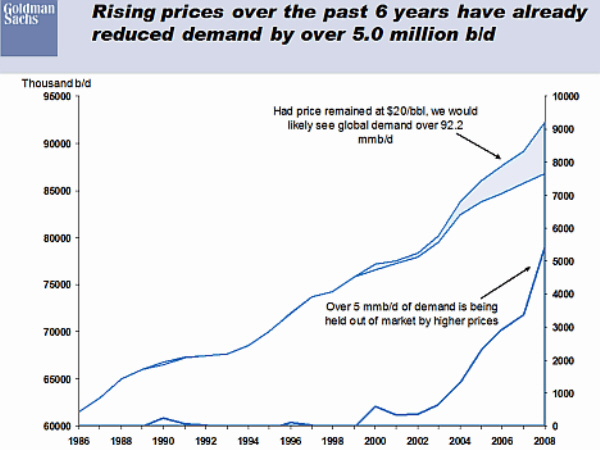
The analysis by Goldman Sachs in the next chart below suggests that price rises to date have already destroyed demand amounting to about 5 million barrels/day or 6% of current world consumption. Any further price rises may be expected to cause further demand destruction and consequent hardship for those being priced out of the fuel market. 
Your browser may not support display of this image.


Why shouldn't we get back to the $20/barrel we enjoyed in the 1990's?

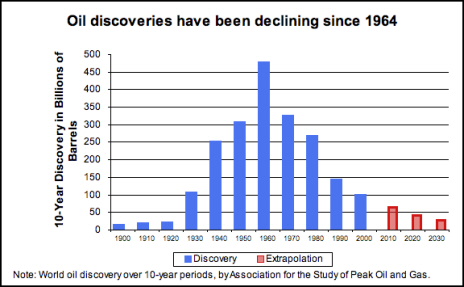
It's simple – the world has used up practically all the easy "light sweet" crude oil that used to pour out of desert sands for $3 – 4/barrel and be easily refined into saleable products. Discovery of oil peaked more than 40 years ago – see the chart below.   
Your browser may not support display of this image.

Not only is it costing much, much more to find and extract each new barrel of oil (typically $60/barrel for new deep offshore wells) but most of the oil we can now get is shifting towards "heavy" and/or "sour" grades that require billions of dollars of new investment in refineries to process them.

"The oil is getting harder to extract. Most oil comes from ageing, waning giant fields discovered long ago. There are no more giant fields to find, only lots of small ones, difficult ones or fields deep under the ocean. The remaining crude oil is heavier, thicker, dirtier, quite simply cruder! It's difficult to get out, expensive to get out, slower to get out. So, the rate of oil extraction will decrease." Michael Lardelli on Perspective, ABC Radio National, 26 June 2008

There is no going back to $20/barrel short of a world recession that shuts down demand for oil, and for everything else. 

This year many refineries have been finding it harder to buy oil of a grade they can economically refine, especially the 50% of US refineries located in the Gulf of Mexico who are suffering steep declines in overseas supply from their

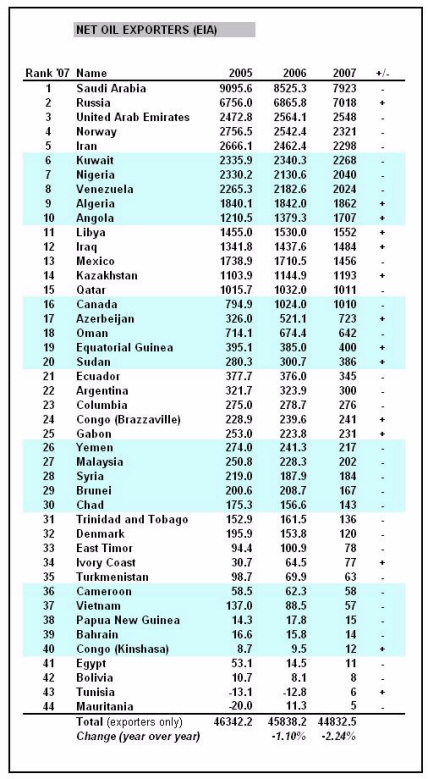
The table below shows, for oil exporting nations, net export declines accelerating from 2006 to 2007. Monthly data for 2008 shows that the overall downward trend is continuing. It is the declining volume of tradeable oil on global markets that is causing steep price rises this year when we are seeing only moderate abatement of growth in global demand.

If declines in the supply of tradeable oil were not enough to create a tight market, buyers are reacting nervously to talk of attacks on Iran by Israel or the USA, and it only takes a rumour to send oil prices on another upward jump.
Your browser may not support display of this image.

Critically, Saudi Arabia appears now unable to perform the role of market stabiliser that it played from the 1980's until the 2000's on the basis of its known ability to pump up to 20% extra volume at short notice. Depletion of Saudi Arabia's giant oil fields appears to have taken away its ability to help the world in this way, though the Saudis will not directly admit they no longer have this power.

It seems likely that since 2007 OPEC has lost effective cartel power because few of its members have the ability to pump more oil. This means the cartel as a whole can do practically nothing to bring down prices even though key members like Saudi Arabia have much of their wealth tied up in Western economies and are clearly concerned about damage to their own interests if oil prices go any higher – thus the Saudi conference held on the 22nd of June 2008. 


So what happens next?

Price rises did indeed pause in mid-June after an astonishing $11 run-up on Friday 6th June. Traders may have been waiting for an outcome from the Saudi conference on 22nd June, which was soon seen to have provided little new knowledge or cause for optimism.

Game on. Futures topped $140 for the first time on 26th June. 

So what will next week, next month and next year bring?

"Predictions are always difficult, especially about the future." Niels Bohr 

There are essentially two patterns of oil price prediction being made by informed pundits:

  1. Ongoing steady price rises driven by the continuing supply-demand squeeze
  2. A big discontinuity caused by demand destruction of a major sort, followed by a short period of lower prices then a resumption of ongoing steady price rises driven by the continuing supply-demand squeeze.

"We are compelled to once again raise our target prices for oil. We are lifting our target for West Texas Intermediate by $20 per barrel to an average price of $150 next year and by $50 per barrel to an average price of $200 per barrel by 2010." 


Pattern B – Price moves down then up on a rising trend

The other school of oil price projections makes the common-sense point that serious demand reduction and perhaps economic recession in some countries will be triggered when oil prices reach a critical level – when "demand destruction" becomes really destructive. Proponents suggest that such a free-fall in demand from one or more larger consuming countries such as the USA will be dramatic enough to drop price back to, say, US$100/barrel for a period of time.

Some writers guess that the critical price point to cause such sudden and significant demand destruction may be US$200 - 300/barrel, based on percentages of world GDP, but the accompanying analysis is weak and the arguments published to date do not convincingly pinpoint a critical price for oil above which it cannot go. 


Conclusion: Stay awake, expect oil prices to be in dynamic movement.

Conservatively, plan for US$200/barrel by 2010, but don't be surprised if a recession somewhere drops price back to US$100, for a short while, or sudden war in the Middle East sends prices skyrocketing.

Expect the fundamentals of fading supply growth and growing demand to push prices ever higher in the 5 year horizon, perhaps well beyond US$300/barrel.  


Finally, let's look on the bright side.

There is plenty to like about moderately higher oil prices, if communities, businesses and economies take heed and get time and help to adjust.

Less traffic, less congestion and less pollution would be a big plus for most of us.

New business opportunities should spring up in areas such as energy conservation, Natural Gas conversions, cleantech industries, electric vehicles and freight optimisation.

Having the world place a higher value on energy from oil will change a lot of business decisions, improving our resource efficiency and enhancing sustainability.


Read full guest post from anawhata at The oil drum

Parents Beware of The Drug Pushers...

Yes, Big Pharma wants to get your kids hooked on drugs as early as possible.
 
The Washington Post reported:
    "In a further concession to the impact of the childhood obesity epidemic in the United States, a leading group of pediatricians is recommending that kids as young as 8 years old be given cholesterol-lowering drugs in hopes of preventing heart problems later in life. The academy is also recommending that children whose family history of cholesterol is not known, or who have risk factors for heart disease - have their cholesterol tested. The recommendations were published in the July issue of the journalPediatrics.
 
    According to the recommendation, the best method for checking cholesterol is a fasting blood test. Children whose cholesterol is normal should have the test repeated every three to five years.
 
    For those children older than 8 who have high levels of LDL (bad) cholesterol, doctors should consider giving them statins.
 
Shelov admitted that very little is known about the risks and benefits of using cholesterol-lowering drugs like statins in a large pediatric population.
 
Potentially, millions of children could be placed on cholesterol-lowering drugs, he said. 'At the same time, there needs to be a systematic look at the effects of these medications on children, because they do have side effects,' he added.
 
'If we are going to go ahead and do this, we're going to need guidelines on exactly who would warrant the therapy and careful measurement of any side effects,' Shelov said.
 
'It's possible that many children who start taking statins would not be on them for life.
 
But there is nothing to rule out the possibility that your children will be taking statin drugs for the rest of their lives. And if you watch the TV ads for statin drugs they caution that "these drugs are not recommended for women who are pregnant, nursing or who may become pregnant". So can you imagine the long term impact of these drugs will be on the reproductive system of little girls?
 
Parents consider the fact that there are no long term studies on the impact of placing a pre-pubescent child on statin drugs.
 
Consider the fact that many people on statin drugs experience side effects and need to take other drugs to treat the resulting ailments.
 
Consider the fact that the studies that propose that there is a direct correlation between high cholesterol and heart disease have come into question.
 
And finally, parents please consider the fact that if your child receives a healthy diet full of fresh fruits of vegetables, without fast foods and processed foods full of salt and sugar, and with lots of fun exercise, obesity probably won't be an issue.
 
The CBS evening news discussed the fact that there is no concrete evidence that statin drugs will prevent heart disease...


Jul 7, 2008

FrankenFruit - scientists engineer meal to make your day

SCIENTISTS say they have genetically engineered fruit and vegetables capable of providing most of a day's nutrients in a single meal.
 
Heading towards the market are potatoes with 33 per cent more protein content, modified tomatoes that could be capable of protecting against cancer and peanuts without the chemicals that cause deadly nut allergies.
 
Such foods, the first genetic modifications offering nutritional benefits to consumers, would be in marked contrast to the GM crops marketed to date. These were designed to boost the profits made by farmers and seed firms by raising yields or cutting costs.
 
Their attempted introduction to Europe in the late 1990s provoked a backlash from consumers suspicious at being asked to consume plants whose DNA had been "contaminated" but which offered them no benefit.
 
Plant scientists hope the new plants will reverse such fears.
 
"It's time to reopen the debate over GM crops," said Chris Leaver, professor of plant science at Oxford University and a long-term supporter of GM. "Earth's population will reach nine billion by 2040. We need crops that offer better nutritional quality, can withstand drought, use fertiliser more efficiently and resist diseases and pests. GM can contribute to achieving that."
 
Such claims will infuriate the green lobby, which sees the promotion of the new "nutritionally enhanced" crops as a cynical marketing exercise. Some scientists, however, have growing impatience with such views. They point out that the BioCassava Plus project is funded with a $12.4million donation from the Bill & Melinda Gates Foundation rather than a profit-hungry corporation, and say it could help ease food shortages in Africa.
 
"Who wants to eat a giant bowl of cassava or golden rice each day? These ideas are just a new way of marketing GM."
 

Charging a Electric car from household outlet could take 30 hours!

...an interesting note in the article from Greenwich Time is the length of time required to charge up the Roadster's battery. They note that charging the battery from a normal household outlet could take up to 30 hours. The Roadster's battery has a capacity of 53kWh. Tesla quotes a charge time of 3-3.5, but that is based on charging from a 220V 80A circuit. If, on the other hand, you plug the car into a typical outlet in your living room, you would only have 15A flowing at 110V. That's 53,000W / (110V * 15) = 32.12 hours. So if you plan to get yourself a plug-in electric car with any kind of serious range, be prepared to have an electrician install a high current outlet to charge it. At the very least you'll want a 220V/40A circuit for overnight charging in 6-7 hours.

Source: Greenwich Time

70mpg was possible in 1995

High fuel efficiency is a hot topic today, but people have been tinkering with miserly vehicles for a long time. Take GreenPeace, which started working on the "SmILE-Project" in the mid '90s. GreenPeace thought that if it was going to have to be cars that we use for transportation, they may as well be "Small, Intelligent, Light und Efficient" (hence, SmILE). Unveiled in 1996, the tweaked first generation Renault Twingo got dramatically better fuel economy and, had Renault followed up and put these into production, would undoubtedly be a huge seller today.
 
The vehicle itself is labeled with the words "First Aid for the environment - same performance, half the fuel usage." That's not an exaggeration. Before the work, the Twingo used 6.7 liters per 100 km (35mpg U.S.) and afterwards just 3.3 (71mpg U.S.). Thanks to Slim for the tip!
 

sad stories of SUVs...

Jul 6, 2008

Yep-GM Read my blog and may bring small cars to U.S. market

Greenwire, 3 July 2008 - General Motors Corp., struggling to adapt to a fuel-scarce economy, may begin selling a tiny car normally reserved for Asian and Latin American markets in the United States.
 
The 138-inch-long Chevrolet Beat, which gets as much as 40 miles per gallon, would be the second-smallest car in the United States after Daimler AG's 106-inch Smart car.
 
"This is a very big change for GM," said John Wolkonowicz, an analyst at Global Insight. "They have no choice. There has never been as rapid a shift in consumer demand in the history of the auto industry."
 
GM reported its biggest annual loss in 2007 and has not turned a profit since 2004. The company's stock fell 15 percent yesterday -- bringing its current market value down to a tenth of what it was eight years ago -- and a Merrill Lynch analyst says that bankruptcy is "not impossible if the market continues to deteriorate."
 

Bush Vows To Remove Toxic Petroleum From National Parks

WASHINGTON, DC–Vowing to "restore the pristine splendor of America's natural treasures," President Bush Monday unveiled "Project: National Parks Clean-Up," an ambitious program to remove all toxic petrochemical deposits from national parks by 2004.
 
"Places like Yellowstone and Yosemite were once pure, unspoiled wilderness," Bush said at a White House press conference. "But over the course of the past 10 million years, we have allowed them to become polluted with toxic fossil-fuel deposits, turning a blind eye to the steady build-up of vast quantities of dangerous pollutants. It's time to end this terrible neglect."
 
To underscore the severity of the crisis, Bush produced a chart illustrating survey results for Yellowstone National Park, where a "staggeringly huge" toxic-petroleum deposit was discovered.
 
"This amount represents the equivalent of 40,000 supertankers worth of oil," said Bush, gesturing toward a line on the chart. "To put the dangers into perspective, consider this: If these 'petro-poisons' should ever spill out into the park itself, the resulting environmental disaster would be 40,000 times worse than the damage caused by the wreck of the Exxon Valdez."
 
Bush Vows_jump"We cannot allow such a thing to happen," Bush said. "We must remove this oil now, before it's too late."
 
Under the Bush plan, 7.2 billion tons of toxic petroleum would be removed by the target date of January 2004. Unlike other federal environmental clean-up initiatives, administration officials say the plan would pay for itself, offsetting costs through the sale of petroleum byproducts produced as a result of the clean-up process.
 
The clean-up, EPA chief Christine Todd Whitman said, may even prove profitable, a prospect that has attracted the participation of private industry. Already, many U.S. companies have expressed interest in lending assistance, and it is hoped that these companies will carry out much, or perhaps all, of the clean-up effort.
 
"Nothing is more important than the legacy we leave future generations," Bush said. "The costs of this project pale in comparison to the importance of safeguarding our planet's ecosystem. Our primary mission must be to protect and foster our nation's most precious natural resource: oil. I mean, the environment."
 

Jul 5, 2008

Biofuels behind food price hikes: leaked World Bank report

Biofuels have caused world food prices to increase by 75 percent, according to the findings of an unpublished World Bank report published in The Guardian newspaper on Friday.
 
The daily said the report was finished in April but was not published to avoid embarrassing the US government, which has claimed plant-derived fuels have pushed up prices by only three percent.
 
Biofuels, which supporters claim are a "greener" alternative to using fossil fuel and cut greenhouse gas emissions, and rising food prices will be on the agenda when G8 leaders meet in Japan next week for their annual summit.
 
The report's author, a senior World Bank economist, assessed that contrary to claims by US President George W. Bush, increased demand from India and China has not been the cause of rising food prices.
 
"Rapid income growth in developing countries has not led to large increases in global grain consumption and was not a major factor responsible for the large price increases," the report said.
 
Droughts in Australia have also not had a significant impact, it added. Instead, European and US drives for greater use of biofuels has had the biggest effect.
 
The European Union has mooted using biofuels for up to 10 percent of all transport fuels by 2020 as part of an increase in use of renewable energy.
 
All petrol and diesel in Britain has had to include a biofuels component of at least 2.5 percent since April this year.
 
"Without the increase in biofuels, global wheat and maize stocks would not have declined appreciably and price increases due to other factors would have been moderate," the report said.
 
It added that the drive for biofuels has distorted food markets by diverting grain away from food for fuel, encouraging farmers to set aside land for its production, and sparked financial speculation on grains.
 
But Brazil's transformation of sugar cane into fuel has not had such a dramatic impact, the report said.
 
"The basket of food prices examined in the study rose by 140 percent between 2002 and this February," The Guardian said.
 
"The report estimates that higher energy and fertilizer prices accounted for an increase of only 15 percent, while biofuels have been responsible for a 75 percent jump over that period."


...neither candidate mentions science.

SCIENCE BUDGET:  ROUND-OFF MONEY AVERTS LAYOFF.
As WN pointed out last week, $400 million in the $186 billion supplemental  war spending bill, or about 0.2 percent, is for science.  It's divided  among four agencies.  Still, it allowed Fermilab, the nation's top  accelerator laboratory, to resume its research program and avoid the lay  off of 80 employees.  Fermilab has been paying employees from an anonymous  $5 million gift since May.   For the top high-energy physics research  facility in the world's most powerful nation to be reduced to operating on  private charity is a national embarrassment.  We desperately need change in our science policy.  Somebody's campaign slogan is "change," but neither candidate ever mentions science.
 
CHANGE:  IT SOUNDS GOOD, BUT WHICH WAY IS IT GOING?
It is standard political lore that anyone seeking nomination must fish in  friendly water.  Once nominated, they should begin casting their lines in  the direction of their opponent.  So it is that having secured the nomination Obama is now trying to hook a few evangelicals, even calling for expansion of Bush's controversial faith-based initiative.  His fund raising now targets the big fish rather than the ten-dollar mom-and-pop donations he boasted of during the nomination.  Yesterday, according to the NY Times, Obama gave a talk in Fargo, ND in which he made his usual point that the United States cannot sustain a long-term military presence in Iraq, but then added that he might "refine" his policies on Iraq after he meets with American commanders in Iraq next month.  This, I'm assured, is smart politics, but I liked him better when he wasn't that smart.