
"In the wake of a major global food crisis in 2007 and 2008, cereal prices are expected to be higher and more volatile in the coming years," said Colin Chartres, director general of IWMI, whose research is supported by the Consultative Group on International Agricultural Research (CGIAR). "Asia's food and feed demand is expected to double by 2050. Relying on trade to meet a large part of this demand will impose a huge and politically untenable burden on the economies of many developing countries. The best bet for Asia lies in revitalizing its vast irrigation systems, which account for 70 percent of the world's total irrigated land."
Asian agriculture registered dramatic advances during the 1960s and 1970s through a combination of irrigation, improved crop varieties and fertilizers. The resulting Green Revolution made it possible to avert widespread hunger and raise living standards. From 1970 to 1995, the area under irrigation in Asia more than doubled, according to the IWMI-FAO report, making this the world's most intensively irrigated continent.
"Today, the option of expanding irrigated land area in Asia to feed a growing population is becoming increasingly problematic due to land or water constraints,"



 According to The Tobacco Atlas, 2.1 million cancer deaths per year will be attributable to tobacco by 2015. By 2030, 83% of these deaths will occur in low and middle-income countries. Unique among cancer-causing agents, the danger of tobacco is completely preventable through proven public policies. Major measures include tobacco taxes, advertising bans, smokefree public places, and effective health warnings on packages.


 A study has found that as plastics break down in the sea they release potentially toxic substances not found in nature and which could affect the growth and development of marine organisms. . . The scientists found that when plastics decompose in the ocean they release a range of chemicals, such as bisphenol A and substances known as polystyrene-based oligomers, which are not found naturally. Bisphenol A has been implicated in disrupting the hormonal system of animals.
 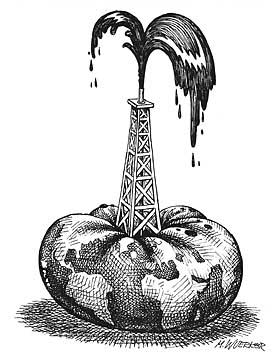 we constantly fret about running out of oil. But we should be paying more attention to another limited natural resource: water. A water crisis is threatening many parts of the country -- not just the arid West.
 In Europe, slash-and-burn techniques for clearing forested land allowed the farming of crops that had spread from the Fertile Crescent. This practice loosed the forests’ stored carbon into the atmosphere in the form of carbon dioxide. In eastern Asia a couple of millennia later there was a tenfold increase in the growth of rice as the region’s principal foodstuff. That meant the destruction of vast grasslands, which released equally vast amounts of methane—a gas far more efficient at trapping heat than carbon dioxide is.


