Jan 9, 2011

Four Previously Abundant Species of Bumblebee Close to Disappearing in U.S.

"If the bee disappears from the surface of the earth, man would have no more than four years to live." - Albert Einstein

Reuters / ABC - Four previously abundant species of bumblebee are close to disappearing in the United States, researchers reported on Monday in a study confirming that the agriculturally important bees are being affected worldwide.

They documented a 96 percent decline in the numbers of the four species, and said their range had shrunk by as much as 87 percent. As with honeybees, a pathogen is partly involved, but the researchers also found evidence the bees are vulnerable to inbreeding caused by habitat loss.

"We provide incontrovertible evidence that multiple Bombus species have experienced sharp population declines at the national level," the researchers reported in the Proceedings of the National Academy of Sciences, calling the findings "alarming."

"These are one of the most important pollinators of native plants," Sydney Cameron of the University of Illinois, Urbana, who led the study, said in a telephone interview.

Please read full at 
Reuters / ABC

More about this problem here

Honey bees are the most economically valuable pollinators of agricultural crops worldwide. Scientists at universities and the U.S. Department of Agriculture (USDA) frequently assert that bee pollination is involved in about one-third of the U.S. diet, and contributes to the production of a wide range of fruits, vegetables, tree nuts, forage crops, some field crops, and other specialty crops. The monetary value of honey bees as commercial pollinators in the United States is estimated at about $15-$20 billion annually. 
Currently, USDA states, researchers are focusing on three major possibilities:
  • pesticides that may be having unexpected negative effects on honey bees;
  • a new parasite or pathogen that may be attacking honey bees, such as the parasite Nosema ceranae or viruses; and
  • combination of existing stresses that may compromise the immune system of bees and disrupt their social system, making colonies more susceptible to disease and collapse. Stresses could include high levels of infection by the Varroa mite; poor nutrition due to apiary overcrowding, pollination of crops with low nutritional value, or pollen or nectar scarcity; exposure to limited or contaminated water supplies; and migratory stress.

Your "ecosystem" is now the term for National internet I.D.

The Obama Administration announced plans to develop an internet identity ecosystem that officials claim will reduce fraud and identity theft while streamlining online transactions.

Locke was joined by Howard Schmidt, the White House Cybersecurity coordinator, at the Stanford Institute for Economic Policy Research at Stanford University, where they outlined the framework for an "identity ecosystem" which will allow people to complete online transactions with confidence that their personal information was safe

"We are not talking about a national ID card. We are not talking about a government-controlled system," Locke said.


Please read full at
eWeek

More than an eighth of U.S. on food stamps

Bloomberg: The number of Americans receiving food stamps rose to a record 43.2 million in October as the jobless rate stayed near a 27-year high... subsidies for food purchases jumped 15 percent from a year earlier, the U.S. Department of Agriculture said today in a statement on its website. Participation has set records for 23 straight months.HTML clipboardhttp://beetlebabee.files.wordpress.com/2009/08/no_water_no_jobs.jpg?w=477&h=357

And the number of poor in America could be Millions higher
Bloomberg - The number of poor people in the U.S. is millions higher than previously known, with 1 in 6 Americans — many of them 65 and older — struggling in poverty due to rising medical care and other costs, according to preliminary census figures released Wednesday.

Under a new revised census formula, overall poverty in 2009 stood at 15.7 percent, or 47.8 million people. That’s compared to the official 2009 rate of 14.3 percent, or 43.6 million, that was reported by the Census Bureau last September.


Also  Global food price index hits record high
FAO food price index hits record high in December
Global food prices rose in December, with the FAO Food Price Index at a record high, the U.N Food and Agriculture Organization said on Wednesday, past 2008 highs when rising food prices sparked riots in a number of countries.
HTML clipboardhttp://dogonablog.files.wordpress.com/2007/01/winkle1.jpg
Up for the sixth month in a row and fueled by surging sugar prices and rises in cereals and oils, the index was the highest since records began in 1990, in nominal terms, and topped the high of 213.5 in June 2008, during the food crisis of 2007/08.

The index, which measures monthly price changes for a food basket composed of cereals, oilseeds, dairy, meat and sugar, averaged 214.7 points last month, up from 206.0 points in November.  - Reuters

Solar at half the cost?

Physorg -  An innovative Oxford company has developed new solar cell technology that is manufactured from cheap, abundant, non-toxic and non-corrosive materials and can be scaled to any volume.
http://freesolarpanelsoxford.com/wp-content/themes/freeelec_v3/media/images/flower.png 
Harnessing the Sun's energy, the are printed onto glass or other surfaces, are available in a range of colours and could be ideal for new buildings where solar cells are incorporated into glazing panels and walls.
 HTML clipboard
...Leading thin film technologies are currently hampered by the scarcity of minerals used. Other dye-sensitized solar cells are being held back by the volatile nature of liquid electrolytes.

Oxford PV's technology replaces the liquid electrolyte with a solid organic semiconductor, enabling entire solar modules to be screen printed onto glass or other surfaces.

Green is the most efficient "semi-transparent" colour for producing electricity, although red and purple also work well.

The materials used are plentiful, environmentally benign and very low cost.
Oxford PV predicts that manufacturing costs of its product will be around 50% less than the current lowest-cost thin film technology and expects its new mechanism will eventually match the unsubsidised cost of electricity generated from fossil fuels.
Read on at Physorg

Government recommends lowering fluoride levels in U.S. drinking water

CNN  the government is proposing that the recommended amount of fluoride in drinking water be set at 0.7 milligrams per liter of water. The recommended range has been 0.7 to 1.2 milligrams per liter since 1962. The EPA will determine whether the maximum amount of fluoride allowed in water will also be lowered.

Fluoride was first added to water in the United States in the 1940s to help prevent tooth decay in children 8 years and under.
http://www.wnd.com/images/fluoride_map2002.jpg
"One of water fluoridation's biggest advantages is that it benefits all residents of a community -- at home, work, school or play," said Health and Human Services Assistant Secretary for Health Dr. Howard Koh. "And fluoridation's effectiveness in preventing tooth decay is not limited to children, but extends throughout life, resulting in improved oral health." HTML clipboard

The Centers for Disease Control and Prevention says dental fluorosis is highest among adolescents between the ages of 12 an 15. One reason for the increase in fluorosis: Americans now have access to fluoride from a variety of sources, including toothpaste, mouth rinses and prescription supplements, the Department of Health and Human Services says

"Dental fluorosis in the United States appears mostly in the very mild form -- as barely visible lacy white markings or spots on the enamel," The department said in a statement Friday. "The severe form of dental fluorosis, with staining and pitting on the tooth surface, is rare in the United States."

The change is being made now, according to an administration official, because the current range is out of date. He said that in the 1960s, when fluoridating water began, air conditioning was much less common. So children in hotter regions drank more water and needed lower levels of fluoride to protect their teeth, while children in colder climates drank less water and needed higher levels.
HTML clipboard
"Now since air conditioning is so common," the official said, "you don't see those differences in consumption, and that's why they're getting rid of the range and recommending one level."

The American Dental Association says the new recommended levels will still reduce tooth decay but minimize fluorosis. The group says it continues to support fluoridation of community water as a safe and effective way to prevent tooth decay.

"This is a superb example of a government agency fulfilling its mission to protect and enhance the health of the American people," said ADA President Dr. Raymond F. Gist. "We have always looked to the federal health agencies to guide us on this and other public health matters, and we will continue to do so. We applaud the Department of Health and Human Services for reaffirming the safety and efficacy of optimal community water fluoridation, with science on their side."
http://www.wiseupjournal.com/wp-content/uploads/2008/01/prozac.gif
The Environmental Working Group, a nonprofit organization whose goal is to protect public health and the environment, says it has been pushing governmental officials to reduce fluroide levels for years.

"We've had to wait too long, but the government's official, belated -- and perhaps begrudging -- announcement marks its recognition that fluoride policies have been out of step with the science on the tap-water additive's toxicity to children, and that many American children are at risk from excess fluoride in drinking water and other sources," said Jane Houlihan, senior vice president for research at the Environmental Working Group.

"Since 2005, EWG has been calling on federal agencies to respond to these findings, which come from National Academy of Sciences and many others, documenting that excess fluoride exposure poses dangers that range from discolored teeth to potential hormone disruption and neurotoxicity. HHS has taken an important first step.
Now it's up to water utilities to respond and for the EPA to lower its high, legal limit on fluoride in drinking water, which is more than five times higher than the new maximum recommended amount."


Jan 8, 2011

The numbers on LED Light Bulbs and world energy reductions....

Ryo Chijiiwa was kind enough to share his experience with LED and CFL bulbs.
Even better, he provided my favorite things... how it applies to what is available, cost and global and local benefits.

He started it, so I thought I would add my personal experience with them as well.

My comment and some more from the post
HTML clipboard HTML clipboard
In WI I have very few CFL that have even lasted 3 or more years. Four burst in bath/kitch rooms with kids and pets making mercury cleanup a HazMat clean up.

Last year Menards, costco and walmart all carried 40-60watt LED equivalents for $10-16 (yes under $20 ;-) I ended with the Menards models (rest were dim or junk).  (See picture at above for make and model - 40 watt equiv)
They use less than 4 watts.

I slowly replaced bad CFls and went to 4watt LED's around home.

In below 30'F (4 months in WI) the LED's are brighter and last longer than CFL.
(Picture below shows LED outside in bright snow conditions.)


At sub $15  and with the health and safety problems with mercury in CFL's ... LED has a bright future.

More than saving money and changing a light bulb
...our energy usage also went down because we reduced the amount of total lights in our house by half. When we lost power for three days a simply 600watt power inverter was enough to run our main area lights,wireless router, laptop and frig from our car battery. So it's as much a safety as a energy.
HTML clipboard
Our future depends on understanding basic math

In the U.S. use of renewable energy continues to increase but not at a pace that is keeping up with usage and in India and China the numbers are alarming. While every nation plays a game saying they want to use renewable energy this has only increased our fossil fuel use.

Ultimately the ONLY way to reduce energy consumption is to REDUCE... just easy math that's hard for a modern world to comprehend.
chart of the day, coal-fired electricity generation by region, nov 2010
The architecture2030.org program further exemplifies some points Ryo Chijiiwa made applied to buildings. How simple energy reductions can eliminate 80-90% of our fossil fuel use WHILE our population grows.


Sadly, reducing, recycling and living with what you need.... is not as sexy, political or media hype like "Al Gore" crying and polar bears dying... so you will not see it on CNN or FOX.

HTML clipboard
More is more, less is less
Retailers often try to get consumers to buy more stuff by offering lower per-unit costs when purchased in bulk. While buying in bulk may lead to real savings, such deals can also be a pitfall that leads to excessive consumption and spending. The question to ask is, "Do I have to alter my behavior, in order to take advantage of this deal?" If the answer is "yes", it is best to stay away from bulk purchases. For example, let's say a grocery store has a deal on ice cream, such that if you buy 2, you get 1 free. The question is "Would I eat more ice cream if I bought 3?" If the answer is "yes" (and let's be honest now), just buy one, because one is still cheaper than two, in absolute terms. On the other hand, if you're dealing with something like toilet paper where abundance probably won't lead to higher consumption, buying in bulk might actually save you money. HTML clipboardhttp://www.scoodi.com/blog/wp-content/uploads/2008/06/217x188_sos_banner002.jpg
The same applies for lighting. If you can get away with less lighting, it will save power and money. Don't let the illusion of better "value" trick you into consuming more unless that is really what you want, because you will pay more for it. Using one "100W" CFL bulb for 5 hours a day over 5 years will cost an estimated $38.18, while a "40W" LED bulb used for the same duration will only cost $16.29, even when factoring in the cost of the bulbs. Yes, you get less lighting, but you get less for less, while more costs more.

Lighting accounts for 12% of domestic electricity consumption in the US, and I would argue that that makes it a ripe target for reduction. While current trends are towards improving efficiency, Jevon's paradox warns us that efficiency may in fact increase consumption. If that is true, it seems to me that the true path to reduction is, well, to reduce. That is, rather than merely swapping 60W incandescent bulbs with "60W" CFL bulbs, consider using "40W" bulbs.

Instead of having area lighting consisting of 5 or 6 bulbs, consider having 5 or 6 individual lamps located strategically, so that only localized areas that actually need lighting are lit at any given time. Or, for that matter, turn those lights off entirely, and go to bed early. Artificial lighting can interrupt our natural circadian rhythm, leading to sleeping disorders and other maladies. So going to bed early and getting some extra sleep can save your health and the planet.

Now that's what I call a good deal. - Ryo Chijiiwa

Trillion - A lot of zeros and what it buys....

Jan 7, 2011

Mass animal deaths due to the recent increase in sun spot and earths magnetic field activity?

Please note that experts at have reported that Mass Bird, Fish Deaths Occur Regularly
First, the blackbirds fell out of the sky on New Year's Eve in Arkansas. In recent days, wildlife have mysteriously died in big numbers: 2 million fish in the Chesapeake Bay, 150 tons of red tilapia in Vietnam, 40,000 crabs in Britain and other places across the world. Blogs connected the deadly dots, joking about the "aflockalypse" while others saw real signs of something sinister, either biblical or environmental.
http://resources3.news.com.au/images/2011/01/06/1225983/085227-chesapeake-fish-kill.jpg
The reality, say biologists, is that these mass die-offs happen all the time and usually are unrelated.

Federal records show they happen on average every other day somewhere in North America. Usually, we don't notice them and don't try to link them to each other.


"They generally fly under the radar," said ornithologist John Wiens, chief scientist at the California research institution PRBO Conservation Science.

And Madison lab does NOT believe it is related to anything out of regular occurrences
Since the 1970s, the U.S. Geological Survey's National Wildlife Health Center in Wisconsin has tracked mass deaths among birds, fish and other critters, said wildlife disease specialist LeAnn White. At times the sky and the streams just turn deadly. Sometimes it's disease, sometimes pollution. Other times it's just a mystery.

"Depending on the species, these things don't even get reported," White said.


Weather - cold and wet weather like in Arkansas New Year's Eve when the birds fell out of the sky - is often associated with mass bird deaths, ornithologists say. Pollution, parasites and disease also cause mass deaths. Some are even blaming fireworks for the blackbird deaths.

So what's happening this time?
Blame technology, says famed Harvard biologist E.O. Wilson. With the Internet, cell phones and worldwide communications, people are noticing events, connecting the dots more.

"This instant and global communication, it's just a human instinct to read mystery and portents of dangers and wondrous things in events that are unusual," Wilson told The Associated Press on Thursday. "Not to worry, these are not portents that the world is about to come to an end."

Wilson and the others say instant communications - especially when people can whip out smart phones to take pictures of critter carcasses and then post them on the Internet - is giving a skewed view of what is happening in the environment.

The irony is that mass die-offs - usually of animals with large populations - are getting the attention while a larger but slower mass extinction of thousands of species because of human activity is ignored, Wilson said.


USGS: http://www.nwhc.usgs.gov/mortality_events/ongoing.jsp

-----------------------------------------------------------------------------------------------

I left a little comment on the Boing2

I can't be the only scientist correlating these mass migratory animal deaths to the recent increase in sun spot and earths magnetic field activity? Am I?

Really "earth science 101" stuff : -)
www.pbs.org/wgbh/nova/magnetic/animals.html


Solar flares and magnetic (pole) fluctuations can control and disrupt migratory animal patterns

The first thing I thought of when I heard of the recent Mass Animal Deaths .... was "I hope that doesn't have anything to do with the solar/earth pole shift stuff going on."

NOTE: The Correlation between migratory animals deaths, Earth's Magnetic North Pole and sun spot as a theory was actually reported back in 2005.  And in 1940/50's a scientist recorded mass  animals deaths due to "Massive Magnetic Test" - Haase


Hacking a hack: electric hybrid Geo Metro

OK, This project is dangerous and a little complicated to be reliable... but awesome compared to a $40,000 VOLT.

Really portrays how innovative concepts can be applied to the fleet of older models that will be here for decades to come.

[Ben Nelson] turned his electric Geo Metro into a plug-in hybrid. But wait, where'd he get an electric Geo Metro? It seems that we're one hack behind [Ben], who converted the vehicle to all electric back in 2008 using a forklift motor and some batteries. This time around he's following the Chevrolet Volt's example by adding a backup generator. Instead of going with a gasoline power he added a tank of propane and the generator from a Recreational Vehicle. This won't put out enough juice to drive while the generator is running, but you can use it to
Read and comment at HackAday

Jan 6, 2011

Shift of Earth’s Magnetic North Pole Closes Main Runway at Tampa International Airport

Tampa Bay Online: Scientists say the magnetic north pole is moving toward Russia and the fallout has reached — of all places — Tampa International Airport.

The airport has closed its primary runway until Jan. 13 to repaint the numeric designators at each end and change taxiway signage to account for the shift in location of the Earth's magnetic north.

The closure of the west parallel runway will result in more activity on the east parallel runway and more noise for residential areas of south Tampa.

… The Federal Aviation Administration required the runway designation change to account for what a National Geographic News report described as a gradual shift of the Earth's magnetic pole at nearly 40 miles a year toward Russia because of magnetic changes in the core of the planet.

Haase Comment:

Also interesting that birds fish and most migratory animals are adversely affected by Earth's Magnetic North Pole
Could be a hint to the noted increase in mass animal deaths in recent news?

See Google world map of Mass Animal Deaths

Reusable grocery bags bad for the environment and pose health risk?

WTF??? CBC News reported that reusable bags the "must-have for the eco-conscious shopper" may contain unsafe levels of lead. . . Health Canada is currently looking into the lead issue. Last year Health Canada issued an advisory warning consumers about the use of reusable shopping bags. However at that time their concern had nothing to do with lead but instead of E. coli and other food born cross-cohttps://blogger.googleusercontent.com/img/b/R29vZ2xl/AVvXsEjsstrBywgcBjP-MhAAdyeUohxA_FkXvxR3-gRXa0jNk0VOojreyG3CPOB2ET8hUTc4b2ehfkNk3GCYs81xYo4wWOv68PqXNJq7Cq2hV9bwvTWw2XQ4J-z-XBct_j_Odejbxd9_Rw/s1600/reusable+grocery+bags+GERMS+.jpgntamination.

A research study by the University of Arizona and Loma Linda University in California found there is "a serious threat to public health, especially from E. coli" and that "consumers are alarmingly unaware of these risks".

The best case scenario is that consumers sterilize their reusable shopping with bleach and hot water after use which will kill nearly all bacteria that accumulate. Of course, this would pose environmental risks to the water table with more chlorine bleach entering the water table as it is rinsed down the drain.

The largest problem comes from cross-contamination. By re-using a bag without sanitizing it between uses, which the study found 97% of consumers do not do, foods are allowed to contaminate the bag which then cross-contaminates the next purchase.

The National Post reported last year that two independent laboratories found unacceptably high level of bacterial, yeast, mold and coliform counts in the reusable bags. "The main risk is food poisoning" Dr. Richard Summerbell says.

....It seems the best way for consumers to protect themselves is to demand the grocery store clerk washes their hands to avoid cross-contamination from previous customers filthy reusable bags. Then bag everything in plastic bags which you then place yourself into your own reusable bag. Once at home make sure you sanitize your reusable bag using chlorine bleach.

Being green in this case appears to come at a cost, to your wallet and to the environment.


Read full via The New Recipe Times

Jan 5, 2011

The "green”….The coal-powered car!

 Chris Kobus deserves a medal for coming up with a phrase that I hope gains as much currency as Sarah Palin's "death panels."  In a headline yesterday at Right Wing News, Kobus referred to the Chevy Volt as a "coal-powered car."te millions of new "green jobs" in the auto companies that President Obama now controls. They're also supposed to help us clean up the air and save the earth — but their promoters never, ever talk about where the electricity for those electric cars comes from.HTML clipboard

Since our President likes to berate you and me for not paying enough attention to "facts and science," we here at West to the West Wing are going to do our part to correct that situation. Herewith, some "facts and science" about those wonderful earth-saving electric cars of which The Facts-and-Science President ™ is so fond.

First fact:  45% of the nation's electricity comes from coal-powered generating plants. (Interestingly, an environmentalist website places it at 57% — but they're using figures from ten years ago. Maybe they should update their "facts.")

Second fact:  On average, 7.2 percent of the electricity generated at any power plant is lost between source and destination.

Other companies know this issue as "line losses." When electricity passes through conductors over a long distance, it generates heat and some of the electricity is dissipated. Put together 1,000 feet of household extension cords, for example, and the power from wall plug to lamp will weaken so much that it will no longer light a 100-watt bulb.

Large power plants sometimes are significant polluters and unwelcome neighbors, so they typically locate far from the urban centers that consume most of the power. That means power sometimes has to move hundreds of miles to its final destination, and that means line losses.

Third fact:  Only about 40 percent of the thermal energy in coal can be converted to electricity in the first place — i.e., 60 percent is wasted.

HTML clipboard

So here's what we've got so far. The electric car runs on batteries, which are recharged at electrical outlets, which deliver electricity from power plants. 45% of that power, nationwide, comes from coal ("bad, bad! dirty, dirty!"); 19% from nuclear plants (which produce radioactive waste that we still have not figured out a way to dispose of long-term); 6% comes from hydroelectric dams ("bad! bad! let the rivers run free!"); and 24 % comes from natural-gas plants — which I happen to like very much, because the stuff burns amazingly clean, and we have lots of it, but environmentalists condemn because the carbon dioxide given off supposedly causes global climate change. Basically, for an environmentalist, there is no acceptable way to generate electricity — and yet, they keep promoting these electric cars. Go figure. (Oh, but they, unlike us evil conservative hicks, are "facts-and-science-based.")

As long as we're laying facts and science on the environmentalists, how about this one:

Fourth fact:  A typical 500 MW coal-powered electric plant annually produces 10,000 tons of sulfur dioxide (the main cause of acid rain) and 10,500 tons of nitrogen oxides, which cause smog and acid rain. Coal-burning also produces smaller amounts of mercury and other problematic elements, including radioactive ones. Oops. In all the hyped-up, ballyhooed hullabaloo about "man-caused global warming," folks seem to have forgotten about bad ol'-fashioned air pollution — the real thing, which causes massive deaths in places like China, India and Mexico City, but which has been dramatically reduced in our own country because of advanced coal-burning technologies.

So, next time a U.S. president or his lackeys try to shove an electric car down your throat, hit 'em back with some facts.

From westforwestwing2012

California Dims the Incandescent Bulb

edison, light bulbs, light bulb banAs of January 1, 2011, standard 100-watt incandescent light bulbs are being phased off of California store shelves. Bulbs that were manufactured before January 1 or already on store shelves can still be legally sold and purchased, but no more of the low-tech, energy sucking bulbs can be brought to market in California.

The California Energy Commission is quick to claim that this is not a "ban" on incandescent bulbs, but rather a new energy efficiency standard. In fact, it's the same standard that was passed by Congress and signed into federal law by George W. Bush, which will go into effect on January 1, 2012. As is so often the case, California legislators decided to get ahead of the rest of the nation.

According to the CEC, "California has enacted the federal standards one year earlier to avoid the sale of 10.5 million inefficient 100-watt bulbs in 2011 which would cost consumers $35.6 million in unnecessarily higher electricity bills (Source: PG&E Case Study)."

As for the New Year's roll-out date, Renee Montagne pointed out a quirky coincidence on Morning Edition: "So incidentally, it was on New Year's Eve in 1879 that Thomas Edison first demonstrated his newfangled incandescent light bulb to the public."

Read more from GOOD

New US Energy Chairman: "I Don't Think We Have to Regulate Carbon"

HTML clipboardhttp://blog.mlive.com/elections_impact/2009/01/medium_fred-upton-victory-party-2002.jpgFred Upton (R-MI) is the incoming chairman of the Energy and Commerce Committee in the US House of Representatives...has dramatically changed his views on regulating carbon emissions over the past several months, evolving from a position that "[c]limate change is a serious problem that necessitates serious solutions" in April 2009 to writing in the Wall Street Journal this week that he opposes any regulation of carbon emissions, and that if the EPA did so, it would be an "unconstitutional power grab that will kill millions of jobs."- Think Progress

Jan 4, 2011

Blown up plane about same chance you will get cancer from a TSA scan

Terrorist will blow up your plane is about the same as the chance that you will get canchttp://filipspagnoli.files.wordpress.com/2009/06/lady-liberty-in-a-body-scan.jpger from a TSA scan
Arizona State University physics professor Peter Rez calculated the amount of radiation exposure a human is likely to receive in one of those newfangled Rapiscan porno-scanners the TSA is so fond of, and determined that exposure to be roughly one-fiftieth to one-hundredth the amount of a standard chest X-ray.

From an MSNBC report
He calculated the risk of getting cancer from a single scan at about 1 in 30 million, "which puts it somewhat less than being killed by being struck by lightning in any one year," he told me.

While the risk of getting a fatal cancer from the screening is minuscule, it's about equal to the probability that an airplane will get blown up by a terrorist, he added. "So my view is there is not a case to be made for deploying them to prevent such a low probability event." - Boing Boing


US does not have infrastructure to consume more ethanol, study finds

...a former Purdue graduate student, used U.S. Department of Energy and Environmental Protection Agency data to determine that the United States is at the "blending wall," the saturation point for ethanol use. Without new technology or a significant increase in infrastructure, Tyner predicts that the country will not be able to consume more ethanol than is being currently produced.

The federal Renewable Fuel Standard requires an increase of renewable fuel production to 36 billion gallons per year by 2022. About 13 billion gallons of renewable fuel was required for 2010, the same amount Tyner predicts is the threshold for U.S. infrastructure and consumption ability.

"You can't get there with ethanol," said Tyner, whose findings were published in the December issue of the American Journal of Agricultural Economics.

Tyner said there simply aren't enough flex-fuel vehicles, which use an 85 percent ethanol blend, or E85 stations to distribute more biofuels. According to EPA estimates, flex-fuel vehicles make up 7.3 million of the 240 million vehicles on the nation's roads. Of those, about 3 million of flex-fuel vehicle owners aren't even aware they can use E85 fuel.

There are only about 2,000 E85 fuel pumps in the United States, and it took more than 20 years to install them.

"Even if you could produce a whole bunch of E85, there is no way to distribute it," Tyner said. "We would need to install about 2,000 pumps per year through 2022 to do it. You're not going to go from 100 per year to 2,000 per year overnight. It's just not going to happen."

And even if the fuel could be distributed, E85 would have to be substantially cheaper than gasoline to entice consumers to use it because E85 gets lower mileage, Tyner said.

If gasoline were $3 per gallon, E85 would have to be $2.34 per gallon to break even on mileage.


Read more from ScienceDaily

$30 domestic coal oil?

The story is a little dated. But, not as dated as the 100 year old process of making oil from coal.http://www.oilgame.org/images/coal-to-liquid12_1292.jpg
And don't be fooled... the conversion of any fuel from one state (solid/liquid) to another comes with a major energy loss and heavy utilization of other often finite resources.
WFAA - Researchers at the Unviersity of Texas at Arlington say they've found a practical way to make synthetic crude from inexpensive coal that's common in Texas.
It's still fossil fuel, but scientists say it could bridge the gap until greener technologies catch up.
People have been turning coal into oil for 100 years or more, but researchers at UTA say they've invented a better way to do it.

"This is East Texas lignite coal. We go from that to this really nice liquid," said Professor Brian Dennis of a light synthetic crude, easily refined into gasoline.

"We're improving the cost every day. We started off sometime ago at an uneconomical $17,000 a barrel. Today, we're at a cost of $28.84 a barrel," said engineering dean Rick Billo.

That's $28 a barrel versus $75 we pay now for imported crude.
Read full at WFAA

US Energy Independence by a thorium nut

The below post is about saving the death of nuclear energy through better fuel, reactor design and spent fuel management.

David Archibald's  thesis is that the rising oil price will drive inter-fuel substitution to the highest value markets, which are those transport applications that require a high-density liquid fuel with good storage characteristics – essentially diesel and jet fuel. Coal will be substituted for oil into the transport fuels market. That in turn will make it too valuable to burn for power generation, in which nuclear will substitute for coal. I (David Archibald) am a thorium nut as well as a coal-to-liquids (CTL) proponent. The nuclear industry has financed a lot of the AGW hysteria, as they saw this as the only way they could sell nuclear plants against coal. They needn't have bothered. At the current oil price and above, coal is diesel that is waiting to go through a CTL plant. At US$120 per barrel, it becomes worthwhile to close existing coal-fired power generation and replace it with nuclear, taking the hit on the capital charge of the idled coal plant.

Some people call for US energy independence but have no practical idea of how that could be achieved. Others, strangely, rail against the concept. So, here follows a plan for US energy independence by 2020. The technology exists and it is costed and affordable.

Read full post by David Archibald

More reading and presentations at:

http://www.energyfromthorium.com
http://www.popsci.com/technology/article/2010-08/thorium-reactors-could-wean-world-oil-just-five-years
Unless new breed of reactors are used 'peak uranium' will implode nuclear renaissance
Uranium Is So Last Century... Enter Thorium

You can also find out more by searching "thorium" on this site.

Time Magazine + Global Warming = Subscriptions

Watt's Up With That a great compendium of Time Magazine covers that illustrate the history of that magazine's global warming coverage from the 1970′s to the present. It's worth the click.


Of course this is all just fun and satire, but for those who didn't get the spoof, there's further reading. Check out this WUWT story on Time's recent article about the December snows of 2010, where they were dead serious.

Time Magazine blizzard science sets low standard for green journalism


The value of nothing... $50 Billion

Welcome to 2011.http://www.concurringopinions.com/archives/images/facebook-cartoon.jpg
Yesterday Goldman Sachs and a Russian firm called Digital Sky Technologies have pumped $500 million into Facebook.

Worthless idea of social networking is now valued at $50 billion... more than eBay, Yahoo! or Time Warner.

You have 500 million people playing Farmville and mindless banter... telling the world how wasted they got last night.

How has Facebook benefited mankind for the Billion$ wasted in lost time and productivity it has stolen?

How many families, marriages and relationships has it destroyed for every "fictitious friend" people gained?

Social websites "toxic" to children's brains....

'I'm hardly against technology and computers. But before they start social networking, they need to learn to make real relationships with people.'

Sites such as Facebook, Twitter and Bebo are said to shorten attention spans, encourage instant gratification and make young people more self-centred.
 
Experts are concerned children's online social interactions can 'rewire' the brain
'We are seeing children's brain development damaged because they don't engage in the activity they have engaged in for millennia.
Social networking websites are causing alarming changes in the brains of young users, an eminent scientist has warned.

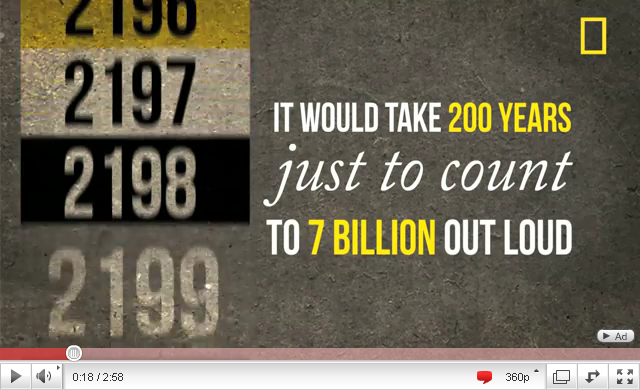
7 Billion, National Geographic Magazine video on typography

The rate at which the human population is increasing is phenomenal. In just 199 years we have gone from a world population of 1 billion to 6 billion. This year, just 12 years after hitting 6 billion, we are going to pass the 7 billion mark.

7 billion is a big number, and this National Geographic video does a good job of making you realize just how big it is. The standout facts for me are that 5 people are born every second, but only 2 people die. That's a population increase of 180 people every minute of the day.
On the flip side to the amount of people there are, we apparently don't take up very much space. Crowd us shoulder to shoulder and 7 billion people only fill an area the size of Los Angeles. In reality we all have our own space, be it a large house or a small shack somewhere in the world.
Still, the world has to cope somehow, and the population is set to increase to 9 billion by 2045. More of us are moving to cities, and overcrowding will become an increasing problem. I don't envy the job of future local governments figuring out how to house us all and clean up after us every day.

World-Population - Wikipedia Commons
Although population issues are politically sensitive, the magazine doesn’t shy away from asking the obvious question:
Right now on Earth, water tables are falling, soil is eroding, glaciers are melting, and fish stocks are vanishing. . . . Decades from now . . . there will be billions more people wanting and deserving to boost themselves out of poverty. If they follow the path blazed by wealthy countries—clearing forests, burning coal and oil, freely scattering fertilizers and pesticides—they too will be stepping hard on the planet’s natural resources. How exactly is this going to work?
Not to keep you in suspense, the article never quite answers its own question. Noting the vastly greater levels of consumption in the developed world, it rightly points out that “how people consume resources matters a lot more” than the total number of people. 

But then it offers another conundrum: “The central challenge for the future of people and the planet is how to raise more of us out of poverty—the slum dwellers in Delhi, the subsistence farmers in Rwanda—while reducing the impact each of us has on the planet.”

A recent report by WWF concluded that the Earth’s productive capacity is already overextended, and that by 2030 the world’s population will need the equivalent of two Earths to meet its resource needs sustainably. As the introduction stated,
The implications are clear. Rich nations must find ways to live much more lightly on the Earth, to sharply reduce their footprint, in particular their reliance on fossil fuels. Put plainly, we have to devise ways of getting as much, and more, from much less.

A distinguished group of scientists, writing in the Proceedings of the National Academy of Sciences in October, reported that slowing the Earth’s population growth could achieve 16 to 29 percent of the greenhouse gas emissions reductions needed to keep the planet from seriously overheating. They pointed out that curbing population growth matters both in the developed world, where emissions are highest, and in the developing world, where emissions are rising fast.

On the other hand, population control clearly isn’t sufficient by itself. A study published in September noted that from 1980 to 2005, China accounted for 44.5 percent of global emissions growth, even as its population growth rate declined.

Jan 3, 2011

Review and remove yourself from Spokeo.com

If you did not see this already...
There's a site called Spokeo.com that's a new online USA phone book w/personal info: pics you've posted on FB or web, your approx credit score, home value, income, age, etc.

How to remove yourself:
Search for yourself on their site (don't buy the access), copy that URL of your page,and then go to the bottom of the page and click on the PRIVACY button to remove yourself.


Copy & repost so your FB friends are aware.

16 Stats About Retirement Crisis That Will Drop Your Jaw

Companies all over America have been dropping their pension plans in anticipation of the time when the Baby Boomers would retire.  401k programs were supposed to be part of the answer, but if the stock market crashes again, it is absolutely going to devastate the Baby Boomers.
  1. Beginning January 1st, 2011 every single day more than 10,000 Baby Boomers will reach the age of 65.  That is going to keep happening every single day for the next 19 years.
  2. According to one recent survey, 36 percent of Americans say that they don't contribute anything at all to retirement savings. 
  3. Pension consultant Girard Miller recently told California's Little Hoover Commission that state and local government bodies in the state of California have $325 billion in combined unfunded pension liabilities.  When you break that down, it comes to $22,000 for every single working adult in California.
  4. According to a recent report from Stanford University, California's three biggest pension funds are as much as $500 billion short of meeting future retiree benefit obligations.
  5. Robert Novy-Marx of the University of Chicago and Joshua D. Rauh of Northwestern's Kellogg School of Management recently calculated the combined pension liability for all 50 U.S. states.  What they found was that the 50 states are collectively facing $5.17 trillion in pension obligations, but they only have $1.94 trillion set aside in state pension funds.  That is a difference of 3.2 trillion dollars.  So where in the world is all of that extra money going to come from?  Most of the states are already completely broke and on the verge of bankruptcy.
  6. According to the Congressional Budget Office, the Social Security system will pay out more in benefits than it receives in payroll taxes in 2010.  That was not supposed to happen until at least 2016.  Sadly, in the years ahead these "Social Security deficits" are scheduled to become absolutely horrific as hordes of Baby Boomers start to retire.
  7. In 1950, each retiree's Social Security benefit was paid for by 16 U.S. workers.  In 2010, each retiree's Social Security benefit is paid for by approximately 3.3 U.S. workers.  By 2025, it is projected that there will be approximately two U.S. workers for each retiree.  How in the world can the system possibly continue to function properly with numbers like that?
  8. According to a recent U.S. government report, soaring interest costs on the U.S. national debt plus rapidly escalating spending on entitlement programs such as Social Security and Medicare will absorb approximately 92 cents of every single dollar of federal revenue by the year 2019.  That is before a single dollar is spent on anything else.
  9. After analyzing Congressional Budget Office data, Boston University economics professor Laurence J. Kotlikoff concluded that the U.S. government is facing a "fiscal gap" of $202 trillion dollars.  A big chunk of that is made up of future obligations to Social Security and Medicare recipients.
State and local governments are scrambling to find ways to pay out all the benefits that they have been promising.  Many state and local governments will be forced into some very hard choices by the hordes of Baby Boomers that will now be retiring.

Jan 2, 2011

China has seen the future, and it is coal

China needs to burn more coal to fire its plants making wind turbines to produce green energyhttp://www.mostpowerfulidea.com/images/Rose_power_9781-330-exp.jpg
...approved construction of a coal export terminal from which millions of tons of U.S. coal could be shipped to Asia annually.

Both Oregon and Washington are curtailing the coal-fired generation of electricity, but the future looks to greens as black as coal. The future looks a lot like the past.

Historian William Rosen (who wrote "The Most Powerful Idea in the World," about the invention of the steam engine) says
HTML clipboard coal was Europe's answer to the 12th-century "wood crisis," when Christians leveled much forestation to destroy sanctuaries for pagan worship and to open up farmland. Population increase meant more wooden carts, houses and ships, so wood became an expensive way to heat dwellings or cook. By 1230, England had felled so many trees it was importing most of its timber and was turning to coal…Half of the 6 billion tons of coal burned globally each year is burned in China. A spokesman for the Sierra Club, which in recent years has helped to block construction of 139 proposed coal-fired plants in America, says, "This is undermining everything we've accomplished." America, say environmentalists, is exporting global warming.
Read full at WashingtonPost

Haase - "Learn from history or become it"

Eco FAIL - This year electronics were #1 gift

epic fail photos - Eco-Friendly Fail

Your personal safety and security online...

HTML clipboardspokeo.jpgSpokeo is a new site that claims to not be your "grandma's phonebook." This is because it pulls a ton of info about you from all over the web into one place. And I mean a ton. More than you might be comfortable with, in fact.

But luckily, it appears you can "remove your Spokeo listing from public searches for free" by following these simple instructions.

Also!: If you visit spokeo.com for any reason, you may want to delete any browser cookies from "spokeo" afterwards. It seems they install a grip of them.
From Boing2

End of days May 21, 2011?

If you've been sucked in by the 2012 Hollywood propaganda, get ready to panic.
"Civil engineer Harold Camping, who has done a bunch of math with calculators and The Bible, and has determined that
the world will actually end on May 21, 2011. "

Oh crap... Not the best gift for my Wife's birthday ;-(

More U.S. cities dimming the lights

USA Today- "It's a broad environmental issue, and it's also a safety issue," Parks says. "It's a pure waste of energy, dollars, and it contributes to greenhouse emissions. ... For every watt of electricity used needlessly, somewhere a coal power plant is generating that electricity."

Dark-sky legislation — laws requiring such measures as shielding outdoor lighting to reduce light pollution — has been embraced by about 300 counties, cities and towns.

HTML clipboard

More than 50 state bills have been introduced in the past two years, and seven were enacted. Eighteen states —Arizona, Arkansas, California, Colorado, Connecticut, Hawaii, Maine, Minnesota, Missouri, New Hampshire, New Mexico, New York, Oklahoma, Rhode Island, Texas, Vermont, Virginia and Wyoming — have adopted dark-sky legislation in recent years, according to Bob Parks, executive director of the Tucson-based International Dark-Sky Association.

The laws have won support in states such as Texas, home to several military bases, because lights at night can interfere with military drills. Trying to simulate flying over remote parts of Afghanistan is difficult when skies are aglow from city-light glare.

OPEC is cheating... $200 Oil is Imminent

Now that the Peak has passed, all sorts of interesting tidbits are emerging.HTML clipboard

Apparently, the oil cartel pumped 26.78 million barrels per day (mmbd) this year. Yet they have a production limit of only 24.845 mmbd, set at the end of 2008 in response to the recession.

So your friendly neighborhood fuel gang has been breaking its output limit by 1.934 million barrels — everyday, all year long.https://blogger.googleusercontent.com/img/b/R29vZ2xl/AVvXsEjcYql0W1NjvVUW3tBSc9ssuZE90UmpbUuOGPPQp4tQDvYyv7hAYj9YgcI4AW9VKV2c5rVIYkv1aexUFT4YGKmEsIvNH94zA8x7gezV3Uc5vcLXCN1re827m9PYtgV2qSgBbKef/s400/Little+Rascals+From+Our+Gang+Comedies.JPG

With crude at its highest price in two years, overproduction allows OPEC members to boost profits without formally changing output targets.

An extra 1.934 mmbd at $80 works out to a nice "informal" $56.47 billion boost.


Analysts, start your engines

If the price of oil creeps high enough, OPEC will officially raise its target to cash in.

$100 seems to be the obvious trigger to make that happen, and the consensus is that it will happen this year.

Oil's at $91.43 as I write this — up 30% from the year's low.

Goldman says it'll "average $100 in 2010 and $110 in 2012." JPMorgan says we'll see $120 by the end of 2012.

Adding to the pricing fire, U.S. stockpiles declined by 19 million barrels this month thanks to intense cold and holiday travel. That's the biggest monthly decrease since December 2006.

I'm sure you've noticed gas station marquee numbers are back on the march.

Read full at energyandcapital

GM after 40 years, still looking for batteries that work.

A 1966 article in ACS' Chemical & Engineering News described a General Motors press conference at which the automaker outlined research work being done on non-gasoline-based automotive power sources, with a heavy emphasis on the electrical.http://www.motifake.com/image/demotivational-poster/0906/general-motors-car-demotivational-poster-1246329086.jpg

At the press conference, GM demonstrated:

  • A working laboratory model of a lithium-chlHTML clipboardorine battery.
  • Electrovan—a hydrogen-oxygen fuel cell-powered GMC van.
  • Electrovair II—a silver-zinc battery-propelled Corvair.

For good measure, GM also described work on gas turbines and the Stirling thermal engine. But the emphasis was clearly electrical. GM is taking a hard look at high energy-density batteries, as are Ford Motor, General Dynamics, Gulton Industries, and others (C&EN, Oct. 24, page 55).

Edward Cole, GM's executive vice president, states that the company is interested in electrical propulsion because "energy conversion is our business." He also hopes for the research to affect other phases of the company's business.

Cole became president of GM in 1967. Anticipating federal air pollution regulations, he directed GM engineers to lower engine compression ratios and to design engines that could be run on unleaded gasoline. Under his leadership, General Motors developed the catalytic converter and introduced it on the 1975 model year cars. In the early 1970s, he also was a major advocate for the improvement of rotary engines.

Resources

Wilderness Vanishing Act of 2011

Wilderness Vanishing Act in Big Cypress:HTML clipboard
VIA - DocuTicker  HTML clipboardhttp://www.ezzal.com/wp-content/uploads/2009/09/dog1.jpgIn one of the most contrived moves in recent memory by a land management agency, the National Park Service has reclassified 40,000 acres of Big Cypress National Preserve land that was eligible for wilderness designation to be ineligible – clearing the way for a network of off-road vehicle (ORV) trails.  This quickie reclassification of lands violates both law and agency policies, according to a legal complaint filed today by Public Employees for Environmental Responsibility (PEER).

Back in 1988, Congress added lands to Florida's Big Cypress National Preserve and directed the National Park Service (NPS) to study which of those lands would be suitable for designation as wilderness.  Two analyses, one in 2002 and the other in 2009, concluded that the vast majority of the 147,000 acres of the Addition lands was wilderness eligible.  In April 20, 2010, Pedro Ramos, Superintendent of the Preserve, signed off on a new "reanalysis" that found only 71,000 acres were eligible.  This stripped wilderness eligibility from 40,000 acres – all of which are about to be declared open for building ORV trails.

This wilderness reanalysis was kept under wraps, contrary to agency policy, and was first unveiled on November 23, 2010, when NPS published its Final General Management Plan/Environmental Impact Statement for the Big Cypress Addition – thus circumventing required public involvement in wilderness eligibility decisions and pulling a bait-and-switch on the public who commented on the draft plan.

* As promised... bad news comes with

International Year of Chemistry 2011

Feature

On 1 January, the American Chemical Society (ACS) began a global, year-long observance of the Intern

ational Year of Chemistry 2011 (IYC 2011) by launching an online calendar that serves as a virtual time machine, transporting the public back to some of the events and great intellects that shaped modern society through chemistry.

Called 365: Chemistry for Life, the calendar links almost 250 days of the year to events triumphal and trivial in chemistry, health, medicine, energy, the environment and related fields.

"This calendar is a wonderful way to spotlight chemistry's contributions to everyday life,"

Jan 1, 2011

New Years Blog Resolution...

I am not one for resolutions. If I could have, should have or would have... then I did.
However, I did notice posts from last year were getting a little depressing with our nations situation.

Environmental, Health and Safety issues always have an element of hope and a positive message.
In 2011 I will exemplify the positives in every post.
If the posts do not have a positive message... I will include a cute or funny picture to reflect that for every negative life has a positive ;-)

Example for "Antibacterial agents are degrading our immune system and  building a army of super bugs"
epic win photos - TL;DR: Budget Hotel WIN

One more good year