Jan 19, 2011

Phytophthora Ramorum: Tree Infection Spreading Like Wildfire

The Guardian  ... a desperate effort to contain a new disease which poses a threat to British forests on a scale not seen since Dutch elm disease wiped out millions of trees, changing the landscape of the country for ever.http://farm4.static.flickr.com/3380/3482730323_7edb896e31.jpg

Already 3,000 hectares of larch forest – one hectare is about the size of a football pitch – in Wales, Devon, Cornwall, Somerset and Northern Ireland are known to be infected by Phytophthora ramorum – sudden oak death – which comes from the same family as the potato blight organism that caused the Irish famines in the 19th century.

Named in the United States, where it has killed millions of oak trees in California, the strain now in the UK had never been seen before by science before it was detected in imported shrubs in a Sussex nursery in 2002.

..."I don't want to scaremonger, but we are very worried," said Roddie Burgess, the head of plant health at the Forestry Commission.

"This disease wasn't even known to science and it shows how people need to be vigilant. Buying locally produced, smaller plants for your gardens wouldn't hurt either; these big imported plants are far more likely to be a risk."


For Hill, 40, who first worked in this wood as a 12-year-old learning forestry from his father, it's difficult to see: "I was due to be coming here to thin this lot, but now we're flattening them all; it's shocking. I'd hoped to be able to bring my son up here, but that's not going to happen now. And they won't be able to replant for a few years, so it's not going to look nice."


"We can put up signs, but can't police it," he said. "People will just ignore the dangers and carry the spores out on their tyres and their boots. People love larch forests because they are open and light and you can see around you and they will really miss them if they go. Everyone is really concerned, especially with the speed at which it kills the trees.

"The next year will be critical. At the moment it's all hands on deck trying to get as many trees down before the spring flush, when they start spreading the infection once more. We've done our bit and got off the mark. It's just down to the phytophthora doing its worst now."
Read more at The Guardian

Chinese scientists make major breakthrough in reprocessing and reusing uranium

Xinhuanet - Chinese scientists have made a breakthrough in spent fuel reprocessing technology that could potentially solve China's uranium supply problem, Chinese television reported on Monday.https://blogger.googleusercontent.com/img/b/R29vZ2xl/AVvXsEh8RxkhVvMfu_P5VXGqvKKmCSACREKKqz6DHviHAMmUa3zUqQbDERYIBeklleApAx6_FBe2nooraKASvzKShixYqaiZKRCwZUQ-b0COkVTSJ-NEz4xu9X03BwpMf_Hl6LGqO-0vDA/s1600/nuclear01.jpg

The technology, developed and tested at the No.404 Factory of China National Nuclear Corp in the Gobi desert in remote Gansu province, enables the re-use of irradiated fuel and is able to boost the usage rate of uranium materials at nuclear plants by 60 folds.

"With the new technology, China's existing detected uranium resources can be used for 3,000 years,"

China, as well as France, the United Kingdom and Russia, actively supports reprocessing as a means for the management of highly radioactive spent fuel and as a source of fissile material for future nuclear fuel supply.

But independent scientists argued that commercial application of nuclear fuel reprocessing has always been hindered by cost, technology, proliferation risk and safety challenges.


China has 171,400 tonnes of proven uranium resources spread mainly in eight provinces ... China is planning a massive push into nuclear power in an effort to wean itself off coal, the dirtiest fossil fuel. It now has 12 working reactors with 10.15 gigawatt of total generating capacity.

China has set an official target of 40 gigawatts (GW) of installed nuclear generating capacity by 2020, but the government indicated it could double the goal to about 80 GW as faster expansion was one of the more feasible solutions for achieving emissions reduction goals.

As such, China will need to source more than 60 percent of the uranium needed for its nuclear power plants from overseas by 2020, even if the country moves forward with a modest nuclear expansion plan, Chinese researchers say.


Read full at Xinhuanet

Steve Jobs condition... is the iPad killing him?

demotivational posters - CUTTING EDGE

Some UK researchers have studied the question on everyone's minds and found that it's true:

Your iPad is killing you.

People who use iPads for 4+ hours a day have a greater chance of dying than people who use them less than 2 hours a day.

The good news, such as it is, is that it's not just your iPad: Your TV is killing you, too. And your Mac. And your PC. And your iPhone. And all things that involve "screen time."

Basically, "recreational sitting," which is what it's called when you play Angry Birds on your iPad instead of say, throwing a baseball outside, increases your odds of having a "mortality event." Interestingly, these increased odds of dying are not just due to your being fatter and more out of shape because you spend more time sitting on your butt.

Here's the summary from the Journal of the American College of Cardiology:

Conclusions: Recreational sitting, as reflected by television/screen viewing time, is related to raised mortality and CVD [cardio-vascular disease] risk regardless of physical activity participation. Inflammatory and metabolic risk factors partly explain this relationship.

Read more about the study here >

Cancer costs projected to reach at least $158 billion

DocUticker - National Institutes of Healthhttp://www.choosehope.com/img/cache/variation/I_didn_t_survive_CA_STRESS_Button_pic_re_do.jpg

Based on growth and aging of the U.S. population, medical expenditures for cancer in the year 2020 are projected to reach at least $158 billion (in 2010 dollars) — an increase of 27 percent over 2010, according to a National Institutes of Health analysis. If newly developed tools for cancer diagnosis, treatment, and follow-up continue to be more expensive, medical expenditures for cancer could reach as high as $207 billion, said the researchers from the National Cancer Institute (NCI), part of the NIH. The analysis appears online, Jan. 12, 2011, in the Journal of the National Cancer Institute.

The projections were based on the most recent data available on cancer incidence, survival, and costs of care. In 2010, medical costs associated with cancer were projected to reach $124.6 billion, with the highest costs associated with breast cancer ($16.5 billion), followed by colorectal cancer ($14 billion), lymphoma ($12 billion), lung cancer ($12 billion) and prostate cancer ($12 billion).

If cancer incidence and survival rates and costs remain stable and the U.S. population ages at the rate predicted by the U.S. Census Bureau, direct cancer care expenditures would reach $158 billion in 2020, the report said.

Report Cancer Prevalence and Cost of Care Projections

Jan 18, 2011

Fuel cell powered ships could be used for smaller marine ships.

NextBigFuturehttp://www.datacenterknowledge.com/wp-content/uploads/2009/02/tmobile-fuelcell.jpg
Molten carbonate fuel cells demand very high operating temperatures (600°C and above) and most applications for this kind of cell are limited to large, stationary power plants. The envisaged initial application is associated with waste heat, industrial processing, and in steam turbines to generate more electricity.

The MC WAP project has developed a molten carbon fuel cell which uses hydrogen obtained from a system that converts diesel oil into a hydrogen-rich gas, and air coming from the compressor of a microturbine. The reaction produces electricity and heat, without combustion.

The energy produced by the current system, corresponds to about 250 kilowatts, and represents one production unit of reserve energy that can power the essential systems on board, such as the control systems, communication, lighting and main auxiliary systems. Although at this time it will not power the propulsion, it will be able to contribute to it in some cases.

Nuclear power already powers hundreds of ships and submarines with clean power to over hundreds of megawatts in new aircraft carriers. Nuclear powered shipping has been operating for several decades.

Fuel cell powered ships could be used for smaller marine ships.

Green Super Rice and reducing world hunger

For every one billion people added to the world's population, 100 million tons of rice (paddy) need to be produced more annually –- with less land, less water, and less labor, in more efficient, environmentally-friendly production systems that are more resilient to climate change and also contribute less to greenhouse gas emissions.

Green Super Rice (GSR) is bred to perform well in the toughest conditions where the poorest farmers grow rice. GSR is a step away from reaching farmers thanks to a major project led by the Chinese Academy of Agricultural Sciences and the International Rice Research Institute (IRRI).
278 page proposed plan for the Global Rice Science Partnership, Sept 2010


Green Super Rice is actually a mix of more than 250 different potential rice varieties and hybrids variously adapted to difficult growing conditions such as drought and low inputs, including no pesticide and less fertilizer, and with rapid establishment rates to out-compete weeds, thus reducing the need for herbicides. More types of Green Super Rice that combine many of these traits are in the pipeline

Green Super Rice is already in the hands of national agricultural agencies in key rice-growing countries for testing and development.

The project has also identified drought-tolerant GSR lines with IR64 as the recurrent parent. For example, IR83142-B-19-B, a GSR line, performs better than Sahbhagi dhan under drought and zero-input (which means no fertilizers and no pesticides, and only one manual weeding) conditions.

In recent years, rice scientists have been forced to face the additional challenge of balancing food security with preserving natural resources and protecting the environment. For IRRI, the key is a doubly green revolution: the development and diffusion of conventional environment-friendly agricultural practices and innovative varieties such as GSR.

Insect-Resistant Genetically Modified Rice in China: From Research to Commercialization

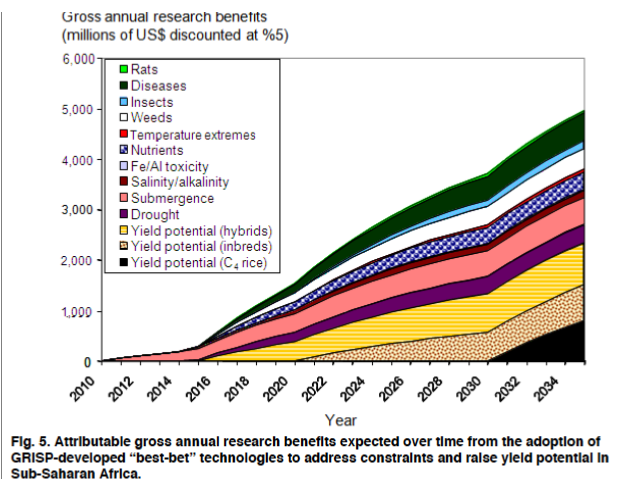
Summary of potential key impacts. Based on these preliminary analyses of a subset
of expected GRiSP benefits, the following key impacts are forecast from the GRiSP:
By 2020:
  • Expenditures on rice by those under the $1.25 (PPP) poverty line will decline by PPP
  • $4.9 billion annually (holding consumption constant).
  • Counting those reductions as income gains means that 72.2 million people would be lifted above the $1.25 poverty line, reducing the global number of poor by 5%.
  • As a result of increased availability and reduced prices, 40 million undernourished people would reach caloric sufficiency in Asia, reducing hunger in the region by 7%. Approximately 275 million tons of CO2 equivalent emissions will be averted.

By 2035:
  • Expenditures on rice by those under the $1.25 (PPP) poverty line would decline by PPP $11.0 billion annually (holding consumption constant).
  • Counting those reductions as income gains means that 150 million people would be lifted above the $1.25 poverty line, reducing the global number of poor by 11%.
  • As a result of increased availability and reduced prices, 62 million undernourished people would reach caloric sufficiency in Asia, reducing hunger in the region by 12%.
  • Nearly 1 billion tons of CO2 equivalent emissions will be averted.
Please read full at NextBigFuture

World's largest carbon sequestration project killing animals and causing explosions.

Carbon sequestration might will not work

The Alberta government has committed $2 billion to similar pilot projects. The United States has committed $3.4 billion for carbon capture and storage.

A Saskatchewan farm couple whose land lies over the world's largest carbon capture and storage project says greenhouse gases seeping from the soil are killing animals and sending groundwater foaming to the surface like shaken soda pop.

The gases were supposed to have been injected permanently underground. 

Cameron and Jane Kerr own nine quarter-sections of land above the Weyburn oilfield in eastern Saskatchewan. They released a consultant's report Tuesday that links high concentrations of carbon dioxide in their soil to 6,000 tonnes of the gas injected underground every day by energy giant Cenovus (TSX:CVE) in an attempt to enhance oil recovery and fight climate change.

"We knew, obviously, there was something wrong," said Jane Kerr.

A Cenovus spokeswoman said the company doubts those findings. She pointed out they contradict years of research from other scientists.

"It's not what we believe," said Rhona Delfrari.


Figure 13. Cumulative Electricity Generating Capacity Additions (gigawatts).  Need help, contact the National Energy Information Center at 202-586-8800.Since 2000, Cenovus has injected about 16 million tonnes of carbon dioxide underground to force more oil from an aging field and safely store greenhouse gases that would otherwise contribute to climate change.

But in 2005, the Kerrs began noticing algae blooms, clots of foam and multicoloured scum in two ponds at the bottom of a gravel quarry on their land. Sometimes, the ponds bubbled. Small animals — cats, rabbits and goats — were regularly found dead a few metres away.

Then there were the explosions.


Not to worry... we have a old report to reference with no long term monitoring.

Delfrari said Cenovus has hired three independent consultants to evaluate Lafleur's work.

She pointed to a 2004 report on the project by Saskatchewan's Petroleum Training and Research Centre, an agency bringing together government, academics and industry. That report found that after four years of injection, there was no indication carbon dioxide was making its way up through 1,400 metres of rock.

... "We're confident that none of (the carbon dioxide) is making its way back to the Kerr property."

"All reservoirs leak. Every one of them."

Lafleur emphasized that most of the carbon dioxide stays underground. But so much is injected that even small leaks can have health impacts.

He said environmental monitoring of the Weyburn project virtually ceased in 2005.

Read more at Winnipeg Free Press


Howard Herzog of MIT's Laboratory for Energy and the Environment said last year,

"How can we expect to build hundreds of these plants when we're having so much trouble building the first one?"


Also note: Capturing and compressing CO2 requires much energy and would increase the fuel needs of a coal-fired plant with CCS by 25%-40%.[2] These and other system costs are estimated to increase the cost of energy from a new power plant with CCS by 21-91%.[2]

Chevy VOLT - "Technically" a 10 million new problems

http://static.funnyjunk.com/pictures/gm_fail.jpgDoes overly complicated = "unreliable"?
The Chevy Volt will be the first car of its type: not because it is a hybrid electric/petrol vehicle, but because GM plans to give each one the company sells its own IP address.

The Volt will have no less than 100 microcontrollers running its systems from some 10 million lines of code. This makes some hackers very excited and Adriel Desautels, president of security analysis firm Netragard, very worried.

Before now, you needed physical access to reprogram the software inside a car: an 'air gap' protected vehicles from remote tampering. The Volt will have no such physical defense. Without some kind of electronic protection, Desautels sees cars such as the Volt and its likely competitors becoming 'hugely vulnerable 5000lb pieces of metal'.

Desautels adds: "We are taking systems that were not meant to be exposed to the threats that my team produces and plug it into the internet. Some 14 year old kid will be able to attack your car while you're driving. "

Read more from Findlay Media

Laptop Is Faster & power consumption halved to less than two Watts

"Not only is power consumption halved to less than two Watts and price of the motherboard reduced, the performance of the next generation OLPC Laptop is actually better for running full Fedora Linux compared to x86. Here's a video interviewing OLPC's CTO, Edward J. McNierney, where he explains how and why OLPC's world class engineers are making this change of CPU architecture. If OLPC XO-1 threatened Intel enough to start the netbook market and has reached two million poor kids in third-world countries thus far - SlashDot

Four More Wind Powering America Free Webinars

EERE - Start off 2011 by joining Wind Powering America this Wednesday, January 19, at 1:00 p.m. MST (3:00 p.m. EST) to kick-off its 2011 monthly Webinar series. Wind Powering America will host a discussion about new and exciting wind workforce development initiatives. 

hp_wpa_photo_head.jpg

The Webinar is free; no registration is required. Login information is available.

Wind Powering America hosts FREE live Webinars on a variety of themes on the third Wednesday of every month. Audio visual and transcript archives of the Webinars are posted on the Wind Powering America Web site after the events.

First Four 2011 Webinars
Click on any of these future Webinars below for login information. Stay up to date on these Webinars and other Wind Powering America activities by signing up for our biweekly newsletter.

Jan 16, 2011

Our dreams shall be recognized in the words of Martin Luther King Jr.

"Our lives begin to end the day we become silent about things that matter." - Martin Luther King Jr. HTML clipboard
HTML clipboard
Observed on the third Monday of January each year, Martin Luther King Jr. Day marks the anniversary of the birth of civil rights leader Reverend Martin Luther King, Jr..
 
In 1994, the Congress initiated the King Day of Service to transform the federal holiday honoring King into a national day of community service grounded in his teachings of nonviolence and social justice. As our nation makes progress toward realizing King's dream of racial equality, the work to achieve liberty and justice for all is never-ending.

Following in the footsteps towards equality... the historic signing of the "Hate Crimes Prevention Act" President Barack Obama reflects the real advances our nation has made in the fight against the bigotry and hate that King opposed. Further supporting the original 1964 Federal Civil Rights Law, 18 U.S.C. § 245(b)(2) and subsequent 1969 federal hate-crime law (18 U.S.C. § 245(b)(2)) 

To mark the 25th anniversary of the holiday, and to continue the momentum for the MLK Day of Service throughout the year, on Monday the White House is launching the MLK Day: What Are You Doing for Others? | The White House
HTML clipboard
http://www.winslow-schools.com/Portals/8/DrMartinLutherKingJr.jpg
The King Legacy of Service 25th Anniversary video tells the story of how Dr. King's birthday evolved into a national day of service. Featuring civil rights luminaries such as Congressman John Lewis, Reverend Dr. Joseph Lowery, and Ruby Bridges, the video reminds us of the importance of keeping Dr. King's legacy of service alive and challenges us to make service a part of our lives - everyday of the year. Watch the Video

Listen, learn, love... 
 
HTML clipboard
Haase - His words and ideals immortally preserved in my mind and soul, Martin Luther King will be missed today and always.

Food skyrockets to highest prices ever... as poverty soars

"Due to the recession there are now 15,000 less lawyers. Nobody ever talks about the good things that happen because of the recession." –Jay Leno  

NaturalNews - The povertization of America is a real problem, and it is one that has been slowly escalating for quite a while. But more government intervention in the form of taxes, regulation, and control, is not the answer to the problem. If Americans ever hope to regain their freedom -- which includes the freedom to prosper and not be chained to the slavery of an overtaxing, overburdening central government -- they will have to forcibly decouple themselves from these yokes of slavery that are not only constraining them, but now slowly starving them.
HTML clipboard


First, investors and banks gambled with your retirement... now your lives.
The Food and Agriculture Organization (FAO) index of 55 food commodities indicates that worldwide food prices hit a record high in December..."food inflation" will occur right alongside the commodity price gains. And rapid food inflation has already taken place in India, for example, with recent reports indicating that the country experienced an overall food inflation rate of 18 percent in 2010. - BloomBerg


Get in line for your government cheese
Those who insist the "recession" is over might want to tell that to the nearly 50 million people, and growing, in the U.S. that are now considered to be "food insecure," or unable to provide food for themselves and their families. According to Chaz Valenza, a New Jersey-based writer and small business owner, thousands of Americans that were once considered middle and even upper-middle class are now entering the ranks of the poor and hungry.
http://www.cluelessemma.com/.a/6a00e54efc9d1088340120a57fb843970c-pi
For many, job losses and perpetual unemployment landed them in line at the local food bank. But for a surprising many others, inflation and the many sectors of life that are affected by it drove their otherwise stable middle class incomes into the category of poverty. And based on the way it looks, things are only going to get progressively worse for many more Americans if things do not change.

Valenza explains in his article that while America's poverty crisis is nowhere close to various third-world countries where people live on mere cents a day, the trend towards poverty in the U.S. is on the rise in a way that would shock most people. Many folks who work the same amounts or even more than middle class people did just a few decades ago, for instance, are barely making ends meet today. And except for those who are financially independent, even some of the wealthiest among us are only a paycheck or two away from the bread line.


Related?
 Can Unemployed Older Workers Find Work? 
Job loss during the Great Recession is upending retirement savings plans for many older workers. Fewer than a quarter of workers age 50 and older who lost their jobs between mid-2008 and the end of 2009 found work within 12 months, much lower than the reemployment rate for younger workers. Older displaced workers who find jobs must often accept deep pay cuts. These challenges highlight the need for more training and employment services for those 50 and older Full Report here

Education is Not the Cure for High Unemployment or for Income Inequality...
With signs pointing to persistent high unemployment and a recovery even weaker than those of the early 1990s and 2000s, it is becoming common to hear in the media and among some policy makers the...Full PDF

 
Sources for post:
Chaz Valenza - "WordsWillNever"


NOTE: I post articles because I think they are of interest. Doing so doesn't mean that I necessarily agree with every—or any—opinion in the posted article. This includes photos ;-)

200 Dead Cows Found In Wisconsin Field

An investigation is under way after 200 dead cows were found in a field in the Town of Stockton.

The Portage County sheriff's office says the owner of the cattle has been working with a local veterinarian and it's believed the animals died from the IBR/BVD virus. The virus can cause respiratory and reproductive problems.

Read more at JSOnline

Third-Largest Maker of Solar Panels in the U.S. Moves Factory to China

New York Times: HTML clipboardAided by at least $43 million in assistance from the government of Massachusetts and an innovative solar energy technology, Evergreen Solar emerged in the last three years as the third-largest maker of solar panels in the United States. But now the company is closing its main American factory, laying off the 800 workers by the end of March and shifting production to a joint venture with a Chinese company in central China. Evergreen cited the much higher government support available in China.

Beyond the issues of trade and jobs, solar power experts see broader implications. They say that after many years of relying on unstable governments in the Middle East for oil, the United States now looks likely to rely on China to tap energy from the sun...
Read on at
New York Times

Happy Meal Ban Idiocy - Give Me a Break...

Is Mc Donalds a bad choice to eat as a treat? Nope.
Is it a bad choice to eat everyday? Yep.

No one likes simple math... instead we feel the need to blame someone else for our lack of parenting and self control.

San Francisco's Happy Meal Ban
www.thedailyshow.com


In this classic "Stewart", the leader of SF fun food control defines both a failure in food education and self control, while proving that guidance and parenting are strong tools for educating our youth on nutritional balance.


Jan 15, 2011

Airborne Prions Prove Lethal In Studies

"Wired has a story up on the lethality of airborne prions. It should be noted that prions (which cause 'mad cow disease' and similar disorders) are not normally airborne, and take a long time to kill the infected animal, but so far are 100% lethal if something else doesn't kill the animal first. So, they are not likely to be useful as a biological weapon (my first thought when reading their headline), but they present another safety precaution to consider."

Read more of this story at Slashdot.

Customers face huge bill for wind farms that don't work in the cold

The Daily Mail UK reports on the unexpected consequences of the colder than normal British winter:

    The failure of Britain's wind farms to produce electricity in the extreme cold will cost billions of pounds, create an economic crisis and lead to blackouts, leading industrialists have warned.
HTML clipboardhttp://seeineye.free2explore.com/wp-content/uploads/2010/02/frozen_wind_turbine.jpg
    To cover up the ineffectiveness of wind farms the Government will be forced to build emergency back-up power plants, the cost of which will be paid by industry and consumers.

    … Industry regulator Ofgem has already calculated that the cost of achieving sustainable energy targets – set by Brussels but backed by the British Government – will amount to £200 billion, which will mean that annual household fuel bills will double to about £2,400 on average within the next ten years.

    In the last quarter ending December 23, wind turbines produced on average 8.6 per cent of our electricity, but the moment the latest bad weather arrived with snow and freezing temperatures, this figure fell to as low as 1.8 per cent.

    The slack was immediately taken up by efficient, but dirty, coal-fired power stations and oil-fired plants.

Jan 14, 2011

Get your rock star scientist posters

COAL - The most costly energy project in state history is done.

What is Wisconsin's state of the art, one of the most efficient energy plants in the country, powered by you ask?
Old King COAL - FAIL

After five years, six months and two weeks, the We Energies Oak Creek power plant project is finished.

The second of two coal-fired power plants was completed Wednesday, the utility told securities regulators in announcing a key milestone for the more than $2 billion project. That's more than the combined cost of building Miller Park and rebuilding the Marquette Interchange.

Our future of power in Wisconsin is Sooo 1890's
"This was the largest privately funded construction project in the state, and it was done during a period w
ere there was quite a bit of volatility in terms of labor supply and the cost of commodities," said Rick Kuester, chief executive of We Power, a Wisconsin Energy subsidiary that runs the utility's power plants.

The plant is among the five most efficient coal plants in the country, which results in comparatively less pollution compared with older coal plants.

"We think it's going to provide a lot of value for the customers of We Energies for a long period of time," Kuester said. "Coal supplies 50% of the energy in this country" and will remain a key source of energy going forward, even as regulations prompt utilities like We Energies to consider adding pollution controls or replacing older coal plants.

Pushing rates, costs and budgets to historic levels

The biggest unknown: the project's final cost. We Energies will file reports detailing the final cost this year when it seeks to adjust rates for 2012 and 2013, Kuester said.

Regulators approved a $2.15 billion price tag for the project, and set a cap allowing overruns of up to 5% to be passed along to utility customers. http://www.ucsusa.org/assets/images/ce/ucs-rpt-coal-5-thumbnail.jpg

"We hope customers won't have to pay for any cost overruns associated with the construction of the power plants," Charlie Higley

We Energies ratepayers have seen steady price increases in recent years to pay for the project, including a 17% rate increase in 2008 that was implemented in phases (
I am sure their record earnings up at least 17% from 2009 is just a coincidence ;-), with the final installment hitting customers this month. The latest increase this month sent monthly power bills for the typical residential customer past the $100 mark for the first time.

...The project is being completed at a time when the recession has cut demand for power sharply, resulting in an investigation by the state Public Service Commission about whether power plants should be idled or shut down because of a power glut.

Read full at JSOnline

Jan 13, 2011

'Cash for Clunkers' modeled after European failure

Most Americans wouldn't know it, but the Cash for Clunkers model originated in Europe in the mid-1980s.
The idea was two-fold:  
(1) get high-polluting and fuel-guzzling "clunkers" off the road and
(2) stimulate new car sales. It was called "Prime à la Casse."

Over the years, European governments with large national production (Germany, Italy, Spain, the United Kingdom) implemented similar programs, and even states with little if any production (Luxembourg, Ireland) joined in, says Victor Dial, former chairman and general manager of Ford France.

When the Cash for Clunkers program started in America in 2009, Dial admits he was surprised at the almost immediate outcry from economists, pundits and, yes, citizens, denouncing it as wasteful. They were, of course, right: It pulls forward new car sales, but it also scraps perfectly good, serviceable vehicles, thus lowering supply and driving up used-car prices, says Dial.

Read more at NCPA

Also see
Cash for Clunkers cost taxpayers $24,000 per vehicle sold of 625,000 cars sold through Cash for Clunkers...Duke University helps you Do the math

Watch full of Unintended Consequences here  by inflation.us

Bird deaths just a fraction of real death toll

Shortly after midnight on January 1st, thousands of red-winged blackbirds fell from the sky in Beebe, Arkansas. Some were outright dead, others mortally wounded, all were found to have suffered severe injury through blunt-force trauma. While there has been speculation around a number of hypotheses including a climate change-driven weather phenomenon and even a fluctuation in the earth's magnetism...

However, these deaths represent just a fraction of the true impact humans have on birdlife.

"There are many human-related causes of bird mortality including buildings, outdoor cats, pesticides, communication towers, automobiles, wind farms, and lead poisoning from spent ammunition and lost fishing tackle." said American Bird Conservancy Vice President, Mike Parr. "But because most of the deaths from those sources often occur in ones or twos, they often go unnoticed or unreported."

In total, says Parr, studies have estimated that up to one billion birds may be killed annually due to collisions with buildings. Another billion fall prey to domestic cats. Up to 50 million birds are killed each year after hitting communications towers, and pesticide poisoning has been linked to the deaths of up to 15 million birds each year.

In addition to all these hazards, the increasing presence of wind turbines is a threat to many birds, especially when they're built in the path of migration routes.

"When you look at the totality of human-caused threats to birds, it has got to give cause for serious concern about our cumulative effects on their populations," Parr said.


Read more at mongabay

The Chinese Eco-Disaster

http://hanopolis.com/media/2010/12/rabbit_2.JPGWhen Jonathan Watts was a child, he was warned: "If everyone in China jumps at exactly the same time, it will shake the earth off its axis and kill us all."

Three decades later, he stood in the gray sickly smog of Beijing, wheezing and hacking uncontrollably after a short run, and thought: The Chinese jump has begun.

He had traveled 100,000 miles crisscrossing China, from Tibet to the deserts of Inner Mongolia, and everywhere he went, he discovered that the Chinese state had embarked on a massive program of ecological destruction.

It has turned whole rivers poisonous to the touch, rendered entire areas cancer-ridden, transformed a fertile area almost twice the size of Britain into desert—and perhaps even triggered the worst earthquake in living memory.


Read more at the SLATE

More people die from antibiotic resistant bacteria than AIDS, car accidents & prostate cancer combined.

Dan Rather, a 22-year-old Marine Corps recruit. Dan Rather - "Crisis" is not too strong a word for describing what has happened to antibiotics. As our use of the drugs rises every year in the United States, bacterial resistance has risen right alongside it: there isn't a single known antibiotic to which bacteria have not become resistant.

Every year, more than ninety thousand Americans die from infections that have become resistant to antibiotics. That stunning figure is higher than the death toll from AIDS, car accidents and prostate cancer combined.

Seven decades since the discovery of antibiotics, it's clear that science still cannot keep pace with bacteria. Dr. Stuart Levy, a professor of molecular biology at the Tufts School of Medicine and one of the world's leading medical authorities on antibiotics, says the cause of the crisis is not in dispute: we are simply using too many antibiotics.

Please read more by Dan Rather


Cool photo of Dan Rather as 22 year old Marine from achievement.org

Jan 12, 2011

UPDATED- EPA Superfund, TRI, EPCRA, RMP and Oil Information Available

The following is an update from EPA's Superfund, TRI, EPCRA, RMP & Oil Information Center:
On December 16, 2010, EPA released the 2009 TRI National Analysis, an annual report that displays EPA's analysis of the most recent TRI data.  It includes a variety of documents and Web sites that outline national and local trends in toxic chemical disposal or other releases to the environment, as well as trends in toxic chemicals managed by TRI facilities. 

For 2009, EPA has added three new resources
into the National Anal
ysis including an overview of the National Analysis with additional context and explanation, briefing slides that show high-level messages and trends, and three geographic-specific analyses that highlight urban communities, large aquatic ecosystems, and Indian country and Alaska Native Villages.

In reporting year 2009 (RY09), 20,797 facilities reported 3.42 billion pounds of toxic chemicals disposed of or otherwise released into the environment, down 12% from 2008 to 2009.


Access to the 2009 National Analysis is available at the following URL:
www.epa.gov/tri/tridata/tri09/nationalanalysis

High speed rail Outsourcing Jobs and Million$ to China

TPR - Stimulus outsourcing: Foreign countries eye big bucks in high speed rail
The Chinese want in on the state's fledgling high-speed rail project. They're eager to help bankroll and build the system and, eventually, provide the trains to operate on the tracks. China's not alone. Eight nations have agreements with the California High-Speed Rail Authority to share information about high-speed rail -- and each wants a piece of California's business.


"Other countries want to be a part of this because they know high-speed rail can be profitable," said Jeffrey Barker, the authority's deputy executive director. "Their ultimate interest is operating the system."  Read on at Sacramento Bee


RE: "high-speed rail can be profitable"
The idea of taxing the poor and working class to subsidize luxury rides for the wealthy is called tyranny.

Our nation was built on rail that provided  jobs and transportation FOR the poor and working class.

Through three generations -  my father, grandfather and I use to jump trains in Sheboygan, WI with either a token or a "hobo invite".

The MASSIVE problem with the proposed "HighSpeed Rail for the Rich" is that it can't provide affordable rides for individuals who can't afford transportation and it is really hard to jump on a 120mph train ;-)

Jan 11, 2011

Household sewage: Not waste, but a vast new energy resource

http://c1.planetsave.com/files/2010/08/geneco_BioBug_process_356.jpgphysorg a finding that gives new meaning to the adage, "waste not, want not," scientists are reporting that household sewage has far more potential as an alternative energy source than previously thought. They say the discovery, which increases the estimated potential energy in wastewater by almost 20 percent, could spur efforts to extract methane, hydrogen and other fuels from this vast and, as yet, untapped resource. Their report appears in ACS' journal Environmental Science & Technology.

Elizabeth S. Heidrich and colleagues note that sewage treatment plants in the United States use about 1.5 percent of the nation's electrical energy to treat 12.5 trillion gallons of wastewater a year. Instead of just processing and dumping this water, they suggest that in the future treatment facilities could convert its organic molecules into fuels, transforming their work from an energy drain to an energy source. Based on their research, they estimate that one gallon of wastewater contains enough energy to power a 100-watt light bulb for five minutes.

Only one other study had been done on , and Heidrich thought that the results were too low because some energy-rich compounds were lost to evaporation. In the new study, the scientists freeze-dried wastewater to conserve more of its energy-rich compounds. Using a standard device to measure energy content, they found that the wastewater they collected from a water treatment plant in Northeast England contained nearly 20 per cent more than reported previously.
More information: "Determination of the Internal Chemical Energy of Wastewater", Environmental Science & Technology.

Provided by American Chemical Society portal.acs.org


Georgia Man Fined for Growing Vegetables

An Atlanta-area man is facing fines of up to $5000 for growing too many vegetables on his land.http://www.gardenrant.com/my_weblog/images/2008/05/30/arborvitae.jpg

Steve Miller (not Steve Miller of classic rock fame), has had an organic vegetable garden on his property for years. He grows food for himself and has even sold some of his bounty at local farmers markets.

He received his first citation from code enforcement back in January and has since incurred $5000 in fines. The tricky thing here is that after citations in January and February, Miller got his property rezoned to allow his garden. The county is still suing him for the fines related to the earlier charges.

Here is an interview with Miller and his attorney from WSBT:

The question I have is how did code enforcement find out about Miller's garden in the first place? Code enforcement isn't in the habit of randomly dropping in on properties – did someone complain?

Have you guys run across zoning laws that prevent large-scale gardens? I know many areas have laws restricting things like backyard chickens, but this is the first case I've heard involving edible plants.

Source: WSBTV   (via eatdrinkbetter)

Jan 9, 2011

James Hansen... Carbon tax or we all die

Hansen (In a Al Gore Style)  Tax on carbon is the "The only way to save our planet" - Independent

It sounds a little nutty becasue it is... however it is less nutty that most things Hansen proposes. And lord knows this may work as governments LOVES the idea of controlling resources through taxes. Worked great throughout history ;-)
My commnets from 2009 : As OECD countries begin to tax their own economies by charging growing fees on CO2 emissions, their their trading partners will diminish rapidly.... killing the GDP of those countries whose supply chains depend on OECD countries.
FACT: Developing World - Principal Source of Emissions.
Total global emissions have risen by a cumulative 25% since the beginning of the decade. But only a small fraction of those emissions came from North America, Western Europe and OECD economies. In fact, emissions in the most advanced economies of the world have grown by a paltry 5%, one-tenth the 50% increase seen of the developing world. This completey removes the aurguemnt of cap and trade measures being 'the most effective way to control greenhouse gases is through a cap and trade mechanism'.
Who and what are we controlling and why?
I would agree that the taxing of high carbon unsustainable commodities is a strong tool to fight for longterm conservation and sustainable communities... but blanket taxing the resources that economically sustain basic energy, health and infrastructure to non-OECD nations will only continue a sustainable economy for coffin makers.
 
Trading markets for 'co2' and 'carbon' ideas of clean coal, biofuel harvested from rainforest's and food pools?
Seriously, these are the same people who brought you the pet rock and bottled energy water.
I don't feel sorry for the gullible until they invest the future of others on magic beans.
What about this? world's oldest economic instrument, the tax, hasn't worked and cannot work.
This post by James Greyson explains why a carbon-only focus hasn't worked and cannot work.
Governments have invested a grand total of nothing at all in researching new kinds of economic instruments that work with all kinds of resources including fossil carbon. Nevertheless such an instrument has been designed, a version of insurance that requires neither taxes nor caps. It implements the 'circular economy' described in China's national plan and would boost rather than suppress economic growth.

HTML clipboard

HTML clipboard

Circular Economics

Boulding envisaged the economy taking part in a "cyclical ecological system which is capable of continuous reproduction of

http://greenthinkinchic.files.wordpress.com/2010/10/tree-in-hand.jpg?w=400&h=321

material form even though it cannot escape having inputs of energy." This is not academic: China's 11th five year plan for 2006-2010 established a national goal of circular economics, "It is an overall, urgent and long-term strategic task for China to vigorously develop the circular economy" (Zhou, 2006). The future for growth is circular economics where more economic activity would mean a faster pace of change away from waste-making and towards looking after the world and all its inhabitants. This would preserve and regenerate material value, co-operation and natural capital instead of losing it, so growth would work to build the basis for more growth. Today this may appear idealistic. Yet if circular economics was already practiced, and people were accustomed to prosperity based on resource security, then any proposal to adopt an exploitive self-defeating vision would be laughable.
 
HTML clipboard

Precycling

Economic dependence on waste is perpetuated by managing waste primarily as an addiction to disposal, "how can we get rid of all this junk?" The 'waste hierarchy' (reduce, reuse, recycle, then dispose) that has been available since 1975 (European Union, 2008) is commonly quoted but in practice the bulk of effort and funding provides for continuing long-term disposal to ecosystems (by landfill, waste-burning and pollution). The waste hierarchy is being used backwards and no nation has yet attempted to create the incentives for an economy that grows from the work done to end waste dumping and implement circular economics. This is achievable with the concept of 'precycling' (O'Rorke, 1988) originally used for public waste education. Precycling is applicable throughout an economy (Greyson, 2007) and may be understood as action taken to prepare for current resources to become future resources. The 'pre' prefix emphasises that this cannot be arranged after something becomes waste; it must be done beforehand. The scope of action extends far beyond recycling, to creating the economic, social and ecological conditions for all resources to remain of use to people or nature.

  Do All The Good You CanHTML clipboard

A free market in harmony with nature

Precycling insurance would switch the power of markets to reversing the planet crunch. The speed and scale of change would exceed the expectations of all who are accustomed to ineffectual controls designed to make markets less-bad. All market participants (such as buyers, sellers, investors and governments) would adapt their decisions to the new incentives, profiting by addressing actual needs rather than superficial consumerist wants. Producers would remain free to choose how to meet customers' needs without waste, and even free to continue making wasteful products, in competition with other producers cutting their costs (including precycling insurance costs) by cutting their product's waste risk. Economic growth would no longer be a competitive scramble between people rushing to acquire and discard ever more resources from an every-shrinking stock. The economy would prosper in harmony, rather than in conflict, with nature.


Shrinking material and energy demands

The material requirements of today's linear economy would rapidly shrink since the new incentives would lead to the most needs being met with the least materials moved the least distance and then regenerated rather than dumped. The energy requirements of today's linear economy would rapidly shrink since a smaller material flow with higher quality materials closer to where they are needed requires less energy to process. For example, a factor 10 improvement in resource productivity would dampen energy requirements by up to 80% (Schmidt-Bleek, 2008), putting renewables within easy reach world-wide and putting waste-making energy sources (such as new coal-fired plants, nuclear, food or forest-consuming biofuels and mixed-waste incineration) back on the shelf. Shrinking energy dependence is the key to energy security, economic recovery, climate restabilisation and prevention of conflict over diminishing non-renewable resources. The resource and energy efficiency of circular economics makes it realistic to plan the necessary reductions in GHG concentrations (ie net-negative emissions).

Oil companies will drill offshore with no environmental review

AP Yahoo News, "The decision is a victory for the drilling companies, which in the past had routinely won broad waivers from rules requiring detailed environmental studies. After the BP disaster, the Obama administration pledged it would require companies to complete environmental reviews before being allowed to drill for oil."

The AP reports that 10 of those 13 are drilling exploratory wells; the same kind that BP was drilling when disaster struck.

The companies still must comply with other revised policies and standards, such as the new safety rules and specific requirements for equipment like blowout preventers (the device that notoriously failed after the explosion that caused the BP spill).

But the companies nonetheless get to skirt the full environmental review Obama promised offshore drilling projects would have to face, and mostly due to political reasons: The administration has been under persistent pressure to ease up its stance on drilling from politicians in the Gulf and from the GOP in general.

Read more from a hugger