Jun 23, 2009

Supercritical savings Nuclear Reactors

FROM nextbigfuture
The capital cost of the basic design compared to a helium Brayton cycle is about the same, but the supercritical COB2B cycle operates at significantly lower temperature.
The thermal efficiency of the advanced design is close to 50% and the reactor system with the direct supercritical COB2B cycle is ~ 24% less expensive than the steam indirect cycle and 7% less expensive than a helium direct Brayton cycle. It is expected in the future that high temperature materials will become available and a high performance design with turbine inlet temperatures of 700P o PC will be possible. This high performance design achieves a thermal efficiency approaching 53%, which yields additional cost savings. [Current nuclear reactors are at about 35% thermal efficiency, and some newer designs will have 40-45%]

The turbomachinery is highly compact and achieves efficiencies of more than 90%. For the 600 MWBthB/246 MWBeB power plant the turbine body is 1.2 m in diameter and 0.55 m long, which translates into an extremely high power density of 395 MWBeB/mP 3P. The compressors are even more compact as they operate close to the critical point where the density of the fluid is higher than in the turbine. The power conversion unit that houses these components and the generator is 18 m tall and 7.6 m in diameter. Its power density (MWBeB/mP 3 P) is about ~ 46% higher than that of the helium GT-MHR (Gas Turbine Modular Helium Reactor).

Information from a 2004 MIT study that is 6.6 megabytes and 326 pages.

H/T Kirk Sorenson at thoriumenergy for his article "Supercritical CO2 is dense like water".

More information on supercritical carbon dioxide at wikipedia

HUGE 30% reduction in rail fuel consumption and cost from CHINA

From the "next big future"-  China is installing two prototype magnetically levitated (maglev) systems for transporting coal in Inner Mongolia in an attempt to increase transport speeds and efficiencies, and to reduce pollution. Cost studies show $0.13 to 0.017 per ton-mile depending upon the length of magnetic pipe. Rail and truck costs are in the $0.35 to 0.05 per ton-mile cost range.

Magplane Magpipes
Magplane Technology designs and fabricates pipeline transport systems using the linear synchronous motor technology developed for the Magplane system. Typical applications for pipeline transport range from priority mail packages to ore transport. A typical ore application would have an underground pair of 60 cm diameter pipes for outbound and returning capsules, and typically carry 10 millions tons per year over a distance of 50 km. A 15 page pdf "Capsule Pipeline Transport Using An Electromagnetic Drive"


Truck and Rail Freight Statistics Updated
Treehugger reports on the latest efforts to increase the efficiency of rail and truck freight transportation costs.
State-of-the-art trucks can begin to approach the ton-miles per gallon of trains (350+ ton-miles for trucks vs. 400 to 450 ton-miles for rail).

RMI's [Rocky Mountain Institute - energy efficiency evangilists] 2008 peer-reviewed analysis, based on tested science, found a combination of improved aerodynamics, low rolling resisitance tires, and more efficient engines could more than double the ton-mileage of the average class 8 truck from 130 ton-mile per gallon to 275 ton-mile/gallon.

This is mostly theoretical improvements which have not been implemented even in a real life test trial. Walmart has the goal of achieving these level of efficiency gains for its truck fleet by 2015

US Bureau of Transportation Statistics (BTS) show that pipelines move about 20% of the nations freight.

US Bureau of Transportation Statistics (BTS) costs of freight transporation by mode

Air 82 cents per ton mile
Truck 26 cents per ton mile
Rail 2.9 cents per ton mile
Barge 0.72 cents per ton mile (2001)
Pipeline 1.49 cents per ton mile (2001)


RAND study of rail versus truck freight external costs in accidents and pollution. Magnetic pipelines would have lower external costs as well as lower energy costs. Only barges would have lower costs. Barges have more pollution and barges need to have a sufficiently deep waterway to allow for transportation. The magnetic pipeline is faster than a barge.


2008 Canadian Railway study of rail trends. (38 page pdf)

Energy use by mode of freight transportation according to the CBO (Congressional Budget Office.)

Oil pipelines use only 500 BTUs (British Thermal Units) per ton-mile (280 ton-miles per gallon of diesel fuel), but they are limited by their very specialized function. The efficiency of inland barges (990 BTUs per ton-mile or 140 ton-miles per gallon on average), is likewise offset by the roundaboutness or circuity of most rivers. Also, significant amounts of energy may be required to bring cargo to a waterway system: grain and other farm products are sometimes trucked 200 miles to a river, increasing energy use per ton-mile by 50 percent or more.

The efficiency of rail transportation varies considerably depending on the commodity and the level of service provided; at one extreme, unit trains designed to carry only coal typically require less than 900 BTUs per ton-mile of cargo (155 ton-miles per gallon), while at the other extreme high-speed short trailer-on-flat-car (TOFC) trains use about 2,000 BTUs per ton-mile of cargo (68 ton-miles per gallon).

Intercity trucks require on average about 3,400 BTUs per ton-mile of cargo (41 ton-miles per gallon), twice the rail average and 1.7 times that for rail TOFC.
It is not surprising that trucks require more energy since they provide a generally higher level of service than rail.

The real energy & environment problem... why there will not be enough.

I am amazed by the people who believe our 'energy crisis' is a U.S. problem and the U.S. can solve it with a handful of G20's on board...
Yes we have issues. Yet, unlike 99% of the world we have viable and nearly inexhaustible options (a few OECD countries do).

The non-OECD countries of suffering do not have the efficiencies , regulations, funding or incentive to change and now the are not only the largest (and growing) CO2 and global emission generators, they now exceed OECD countries

From the wire:
“Energy consumption from non-OECD countries has passed OECD countries for the first time ever,” reports Chris Mayer, with BP’s latest Statistical Review of World Energy report in hand. “OECD stands for the Organization for Economic Cooperation and Development. There are 30 members. Essentially, it is a group of “Western” countries, including the U.S and U.K., along with several other European countries.

“Non-OECD countries include everyone else -- most notably, China, India, Russia and Brazil.
So you can look at the OECD broadly as developed countries versus the developing countries of the non-OECD.

“The Asia-Pacific region alone accounted for 87% of consumption growth. China by itself accounted for 75% of the increase. Even through the economic bust, Chinese demand for oil still rose 7% in 2008.

“My guess is that these lines won’t ever cross again, unless the membership of the OECD shifts. The world has changed in a fundamental way. The focus is east, not west.”

EPA guide to save Millions$

EPA Issues Clean Energy Guidebook To Help States Save Money, Reduce Greenhouse Gas Emissions

EPA today released a first-of-its-kind guide to help states save money and reduce greenhouse gas emissions by adopting clean energy practices in their facilities, operations and vehicle fleets.

States spend about 10 percent of their operating budgets on energy bills, yet these costs can be greatly reduced by implementing well-designed energy management and greenhouse gas reduction programs. For example, in New York, where a 2001 executive order directed state agencies to reduce energy consumption by 35 percent by 2010 relative to 1990 levels, the state saved $54.4 million in energy costs from energy efficiency improvements between fiscal years 2001-2002 and 2003-2004.

EPA’s Clean Energy Lead by Example Guide helps states identify key strategies, resources and tools best-suited to their energy needs. Each strategy has been tested and is proven to be cost effective.Download here - Clean Energy Lead By Example Guide (PDF)

Jun 21, 2009

fungus could wipe out more than 80% of world wheat crops?

Odd but good link from Bruce who had been wondering whether to post this, since it's not really a security threat -- there's no intelligence by the attacker: (Click image of spread using RustMapper)
Crop scientists fear the Ug99 fungus could wipe out more than 80% of worldwide wheat crops as it spreads from eastern Africa. It has already jumped the Red Sea and traveled as far as Iran. Experts say it is poised to enter the breadbasket of northern India and Pakistan, and the wind will inevitably carry it to Russia, China and even North America -- if it doesn't hitch a ride with people first.

"It's a time bomb," said Jim Peterson, a professor of wheat breeding and genetics at Oregon State University in Corvallis. "It moves in the air, it can move in clothing on an airplane. We know it's going to be here. It's a matter of how long it's going to take."

Read full from LA Times


Always good to read comments by the guys at 'Schneier on Security' who 'balance the actual threat of it'. - Haase

New Scientist - "This thing has immense potential for social and human destruction.' Startling words - but spoken by the father of the Green Revolution, Nobel laureate Norman Borlaug, they are not easily dismissed..."The famines that were banished by the advent of disease-resistant crops in the Green Revolution of the 1960s could return, Borlaug told New Scientist." As I understand it, what they're worried about now isn't so much the destruction of industrialized nations' wheat crops, but those of third-world countries.

On the The RustMapper - coloring of reportage ranged from the dire — “‘Stem rust’ fungus threatens global wheat harvest,” said The Guardian – to the mildly triumphant — “Scientists gain in struggle against wheat rust,” said the AP. For the science, click here or here, for the layman terms..

Third world Oil Wars 'We are fighting for our lives and our dignity'

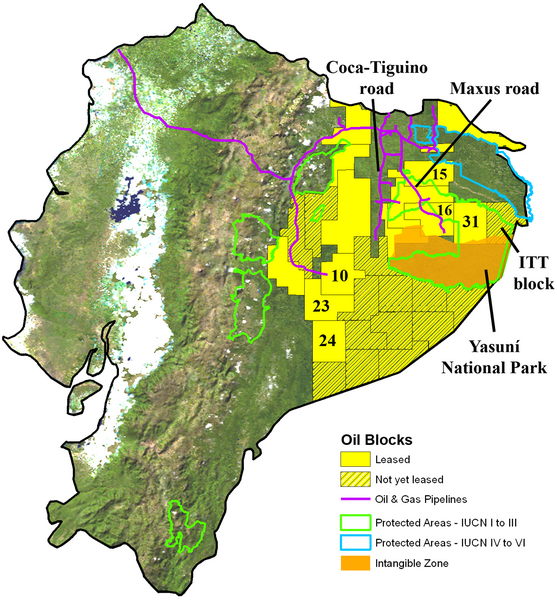
Link TRP - It has been called the world's second "oil war", but the only similarity between Iraq and events in the jungles of northern Peru over the last few weeks has been the mismatch of force. On one side have been the police armed with automatic weapons, tear gas, helicopter gunships and armored cars. On the other are several thousand Awajun and Wambis Indians, many of them in war paint and armed with bows and arrows and spears.

In some of the worst violence seen in Peru in 20 years, the Indians warned Latin America what could happen if companies are given free access to the Amazonian forests to exploit an estimated 6bn barrels of oil and take as much timber they like. After months of peaceful protests, the police were ordered to use force to remove a road bock near Bagua Grande.. . .

"An aggressive drive is taking place to extract the last remaining resources from indigenous territories," says Victoria Tauli-Corpus, an indigenous Filipino and chair of the UN permanent forum on indigenous issues. "There is a crisis of human rights. There are more and more arrests, killings and abuses.

"This is happening in Russia, Canada, the Philippines, Cambodia, Mongolia, Nigeria, the Amazon, all over Latin America, Papua New Guinea and Africa. It is global. We are seeing a human rights emergency.

A battle is taking place for natural resources everywhere. Much of the world's natural capital " oil, gas, timber, minerals" lies on or beneath landsnds occupied by indigenous people,"
. . . Read more from Oil Depletion Analysis Centre Newsletter

Fro history and more area maps at: DailyKOS

Jun 20, 2009

Ocean "dead zone" could be one of the largest on record this year,

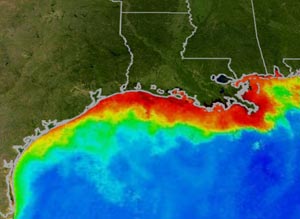
Jcwinnie  previously noted, it is likely that the GOM (Gulf Of Mexico) Dead Zone will worsen since petroleum is important to the manufacturer of commercial fertilizers and feed lots are a principle source of manure. Ecologists attribute the worsening situation to commercial fertilizer runoff and animal manure discharge, compounded by human waste from urban areas in Illinois, Iowa, Indiana, Missouri, Arkansas, Kentucky, Tennessee, Ohio and Mississippi.NOAA image showing Gulf of Mexico dead zone

"Summertime satellite observations show highly turbid waters in the Gulf of Mexico which may include large blooms of phytoplankton extending from the mouth of the Mississippi River all the way to the Texas coast. When these blooms die and sink to the bottom, bacterial decomposition strips oxygen from the surrounding water, creating an environment very difficult for marine life to survive in. Reds and oranges represent high concentrations of phytoplankton and river sediment."

The Energy and Global Warming News for June 19th encapsulated for us by Climate Progress includes a forecast that this summer, the 'dead zone' could be largest on record.

The Gulf of Mexico's oxygen-depleted "dead zone" could be one of the largest on record this year, a federal scientific team said today.

Seasonal oxygen levels could drop too low to support aquatic life in an area the size of New Jersey, according to the team supported by the National Oceanic and Atmospheric Administration.

Scientists forecast the dead zone at between 7,350 and 8,456 square miles, with a strong chance of it growing larger, given the recent flooding of the Mississippi River. The largest dead zone on record was 8,484 square miles in 2002.

Please read full from After Gutenberg

Ouch...mammoth carbon- credits given away free.

Illustration by KAL - The Economist
This quote by an author at The Economist speaks for itself:
"Under a mammoth carbon-emissions bill now working its way through Congress, 85% of valuable permits to emit carbon dioxide (which might all have been auctioned) will be given away free. This creates a huge new pot of favors for government to hand out, and new incentives for businesses to lobby. It will be costlier to fight climate change, while harder to avoid political favor-trading." Safe to assume that many companies will decide its cheaper to hire a bunch of lobbyists to get some of those free permits rather than to make cuts in emissions ...read more from a hugger
Please read full at The Economist

Waste to Energy programs may rescue California Renewables goal

As I just was losing all hope for California to prove to our nation that 'renewable energy' is a financially as much as environmentally sustainable option.

Things do not look good financially or environmentally for any of California's goals but 'waste to energy and biogas programs' starting in San Jose may prove highly viable.

RedGeenandBlue - Achieving a goal of 100 percent energy independence is a little closer for San Jose thanks to a momentous move by the City Council today. The City Council authorized the City Manager to negotiate and execute a Memorandum of Understanding (MOU) to develop potential lease terms and guidelines for developing an organics-to energy bio-gas facility.

The bio-gas facility would also be bound on either side by two solid waste recovery and recycling facilities.

San Jose will issue a lease to Zero Waste Energy Development Company, Inc., a partnership between GreenWaste Recovery and their sister company, Zanker Road Resource Management.

This project would also see the cooperation of GreenWaste and Harvest Power, Inc., a company that provides leading technology and project development capabilities for harnessing the renewable energy in organic waste.

Read more of this story

Searchable Food Database Reveals Toxicology of Chemical Residue

By Gina Munsey GreenOptions

Pesticides on Food

You've likely heard of Skin Deep, the cosmetic safety database which lists the toxicity of ingredients in personal care products.  But did you know there is now a similar database for food?

What's On My Food, a brand-new searchable database launched yesterday by the Pesticide Action Network, will give you the inside scoop on exactly what chemicals are on the food you eat.  With just a click of the mouse, you can view the toxicology risk and known pesticide residues on everything from almonds to oats to winter squash .

For instance,  did you know 82% of conventional applesauce contains Carbendazim, an endocrine disruptor known to cause tumors in rats and ranked by Friends for Earth as one of the "Filthy Four" pesticides? Suddenly organic applesauce doesn't seem quite so expensive, and the thought of making it at home doesn't seem nearly as daunting.

Read the helpful — if not somewhat disturbing story at GreenOptions  

July Green Infrastructure Workshops - Registration Open!

EPA will be hosting green infrastructure workshops at the following locations over the next few weeks.
These workshops will focus on how wet weather programs can be effectively managed using green infrastructure technologies and approaches. Space is still available in each workshop. Information about the workshops, including agendas and registration, is available at EPA 
  • Locations - Ft. Myers, Florida (July 1-2), Hartford, Connecticut (July 8-9), Charleston, West Virginia (July 21-22)
Green Infrastructure Webcast June 23, 2009 on Funding/Incentives and Brownfield Redevelopment
This fifth webcast in the green infrastructure webcast series will be held June 23 from 1:00 to 3:00 EDT and feature Abby Hall from EPA discussing "Funding & Incentives" and Stacy Swartwood from EPA discussing "Brownfields Redevelopment." The "Funding & Incentives" portion will include summaries of local incentives that communities have used to encourage the use of green infrastructure approaches. An overview of how many communities have funded green infrastructure will be discussed. The second portion of the webcast will cover design considerations and appropriate best management practices for stormwater management on brownfields. This webcast will discuss how green infrastructure practices can retain, treat and then release stormwater without it ever coming into contact with contaminated or compacted soils. Register at: EPA

Eco-roofs and green street planters in Portland, OR.

About Green Infrastructure: is an approach to wet weather management that is cost-effective, sustainable, and environmentally friendly. Green Infrastructure management approaches and technologies infiltrate, evapotranspire, capture and reuse stormwater to maintain or restore natural hydrologies. See EPA examples of green infrastructure and design approaches.

At the largest scale, the preservation and restoration of natural landscape features (such as forests, floodplains and wetlands) are critical components of green stormwater infrastructure. By protecting these ecologically sensitive areas, communities can improve water quality while providing wildlife habitat and opportunities for outdoor recreation.

On a smaller scale, green infrastructure practices include rain gardens, porous pavements, green roofs, infiltration planters, trees and tree boxes, and rainwater harvesting for non-potable uses such as toilet flushing and landscape irrigation.

 
How Does Green Infrastructure Benefit the Environment?
Green Infrastructure is associated with a variety of environmental, economic, and human health benefits, many of which go hand-in-hand with one another. The benefits of green infrastructure are particularly accentuated in urban and suburban areas where green space is limited and environmental damage is more extensive. Green infrastructure benefits include:
  • Reduced and Delayed Stormwater Runoff Volumes
  • Enhanced Groundwater Recharge
  • Stormwater Pollutant Reductions
  • Reduced Sewer Overflow Events
  • Increased Carbon Sequestration
  • Urban Heat Island Mitigation and Reduced Energy Demands
  • Improved Air Quality
  • Additional Wildlife Habitat and Recreational Space
  • Improved Human Health
  • Increased Land Values
 

33% Renewables... California Just Dreaming

Wall Street Journal
Clean-energy advocates are up in arms about the watered-down renewable-energy mandates that survived Waxman-Markey climate bill horse-trading to date, arguing they'll fall short of promoting a massive deployment of new clean energy.
In a nutshell: On paper, California could meet its targets, provided it can afford and build $12 billion in new transmission lines and higher electricity costs. In reality, the state probably won't make the target... though meeting the renewable-energy targets will raise California electricity prices a further 10% by 2020.
 

Power all of our energy demands thousands of times over...

There is enough energy stored beneath the earth's surface to power all of our energy demands thousands of times over.

Potter Drilling, is developing technology that his father, Robert Potter, initiated over 30 years ago while working at the Los Alamos National Laboratory. Robert Potter worked on developing Hot Dry Rock (HDR) heat mining, which, simply put, is a method of harvesting geothermal energy by pumping water into hot, crystalline rock via an injection well. The water is superheated as it flows through open joints in the hot rock reservoir, and is returned through production wells. At the surface, the useful heat is extracted by conventional processes, and the same water is recirculated to mine more heat.

Geothermal power — harnessing the earth's heat to produce electricityproduces essentially no greenhouse gas emissions and, unlike solar and wind power, is available 24 hours a day. With enough heat trapped deep in the earth to meet the nation's electricity demand thousands of times over it's no wonder that Potter wants to find a more effective way of harnessing that heat. Getting to it at costs that can compete with coal-fired energy is the challenge.

Read more of this story

Jun 19, 2009

60 mpg American made ' Best Cars For The Environment' Not yours but...

American made... but not yours on U.S. shores ;-(
All seat 5 get over 50mpg and these three are FUN and Fast!
It appears someone from Honda and Toyota paid them to leave VW out... as VW would have all top 5 spots.*

#7 Ford New Fiesta


Description:
Post 2009 Model Year 1.6 Duratorq TDCi
Fuel: Diesel, 64 mpg

#9 Mazda Mazda2

Description: 2007 Model Year 4 Door
Transmission: 5-speed manual
Fuel: Diesel, 68.9 mpg

#4 Nissan Pixo


Transmission:
5-speed manual
Fuel: Gasoline, 53 mpg

See all ten at The Business Insider

*
(VW currently offers 90mpg 5 passenger cars (since 2000) and cargo trucks that get over 50mpg (link) .)

Example of budget scale - complex math with simple visual

I can watch in peoples eyes when I 'lose them' going over project scale viability statistics.
Yet it is the fiscal key to the success of ALL sustainable energy programs.

While I will always struggle relaying 'big math' to the massive... this video is short, sweet and validates the issue of not understanding 'scale'.

People think we have a 'big' problem, without any understand of what 'big' is.

Wohoo! DOE Extends Deadline for Wind Energy Grant Solicitation

From EERE -  DOE has amended the Funding Opportunity Announcement (FOA) entitled, "Recovery Act: Wind Energy Consortia between Institutions of Higher Learning and Industry." The amendment extends the date for submitting Letters of Intent from university applicants to June 29, 2009, 11:59 p.m. Eastern Time. The application due date remains the same—July 29, 2009, 11:59 p.m. Eastern Time. The FOA provides $24 million for the development of consortia between universities and industry to focus on critical wind energy challenges. More Progress Alerts

Will rogers quote on the economy... What we consume us, consumes us....

Too many people spend money they haven’t earned, to buy things they don’t want, to impress people they don’t like. - Will Rogers
(Source)

Magic Beans for 100 Nuclear Power Plants

At some point you just have to ask yourself, what is it that these politicians are getting to push nuclear energy so hard? Last week, House Republicans called for a hundred new nuclear power plants to be built in the next two decades. They say that this is part of the legislation they're backing because it's better than what the Democrats are offering... Now I'm not saying the Democrats have submitted some amazingly stellar plan. There are certainly some issues there too. Most of which can be traced to the myth of clean coal and Energy Secretary Steven Chu's attachment to nuclear. But 100 new nuclear power plants in 20 years? Really?!!!

Let's put this in perspective, shall we?

These guys are basically talking about building an average of five new nuclear power plants a year, for the next 20 years. I guess they missed the memo on how long it takes to actually build one.

There are all kinds of numbers floating around on this. Some nuclear advocates will tell you it'll only take you a couple of years. Some anti-nuclear types will tell you it could take up to 25 years. Both are likely highly exaggerated. So for our purposes we'll look to Florida Power & Light (FPL), which currently has two nuclear power plants in operation, and in April, 2008, received final approval from the Florida Public Service Commission for two additional nuclear facilities (Turkey Point Units 6 & 7) at its existing Turkey Point complex.

According to FPL
, from beginning to end, the siting, licensing and construction of Turkey Point Unit 6 could be completed in 2018 – or in about 9 years. The estimated completion year for Turkey Point Unit 7 is 2020.

And we're supposed to believe we can throw up 5 new ones every year – starting now? Even if you support integrating more nuclear into our domestic energy infrastructure, you'd have to be out of your mind – or getting paid a hell of a lot of money by the nuclear industry – to believe that we're going to build 100 new nuclear power plants in 20 years.

But let's just assume for a moment, they could pull it off. I don't know, maybe they found some magic beans and this became doable. What happens to those 100 nuclear power plants when they need to be decommissioned?

Continue Reading at triplepundit

Increasing Ethanol in Gasoline Equals Diaster

Adding more corn-based ethanol into gasoline will create a higher demand for corn, which will raise the price of corn. In short, it’s a recipe for disaster, according to three recent studies. A study by Advanced Economics Solutions concluded that corn prices “will be much higher and more volatile” if corn-based ethanol production increases. If corn acreage “does not grow significantly” more than half of the corn crop in the U.S. “will be diverted from food and feed to fuel if corn ethanol production grows to 22.1 billion gallons.”... read more from triplepundit

More Transparency of largest floating plastic in Ocean

Posted by: GOOD , Jacob Magraw-Mickelson

By now, most of us are aware that there is a large patch of floating plastic in the middle of the Pacific Ocean. What you may not know is that it’s not made up of plastic bags and empty bottles. It’s made up of billions of tiny pieces of plastic, and it’s basically invisible unless you’re floating in it. While this might seem better, it’s actually much worse for the environment—and for you. Please see a look at the Pacific Gyre and the plastic floating in it.

No more fish in the seas... this IS a REAL issue

Post by Thomas Porostocky Good Magazine

People eat a lot of fish. In fact, per capita fish consumption has nearly doubled in the last 50 years. The problem is that there may not be any more fish if we keep catching and consuming them at this rate. The Food and Agriculture Organization of the United Nations measures how many of each species of each fish were caught each year. Using these numbers, we can see how some fish catches have peaked, meaning that there are simply not enough fish left to catch. Other fish’s catch numbers are still rising, meaning that demand for that fish is increasing: if we keep fishing the way we are, those populations will also start to drop and potentially die out. Please see a look at catch numbers of some of the most popular fish in the world.


Who drugged my water... big picture.

Click image for larger image from goodmagazine

When you sleep they get you... Vampire report

Click image for larger image... source DOE

Jun 18, 2009

Big industry finds its alternative energy: corncobs

I have posted 'good uses for corn & corn cobs before' and here is another novel approach to resolve several major issues with corn and waste...

http://www.ecofriend.org/images/con-cobs-2_1822.jpgWASHINGTON -   (VIA the OilDrum)
"When energy prices were very, very low, you couldn't compete," he said. But natural gas prices have increased over recent years, driving many U.S. fertilizer companies to close their doors because natural gas prices overseas were lower. Today more than half the country's nitrogen fertilizer is imported, and about 20 percent of the imports are from Russia.

Natural gas is used to make ammonia, the basic component for nitrogen fertilizer. Prices for natural gas rose dramatically in the U.S. over the past 10 years, according to the U.S. Department of Agriculture. Because natural gas is cheaper in other countries, the U.S. has increasingly turned to foreign supplies for ammonia since 1990.

"We don't relish being in Ukraine's shoes," Oswald said, referring to Russia's embargo on natural gas supplies to its neighbor during the winter.

The cost of natural gas now accounts for up to 90 percent of the cost of making nitrogen fertilizer, according to the U.S. Government Accountability Office. Last year, when natural gas prices rose, so did the cost of fertilizer, one of farmers' biggest expenses.


SynGest says its plan to build small plants in the Midwest to make fertilizer from corncobs would eliminate the price volatility farmers have had to put up with and help ensure that U.S. farmers won't face a shortage.

High natural gas prices, like last year's, would make the SynGest process profitable, but currently natural gas is relatively low and likely to be the cheapest raw material to produce nitrogen, said Wen-yuan Huang of the U.S. Department of Agriculture's Economic Research Service...

Read full from Idaho Statesman

Why blog about nuclear power options with the Washington Post

From Washington Post
Government to Guarantee Loans for Nuclear Power Plants
The Energy Department is planning to award $18.5 billion in loan guarantees for the construction of new nuclear power plants to four utilities, government sources said today. The companies include UniStar Nuclear Energy, NRG Energy Inc., Scana Corp. and Southern Co.

Nuclear power advocates hope that the loan guarantees will help launch a new wave of nuclear power plants that use a new generation of technology; moreover, they note, nuclear plants do not emit greenhouse gases. But foes of nuclear power argue that the plants remain too expensive to build without federal assistance and that energy efficiency and renewable energy resources offer better alternatives. New plants could cost anywhere from $6 billion to $12 billion, industry executives say.

RE: What is your position on nuclear energy once more?
I have been asked by several readers why I am bringing up nuclear energy options again... Short answer - so we have 'sustainable options'.

I am trying to encourage 'good behavior' with billions of tax dollars... if we are 'dead set' on going forward on nuclear energy, we need to utilize the best available options and NOT the same mistakes that have plagued the industry for four decades (sounds like I am talking about health care or war in middle east).

Going forward with the most viable, economic nuclear energy options will not only save our own future, but will build a sustainable longterm future for the nuclear energy industry. The way we are going through fuel, mining, water resources while building 1,000 year bunkers of radioactive waste will not lead to this...

Longer answer - Understanding 'why' people could be 'for' current technology nuclear power options is confusing to say the ... and understand there is very little eviro or economic hope in its future without doing it very differently as I have covered before (fast bed gen 4 reactors that are decades off).

Like the 80's we will spend 10's of Billions over the next decade without getting a gigawatt of power out of any production... while our energy demand and cost become epic.

The financial expense alone will win any argument in today's economic environment and even 45 more plants will do nothing for our future. With the renewable electricity cost premium ranges from 0.1 cents per kWh to 0.2 cents per kWh we would have no reason for a higher price... (link source DOE)

The U.S. Consumer Price Index from 2000 to 2007 increased by a factor of 1.2, while in the same period the Power Capital Costs Index increased by a factor of 2.3. If one were to rely on general economy inflation rates, you would think a power plant that cost $1 billion to build in the Year 2000 would only cost $1.2 billion to build in 2007. However, CERA has noted the same power plant would actually cost $2.3 billion to build. Picking a realistic escalation rate is very important.

Simplest answer everyone ignores ...
Low Source and Traditional Geothermal - Unlimited and at 0.07 cents per kWh


Twice as efficient, passively-safe reactor...

The SVBR (Svintsovo-vismutovyi bystryi reaktor) is one of three liquid-metal-cooled reators currently under development in Russia, along with the sodium-cooled BN-series and the lead-cooled BREST.
Unlike the lead- and sodium-cooled reactors, which Rosatom ultimately envisions as very large (1600+ MWe in the case of the case of the BN-series), the SVBR is designed as a small, modular, and passively-safe reactor.SVBR should have 90 gwd/ton (90 gigawatt days per ton of uranium. This is close to being twice as efficient with Uranium as existing light water reactors.)
The Oil Drum coverage of the SVBR

Hyperion Power Generation.
The reactor will weigh fifteen to 20 tons, depending on whether you're measuring just the reactor itself or the cask—the container that we ship it in—as well. It was specifically designed to fit on the back of a flatbed truck because most of our customers are not going to have rail. It's about a meter-and-a-half across and about 2 meters tall.

It uses uranium hydride. UH3 is the chemical formula. Low-enriched, about 10 percent [uranium isotope]-235, the rest is U-238.

We're leveraging the design of a very common reactor, called a TRIGA reactor. There are 60-something of those reactors around the world. They are the only reactor that the NRC has licensed for unattended operation, meaning it's so safe that you can literally walk away from it. It's walk-away safe.
Source nextbigfuture

Another big contender I have posted on before:
the Toshiba Ultra-Small Nuclear Reactor

The 200 kilowatt Toshiba designed reactor is engineered to be fail-safe and totally automatic and will not overheat. Unlike traditional nuclear reactors the new micro reactor uses no control rods to initiate the reaction. The new revolutionary technology uses reservoirs of liquid lithium-6, an isotope that is effective at absorbing neutrons. The Lithium-6 reservoirs are connected to a vertical tube that fits into the reactor core. The whole whole process is self sustaining and can last for up to 40 years, producing electricity for only 5 cents per kilowatt hour, about half the cost of grid energy.


Read more about advancements from NRC

Jun 17, 2009

Ford wins! You lose... offers cleanest car in Europe with over 40mpg

Automaker 'FAIL' 40+mpg, clean burning sub $20K - not yours.
Ford's cleanest and best MPG car will not hit U.S. shores...


The new Ford Fiesta is now being offered with a factory-installed LPG option in Europe.
This is the fourth Ford model that uses this technology and allows the car to run both with unleaded gasoline and LPG, similar to the new Golf Plus Bi-Fuel. The base model Fiesta uses a 1.4-liter gasoline engine. In the conversion, the spare tire is replaced with an additional 42-liter tank for the LPG. This model has an engine output of 92hp.

Since the gasoline tank is left untouched, the Fiesta LPG has a total range of 1,200 km when burning the both fuels.
Prices start at €15,490, which already includes the €1,990 conversion cost.

The conversions are performed at the Ford's brand new facilities.

Was I wrong about the H2 car... ready now.

I really hope that this car can prove me wrong about the sustainability of H2 cars.
Scale and local energy is everything... if the
electrolysis can be generated locally and sustainably,  electric cars and even H2 cars have viability.

Many 'plug-in hybrids and current electric car designs do have better 'cradle to cradle' energy with less environmental impact than this model. But, with the idea being 'open source' these obstacles may be resolved by rapid advancements that surpass mine and many expectations.

Regardless, it is an exciting and encouraging development in the future of hydrogen cars.

gas2.org 
A new hydrogen-powered car, whose designs will be “open source” and posted for free use on the web, was unveiled today in London. The company behind the Riversimple urban car claim the new model proves hydrogen automotive technology is ready for roll-out now rather than in 10 years’ time.

The open-source approach means entrepreneurs around the world could download the designs and manufacture the two-seater prototype locally for free.

The car, which drove in to the launch event, is capable of a 50mph top speed, 0-30mph acceleration in 5.5 seconds, and has a 240 mile range. The car’s backers say it has greenhouse gas emissions of 30g/km CO2, less than a third of the latest hybrid petrol cars such as the Toyota Prius and Honda Insight.

The lightweight Smart car-size vehicle uses hydrogen in a modest 6kW fuel cell, and – in the case of this prototype – uses hydrogen converted from natural gas. Hydrogen can also be created from water using electrolysis and potentially even from bio-fuels.

Read more of this story at
gas2.org 

Ritalin kids with ADHD 7 times more likely to die suddenly.

Posted by ecochildsplay:

A common prescription for ADHD is a stimulant medication.

You’ve probably heard the brand names Adderal and Ritalin.

Problem is, stimulants like these make kids who take them 7 times more likely to die suddenly.

What we found — to our surprise — is that even if you take out confounding factors, the association between stimulant use and sudden death was still significant.

Read more of this story from ecochildsplay

Wisconsin - America’s iconic Midwest forests in significant decline

Wow, Jeremy Hance gets it right again...   Decline in Midwest forests significant problem
Fragmentation from agriculture and sprawl is 'dooming species to extinction'

About a Wisconsin novel - Little House in the Big Woods.

Less than a hundred years since its publication, a study in Conservation Biology finds that these Midwestern 'big woods' are experiencing a worse-than-expected decline and would likely be unrecognizable to Wilder herself.

The new study of forest patches in Wisconsin finds that the temperate forest are losing abundance and diversity of native species due to increasing land-use changes and fragmentation. Bordering Canada, Wisconsin is apart of the Midwest region of the United States where temperate forests were first felled for agriculture beginning in the 1800s. Since then remaining forests have been lost due to housing developments, sprawling suburbs, roads, and strip malls.

Researchers from the University of Wisconsin, Madison looked to the forest floor--surveying shrubs, grasses, and herbs--to determine the impact of humans on the ecosystem. Checking their findings against detailed records made by ecologist John Curtis in the 1940s and 1950s, what the researchers discovered was worse than they expected: even when the patches of forests appeared healthy, they were no longer capable of preserving the region's biodiversity. They found a widespread decline in abundance and diversity of native plants, especially in southern Wisconsin where forests have been increasingly lost due to land-use changes.

"Things may look healthy, but over time we see an erosion of biodiversity," co-author Don Waller says, a professor of botany

Furthermore, the researchers found that biodiversity was even in decline in state parks and other protected areas.

"These forest patches are not just losing species -- their whole biological nature is changing," says David Rogers, an assistant professor of biological sciences who led the study.

 "Surrounding landscape factors, like urbanization and agricultural dominance, are now determining which species can survive in these little patches."

Waller explains that the forests still appear healthy because there has been a time-lapse between the loss of forests and the visible affect on the ecosystem. "When we isolated these forest patches 50 or 100 years ago, we were dooming species to extinction," he explains. "It may not happen right away -- and in that sense it's an 'extinction debt' -- but it will accumulate over time."

"Plant species might go locally extinct for lots of different reasons,"
Waller explains. "But typically the area will be re-colonized very soon by nearby populations of the same species. That's what does not happen once a habitat becomes isolated or that patch becomes smaller."

"People are a really important part of the system," Rogers says. "We are having a greater influence over our local ecology, whether we want to or not. That puts the responsibility on people to take care of it, protect it and maintain it."

Read more from source Mongabay (VIA - ecoearth )

Not to late for Nation's Premier Energy Education Event

A little to late for me, as I just got my post card in the mail...

But if you hurry you can still sign up
The 20th Anniversary Energy Fair is scheduled for June 19-21, 2009 at the ReNew the Earth Institute in Custer, WI.
The 2008 Energy Fair was a record breaking with over 22,500 attendees!

Fair Hours: Friday June 19 and Saturday June 20 from 9 am to 7 pm and Sunday June 21 from 9 am to 5 pm

General Energy Fair Information

Since 1990, the Energy Fair has shown fairgoers how to change the world while having fun. Each summer the Fair transforms rural central Wisconsin into the global hot spot for renewable energy education. The Energy Fair is the world's largest renewable energy, energy efficiency, and sustainable living educational event of its kind. Please join us this year!

The Energy Fair features hundreds of workshops and exhibits all emphasizing clean energy & sustainable living and is fun for the whole family.

Energy Fair Features
* Over 270 exhibitors (Exhibit space is SOLD OUT!)
* Over 200 workshops
* Mass transit offered from Madison, Milwaukee, Green Bay/Appleton, Chicago and Minneapolis.
* Free hourly shuttles from Stevens Point
* Clean Energy Car Show
* Green Home Pavilion
* Sustainable Table Workshop Area
* Educator Workshops
* Hands On Workshops
* Food, entertainment for the whole family!


EDUCATOR OPPORTUNITIES:
The Wisconsin K-12 Energy Education Program (KEEP) offers a number of classes and networking opportunities at The Energy Fair. Check out the KEEP website for details. Find out more at: MREA

DOE Webcast: Low-Cost Financing with Clean Renewable Energy Bonds

The U.S. Department of Energy (DOE) Technical Assistance Project (TAP) for state and local officials is offering a webcast on how to take advantage of low-cost financing using Clean Renewable Energy Bonds (CREBs). The presentation will take place Wednesday, June 24, from 3:00 to 4:15 p.m. Eastern Standard Time, and is titled "How to Use CREBs for Financing Renewable Energy Projects on Public Lands."

The presenters will be Claire Kreycik from the DOE National Renewable Energy Laboratory and Aneta Rettig from Denver Water. Kreycik will discuss the ins and outs of using CREBs, and Rettig will discuss her department's experience with using CREBs to finance construction of two small hydroelectric systems near Denver.

The webcast is free of charge, but you must register in advance to obtain a URL for the presentation and call-in phone number. You can register online, find more information about the presenters, and read background materials and reports on the TAP Webcast section of the DOE Weatherization and Intergovernmental Program Web site.

Submitted by EERE


Fusion wiffleballs could lead 4,000 factor increase in power output

Haase - "with confident of results of WB-8 begin WB-9 planning" giving more hope 'We Will Know In Two Years'

Simon with some insight into how WB-7 has gone. From the looks of things - rather well.


...options for a modified wiffleball 8 (WB8.1) and modified ion gun could provide the Navy with data for potential applications that may lead to a shipborne fusion power reactor. Which would be kinda handy to have to power two or four of those electric motors turning the screws of an aircraft carrier (or a U.S. town)


WB -8 Demonstrations that could:
  • ...be operated at a magnetic field strength of approximately 0.8 Tesla, which represents an increase of 8 times the magnetic field strength of previous WB machines. Improvements over previous WB machines in WB confinement, ion energy and fusion reactivity are expected as a result of these changes to WB machine design.
  • ...address the plasma dynamics of WB devices, and shall address the scaling laws that apply to polywell fusion.
  • ...provide a predictive model of WB behavior including data points for detailed 2D/3D profile measurements of plasma density, ion energy and WB magnetic field structure during follow-on tests to validate the scientific basis for a Polywell fusion power reactor, and guide further research.
The magnetic profile of an operating device is critical for knowing how the device actually operates. Without that it is very difficult if not impossible to design in improvements.

So the program is starting to take on a life of its own. A WB-9 device is already under consideration even before experiments on WB-8 are even completed. This indicates a fair amount of confidence in the forthcoming results. Excellent.

Apples to apples comparisons...
An increase of field strength by a factor of 8 means - if the scaling laws hold a factor of about 4,000 increase in power out.

Read more by Simon

Health Care & Banking the small stuff... Clean Water is priority

From triplepunditliving%20machine%20infographic.jpg

Jim Fouts, the mayor of Warren, Michigan, a suburb just outside of Detroit, says that our aging water infrastructure is a “a ticking time bomb that’s ready to go off.”

A report by the EPA cites that repairing and renovating public water systems will require $334.8 billion over two decades. And as lawmakers debate over banking reform or universal health care, it appears that our nation's pressing water issues will not be addressed from a policy level.

Enter the Living Machine. Worrell Water Technologies' Living Machine system works with existing building and municipal water infrastructures to clean wastewater for reuse.

It utilizes planned wetlands, often times trees in the lobby of a building, using soil, bacteria, and "specially engineered films of beneficial microorganisms" to kill pathogens in the water.

Read more from
triplepundit

Free energy since 1962 - just thrown away

To imagine all of this free energy has been completely thrown away for 4 decades is mind blowing
Some for centuries...

Boing :
It's a massive underground coal fire that's been smoldering beneath the town of Centralia, Pennsylvania ever since 1962:

The town sits on top of a rich vein of coal, and the fire has defied every attempt to extinguish it. National awareness of Centralia's unending environmental catastrophe came in 1981 when a 12-year-old boy fell into a 150-foot hole that suddenly appeared in his back yard. Most residents were relocated in 1984, and in 1992 the entire town was condemned. Most buildings were torn down, creating the Centralia that can still be seen today: a network of streets running through empty fields and, increasingly, new growth forest. As of 2007, Centralia had nine residents.

Then Dylan told me about a similar, and even more dramatic, subterranean fire that's been burning for almost as long under the Karakum desert of Turkmenistan (pictured above). Locals call it the "Gates of Hell":

The hole is the outcome not of nature but of an industrial accident. In 1971 a Soviet drilling rig accidentally punched into a massive underground natural gas cavern, causing the ground to collapse and the entire drilling rig to fall in. Having punctured a pocket of gas, poisonous fumes began leaking from the hole at an alarming rate. To head off a potential environmental catastrophe, the Soviets set the hole alight. The crater hasn't stopped burning since.

Turns out, these sorts of mine fires can stay lit for a very long time. One burned in the city of Zwickau, Germany from 1476 to 1860. Another coal fire in Germany, at a place called Brennender Berg (Burning Mountain), has been smoking continually since 1688!

Read more VIA - Joshua a freelance science journalist Boing Boing.