Dec 23, 2010

CellPhone radiation correlation and causation should never be mistaken

HTML clipboard
Engineer Quote of the week:
And, of course, there is the problem of confusing correlation with causation. Families with espresso makers have a lower incident of child mortality than families that do not. - Nice Matt ;- )


In the United Kingdom, the more mobile phone towers a county has, the more babies are born there every year. In fact, for every extra cell phone tower beyond the average number, a county will see 17.6 more babies. Is this evidence that cell phone signals have some nefarious baby-making effect on the human body? 

Nope. Instead, it's a simple example of why correlation and causation should never be mistaken for the same thing. http://www.148apps.com/wp-content/uploads/2010/03/Screen-shot-2010-03-07-at-1.42.03-AM.pngWrites Matt Parker in the Gaurdian:

This was discovered by taking the publicly available data on the number of mobile phone masts in each county across the United Kingdom and then matching it against the live birth data for the same counties. When a regression line is calculated it has a "correlation coefficient" (a measure of how good the match is) of 98.1 out of 100. To be "statistically significant" a pattern in a dataset needs to be less than 5% likely to be found in random data (known as a "p-value"), and the masts-births correlation only has a 0.00003% probability of occurring by chance.

The match between mobile phone towers and birth rates is an extremely strong correlation and it is highly statistically significant. ... Mobile phone masts, however, have absolutely no bearing on the number of births. There is no causal link between the masts and the births despite the strong correlation. Both the number of mobile phone transmitters and the number of live births are linked to a third, independent factor: the local population size. As the population of an area goes up, so do both the number of mobile phone users and the number people giving birth.

But wait, there's more! To test the media's science savvy, Parker sent out a press release detailing the correlation he found—but without any information on the real cause of both factors. Interesting object lesson or in-real-life trolling? Can't it be both? The press release went out late last week. If you've spotted any stories about the fertility powers of cell phone towers, leave a link in the comments at the Boing

Santa's Naughty List Hits WikiLeaks (Assange's on it ;-)

HTML clipboard 5280934335_4122ba1fe8_o.gif

DuPont penalty of $3.3 million for Toxic Substances Control Act (TSCA) violations

The U.S. Environmental Protection Agency (EPA) today announced that DuPont has agreed to pay a penalty of $3.3 million to resolve 57 Toxic Substances Control Act (TSCA) violations. DuPont failed to immediately notify EPA of research indicating substantial risk found during testing...

Statement from EPA Administrator Jackson regarding her meeting with 10 U.S. senators on Chromium-6

The following is a statement from Administrator Lisa P. Jackson regarding that meeting: HTML clipboardhttp://2media.nowpublic.net/images//c4/1a/c41a825e351a50c4b463c81d9894a395.jpg
"Yesterday, I briefed members of the Senate on chromium-6 in drinking water supplies as it relates to the recent Environmental Working Group report. EPA has already been working to review and incorporate the ground-breaking science referenced in this report. However, as a mother and the head of EPA, I am still concerned about the prevalence of chromium-6 in our drinking water...

The science behind chromium-6 is evolving. EPA is already on a path toward identifying and addressing any potential health threats from excessive, long-term exposure with its new draft assessment released this past fall. This assessment still needs to be reviewed by independent scientists as an essential step toward tightening drinking water standards for chromium-6. Strong science and the law will continue to be the backbone of our decision-making at EPA. EPA takes this matter seriously and we will continue to do all that we can, using good science and the law, to protect people's health and our environment."

Please read full at EPA

Hexavalent Chromium Found in 31 US Cities' Tap Water- List

EPA Removes Saccharin from Hazardous Substances Listing

EPA Removes Saccharin from Hazardous Substances Listing
Source: U.S. Environmental Protection Agency

The U.S. Environmental Protection Agency (EPA) has removed saccharin, a common artificial sweetener, and its salts from the agency's list of hazardous substances. Saccharin is no longer considered a potential hazard to human health. http://www.1466group.com/.a/6a00e54fbc3ff88833011168690b7f970c-pi

Saccharin is a white crystalline powder that is found in diet soft drinks, chewing gum and juice. Saccharin was labeled a potentially cancer-causing substance in the 1980s. In the late 1990s, the National Toxicology Program and the International Agency for Research on Cancer re-evaluated the availaHTML clipboardble scientific information on saccharin and its salts and concluded that it is not a potential human carcinogen. Because the scientific basis for remaining on EPA's lists no longer applies, the agency has removed saccharin and its salts from its lists.

EPA proposed the removal of saccharin and its salts from the lists on April 22, 2010 and did not receive any comments opposing the proposal.

Removal of Saccharin from the Lists of Hazardous Constituents and Hazardous Wastes under RCRA and from the List of Hazardous Substances under CERCLA

U.S. is exceptional, but far from secure...

2001-2010 Trend: Ratings of the Quality of the Environment in the U.S.At the same time that Americans believe the U.S. is exceptional, they also are inclined to believe that status is far from secure, according to the Dec. 10-12 USA Today/Gallup poll. Three-quarters of those who believe the U.S. is exceptional (62% of all Americans) also believe the U.S. is currently at risk of losing its unique character... viewpoint reflects Americans' tendency to see national conditions as getting worse rather than improving. HTML clipboard

Gallup has observed this pattern in a variety of areas, including the state of U.S. morals, the quality of the environment, the crime situation in the U.S., and the economy.

Scientists Confirm that Dispersants Are Increasing Contamination in the Gulf

Journal Nature is also reporting on the increase of PAH contamination due to the use of dispersants in the Gulf:
The problem, explains Hodson, is that the dispersed cloud of microscopic oil droplets allows the PAHs to contaminate a volume of water 100–1,000 times greater than if the oil were confined to a floating surface slick. This hugely increases the exposure of wildlife to the dispersed oil. …

Worse, the toxic constituents of oil hang around longer than other components, another speaker told the meeting. "This idea that there's an oil biodegradation rate doesn't hold,"... Alkanes, the simple hydrocarbons that comprise the bulk of oil, are degraded more readily than the PAHs, he points out.

As the Press Register notes:"These chemicals, these are PAHs that are carcinogenic. "There's no low-dose level that's acceptable to eat."…

Two Years After the Largest Toxic Spill in the Nation's History, Where's the Regulation on Deadly Coal Ash Dumps?

EPA identified 431 containment units for coal slurry and has labeled 49 of them "high hazard"—meaning they pose a risk to human health and the environment.

It has been two years since an earthen dike holding back 1.1 billion gallons of coal slurry ruptured, unleashing a tsunami of dark gray sludge from the Tennessee Valley Authority's Kingston Fossil Plant in Harriman, Tennessee. The wave destroyed homes, surged into the yards of neighbors, and caused the nearby ponds and streams to overflow. More than 300 acres of land were covered in the stuff, and in the weeks after, the ash would travel as far as 30 miles downstream on the nearby Emory River. Locals refer to the "ash bergs" up to 40 feet tall that landed in their yards and floated down the river...what has happened read at AlterNet

EIA's primary report of recent energy statistics

EIA's primary report of recent energy statistics indicate that in the first 9 months of 2010:
  • U.S. primary energy production totaled 56 quadrillion Btu, a 2% increase compared with the first 9 months of 2009.  Fossil fuels accounted for 78% of primary energy production, nuclear electric power accounted for 11% of primary energy production, and renewable energy accounted for 11% of primary energy production.
  • Compared with the first 9 months of 2009, U.S. coal production decreased 1%, dry natural gas production increased 3%, and crude oil production increased 3%.
  • Compared with the first 9 months of 2009, U.S. renewable energy production increased 6%.  Wind energy production increased 27%, biomass energy production increased 10%, and hydroelectric power production decreased 5%.

Christmas Gas Prices....

Dec 22, 2010

California Mine Will Reopen to Meet U.S. Demand for Rare Earth Materials

[Technology Review] Japan has already taken measures to innovateand make deals around China's monopoly on the global supply of refined rare earth elements, and the U.S. is now doing the same. Rare earths producer Molycorp has secured the proper permits and clearances needed to reopen the Mountain Pass, Calif., mine that should be able to cover the current domestic demand for rare earths once it reaches full production.http://www.jackliftonreport.com/WP/wp-content/uploads/2010/01/rare-earth-metals.jpg

Mountain Pass would be the first domestic producer of rare earths in the U.S. in more than a decade, when cheap Chinese imports rendered the U.S. market unprofitable. The 50-acre pit near Las Vegas is about 500 feet deep currently, but expansion will push it down another 1,000 feet in coming years.

The materials that come out of Mountain Pass will be used to make high-strength magnets necessary for electric vehicle engines, wind turbines, and a variety of other high-tech products. However, the U.S. possesses neither the technology nor the licensing to manufacture the neodymium-iron-boron alloy necessary for their production. As such, Molycorp has partnered with Japanese firm Hitachi Metals to manufacture the magnets in the United States.

The development of a domestic U.S. source of rare earths really doesn't come as a surprise, though it does add another wrinkle to the ongoing rare earhts narrative that is increasingly seeing the U.S., Europe, and Japan aligning themselves opposite China in a sometimes quiet, sometimes overt struggle for these prized raw materials that are necessary to manufacture everything from portable electronics to emerging green technologies to high-tech weaponry. Both the Department of Energy and the Department of Defense have voiced concerns about a disruption in supply, concerns that were exacerbated this year when China quietly imposed a brief and unofficial embargo on exports to Japan.

New safeguards for drinking water and water supplies

WDNR -  Measure to kill viruses in drinking water, others on tap

Wisconsin residents - and the 8.5 billion gallons of water that Wisconsin businesses, farms and utilities use every day will be safer in 2011 and beyond, state environmental officials say. HTML clipboard

A trio of new safeguards adopted by the state Natural Resources Board and approved by the legislature earlier this year are starting to kick in:

  • Effective Dec. 1, 2010, prevention against viruses in groundwater that sicken people goes statewide. While 88 percent of municipal water supply systems already disinfect their water to kill viruses, all municipal water supplies will be required to do so.
  • Effective Jan. 1, 2011, groundwater standards are established for 15 new contaminants including four pesticides, compounds left when pesticides break down, and compounds related to the production of explosives and munitions, including those detected in groundwater near the Badger Army Ammunition Plant. The standards determine when health problems will arise and allow clean-up to be started.
  • Effective Jan. 1, 2011, three measures to help implement the Great Lakes Compact and better track water use in Wisconsin go on the books.

"These new safeguards will better protect public health, our groundwater and surface water supplies," says DNR Secretary Matt Frank. "Wisconsin families, our environment, and our economy will benefit now and in the future."


88 percent of systems already disinfect; now all will do sobeachcombers

The disinfection rule, affecting Natural Resources chapters 809, 811, and 810 of the Wisconsin Administrative Code, enables Wisconsin to meet recent requirements in federal Safe Drinking Water Act amendments and responds to recent research about illnesses from viruses in drinking water drawn from groundwater.

Research from the U.S. Geological Survey, Wisconsin Geological and Natural History Survey, and Marshfield Clinic Research Foundation showed that viruses carried in municipal wastewater can seep out of leaky sanitary sewer systems and contaminate municipal groundwater wells. The viruses are not filtered out naturally as they seep through layers of soil and rock, as previously believed. The research ("Assessment of Sewer Source Contamination of Drinking Water Wells Using Tracers and Human Enteric Viruses," (exit DNR) and a related study, "Assessment of Virus Presence and Potential Virus Pathways in Deep Municipal Wells," (exit DNR;pdf) )led the DNR to develop rules requiring that all municipal water systems disinfect their water to kill viruses.

About 12 percent of Wisconsin's 614 municipal drinking water systems do not now disinfect. The water systems can apply for state financial help through DNR's low-interest loan program for drinking water projects.


Standards protect groundwater from contaminants - The second measure added groundwater standards for 15 new contaminants and revised standards for 15 others. Standards are set for the first time for four pesticides, compounds left when pesticides break down, and compounds related to the production of explosives and munitions, including those detected in groundwater near the Badger Army Ammunition Plant.

"Wisconsin relies more heavily on groundwater for our drinking water supply than most other states, so it was important to get these proposals in place," Frank says.


Rules implement Great Lakes Compact - Three rules go into effect next year implementing the Great Lakes Compact, a formal agreement between the Great Lake states, and two Canadian provinces, and the Wisconsin legislation stemming from those agreements.

The Compact commits the states and provinces to manage water in the Great Lakes watershed collectively, including banning water from being "diverted," or piped out of the basin with a few limited and strictly regulated exceptions, and instituting water conservation requirements within the basin.

Read full at WDNR

Changes proposed to ballast water rules

WDNR - Wisconsin is proposing to change its requirements for oceangoing ships arriving in its Great Lakes waters. The change would set ballast water discharge sHTML clipboardcommercial shiptandards to those required by the International Maritime Organization. The proposed change reflects the latest science about reducing the risk from invasive species carried in the ships' ballast water, state officials say.

The proposed modifications to a general permit issued by the Wisconsin Department of Natural Resources to large oceangoing commercial ships will be the subject of a public hearing January 26 in Superior.

Large commercial ships take on and release water to help balance the vessels as cargo is loaded on and off. Along with the water, plants, animals and pathogens are taken in and released as well. Ballast water is the primary way aquatic invasive species such as the zebra mussel, round goby and spiny water flea have been introduced into the Great Lakes over the last century.

Wisconsin issued a ballast water discharge general permit effective February 1, 2010, with a requirement to determine, by the end of 2010, if effective treatment systems would be available by the implementation date.

...Certain Wisconsin requirements for handling ballast tank sediment, seawater, and other substances took effect on February 1, 2010, and applied both to oceangoing ships and to the ships that travel only within the Great Lakes. Other requirements will phase in over time, specifically the numerical treatment standard that would apply only to oceangoing ships. New ships must meet the requirement in 2012 and existing ships in 2014. These implementation dates will remain effective in the proposed permit modification.

"If proposed changes to the permit requirements are made," Frank noted, "Wisconsin still has one of the most protective ballast water permits in the Great Lakes."

Read full at WDNR

New rules will help Wisconsin’s bats

WDNR - Bats in Wisconsin have received some much needed assistance to help stave off a deadly disease. Northern    	long-eared bat Earlier this month the Natural Resources Board unanimously approved three new rules to help protect Wisconsin cave bats from white-nose syndrome, a fungus that has killed over a million bats as it spreads rapidly across the northeastern United States.

The new rules list four cave bat species as threatened; list the white-nose syndrome fungus as a prohibited invasive species; and calls for monitoring of caves and mines and other preventive measures to limit the potential introduction and spread of white-nose syndrome.

"We're grateful that we've been able to work collaboratively to develop policies that will help protect our bat populations without harm to Wisconsin's business, tourism and recreation interests," said Osterndorf.

"We are now at the front line in fighting this disease," said Dave Redell, DNR's lead bat ecologist. "The next three to four years are crucial. If white-nose syndrome reaches Wisconsin, we are looking at potentially losing almost all of our cave-dwelling bat populations."

More information on how to help protect bats can be found on the Saving Wisconsin Bats page of the DNR website.

Cash 4 Clunkers - Gift that keeps on giving...

Forget Reduce, Re-use, Recycle this was a spend and destroy program. Now look at how it is still costing our environment and wallets during this holiday season.

"The United States government's "cash for clunkers" program exemplified ... It's insane to think that destroying perfectly good and valuable assets, cars that people can drive, will help save our economy. This program is digging our economy into a deeper hole that we will never be able to dig out of. We do not have an automobile crisis in the U.S., the average American household already has 2.3 cars.... By artificially boosting car sales, the government is prevented the free market from cleaning out the excesses in the industry." - Costing 10's of billion$ to the economy
 
Cash for Clunkers cost taxpayers $24,000 per vehicle sold of 625,000 cars sold through Cash for Clunkers...Duke University helps you Do the math

Watch full of Unintended Consequences here  by inflation.us


Schwarzenegger Seeks Role of 'Energy Tsar' in Obama Administration

First sign of the apocalypse in 2011:
"People are very receptive when I talk about these things because I'm a Hummer driver not a tree-hugger."  - Schwarzenegger

Mr Schwarzenegger suggested he would like to go to Washington and influence national policy on clean energy use, and promote environmentalism.

The former Hollywood action star has until now refused to disclose what he plans to do after he leaves office next month.

Giving his first indication of what direction he wants to pursue however, Mr Schwarzenegger said he was a "very big believer in environmental issues" and wanted to build, at the national level, on legislation he enacted in California to reduce greenhouse gas emissions.

Mr Schwarzenegger suggested he was an ideal person to appeal to the American public at large on environmental issues because of his "celebrity power, knowledge and experience."

He added that energy consumers were more likely to listen to him about the need for reform because he would not be seen as a radical, adding: "People are very receptive when I talk about these things because I'm a Hummer driver not a tree-hugger."

What Schwarzenegger can do for energy and the environment


FCC approves controversial ‘Net Neutrality’ regulations

RawStory -  Sen. Al Franken (D-MN), who has championed "Net Neutrality" in the HTML clipboardHTML clipboardhttps://blogger.googleusercontent.com/img/b/R29vZ2xl/AVvXsEgQlrxFU17-QZZelLUjlQ-igF4wVhKsR6XySKQ7xozdFo4DiXs9KXysC7aOUnV5peo4LBzmBKTUCYHDPDCQn3ACb0NANIaPBFa3fZz6lM6P2kGR7VGxFkVYusCOKENQqVq3rSto/?imgmax=800past, said the FCC's proposed rules would actually "destroy" the principle of "Net Neutrality."

The rules authored by FCC Chairman Julius Genachowski would require ISPs to allow their customers to have access all legal online content, applications and services over their wired networks and prohibit unreasonable network discrimination.

But the plan would also allow for a greater fractioning of the Internet and data rationing on mobile and wired networks, according to analysis of the policies. Major network stakeholders like Verizon and AT&T would be able to sell bandwidth in capped tiers, with overage charges for users who download too much information, and certain types of data traffic like peer-to-peer file transfers could be banned altogether.

If they pass and telecoms are allowed to move forward with their plans, "the Internet as we know it would cease to exist," Sen. Franken concluded in an editorial published by Huffington Post.

"The FCC will be meeting to discuss those regulations, and we must make sure that its members understand that allowing corporations to control the Internet is simply unacceptable." Read more at RawStory

Dec 18, 2010

Manure Renaissance?

HTML clipboardWhy a Fertilizer Crisis May (Thankfully) Make Farmers Ditch the Chemicals for Old-Fashioned Poop
People talk about Peak Oil, but we're also at Peak Fertilizer. Without plenty of some kind of fertilizer, there will not be enough food to go around.
I never thought I'd see the day when shit -- the bodily kind -- would make headlines the way it is right now.

When my book about managing manure, Holy Shit, came out recently, erstwhile friends grinned and remarked, "You've been shooting the bull all your life so, sure, why not write a book about it?"

But this time what I'm writing is definitely not B.S. The current fertilizer crisis is real. Chemical fertilizer prices rise and fall with every change of pulse in supply and demand, but they are definitely on a long-term rise -- not only because production and transportation costs are increasing, but because of anticipated shorter supplies in the future. People talk about Peak Oil, but we're also at Peak Fertilizer. Without plenty of some kind of fertilizer, there will not be enough food to go around. The headline hype is not just overreaction from the press: recently farming news sources such as DTN were reporting all over their networks about how international traders in phosphorous and potash are elbowing for bigger chunks of the remaining fertilizer pie.

I would like to puff up and brag about how smart I must be to see this coming, but actually for anyone who has milked cows for a living like I have, it's a no-brainer. Although I spent an awful lot of time in classrooms studying weird subjects like theology and anthropology, my real education began as a hired man for a dairy farmer in Minnesota, who was very astute and rather wealthy, too. He made money even though the bright boys at the university would say he was backward. He still used horses for much of his farm power, and he didn't use any "bought" fertilizer. As a farm boy from Ohio who thought he knew a thing or two about farming, I was surprised to see how well his corn grew anyway.

My employer smirked when I said as much, and patiently explained to me that the gods of manure and legumes could keep a farm profitable by keeping the farmer independent of all those agribusiness suppliers who so much wanted to lead him to the poorhouse. Since then, my own experience milking a hundred cows has taught me the same lesson. Manure can be the key to real farming success. It not only fertilizes the crop but also builds organic matter, the secret to sustainable agriculture. As Edward Janus says in his new book, Creating Dairyland, in the days before chemical fertilizers, wheat farming nearly impoverished Wisconsin, until it became a leading dairy state.

"You might say that manure was the poop that saved Wisconsin," writes Janus.

I firmly believe manure will be the salvation of the whole world in the days after chemical fertilizers run short. That's why I call it holy.

Janus' book also describes a very large dairy and cheese factory business that uses its manure to produce methane, generating enough electricity from it to power the business and some 450 residential homes. The amount of electricity generated is valued at $300,000, a very impressive number. The cost of producing those kilowatts is, however, is not offered. In fact, from all the research I've been able to do, there isn't any proof yet of profit-generating electricity from methane. But even if this idea does become profitable, what if the manure used is worth $300,000 for fertilizer, or even half that? Will we use such manure to make light bulbs glow or bodies grow?

Stories about holy shit are popping up all over the Internet. Last week, Treehugger reported that the Soil Association, a venerable organic farming organization in England, had just released a study concluding that we are approaching "peak phosphorus" as early as 2033. In addition, deposits of potash in Canada, our usual and handiest source of another necessary plant nutrient, are declining by all accounts. Commercial nitrogen fertilizer, the third of the big three plant nutrients, is manufactured almost entirely with natural gas, which has an increasing number of competing uses.

Tell me: If you heat with gas, are your bills going down these days?

Read more at AlterNet

Dec 17, 2010

How $90 Oil Affects the Global Economy

With 10 shopping days before Christmas, it's looking more and more likely: The holiday-season price of gasoline will top $3 a gallon for the first time.3-Month Performace of Crude Oil vs. the US Dollar

According to AAA, the national average today for regular unleaded is $2.984 – up nearly a dime over the last month. The price of crude oil is up $7 a barrel over the same period... And over the last three months, it's gone basically nowhere, while crude has jumped over 12%..$90 oil is "a mild threat to the global economy," says The Financial Times. Could it be even worse for Americans? It's been said that every $1 added to the price of a barrel of oil is $100 billion subtracted from GDP. Even in a $14 trillion economy, that adds up.

Case in point: FedEx just announced its profits fell 18% in the third quarter. Its fuel costs were 26% higher than Q3 2009. No doubt that's one reason you'll be paying 3.9% more to ship something via FedEx starting next month. (No luck switching to UPS; it's jacking up rates 4.9%.)

So why are oil prices outpacing the dollar?

As is often the case these days, we look to China for an answer.

"Last summer," says Byron King, editor of Outstanding Investments, "the Chinese government announced that it wants domestic industries to become more efficient in their use of electricity (most of which comes from polluting coal-fired plants in China). The Chinese government enforced this edict by – literally – pulling the switches on the power grid and blacking out entire factory complexes and industrial areas. Nothing subtle about it, eh?

"So what did the Chinese factory owners do? They threw other switches and fired up their backdoor diesel generators. The result? There was an instant, sustained surge in demand for diesel fuel across China. Indeed, starting in August, oil imports surged into China, as did imports of refined diesel fuel.

How $90 Oil Affects the Global Economy originally appeared in the Daily Reckoning.

China passed USA in pollution and energy needs...GDP soon

This will bring an unstoppable amount of energy & environmental needs

The Economist predicts that China will pass the USA in US dollar GDP at market conversion rates in 2019

The Economist provides an online calculator for people to calculate their own date when China will pass the USA

The maximum values are plus or minus 10% for GDP growth, inflation and currency appreciation.

Over the past decade annual inflation (as measured by the GDP deflator) has averaged 3.8% in China against 2.2% in America. And since China ditched its strict dollar peg in 2005 the yuan has risen by an annual average of 4.2%.

I have predicted that China will pass in 2016-2018.

My most likely date is 2017.


China GDP growth averaging 8.5, combined inflation and yuan appreciation of 10%.
US with growth of about 2-3%.
Inflation and yuan appreciation could be 8.5% and the date would still be 2017.
China GDP growth could slow to 6.5% per day witha combined inflation and yuan appreciation of 8.5% and the date would be 2018 (with moderately slow US growth).

Please read more at NBF

Calif. regulators OK major greenhouse gas rules - hoping for change

Gov. Arnold Schwarzenegger addresses the California Air Resources Board urging them to adopt some of the nation's most sweeping clean air regulations, in Sacramento, Calif., Thursday, Dec. 16, 2010. The CRB was expected to pass a key piece of the state's 2006 climate law, called AB32. If it passes, power plants, refineries and other major greenhouse gas emitters will have pollution capped by new regulations being considered by the regulatory agency. The new rules set up the nation's most extensive carbon trading market that officials hope will provide a financial incentive for the state's worst polluters to cut emissions.

The Air Resources Board voted 9-1 Thursday to pass the key piece of California's 2006 climate law - called AB32.

"We're inventing this," said Mary Nichols, chairwoman of the state's air quality board. "There is still going to be quite a bit of action needed before it becomes operational." HTML clipboard

http://www.armageddononline.org/images/homer_simpson_end_is_near.jpg...California is trying to "fill the vacuum created by the failure of Congress to pass any kind of climate or energy legislation for many years now," said Nichols.

A standing-room only board chambers featured testimony from more than 170 witnesses Thursday. Outside the chambers, a few climate change skeptics held signs reading "Global Warming: Science by Homer Simpson."

Some businesses that would fall under the new rules say the system could dampen California's already flagging economy, complicate lawmakers' efforts to close a $28.1 billion revenue shortfall and lead to an increase in the price of electricity.

The rate increases, however, would still need approval from the state.

Gov. Arnold Schwarzenegger told the board he is sensitive to the recession, but argued that many of the new jobs being created under the system are in the clean technology industry.

"The real jobs we're creating right now are green jobs. Since 2006 or so green jobs have been created 10 times faster than in any other sector, so it's also an economic plus," he said.

But he said reducing greenhouse gas pollution is not just about climate change, but about human health and national security.

"I despise the fact that we send $1 billion a year to foreign places for our oil and to places that hate us. We send this money to people that hate us and that are organizing terrorists and trying to blow up our country," he said.

http://www.socalofficerealestateblog.com/wp-content/newuploads/2009/10/ab-32-signing-schwarzeneggar.jpg
Supporters say the system will help spur economic recovery and innovation, pushing business to invest in clean technologies.

They say the billions of dollars the state collects in the system could help fund clean air programs and help offset any increases in utility rates. Details of the uses of these new funds is still uncertain. HTML clipboard HTML clipboard

California has already enacted the strictest climate-related regulations in the country involving renewable energy mandates for utilities, tighter fuel-efficiency standards for automobiles and low-carbon fuel standards.

The state's landmark climate law had a Jan. 1, 2011, deadline for devising and enacting the so-called cap-and-trade system.

Here's how it would broadly work:
A company that produces pollution, such as a utility or a refinery, buys a permit from the state that allows it to send a specified amount of carbon dioxide and other greenhouse gases into the air each year.

Those permits could then be bought and sold by the polluters in a marketplace.

If a company in Fresno is 15 percent under its pollution allowance, it can sell the unused portion to a company in Long Beach that has exceeded its quota. The Fresno company gets to keep the money.

Polluters can even make a profit, if the marketplace sets a price above the initial cost of the permit.

The lone dissenting board member, Dr. John Telles, said he had concerns that the new market created by the regulation was too vulnerable to cheating.

"We're potentially vulnerable here to be manipulated," he said. "And I don't see enough safeguards in the design of the market."
HTML clipboard
http://media.namx.org/images/editorial/2010/05/0524/n_nguyen_ab_32_2/n_nguyen_ab_32_2_500x279.jpgThe board's staff said it would be working on market issues in the coming year before the launch of the program, but recognized that they were creating something that had not been tried before.

Adding another wrinkle, a company that exceeds its allowance can also buy what are called "offsets." These can be bought by companies with forestry or other projects that reduce greenhouse gases.

Those companies can sell those to polluters in the marketplace, also at a profit.

...Obama, who made the climate bill the centerpiece of his Democratic agenda, pulled support for it after the midterm elections put Republicans in control of the House. The president said he would be looking at other ways to address climate change.

While the Environmental Protection Agency has proposed the first-ever rules to reduce greenhouse gases from large industrial polluters, the GOP, with some support from Democrats, vows in 2011 to block it from moving ahead with the regulations.

California's system, however, could end up being linked to ones being developed in other countries. State officials are talking with the European Union as well as provinces in China and Canada to link systems.

Read more at physorg


China to step up efforts to control Mother Nature

physorg - director of the China Meteorological Administration, said chronic in parts of the country will worsen in the decades ahead and "thus we need to control the weather," Xinhua news agency reported.

It fired chemical-laden "rain dispersal rockets" over Beijing to wring moisture out of threatening and clear the capital's smoggy skies for the Beijing Olympics opening ceremony in August 2008.

China  has increasingly relied on weather-changing methods in recent years

Such activities will be expanded to combat such as droughts, "explore airborne water resources, improve the ecological environment," and secure stable water supplies for cities, industry and agriculture, Xinhua said, citing the administration's plans.

China has increasingly relied on weather-changing methods in recent years, both for political reasons and to address frequent droughts.

Read full at physorg


Dec 16, 2010

California Releases Third Draft of Safer Consumer Product Alternatives Regulations

Even though the scope of the regulations has been narrowed for the first five years of the program, ACA submitted comments early in December, urging DTSC to make additional changes to the proposed regulations. Full article: http://www.paint.org/news/12-16-10-issue01.cfm

US Department of Energy moving beyond Ethanol development

The US Department of Energy today announced $30 million for research projects that would develop advanced biofuels that could replace gasoline or diesel without requiring special upgrades or changes to the vehicle or fueling infrastructure.http://www.virtualcx.com/storage/department_of_energy_logo.jpg?__SQUARESPACE_CACHEVERSION=1277699111011

The $30 million would be spent over the next four years to support as many as five "traditioHTML clipboardnally high-risk biofuels projects," such as converting biomass into biofuels and bioproducts to be eventually used for hydrocarbon fuels and chemicals.

From the DOE: " The projects will focus on optimizing and integrating process steps that convert biomass into biofuels and bioproducts that will eventually be used to support hydrocarbon fuels and chemicals.  These process improvements could include pretreatment methods that alter the biomass to improve the yield of sugars in subsequent process steps, less costly and more efficient enzymes that produce sugars, and fermentation organisms and catalysts that convert the sugars into fuel and chemical intermediates."

According to the DOE, government investment in developing Ethanol-based fuel alternatives has been critical to developing those fuels. What the DOE hopes to do now is expand beyond Ethanol development.  

Going beyond Ethanol has been a DOE theme of late.  Just this month the DOE awarded a massive amount of its world-class supercomputing time to 57 research projects looking at everything from biofuels and climate change to nuclear power and lithium air batteries.  In Sept., the DOE announced $9.6 million for what it called transformational energy research projects. And in June the DOE said it would invest $24 million in three research groups to tackle the challenges of bringing algae-based biofuels to market.

Read full at networkworld

Dec 15, 2010

EPA Documents Bayer Pesticide That Kills Honey Bees

Hate to say I knew where and why the bee's were disappearing... but you read it here in 2008.

Fast Company: The world honey bee population has plunged in recent years, worrying beekeepers and farmers who know how critical bee pollination is for many crops. A number of theories have popped up as to why the North American honey bee population has declined–electromagnetic radiation, malnutrition, and climate change have all been pinpointed. A EPA document reveals warnings from EPA scientists about the widespread use of a bee-toxic pesticide.

...Clothianidin, a pesticide produced by Bayer that mainly is used to pre-treat corn seeds. The pesticide scooped up $262 million in sales in 2009 by farmers, who also use the substance on canola, soy, sugar beets, sunflowers, and wheat, according to Grist.


The EPA document (PDF) was put out in response to Bayer's request to approve use of the pesticide on cotton and mustard. The document invalidates a prior Bayer study that justified the registration of clothianidin on the basis of its safety to honeybees:

 Clothianidin's major risk concern is to nontarget insects (that is, honey bees). Clothianidin is a neonicotinoid insecticide that is both persistent and systemic. Acute toxicity studies to honey bees show that clothianidin is highly toxic on both a contact and an oral basis. Although EFED does not conduct RQ based risk assessments on non-target insects, information from standard tests and field studies, as well as incident reports involving other neonicotinoids insecticides (e.g., imidacloprid) suggest the potential for long-term toxic risk to honey bees and other beneficial insects.

The EPA's Environmental Fate and Effects Division (EFAD) first expressed concern when the pesticide was introduced, in 2003, about the "possibility of toxic exposure to nontarget pollinators [e.g., honeybees] through the translocation of clothianidin residues that result from seed treatment."

The entire 101-page memo is worth a read.


Dec 14, 2010

U.S. has failed every goal set for women's health

HealthDay News  - The United States has failed to reach almost every goal set for women's health, a new report says.
"If you look at the nation overall, the nation hasn't done that well," Dr. Michelle Berlin, vice chair of the report and associate director of the OHSU Center for Women's Health, said during a news conference on Wednesday.
HTML clipboardhttp://images.lifescript.com/media/Lifescript%20Media/Homepage/December_2010/Dec5_Dec11/report_card.jpg
...more women are obese and more suffer from high blood pressure and diabetes. Also, fewer women are getting Pap tests for cervical cancer, and the incidence of Chlamydia and binge drinking are on the increase, the report showed.

Berlin noted that these data also vary state-to-state, so that although some goals have been met nationally, individual states may be falling behind.
"The range is pretty concerning," she said.


In fact, no state was given a overall satisfactory grade for women's health and only two states, Vermont and Massachusetts, got the next highest grade of "satisfactory minus." Thirty-seven states received an unsatisfactory grade, and 12 were given an F.

States ranking at the bottom include Alabama, Arkansas, Louisiana, Mississippi, Oklahoma and West Virginia.

Other findings in the report include:
  • One in five women between the ages of 18 and 64 is uninsured, the highest rate since the U.S. Census Bureau began reporting such data.
  • No state met the Healthy People 2010 goal of 100 percent of women having health insurance.
  • Almost 50 percent of all pregnancies are unintended, missing the goal of reducing unintended pregnancies to 30 percent or less.
  • Only seven states require that prenatal care services be covered in all individual and group health plans.
  • Only eight states require private insurers to cover contraceptives.
  • Nineteen states restrict private insurers' coverage of abortion services.
  • The District of Columbia has the highest heart disease death rate at 174.8 deaths per 100,000.
  • Hawaii has the lowest heart disease death rate at 60.9 per 100,000.
  • More than 33 percent of women in Mississippi are obese, the highest rate in the nation, compared with 19 percent in Colorado, the lowest.
  • Nearly 13 percent of women in West Virginia have diabetes, the highest rate in the nation, compared with 5 percent in Alaska, the lowest.

Dr. Olveen Carrasquillo, chief of the division of general internal medicine at the University of Miami Miller School of Medicine, said he was "not surprised by the report."

"The reductions in the biggest killers of women, cardiovascular disease and some cancers, are probably the biggest victories we have had in health in the last 20 years," he said. "But clearly there are a ways to go."

Please read full from HealthDay News via businessweek

Are We Running Out of Antibiotics?

Newsweek: As more bacteria become resistant to the most powerful drugs in our arsenal, new weapons are getting harder and harder to find. Why we need to change the way we think about treating infection.

.. infectious-disease specialists like Brad Spellberg of UCLA's David Geffen School of Medicine have been reading up on those days because of a growing fear they are not all in the past. Wealthy countries take for granted the triumph of science over bacteria, but increasingly doctors are coming up against infections that can be quelled only by the most powerful antibiotics known to medicine—or by none of them. "It's already happening," says Spellberg, to the tune of roughly 100,000 deaths a year from antibiotic-resistant infections in the United States alone. "But it's going to become much more common." Imagine a world in which antibiotics resemble chemotherapy drugs—producing toxic side effects and unpredictable outcomes instead of the guaranteed cures we have come to expect...

We have handicapped ourselves in this race, partly through carelessness and partly as an outcome of the complex politics and economics of drug policy. We've squandered our antibiotics through overuse—in animal feed, or on diseases they can't cure, such as influenza—and, paradoxically, by under-use. Particularly among the poor and illiterate, it's not uncommon for patients to stop taking antibiotics as soon as they feel better—leaving behind a residual population of resistant bacteria to multiply and spread. Read full at Newsweek

Oil Prices Surge helped by a weaker dollar.

While higher oil prices put more money in OPEC pockets, oil-producing countries worry that prices could go too high, fan inflation and slow the global economic recovery. "The ministers generally love existing prices," energy consultants Cameron Hanover said in a report. "Some insiders have hinted at a quota increase if crude oil prices break above $100 a barrel." AP - Yahoo

First City to fall... Detroit Halting Garbage Pickup & Police Patrols

Detroit has been bankrupt for years. It simply refuses to admit it. Detroit's schools are bankrupt as well. A mere 25% of students graduate from high school.http://www.thestranger.com/binary/b0b1/Feature-570.jpg

Yet, in spite of hints and threats from mayors and budget commissions, and in spite of common sense talk of bankruptcy, Detroit has not pulled the bankruptcy trigger. HTML clipboard

In a futile attempt to stave off the inevitable one last time, Mayor Bing's latest plan is to cutoff city services including road repairs, police patrols, street lights, and garbage collection in 20% of Detroit.

City officials suggest this will not shrink the size of the city. Perhaps it won't shrink Detroit on Google Maps. However, Bing's plan would effectively surrender 20% of the city to gangs and the homeless

Would you want to live in one of the gang war-zones that his plan would create? Would you want to live in a bordering neighborhood or in a bordering city? The Wall Street Journal discusses Bing's plan

Of course the Mayor's office did not say they would abandon sections of the city to gangs. But how the hell can repurposing as described above possibly mean anything else? Read more at Business Insider

But lords knows they will find the money for a new dome stadium :-(

Dec 13, 2010

Wood Stove Safety

Steve Spence over at Green-Trust.Org offers some life saving tips: Our recent house fire has put my mind in a safety mode, and I wanted to share some info on safely heating your home with a woodstove. Maintain proper clearances, take care with chimney installation and cleaning, and especially dispose of ashes properly (use a metal can and dispose far away from building in a non combustible space). Watch Video here

Dec 11, 2010

Tomorrow's Women Engineers

On February 24, middle school girls in Argonne, Illinois, will meet with women engineers to work together on hands-on projects as part of Argonne National Laboratory's "Introduce a Girl to Engineering Day."

Girls at 2010's "Introduce a Girl to Engineering Day"

The event is part of National Engineering Week and is designed to introduce girls to the inspiring opportunities available to them through engineering careers. read more at DOE blog.

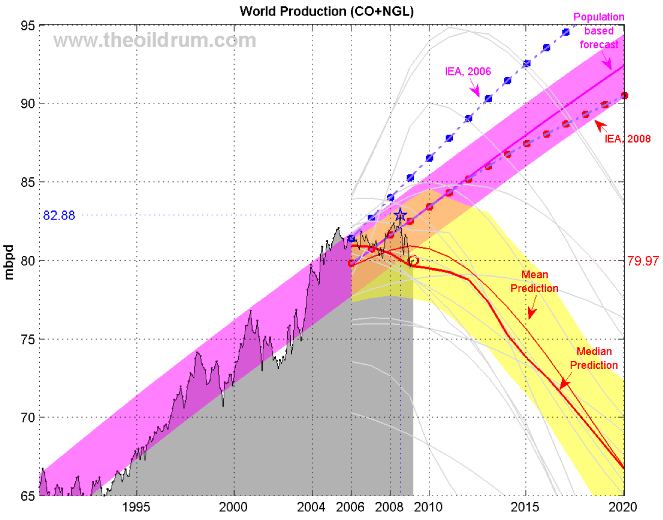
Oil demand hit highest level ever...reserves at lowest

NEW YORK (CNNMoney.com) - Worldwide oil demand hit its highest level ever on the back of explosive growth in the developing world, according to preliminary figures in a recent report.

But the world's thirst for the hot commodity is unlikely to lead to the price spike witnessed in 2008 -- largely due to oil field investments made during the last bubble, analysts say.

Globally, oil demand hit 88.3 million barrels a day in the third quarter of 2010, according to preliminary numbers released earlier this week from energy consultants Wood Mackenzie. That tops the previous quarterly record of 88 million barrels a day, reached in the fourth quarter of 2007.


Demand high production low = pain

World oil production (EIA Monthly) and various forecasts (2001-2027)

Beware $90 oil - With high unemployment, weak consumer spending and falling home prices, what else could possibly slow America's economic recovery? Oil prices. Gasoline: $3 by Christmas and a 'Mini-Apocalypse' in Spring? and What will 2011 bring? Triple-digit oil

Related? Risk Of Chinese Overheating After "Astonishing" Oil Growth


All included updates above from TOD

FREE: #1 Best Selling Amazon "Energy" Book

Author Craig Shields makes available his best-selling energy book as a free download.The book is based on interviews with 25 of the world's top researchers, authors, analysts and industry leaders. A surprisingly large percentage of these experts point to these "tough realities" that exist in the technology migration, the economic implications, and the political issues that affect the world energy industry.
HTML clipboardIMAGE: Craig Shields
Says Shields, "The truth is, the energy industry faces tough realities in several forms, not only technology readiness, but more importantly the pushback from powerful vested interests." "Whether our concerns are healthcare issues caused by emissions, enriching terrorists, military conflicts, social chaos and injustice, global climate change, or other forms of long-term environmental damage, there is no doubt that we need to put an end to our reliance on fossil fuels." 

When alternative energy author and consultant, Craig Shields, published his 314-page book, RENEWABLE ENERGY - FACTS AND FANTASIES, earlier this year, he wanted it to go big.  "I was delighted when it hit #1 on Amazon in two different subjects [energy and engineering]; I never thought that would happen," Craig admits. But now Shields wants to send the message even more broadly, and has consented to giving away electronic copies for free to anyone endeavoring to separate the truth from the lies regarding this important subject.   

Click the following link to download RENEWABLE ENERGY - FACTS AND FANTASIES for no cost:

http://2greenenergy.com/renewable-energy-facts-fantasies-ebook/

Says Shields, "Of all the tragedies facing the world, the failure of our civilization to understand and embrace clean energy may be the saddest – because it's so avoidable."

Book: Renewable Energy Facts and Fantasies"All of us – well, almost all of us – want clean energy," Shields points out. "Whether our concerns are healthcare issues caused by emissions, enriching terrorists, military conflicts, social chaos and injustice, global climate change, or other forms of long-term environmental damage, there is no doubt that we need to put an end to our reliance on fossil fuels.  But it's just not that easy.  We would do well to understand the realities if we are to have informed, relevant discussions as to what we must do as a civilization."

Those looking for drama will find plenty, associated with some of the book's main topics:

  • Peak oil.  What are the facts?  The most likely consequences?  See page 13.  

  • Oil addiction.  What are the US national security implications?  See page 24.  

  • Unseen forces.  Are there sinister forces that surround our borrowing a billion dollars every day to buy oil? See page 30.  

  • Externalities.  What is the imperative to force the producers and consumers of all forms of energy to pay the true and complete costs? See page 253.

  • Global climate change.  What - and whom - should we believe?  See page 34.

  • Role of government.  What can we and can't we expect to happen at the federal, state, and local level?  See page 79.

  • Promising technologies.  What are the latest developments in solar thermal, PV, wind, geothermal, biomass, etc? See page 291. 

  • The hydrogen economy.  Does it make sense?  See page 182.

  • The 22nd Century. Where are cutting edge ideas like cold fusion most likely to take us? See page 171.
In his folksy and informal manner, Shields says that he "hit the road" in search of the true, most hard-hitting facts that surround the migration to clean energy.  The sun showers the Earth with 6000 times more energy each day than all of us consume.  Shields asks how credible it sounds that we put a man on the moon in 1969 and now, 40 years later, we can't develop an energy solution whose efficiency is 1/6000. "Come on," he begs, "Let's look for the truth here."

E.P.A. Delays Tougher Rules on Emissions

NY Times -The Obama administration is retreating on long-delayed environmental regulations — new rules governing smog and toxic emissions from industrial boilers — as it adjusts to a changed political dynamic in Washington with a more muscular Republican opposition.

U.S Renewable Energy And Energy Efficiency Export Initiative

The U.S. launched its latest salvo in the renewable energy title fight. U.S. Commerce Secretary Gary Locke today joined seven other U.S. government agencies in launching a coordinated effort to promote renewable energy and energy efficiency exports – read the Renewable Energy and Energy Efficiency Export Initiative.