Sep 4, 2011

Will Solar Solve the World’s Triple Unsustainability Crisis?

We are living in an era of global “triple unsustainability” — economic, social and environmental. The indisputable evidence is on the front pages every morning: the never-ending aftershocks from the financial crisis of 2007-2009, events like this year’s North African rebellions and the now undeniable, acute effects of global warming.

Taken together, it represents a new reality that simply can’t be wished away — a reality of unsolved problems crying out for new and fundamental solutions, not the same old Band-Aids that only mask the wound... in order to survive on this planet, humanity has three huge problems to solve: get rid of fossil fuels, stop the demographic expansion and introduce a revolutionary technology that can save the economy.

Is there a common denominator? Fortunately, yes. And in that commonality exist solutions already in our grasp.
Read on here

Has Peak Oil Come To The Non-Opec World?

http://www.permaculture.org.au/images/peak_oil3.jpgForbes - The world’s biggest oil companies put in a pretty pathetic performance in the second quarter of 2011. Not in terms of earnings — those were great, with Exxon posting $10.7 billion and Royal Dutch Shell doing $8 billion. Just what you’d expect with Brent crude at a lofty $120 a barrel.

Where the results were disappointing was in the barrels. Of the 16 big U.S. and European oil companies studied by Deutsche Bank analyst Paul Sankey, 14 of them saw their production of petroleum decline in the quarter. Collectively, the drop amounted to 12% of total liquids volumes, or 1.2 million bpd. Their average output for the quarter totalled, 14.67 million bpd. Even excluding the effect of Libya’s issues, the decline was 8%.

Only Exxon and Shell managed 1% volume gains in liquids.

Read on at Forbes

Latest Jobs Report - Labor Day Edition

Sep 3, 2011

Self powered cyborg insects uses piezoelectric device

Cyborg insects generate power for their own neural control
The latest cyborg insects have generally been powered by batteries.  But now Aktakka and coauthors Hanseup Kim and Khalil Najafi from the University of Michigan (Kim is currently with the University of Utah), have developed an energy scavenger that generates power from the wing motion of a Green June Beetle during tethered flight. Two generators – one on each of the beetle’s wings – use piezoelectric devices to produce a total of 45 µW of power per insect. The researchers predict that this power could be increased by an order of magnitude through a direct connection between the generator and the insect’s flight muscles. Read on at PhysOrg

US Quake risk to reactors greater than thought

AP - T he risk of an earthquake causing a severe accident at a nuclear power plant is up to 24 times greater than previously believed, according to an AP analysis of preliminary government data, and the nation’s nuclear regulator believes that a quarter of reactors may need modifications to make them safer. 
 
The Nuclear Regulatory Commission says more than two dozen plants in the eastern and central U.S. may need upgrades because they're more likely to get hit with an earthquake larger than the one their design was based on. It's a belated conclusion; for more than a decade, regulators ignored the evidence of increased quake risks.  Read full from source here
 
(AP Photo/Amy Sancetta, File)

Japan: Simple ‘Wind Lens’ Doubles Output from Wind Turbines

Sep 2, 2011

Solar Company Folds After $0.5B In Subsidies - 1,100 employees fired.

"Solyndra, a Silicon Valley solar energy firm, subsidized to the tune of $500 million and held as a 'gleaming example of green technology,' announced bankruptcy yesterday. 1,100 employees fired."

The company will likely file for bankruptcy in Delaware next Wednesday, Spokesman David Miller said in an e-mail, while it evaluates options including selling itself or licensing its technology. About 1,100 full-time and temporary employees have been dismissed, effective immediately.

It may have trouble finding a buyer, said Adam Krop, an analyst at Ardour Capital Partners in New York. “I don’t see anyone swooping in,” he said today in an interview. “I don’t see this technology as very viable in the long-term. I see someone maybe buying the facility.”
Technology Not ‘Scalable’

The company has borrowed $527 million of the $535 million Energy Department loan guarantee, Damien LaVera, the agency’s press secretary, said today in an e-mail.
Read full at Bloomberg

"Every time history repeats itself the price goes up." - Oil

Sep 1, 2011

S. 1000, Energy Savings and Industrial Competitiveness Act of 2011

Congressional Budget Office:  S. 1000 would authorize appropriations for a variety of programs and activities aimed at promoting energy efficiency, particularly within residential and commercial buildings and the industrial sector. The bill also would reduce several existing authorizations of appropriations for related activities. Taken as a whole, CBO estimates that implementing

S. 1000 would have a net discretionary cost of $1.2 billion over the 2012-2016 period.

New Authorizations. S. 1000 would specifically authorize appropriations totaling $2.7 billion over the 2012-2016 period for DOE to carry out a variety of activities directed toward improving the energy efficiency of buildings and industrial systems. That specified amount includes:

  • $2 billion for grants to nonfederal lenders to support efforts by industrial and commercial manufacturers to improve their energy efficiency;
  • $400 million to cover the federal government’s cost of providing certain types of credit support for projects to upgrade the energy efficiency of existing buildings that are privately owned;
  • $200 million to establish national construction codes related to the energy efficiency of residential and commercial buildings and to provide technical assistance related to such codes;
  • $20 million to provide rebates to purchasers of certain energy-efficient transformers and devices that reduce energy consumed by motors;
  • $20 million for grants and other incentives to improve the efficiency of processes involved in the production and distribution of products; and
  • $10 million for onsite assessments of the energy efficiency of manufacturing processes.

Reduced Authorizations. To offset a portion of increased discretionary spending, S. 1000 would reduce some existing authorizations of appropriations for DOE programs to support a variety of grants, incentives, and initiatives related to industrial energy efficiency and building technologies. In total, S. 1000 would reduce amounts authorized to be appropriated by $975 million over the 2012-2013 period. Assuming future appropriations are reduced accordingly, CBO estimates that implementing S. 1000 would result in $944 million less in discretionary spending for those programs over the 2012-2016 period.

Read full from
Congressional Budget Office

Aug 31, 2011

U.S. Solar Product Exports Rose 83% Last Year on Sales to China

BloomBerg - U.S. exports of solar products climbed 83 percent last year to $5.63 billion as increasing production in China drove up sales of manufacturing equipment and raw materials, according to the Solar Energy Industries Association.

Buyouts Driving Weakest Solar Companies Into Bankruptcy

'Green Scissors' Proposes Hundreds of Billions in Cuts to Federal Giveaways

(ENS) - Eliminating $380 billion in subsidies to industries that damage the environment could go a long way toward resolving U.S. budget challenges, a coalition of groups from across the political spectrum said today in a new report.

The report, "Green Scissors 2011," identifies cuts to "wasteful spending that harms the environment," that would save $380 billion over five years, the groups said in a statement.

That amounts to about a quarter of the savings the new congressional Super Committee has been charged with achieving, in half the time, the groups point out. "The place to start trimming government spending is where Congress is putting money into the pockets of polluters," they say.

Bureau of Land Management Timber Sale marker near Garnet, Montana (Photo by Heather Andrews)

The groups propose cutting many fossil fuel, nuclear and alternative energy subsidies. Other targets include giveaways of publicly-owned timber, precious metals, oil and natural gas; "poorly conceived" road projects; and a host of "questionable" water projects planned by the U.S. Army Corps of Engineers.

"These common sense cuts represent the lowest of the low hanging budgetary fruit," said Ryan Alexander, president of Taxpayers for Common Sense, one of the four groups that wrote the report.

"Lawmakers across the political spectrum should be scrambling to eliminate these examples of wasteful spending and unnecessary tax breaks that are squandering our precious tax dollars while the nation is staring into a chasm of debt," Alexander said...

"We can go a long way toward solving our nation's budget problems by cutting spending that harms the environment, and this report provides the Super Committee with a road map," said Friends of the Earth climate and energy tax analyst Ben Schreiber. "At a time of great polarization, Super Committee members can and should find common ground by ending wasteful polluter giveaways."

Read full at ENS News

Making Fuel With Newspapers and Bacteria

"Scientists at Tulane have found a natural bacteria (dubbed TU-103) that produces butanol. While butanol-producing bacteria aren't new, there are a few important points about this particular bacterium. It is the first natural bacteria that converts cellulose directly to butanol without the cellulose needing to be processed into sugar first, and it can do this in the presence of oxygen, which kills other butanol-producing bacteria. The simplification of the process could significantly decrease the production costs of butanol. This bacteria could allow virtually any plant product, such as newspaper or grass clippings, to be used to produce fuel for conventional vehicles." - SlashDot

Alloy Could Produce Hydrogen Fuel Using Sunlight

"The University of Kentucky-University of Louisville team demonstrated that an alloy formed by a 2 percent substitution of antimony (Sb) in gallium nitride (GaN) has the right electrical properties to enable solar light energy to split water molecules into hydrogen and oxygen, a process known as photoelectrochemical (PEC) water splitting. When the alloy is immersed in water and exposed to sunlight, the chemical bond between the hydrogen and oxygen molecules in water is broken (abstract).

Because pure hydrogen gas is not found in free abundance on Earth, it must be manufactured by unlocking it from other compounds. Thus, hydrogen is not considered an energy source, but rather an 'energy carrier.' Currently, it takes a large amount of electricity to generate hydrogen by water splitting. As a consequence, most of the hydrogen manufactured today is derived from non-renewable sources such as coal and natural gas. The team says the GaN-Sb alloy has the potential to convert solar energy into an economical, carbon-free source for hydrogen." - SlashDot

Earthquake may have exceeded Virginia nuclear plant's safeguards

http://www.charmaineyoest.com/archives/homer_simpson_nnuclear_power_plant.jpgThe earthquake that prompted the shutdown of a Virginia nuclear power plant last week may have been more severe than the plant’s reactors were designed to withstand, federal regulators said.

The revelation is likely to put increased pressure on the Nuclear Regulatory Commission (NRC) to quickly implement a series of safety recommendations intended in part to protect plants from major natural disasters like earthquakes.

NRC said Monday that its preliminary analysis indicates that the ground motion caused by the magnitude-5.8 earthquake near the North Anna Power Station in Louisa County, Va., exceeded the maximum level the two reactors at the plant were built to handle.

"We have informed the NRC that preliminary reports from instruments show the earthquake potentially exceeded the design basis," Dominion spokesman Ryan Frazier said. "All reports are not final, and probably will not be until the end of the week." Frazier stressed that inspections have found no major damage to the plant. "All safety systems operated as designed and built," he said.

Dominion restored power to the plant late Tuesday night and lifted an emergency alert the following day.

While there have been no reports of major damage at the plant, nuclear critics have pounced on the incident, arguing that it highlights the vulnerability of the U.S. nuclear fleet to major natural disasters.

A federal task force said in a report released last month that the NRC should make wide-ranging improvements to the “existing patchwork of regulatory requirements and other safety initiatives.” The task force was mandated by President Obama in the aftermath of the nuclear disaster at Japan’s Fukushima Daiichi power plant.

Read full at TheHill

Aug 28, 2011

Gibson Guitar Frets: Environmental Enforcement Leaves Musicians in Fear

"Even if you have no knowledge—despite Herculean efforts to obtain it—that some piece of your guitar, no matter how small, was obtained illegally, you lose your guitar forever," Prof. Thomas has written. "Oh, and you'll be fined $250 for that false (or missing) information in your Lacey Act Import Declaration."

Federal agents swooped in on Gibson Guitar Wednesday, raiding factories and offices in Memphis and Nashville, seizing several pallets of wood, electronic files and guitars. The Feds are keeping mum, but in a statement yesterday Gibson's chairman and CEO, Henry Juszkiewicz, defended his company's manufacturing policies, accusing the Justice Department of bullying the company. "The wood the government seized Wednesday is from a Forest Stewardship Council certified supplier," he said, suggesting the Feds are using the aggressive enforcement of overly broad laws to make the company cry uncle.http://www4.images.coolspotters.com/photos/192356/sheryl-crow-and-gibson-sheryl-crow-gallery.jpg

"Surprisingly, musicians, who represent some of the most savvy, ecologically minded people around, are resistant to anything about changing the tone of their guitars," he said.

You could mark that up to hypocrisy—artsy do-gooders only too eager to tell others what kind of light bulbs they have to buy won't make sacrifices when it comes to their own passions. Then again, maybe it isn't hypocrisy to recognize that art makes claims significant enough to compete with environmentalists' agendas.

Read more from WallStreetJournal

Raising food prices on poor and middle class investors move to food stocks

WOW - first they outsourced your job (to save a nickle) then the sold you an impossible home loan foreclosing on your house and then they nearly emptied your pension after draining your savings account.... Finally when you thought you gave all you could, they go after your food.

Imagine what is going on to the starving in our nation and then get you head around the 1 Billion who will die of starvation in the next 5 years as you read this "investors guide" to getting rich on food stocks.


MSN - "Forget stocks; buy food"
Agriculture commodities are on the move, breaking out of consolidation for the first time since last summer.
It's been a tough summer for stocks and other risky assets -- but the same can't be said for agricultural commodities. Hot, dry drought conditions have ruined crops all across the American growing regions. At the same time, demand remains robust thanks to the big appetites of newly empowered eaters in the developing world

The combination of tighter supply and stronger demand is sending prices higher once more. As a result, as a group agricultural goods are pushing up and out of a long seven-month downtrend dating back to February. A powerful new uptrend is being established. Here's how to take advantage. - Read full report here if you can stomach it

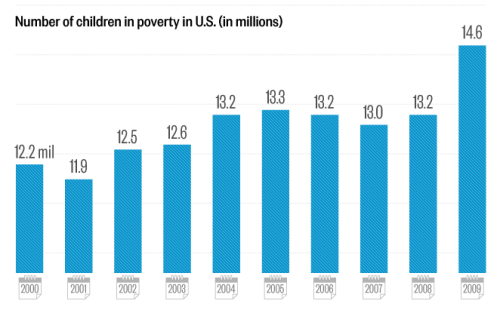
1 in 5 children in poverty in the...USA becomes Food Stamp Nation


Nearly 1 in 5 children lived in poverty in the U.S. in 2009. That’s 15 million kids. Alabama, Louisiana and Mississippi ranked lowest on the study’s 10 indicators of child well-being. New Hampshire, Minnesota and Massachusetts ranked highest.

Altogether, there are now almost 46 million people in the United States on food stamps, roughly 15 percent of the population. That's an increase of 74 percent since 2007, just before the financial crisis and a deep recession led to mass job losses.

At the same time, the cost doubled to reach $68 billion in 2010 -- more than a third of the amount the U.S. government received in corporate income tax last year -
Read full at Yahoo News

Aug 26, 2011

Project Uses Nature’s Inspiration to Create Zero-Waste Farms

The ABLE project is a social enterprise based on a former landfill site in Wakefield in the U.K. The scheme combines the production of fish and horticultural produce with a unique outdoor learning facility, training young people in horticulture, aquaculture and environmental skills. Among other activities, the ABLE project is demonstrating a “closed-loop” no-waste agricultural system inspired by nature.

It begins with waste cardboard, which is shredded and used as animal bedding. Once the cardboard bedding deteriorates over time it is added to animal manure and fed to worms, which compost the materials. The worms are in turn fed to fish which are harvested for human consumption. Worm-made compost is used to help grow crops on land that was previously unused for agricultural purposes.

Brazilian wind power cheaper than natural gas

 The Brazilian authorities have this week confirmed that wind power in the country currently costs less than natural gas, after a series of energy auctions saw wind farm operators undercut other forms of energy generation.
A photo of a line of at least seven wind turbines stretching into the distance, with the wind turbine blades blurred by their motion.
Seventy-eight wind power projects won contracts in last week's energy auctions held by Brazil's National Electric Power Agency, totalling 1,928MW and priced at approximately 99.5 reals (£37.4) per MWh.

By comparison, the average price for power generated with natural gas is currently 103 reals (£38.7) per MWh in Brazil, while the average price for energy determined through the auctions was 102.07 reals per MWh.

According to Brazil's Energy Research Company (EPE), wind power is also now trading around 19 per cent cheaper per MWh than the average price in Brazil last year, suggesting the price of the technology is becoming a more competitive.

EPE president and chief executive Mauricio Tolmasquim said the auctions show that wind and natural gas are competitive, predicting wind prices will continue to fall in Brazil.

"That wind power plants have been contracted at two digit prices, below 100 reals per MWh, showcases the energy market competition through auctions," he said. "That wind power could reach these lows versus natural gas was unimaginable until recently."
Read more from buisnessgreen

Russia Green Lights $65 Billion Siberia-Alaska Rail and Tunnel to Bridge the Bering Strait

Peak Energy
Inhabitat reports (quoting World Architecture News and The Times - the LaRouchies also seem to have an interest in the topic) that Russia has "approved" the long talked about Bering Strait rail tunnel / energy corridor - a critical component in Bucky Fuller's vision of a global energy grid - Russia Green Lights $65 Billion Siberia-Alaska Rail and Tunnel to Bridge the Bering Strait!.

The Register notes "this time its chances of actually being built are strengthened by a 500-mile link from the existing Trans-Siberian line to the Eastern Siberian city of Yakutsk, scheduled for completion in 2013" - however I don't think anyone is holding their breath waiting for tunnel construction to start.

The high speed railway and tunnel will be a private public partnership whose economic impact could be startling. 100 million tons of freight could be moved per year using the most efficient known way of transport. Proposed tidal energy plants could provide 10 gigawatts of energy and a string of wind power fields could churn a constant supply of clean energy, serving as a vital link to a worldwide energy grid. The tunnel alone would take fifteen years to complete — and an energy and railway network would take many more — but the project would significantly change the shipping and energy industry.

Aug 24, 2011

Portable House, Simple Life

 Embarrassed by her middle class affluence after a visit to Guatemala, Dee Williams grabbed her hammer, built a tiny house on wheels, downsized to less than 400 possessions, and parked her house in a friendapos;s yard. Her living arrangement then blossomed into a multi-generational family / community.

Dee shows us her warm and comfy 7x12 foot house, how she meets city codes, and some unusual ways this life has affected her. Her advice to wannabe tiny home builders: Take on the experiment. Just do it!
http://portlandalternativedwellings.com

German Village Produces 321% More Energy Than It Needs

http://www.jgpress.com/images/art/1108/37e.jpgOk, those Germans are just showing off now. Not only has the nation announced plans to shut down all of its nuclear power plants and started the construction of 2,800 miles of transmission lines for its new renewable energy initiative, but now the village of Wildpoldsried is producing 321% more energy than it needs! The small agricultural village in the state of Bavaria is generating an impressive $5.7 million in annual revenue from renewable energy. Read full at Inhabitat

Aug 23, 2011

Germany Makes Facebook “Like” Button Illegal

http://500hats.typepad.com/photos/uncategorized/2007/10/03/addict.jpg“Websites in Schleswig-Holstein must remove their Facebook Like button by the end of September 2011 or they will face a fine of up to €50,000 ($72,000).”

Northern Germany has announced that the Like button, with its ability to track a user’s movement across the internet, violates German and European privacy law. But without tracking plugins, how will corporations and advertisers record our activities and interests, so that they can better serve and satisfy?

Via ZDNet

Aug 22, 2011

More talk and do nothing campaigns ... latest social engineering $hit by MTV make our youth sheep

MTV is promoting its latest social engineering program pushing a generation of sleeping sheep to believe that if you just simply "Give a Sh*t" about the world's problems, they will go away.

So to spread the word and make a difference, MTV's asking people everywhere to tweet or post what they give a shit about in the world, while they... well... take a sh#t.
No this is not a "onion joke site" this is really a campaign.

Haase - I'm pretty sure just giving a sh*t ain't gonna do sh%t

Lighting Improvements Provide Easy Energy Savings Including New Florescent and LED Lamps - Free P2 Webinar

Join us for a Webinar on August 31


Lighting improvements are one of the easiest and most cost-effective energy improvements for businesses. Financial incentives are often provided by utility companies and local energy efficiency programs. Learn how to save money and energy through lighting improvements. This seminar will focus on industrial and warehouse applications. It will cover information about various light sources and control devices plus important aspects to consider when making changes. Case studies of lighting changeouts including analysis and cost savings will be presented.

Title:     Lighting Improvements Provide Easy Energy Savings
Date:     Wednesday, August 31, 2011
Time:     1:00 PM - 2:00 PM CDT

Click here to Reserve your Webinar seat now

This webinar will provide background information on lighting terms, trends in lighting (including new florescent and LED lamps),  legislation which will change what's available to purchase, and technology comparisons, plus case studies from the heartland.  It should be well worth your hour to learn this information, especially if you're considering changing your lighting any time soon.

This webinar is the last of four webinars designed to help companies reduce energy use and conserve materials.  A booklet of case studies (Easy Material and Energy Savings) and the other webinars (energy savings from compressed air, material savings from packaging, and solvent substitution) are available at www.p2ric.org/business

Costco Removes Electric Vehicle Chargers...Citing a Lack of Usage

Costco was an early leader in offering electric-vehicle charging to its customers, setting an example followed by other retailers, including Best Buy and Walgreen. By 2006, Costco had installed 90 chargers at 64 stores, mostly in California but also some in Arizona, New York and Georgia. Even after General Motors crushed its EV1 battery cars, the Costco chargers stayed in place. Yet just as plug-in cars like the Nissan Leaf and Chevrolet Volt enter the market, Costco is reversing course and pulling its chargers out of the ground, explaining that customers do not use them. Read full at NY Times

Getting ready for a wave of coal-plant shutdowns

Washington Post - Over the next 18 months, the Environmental Protection Agency will finalize a flurry of new rules to curb pollution from coal-fired power plants. Mercury, smog, ozone, greenhouse gases, water intake, coal ash—it’s all getting regulated. And, not surprisingly, some lawmakers are grumbling.

Industry groups such the Edison Electric Institute, which represents investor-owned utilities, and the American Legislative Exchange Council have dubbed the coming rules “EPA’s Regulatory Train Wreck.” The regulations, they say, will cost utilities up to $129 billion and force them to retire one-fifth of coal capacity. Given that coal provides 45 percent of the country’s power, that means higher electric bills, more blackouts and fewer jobs. The doomsday scenario has alarmed Republicans in the House, who have been scrambling to block the measures. Environmental groups retort that the rules will bring sizeable public health benefits, and that industry groups have been exaggerating the costs of environmental regulations since they were first created.

"The CRS report also agrees with green groups that the benefits of these new rules shouldn’t be downplayed...EPA estimates that an air-transport rule to clamp down on smog-causing sulfur dioxide and nitrogen dioxide would help prevent 21,000 cases of bronchitis and 23,000 heart attacks, and save 36,000 lives. That’s, at the high end, $290 billion in health benefits, compared with $2.8 billion per year in costs (according to the EPA) by 2014. “In most cases,” CRS concludes, “the benefits are larger.”

So, who’s right? This month, the nonpartisan Congressional Research Service, which conducts policy research for members of Congress, has been circulating a paper that tries to calmly sort through the shouting match. Thanks to The Hill’s Andrew Restuccia, it’s now available (PDF) for all to read. And the upshot is that CRS is awfully skeptical of the “train wreck” predictions.

CRS notes that many of the plants most affected by the new EPA rules were facing extinction anyway: “Many of these plants are inefficient and are being replaced by more efficient combined cycle natural gas plants, a development likely to be encouraged if the price of competing fuel—natural gas—continues to be low, almost regardless of EPA rules.”... Granted, those upgrades and changes won’t be free. The CRS report doesn’t try to independently evaluate the costs of the new rules, noting that they will depend on site-specific factors and will vary by utility and state. (Matthew Wald recently wrote a helpful piece in The New York Times looking at how utilities might cope.) But, the report says, industry group estimates are almost certainly overstated. For one, they were analyzing early EPA draft proposals, and in many cases, the agency has tweaked its rules to allay industry concerns. And many of the EPA’s rules are almost certain to get bogged down in court or delayed for years, which means that utilities will have more time to adapt than they fear.

...Granted, few would expect this report to change many minds in Congress. Just 10 days ago, Michele Bachmann was on the campaign trail promising that if she becomes president, “I guarantee you the EPA will have doors locked and lights turned off, and they will only be about conservation.” That doesn’t sound like someone who’s waiting for a little more data before assessing the impact of the new regulations.

Read full at Washington Post

Aug 21, 2011

Chevy VOLT sales die... after costing tax payers million$

While Chevy VOLT sales continue to die (MSNBC) with bleak sales forecast (YAHOO)... tax payers are stuck with the bill.
The Chevy Volt has only sold about 3,200 units thus far...Nevertheless, Government Motors is ramping up for more Volt production.  According to Yahoo Auto news, GM is forecasting “sales of around 16,000 for the year as a whole, with 40,000 sold by 2012.

The problem is said to be the price of the Volt, which is a massive understatement, because everyone buying a Volt is understating the price.  No one purchasing a Volt has the faintest clue what it really costs, because of all the taxpayer subsidies plowed into production, and hefty rebates offered at the point of sale.  $400 million in federal subsidies were extracted from the taxpayer to fund Volt production, and buyers have enjoyed a $7500 federal tax credit.

That means each of the 3200 Volts sold thus far has rolled out of the lot with $132,500 in taxpayer subsidies stuffed in the glove compartment.  They sticker at $41,000, so that means each Volt sold thus far actually costs $173,500, with only $33,500 paid by the actual purchaser.

California drops electric car support

California has dropped their $5,000 electric car rebates - LA Times

NASDAQ - will gas be $5 soon, causing next great depression?

NASDAQ - No one knows precisely at what point oil begins to substantially hinder consumer spending and slow commercial activity - but this much is known: every $1 per barrel rise in oil decreases U.S. GDP by about $100 billion per year and every 1 cent increase in gasoline decreases U.S. consumer disposable income by about $600 million per year.

....psychological levels and outlook are important factors in the oil-GDP equation.

If the average U.S. price of gasoline, currently about $3.69 per gallon for regular unleaded as measured by gasbuddy.com , rises and stays above $4 per gallon, that would cause consumers to forecast that 'higher gasoline prices here to stay,' and they'll likely adjust their discretionary spending. Similarly, an oil price that rises and stays above $100 per barrel has a similar psychological effect.

Now here's the sobering news: there are scenarios that could push U.S. gasoline prices above $5 per gallon in 2011:

a) a U.S. Government default that causes institutional investors to dump U.S. Government bonds, triggering a plunge in the dollar, pushing up oil's price

b) any sustained unrest in another oil producing nation in the Middle East; or

c) stronger growth in Asia/Latin America emerging market economies, most of which are registering large annual percentage increases in oil consumption.

Energy/Economic Analysis: Again, the U.S. economy can still grow with oil at $100 per barrel and gasoline at $3.70 per gallon, but the chance for strong GDP growth above 4% with those energy prices is slim. Further, if Brent oil ventures toward $120, then $130, with gasoline trending toward $4.50 per gallon, oil enters the danger zone -- compelling wide-spread consumer and commercial cutbacks - Read on at NASDAQ

The explosive truth behind Fukushima's meltdown

Japan insists its nuclear crisis was caused by an unforeseeable combination of tsunami and earthquake. But new evidence suggests its reactors were doomed to fail - Independent


Related U.S. Problems???

Alabama Nuclear Reactor, Partly Built, to Be Finished - The directors of the Tennessee Valley Authority unanimously approved a plan on Thursday to finish the partly built Bellefonte 1 nuclear reactor, a project on which the authority spent billions of dollars in the 1970s and ’80s but dropped in 1988 because of cost overruns and declining estimates of power demand.

Aug 19, 2011

13-Year-Old Teen Finds Solar Power Breakthrough

7th grader Aidan Dwyer, who used phyllotaxis — the way leaves are arranged on plant stems in nature — as inspiration to arrange an array of solar panels in a way that generates 20-50% more energy than a uniform, flat panel array. Aidan wrote, "I designed and built my own test model, copying the Fibonacci pattern of an oak tree. I studied my results with the compass tool and figured out the branch angles. The pattern was about 137 degrees and the Fibonacci sequence was 2/5. Then I built a model using this pattern from PVC tubing. In place of leaves, I used PV solar panels hooked up in series that produced up to 1/2 volt, so the peak output of the model was 5 volts. The entire design copied the pattern of an oak tree as closely as possible. ... The Fibonacci tree design performed better than the flat-panel model. The tree design made 20% more electricity and collected 2 1/2 more hours of sunlight during the day. But the most interesting results were in December, when the Sun was at its lowest point in the sky. The tree design made 50% more electricity, and the collection time of sunlight was up to 50% longer!"- SlashDot

Oil Rising Again from Old Deepwater Horizon Site?

Oil from the Macondo Well site is fouling the Gulf – and BP is scrambling to contain both the crude and the PR nightmare that waits in the wings.
Reliable sources tell us that BP has hired 40 boats from Venice to Grand Isle to lay boom around the Deepwater Horizon site – located just 50 miles off the Louisiana coast. The fleet rushed to the scene late last week and worked through the weekend to contain what was becoming a massive slick at the site of the Macondo wellhead, which was officially “killed” back in September 2010.

The truly frightening part of this development, as reported in a previous post , is the oil may be coming from cracks and fissures in the seafloor caused by the work BP did during its failed attempts to cap the runaway Macondo Well – and that type of leakage can’t be stopped, ever.

Read full from Stuarth Smith

Aug 18, 2011

EIA reports 3.9% increase in U.S. energy-related emissions in 2010

U.S. carbon dioxide emissions from the consumption of fossil fuels were 5,638 million metric tons carbon dioxide (MMTCO2) in 2010, an increase of 3.9 percent from the 2009 level, according to Energy-Related Carbon Dioxide Emissions, 2010, an online analysis released today by the U.S. Energy Information Administration (EIA). This is the largest percentage increase in U.S. energy-related carbon dioxide emissions since 1988. However emissions are still 6 percent below the 2005 level. http://fuelfix.com/files/2010/10/energy_headlines1-306x243.jpg

Among the factors that influenced the rise in emissions was an increase in the Gross Domestic Product (GDP) of 3.0 percent. In addition, the energy intensity of the U.S. economy, measured as energy consumed per dollar of GDP (Energy/GDP), increased by 0.7 percent in 2010. There was also a slight increase in the carbon dioxide intensity of U.S. energy supply (CO2 per unit of energy) in 2010, which is in contrast to a drop of 2.4 percent in 2009. Consumption of coal, the most carbon-intensive fossil fuel, rose by 6 percent in 2010 after falling by 12 percent in 2009.

"The 3.9 percent increase in emissions in 2010 was primarily driven by the rebound from the economic downturn experienced in 2008 and 2009. The Reference case in our latest energy outlook projects significantly slower emissions growth over the next decade, averaging 0.2 percent per year," said Acting EIA Administrator Howard Gruenspecht.

This analysis can be found at: www.eia.gov/environment/emissions/carbon