Apr 22, 2009

Earthday roundup - Blah, blahh

Dead in the noise of "green wash marketing" media blitz across our great nation... 

They all forget yesterday and tomorrow were Earthday...

But for those who just look for 'a day in perspective', here is the run down by annual post:

No longer a fan of Earth Day


History... learn from it or become it.

Maybe now goolge will pay up...

Last fall I submitted a proposal to goolge for a $10 Million (prize) investment opportunity to save the economy and environment (linked here)

Of which 100% of the prize would go towards building economically and environmentally sustainable communities (gcommunities.com)


While google has been too busy to get back to me???

Vice President Biden and dozens of others have not....

Vice President Joe Biden today announced $300 million in funding from the American Recovery and Reinvestment Act for state and local governments and transit authorities to expand the nation's fleet of clean, sustainable vehicles and the fueling infrastructure necessary to support them.

"For city and state governments across this country, 'every day is Earth Day'* thanks to the ambitious commitments they are making to green their vehicles and transit systems. Now it's time for Washington to help them deliver on those promises," said Vice President Biden. "From advanced battery cars to hybrid-electric city buses, we're going put Recovery Act dollars to work deploying cleaner, greener vehicles in cities and towns across the nation that will cut costs, reduce pollution and create the jobs that will drive our economic recovery."

Read full at DOE


*Hey 'Vice President Joe Biden quoted me' - Haase

Apr 21, 2009

Forestry BMP's protect state’s water quality

SPOONER, Wis. -- Clean water and healthy forests are essential to Wisconsin's economy and quality of life.

In 1995 the state initiated forestry Best Management Practices or BMPs to help protect water quality during logging projects. This voluntary program, developed by private and public forestry officials and promoted by the Department of Natural Resources, is designed to prevent water pollution from sediments, organic debris, nutrients, chemicals and high stream flows.

A 10-year study of the program found that 83 percent of the time BMPs were applied correctly where needed. The overall BMP effectiveness has also proven to be impressive: when BMPs were applied correctly where needed, no adverse impacts to water quality were found 99 percent of the time.

Equally important is that when Forestry BMPs were not applied where needed, adverse impacts to water quality were observed 71 percent of the time, usually with minor long-term impact.

"These numbers confirm the importance of the Forestry BMP Program in protecting water quality and the continued need to improve BMP application," DeLong said. Future goals of the program involve identifying opportunities for improvement and continuing to protect our state's water resources.

During snow melt and rainy weather, surface water moves across the ground picking up and carrying pollutants to streams and lakes or the groundwater. Soil becomes a "non-point pollutant" when large amounts of it are flushed into a waterway. Nonpoint source pollution – pollution that doesn't come from a pipe or specific discharge -- is regarded as the largest remaining pollution threat to Wisconsin's waters.

Loggers anpod land managers can access the BMP program several different ways

A field manual provides 128 best management activities for forestry, addressing issues such as road building, timber harvesting, prescribed burning and the application of chemicals. The Forestry Best Management Practices for Water Quality Field Manual (Forestry Publication #93 03Rev) is available on the DNR Web site.

Annual BMP workshops are also sponsored by the DNR. These workshops, that include much in field study, have been attended by thousands of landowners and loggers.

Read full via WDNR

Lake property owners “turn back the clock” to protect clean water, habitat

Property owners along Bony Lake in Bayfield County decided they needed to turn back the clock if future generations were to enjoy the lake's clean water and wildlife as they have.

"We realized we were responsible for leaving a healthy lake legacy for our children and grandchildren, and the best way to do that was to partner with our neighbors and local government to remove unsightly riprap and other lake-unfriendly things, and to replace them with the native plants and trees that were here before us," said LeBreck, a member of the Wisconsin Association of Lakes and Bayfield County Lakes Forum [www.bayfieldcountylakes.org] (eixt DNR) who spearheaded a project that's one of the largest habitat restoration efforts in Wisconsin.

"Project success is built upon citizens contributing their talents and skills to drive the effort and share their stories with neighbors and surrounding communities," Toshner said. "Perhaps the greatest gauge of success is that we're hearing from property owners along other lakes who want to follow the lead of the Bony Lake folks."

Read full VIA WDNR

Wisconsin revitalized Menomonee River Valley

New brochure takes residents on trip through revitalized Menomonee River Valley

MILWAUKEE – People taking a hike or bike ride through Milwaukee’s revitalized Menomonee River Valley on the Hank Aaron State Trail are passing by sites -- including Miller Park, home of the Milwaukee Brewers; Marquette University’s soccer fields; and the Harley Davidson Museum – that highlight successful public-private partnerships to restore brownfields in Wisconsin.

A new “Menomonee River Valley Brownfields Walking Tour" (pdf; 2.7kb) brochure from the Department of Natural Resources highlights seven sites along the trail that sit atop former abandon or underutilized contaminated properties with real or perceived contamination, commonly referred to as brownfields.

“Milwaukee’s Menomonee River Valley was once a prime example of a big brownfield in need of some serious cleanup,” according to the new brochure produced by the DNR Remediation and Redevelopment Program.

Originally a shallow marsh, the Valley was filled over time with a variety of materials and adapted for industrial use. However, those industrial practices over many years contributed to the impairment of the Valley’s natural resources.

“Today the Menomonee River Valley has become a natural resource and economic gem once again, thanks to the partnership of numerous public and private parties, including the DNR, city of Milwaukee, Menomonee Valley Partners and other area businesses and non-profit organizations,” the brochure notes.

The brochure and walking tour highlight these many successes, starting with Miller Park and ending at the Harley Museum. However, hikers and bikers can continue on the Hank Aaron Trail all the way to Lakeshore Park on the eastern terminus of the trail.

Read full via WDNR

Apr 20, 2009

Japanese Teenager's Eco-Generator Wins Gold Awards at International Youth Exhibition

Japanese teenager Emi Mase won top gold awards in two of eight categories for her "hybrid power generator harnessing sunlight and wind." The model, developed after several years of trial and error by the 15-year-old junior high school student, from the city of Kariya in Aichi Prefecture, was highly appraised for its eco-friendliness and originality.

The little generator uses hybrid technology, a combination of six solar panels on the top and wind power blades attached underneath, with the aim of utilizing solar and wind power as effectively as possible. A pair of solar batteries is installed under the solar panels. The power difference between the batteries makes the motor rotate toward the direction of the more powerful battery. Thus, the direction and inclination of the shaft adjusts until the batteries start generating equal outputs. At night or during daytime in bad weather, the blades generate electricity by wind. The model, emulating the behavior of a sunflower, turns to face the sun as it moves across the sky. When aimed toward the south, a scale indicates the time of day.

The model is also unique because it is made utilizing readily available waste materials. For instance, the wind power blades are made of plastic nametags glued together, and the motor is a hub dynamo from a broken bicycle. The young female inventor has enjoyed making things out of waste materials since childhood, and her winning invention has also aroused high expectations of her future works.

International Exhibition for Young Inventors

Read full from Japan Institute of Invention and Innovation

"Urban Ore" from Used Electronic Equipment without Human Intervention

NIMS Develops Simplified Method to Recover Rare Metals from Urban Mine

Japan's National Institute for Material Science (NIMS) announced that it had developed a new method which is easier to use in recovering rare metals from piles of used products, so-called "urban mine."

In the method, announced on November 26, 2008, discarded electric devices are shredded into pieces of a few centimeters in size before being put into a ball mill and ground, without undergoing disassembling and selection by hand.

By feeding large objects exceeding the ball mill's accepted maximum size limit, structural parts of the wastes made of plastics and aluminum are not ground and left in the form of plates, whereas junctions, ceramics and plating that contain rare metals, are pulverized into fine particles less than one millimeter in size. Through this process, each component can be obtained in a form to be treated easily in the downstream process.

This method, utilizing a ball mill, a simple piece of equipment widely used in conventional pulverization, basically requires no heat or water, and can be operated in urban area as a small size plant.

NIMS considers this to be an optimal system for "urban mines."

Read full from source here

Apr 11, 2009

The HAASE Energy Tank

Nope not me... but still a great idea and engineering.
 
ENERGY TANK 

Protecting a lasting lifestyle basis for future generations requires a responsible approach to available resources. This means an increase in use of alternative energies, for example when looking at heating solutions for hot water supply to buildings. This way costs for heating could be reduced, and in view of the expected price trend on the energy market, these savings will increase in future.

The time-related fluctuation between supply and demand of energies needs to be evened out/ equalized by the use of or HAASE Energy Tank. The bigger the tanks, the larger the capacity to store regenerative energies and therefore conserving on conventional energy sources.

Read More... For the maximum utilization of area and energy!

Trillions contiune to elude us from logic...

We have spent Trillions on "hydrogen and cold fusion dreams" over the last four decades while ignoring the simple, practical, logical steps that are required to have a sustainable future...  at some point as a nation we will need to wake up from the delusion that throwing more money at a problem will fix it. When the solutions are already free? 

 
Google AP  $3.5 billion, engineers have completed the world's most powerful laser
March 31/2009 - After more than a decade of work and $3.5 billion, engineers have completed the world's most powerful laser, capable of simulating the energy force of a hydrogen bomb and the sun itself.http://www.livejournal.com/community/craftgrrl/7373383.html
 
The Energy Department will announce Tuesday that it has officially certified the National Ignition Facility at the Lawrence Livermore National Laboratory in California, clearing the way for a series of experiments over the next year. Scientists hope the experiments eventually will mimic the heat and pressure found at the center of the sun.
 
The facility, the size of a football field, consists of 192 separate laser beams, each traveling 1,000 feet in a one-thousandth of a second to converge simultaneously on a target the size of a pencil eraser.
 
"What we want to show is scientific proof of the principle of fusion energy," said Moses, predicting some experiments for a short time may produce 50 to 100 times more energy than the lasers themselves generate.
 
Maybe a 'few people' should google "Robert L. Park" bob, and fusion and hydrogen energy scams to grasp the medias delusion...
 
HAASE NOTE - The 'department experts' I correspond with have never appeared delusional about the 'practical' applications of hydrogen or fusion... the ones who disagree, typically are naïve to realistic alternatives or have received a degree or conflicting 'research funding in the impractical fields of confusion'

What energy loss model will we subsidize next?

Hey if 'selling an energy loss worked for ethanol' this should be a great model of reducing your personal carbon footprint ;-)

Total Unemployment Rate at 19.8%

Why is this EHS News?
There is a direct link to and hard job market and increases in serious injuries and incidents.
 
In the near future this will lead our nation to be literally suffering on the job without insurance, skilled EHS professionals or employees who 'buy in' to a safety culture. Leaving employers with the tab and workers with the scars...
 
Real Numbers - (BLS Jobs Reporting Is Seriously Flawed, at Best.) During the Clinton Administration, "discouraged workers" — those who had given up looking for a job because there were no jobs to be had — were redefined so as to be counted only if they had been "discouraged" for less than a year. This time qualification defined away the bulk of the discouraged workers. Adding them back into the total unemployed, unemployment in line with common experience, as estimated by the SGS-Alternate Unemployment Measure, rose to about 19.8% in March, from 19.1% in February.
 
It is the history my father visited in the 80's and my grandfather in the 40's.
 
These are hard times and we need to learn from history or become it.

"the detox of Canada has begun,"

Canadas Bill 167's : "to prevent pollution and protect human health and the environment by reducing the use and creation of toxic substances, and to inform Ontarians about toxic substances"

The bill, introduced on April 7 in the Legislative Assembly of Ontario, is compared favorably to the 1989 Massachusetts' Toxics Reduction Act (TURA).  Under the Massachusetts' program, hundreds of companies have reduced their use of highly hazardous compounds like anhydrous ammonia, cyanide, trichloroethylene and lead and saved millions of dollars in the process.  The Ontario Province hopes to replicate Massachusetts' success.

When the Bill 167 was introduced by Environment Minister John Gerretsen, Environmental Defense (Canada) said "the detox of Canada has begun," and called the bill a "significant step forward for the protection of the environment and human health."   Environmental Defense's news release also noted:

"Ontario is the largest air-emitter of cancer-causing chemicals in Canada.  Data from 2004 (the most recent comparative data available) also showed that Ontario was second only to Texas in terms of tonnes of toxic chemicals being released and transferred in North America.  Blood sample testing by Environmental Defence over the past few years has consistently shown that many hazardous chemicals, such as lead and mercury, are found in the bodies of Canadians." [emphasis added; interesting how they mention Texas, eh?]

Ontario's Ministry of the Environment prepared a consumer-type guide to the legislation, explaining why the province's toxics reduction strategy is necessary:

"Toxic substances are part of our everyday modern life but may threaten our health and our environment, unless we all do our part to manage their use and reduce the risks to human health and the environment.  … To help achieve a greener, more sustainable economy, the proposed Toxics Reduction Strategy would focus on reducing the use of toxic chemicals at the front end of industrial processes and in consumer products."

A Super Big Horrah! to Ontario's Ministry of Environment for recognizing the protection benefits for workers' health in their toxics reduction initiative.  They note:

Toxics reduction can lower business costs related to raw materials, waste disposal, worker safety, liability and regulatory compliance."

Very cool.  But don't take my word for it, the Toxic Use Reduction Institute has dozens of case studies explaining how less hazardous, safer substitute cleaners, solvents and other products save firms money and advanced reduced workers' risk of harm.

Read full from Celeste Monforton, at the thepumphandle

Apr 10, 2009

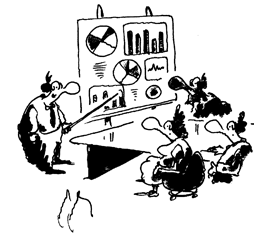
Hours wasted... on fluff

"I think this clearly shows that we spend far
too much on fancy charts and graphs."


Chinese car sales surpass US market

 Gav - The China Daily reports that China is now likely the world's largest market for new cars, partly due to the government stimulus program pushing buyers to new, energy efficient vehicles - Auto sales 'surpassed US in Jan'.
 
    China may have surpassed the United States to become the world's largest auto market based on monthly sales in January, according to analysts and forecasts. General Motors, the leading US automaker, estimates that China sold about 790,000 vehicles last month.
 
   The government passed a stimulus package for the auto sector last month, reducing the purchase tax on vehicles with an engine capacity of less than 1.6 liters by half to 5 percent. It is also spending 5 billion yuan ($730 million) on subsidies to farmers replacing three-wheeled vehicles or outdated trucks with small, 1.3-liter or less, vehicles.
 
    The push is to promote more energy efficient vehicles while improving the competitiveness of the country's highly fragmented auto industry. About 10 billion yuan is going into upgrading automakers' technology and developing alternative energy vehicles.
 

Apr 9, 2009

Water Running on Empty - Unlike global warming, the crisis is right here, right now.

Much of the world already knows that it is possible to live without oil, but that it is impossible to live without water.

Al Jazeera asks how long it will be before the US is runing on empty.
That reality is dawning upon people across the US as the country faces unprecedented water shortages.

Water-challenged native Americans in Orne, Tennessee, are forced to line up for daily water truck deliveries after their local water source dried up.

On the Texas side of the Rio Grande Basin there are Americans forced to live without running water just like their Mexican counterparts across the border.

Along Oregon's Klamath river, local farmers and native American fishermen have been fighting over what they consider to be their birth right to precious water allocations.

It is not just rural Americans facing chronic water shortage; the residents of Atlanta came within 90 days of running out of water last summer.

Many economists and climatologists believe profligate lifestyles and denial of the real value of water as a precious and diminishing resource are leading the US into a crisis far greater than its dependency on foreign oil.

Unlike global warming, the crisis is right here, right now.
Peter Gleick, one of the country's leading water analysts, sets the factual context for the US water crisis from overpopulated desert areas in the Southwest, to the unchecked depletion of natural aquifers throughout the Midwest.

Pollution has made 40 per cent of the country's rivers and lakes unsafe to swim in, yet alone drink from.


Americans are often their worst enemy in the fight to maintain their traditional lifestyles which so depend on a diminished natural resource.

For example, a large hamburger takes 2,000 gallons of water to produce while a round of golf costs approximately 4,000 gallons of water.

Leaving the tap on while brushing your teeth or shaving uses an estimated 350 gallons, which is the daily per capita consumption of water in most African countries.

While the US is making billions of dollars by feeding the rest of the world, they are also exporting a third of their water supplies every year with the flow of "virtual water" to overseas markets in the form of food exports.

Watch Video here - We the People: Running on Empty aired from Thursday, April 02, 2009.


Haase - Now that 'oil has peaked' can we move on to fixing a 'difficult problem'...

What killed the VOLT's and Tesla?

Nissan "It's a real car with 100-mile range,"

From enn "Nissan is making moves that could make it the major mass-market EV player among the established automakers."

The prototype of Nissan's forthcoming electric car may look like a breadbox, but the technology beneath that boxy body could propel the Japanese automaker to the front of the EV pack when the car hits the road next year.

Nissan may be a small player compared to the likes of General Motors, Toyota and Honda, but it's probably the most committed to EVs. CEO Carlos Ghosn has said in no uncertain terms that cars with cords are the future of the automobile. And he's backed that up with an all-in bet on a practical, affordable hatchback with decent range, reasonable recharge time and room for five people.

Oh - and Nissan says it'll cost about 90 cents to charge.


"It's a real car with 100-mile range," said Mark Perry, Nissan's director of product planning. "We may not be the first to market with an EV, but we'll be the first to mass-market an EV."

Forget hydrogen and ethanol. Electricity is the next big thing in cars. Just about everyone has jumped on the EV bandwagon, and most of the major automakers promise to have one on the road between 2010 and 2012.

General Motors, BMW, Daimler,Tesla, Chrysler and Every one of them could end up following Nissan to the party.

"Nissan could end up being the come-from-behind leader in the EV space because Carlos Ghosn has pushed them so aggressively,"
said Darryl Siry, an electric car expert and clean tech analyst at Peppercom. Article continues at Wired

Ethanol the $3 billion a year fail...


The Production Subsidy
(Source CBO)
Since 1978, firms that blend ethanol with gasoline have received a tax incentive from the federal government. The incentive has been adjusted periodically; today, ethanol blenders receive a tax credit of 45 cents for each gallon of ethanol blended into the supply of gasoline. The subsidy has helped keep ethanol competitive with gasoline, even when prices for corn are high. In 2007, the cost of the credit in forgone federal tax revenues was $3 billion.
    Read more at by Douglas Elmendorf's blog here or full report here

CBO - Today, with better technologies, a bushel of corn yields 2.8 gallons of ethanol, and newer facilities may improve yields to 3.0 gallons per bushel.

The break-even ratio also depends on federal policies. At the current subsidy of 45 cents per gallon of ethanol produced, the break-even ratio that would allow producers to cover their fixed and variable costs falls to 0.7.


Ethanol Production and Food Prices

Producing ethanol for use in motor fuels increases the demand for corn, which ultimately raises the prices that consumers pay for a wide variety of foods at the grocery store,

In addition, the demand for corn may help push up the prices of other commodities, such as soybeans.

From April 2007 to April 2008, the increasing... use of corn for ethanol accounted for about 10 percent to 15 percent of the increase in the CPI-U for food over the April-to-April
period.


Cellulosic ethanol

According to researchers, cellulosic ethanol, if successfully developed...
The technology for large-scale commercial production of the fuel, however, has not yet been developed.

... researchers believe that if sufficient grasslands and forests are converted into cropland for producing ethanol feedstocks and for producing the crops displaced by those feedstocks, the potential benefits of ethanol in terms of lower greenhouse-gas emissions will be reduced or eliminated... the conversion of those lands releases greenhouse gases and reduces their ability to sequester carbon—that is, to capture and store carbon to prevent its release into the atmosphere— because cropland absorbs less carbon than do grasslands and forests.
Read full report from CBO


Haase Comment:
Ouchh... although they did not mention the the massive toll
ethanol takes on fresh water sources, this should be enough fuel to end three decades of trillion dollar subsidized mistakes.

Apr 8, 2009

The Nuclear Goliath: Confronting Industrial Energy

The reality of cashin a bad check...
Again - I am NOT against nuclear energy... just the way we are doing it.
 
Frank Joseph Smecker;
Lately, many may have heard the affable radio jingles for nuclear energy as a clean and reliable candidate to supplant the U.S.'s reliance on foreign fossil fuels. This is sheer, malignant propaganda. Nuclear energy, along with its requisite mining, is not only unsustainable to a high degree, but is, in all aspects, violently rapacious as it dissolves the planet's fecundity and ultimately encumbers the creation of life for generations to come. It is imperative that nuclear is removed from the lexicon of domestic energy policy and that we, as a people, consider alternative energy options while significantly reducing our consumption levels.
 
From its inception through mining processes to enrichment, fission, and post-fission, nuclear energy supplies the human race with more destructive waste than energy. A typical 1,000 megawatt plant produces roughly 500 pounds of plutonium and 20-30 tons of high-level radioactive waste annually. There is no known safe and secure way to dispose of the waste. The rate of decay of a radioactive isotope is called its half-life (e.g., the half-life of Plutonium-239 is 24,000 years). The hazardous life of a radioactive element--that being the amount of time needed before the element stops posing a significant risk to people's mortal health--is at least 10 half-lives; that means plutonium-239 will remain deadly for at least 240,000 years.
 
 
Answer to CO2 or coal? Think again...
Considering as well the mining of uranium, fuel enrichment, and plant construction combined to culminate an operating facility, the equivalent of 34-60 grams of CO2 are emitted per kilowatt of energy (from each operational facility).
 
In 2007 the U.S.'s total generation of energy from nuclear fission was 806.5 billion kWh (kilowatt hours).
 
That equals anywhere from 27,421 billion to 48,390 billion grams of CO2 released into the atmosphere in that year alone.
 
The global emissions are much starker, ranging anywhere from 90,429.8 billion to 159,582 billion grams of CO2 released into the atmosphere. Once again, these numbers will only climb drastically with demand.
 
In order to replace the entire world's fossil fuels, more than 2,000 new nuclear facilities would have to be built--an endeavor that would assail the ecology of the planet and its people.    
 
In addition, the deleterious effects of uranium mining imposed on the environment have been felt worldwide--from Saskatchewan all the way to Rum Jungle in Australia, which is perhaps the world's worst case of negligent mining.
 
It is, by far, the indigenous peoples of the world who have most felt the encroaching and damaging effects of the nuclear industry. The aboriginals of Australia, perhaps the oldest human cultures of any still in existence, are threatened daily by the encroachment of uranium mining and the deadly legacy of uranium tailings.
 
In the U.S., the land surrounding Yucca Mountain (a proposed nuclear waste repository and current weapons testing site) is not U.S. territory, but legally belongs to the Shoshone Nation (despite U.S. gold-mining in the area, which is destructive of the land and people).
 
In Canada, ten lakes within the Lake Huron region are now radioactive waste sites due to uranium mining. Uranium mined from Elliot Lake in Ontario was used for U.S. nuclear weapons and the area is now infecund, emitting dangerous levels of radiation, immiserating the Northern Ojibwa peoples.
 
Amid the pandemonium, environmental protection measures have yet to be effectively administered throughout the world's mines. Rehabilitation costs (estimated to be in the millions of dollars) are paid primarily out of the pockets of taxpayers. It is apparent that nuclear energy is not only far from being a safe and "green" form of energy; its entire (anti-) life-cycle is culpable for pervasive damage to the natural world and its complex animate beings.
 
PLEASE - Read more if you can stomach it from Frank Joseph Smecker Petroleumworld
http://www.petroleumworld.com/sf09040501.htm


Dah, study: Low-Carbon Fuel Standards Are Unlikely to Reduce Warming

A low-carbon fuels standard is likely to do little to reduce global warming emissions and can even be counterproductive, according to a paper published in the American Economic Journal: Economic Policy.
 
The study, by three academics, found that the policy reduces consumption of high-carbon fuels like oil, but “increases low carbon fuel production, possibly increasing net carbon emissions.”
 
A low-carbon fuel standard requires that the mix of transportation fuels sold to automobiles or trucks include only a limited percentage of carbon-intensive fuels. The idea is to cut carbon emissions from driving, since transportation accounts for more than a quarter of the country’s greenhouse gas emissions.
 
California is furthest along in adopting a low-carbon fuels standard. A number of Northeastern states are also looking at the idea, as is the Midwest. A major climate change bill unveiled in the House this week also calls for a national low-carbon fuels standard.
 
The economic journal’s paper starkly concludes that a low-carbon fuel standard “cannot be efficient.”
 
One problem with a low-carbon fuel standard is that it could be extremely costly. The paper says that a 10 percent reduction in the carbon intensity of fuels could result in abatement costs ranging from $307 to $2,272 for each ton of carbon dioxide. That is roughly 100 to 700 times the price of carbon dioxide emissions allowances now traded in the Regional Greenhouse Gas Initiative, a program in 10 Northeastern states to combat global warming by cutting power plant emissions.
 
The Dahh factor
The easiest way to cut carbon emissions from transportation is to cut the level and “not drive so much,” Mr. Holland said. “Carpool! Take public transportation! Leave the car at home.”  Read full from NY-Times blog

Energy Department Will Step Up Pace on Renewable-Power Loans

The good news
(Bloomberg) -- The U.S. Energy Department will issue loan guarantees for renewable energy projects at a quicker pace in the coming months, a senior adviser at the agency said.
 
“If we did one during March, we’ll probably do one during April, two during May and then start moving at a faster rate,” Matt Rogers, the senior adviser charged with distributing loans and guarantees, said in a telephone interview yesterday. “The machine is picking up momentum as we work through this.”
 
Rogers also said the department was “on track” to give loans to carmakers and suppliers in April or May under a program to encourage greater fuel efficiency. The agency last month offered its first guarantee, with $535 million to support construction of a solar-panel manufacturing facility.
 
The $787 billion U.S. economic stimulus signed into law by President Barack Obama in February includes $38.9 billion for the department, with funding to underwrite as much as $60 billion in loans.
 
 
The BAD (if not horrible) news
The programs are intended to support renewable energy projects or energy efficiency systems, clean-coal initiatives, nuclear power plants and nuclear fuel systems.
 
Rogers said the department was in talks with nuclear power plant developers about the option of providing “pre- construction financing.”


HAASE comment:
Hey industry guys do you want billions in gov loans? I wonder if they are interested?
"Rogers said they are still trying to determine whether the nuclear industry is interested,"
 
Ahhh, dah.

Improved VOC Analysis Method for Architectural Coatings

Summary (Full report here):

Results of all VOC determinations and the validation study were analyzed and the new methods were found to be superior to available methods in nearly all cases.

Specific VOC method analysis guidelines were developed for each class of coatings. These methods were used successfully to determine the VOC content of all 67 coatings samples. These results were compared with those obtained using EPA Method 24 when possible. Statistical analysis of the results show the new methods to be significantly more accurate the those obtained by Method 24 for nearly all classes of coatings. Although labs participating in the validation generally did not use the specific new methods supplied to them for analysis of the coatings, the results validated the superiority of the new methods in all cases.

Conclusions
New direct methods of VOC analysis using gas chromatography have been developed for all classes of architectural coatings. These new methods will allow the VOC content of all types of architectural coatings to be determined accurately. This remedies the current situation where existing methods are not capable of determining VOC levels of coatings formulated to meet lower VOC limit regulations.

The following new methods were developed as a result of this project:
• Standard Test Method for Direct Analysis of the Volatile Organic Compounds (VOCs) in Waterborne Air-Dry Coatings by Gas Chromatography (Waterborne
Method). This method is a revision of ASTM Method D 6886, Test Method for Speciation of the Volatile Organic Compounds (VOCs) in Low VOC Content
Waterborne Air-Dry Coatings by Gas Chromatography.

• Standard Test Method for Direct Analysis of the VOC and HAP Content of Multi- Component Coatings by Gas Chromatography (2K Method)

• Standard Test Method for the Direct Analysis of the Common Hazardous Air Pollutants (HAPs) in Solvent borne Air-Dry Coatings by Gas Chromatography
(HAP Method)

• Standard Test Method for Determination of the VOC Content Remaining in Paint Films After Total Volatile Content Determination by ASTM Method D 2369
(Film Extraction Method)

• Standard Test Method for Solids Determination of 2K Coatings Containing More than 90% Solids (High Solids Method) Specific VOC method analysis guidelines were developed

Full report here

HUGE 'No More Plastics Bags: McDonald's Promotes Simpler Packaging.

As part of its efforts to reduce environmental impact, McDonald's Japan began reducing its packaging for takeout items at about 3,700 outlets across Japan from December 1, 2008. Instead of polyethylene shopping bags, McDonald's introduced unbleached paper bags, and taking this opportunity, it also replaced other bleached paper bags with more environmentally friendly unbleached ones. The company expects such efforts to save about 2,300 tons of plastic resources annually, equivalent to approx. 6,200 tons of carbon dioxide (CO2) emissions, or to the annual CO2 absorption of approx. 248,700 Japanese cypress trees.

Read full from Japan for Sustainability


Chevy VOLT - Forcing dreams into reality is called a delusion...

I am not a pessimist, but I have a hard time with this one... VOLT is innovative?

Big GAV from accross the pond had a great month talking about innovation, but when I read about the Chevy VOLT over the last year. Innovation was NOT in the context.

I have drove, worked on and helped on some amazing vehicles over the last 20 years. 200 mpg fuel sippers, 7 passenger clean 2 cycle CNG's, a garage full of long range electric... I see innovation coming and it is not from volt.

The volts looks just like it the cars it copies (see photos here) .

Is innovation taking other ideas and selling them under different brands?

My 93' GEO (Chevy/Toyota car) gets between 38-44mpg* all the time, regardless of how I treat it.

Before that, I drove a 85 Renault alliance that averaged over 45 mpg*, but sacrificed mpg for the safety and reliability of the GEO due to having a couple kids (they do that to you).

I waited the last decade with dreams, there would be another Chevy that would replace my GEO.  Or just a GEO with a 1.2L turbo clean diesel engine running CNG/Biogas... like Top Gear's $7,000 70mpg VW.

And yes, it is healthy to dream, but when people force their dreams into reality it is called a delusion...


The VOLT is the last shred of hope...  Did G.M. watch the Top Gear 70mpg VW or hear about GS and Nissan Motors?

Nissan has a 'ready for primetime full long range electric' - I think will rock the world in 2011.

VW and BMW have a glutton of 45mpg safe + family cars on the table... Even in my budget... there are now full electric and hybrid cars coming to WalMart between $1,000-$5,000 But, a VOLT $40,000+ 'copy car' that shows less innovation than the 1905 Pieper.


We also have to equate lifetime environmental and 'true ownership costs'...

The 'Dust to Dust' cost to operate a Prius is still $2.191 per mile.

What will the VOLT be? At least $4 per mile... at $40K (In my lifetime, I have not spent a total of $40,000 on ALL my daily driven cars...)


‘Earth to G.M., Time to get in the game!’

Your recent bailout cash could have bought the companies that make better technology and secured a stable future in the global auto market for decades while saving it at the same time !


Seriously, I have purchased great Chevy's in the past, but I am keeping the GEO or buying Foreign until I see affordable, clean innovation in U.S. show rooms.


*Yes I did 'tweak' the cars for mpg using EPA rated rim fires, hard rubber skinny tires, light oils and free flow intake/exhaust for 15% better mpg.

Apr 7, 2009

Happy 9th Birthday Lithium-ion Battery Price Stagnation

In its May 2000 report "Costs of Lithium-Ion Batteries for Vehicles," the DOE published its estimate of the prices Li-ion battery packs would need to achieve before HEVs, PHEVs and EVs could be cost-competitive. For complete details see Section 6 beginning on page 37.
Battery Type
Baseline
Optimistic
Industry Goal
High-Energy
(35 kWh Battery Pack)
$706 per kWh
($24,723)
$250 per kWh
($8,767)
>$150 per kWh
(USABC)
High-Power
(100 cells, 10 A-h each)
$2,486 $1,095 $300
(PHGV)

These figures were not a forecast of what the Li-ion battery companies were likely to achieve. They were a simple statement of the fundamental economic barriers to entry that had to be overcome before a market could develop.

After nine years of work and incalculable spending on Li-ion battery research and development, the following table shows exactly how far the Li-ion battery industry has come.

Manufacturer
Chemistry
Current Price
Target Price
Ener1 (HEV) Li-polymer $660 per kWh N/A
Valence Technologies (VLNC) Li-phosphate $1,000 per kWh $500 per kWh
Altair Nanotechnologies (ALTI) Li-titanate $1,000 per kWh N/A
A123 Systems (power tool packs) Li-phosphate $1,228 per kWh N/A
2008 DOE SEGIS-ES Estimates
(PV Solar battery packs)
Various $1,333 per kWh $780 per kWh
2009 NEDO Survey Results
(Average of Japanese Producers)
Various $2,018 per kWh $1,000 per kWh
(next year)

Price stagnation is the kindest term I can use for nine years of research that has failed to reduce costs.
 
In the 2008 Annual Progress Report for its Vehicle Technologies Program, the DOE reported that the cost of high-energy Li-ion batteries for PHEV and EV applications "is approximately a factor of three-five too high on a kWh basis." Likewise, with respect to high-power Li-ion batteries for HEV applications, the DOE reported that the cost "is approximately a factor of two too high on a kW basis." Is it any wonder that a recent report on the electric two-wheeled vehicle (E2W) market in China says that roughly 85% of new E2Ws are powered by heavy lead-acid batteries instead of their lighter Li-ion cousins? Could it have something to do with a 400% price differential and a population that knows the value of a dollar?
 
I have seen all the glowing reports about immense progress in the Li-ion battery sector. One of my personal favorites is on Slide 14 from a Summer 2008 presentation by David Anderson of the Rocky Mountain Institute that shows a highly favorable "industry consensus" regarding future Li-ion battery manufacturing costs (Click here for image PDF).

 
In what alternative universe is that kind of industry consensus reasonable? Over the last nine years Li-ion battery companies have had a hard time maintaining Y2K price levels much less reducing them.
 
While their products are safer, I've seen nothing to indicate that the industry consensus is based on anything other than hope and the certain knowledge that unless prices collapse Li-ion batteries will never be cost effective in HEVs, PHEVs and EVs.
 
If you can stomach more Li-ion battery reality, read it from John Petersen at altenergystocks.com

DIY MICRO servers could save billions

Imagine the billions we could save using 'thumb drive size' servers using only five volts or all powered by a 10watt solar panel... 
 
 
FTPmicro is a small embedded web server as big as a package DIP40, based on the PIC18F67J60.

This chip is a 8-bit PICmicro with an integrated 10BaseT Ethernet controller. Despite the small dimensions, the board has some interesting peripherals, like a microSD card slot, a TC1047 temperature sensor, and many analog and digital I/O pins. But even more important is the software that can be performed on this device. Using the Microchip TCP/IP stack, suited for this particular hardware, it is possible to have, in a few minutes, a working HTTP and UDP server with DHCP client. FTPMicro doesn't need any external component: loading the compiled software in the PIC and powering the device at 5V is all you need. It also has a comfortable connector for the ICD2 programmer/debugger by Microchip. Thanks to the SD memory, a large number of files can be saved, and they will be available to the HTTP server. In this way, you can store a complete web-site, with both static (HTML) and dynamic (CGI) pages. By reading data in real-time and sending commands, it is possible to control any hardware.
 
FTPmicro is Open Source and you can DIY www.ftpmicro.com
 

Sponges reprogram anti-resistant bacteria and New Bank goes Sustainable

Research chemists from the Hollings Marine Laboratory have fond a chemical from an ocean-dwelling sponge that reprograms anti-resistant bacteria to make them vulnerable to medicines again. Once-ineffective antibiotics proved lethal for bacteria treated with the compound, researchers found. The sponge’s chemical defense points to a compound called ageliferin. Fragments of the ageliferin compound successfully resensitized bacteria that cause whooping cough, ear infections, septicemia and food poisoning. The compound also works on Pseudomonas aeruginosa that causes horrible infections in wounded soldiers and on MSRA, bacteria resistant to multiple drugs.
 
For newly chartered e3Bank, being “green” or “sustainable” is not a suite of product offerings or a vertical market within a company. It is an operating system. “It is part of our DNA,” according to the Bank’s Chairman Sandy Wiggins. The bank’s name, e3bank, reflects its focus on a triple bottom line: sustainable enterprise, the planetary environment, and social equity.  The bank has designed loan approval criteria to reflect all three dimensions of sustainability and that screen for environmental and social risk. Finance rates for a loan will be reduced, says Wiggins, as projects reach higher levels of sustainability. The bank’s employees will all be LEED certified. The Pennsylvania bank has just received its charter from the FDIC.
 
  - Sustainable Practices provided David Schaller, daschaller at yahoo.com
 

Full electric cars starting at $1,000 and coming to a Costco or Wal-Mart

Ouch... another NANO, VOLT and U.S. automaker FAIL. 
Say 'Ta, Ta' to volt and NANO...
 
A Flemish company has announced plans to sell what it claims to be the world’s only true zero emissions vehicle, the HPV
 
“The vehicle is really exciting,” says Dirk Apers, who spearheaded the project. “The components are relatively simple and easy to mass produce. Also, since the vehicles cost less than $1,000, we hope they will be useful for providing cheaper transportation not only in the developed world, but also in developing countries.”
 
The HPV, which stands for Human Powered Vehicle, works with the use of a biological engine that harnesses the driver’s body energy. While this energy would be an inefficient way to power heavy, traditional cars, the new vehicle’s intelligently designed ultra light body makes the power transfer frighteningly efficient. A WorldWatch Institute report on the HPV found that per passenger-mile the vehicle required only 35 calories of energy, compared to 1,860 for a traditional car.
 
Although other zero emissions cars, such as the “water car” and the “air car,” have so far failed to capture widespread consumer investment, experts believe the HPV has serious market potential for several reasons. Among these is the price. With the average American spending an average of $240,704 to $349,968 on motor vehicles in their lifetime, according to Motor Trend, getting a set of wheels for under a grand may have appeal. The vehicle is also more compact than traditional motor vehicles. In a German demonstration of 100 of the vehicles, they took up only a fraction of the space used by the same number of traditional cars.


While seeing Chinese cars on display at the Detroit Auto Show has become somewhat common these past few years, there is one place they were hardly expected: Costco!
 
Yes, the big-box discount store Costco could be selling the Chinese-designed and Mexican-built vehicles says one auto exec. The CEO of GS Motors — Kathleen Ligocki — told the Hybrid Cars website that she thinks the US will follow in Mexico’s footsteps. GS Motors sold 4,000 China-made vehicles in Mexico last year at…Costco and Wal-Mart.
 
Ligocki, who previously served as president of Ford of Mexico, said the next step is for Chinese-designed cars to go into production in Mexico in 2010. She expects them to hit the American market about five years later. Hybrid Cars reported that GS is building an assembly plant in Michoacan, Mexico, with the China-based FAW Group who has formed joint ventures with automobile giants such as Volkswagen, Toyota and Mazda.
 
GS Motors will launch the FAW brand in Mexico this year with the F1 Hatchback, an entry-level car sold for under $5,500. FAW, one of the largest Chinese automakers, is allied in China with Volkswagen.
 
GS Motors is hurrying to get the first Chinese cars to America via Mexico—but they are not alone. BYD (Build Your Dreams) showed plug-in hybrid and electric model in Detroit last month and promised to bring them to the US as early as next year. While Ligocki and other industry executives believe Chinese cars will inevitably enter the US market... read full from source gas2.org

HAASE Comment - 'Earth to G.M., Get in the game!'
Your recent bailout cash could have bought both these companies and secured a stable future in the global auto market for deacades while saving it at the same time !
 

Apr 4, 2009

"McDonald's To Take Steps To Cut Potato Pesticides"

Reuters  McDonald's Corp, the largest purchaser of potatoes in the United States, has agreed to take preliminary steps to reduce pesticide use in its domestic potato supply, shareholder groups said on Tuesday. Following the agreement, the Bard College Endowment, Newground Social Investment and the AFL-CIO Reserve Fund withdrew a shareholder proposal that, if approved, would have required the company to publish a report on options for cutting pesticide use in its supply chain. The investors said McDonald's has agreed to survey its U.S. potato suppliers, compile a list of best practices in pesticide use reduction and recommend those best practices to global suppliers. It also will share its findings with investors and include the findings in its annual corporate social responsibility report." 
 
Read full from Lisa Baertlein Reuters

DOE's Energy Savers Web Site Helps Consumers Stay Cool, Save Money

Warm weather is on its way. That usually means electric bills will increase and Americans will use more energy than at any other time of year to keep their homes or businesses cool and comfortable.
 
Finding ways to combat these high costs is essential, and that is why the U.S. Department of Energy has launched the Stay Cool, Save Money Web site. This educational tool can help consumers be more energy efficient by implementing simple, cost-effective, energy saving solutions this spring and summer.
 
Find out more at DOE's Stay Cool, Save Money Web site www.energysavers.gov/seasonal


Apr 3, 2009

OSHA compliance - minimally effective safety and health program

From Cal-OSHA Reporter, "OSHA admits that compliance with their regulations is considered a minimally effective safety and health program. Compliance will not prevent all potential exposures or potential incidents." - Gary Ganson, American Industrial Hygiene Association member


'Alarming' Use Of Energy In Modern Manufacturing Methods

Overall, new manufacturing systems are anywhere from 1,000 to one million times bigger consumers of energy, per pound of output, than more traditional industries. In short, pound for pound, making microchips uses up orders of magnitude more energy than making manhole covers.
 
At first glance, it may seem strange to make comparisons between such widely disparate processes as metal casting and chip making. But Professor Timothy Gutowski of MIT's Department of Mechanical Engineering, who led the analysis, explains that such a broad comparison of energy efficiency is an essential first step toward optimizing these newer manufacturing methods as they gear up for ever-larger production.
 
"The seemingly extravagant use of materials and energy resources by many newer manufacturing processes is alarming and needs to be addressed alongside claims of improved sustainability from products manufactured by these means," Gutowksi and his colleagues say in their conclusion to the study, which was recently published in the journal Environmental Science and Technology (ES&T).
 
Gutowksi notes that manufacturers have traditionally been more concerned about factors like price, quality, or cycle time, and not as concerned over how much energy their manufacturing processes use. This latter issue will become more important, however, as the new industries scale up -- especially if energy prices rise again or if a carbon tax is adopted, he says. Read more from Environmental News Network

U.S. power use tumbling with recession

NEW YORK/HOUSTON (Reuters) - U.S. electricity demand will continue to shrink in 2009 as the economic meltdown hits industrial power consumption, but a rebound could come in 2010.

Bigger houses, a myriad of electric devices and an expanding economy have kept U.S. power use on a nearly uninterrupted climb for 25 years - until the recession put the brakes on industrial demand in 2008.
 
Electricity sales to industrial customers are expected to shrink 6.4 percent this year, leading to an expected 1.7 percent drop in overall power consumption in 2009, the U.S. Energy Information Administration said in its most recent outlook.
 
EIA, which provides data and analysis for the U.S. Department of Energy, said in another report industrial consumers bought 11.4 percent less power in January 2009 compared with the same time last year.


Steven Chu's Aprils Fools - Biofuels the 4th!

According to Dave Cohen, Steven Chu sees no particular urgency to our current problems.
 
His way of dealing with potential shortfalls is described as follows:
"The answer is let efficiency take care of it, at least in the foreseeable future 5, 10 or 15 years from now. Chu’s reasoning is based on his miscalculation that we have between 10 and 40 years before oil & natural gas production, taken together, will peak and decline. Efficiency is supposed to double the time we have to find replacement fuels, so Chu has recast the problem to give himself the 20 to 80 years he requires to find a way to replace oil.  (Biopact, October 8, 2007)."
 
The problem with Fourth Generation Biofuels is that they are way, way, way off in the future, if they can be done at all.
 
The plan is to somehow improve the whole process through bioengineering to do what nature does not do now. Is this a sensible way to approach a very real current fuel problem? Read more from the Drum
 

EPA to test air around 62 schools in 22 states

WASHINGTON - The Environmental Protection Agency will soon be adding a different kind of equipment to dozens of school yards around the country — air pollution monitors.
 
The EPA announced Tuesday a list of 62 schools in 22 states where the outdoor air will be tested for toxic air contaminants. The agency will work with state and local officials to begin the monitoring at the selected schools within three months.
 
While the EPA and state and local governments already operate air pollution monitoring networks that collect information on a variety of air pollutants, this will be the first time school-yard air quality will be the focus of their investigations.
The schools were chosen because of their proximity to industrial facilities or other sources of pollution. The list includes elementary, middle school and high school campuses.
 
The list of schools that will be monitored can be found on the EPA's Web site at http://www.epa.gov/schoolair.
 
What contaminants will be tested varies depending on the school. But the focus is toxic chemicals that are known to cause cancer, respiratory and neurological problems — especially in children, who are more susceptible than adults because they are still growing.
 
The monitors will measure the air for gases as well as solid particles such as heavy metals and soot, the EPA said.
 
"EPA, state, and local officials are mobilizing to determine where elevated levels of toxics pose a threat, so that we can take swift action to protect our children at their schools," said EPA Administrator Lisa Jackson. Once in place, the new equipment will collect air samples on 10 days over a month. The EPA will cease monitoring at the school if the results show good air quality. But if high levels of contaminants are detected, the agency will take steps to reduce the pollution.

Read More From The Associated Press VIA - msnbc

Apr 2, 2009

$7,000 builds you a 70 mpg 0-60 in 7 sec...

What seats 5 gets 70mpg has a top speed of 140mph and does 0-60 in 7 sec?
Apparently my first car (tweaked out by top gear ;-)
Top Gear has declared war on oil, poverty and slow cars, all at the same time.
We naively proposed that we could build the car that no car company could manage to build themselves. Specifically, we proposed to marry timeless Italian style with thoroughly adequate performance (0-60 in 7 seconds), shocking fuel economy (70 mpg) and humble frugality (you can duplicate it for $7,000). And we decided to build it in 55 days. In retrospect, both symmetry and our own sanity would have been better served if we gave ourselves 77 days to pull this off, but no matter.
 
Maybe you have to own wrenches to grasp just how ridiculous is the idea of putting a modern (2002) engine in an old (1981) car. Putting a Jetta TDI engine in a Rabbit is an egregious abuse of the word "put." You can put your hat on a rack, and you can put a head of lettuce in your grocery bag, but try putting an elephant in your trunk. Easy to say, far more complicated to do, and odds are good something will go wrong when you try.
 
Each of these problems took hours — sometimes days — to figure out, and by the time we nailed our 0-60 in 7 seconds goal (that's faster than some 1980s Corvettes) and were ready to tackle the 70 mpg part, we had less than a week left and a lot fewer brain cells to work with.
 
There are two sides to improving fuel economy. You make the engine more efficient, so it takes less fuel to make power, and you make the car itself more efficient, so it takes less horsepower to move it in the first place. We've already done everything we can to make our horses more efficient — our new TDI engine is incredibly frugal, with tuning modifications that made it more so — now it's time to tune the car.
 
Our mileage test, then, becomes pass/fail. We'll fill the tank, drive 70 miles and fill it again. If it takes less than one gallon, we've broken the 70 mpg barrier.
 
It's ironic how squeezing the most out of every last drop of fuel — a selfless bit of environmentalism, if there ever was one — means driving like an erratic, self-important douchebag: Accelerating like a grandma, coasting up hills, etc. Our apologies to anyone within a mile of the Sipster who actually has somewhere to be. This said, we're complete novices at this hypermiling thing, so we're sure an actual hypermiler nerd could have infuriated drivers with better results.
 
Exactly 70 miles after we started, we clatter back to the same diesel pump, swipe the card and, with held breath, start pumping. The pump shuts off almost immediately. 0.14 gallons! No, that's not right. That would be 500 mpg.
 
Sometime next week we'll explain the financial realities of building a clattery, unreliable, silly-looking, fast, nimble and incredibly fuel-efficient Sipster of your own for only $7,000. And after that? You decide. Aside from replacing the fuel tank, what should the Sipster do next? Should we try to set a land speed record? Do the 12 Hours of Sebring without refueling?