Showing posts sorted by relevance for query FutureGen. Sort by date Show all posts

Jul 2, 2009

FutureGen: Earmark Becomes the Costliest Pork Project in History

Looks like more pain for futuregen:
It appears that FutureGen does not currently seem to be a “smart investment.” The DOE restarted the project as of 12 June, but lack of private backing for the remaining costs has stalled progress again. Both American Electric Power Co. and Southern Co. have pulled funding as of 26 June

Coburn's amendment would strike the largest single earmark ever - a $2 billion appropriation for the FutureGen Alliance Project of Illinois. Former Illinois Democrat Gov. Rod Blagojevich has been among the project's biggest supporters, even though the U.S. Department of Energy says it's a waste of resources.

Coburn claim: This allocation should be properly called a shameful example of pork spending, since FutureGen was the only possible project that fit allocation criteria. Much of FutureGen funding would have originated in the Department of Energy (DOE) before an abrupt announcement to pull funding in 2008. Renewed evaluation caused officials to doubt the project’s economic and environmental benefits.

FutureGen funding is an earmark President Obama stated would not be included in the stimulus bill.

Administration response: The DOE has reviewed the project and will continue to do so. FutureGen will only receive full funding “if it proves to be a smart investment.

Dear administration, it is not

Read more from washingtonexaminer

Sep 3, 2009

DOE cools off on FutureGen’s clean coal plant?

VentureBeat - The Department of Energy may have just handed out $27.6 million for clean coal projects, but it’s already looking to curtail its

picture-31involvement — particularly in the large-scale Illinois clean-coal plant being built by the FutureGen Alliance, the nexus of nine utilities pushing to make it a reality.

The DOE and FutureGen have inked a deal to slash construction costs and bring in more partners to carry the anticipated $2.4 billion load. Right now, the DOE is carrying the bulk, having granted $1.1 billion to the project.

Still, the DOE is looking to dilute its role in the project, perhaps to free up funds for other cleantech initiatives. In order to make this possible, FutureGen agreed to up the number of companies in its consortium from nine to 20. When VentureBeat last reported on FutureGen, it was 11 utilities strong, but Southern Co. and American Electric Power opted out in June in order to tighten their belts.

Their departure, and the DOE’s decision to back off are not so surprising. Since the 275-megawatt Illinois plant was pitched to the government, the terms have changed. Originally, the new equipment was supposed to trap up to 90 percent of carbon emissions — a figure that has since been scaled to 60 percent. The shift pointed to a lack of technical understanding of the facility’s feasibility. Also, recruiting 20 companies into the fold has been a long-standing goal, but little progress has been made... please read more from venturebeat

Jan 30, 2008

Doyle's FutureGen project derailed by science and common sense

Well let us just pick our grinning jaws up off the floor: The U.S. Department of Energy has told lawmakers that it plans to pull funding for FutureGen, its ambitious and crazily expensive "clean coal" demonstration plant. The feds had planned to cover some three-quarters of the $1.8 billion price tag, and cited ballooning costs as its reason for backing out. The announcement pissed off lawmakers from Illinois, where the plant would have been sited and was expected to create 3,000 construction jobs. Sen. Dick Durbin (D) pledged that the state delegation "is going to make the case for FutureGen directly to the president," while Gov. Rod Blagojevich issued a statement saying the DOE had "deceived the people of East Central Illinois who spent time and resources competing for the project.
 

Jul 25, 2006

Finalists to be named for $1 billion power plant of the future

The FutureGen Alliance scheduled an announcement for Tuesday to identify the finalists among 12 sites in seven states vying for the plant. West Virginia is offering 387 acres of state land for the Point Pleasant site it has in play.

FutureGen is a nonprofit collaboration among electric utilities, coal companies and other investors putting up $250 million to design and build the plant. Among the investors are Columbus-based American Electric Power and the U.S. Department of Energy, which is providing $750 million.

Touted as the power plant of tomorrow, FutureGen involves technology that converts coal into highly enriched hydrogen gas that burns more cleanly than coal and would be used to produce electricity for about 275,000 single-family homes.

Plans call for the 275-megawatt plant to capture most of its emissions of carbon dioxide — a greenhouse gas widely blamed for global warming — and inject them permanently into underground reservoirs, a process called sequestration.

The project would create more than 1,000 construction jobs and as many as 200 jobs at the plant.

The finalists will have to get moving. FutureGen wants to measure the progress of the finalists’ proposals at a meeting next week in Pittsburgh. Environmental impact statements are due in early September, said Jacqueline Bird, the Ohio Coal Development Office director, who is working on that state’s project.

: "$1 billion power plant of the future"

Jun 15, 2009

FutureGen - More billions, no answers - ever... seriously

 When throwing money more at FutureGen is being considered, our problems have grow from horrible to epic.

I could not say enough of what a backwards step this is towards energy independence or sustainability... but what has been said should be enough to bury funding for carbon capture and sequestration until it has been demonstrated that it does not use MORE coal, generate MORE emissions and not leak CO2 back out of storage.

We have thousands of financially sound, 'ready for primetime' options for sustainable energy... this is NOT that.


From New York Times - Clean Coal Project Revived in Illinois

A major public-private project to capture and store carbon dioxide emissions that was abandoned by the Bush administration is being restarted, Energy Secretary Steven Chu announced today.

The Illinois-based project, known as FutureGen, was cut off in January 2008 because of escalating costs (although a later study found that costs had not doubled to $1.8 billion from $950 million, as the Bush administration had believed).


Mar 18, 2009

$17 billion will make "FutureGen the AIG of clean coal"

To get $17 billion to carbon capture and storage by 2025 does not sound like much anymore. Sadly.
 
But that isn't the point of this fluff article, the point is the Coalition for Clean Coal admits in the article that we will not have or use  carbon capture and storage will not be ready for 'primetime until 2025 at the soonest with "hope" 10's of billions will make it viable by then.
 
With the administrations involvement "FutureGen will be the AIG of clean coal" 


The stakes are high, and so are the costs.
 
If the United States and international partners can find a cost-effective way to remove carbon from coal, the coal industry would be guaranteed a future even if the world takes steps later to prevent severe global warming. Finding the right technology, however, and proving that it can be widely used won't happen quickly or cheaply.
 
The American Coalition for Clean Coal Electricity, a group of coal companies and utilities that back the continued use of coal, supports FutureGen. The coalition estimates that it would cost $17 billion to get carbon capture and storage ready for use by 2025.
 
The Obama administration wants to plunge ahead.
 
Energy Secretary Steven Chu told the Senate Energy Committee this month that giving up coal would mean higher electricity rates and higher natural-gas prices as companies shifted to natural gas, which burns with far fewer greenhouse gas emissions than coal does. The higher prices would prompt some industries to move production overseas, he said.
 
"China, India and the United States will not turn their back on coal," Chu said. "So we have got to get it right."
 
A report released Wednesday concludes that the U.S. could reduce its greenhouse gas emissions from current levels by 85 percent by 2050, in line with Obama's goal, without nuclear power or coal. The study looks only at currently available technology, and doesn't consider carbon capture and storage. It says that currently available energy efficiency and renewable energy technology would do the job at about half the cost and would create more jobs than an alternative that looks more like the current mix of renewable energy, nuclear power and coal.
 
Read full at kansascity.com

Nov 16, 2007

Dole throws it away Wisconsin pay for its CO2 sequestered in Illinois

Wisconsin Governor Doyle's climate management strategy?  Pass the buck and pay the tolls....

An all the eggs in one unproven technology basket could well lead to a "we better make it happen" project with high budget over runs and missed deadlines. And who would pay for the heavy-duty pipelines headed south to Illinois, carrying C02 at supercritical pressures? Dream on.

Wisconsin Gov. Jim Doyle on Tuesday signed on as a supporter of the nation's first ultra-clean coal-fired power plant sought for Illinois.

A critical component of the project, known as FutureGen, involves storing carbon dioxide, a greenhouse gas released by coal-fired power plants into the atmosphere, deep underground. The coal would be converted into a gas and then into hydrogen, for potential use in powering fuel cells. Illinois and Texas are vying to host the $1.5 billion FutureGen project, a joint effort of the U.S. Department of Energy and a consortium of coal producers and electric utilities. The project's goal is to test and show that next-generation coal technology will be ready to help coal-fired power plants curb their contribution to global warming.

A regional solution may be needed to address the need to store carbon dioxide after it's released from power plants, energy and geology experts say, because Wisconsin is among states that don't have any geologic formations that are deemed suitable for underground storage.

But Illinois does. As a result, energy planners in Wisconsin see the need to lay groundwork for carbon dioxide from Wisconsin's coal plants to be shipped one day via pipeline to Illinois, where it could be stored underground.

Still waiting to hear from Great Lakes area governors on climate impacts of relying almost exclusively on gasoline made by Texifying God's Country.

Via:Journal-Sentinel Online, "Doyle backs clean coal plant in Illinois, Facility would showcase new technology."

Source Treehugger

Sep 28, 2009

Coal in a black hole hiding as clean

Should the U.S. Build Its Next Coal Plants Underground?

Momentum is growing worldwide to look closely at the idea, a 150-year-old technique of igniting seams of coal deep under the ground to produce electrical power or chemicals. It's a proven technology: Joseph Stalin launched the first national research program into the idea in 1928 and the Soviets used it for 40 years to produce power. Since then, cheap natural gas and shallow, easy-to-mine coal burned in traditional power plants have prevented the technique from taking off.

But gasifying coal underground is now a hot topic among power companies and scientists, with at least 10 pilot projects around the world planned or underway. The cost benefits and climate advantages are among the reasons that five countries run national research programs on the technique; is the United States falling behind on the next big fossil fuel technology?

Yes, says the nonprofit Clean Air Task Force, a well-respected public health and environment advocacy group, in a report issued last week.

 575px-IGCC_diagram.svg.png

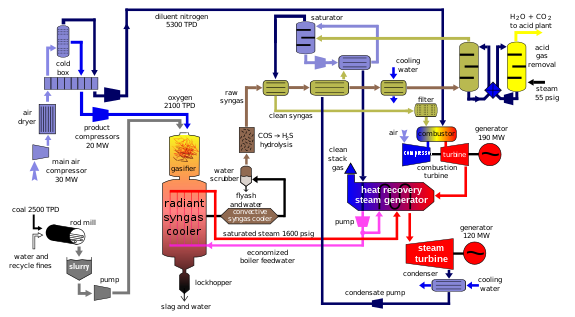
Recent studies suggest that energy obtained using the technique would be cheaper than more popular methods of getting low emissions coal power, like so-called Integrated Gasification Combined Cycle (IGCC), which involves gasifying coal above ground in facilities like the FutureGen project, which the Bush Administration proposed and then killed. The idea would also eliminate the need for strip mining, which is environmentally harmful, or carbon intensive shipping of mined coal.

"The enormous potential of underground coal gasification to meet rising energy demand in a CO2-constrained world warrants a high priority effort by the United States government to speed commercialization," the Task Force study said.

The advantages of the techniques are myriad, says the Task Force, starting with the fact that it's a cleaner version of "clean coal" than other techniques:

[D]uring gasification, roughly half of the sulfur, mercury, arsenic, tar, ash, and particulates from the used coal remain in the subsurface, and any sulfur or metals that reach the surface arrive in a chemically reduced state, making them relatively simple to remove.

So if underground coal gasification is so great, why are commercial projects exploiting the method so few and far in between? Up till now, the reason is the availability of cheap energy using other means, author Julio Friedmann of the Lawrence Livermore National Laboratory in California tells ScienceInsider. During the late '70s energy crisis, the technology got several demonstrations in the United States, but the coal industry stuck with the methods it liked, especially because they owned rights for coal close to the surface. Plentiful and cheap natural gas was a further disincentive.

Now though, with natural gas prices rising and climate a central concern, Australia, Canada, China, New Zealand, and South Africa all have government-funded R&D projects in this area. "China has minted 100 Ph.D.'s in this area," says John Thompson, director of the Task Force's project on coal transformation. "We are losing."

For its part, the report suggests DOE spend more than $100 million over the next 4 years on science, development, and demonstration efforts to try to catch up.

Read full from Science


Mar 6, 2009

Economist - Carbon Capture and Storage is mostly hot air

Wow the "The Economist" must read my blog... nearly word for word ;-)

Money for nothing - Carbon capture and storage: Trouble in store

From The Economist

The problem with CCS is the cost. The chemical steps in the capture consume energy, as do the compression and transport of the carbon dioxide. That will use up a quarter or more of the output of a power station fitted with CCS, according to most estimates. So plants with CCS will need to be at least a third bigger than normal ones to generate the same net amount of power, and will also consume at least a third more fuel. In addition, there is the extra expense of building the capture plant and the injection pipelines. If the storage site is far from the power plant, yet more energy will be needed to move the carbon dioxide.

Estimates of the total cost vary widely. America’s government, which had vowed to build a prototype plant called FutureGen in partnership with several big resources firms, scrapped the project last year after the projected cost rose to $1.8 billion.

America does not have a carbon price at all yet. A bill defeated last year in the Senate would have yielded a carbon price as low as $30 in 2020, according to an official analysis. So CCS might not be financially worthwhile for years to come.

Analysts assume that the price of emissions will rise, as governments impose tighter restrictions, and that the price of CCS will fall, as engineers learn how to do it more cheaply...when the technology is mature, some time after 2030.

Experts argue that it is impossible to be certain that carbon dioxide will not eventually leak out of the ground. Carbon dioxide forms an acid when it dissolves in water. This acid can react with minerals to form carbonates, locking away the carbon in a relatively inert state. But it can also eat through the man-made seals or geological strata intended to keep it in place. A leakage rate of just 1% a year, would lead to 63% of the carbon dioxide stored in any given reservoir being released within 100 years, almost entirely undoing the supposed environmental benefit.

Spills would also be a health risk, since carbon dioxide is heavier than air, and so can build up in low-lying or poorly ventilated spots. Earlier this year, Zurich Financial Services said it would offer insurance for CCS plants and storage sites while they were operating, and for a limited time thereafter.

Politicians are pinning their hopes for delivery from global warming on a technology that is not quite airtight... Read the full article from The Economist

Jul 26, 2006

Big money gets US$1 Billion Coal Plant

: "Developers of a US$1 billion coal-burning power plant which aims to be the world's cleanest generating facility will build in either Illinois or Texas, US energy officials said on Tuesday. "We are not being critical, we need this technology. But we need to move faster and don't need to take so long to demonstrate it. The private sector is getting to the future faster than FutureGen," said David Doniger, policy director of the Natural Resources Defense Council's climate center.

With the federal government slated to fund up to US$700 million of the total cost of the project, states have been eager to participate, seeing the plant as a veritable job generator.

In addition to Illinois and Texas, states vying to host the plant were Wyoming, Pennsylvania, Kentucky, Ohio, Colorado, and West Virginia. Construction could begin in 2009, with operations beginning in 2012, developers said. "

Jul 5, 2008

GETTING ALL OUR LEMMINGS IN A ROW


The G8 nations -- the world's eight richest countries -- will meet in Hokkaido, Japan next week to put the finishing touches on their plan to pass their carbon dioxide (CO2) problem along to all the world's children.
 
The G8 plan -- now fully spelled out in official documents -- is to bury carbon dioxide in the ground, hoping it will stay there forever, but in any case making it our children's problem, not ours.
 
The G8 is an exclusive club that includes Canada, England, France, Germany, Italy, Japan, Russia, and the U.S. Since 2005, the G8 has been systematically putting together the pieces of its CO2-burial plan, which will be endorsed again at next week's meeting in Japan.
 
Burying carbon dioxide in the ground is called "carbon capture and storage", or CCS for short. CCS is being promoted as a "silver bullet" to the global warming problem, as a kind of speculative bubble of expectations has developed around it. CCS has been used for 35 years on a very small scale in oil fields, to loosen up sticky oil and help force it to the surface (the CO2 comes back out with the oil). But on a large scale CCS is untested and untried. Despite this fact, CCS is the basis for claiming that "clean coal" is a viable energy option for the world's future.
 
The U.S. had been building a coal-fired power plant to demonstrate large-scale CCS (and thus "clean coal") at Mattoon, Illinois -- a project called Futuregen -- but runaway costs forced the federal government to abandon the project in January.
 
"We strongly support the recommendation that 20 large-scale CCS demonstration projects need to be launched globally by 2010..., 80 chief executive officers (CEOs) of transnational corporations issued their own endorsement of CCS as the "solution" to global warming. Their report, "CEO Climate Policy Recommendations to G8 Leaders, July, 2008" acknowledged that CCS is essential, but also that free markets would not provide CCS, so taxpayers would have to do it:
 
"For non-mature technologies, however, markets will not be sufficient and enhanced RDD&D [research development, demonstration and deployment] policies will have to be encouraged. Photovoltaics, fourth generation nuclear and the area of carbon capture and storage (CCS) technologies for coal are good examples. Acceleration of the demonstration and deployment of a range of CCS technologies is particularly important because if all new coal fired electricity generation plants are not operating with CCS by 2015 to 2020 onward, it will be difficult to realize the target of 50% reduction in global emissions by 2050." (pg. 16, emphasis added)
 
Still, no one has ever addressed the most fundamental question about CCS: what would constitute a demonstration of "success?"
 
The plain fact is, if the goal is to bury CO2 forever, success will be impossible to demonstrate. On whatever day such a demonstration is declared a "success," leakage could begin the following day. So any such demonstrations will be meaningless. Everyone involved knows this is true.
 
To make a dent in the global warming problem would require burying trillions of tons of CO2 a mile our more below ground thus creating a reservoir of hazardous gas that could leak back into the atmosphere at any time and begin to cook the planet and acidify the oceans. Even if only 0.01% of it leaked out each year -- a suggested industry standard -- two-thirds would escape in 10,000 years. Even CCS advocates acknowledge that this would be a catastrophe. How could a leak of only 0.01% per year be measured? How could humans remain alert to this enormous underground threat for centuries to come? Even if 0.01% leakage were detected, could anything be done about it? Who would be responsible for taking action? Who would pay?
 
This raises the possibility that the G8's goal isn't actual scientific verification of the technology -- but 20 "demonstrations" intended merely to lull the public into thinking that it's OK to build more coal plants because somehow someday CO2 will be safely captured and stored forever. By the time this bit of fakery is widely understood, the present generation of CEOs and politicians will be long dead and all the world's children will be left holding the bag.
 
By definition, the G8's CCS plan is intended to force future generations to deal with the consequences of our present-day cupidity
-- a position that is morally indefensible.