| Source: OECD The outlook for the world’s developed economies is the bleakest since the oil shock of the early 1970s, an indicator of future activity released by the Organization for Economic Cooperation and Development showed Friday.
Adding to the gloom, the OECD’s leading indicator data suggest that the large developing economies are increasingly being dragged down by the recession in richer nations. The OECD’s leading indicator for its 30 developed-country members fell again in December, as did the individual indicators for each of the Group of Seven leading industrial nations. The leading indicators for non-members China, India, Russia and Brazil also fell sharply. “Leading indicators…continue to point to a weakening outlook for all the major seven economies,” The OECD said. “The outlook has significantly deteriorated in the major non-OECD member economies who are now also facing strong slowdowns.” Important parts of some G-7 economies are already experiencing slowdowns on a scale last seen in the early to mid 1970s, when a surge in oil prices and a shortage of energy led to severe cutbacks in industrial production.
'probabilistic computer chip': The chip, which thrives on random errors, ran seven times faster than today's best technology while using just 1⁄30th the electricity.  Just think: One need never again worry about draining an iPhone battery in a day or even a week. Just think: One need never again worry about draining an iPhone battery in a day or even a week. "The results were far greater than we expected," said Palem, a Rice University professor who envisions his chips migrating to mobile devices in less than a decade. "At first, I almost couldn't believe them," he said. "I spent several sleepless nights verifying the results." Probabilistic computer chips have already caught the attention of industry, especially with the end of Moore's Law looming for conventional chips. "This logic will prove extremely important, because basic physics dictates that future transistor-based logic will need probabilistic methods," said Shekhar Borkar, director of Intel's Microprocessor Technology Lab.
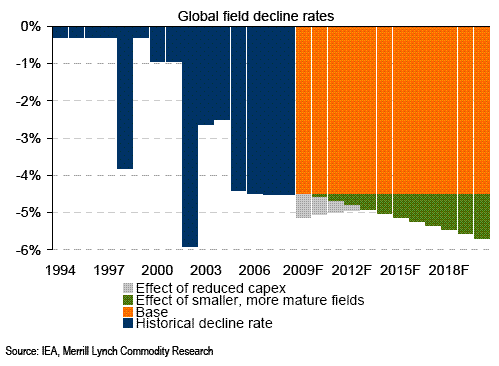
Without ongoing investment to support present production levels, production decline rates will accelerate ... Price Volatility
Vail - This article suggests that oil price volatility will continually increase. At the same time, I generally criticize other theories that argue for perpetual increase (in population, GDP, resource consumption, etc.). Clearly, at some point volatility must either (1) slow or decrease, or (2) reach a functional maximum at which point market signals are reduced to meaningless “trading noise” and the market function ceases to provide utility. Which result, and why? In the spirit of Kurzweil or Moore’s Law, does this process lead inevitably to the end of markets? Half in jest, what if the causal mechanism of the Maya 2012 hypothesis (or insert your favorite apocalypse meme here) is simply global markets grinding to a halt as prices cease to carry meaning and we can’t find a way to reverse the complexification that caused this?
ALGARY, Alberta (Reuters) – Health officials in Alberta confirmed on Friday that there are more cases of cancer than expected in a small aboriginal village downstream from the Canadian province's massive oil sands plants, but they said there was no cause for residents to be alarmed. . . .the study found 47 individuals in the community had 51 different cancers over the 1995 to 2006 study period, more that the 39 cases health officials had expected to find. Read full via news.yahoo.com
Any correlation?...
Suncor oil sands production up Suncor hopes to produce of 300,000 bpd each month this year, compared with an average 228,000 bpd last year, according to company reports.
Fom earlier post for those who missed it ...specifically, the impacts estimated in this report are based upon windfall profits legislation S.2971 proposed in the 110th Congress. Such a tax would also indirectly impact natural gas producers to the extent that crude oil producers also produce natural gas. The analysis assesses how the tax would affect production and imports of petroleum and natural gas as well as key performance metrics of the United States' economy.  The report finds that the proposed increases in the tax burden on the U.S. oil and gas industry would likely result in a significant shift in investment away from the U.S. in oil and gas exploration and production activities and in oil refining. This shift could impact expected patterns of global oil and gas supply; would likely result in long-term job losses for the domestic oil and gas industry; and would likely adversely impact the broader economy. The report finds that the proposed increases in the tax burden on the U.S. oil and gas industry would likely result in a significant shift in investment away from the U.S. in oil and gas exploration and production activities and in oil refining. This shift could impact expected patterns of global oil and gas supply; would likely result in long-term job losses for the domestic oil and gas industry; and would likely adversely impact the broader economy.
The distortional impacts on investment and trade would be clearly seen through increases in U.S. imports of crude oil, refined products and natural gas, coupled with declines in U.S. domestic production of these energy sources. The U.S. energy deficit could be magnified over the next 20 years as a result of the diversion of investment caused by increased taxes on the domestic oil and gas sector. Although this study has specifically assessed the impact of a proposed Windfall Profits Tax, similar forms of increased taxation on the industry would be expected to have directionally similar negative consequences. Report Linked here
First rules - Recycle, Renew, Reuse:
WIN! - The $16 billion to encourage buyers to purchase new autos... was pulled from stimulus. Imagine spending about $549 billion annually on more military under Obama? Ouch again...
HARD NOSE FACT - Renewable energy needs to become a lot more renewable – This reality emerged at the Financial Times Energy Conference in London this week. Although scientists are agreed that we must cut carbon emissions from transport and electricity generation to prevent the globe's climate becoming hotter, and more unpredictable, the most advanced "renewable" technologies are too often based upon non-renewable resources, attendees heard. Read more here via newscientist.com (Original link from the theoildrum)
WASHINGTON, Feb. 5, 2009 — Millions of homes in rural areas of Far Eastern countries are heated by charcoal burned on small, hibachi-style portable grills. Scientists in Japan are now reporting development of an improved "biomass charcoal combustion heater" that they say could open a new era in sustainable and ultra-high efficiency home heating. Their study was published in ACS' Industrial & Engineering Chemistry Research, a bi-weekly journal. In the study, Amit Suri, Masayuki Horio and colleagues note that about 67 percent of Japan is covered with forests, with that biomass the nation's most abundant renewable energy source. Wider use of biomass could tap that sustainable source of fuel and by their calculations cut annual carbon dioxide emissions by 4.46 million tons. Using waste biomass charcoal, their heater recorded a thermal efficiency of 60-81 percent, compared to an efficiency of 46-54 percent of current biomass stoves in Turkey and the U.S. "The charcoal combustion heater developed in the present work, with its fast startup, high efficiency, and possible automated control, would open a new era of massive but small-scale biomass utilization for a sustainable society," the authors say. *The research in this press release is from a copyrighted publication, and stories must credit the journal by name or the American Chemical Society. News media may obtain a full text of this report ("Development of Biomass Charcoal Combustion Heater for Household Utilization") in ACS' Industrial & Engineering Chemistry Research by downloading the full text article at http://pubs.acs.org/doi/pdf/10.1021/ie8006243. Link source the oildrum HT
All evidence suggests that the majority of Americans want single-payer healthcare, that it would be good for all businesses (with the exception of the healthcare corporations), and that it would stimulate the economy - commondreams Besides being the moral and compassionate thing to do (two values which Americans used to embrace), single-payer healthcare makes good business sense. In this study (PDF), research shows single-payer healthcare/Medicare for all would:
- Create 2,613,495 million new permanent good-paying jobs (slightly exceeding the number of jobs lost in 2008)--jobs that are not easily shipped overseas
- Boost the economy with $317 billion in increased business and public revenues
- Add $100 billion in employee compensation
- Infuse public budgets with $44 billion in new tax revenues
The U.S. already spends far more on healthcare than any other nation; yet with all our power and treasure, we are the lone wealthy industrialized nation that does not ensure healthcare for all of our citizens. Fifty million Americans are currently uninsured, and twenty two thousand of those Americans die every year because they do not have access to healthcare.
Meanwhile, CEOs of healthcare corporations earn $3.3 million to $22.2 million in salary per year, paltry amounts compared to their stock options. When a CEO earns $1.6 billion in stock options ("Business 2006: Who Won, Who Lost," Associated Press, December 2006), who loses? The average American, that's who—the people who are dying, getting sick from lack of preventative care, facing bankruptcy from medical bills, losing their jobs and their homes. They are Americans who can't afford "health insurance" and certainly can't afford large contributions to senatorial, congressional, and presidential campaigns...
Now that Scientists have Confirmed 'Algae Is the Most Effective Alternative Energy Source'...  Jared Bouck shows us 'How to build your own algae reactors' Jared Bouck shows us 'How to build your own algae reactors'
with a simple example of a bio reactor using simple off the shelf parts and aquarium parts available from nearly any big chain store to make a simple reactor on the cheap. This is the most basic algae reactor design overall and while he used some glass containers for my reactor other ideal containers would be an empty 2 leader bottle or plastic milk jug. This design is really perfect for backup cultures or to keep unique strings of algae's to start larger reactors off. Using simple off the shelf parts and aquarium parts available from nearly any big chain store these days you can make this simple reactor on the cheap.
YIKES - The Prince and I have a much different idea of what 'sustainable' and 'living' are... Prince Charles's speech about Mumbai's Dharavi, the largest slum in the world (featured in the film Slumdog Millionaire) is making headlines for its tone of respectful admiration for the human and humane living conditions there. 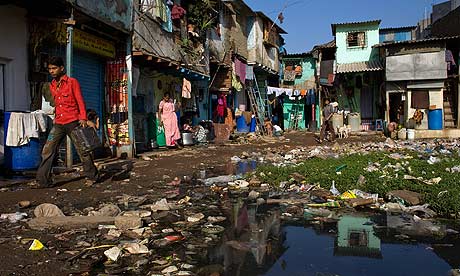 He warned that a soaring urban population - rising from 50% of all the world's inhabitants today to 70% by 2050 - could only be accommodated without disastrous social and environmental consequences by developing local urban design rather than "a single monoculture of globalization". "I strongly believe that the west has much to learn from societies and places which, while sometimes poorer in material terms are infinitely richer in the ways in which they live and organize themselves as communities," he told planners, charity workers and government officials. "It may be the case that in a few years' time such communities will be perceived as best equipped to face the challenges that confront us because they have a built-in resilience and genuinely durable ways of living." Dwellers go about their daily routine in the Dharavi slum in Mumbai. Photograph: Daniel Berehulak/Getty Images Dharavi, a Mumbai slum where 600,000 residents are crammed into 520 acres... Haase - "the words these men use" are lost in the reality of the pictures that depict a world of waste, suffering disease and lost hopes and dreams... no is this the future our leaders see as 'sustainable'? YIKES!
A Senate committee in Kentucky just passed a bill that could potentially allow for the new construction of nuclear power plants in the Bluegrass State. Essentially, the bill would repeal a 1984 law that placed a moratorium on nuclear power plant construction until the federal government can figure out how to dispose of the waste. Still, nuclear power plants have been sending massive amounts of juice to the grid for years. And as a result, we now have tons of nuclear waste - and no safe, centralized place to put it. Of course, more than two decades ago, as mandated by the Nuclear Waste Policy Act, the DOE became responsible for finding a suitable site to store about 77,000 tons of spent nuclear fuel and high-level radioactive waste. That location ended up being Yucca Mountain, NV. It is likely that you've heard about Yucca Mountain before. Especially after last year, when it turned out that the repository will cost $96.2 billion (in 2007 dollars). That's $38.7 billion higher than the 2001 estimates of $57.5 billion. And guess who's footing the bill for that? Turns out ratepayers will be responsible for about 80 percent - or just over $77 billion! But wait...it gets better! That $96.2 billion (right now) will be enough to develop a repository large enough to handle 77,000 metric tons. Here's the problem - more than 56,000 tons are already stored at more than 77 reactor sites across the country. And this number increases by about 2,000 tons each year. So by 2036 (when Yucca would be filled to capacity), we'll be looking at about 110,000 tons - or 33,000 tons above what Yucca can store. Translation - problem NOT solved! Of course, some have suggested that Yucca could hold as much as 120,000 tons, if Washington allowed it. That would give us a 10,000 ton buffer - for five more years. Either way, I wouldn't count on that happening. After all, Obama was very vocal about his opposition to Yucca Mountain, and many Democrats in the House and Senate are likely to continue to chip away at the project's budget. Still, something does need to be done with all that waste we have sitting in our backyards today. Will it be a centralized storage location? Could we possibly see reprocessing gain momentum as a result of the Yucca Mountain controversy? (Jeff Siegel )I have no idea. But one thing we can do, and one thing we must do, is stop continuously creating this problem to begin with.
Japan's little secret is out. fish are a renewable resource -- but not renewable enough. Blue-fin tuna in particular are being eaten faster than they reproduce – and it's not just tuna. Catches are declining everywhere. All over Asia, and indeed the rest of the world, people are discovering what the Japanese have known for centuries: fish is good for you. This may seem a benign discovery. But in the case of seafood, as with any resource, it raises awkward questions about how spoils should be divided and what happens if competing interests cannot be reconciled. It is far from Japan's problem alone. Lida Pet-Soede of environmental group WWF says the Chinese taste for grouper, a top-predator reef fish, is destroying reefs and imperiling ecosystems. China is still only the world's sixth biggest importer, producing most of its own fish, a lot on farms. Aqua-culture may be part of the solution, though it is no panacea; artificially raised fish also need feeding, whether on marine products or on competing food sources, such as soybeans. In any case, as the taste of Chinese and other emerging consumers turns to international varieties, fish stocks will come under increasing pressure. The idea of a war over fish is no more preposterous than that of a conflict over water or petroleum.
Energy and Economic Impacts of a Proposed Windfall Profits Tax on Producers of Oil and Refined Products in the United States Specific impacts of the legislation on domestic energy markets include the following: • A windfall profits tax on the oil and natural gas industry could result in an estimated average decline in domestic crude oil production of approximately 21-26% from baseline levels or between 1.5 to 1.9 million barrels of oil equivalent per day (MMBOE/day)1 over the 2010–2030 period. The loss in domestic crude oil production would result in imports of crude oil increasing by 13-18% over baseline levels or approximately by 1.2 to 1.5 MMBOE/day. • Because many domestic crude oil producers also produce natural gas, a windfall profits tax could also result in a decline in domestic natural gas production of between 1.6-2.4 Tcf (9-13% from baseline levels) by the period 2020-2030. This loss in domestic production would in part be offset by greater reliance on foreign imports with imports increasing between 0.5-1.2 Tcf (14-55% over baseline levels) during the period 2020-2030. • A windfall profits tax could reduce investment in domestic refineries and is estimated to result in a reduction in production of petroleum products of 410-660 thousand barrels of oil equivalent per day (MBOE/day), or 2-4% below baseline levels, during the 2010-2030 period. The loss in domestic refinery production could in part be offset by increasing foreign imports of petroleum products by 230-430 MBOE/day (15-21% over baseline levels) during the 2010-2030 period. Link via from theoildrum
“Each of these 90-day wonders might fix one thing really well. But what if, in the process, you mess up the two that are connected to it?” Bea says. At a time when engineers are calling for careful study of the relationship among different infrastructure systems, and long-term planning and construction to prevent areas like California’s Sacramento delta from suffering catastrophic levee failures, shovel-ready thinking might be worse than a distraction. Because whatever a 90-day project does or doesn’t do, it’s not going to solve complex, and sometimes life-threatening, problems. The term "shovel-ready"—as in, infrastructure projects that are ready or almost ready to begin—has become a favorite of policy makers in recent weeks. As the Senate gets ready to vote on a stimulus bill, it looks like the idea has stuck: The latest bill gives only projects that are able to start construction within 90 days eligibility for funding from the $90 billion set aside for infrastructure. Here is why the shovel-ready mandate could make the infrastructure crisis worse by popularmechanics
Like Atlanta in the US massive growth and trillions of gallons of water pumped out and sold out of their area has led to dire problems... Natural? Gullible warming or man made... When water from local eco systems is 'shipped out' it is gone and so are the normal rain, climate and eco cycles... China has declared an emergency in northern and central drought-hit regions, where nearly four million people are suffering water shortages.
Nearly half of China's winter crop - some 10m hectares (24m acres) of wheat and rape seed - are also under threat.
President Hu Jintao and Premier Wen Jiabao ordered all-out efforts to fight the drought, allocating 400m yuan ($58m, £40m) in relief assistance.
China's drought relief office called it an event "rarely seen in history".
China faces droughts and floods annually but has seen a recent increase in extreme weather conditions.
The Chinese authorities say the current drought is expected to continue as no rain has been forecast in the affected areas for at least 10 days.
The agriculture ministry says it is on red alert.
The official China Daily newspaper, citing meteorological authorities, said Henan had recorded its worst drought 1951, going 105 consecutive days without rain.
Much of China's farming still relies on rainfall as they have a poor irrigation system.
The BBC's China analyst Shirong Chen says the prolonged drought has added to the misery in rural areas where millions of migrant workers have lost their jobs as a result of the global economic downturn.
A poor harvest in the summer would mean even less income for the farmers. The government is worried that this will dent its effort to stimulate consumer spending in rural areas, making it harder to maintain social stability, he says.
Other fav quote's by Mr. Hasen:
Young people (who deserve a large share of credit for helping Obama get the nomination and win the election) had better ask what is happening.
The answer, or so it seems: not much. If that impression is right, there had better be a hue and cry soon, or the opportunity for fundamental change may be missed. I could harp about the greenwashed (or worse) politicians, but what is the point of that? Now, given the election that has occurred, it should be possible to solve the problem. Solution is possible, but will it happen? The national government has all the power that it needs to, in effect, declare a moratorium on any new coal plants that do not capture and store the CO2. Is Obama going to explain the need for a substantial and rising carbon tax on coal, oil and gas in his first fireside chat? The tax does not have to start out large, though it should be substantial. It has to be a tax that covers all fossil fuels. It should not be a cap-and-trade that allows some carbon to escape and makes Wall Street millionaires on the backs of the public. Reasons for concern: 1. The big action so far is the indication that the government will demand fuel efficient cars.... will not prevent the world's major oil pools from being used, but efficiency helps buy time, 2. Jesse Ausubel makes a case that government policies don't matter much -- the energy-fossil fuel situation determines things. Conclusion We are only weeks into the Obama administration. But people are getting restive. I have been asked to speak at or support several different actions, in different parts of the country, by young people and not so young... s he begins to address the nation's energy, climate and economic challenges, he needs to remember these people, among his core original supporters. They are counting on him to change direction -- a real change.
Gardian - Sweden scraps ban on nuclear power with plan to replace 10 reactors
The Swedish government plans to reverse a nearly 30-year-old ban on building nuclear power plants, giving the green light to a new generation of reactors. The centre-right government wants the new reactors to be built to replace the country's 10 existing stations. The decision reverses a 1980 referendum when the majority of voters backed an end to nuclear expansion and the government pledged to phase out nuclear power plants. In 2006, Sweden pledged to replace the use of all fossil fuels by 2020, but nuclear was not part of that plan.
Close ...isn't there yet, which means your fishtank is not a gold mine.
You can grow algae with carbon dioxide and sunlight, but that doesn't mean it's free.
Although many believe that algae will become one of the chief feedstocks for diesel and even hydrocarbon-like fuels, growing large amounts of algae and then converting the single-celled creatures remains expensive, said experts at the National Biodiesel Conference taking place in San Francisco on Tuesday. Algae biofuel startup Solix, for instance, can produce biofuel from algae right now, but it costs about $32.81 a gallon, said Bryan Wilson, a co-founder of the company and a professor at Colorado State University. The production cost is high because of the energy required to circulate gases and other materials inside the photo bioreactors where the algae grow. It also takes energy to dry out the biomass, and Solix uses far less water than other companies (see Cutting the Cost of Making Algae by 90%). By exploiting waste heat at adjacent utilities (one of our favorite forms of energy around here), the price can probably be brought down to $5.50 a gallon (see Will Waste Heat Be Bigger Than Solar?). By selling the proteins and other byproducts from the algae for pet food, the price can be brought to $3.50 a gallon in the near term. But that's still the equivalent of $150 a barrel of oil. "We we're excited in July [when oil was approaching that level]," he joked. "But we knew it wasn't sustainable." It's only in phase II of Solix's business plan that it will be able to drop production costs to $3.30 to $1.57 a gallon, or around $60 to $80 a barrel. Solix has set a goal of cutting the cost of making algae by 90 percent. Is algae a good feedstock? Yes, he insisted. Ultimately, algae could yield 5,000 to 10,000 gallons an acre, far higher than other feedstocks. Soy is only good for around 40 to 50 gallons an acre. Touted plants like jatropha might only produce 175 gallons an acre, he said. "Algae is by far the best organism on the planet for converting fixed carbon into oil," he said. "But economically, others are more efficient at taking sunlight and carbon dioxide and turning it into oil."
UK's various waste streams could produce enough biogas to heat half the homes in the country, according to new research commissioned by National Grid. The study, which was undertaken by Ernst & Young, concluded that biodegradable waste streams such as sewage, animal manure, food and wood could be harnessed relatively easily to generate biomethane that could be connected to the existing gas network. It said that a UK-wide biogas network could be developed at a cost of around £10bn – a price tag the report claims is competitive with other forms of renewable energy such as wind power even before considering the higher infrastructure costs associated with connecting those other forms of renewables to the electricity grid. Janine Freeman, head of National Grid’s Sustainable Gas Group, said that biogas had the potential to act as something of a silver bullet solution, simultaneously cutting methane and carbon emissions, boosting renewable energy capacity and providing a domestic replacement to waning North Sea gas reserves. "Biogas has benefits on so many fronts," she argued. "It is renewable and could help to meet the target of 15 per cent of all our energy coming from renewable sources by 2020. It provides a solution for what to do with our waste with the decline in landfill capacity and it would help the UK with a secure supply of gas as North Sea sources run down." The report also concluded that the two main approaches for producing biogas - anaerobic digestion which turns wet waste such as sewage into biomethane, and thermal gasification of dry waste such as waste wood or energy crops - are technically proven and offer a more efficient alternative to current small-scale projects to use landfill waste to generate electricity. It argues that the only barrier to wider adoption of biogas technologies is the fact that the sector has not received the same level of government support as more established renewables sources. It also calls for an immediate overhaul of renewable heat policy. Freeman said that biogas' "tremendous potential" would only be realised if the government commits to "a comprehensive waste policy and the right commercial incentives". In particular, the report recommends the government develops a waste management policy to ensure each waste stream is directed to the appropriate biogas technology. It also calls for a new incentive scheme to encourage renewable gas producers to grid-inject their gas rather than generate electricity from it, as they are currently incentivised to do under the government's Renewables Obligation scheme. A spokesman for the Department for Energy and Climate Change said that the government was already committed to recovering greater levels of energy from waste streams, adding that "further work is taking place in the context of our Renewable Energy Strategy to establish what potential might exist for biogas injection to the gas grid".
As a Brownfields stakeholder, you won't want to miss THE BIG DEAL 2009, hosted by the National Brownfield Associations (NBA) and the City of Phoenix, March 23 and 24 at the Phoenix Convention Center. This conference brings together green build, real estate and brownfield industry professionals from across North America to discuss sustainable development, and connect green building to brownfield sites. At more than 30 content-rich breakout sessions, you will gain state-of-the-practice know-how to finance, insure, and engineer your next project. Take this opportunity to exchange ideas, share experiences and develop business opportunities with the NBA's network of more than 1,200 public and private sector decision-makers. Meet over 100 vendors in the exhibit hall and view properties at the Transaction Forum. Travel to the conference may be an eligible expense for EPA grantees, depending on the workplan. Please visit www.nbabigdeal.org for conference details. Thanks for the Heads Up Doris ;-)
A radioactive spill has occurred at the aging Chalk River nuclear reactor west of the nation's capital after the facility was recently cranked up to double its normal output of medical isotopes, used in diagnosing and treating cancer, Sun Media has learned. The reactor is supplying up to 70% of the world's medical isotopes. But the radioactive spill and another ongoing leak at the reactor are bound to spark renewedcontroversy over the safety of the nuclear facility built in 1958. An internal report to federal nuclear regulators shows radioactive tritium was released into the air during the incident at the Chalk River reactor on Dec. 5. Atomic Energy of Canada officials running the 51-year-old apparently defective reactor reported they managed to contain another 800 litres of contaminated water now being stored in special drums. The report alleges there was no threat to the health of workers at the reactor, and officials say the tritium released into the air posed no significant danger to the surrounding environment. Nonetheless, after a brief shutdown, the reactor has continued to operate at full power, even though Chalk River officials admit they don't know what caused the leak, and say it could happen again. Documents indicate officials at Atomic Energy took four days to report the spill to the Canadian Nuclear Safety Commission. Even then, the spill proved to be five times larger than what the officials initially reported. A press release about the brief shutdown of the reactor in December made no mention of a spill, only "unanticipated technical challenges." Radioactive water leak in the human drinking supply of water Meanwhile, another part of the reactor has sprung a water leak from a 2.4-inch crack in a weld. That leak has not been repaired since it was first reported more than six weeks ago. Instead, technicians are simply pumping water into the unit to replace the estimated 7,000 litres a day spewing from the cracked seam. In answer to written questions from Sun Media, the Canadian Nuclear Safety Commission said the leaking water from the failed weld has "a very low level of radioactivity" and is not a safety concern. The water is being dumped into the Ottawa River. As the Sierra Club documents, since its creation in 1944 as part of the allied war effort to develop the atomic bomb, Chalk River Laboratories has become Canada’s most contaminated nuclear site, threatening the drinking water of millions of Canadians living downstream, including the residents of the nation’s capital, Ottawa.
OTTAWA, Ontario, Canada, January 30, 2009 (ENS) - The Canadian government today declared two chemicals used in lipstick and other personal care products to be toxic to the environment, although officials said they are not used in large enough quantities to be of concern for human health. Two other chemicals used in cosmetics were found to be harmful to human health. Canada's declaration is the first environmental or health-based determination concerning these chemicals issued by any country. The two personal care chemicals of concern for the environment are the siloxanes D4 and D5. Used as emollients to soften the skin, siloxanes are found in most personal care products on the market in Canada and the United States. The siloxanes are also used in textiles, paints and coatings, antiperspirants, sealants, lubricants, plastics, non-medical ingredients in pharmaceuticals, silicone polymers, food additives, surface treatments for wounds, and medical devices. While not believed to be harmful to health, because these chemicals enter the environment in large quantities, persist in the environment, bioaccumulate up the food chain and may harm fish and aquatic organisms, Canada is proposing to set concentration limits for them. This will minimize the amount of D4 and D5 in personal care products that is released to municipal wastewater streams when they are washed off. The government also proposes to regulate the amounts of D4 and D5 that are released to the environment manufacturing process wastewater. Two other substances used in cosmetics were found to be of concern for human health - isoprene and epichlorohydrin - both considered to be human carcinogens. They will be added to the Cosmetic Ingredient Hotlist to prevent their future use in cosmetics. For isoprene, Health Canada is proposing that manufacturers use best-available technology to control releases. Environment Minister Jim Prentice and Health Minister Leona Aglukkaq announced the findings of toxicity today as they released final conclusions and initial risk management approaches for Batch 2 substances in Canada's Chemicals Management Plan "The government of Canada is doing its part to protect Canada's environment from the harmful effects of chemical substances, In the United States, environmentalists called on the federal government to undertake similar evaluations. "Today's move by Canada is not only important for the health of its citizens, it helps underscore the need for real reforms within the EPA's failed programs to regulate toxins in the U.S.," said Jane Houlihan, vice president for research with the Environmental Working Group based in Washington, DC. "Congress and President [Barack] Obama need to overhaul broken toxics laws," she said....
AUSTIN, Texas — Physicists at The University of Texas at Austin have designed a new system that, when fully developed, would use fusion to eliminate most of the transuranic waste produced by nuclear power plants.
The invention could help combat global warming by making nuclear power cleaner and thus a more viable replacement of carbon-heavy energy sources, such as coal. "A hybrid fission-fusion process has been developed that can be used in some traditional fission reactors to process radioactive waste and reduce the amount of waste produced by 99%. This process uses magnetic bottle techniques developed from fusion research. This seems like the first viable solution to the radioactive waste problem of traditional nuclear reactors. This could be a big breakthrough in the search for environmentally friendly energy sources. Lots of work remains to take the concept to an engineering prototype and then to a production reactor." The idea behind the compact Fusion-Fission Hybrid is that fusion can be used to burn nuclear waste, producing energy and getting rid of much of the long-lived waste generated by nuclear reactors. View the complete illustration of the new nuclear waste destruction system, demonstrating how a fusion-fission hybrid, made possible by the Super X Divertor invented by University of Texas at Austin physicists, could integrate into the nuclear fuel cycle. (Large image opens in a new window.)
Haase - While a lot of this 'shock story' is not a toxic shock. There were a few facts some may find interesting... the rest is basic 'tactical fear book selling'... Toxic make-up: The deadly chemicals in our beauty products The British cosmetic, toiletry and perfumery industry is worth more than £6.5 billion a year. Yet just this week, research was published showing that common chemicals used in toiletries may make women more likely to be infertile. Indeed, inside all those gleaming bottles and tubes we take for granted lurks a cocktail of dangerous synthetic chemicals that research suggests may be responsible for everything from reproductive complications to allergies and cancer.
In her new book, Toxic Beauty, investigative journalist DAWN MELLOWSHIP takes a look at what's really in our cosmetics. ..
Soaking in the bath leaves the skin, urogenital and anal areas exposed to the harsh detergents (such as SLS) used in many shampoos, bubble baths and soaps. This can trigger urinary-tract infections in sensitive individuals (particularly babies and children). In the U.S., children's foaming bath products carry a health warning alerting parents to this. NASTIES: Formaldehyde is used as a preservative in nail polishes, soaps and other cosmetic products. It is also found in household products such as furniture polish. The International Agency for Research on Cancer (IARC) says there is evidence formaldehyde causes a form of throat cancer in humans.
Telegraph, UK - An 'immortal' jellyfish is swarming through the world's oceans, according to scientists. The Turritopsis Nutricula is able to revert back to a juvenile form once it mates after becoming sexually mature. Marine biologists say the jellyfish numbers are rocketing because they need not die. Dr Maria Miglietta of the Smithsonian Tropical Marine Institute said: "We are looking at a worldwide silent invasion." Turritopsis Nutricula is technically known as a hydrozoan and is the only known animal that is capable of reverting completely to its younger self.
It does this through the cell development process of transdifferentiation.
Scientists believe the cycle can repeat indefinitely, rendering it potentially immortal.
What does professional sports has to do with the environment & energy? Well ask yourself, 'how much environmental damage and energy use does one superbowl use'?
Add all the food, tickets, advertising, shirts, hats, webcasts, preshows, half time and you'll find it wastes enough to power all U.S. homes for a year... or the GDP of most non-OECD nations.
And during this off economy "We're using the Super Bowl to harness the audience of the world's biggest advertising stage" ... "in a game that no one actually cares about (Steelers-Cardinals?) and which everyone will watch anyway."
No, I loved going to the Super Bowl for the chance to write about the True Meaning of the Game, which has always been, of course, about wretched excess, Harmony and Understanding notwithstanding.
This year, the Super Bowl comes to us as the news of recession grows ever worse. I try never to use GDP numbers in a column, but any time it tumbles 3.8 percent, I make an exception.
This is where we've come to: Steve Hayden, who co-authored the famous "1984" Apple commercial 25 years ago, told USA Today, "This is the first Super Bowl of the Great Depression 2.0. (Advertising) on the Super Bowl this year is like driving around in a Duesenberg in 1929." Or maybe like getting part of the $18 billion bonus money that went to Wall Street executives in 2008 - a number that Barack Obama, while taking time from planning his first White House Super Bowl party, called "shameful." Or maybe being like yet another Obama Cabinet appointee who somehow failed to pay all his taxes. The latest is Tom Daschle, who had to repay $140,000 for a car and driver he didn't claim. Wouldn't you love to be able to owe $140,000 in taxes? How about just affording a new car? Which brings us back, of course, to the big game - and one of my favorite stories, which might even be true. It goes back to Super Bowl XXXI (do your own math) when Mike Holmgren, then the Green Bay coach, got his players ready on the eve of the game by spreading 96,000 $1 bills on a table - one bill for each dollar a Super Bowl win would mean to each player. Green Bay won. And if that isn't the meaning of the Super Bowl, well, just pass the beer and the bacon explosion, and we'll figure it out next year.
|
 Real Cost Of Power In US. Image credit:Forbes, via DayDreaming Environmental News Service is reporting that the Senate Conference Committee has done good work:- 'Nuclear Pork' Cut Out of Final Recovery and Reinvestment Package. "While other interests are concerned with issues such as the balance between tax cuts and spending, many environmental groups are relieved that a provision in the Senate's version that could have been used to fund new nuclear reactors has been cut from the final text. The conference committee axed a proposal to include $50 billion in federal loan guarantees..." ... read more from a treehugger
 BG
BG  F
F Total global emissions have risen by a cumulative 25% since the beginning of the decade. But only a small fraction of those emissions came from North America, Western Europe and OECD economies. In fact, emissions in the most advanced economies of the world have grown by a paltry 5%, one-tenth the 50% increase seen of the developing world. This completey removes the aurguemnt of