Jun 9, 2013

Philly closes 23 Public Schools, but buiding $400 million prison with classrooms

Alternet - Philadelphia is so broke the city is closing 23 public schools, never mind that it has the cash to build a $400 million prison.

Construction on the penitentiary said to be "the second-most expensive state project ever" began just days after the Pennsylvania School Reform Commission voted down a plan to close only four of the 27 schools scheduled to die. Facing a $304 million debt, the Commission instead approved a measly $2.4 billion budget that would shut down 23 public schools, wiping out roughly 10% of the city's total.

...Scheduled to be completed in 2015, the new prison's cell blocks and classroom will be capable of housing almost 5,000 inmates. 

Philly closes 23 Public Schools, but buiding $400 million prison with classrooms

Alternet - Philadelphia is so broke the city is closing 23 public schools, never mind that it has the cash to build a $400 million prison.

Construction on the penitentiary said to be "the second-most expensive state project ever" began just days after the Pennsylvania School Reform Commission voted down a plan to close only four of the 27 schools scheduled to die. Facing a $304 million debt, the Commission instead approved a measly $2.4 billion budget that would shut down 23 public schools, wiping out roughly 10% of the city's total.

...Scheduled to be completed in 2015, the new prison's cell blocks and classroom will be capable of housing almost 5,000 inmates. 

Student science experiment finds plants won't grow near Wi-Fi router

Mother Nature Network - Five ninth-grade young women from Denmark recently created a science experiment that is causing a stir in the scientific community.

...The students placed six trays filled with Lepidium sativum, a type of garden cress, into a room without radiation, and six trays of the seeds into another room next to two routers that according to the girls' calculations, emitted about the same type of radiation as an ordinary cellphone.

Over the next 12 days, the girls observed, measured, weighed and photographed their results. By the end of the experiment the results were blatantly obvious — the cress seeds placed near the router had not grown. Many of them were completely dead. Meanwhile, the cress seeds planted in the other room, away from the routers, thrived.
Please continue reading at:

West Texas Oilfield Town Runs Out of Water | #sustainable #water

The Texas Tribune..."The water system indicated that the water level in their only active well has dropped to the point the pumps are pulling air, the well recovery is very slow, and the system's distribution pressure has decreased significantly," the TCEQ statement said. "On June 6, 2013, the water system issued a boil water notice as a precautionary measure due to the low water pressure. The water system is in the process of receiving approval from the Water Supply Division for a previously used well."

Barnhart is not the first Texas community to run short of water. Early last year, wells failed for the community of Spicewood Beach, near Austin, which then began trucking in water.

About 30 communities statewide could run out of water by the end of the year, according to a list compiled by the Texas Commission on Environmental Quality.

Please read full and follow at:
http://www.texastribune.org/2013/06/06/west-texas-oilfield-town-runs-out-water/

All-solid lithium-sulfur battery stores four times the energy of lithium-ions

Researchers are building an all-solid Li-S battery that is cheap, safe, durable, and store...

Researchers at the Oak Ridge National Laboratory (ORNL) have come up with a promising design for a lithium-sulfur rechargeable battery that is considerably cheaper and energy-dense than standard lithium-ion. Using a solid electrolyte rather than a liquid one, the battery is also testing much safer and more durable than previous designs... Continue Reading All-solid lithium-sulfur battery stores four times the energy of lithium-ions

Jun 8, 2013

Glowing polymer detects explosives

Prof. William Dichtel and Deepti Gopalakrishnan with samples of the polymer

Detecting bombs in places such as airports could be getting easier, thanks to a new fluorescing polymer. While you might expect the material to glow in the presence of explosives, they actually cause it to stop glowing. .. Continue Reading Glowing polymer detects explosives

TOSA tech charges up electric buses in 15 seconds

A new flash-charging system for electric buses delivers 15-second-long battery boosts at s...

When you think of an electric bus, you probably either picture a vehicle that has to stay constantly connected to overhead trolley cables, or that attempts to run its entire route on one charge of its onboard batteries. In Geneva, however, they're trying something else – a system in which an electric bus takes 15 seconds to receive an energy boost at selected stops... Continue Reading TOSA tech charges up electric buses in 15 seconds

MIT maps solar potential of Cambridge, Massachusetts with record accuracy

The map displays solar radiation data with outstanding resolution (Photo: MIT)

MIT researchers have developed a new technique that can be used to accurately predict the annual yield of a photovoltaic solar array located anywhere on the planet, taking into account local climate, panel orientation, and obstructions from nearby buildings. As a proof of concept, the scientists have mapped out the 17,000 rooftops of Cambridge, Massachusetts and created a user-friendly web interface that residents can use to look up their homes and get an accurate projection of the cost and return on investment of placing a PV panel over their heads... Continue Reading MIT maps solar potential of Cambridge, Massachusetts with record accuracy

Section: Environment

Tags: , ,

MotoCzysz Zero electric bike race demonstrating 4 decades of progress in just 4 years!

In 2009, electric bikes averaged the same speeds as 1936. In 2013, their speed had increas...

MotoCzysz today won its fourth TT ZERO race in a row, demonstrating just how far the electric motorcycle has come in a short time. The first five runnings of the TT ZERO event at the 105 year-old Isle of Man motorcycle racing festival suggest electric bikes will catch up to the fastest gas-powered bikes in about five years. Every practice session has seen lap speeds increase. The inaugural 2009 electric lap record was run at the same speed as the circuit record in 1936 on the first Manx Norton. This week, electric motorcycles have surpassed the laps times of Hailwood's RC181 Honda 500, Duke's Gilera, Agostini's MV Agusta fire engines, and they're about to better the Kawasaki KR750, Suzuki RG500 and Yamaha TZ750 two-strokes of the mid-seventies. Four decades of progress in 48 months. Read on.. Continue Reading MotoCzysz wins IOM TT Zero electric bike race demonstrating 4 decades of progress in just 4 years

New bill could make U.S. exclusively liability for damages resulting from ethanol in fuel.

H.R.2267 - To make the United States exclusively liable for certain claims of liability to the extent such liability is a claim for damages resulting from, or aggravated by, the inclusion of ethanol in transportation fuel. 113th Congress (2013-2014)
Please continue reading at:

Student-built wheelchair runs indefinitely on solar power

The University of Virginia solar-powered wheelchair

A solar-powered wheelchair designed by students at the University of Virginia has won first prize in a competition, Change My Life in One Minute, to mark World Cerebral Palsy Day. Entrants to the competition were asked to come up with an innovation that could make a significant difference to a person with a disability. The solar-powered wheelchair can run continuously powered only by the sun... Continue Reading Student-built wheelchair runs indefinitely on solar power

Jun 7, 2013

Workers' Compensation Claims for Musculoskeletal Disorders Among Wholesale and Retail Trade Industry Workers

CDC report begs once more the question of when OSHA is going to deal with the a very important and ongoing epidemic of Work Related MusculoSkeletal Disorders (WMSD's)
Workers' Compensation Claims for Musculoskeletal Disorders Among Wholesale and Retail Trade Industry Workers — Ohio, 2005–2009
Work-related musculoskeletal disorders (WMSDs) resulting from ergonomic hazards are common in the United States. Recent data from the Bureau of Labor Statistics (BLS) indicate that in 2011, one third of occupational injuries and illnesses resulting in lost time from work were WMSDs (1). Based on data from the 2010 BLS Survey of Occupational Injuries and Illnesses, a higher rate of WMSDs resulting in lost time from work occurred in the Wholesale and Retail Trade (WRT) industry compared with most other industries (2). To assess trends and identify WRT subsectors and subgroups associated with high rates of WMSD workers' compensation claims, the Ohio Bureau of Workers' Compensation (OBWC) and CDC analyzed OBWC claims data for single-location WRT employers in Ohio for the period 2005–2009. From 2005 to 2009, the rate of WMSD claims declined from 86.3 to 52.8 per 10,000 employees. The three WRT industry subsectors with the highest rates of WMSD claims were Merchant Wholesalers, Nondurable Goods; Furniture and Home Furnishings Stores; and Merchant Wholesalers, Durable Goods. Within those three WRT subsectors, the highest rates of WMSD claims were noted in five subgroups: furniture stores and wholesalers of alcoholic beverages, groceries and related products, metal and minerals, and motor vehicle parts. Providing recommendations for WMSD prevention is particularly important for these WRT subgroups.

OBWC is the largest of four state-run workers' compensation systems in the United States where the state is the sole provider of workers' compensation insurance.* Data for OBWC-insured, single-location† employers in the WRT industry were used for this report; subsectors and subsector groups were categorized according to the North American Industry Classification System (NAICS). With few exceptions, WMSD claims were defined according to BLS case definitions.§ Coded injury/illness diagnosis data and narrative text on causation were used to identify WMSD claims; a Bayesian auto-coding technique (3) used both data elements to identify WMSDs by using a "training" and "testing" set of manually coded claims. The sensitivity and specificity of this auto-coding technique when applied to a test set were 0.90 and 0.98, respectively. Auto-coded WMSD claims were flagged for manual, expert review when the injury/illness diagnosis was not a WMSD. Lost-time claims for WMSDs were defined as claims resulting in more than 7 days away from work. To calculate incidence rates, OBWC claims data were linked with denominator data (number of employees) from the Ohio Department of Jobs and Family Services by federal employer identification numbers. Trends in rates were tested using Poisson regression analysis. Disallowed and dismissed claims were excluded from all analyses.

In 2009, CDC identified 31,599 OBWC-insured, single-location employers in the WRT industry, employing at least 289,441 workers. Of those identified WRT employers, 13,930 (44%) were in the wholesale category of the industry. The proportion of all claims attributable to WMSDs was relatively stable at approximately 20% throughout 2005–2009; the proportion of WMSD lost-time claims decreased from 37.4% in 2005 to 31.8% in 2009 (p<0.05) (Table 1). During 2005–2009, the majority of claimants were men aged 25–54 years, who worked for employers with 11–249 employees. The greatest number of WMSD claims occurred in the WRT subsector Merchant Wholesalers, Durable Goods (Table 1).

The rate of WMSDs resulting in a claim or a lost-time claim decreased significantly from 2005 to 2009 for WRT industry employers overall but not for all WRT subsectors. Overall in the WRT industry, the respective rates of WMSD claims and lost-time WMSD claims per 10,000 employees decreased from 86.3 and 28.7 in 2005 to 52.8 and 14.1 in 2009 (Table 2). Employers with more employees tended to have higher rates of total and lost-time WMSD claims. During 2005–2009, lost-time WMSD claim rates per 10,000 employees for three WRT subsectors were among the highest five each year: Merchant Wholesalers, Nondurable Goods (29.2 in 2009); Furniture and Home Furnishings Stores (21.7); and Merchant Wholesalers, Durable Goods (15.5) (Figure, Table 2). The high lost-time WMSD rates in these three WRT subsectors were consistently attributable to high rates in five subgroups within the subsectors: wholesalers of alcoholic beverages (114.8 in 2009), grocery and related products (30.9), metal and minerals (28.0), and motor vehicle parts and supplies (25.4); and furniture stores (27.2).

Please see full at:
http://www.cdc.gov/mmwr/preview/mmwrhtml/mm6222a2.htm

WI CHMM - EHMM Course comprehensive overview of all things related to hazardous waste management.

Do you know a colleague that may benefit from taking the EHMM Course? It's not only a great prep for the CHMM Exam, but a comprehensive overview of all things related to hazardous waste management. Plus, the course will address the new IHMM blueprint.

EHMM Course to be held on July 16, 17 and 18, 2013 at the Hyatt Place Milwaukee Airport.

For agenda and registration details, visit www.fetinc.org or www.wichmm.org.

Or Register now at  http://www.wichmm.org/EHMMJuly2013.pdf


Bread, butter, and food stamp economy: Is the US developing a permanent under-class of citizens economically?

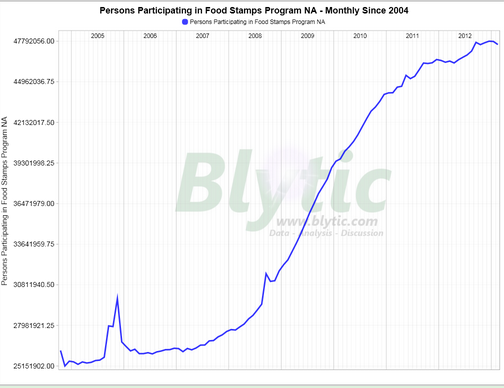
The American economy has developed a deep disconnect between its financial markets and the working and middle class.  The stock market has soared by 138 percent from the low reached in 2009.  Yet very little of this has trickled down to the majority of Americans.  In fact, most Americans actually saw little to negative growth in their net worth over this period.  Even more problematic is the emergence of a permanent working poor in spite of a booming stock market.  Over 47 million Americans are still receiving food stamps on a monthly basis.  Not only has this number remained high, there is now an economy that is building up around servicing the needs of this large constituency.  Why wouldn't there be a new booming market here?  Nearly one out of every six Americans is on food assistance in the most prosperous country in the world.  Doesn't exactly go hand and hand with the perception of a record breaking stock market.  Is the US and the current economy developing a permanent under-class of citizens?

The boom in food stamp participation

What is fascinating is that the boom in food stamp usage coincided with the massive rally that started in 2009.  The recession officially ended in the summer of 2009 but take a look at this chart:

food stamp usage

Source:  SNAP

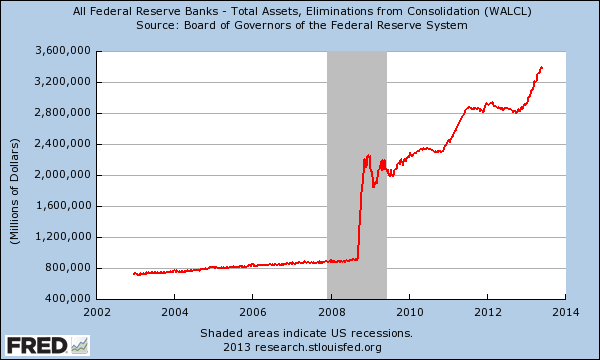
Since the recession ended, we have added over 17 million Americans to the food stamp program.  This was a 56 percent rise during a time that the stock market rose by 138 percent.  Yet a large part of the rise has occurred courtesy of the Federal Reserve allowing banks to borrow for very little and allowing for the same kind of speculation to occur once again that led to the initial financial crisis.  The Fed's balance sheet currently stands at $3.38 trillion:

Fed balance sheet

The expansion is fascinating because it allowed banks to offload non-performing and sluggish loans and freed up leveraging capabilities so the large financial institutions could go back to speculating in global markets.  American households are still in a process of debt deleveraging.  Yet it is abundantly clear that very little of this freed up money flowed into the working and middle class.  In reality more and more of the wealth in the country is flowing into the hands of a few:

share of net worth

In 1989, 32 percent of all the wealth in the US was held by those in the 0 to 90 percentile of income.  Today it is merely 25 percent.  And the top one percent is holding a much larger share showing that the inequality when it comes to wealth is only getting larger.

Another point to make is that most Americans do not own any sizable amount of stocks or investments.  Most Americans derive whatever net worth they have from housing.  Yet in a low yield environment the Fed has created an incentive for Wall Street to invest in residential real estate again but this time crowding out regular buyers.  Even with that said, the gains in housing pale to what has occurred in the stock market recently...


Please read full and follow at:

Jun 6, 2013

Study: Corn syrup, other honey substitutes may have played role in decline of honeybees

While some have blamed pesticides known as neonicotinoids for the decline in population in bees, a new study says that beekeepers' use of corn syrup and other honey substitutes to feed bees may have weakened their immune systems, and played a role in the loss of more than 30 percent of honeybee colonies over the winter, reports Richard Valdmanis for Reuters. (Huffington Post photo)

Bees normally eat their own honey, which contains compounds like p-coumaric acid that appear to help detoxify and strengthen a bee's immunity to disease. The study by scientists at the University of Illinois says, "The widespread apicultural use of honey substitutes, including high-fructose corn syrup, may thus compromise the ability of honey bees to cope with pesticides and pathogens and contribute to colony losses." 

WOW - Feds to pay OSHA whistleblower $820,000 settlement! #OHS #OSHA #SAFETY #NEWS

The U.S. Department of Labor will pay former OSHA official Bob Whitmore $820,000 – one of the largest federal whistle-blower settlements ever approved – under a deal that will end his four-year fight against the government.

The settlement is a major victory for Whitmore, who says he was fired because he publicly criticized his agency for allowing companies to underreport workplace injuries.

Whitmore, formerly the Occupational Safety and Health Administration's top official for record keeping, was fired in 2009 after speaking to Observer reporters who were investigating dangerous conditions and workplace injuries in the poultry industry.

"I think Bob paid a very big price for people injured in the workplace," said Robert Seldon, a Washington lawyer who represented Whitmore. "The government paid a bigger price with a landmark settlement.

"There are people who are not going to get killed or injured in the workplace because of Bob Whitmore."


Whitmore, who worked for the Labor Department for 37 years, filed a complaint against the agency under the Whistleblower Protection Act, a 1989 law designed to protect federal employees who report misconduct by their agencies.

Under the settlement, approved Wednesday by the U.S. Merit Systems Protection Board, Whitmore agreed not to seek employment with the Labor Department for 15 years.

"I regret that I'm not going to get the opportunity to finish what I set out to do," said Whitmore, who turns 66 on Thursday. "That will bug me."

Please read on at:
http://www.charlotteobserver.com/2013/06/05/4087567/feds-to-pay-osha-whistleblower.html

States’ Policies on Health Care Exclude Poorest - will leave millions of poor people ineligible

NYTimes.com — The refusal by about half the states to expandMedicaid will leave millions of poor people ineligible for government-subsidized health insurance under President Obama's health care laweven as many others with higher incomes receive federal subsidies to buy insurance.
Please read full and follow at:

Groundwater is being depleted in most areas of the U.S., not just in the High Plains

Aquifers consisting of underground drinking water in the High Plains states have continued to decline in recent years, with some areas in Texas and Kansas suffering significantly. But a U.S. Geological Survey study released Thursday says the problem is nationwide, and that 40 aquifers have been seriously depleted, reports the Environmental News Service.

From 1900 to 2008, the average rate of depletion per year was 9.2 cubic kilometers, but from 2000 to 2008, the study period, the average rate was 25 cubic kilometers per year. Total groundwater depletion during the 20th Century was 800 cubic kilometers. From 2001 to 2008, the total increased 25 percent, to 1,000 km3. To read the full report click here. (USGS map)

Wisconsin program gives first responders hazard information from farms; continued funding in doubt

Wisconsin farmers have teamed up with researchers and firefighters to create an online pilot program that maps farm hazards, a move that will provide first responders immediate information of any stored chemicals and other hazards at the scene, reports M.L. Johnson for The Associated Press. Maps will also show where to disconnect power, and provide areas for potential sources of water.

Firefighters look at a tablet with a digital map
showing hazards on a farm near Pittsvile, Wis.

National Farm Medicine Center photo
Pittsville Fire Chief Jerry Minor told Johnson, "We don't have a lot of incidents on farms. But when we do, they pose a real high threat to rescue personnel because of unfamiliarity with farms and all the hazards that are present."

Although similar programs exist in states such as Illinois, Michigan, and Pennsylvania, the project's future is up in the air, after President Obama's proposed budget eliminated money for the National Farm Medicine Center, which runs the program for the National Institute for Occupational Safety and Health.

Chinese company opens $2.5 million processing plant for Asian carp at center of their U.S. range

We've often reported, most recently here, about the massive number of Asian carp wreaking havoc in the Ohio and Mississippi rivers by damaging sports fisheries and endangering boaters and skiers. Federal agencies have spent more than $200 million to stop the carp from getting into the Great Lakes, while states like Kentucky have been considering options such as commercializing the fish for animal feed and human consumption.

Kentucky seems to have found a solution, by way of China. One day after a Chinese company agreed to buy Smithfield Foods in the biggest Chinese takeover of an American firm, a Chinese company is investing $2.5 million in Kentucky by opening the first American processing plant for Asian carp.

The plant is in Wickliffe, where the Ohio meets the Mississippi, and at the center of the Asian carp population. (U.S. Geological Survey map) It is expected to create 50 jobs and process up to 10,000 pounds of fish per day, which will be shipped to Southeast Asia, reports Robert Bradfield for WPSD-TV in Paducah.

The Kentucky Economic Development Finance Authority has given the company preliminary approval for up to $1 million in tax incentives through the Kentucky Business Investment program, reports Bradfield. The Delta Regional Authority also authorized $307,000 for the company. 
Please continue reading at:

EPA extends comment period on huge Alaska mine

The Environmental Protection Agency has extended until June 30 the comment period on the environmental impact of a proposed Alaska gold and copper mine that would be the largest mine in North America and, according to EPA's preliminary assessment, "probably cause the loss of between 54 and 89 miles of streams and between four and seven square miles of wetlands," Juliet Eilperin reports for The Washington Post.

The decision on the fate of the proposed Pebble Mine "may be one of the most important environmental decisions of President Obama's second term -- yet few in the Lower 48 are even aware that the fight is happening," Eilperin writes. The Anchorage Daily News added the italicized phrase to its version. (New York Times map; click it for larger version)

The mine would be "in a remote area that is home to several Alaskan native tribes and nearly half of the world's sockeye salmon," and six Alaska Native tribes have asked EPA to block the mine on grounds it would "harm the region's waterways, fish and wildlife," Eiperin writes. "Environmentalists argue that the Bristol Bay project poses a serious threat to the area's delicate ecosystem and to the local fishing industry. Fishing businesses and tribal leaders, who have often quarreled, have banded together to oppose it. . . . The two mining firms behind the project, Northern Dynasty and Anglo American, have struck back with a major lobbying and public-relations campaign aimed at derailing any EPA intervention." 

Public to vote on $53 billion plan to increase Texas' water reserves #sustainable #water

Lawmakers in Texas have come up with a proposal they hope can fix the state's dwindling groundwater supply. The plan, which still needs to be approved by voters, calls for $53 billion in infrastructure upgrades that include construction of 20 reservoirs, reports Jim Malewitz for Stateline. At its current pace, Texas is expected to lose 10 percent of its water reserves in the next 50 years, while the population is expected to increase by 80 percent. (AP photo: Dead fish near the banks of Lake Wichita near Wichita Falls)

The problem is that many Texans don't view the dwindling water supply as a top priority in the state, reports Malewitz. "In 2011, Texas' driest year on record, voters narrowly approved a ballot allowing state water planners to issue $6 billion in extra bonds to fund water projects including fixing pipes and constructing treatment plants. But they voted down a proposition that would have lowered taxes for landowners who practice water conservation techniques." (Read more)

Jun 5, 2013

Clean energy gains countered by population growth

Thompson Reuters Foundation - The world has made important progress towards improving energy efficiency, using more renewable sources of power and providing basic electricity to every household over the last two decades.

But the gains have barely been enough to keep up with population growth and surging energy demand and are far short of what is needed to curb climate change, a new UN-backed energy report suggests.

In the last 10 years, 1.7 billion people around the world gained access to electricity. But the world's population grew by 1.6 billion over that same period, nearly wiping out the gains. Similarly, rising energy demand effectively eliminated half the energy efficiency savings and 70 percent of the gains from growth in renewable energy over the past decade.

"Even to stand still, we have to run extremely fast. That's the challenge," said Vivien Foster, a sustainable energy leader at the World Bank and one of the lead authors of the Global Tracking Framework report.

Please continue reading at:

Two thirds don't know if they'll sign up for Obamacare #Health #Politics

CNBC - There's no assurance folks will be buying insurance under Obamacare, and that could spell trouble for the Affordable Care Act.

Nearly two-thirds of Americans who currently lack health insurance don't know yet if they will purchase that coverage by the Jan. 1 deadline set by the ACA, a new survey revealed Monday.

And less than half of those in the survey released by InsuranceQuotes.com think they'll get better health care after Obamacare takes full effect. Nearly 50 percent believe the ACA will make it more difficult for them to get tests and procedures done in a timely manner, according to the phone survey of 1,001 adult Americans conducted in early May.

And a whopping 68 percent of low-income Americans aren't sure they qualify for tax credits that would subsidize their purchase of health insurance—despite they fact that they almost invariably will qualify, the survey found. That population is most likely to benefit from government subsidies under the health-care reform law.

Please continue reading at:

Jun 4, 2013

Fwd: CBO's Publications - H.R. 1919, Safeguarding America’s Pharmaceuticals Act of 2013

The legislation would require the Food and Drug Administration (FDA) to establish national standards for monitoring the movement of prescription drugs  through the drug distribution system. The "drug distribution system" encompasses the network of companies that produce, handle, distribute, and dispense drug  products. The legislation also would require the FDA to establish a licensing program for certain third parties that provide logistic services to support  pharmaceutical manufacturers, wholesalers, and dispensers.

Read full at:
http://www.cbo.gov/sites/default/files/cbofiles/attachments/HR1919_SPAYGO.pdf

Safety checklist for your first office space

Small business tips from former Assistant Secretary of Labor for Occupational Safety and Health IMAGE COURTESY OF FISHER & PHILLIPS

This week's "Ask the Mompreneur" features an interview with Ed Foulke, former head of OSHA, the Occupational Safety and Health Administration, from 2006 to 2008.  Foulke is now a partner at Fisher & Phillips LLP, a law firm that represents employers across the country.


Ask the Mompreneur:

Many owners of growing businesses will need to rent commercial office space when they outgrow the spare bedroom.  What do they need to do when setting up their space to ensure safety and avoid potential liability?


Ed Foulke:

When beginning a new venture and purchasing or renting an office or building space, many small business owners assume there are no safety or health issues or that those issues are handled by the seller or rental management agent.  Such an assumption is wrong and, in many cases, could result in the small business owner being faced with significant OSHA penalties for safety and health violations.


Every entrepreneur needs to realize that once he or she starts their new venture and hire their first employee, they are automatically covered under the Occupational Safety and Health Act of 1970 and subject to safety and health inspections by Compliance Officers with OSHA.  In addition, depending on the state in which the new business is started, there may be additional safety and health laws which have been promulgated by that particular state or local government entity.


There are three broad areas of safety and health concerns that all entrepreneurs must examine when setting up their first office space.  The first concern involves the physical structure to be purchased or rented.  It is critical that the entrepreneur receive written assurances that the space being purchased or rented complies fully with the state and local building codes, the life safety codes and all OSHA safety and health standards.  Specifically, from an OSHA perspective, the small business owner must determine if there are any physical safety and health hazards to which employees may be exposed.  Those physical hazards may include electrical hazards, walking and working surface issues, sanitation, exit routes, ventilation, noise exposure, hazardous materials, fire protection, and machine guarding.  The owner must also closely examine whether there are any other health hazards, including mold, hazardous chemicals or substances in the walls, ceilings and carpeting and, if the building is built before 1980, that either all the asbestos in the space has been removed or is in a non-friable state, thus not exposing any employees to asbestos fibers.


Please read on at:

http://www.charlotteobserver.com/2013/06/03/4082761/safety-checklist-for-your-first.html

China is CURRENTLY Iraq’s Biggest Customer For Oil, With The Price of $91.85 Per Barrel

China Is Reaping Biggest Benefits of Iraq Oil Boom

Since the American-led invasion of 2003, Iraq has become one of the world's top oil producers, and China is now its biggest customer.

China already buys nearly half the oil that Iraq produces, nearly 1.5 million barrels a day, and is angling for an even bigger share, bidding for a stake now owned by Exxon Mobil in one of Iraq's largest oil fields.

Before the invasion, Iraq's oil industry was sputtering, largely walled off from world markets by international sanctions against the government of Saddam Hussein, so his overthrow always carried the promise of renewed access to the country's immense reserves. Chinese state-owned companies seized the opportunity, pouring more than $2 billion a year and hundreds of workers into Iraq, and just as important, showing a willingness to play by the new Iraqi government's rules and to accept lower profits to win contracts. Please continue reading at: http://www.nytimes.com/2013/06/03/world/middleeast/china-reaps-biggest-benefits-of-iraq-oil-boom.html


Oil falls below $92 after data shows manufacturing in China isn't picking up the pace 

The price of oil remained below $92 after a private survey showed a worse-than-expected dip in China's manufacturing for the month of May.

Benchmark oil for July delivery fell 12 cents to $91.85 per barrel at midday Bangkok time in electronic trading on the New York Mercantile Exchange. The contact fell $1.64 to close at $91.97 Friday in New York.

Please continue reading at: http://www.foxnews.com/world/2013/06/03/oil-falls-below-2-after-data-shows-manufacturing-in-china-isnt-picking-up-pace/

Jun 3, 2013

Postal Service is on its last legs, with little help in sight - tens of billions in debt and congress won't let them fix it.

latimes.com...future of the U.S. Postal Service, is in doubt. The Postal Service lost $1.9 billion between January and March, and $15.9 billion last year. The 238-year-old institution loses $25 million each day, and has reached its borrowing limit with the federal Treasury. Daily mail delivery could be threatened within a year, officials say.

Americans increasingly go online to write letters, pay bills and read magazines, and mail volume has fallen by a quarter since 2006, according to the Government Accountability Office. The decline is expected to continue.

..."The Postal Service has far too little flexibility when it needs to adjust, and it's really in handcuffs because of all the requirements Congress puts on it," Schuyler said.

Postal officials recently tried to end Saturday letter delivery, which could have saved $2 billion per year, but Congress blocked it. A legislative proposal to replace doorstep delivery with curbside delivery, which would save $4.5 billion, failed last year. A plan to close thousands of rural post offices was abandoned after postal officials deemed the closures would "upset Congress a great deal," Barnett said.

Please read full and follow at:

Suicide rate doubled for middle-aged Americans from divorce, job loss, dual care-giving & economy

Reuters... Centers for Disease Control and Prevention said suicides among people in their 50s doubled in that time frame...

"Traditionally, we focus suicide prevention on adolescents and the older retired population, but the results of this study really emphasized the public health burden faced by the middle aged population," said Dr. Thomas Simon, a researcher with the CDC's Injury Center.

"There are unique risks at each developmental stage," said Simon, pointing to bullying and confusion about sexuality in teenagers and getting used to retirement for seniors. "And then there are some particularly salient challenges for the middle-aged group: divorce, job loss, and dual care-giving."

The increase in the U.S. over the past two decades may also reflect the influence of the weak economy - suicides generally rise during downturns - and an increase in the use of prescription opioid painkiller drugs, the CDC said.

The U.S. economy twice went into recession during the study period, briefly in 2001 and sharply during the so-called Great Recession of December 2007-June 2009 that sent the unemployment rate as high as 10 percent.

Please read full and follow at:

DoE Lost Billions in Deal with Tesla

An article on Slate.com has basically claimed that the government lost more money investing in Tesla than it did in Solyndra. A bold statement considering that Solyndra defaulted on its loan, and Tesla has already paid their loan off, nine years early, and with interest; but here is the reasoning.

In 2009 the global financial crisis was still in full affect. General Motors and Chrysler were heading towards bankruptcy and Tesla had suffered a year of layoffs, cancelled orders, and record losses. The US Department of Energy came to Tesla's rescue with an offer to lend the company $465 million at incredibly low interest rates. Four years later and Tesla is a roaring success. Valued at more than $12 billion on Wall Street it offers a sharp contrast to Solyndra.

Please continue reading at:

Jun 2, 2013

90% of world's Ritalin is used in U.S.

Lisa King, Washington Times - American kids are the most medicated in the world. Every year more than 200 million prescriptions are written for children and teenagers in the United States.

That works out to more than three prescriptions per child every year.

The increase in use of attention-deficit hyperactivity disorder (ADHD) drugs has been nothing short of staggering in its implications. In 30 years, there has been a twenty-fold increase in the consumption of attention-deficit disorder medications. America is responsible for 90% of worldwide consumption of Ritalin. Four million children and teens in America are currently taking Ritalin.

Please continue reading at: http://communities.washingtontimes.com/neighborhood/appalachian-chronicles/2012/jun/24/doping-america-part-2-ritalin-generation/

American househods have regained less than half of wealth lost during recession

Firedog Lake -According to a new study by the Federal Reserve, American households have regained less than half of the wealth lost during the recession. While the wealthiest have actually gained since the crash the 99% are still not nearly whole.
From the peak of the boom to the bottom of the bust, households watched a total of $16 trillion in wealth disappear amid sinking stock prices and the rubble of the real estate market. Since then, Americans have only been able to recapture 45 percent of that amount on average, after adjusting for inflation and population growth, according to the report from the St. Louis Fed released Thursday.

In addition, the report showed most of the improvement was due to gains in the stock market, which primarily benefit wealthy families. That means the recovery for other households has been even weaker.
While the business press is obsessed over the stock market, its ups and downs are mostly irrelevant to the fate of nearly all Americans. Financial wealth is heavily concentrated with 1% of the population owning roughly 45% of all financial assets and the bottom 80% of Americans owning roughly 20%.
Please continue reading at:

Record 12.2% unemployment, low inflation underline Europe's pain

(Reuters) - Unemployment has reached a new high in the euro zone and inflation remains well below the European Central Bank's target, stepping up pressure on EU leaders and the ECB for action to revive the bloc's sickly economy.

Joblessness in the 17-nation currency area rose to 12.2 percent in April, EU statistics office Eurostat said on Friday, marking a new record since the data series began in 1995.

With the euro zone in its longest recession since its creation in 1999, consumer price inflation was far below the ECB's target of just below 2 percent, coming in at 1.4 percent in May, slightly above April's 1.2 percent rate.

Please continue reading at:

Peak Water, Peak Oil…Now, Earth facing peak soil

Common Dreams - Soil is becoming endangered.This reality needs to be part of our collective awareness in order to feed nine billion people by 2050, say experts meeting here in Reykjavík.

And a big part of reversing soil decline is carbon, the same element that is overheating the planet. "Soils are like a bank account. You should only draw out what you put in." -- Rattan Lal of Ohio State University

Each year, 12 million hectares of land, where 20 million tonnes of grain could have been grown, are lost to land degradation. In the past 40 years, 30 percent of the planet's arable (food-producing) land has become unproductive due to erosion. Unless this trend is reversed soon, feeding the world's growing population will be impossible.

The world will likely need "60 percent more food calories in 2050 than in 2006?, according to a new paper released May 30 by the World Resources Institute. Reaching this goal while maintaining economic growth and environmental sustainability is one of the most important global challenges of our time, it concludes.
Please continue reading at:

Jun 1, 2013

Deadly sleeping pills: 1 to 18 pills of any sleep aid had three-fold increased risk of death and 35% more likely to develop cancer.

What You Don't Know About Your Sleeping Pills | The Dr. Oz Show... In January 2013, the FDA reduced the recommended dosage for medications containing zolpidem for women because many women were waking up in the morning with active levels of the drug in the blood stream. This can cause morning drowsiness and impair activities that require alertness, like driving. Read more about the new recommended dosage for sleep medications containing zolpidem.


Many studies have also found connections between regularly taking sleep aids and an increased risk of death and cancer. Compared with non-users of sleeping pills, one study discovered that those who took 1 to 18 pills of any sleep aid or hypnotic medication per year had a greater than three-fold increased risk of early death. They also found that heavy hypnotic users were 35% more likely to develop a new cancer.


There are no clear explanations for this connection; however, some studies have connected increased risks of suicide and risky behavior, like impaired driving, with the use of prescribed sleep aids. Zolpidem can also increase stomach regurgitation, which can increase your risk of esophageal cancer.


So What Are My Alternatives?

Please continue reading at:
http://www.doctoroz.com/videos/what-you-dont-know-about-your-sleeping-pills?page=2