Aug 10, 2017
Marijuana use holds three-fold blood pressure death risk: study
RUSSIA TO IMPROVE NUCLEAR PROTECTION FORCE BY ADDING NEW ROBOTS TO DEAL WITH FUTURE THREATS
UT Helps First Responders Prepare for Nuclear Incident
As reported by the News Sentinel, the course was the first of its kind offered in Tennessee, and quickly filled up due to an overwhelming response.
Howard Hall, head of the Institute and the UT-Oak Ridge National Laboratory Governor's Chair for Global Nuclear Security, said the course came out of an observation made by the legislature.
"We've been teaching folks outside the U.S. for a number of years on behalf of the State Department," Hall told the KNS. "We were asked a very good question earlier this year by some of our colleagues in the legislature who said, 'Well, that's really cool. Why aren't you doing that for Tennessee?' and that was an awfully good question."
Hall, who works in the Department of Nuclear Engineering in UT's Tickle College of Engineering as well as the Howard H. Baker Jr. Center for Public Policy, focused the he course on lessons learned from real-life incidents, including Chernobyl and Fukushima.
The main takeaway?
Communication, time, and distance are the three most critical factors following such disasters.
Aug 9, 2017
EPA ELIMINATES NEW-CHEMICAL BACKLOG, ANNOUNCES IMPROVEMENTS TO NEW CHEMICAL SAFETY REVIEWS
EPA Administrator Pruitt Strengthens TSCA New Chemical Review Program to Ensure Safety, Transparency and Continuous Improvements WASHINGTON (August 7, 2017) – Following through with Administrator Pruitt's commitment to eliminating the backlog of new chemical cases that were stuck in EPA's review processes upon his confirmation, Administrator Pruitt is reporting that the backlog is eliminated. "EPA has a tremendous responsibility to review new chemicals intended to enter the U.S. market for safety," said EPA Administrator Scott Pruitt. "EPA can either be a roadblock to new products, or it can be supporter of innovation and ever-improving chemical safety. I am happy to report that the backlog of new chemical reviews is eliminated. With the ongoing commitment of the staff working on TSCA reviews, and input from stakeholders, our goal is to ensure a new chemicals program that is both protective of human health and the environment, while also being supportive of bringing new chemicals to market." The Toxic Substances Control Act (TSCA), amended by the 2016 Lautenberg Chemical Safety Act, ensures that EPA must make an affirmative safety determination before a new chemical can come to market. EPA can request more information from chemical companies if it needs more information to make a safety determination. When Administrator Pruitt was confirmed, over 600 new chemicals were 'stuck' in the EPA review process. The current caseload is back at the baseline and now in line with the typical active workload. Administrator Pruitt committed to being a partner in the regulatory process, and ensuring safety for health and the environment, while also seeking ways to allow new chemicals to enter the market quickly, once EPA is assured that the chemical is not likely to present unreasonable risk for the intended and reasonably foreseen uses. In addition to announcing the elimination of the backlog, EPA Administrator Pruitt is committing the Agency to a more predictable and transparent process for making safety determinations through a commitment to following operating principles; continuously improving; and, increasing the transparency in the decision-making for new chemical safety determinations. "Not only do I support reducing the backlogs that have built up at this Agency, I also encourage continuous improvement and increased transparency," said EPA Administrator Scott Pruitt. Additional Details of New Measures to Strengthen EPA's New Chemicals Review EPA is committing to the following operating principles in its review of new chemicals: Where the intended uses in premanufacture notices (PMNs) or other Section 5 notices (such as low volume exemption (LVE) requests) raise risk concerns, EPA will work with submitters, and, if the submitters submit timely amended PMNs addressing those concerns, EPA will generally make determinations based on those amended submissions. Where EPA has concerns with reasonably foreseen uses, but not with the intended uses as described in a PMN or LVE application, as a general matter, those concerns can be addressed through significant new use rules. As described in the risk evaluation rule EPA Administrator Scott Pruitt signed on June 22, 2017, identification of reasonably foreseen conditions of use will be fact-specific. It is reasonable to foresee a condition of use, for example, where facts suggest the activity is not only possible, but, over time under proper conditions, probable. The purpose of testing in a Section 5 order is to reduce uncertainty in regard to risk. Specifically, it is to address risk concerns that gave rise to a finding of "may present unreasonable risk" or another Section 5 finding other than "not likely to present unreasonable risk." In addition, consistent with the statute, any request for testing by EPA will be structured to reduce and replace animal testing as appropriate. EPA supports continued improvement of EPA's TSCA new chemicals program, including: Redeploying staff to increase the number of Full-Time Equivalent (FTE) staff working on new chemicals. Initiating a LEAN exercise to streamline work processes around new chemicals review. Institutionalizing a voluntary pre-submission consultation process so that submitters have a clear understanding of what information will be most useful for EPA's review of their new chemical submission, and of what they can expect from EPA during the review process. While such engagement prior to submission is an additional up-front time and resource commitment by submitters and EPA, it should more than pay for itself with faster, better-informed EPA reviews.EPA needs to be more transparent in how it makes decisions on new chemicals under TSCA: In Fall 2017, EPA's Office of Pollution Prevention and Toxics (OPPT) intends to release, for public comment and stakeholder engagement, draft documents that will provide the public with more certainty and clarity regarding how EPA makes new chemical determinations and what external information will help facilitate these determinations. EPA will facilitate a public dialogue on the Agency's goal of continued improvement in the new chemicals review program. EPA will continue posting weekly web updates of program statistics, so that manufacturers and the public can determine the disposition of cases as quickly as possible. For more information on the TSCA program, please visit: https://www.epa.gov/reviewing-new-chemicals-under-toxic-substances-control-act-tsca/statistics-new-chemicals-review
Aug 7, 2017
13 Injured, Including 2 Hospitalized, After Long Beach Container Leaks Chemical Substance in Hazmat Incident
Aug 3, 2017
Hazards of high oxygen concentration, mixing incompatible materials, and more in process safety newsletters
From AIChE's "Process Safety Beacon" newsletters:
Hazards of high oxygen concentration – "Autoignition temperature (AIT) and minimum ignition energy (MIE) are lowered markedly by higher oxygen content. Substances ignite more readily, burn faster, generate higher temperatures, and are difficult to extinguish."
Mixing incompatible materials in storage tanks – "Understand potential hazardous interactions among different materials that you unload into your plant's storage tanks. The July 2016 "Beacon" describes the "Chemical Reactivity Worksheet," a tool which your engineers and chemists can use to help understand chemical interactions."
…but the temperature was below the flash point! – "Because the vessel was operating below the flash point of the contents, the concentration of fuel vapor in the vessel atmosphere was too low for ignition. There should not have been an explosion hazard. But the fuel may not only be present as a vapor (remember dust explosions). The investigation determined that the vessel agitator created a fine mist of liquid droplets (Fig. 2). The tiny droplets were estimated to have an average size of about 1 micron. … Flammability testing demonstrated that the mist could be ignited at room temperature in air – and the mist would be ignited even more easily in a pure oxygen atmosphere."
Are you sure that vessel is empty? – "When returning equipment to service following maintenance, make sure that it is completely clean and does not contain anything that could be incompatible with process materials or operating conditions."
Corroded tanks! – "Holes in tanks can allow toxic or flammable vapors to escape into the surrounding environment. Corrosion can weaken tanks, pipes, or other equipment so they can fail under normal operating conditions."
Incident investigation of a steam pipe failure – "There is a reason for including a team of people with different expertise in an incident investigation… In this incident, the engineers and other experts did not recognize the machine tool marks on the failed pipe, and yet it was immediately obvious to the expert, experienced machinist. His knowledge completely changed the conclusions of the investigation, and was essential for understanding the cause of the incident."
Source:
EPA to Clarify Definition of “Waters of the United States” (WOTUS)
The U.S. Environmental Protection Agency (EPA) and the Department of the Army Corps of Engineer published in the Federal Register a proposed rule on July 27, initiating the first step in a two-step process intended to review and revise the definition of "waters of the United States," (WOTUS), which defines the scope of the Clean Water Act (CWA). The proposal would retract the broad WOTUS definition issued by EPA and the Army Corps of Engineers in 2015.
During the 2014-2015 rulemaking process, ACA opposed EPA and the Army's efforts to dramatically expand the scope of federal authority over water and land uses across the United States.
Because of the expanded WOTUS definition, the federal government was given jurisdiction over some of the smallest waterways in the country. On Feb.28, 2017, President Trump signed an executive order, "Restoring the Rule of Law, Federalism, and Economic Growth by Reviewing the 'Waters of the United States' Rule," to begin the process to return to the previous WOTUS definition.
The agencies' initial step proposes to apply the definition of WOTUS as it is currently being implemented, that is informed by applicable agency guidance documents and consistent with Supreme Court decisions and longstanding practice. According to EPA, "proposing to re-codify the regulations that existed before the 2015 Clean Water Rule will provide continuity and certainty for regulated entities, the States, agency staff, and the public."
In a second step, the agencies will pursue notice-and-comment rulemaking in which the agencies will conduct a substantive re-evaluation of the definition of WOTUS.
While EPA undertakes that effort, the U.S. Supreme Court will hear arguments in the case on Oct. 11. The nation's highest court will consider whether a federal district rather than an appeals court should hear challenges to the 2015 WOTUS Rule.
On Oct. 9, 2015, the U.S. Court of Appeals for the Sixth Circuit stayed the updated WOTUS rule. The decision was the result of several lawsuits consolidated into a multi-district case, including suits brought against EPA challenging the rule by Georgia, West Virginia, Alabama, Florida, Kansas, Kentucky, South Carolina, Utah, Wisconsin, Oklahoma, Ohio, Michigan, Texas, Louisiana and Mississippi, as well as the U.S. Chamber of Commerce, the American Farm Bureau Federation, and the American Petroleum Institute.
The appellate decision followed just weeks after Judge Ralph Erickson of the U.S. District Court for the District of North Dakota granted a preliminary injunction for 13 states on Aug. 27, 2015, to prevent the rule from taking effect Aug. 28. Those 13 states — Alaska, Arizona, Arkansas, Colorado, Idaho, Missouri, Montana, Nebraska, New Mexico, Nevada, North Dakota, South Dakota and Wyoming — argued that EPA went outside its authority because the final rule violates state sovereignty, asserting jurisdiction over waters that are subject to state rather than federal control.
Those states prevailed because they sufficiently demonstrated that their claim is likely to succeed on the merits and that the states would suffer irreparable harm without injunctive relief. "The risk of irreparable harm to the states is both imminent and likely," Erickson was quoted in the Washington Post, and noted that the rule would require "jurisdictional studies" of every proposed natural gas, oil or water pipeline project in North Dakota.
Read more at: http://www.paint.org/wotus/
House Passes Bill to Delay Ozone Standards to 2025
On July 18, the U.S. House of Representatives passed H.R. 806, the Ozone Standards Implementation Act of 2017, which would delay implementation of the 2015-set national ozone standards to 2025. The legislation, which ACA supported, passed the House by a bipartisan vote of 229-199. It now heads to the Senate for consideration, where a related measure, S.263, is pending.
The bill, if enacted, would give the U.S. Environmental Protection Agency (EPA) an additional eight years to determine which areas of the country do not meet the 70 parts per billion ozone standards set in 2015. The measure also would extend from every five years to every 10 years the requirement for EPA to review and, if necessary, update the national ambient air quality standards (NAAQS) for ozone and other pollutants.
EPA, in October 2015, lowered the National Ozone Standard from 0.75 parts per million (ppm) to 0.70 ppm. However, EPA's final rule on the ozone standard is forcing a significant number of states that are currently "in attainment" to "non-attainment" status, triggering a requirement to revise their State Implementation Plans and adopt even stricter volatile organic compound (VOC) emission regulations for coatings. This triggering event is being realized as ozone monitors across the country are demonstrating a marked improvement in air quality under the 2008 standard of 0.75 ppm.
"Our nation has worked hard to reduce ozone levels and improve air quality," said bill sponsor, Rep. Pete Olson (R-Texas). "As we continue this progress, we need to give states better tools to meet air quality goals efficiently. As we work to keep this trend moving in the right direction, my bill provides needed flexibility so that states and localities can adequately achieve new, lower standards with time for compliance. Health remains the first priority in setting standards and giving our local officials the tools they need make the Clean Air Act work. I'm proud that this common sense bill received bipartisan support in the House and I urge the Senate to act quickly as well."
On a related matter, a House Appropriations Committee subcommittee on July 11 approved by voice vote a spending bill that proposes cuts for EPA and Department of Interior, would also further delay national ozone standards implementation until October 2025. The House Appropriations Subcommittee on Interior, Environment and Related Agencies passed the spending bill that goes beyond EPA's announcement in June that it would delay by one year — till October 2018 — implementation of the ozone standards. The spending bill will likely be conflated with other appropriations in an omnibus bill.
On June 6, EPA Administrator Scott Pruitt notified governors that states would have an additional year to comply with the NAAQS for ozone promulgated in October 2015. EPA said that it is giving states more time to develop air quality plans, and the agency is looking at providing greater flexibility to states as they develop their plans. Pursuant to the language in the recently enacted FY2017 Omnibus funding bill, Administrator Pruitt is establishing an Ozone Cooperative Compliance Task Force to develop additional flexibilities for states to comply with the ozone standard.
Read on at:
EPA to Publish Three Final Rules under TSCA
On June 22, the U.S. Environmental Protection Agency (EPA) made three final rules available on its website, pending official publication. The rules guide the agency's path for assessing and regulating chemicals in commerce under the amended Toxic Substances Control Act (TSCA). EPA's issuance of final rules for 'Prioritization," "Risk Evaluation," and "Inventory Reset," will impact how EPA evaluates chemicals used in the coatings industry. ACA has been actively developing coatings industry positions and comments on these important rulemakings since their proposal in January 2017. ACA is currently working to provide compliance materials for the industry. Since the June 22 pre-publication, EPA officially published the prioritization and risk evaluation rules in the Federal Register on July 20. The inventory reset rule is expected to be officially published soon.
In addition, EPA released its TSCA Risk Evaluation Guidance, outlining the expectations for draft risk evaluations provided by interested parties, and articulating the approach EPA will apply in risk evaluations conducted under the risk evaluation process rule under TSCA Section 6. EPA also published scoping documents that will shape evaluations of the first 10 chemicals for initial risk evaluation: asbestos; pigment violet 29; 1,4-dioxane; cyclic aliphatic bromides cluster; carbon tetrachloride; 1-bromopropane; methylene chloride; n-methylpyrrolidone; trichloroethylene; and tetrachloroethylene.
The Frank R. Lautenberg Chemical Safety for the 21st Century Act, signed into law on June 22, 2016, mandates the agency to restrict chemicals already in commerce that pose unreasonable risks to public health and the environment.
The following outlines the rule's evolution from proposal to finalization, with ACA's comments and the rule's final most salient changes summarized.
Inventory Reset Rule
Overview
This rule establishes a process to designate substances on the TSCA Inventory as "active" or "inactive," also known as the TSCA Inventory Reset. Once the TSCA Inventory has been "reset," no one would be permitted to manufacture or process an inactive chemical substance without first submitting a notification to EPA prior to manufacturing or processing the substance, provided that notification cannot be more than 90 days prior to the expected date of manufacture or processing.
Under TSCA, Sec. 8(b)(6), EPA is obligated to designate chemicals reported under the 2016 Chemical Data Reporting rule (CDR) as an interim list of active substances. In response to public comment, EPA expanded the interim list to include chemicals reported pursuant to the 2012 CDR rule, in addition to the 2016 CDR rule as required by statute. In effect, manufacturers and processors of chemical substances listed on either the non-confidential or confidential portion of the TSCA inventory would not have to tell the agency that they made a chemical if they or another manufacturer had already reported information required under the 2012 or 2016 CDR rules. In the final rule, EPA determined that this exemption applies regardless of listing as confidential or non-confidential. The CDR rules required companies that produced certain volumes of a chemical (generally 25,000 pounds or more) submit to the EPA information such as the identity of the chemical they make, the volume made or imported, how the chemical was used, and the extent to which workers were exposed to it. EPA issues the CDR rule every four years. With inclusion of chemicals reported during the 2012 and 2016 CDR reporting period in the interim list of active substances, the list now covers substance reported for the last two CDR reporting periods, instead of just the most recent period as instructed in TSCA Section 8(b)(6).
Read on:
Aug 2, 2017
Free @jjkeller OSHA Seminar - Chicago, IL 8/16/17
You're Invited - Chicago, IL 8/16/17 - Safety Management Education
Join J. J. Keller experts at this complimentary seminar as they provide an executive overview on the latest OSHA regulatory changes. Updates include OSHA's new electronic injury and illness reporting rule, crystalline silica rule and walking-working surfaces rule. Also learn about the increases in OSHA penalties that will soon be in effect, OSHA's new inspection "weighting" system, the OSHA inspection process, and best practices and tools you can use should your operation be faced with an inspection. Network with local peers and gain new insights on mitigating risk and establishing compliance levels. Don't miss this informative discussion!
Discussion Topics:
- Injury & Illness Record-Keeping Updates (Bonus Session)
- What's New — OSHA's Top 10 Violations, Penalty Structure & Inspection Weighting System
- Submitting Injury and Illness Data to OSHA - Public and Searchable
- Finalized and Proposed Rulemaking including Walking-Working Surfaces
- Surviving an OSHA Inspection - Process, Inspection Triggers & Potential Fines
- Resources & Support
BONUS SESSION: Come early for a Bonus Update on Injury & Illness Record-Keeping!
Also this week in Chicago, IL- Complimentary ELD Seminar (8/15/17) & HR Seminar (8/17/17) To view more information or to register for this event, please visit https://www.jjkeller.com/learn/events
Aug 1, 2017
OSHA puts brakes on new combustible dust standard
WASHINGTON -- Occupational Safety and Health Administration (OSHA) earlier initiated rulemaking to develop a combustible dust standard for general industry. OSHA intended to use information gathered, including from an upcoming SBREFA panel (small business forum), to develop a comprehensive standard that addresses combustible dust hazards.
OSHA recently announced it is withdrawing this entry from the agenda at this time due to resource constraints and other priorities.
OSHA started the rulemaking process to develop a combustible dust standard for general industry in 2009. Combustible Dust, Advance notice of proposed rulemaking, OSHA Federal Register, 74:54333-54347, was dated October 21, 2009.
Moving away from some of the potential workplace safety rules was seen as part of the Trump administration's move toward deregulation.
In correspondence with Woodworking Network, Jamison Scott of Air Handling Systems said that even though OSHA will not be taking any immediate action on a new standard the industry will still have NFPA's voluntary consensus standards that can be used by OSHA inspectors.
Scott has been a frequent speaker on combustible dust, and spoke on the topic twice last week at AWFS Fair.
Source:
Jul 27, 2017
EPA Issues July Freshwater Harmful Algal Blooms Newsletter
- A Method for Examining Temporal Changes in Cyanobacterial Harmful Algal Bloom Spatial Extent Using Satellite Remote Sensing
- Microcystin Prevalence Throughout Lentic Waterbodies in Southern California
- Using Fluorescent Microscopy to Distinguish Algae from Cyanobacteria in Lakes
Jul 25, 2017
Have Your Say on the Future of Lake Huron!
Jul 24, 2017
Surveillance for Silicosis Deaths Among Persons Aged 15–44 Years — United States, 1999–2015
Jul 20, 2017
Free ECHO Compliance Webinar on Water Facility Search Tools
Advanced ECHO Webinar: Water Facility Search Tools
August 22, 2017, Time: 12:30 PM - 1:30 PM CDT
Webinar
Type: Event
Contact Information:
House panel approves $300 million for Great Lakes
Despite a White House proposal to eliminate $300 million for the Great Lakes Restoration Initiative, the House Appropriations Committee voted late Tuesday to fully fund the program through September 2018.
The vote marks an important step toward securing funding for the Great Lakes cleanup program in the federal budget for the next fiscal year.
The funding was part of an Environmental Protection Agency spending bill. Overall, the bill decreases annual funding for the agency by $528 million. President Trump's budget called for a $2.6 billion cut.
Read our series on the impact of the Trump budget plan.
The Great Lakes Restoration Initiative has a history of strong bipartisan support, and has funded projects aiming to improve water quality, decrease harmful algal blooms, and manage invasive species.
The spending bill also includes funds for the U.S. Fish and Wildlife Service to continue fighting invasive species like quagga mussels and Asian carp.
A similar effort to restore the Chesapeake Bay took a hit. The committee approved $60 million for the bay program — $13 million less than the 2017 allocation.
The committee vote means the bill can now move on to the House.
2016 Chemical Data Reporting Results
FACT SHEET: Final Rule to Update General Industry Walking-Working Surfaces and Fall Protection Standards
Get the "Fact Sheet"
OSHA: Falls from heights and on the same level (a working surface) are among the leading causes of serious work-related injuries and deaths. OSHA has issued a final rule on Walking-Working Surfaces and Personal Fall Protection Systems to better protect workers in general industry from these hazards by updating and clarifying standards and adding training and inspection requirements.
The rule affects a wide range of workers, from painters to warehouse workers. It does not change construction or agricultural standards.
The rule incorporates advances in technology, industry best practices, and national consensus standards to provide effective and cost-efficient worker protection. Specifically, it updates general industry standards addressing slip, trip, and fall hazards (subpart D), and adds requirements for personal fall protection systems (subpart I).
OSHA estimates that these changes will prevent 29 fatalities and 5,842 lost-workday injuries every year.
Benefits to Employers
The rule benefits employers by providing greater flexibility in choosing a fall protection system. For example, it eliminates the existing mandate to use guardrails as a primary fall protection method and allows employers to choose from accepted fall protection systems they believe will work best in a particular situation - an approach that has been successful in the construction industry since 1994. In addition, employers will be able to use non-conventional fall protection in certain situations, such as designated areas on low-slope roofs.
As much as possible, OSHA aligned fall protection requirements for general industry with those for construction, easing compliance for employers who perform both types of activities. For example, the final rule replaces the outdated general industry scaffold standards with a requirement that employers comply with OSHA's construction scaffold standards.
Timeline
Most of the rule will become effective January 17, 2017, 60 days after publication in the Federal Register, but some provisions have delayed effective dates, including:
- Ensuring exposed workers are trained on fall hazards (May 17, 2017),
- Ensuring workers who use equipment covered by the final rule are trained (May 17, 2017),
- Inspecting and certifying permanent anchorages for rope descent systems (November 20, 2017),
- Installing personal fall arrest or ladder safety systems on new fixed ladders over 24 feet and on replacement ladders/ladder sections, including fixed ladders on outdoor advertising structures (November 19, 2018),
- Ensuring existing fixed ladders over 24 feet, including those on outdoor advertising structures, are equipped with a cage, well, personal fall arrest system, or ladder safety system (November 19, 2018), and
- Replacing cages and wells (used as fall protection) with ladder safety or personal fall arrest systems on all fixed ladders over 24 feet (November 18, 2036).
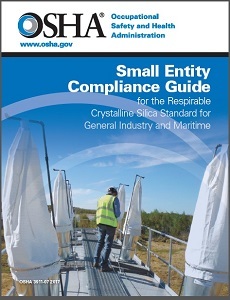
New guide will help small businesses comply with OSHA's silica rule for general industry and maritime
![]() |
OSHA has released a Small Entity Compliance Guide for General Industry and Maritime to help small business employers comply with the agency's Final Rule to Protect Workers from Exposure to Respirable Crystalline Silica. The guide describes the steps that employers are required to take to protect employees in general industry and maritime from the hazards associated with silica exposure. These requirements include: assessing worker exposures; using engineering and work practice controls to keep exposures below a specified safety threshold; and offering medical exams to certain highly exposed workers. Enforcement of the final rule in general industry and maritime is scheduled to begin June 23, 2018.
OSHA: Form for electronically submitting injury, illness data available Aug. 1
On Aug. 1, OSHA will launch a web-based form that will allow employers to electronically submit required injury and illness data from their completed 2016 OSHA Form 300A. The webpage will offer three options for submitting data, and includes information on reporting requirements, a list of frequently asked questions, and a link to request assistance with completing the form.
OSHA published a notice of proposed rulemaking last month to extend the deadline for electronically submitting the data to Dec. 1, 2017. The proposed extension gives those affected sufficient time to familiarize themselves with the electronic reporting system, and provides the new administration an opportunity to review the new electronic reporting requirements prior to their implementation. For more information, read the news release