Showing posts sorted by relevance for query biogas. Sort by date Show all posts

Oct 15, 2014

How to Make Biogas in 5 Easy Steps – #Renewable #Energy

MOTHER EARTH NEWS...The microscopic organisms that produce biogas, known as Archaea, are among the oldest life forms on Earth. They predate the planet's oxygen atmosphere — much less oxygen-breathing and CO2-absorbing plant life — by a cool 3.5 billion years. That's billion with a "B." Archaea are not bacteria, they are genetically closer to humans and other animals (eukaryotes), and form their own animal kingdom. As the Earth's atmosphere became predominantly oxygen about 500 million years ago, archaea became isolated in the few remaining airless places, such as stagnant swamps, deep oceans, caves and hot springs, and of course the stomachs of vertebrates. To create biogas, we must recreate the conditions in which Archaea thrive in nature.

5 Steps to Making Homemade Biogas

The following table outlines the five steps to creating flammable biogas and I will get into further detail with each one. Biogas is reproduced in a special airtight tank called an anaerobic digester. The design of the anaerobic digester determines the first three steps.

How To Make Homemade Biogas 

Step 1. Airtight Environment. A Ziploc baggie can be used for an anaerobic digester. The difficulty arises from trying to add fresh material without allowing oxygen into the system. The most common method of creating a continuous flow digester is the "teapot" or "P-trap" shape. Most biogas digesters are some variation of this teapot shape.

Homemade Biogas Gas Storage 

Step 2. Archaea love water. When loading a digester, the water content in the material put in it should be taken into consideration. A head of lettuce, for example, looks very solid to us, however, it is 98% water. Dried rice is only 14% water. Regardless of the size of your digester, the "40-50-10 Rule" is simple rule of thumb to follow to get the correct volume: Forty percent material, fill the rest of the digester with water except for 10% headspace.

Home Biogas Digester Contents 

Step 3. A good analogy to think about regarding temperature and anaerobic digestion is your temperature is like the gas pedal of your car. The more you step on it, the faster your digester will convert waste into gas. However, also just like stepping on the gas pedal, there are consequences for it. The warmer your digester is, the archaea that decompose your waste get more fragile and susceptible to an unexpected crash.

Home Biogas Generator Chart 

Temperature can be controlled a few different ways. In China, digesters are typically buried underground and built much larger than they need to be. This way they can be overloaded in winter months to maintain consistent gas production. Other designs employ a greenhouses or hoop house over them. More advanced systems integrate some kind of heat exchanger, which can be heated with solar collectors. Regardless of your design, avoid using biogas or any other fuel to heat your digester. Make sure energy you use is excess energy on its way to being wasted.

Step 4. Neutral pH is an important parameter in anaerobic digestion, just as it is for aerobic composting. If pH is measured at the inlet, it will be slightly lower than neutral — usually around 5.5 — as fresh material is converted into acids. The pH will neutralize as these acids are converted into methane gas. By the time the liquid biofertilizer comes out the digester, it should be 7. If the pH of the biofertilizer is lower than this, it is an indicator the digester has been over-fed and is at risk to "sour," or stop working due to low pH. If the pH at the inlet goes below 5.5, it is necessary to add some wood ashes or lime to buffer the digester. A soured digester has no bubble activity and instead of producing gas, instead it draws air into it. The top will be sucked in tightly against the surface of the liquid and if a brewer's airlock is being used, the water in the airlock will be sucked into the digester. Restarting a soured digester is time consuming, and in most cases it is simpler to dump it out and start over. 

Step 5. Biogas production is best at the same 25:1 C:N ratio as aerobic composting. The reason cattle manure is far and away the most common feedstock for biogas is cattle manure is naturally the perfect 25:1 carbon-to-nitrogen ratio. Cattle manure makes an excellent feedstock to begin experimenting with biogas with. Other wastes need to be combined as a compost pile is.

Best Biogas Materials Chart

After these five steps, it is important to know that for the first 48 hours for a small digester or up to a couple of weeks for a larger system, the digester will only produce carbon dioxide (CO2). Carbon dioxide is of course used in fire extinguishers. When you put a match to the gas to test for flammability, it will be blown out with an audible "hiss" and a wisp of black smoke. As the biogas begins to come on, the hiss and black smoke will be gone and you will smell the distinct "rotten eggs" scent of the hydrogen sulfide (H2S). This odor is the signal to begin capturing your gas, as it is either flammable or soon will be. This "CO2 Phase" has caused many people to abandon DIY projects that might have been flammable if they had waited a short time longer.

Please read full and follow at: http://www.motherearthnews.com/renewable-energy/how-to-make-biogas-in-5-easy-steps-zbcz1410.aspx

Jul 18, 2008

Biogas Flows Through Germany's Grid Big Time

I hope the "hill reads this" PLEASE add "BIOgas" to Drive America on Natural Gas Act


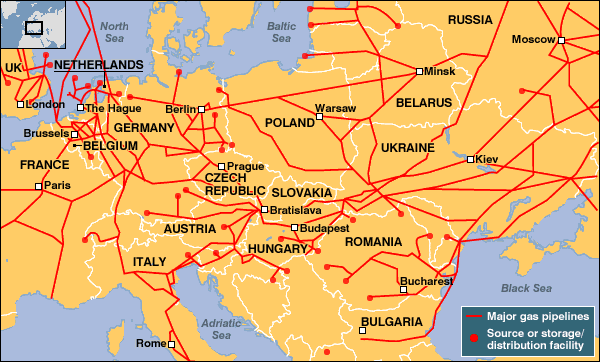
The biggest biogas plant in the world to feed gas directly into the national gas grid is set to go into operation in eastern Germany at the beginning of 2009.


The plant at Konnern will feed 15 million cubic meters (m³) of biomethane into the national grid for use by customers anywhere in Germany. Experts say it is the start of a boom in biogas as the country's energy providers increasingly look to home-produced biogas to reduce their dependence on natural gas imported from Russia.


In 2007, there were 1280 megawatts (MW) of installed biogas capacity and about 3,750 biogas plants in Germany. As much as 20 percent of Germany's natural gas needs could be supplied from biogas by 2020, "Biogas is the market of the future because it allows energy to be produced and transported economically and in a decentralized way around the country,"

The boom in biogas comes thanks to a key technological breakthrough a year ago that allowed biogas to be injected into the natural gas grid and so transported around Germany economically, said Thomas Wilkens of WELtec BioPower, a company that manufactures biogas units. Read full via renewableenergyworld

Important reader comment: Anything that is compostable can be used as a feedstock for biogas. Therefore, the obvious answer to the feedstock problem is to use organic material diverted from our waste stream. This kills three birds with one stone: a). Less material going to landfill; b). Less methane production in landfills; c). free energy source for biogas production. Interestingly enough, manure is not an ideal feedstock (too much nitrogen); the ideal feedstock has a carbon to nitrogen ratio of 30:1. If you want to see how different material combinations will affect methane outputs, check out the Anaerobic Digestor Calculator located here So where could one find a bunch of carbon-heavy, organic feedstock? Hmmm...how about suburban American? With our sprawling lawns and fastidious homeowners...we produce a heck of a lot of organic material (grass clippings, etc) that just goes to waste. My hometown of Madison, WI, for example, has to pay to truck this waste to 3 big composting sites outside of town...why not just use this as an energy source right in town?

Mar 29, 2010

Biogas from Sewage Sludge to Be Supplied as City Gas

JFS/Sewage Sludge Biogas
Copyright Kobelco Eco-Solutions Co.

JFS - Major Japanese gas supplier Osaka Gas Co., Kobe City in western Japan and Kobelco Eco-Solutions Co., announced on October 19, 2009, that they would jointly start a test project to purify biogas generated in a sewage treatment plant to the level of city gas, and to feed the gas directly through gas pipes. The project is slated to start in fiscal 2010 and is the first attempt of its kind in Japan. The group plans to produce approximately 800,000 cubic meters of biogas per year, which will cover about 2,000 households' annual usage of gas and will reduce carbon dioxide emissions by roughly 1,200 tons.

Biogas is a combustible gas which is composed mostly of methane generated from sewage sludge or food residue. Being a carbon-neutral renewable energy, the biogas is expected to be used effectively as one of the measures to curb global warming. However, the biogas from sewage sludge treatment has had limited use because it is low in calories and contains impurities. Kobe City and Kobelco Eco-Solutions Co. have been working to purify the biogas produced from the Higashinada Sewage Treatment Plant in Kobe City, and have succeeded at providing the gas for use in natural gas vehicles. They started to sell the gas named "Kobe Biogas" to city buses and commercial trucks beginning in April 2008.

This project is intended to increase the use of Kobe Biogas. The Higashinada Plant installed equipment for adjusting calories and eliminating minor constituents, purifying the biogas generated in the plant to a level similar to that of city gas supplied by Osaka Gas Co., providing the biogas as city gas to the Osaka Gas customers directly through gas pipes.

Bio-Methane from Sewage Sludge to Be Used as Bus Fuel (Related JFS article)
http://www.japanfs.org/en/pages/026319.html

Jan 24, 2009

Senator Nelson Introduces Biogas Legislation

January 22, 2009 – Billions of gallons of fossil fuels could be reduced through renewable energy sources produced from wastes with a little ingenuity and modest government support.  Nebraska’s Senator Ben Nelson has introduced groundbreaking legislation that promotes the development of biogas – a natural gas substitute created by converting agricultural, animal or other organic wastes – through tax incentives.
 
“We already have the technology to break down these wastes to create biogas but it needs encouragement from the federal government to become a commercially-viable alternative to natural gas.  This new energy source would benefit rural communities and the environment while lessening our dependence on fossil fuels and ensuring energy security,” said Nelson.  “We shouldn’t waste the waste; we should promote biogas development.”
 
Biogas is produced through technologies such as anaerobic digestion (AD) that can convert animal wastes and other agricultural or organic wastes into at least 50% methane (the principal ingredient of natural gas).  Biogas can be used as is on the farm or co-located with another facility such as an ethanol plant, or as a renewable substitute for natural gas, propane or other fossil fuels.
 
Nelson’s legislation, the Biogas Production Incentives Act of 2009, would encourage greater production of biogas for energy purposes by providing biogas producers with a tax credit of $4.27 for every million British thermal units (mmBtu) of biogas produced. This could mean more jobs and a boon for rural communities.
 
Biogas production also offers environmental benefits such as a reduction in the greenhouse gas emissions of both carbon dioxide and methane and improved water quality through better manure management.
 
“We’ve made great strides in developing an ethanol industry in Nebraska and we should do more to diversify and expand our production of biofuels and renewable energy,” said Nelson.  “My legislation will put into place tax incentives for large scale and small scale producers to get involved in biogas production.”


Feb 5, 2009

Biogas network could meet half domestic heating needs

UK's various waste streams could produce enough biogas to heat half the homes in the country, according to new research commissioned by National Grid.
 
The study, which was undertaken by Ernst & Young, concluded that biodegradable waste streams such as sewage, animal manure, food and wood could be harnessed relatively easily to generate biomethane that could be connected to the existing gas network.
 
It said that a UK-wide biogas network could be developed at a cost of around £10bn – a price tag the report claims is competitive with other forms of renewable energy such as wind power even before considering the higher infrastructure costs associated with connecting those other forms of renewables to the electricity grid.
 
Janine Freeman, head of National Grid’s Sustainable Gas Group, said that biogas had the potential to act as something of a silver bullet solution, simultaneously cutting methane and carbon emissions, boosting renewable energy capacity and providing a domestic replacement to waning North Sea gas reserves.
 
"Biogas has benefits on so many fronts," she argued. "It is renewable and could help to meet the target of 15 per cent of all our energy coming from renewable sources by 2020. It provides a solution for what to do with our waste with the decline in landfill capacity and it would help the UK with a secure supply of gas as North Sea sources run down."
 
The report also concluded that the two main approaches for producing biogas - anaerobic digestion which turns wet waste such as sewage into biomethane, and thermal gasification of dry waste such as waste wood or energy crops - are technically proven and offer a more efficient alternative to current small-scale projects to use landfill waste to generate electricity.
 
It argues that the only barrier to wider adoption of biogas technologies is the fact that the sector has not received the same level of government support as more established renewables sources. It also calls for an immediate overhaul of renewable heat policy.
 
Freeman said that biogas' "tremendous potential" would only be realised if the government commits to "a comprehensive waste policy and the right commercial incentives".
 
In particular, the report recommends the government develops a waste management policy to ensure each waste stream is directed to the appropriate biogas technology. It also calls for a new incentive scheme to encourage renewable gas producers to grid-inject their gas rather than generate electricity from it, as they are currently incentivised to do under the government's Renewables Obligation scheme.
 
A spokesman for the Department for Energy and Climate Change said that the government was already committed to recovering greater levels of energy from waste streams, adding that "further work is taking place in the context of our Renewable Energy Strategy to establish what potential might exist for biogas injection to the gas grid".
 

Apr 9, 2007

EU looks at feeding biogas into the main natural gas grid

The biogas sector is undergoing a rapid transformation in Europe. Whereas green gas production used to be an activity associated with individual farms and community waste management programs, it has been scaled up to become an industry that produces quantities large enough to be fed into the main natural gas grid. More and more, dedicated biogas crops (such as specially bred biogas maize, exotic grass species such as Sudan grass and sorghum, or new hybrid grass types) are being utilized as single substrate feedstocks for large digester complexes, and biogas upgrading to natural gas standards is becoming more common.
 
Upgrading biogas to NG quality
A key technology for injection of biogas into the natural gas grid is upgrading of the biogas to natural gas quality after which it can be compressed to transport grid pressure. Biogas consists of around 50 to 65% of methane, small fractions of other compounds and 50 to 35% of carbon dioxide, which has to be removed before injection. (Earlier we pointed out why this large CO2 fraction makes pre-combustion carbon capture from biogas an interesting option in the context of carbon capture and storage, which results in the concept of a radical carbon negative energy system - previous post).
 

Sep 11, 2014

Replacing coal with biogas #renewable #energy

RNE has a look at some CEFC programs to increase the use of biogas in Australia - Major beef processor turns to biogas to halve power bills.
One of Australia's largest meat processors – and a major regional employer, providing 830 jobs – is among the latest recipients of funding from the Clean Energy Finance Corporation, in a deal to co-finance a major on-site energy project at northern NSW-based Bindaree Beef.

The CEFC announced on Tuesday it would provide up to $15 million, together with additional bank finance and an Australian Government Clean Technology Investment Program grant, to fund the installation of a biodigester and energy efficient rendering facilities to improve the efficiency and competitiveness of operations at Bindaree Beef.

As well as the biodigester, the funding will go towards development of an electricity generation facility using biogas (produced by the biodigester) as fuel, and a new more energy efficient rendering plant to replace the existing coal-fired plant and eliminate the use of coal. Screen Shot 2014-07-22 at 10.37.13 AM

The new equipment is expected to halve the company's power bills and cut its annual carbon emissions by three quarters. The biogas plant will also create a new business revenue stream through sales of organic fertiliser – a by-product of the energy conversion process.

Bindaree Beef Director John Newton said securing finance from the CEFC – a $10 billion Labor government initiative, which remains on the Abbott government's chopping block – had been integral to securing the interest of additional private finance, which, along with the government grant, would cover the total project cost. ...

In March this year, the CEFC contributed $20 million to a funding deal with Quantum Power Limited – Australia's leading biogas company – to catalyse up to $40 million in biogas infrastructure aimed at helping farmers and manufacturers cut costs and boost productivity in the face of rising electricity prices. 

Please read full and follow at:  Peak Energy

May 4, 2010

EPA and Ag Secretary Team Up for Farm Energy Generation

(WhooHoo ;-)

The Environmental Protection Agency and U.S. Department of Agriculture  announced a new interagency agreement promoting renewable energy generation and slashing greenhouse gas emissions from livestock operations.  The agreement expands the work of the AgStar program, a joint EPA-USDA effort that helps livestock producers reduce methane emissions from their operations.

"We want to seize every opportunity to confront climate change and move into the clean economy of the future. This is a smart way to transform what would be a harmful greenhouse pollutant into a source of renewable energy — and make a profit for American farmers," said EPA Administrator Lisa P. Jackson.

"We have the technology and the expertise, all we need now is to act.  The AgStar program brings real benefits to our air and creates new opportunities for our farming community."

"The farms and ranches that dot our countryside can contribute greatly to addressing America's long-term energy challenges and the partnership we are announcing today will not only help generate renewable energy, but provide new income opportunities for farmers and ranchers," said Agriculture Secretary Tom Vilsack.

EPA and USDA's enhanced collaboration will provide up to $3.9 million over the next five years to help the farms overcome obstacles preventing them from recovering and using biogas.  The collaboration will expand technical assistance efforts, improve technical standards and guidance for the construction and evaluation of biogas recovery systems, and expand outreach to livestock producers and assist them with pre-feasibility studies.

HTML clipboard


Biogas is composed primarily of methane, a greenhouse gas 20 times more potent than carbon dioxide. Biogas emitted from manure management systems called digesters can be collected and used to produce electricity, heat or hot water. Due in large part to AgStar's efforts, about 150 on-farm manure digesters are now operating at livestock facilities across the U.S.  In addition, EPA estimates there are about 8,000 farms across the United States that are good candidates for capturing and using biogas. If all 8,000 farms implemented biogas systems, methane emissions would be reduced by more than 34 million metric tons of carbon dioxide equivalent a year, roughly equal to the annual emissions from 6.5 million passenger vehicles. In addition, these projects could generate more than 1,500 megawatts of renewable energy.

Information on the AgStar Program: http://www.epa.gov/agstar

Source Laura B.


Jul 19, 2014

Forging a path for #Biogas #Energy in Alberta, decade-long adventure into the somewhat unchartered waters of Canadian renewable energy.

hazmatmag.com/ There was a time not long ago when Stefan Michalski knew regulators were happy to see him leave their office. As much as they supported the concept of biogas and green energy, it was more of a technology left to the Germanys of the world, from where Michalski hails, not the wilds of Alberta.

Lethbridge Biogas LP

But now, more Stefan Michalskis are coming out of the woodwork, looking for answers from Canadian regulators, particularly in Alberta, where the feedstock-laden landscape is an anaerobic digester's dream.

Still, the question remains whether provincial officials will eventually craft legislation that deals directly with the burgeoning technology of biogas, or continue what Michalski calls a "one-off" approach—a kind of regulatory patchwork that pulls heavily from the traditional oil and gas sector, one that in some ways operates completely antithetical to the greener principles of a company like Lethbridge Biogas LP, Michalski's decade-long adventure into the somewhat unchartered waters of Canadian renewable energy.

May 1, 2012

Apple's North Carolina Data Center Will Feature Biogas Generators - @Slashdot

"Apple's North Carolina data center will tap landfills for biogas, which will then be converted into electricity using fuel cells from Bloom Energy. The 24 'Bloom boxes' will have a capacity of 4.8 megawatts of power, and along with a large solar array, will provide Apple with a significant on-site generation of sustainable energy. Microsoft is also developing biogas-powered data plants where modular data centers will be housed near water treatment plants and landfills. GigaOm has a useful primer onbiogas in data centers, as well as video of the new higher capacity Bloom boxes that will support Apple's server farm."
Please read full and follow at:

Oct 13, 2009

PepsiCo Healthy snack to be manufactured using biogas


The plant produces enough biogas for two processing lines out of the seven lines producing Kurkure.

PepsiCo India has installed a biogas plant to power fryer burners at its Frito-Lay manufacturing unit in Pune.

The gas produced will be used for the production of its snack product Kurkure. The plant commissioned in June already runs at full daily capacity.

The plant produces enough biogas for two processing lines out of the seven lines producing Kurkure. The green makeover is expected to cut down on 600 tons of carbon dioxide emissions and substitute 200 tons of liquefied petroleum gas annually.

Punekar, a local news site, reported that the plant generates 10 to 12 tons of waste daily, comprising potato peels, extra burnt chips, green potatoes.

The conversion to the biogas plant, installed at an investment of 35 million rupees ($731,300), could result in 15 million rupees in savings for PepsiCo India.

-   Read full from ecoseed

May 27, 2014

From Poop to Pump for Half the Cost of Conventional Biogas

Whether you're turning lead into gold or farts into fuel, taking something that has no value and transforming it into the very thing that makes your economy run has been the dream of philosophers, alchemists, and scientists since humanity first started thinking of stuff. Recently, Spain launched an initiative to do just that- but the costs have been excessive.

Enter: the Green Cross Method.

This new method is being developed on a farm located just outside of Moscow, and is currently being used to process the manure and methane from about 200 cows into a commercially viable biogas. Derek Markham, over at our sister site, Ecopreneurist, has more on the story, below. Enjoy!


New Method Converts Manure to Biogas at Half the Cost

New Method Converts Manure to Biogas at Half the Cost (via Ecopreneurist)

One of the key pieces in building systems that are more sustainable is the idea of using waste as a resource, especially those waste products that aren't avoidable. It's one thing to reduce the amount of waste that gets produced from processes,…


The post From Poop to Pump for Half the Cost of Conventional Biogas appeared first on Gas 2.

Mar 28, 2007

First delivery of pipeline-quality biogas

Already practiced in Europe on a relatively large scale, feeding biogas into the natural gas grid is now a fact in the US too. Environmental Power Corporation today announced that its subsidiary, Microgy Holdings, LLC, has achieved the initial delivery of pipeline quality renewable natural gas .

The facility is able to generate biogas from manure and other agricultural waste streams, condition the biogas to natural gas standards and distribute it via a commercial pipeline. Microgy's has branded, the renewable, pipeline-quality biomethane product as 'Renewable Natural Gas'.

At full build out, Huckabay Ridge may be the largest biogas production facility in the world, with annual output of approximately 650,000 MMbtus of RNG per year - the equivalent of over 4.6 million gallons (17.4 million liters) of heating oil.
 
"Our standardized modular plants will enable us to implement numerous large-scale RNG facilities rapidly and in a cost-effective manner."


Nov 21, 2007

Company Feeds Natural Gas Pipeline with Biogas from Manure

From  EERE :

Environmental Power Corporation announced early this month that it has completed a facility to convert manure and other agricultural waste into a methane-rich biogas that will be sold as natural gas. The Huckabay Ridge facility in Stephenville, Texas, will employ anaerobic digesters to convert manure into biogas. Bacteria in the oxygen-free digester vessels feed on the wastes, producing a gas consisting mostly of methane and carbon dioxide. Environmental Power then conditions the biogas to natural gas standards and distributes it via a commercial natural gas pipeline. The company is currently selling the natural gas to the Lower Colorado River Authority, and in October 2008, it will begin selling natural gas to Pacific Gas and Electric Company under a new 10-year contract. The Huckabay Ridge facility has the capacity to produce 635 billion Btu of natural gas per year, enough to provide all the energy needs for more than 6,000 average U.S. homes. See the Environmental Power press release.

Landfills are another major source of methane, and as North America's leading provider of waste services, Waste Management has a corner on the landfill gas market. The company currently captures and produces energy from enough landfill gas to meet the energy needs of a million homes per year, and in an environmental initiative announced in October, the company committed to doubling its energy production by 2020. But for the sheer elegance of its approach, it's hard to beat the Prometheus Energy Company, which creates liquefied natural gas (LNG) from landfill gas and delivers it to vehicle fleets in Southern California. The elegance comes in with the company's purchase of an LNG-fueled Kenworth tractor, which is now being used to deliver the LNG. So the company is burning its own landfill gas to deliver landfill gas to other users. The first 10,000-gallon shipment was delivered to the Orange County Transit Authority, which operates a fleet of 232 LNG-fueled buses. See the Waste Management press release (PDF 48 KB) and the Prometheus Energy press release (PDF 63 KB). Download Adobe Reader.

Sep 29, 2014

From poop to power in California

Take Part - Officials in the California community of Victor Valley on Friday unveiled the United States' first carbon-neutral waste water treatment plant. Biogas produced from food waste and sewage powers the plant while keeping tons of garbage out of landfills.

Officials at the Victor Valley Wastewater Reclamation Authority expect the system to operate independent of the power grid by 2015, diverting more than 1,400 tons of waste from the trash heap.

"Why would we not want to recover the inherent energy in our waste to power this facility so that we're out of that Edison cycle of 'Well, here's your rate increase, here's your rate increase' every year?" Logan Olds, general manager of the high desert city, told the Daily Press. "It's a demonstration project and has not been done anywhere else. There are currently no other installations of this technology in the U.S." 

Called the Omnivore Biogas Renewable Energy Project, the system uses co-digestion technology provided by Ontario, Canada–based energy group Anaergia, which was able to retrofit three older digesters already on the plant.

The new system mixes high solids (such as solid food) with sludge (sewage) and uses anaerobic digestion technology to convert the waste into biogas. That biogas, which used to be burned and released into the atmosphere, is harnessed and turned into low-carbon fuel. 

Dec 10, 2012

Biogas created by waste fuels Nepal’s tree regrowth | piped into kitchens to be used to cook.

While forests in Nepal have been shrinking for years, between 2007 and 2010 trees in the South Asian country of 27 million inhabitants began to grow again, reported Al Jazeera English.

Biogas has been credited with the shift, as roughly 250,000 Nepalese now use the fuel.

Biogas is created by combining manure and other organic waste, including toilet waste, with water, which is put underground in an airtight container where it creates methane, which travels by underground pipes into kitchens to be used to cook.

Please continue reading at:

Jan 23, 2009

Peak Oil, Gas, Coal and Uranium... Peak prosperity?

Much Awesomeness From BigGAV
 
One of the biggest energy conference in the world that is being attended by key policy makers, financiers, leading academics and no less than 400 journalists from all over the world opened with a prince who spoke about the lessons that we need to learn from the collapse of historic civilizations in perspective to the four peaks of oil, gas, coal and uranium that await us.
From  A Prince and Four Peaks: Peak Oil, Gas, Coal and Uranium speech:
Ladies and gentlemen, did you know that when the Roman Empire finally collapsed, large parts of Europe had been deforested. Acres of forestland had been cleared for farmland and to provide firewood. Wood and food were essential, to maintain the Roman Empire. To meet their short term needs, the Romans overexploited their prime energy resource. They did not think about the consequences for later generations. So the demise of a seemingly invincible civilization was partially due to the unsustainable use of their prime energy resource. The question is, are we going to be any wiser?

What the Romans were experiencing, we would now describe as peak wood. Reaching a point of maximum production after which it enters terminal decline. We are now facing a century of at least four undesirable peaks, peak oil, peak gas, peak coal and peak uranium. Mountaineers may be proud to conquer peaks, but there is no reason whatsoever for us to be proud. We can, however, change the course of history. The technologies we need are there.

On a global level, the sun and the deserts present us with major opportunity. We know all energy resources originate from one source, one masdar, nuclear fusion from the surface of the sun. Arab traders sailed the Indian Ocean, long before Europeans ventured into these regions. The same winds Columbus used were there, generated by the sun's heat to make his historic journeys. My wife and I traveled to this beautiful city by plane, with fossil energy generated millions of years ago by that same sun. If it were up to the sun we would have no energy problems at all. Every 30 minutes the earth absorbs enough light to meet the energy needs for one year. Every 30 minutes, if only we could harvest it. To do so we need the world's deserts. Many regard deserts as a barren and hostile environment. In fact, they are a precious source of life, which we should embrace and protect for the common good.

The point is, if we don’t treat energy as a long term investment, we will end up paying much higher bills. But we mustn’t wait until solar energy plants and cross border grids are available for sustainable energy supplies. We need to invest at the local level too. Technologies for local production of sustainable energy are readily available for both electricity and local cooling. These technologies can be applied without a large infrastructure, making them more promising than existing examples. There are three examples I would like to share with you today, two designed in the Netherlands and a third a joint venture between Canadian and Spanish scientists and entrepreneurs.

The first is the green greenhouse, a new generation of greenhouses that produces not only plants and food but also clean electricity, heating and cooling. One transformed, greenhouse can provide sufficient energy for 200 homes. The green greenhouses produce biogas for electricity generation and uses the CO2 thus generated to stimulate the growth of plants. This process also produces water of drinking quality.

The second example is vacuum sewerage for toilet and kitchen disposal. The sewage is used locally for the production of biogas. The pipelines are only half the size of the normal pipelines, giving higher flexibility for construction. Both CO2 emissions and water use are reduced by 50%. No larger infrastructure is required and developing regions are presented with the opportunity to obtain much better water conditions.

The third example is the production of clean energy by a new, completely closed system of garbage gasification in small units. 99.8% of the total garbage supply is re-used or converted, producing 80% more biogas then it uses. No water is wasted during the process. On the contrary, water is one of the products.

What makes all these technologies interesting is that they contribute to the solution of the energy problem and also help in other areas. They help us reduce water scarcity and get rid of excess waste, and present new economic opportunities in developing regions. Contrary to general belief, they are no more costly than the traditional polluting production processes. In fact, they result in substantial savings. The payback time, in green greenhouses for example, is only three years.

So, ladies and gentleman, we know the technologies are there, for both global and local solutions. We need the political will and the right approach to investment for a fundamental transition toward a new energy system. We owe it to our children and to future generations. Investments in sustainable solutions make our communities healthier, our planet cleaner, our economy stronger, and our future brighter.

Let us look beyond the current financial and economic crisis and build the foundations of a sustainable future. As a result of this crisis, billions of dollars of public spending are needed to build better economies and generate economic growth. If we spend wisely in sustainable solutions, these investments will also contribute towards rescuing our planet.
 
Read full from the BigGAV

Aug 7, 2010

Volkswagen Creates Sewage-Powered Beetle

"The Telegraph reports that Volkswagen is giving new meaning to the term ' beetle_1691444c.jpgDung Beetle' with a prototype able to cover 10,000 miles annually on the waste from 70 households. The Bio-Bug was launched by Wessex Water, which is generating methane from human waste at a sewage treatment works near Bristol. 'Our site has been producing biogas for many years, which we use to generate electricity to power the site and export to the National Grid,' says one company official. 'We decided to power a vehicle on the gas, offering a sustainable alternative to using fossil fuels which we so heavily rely on in the UK.'

 The Anaerobic Digestion and Biogas Association says the launch of the Bio-Bug proves that biomethane from sewage sludge can be used as fuel. 'This is a very exciting and forward-thinking project demonstrating the myriad benefits of anaerobic digestion (releasing energy from waste). Biomethane cars could be just as important as electric cars.'" - Via
/.

Haase - Hardly new idea...
Haven't I showed this example several times over the years?
ANY car can be converted to run on BioGas.
 
Three-wheeled ANG vehicles are expected to be the fastest-growing segment of the automotive market with 200 million sales expected, most of them in Asia. Running these critters on natural gas seems like an affordable way to relieve some of the potential pollution that they will bring, although burning ANG still produces CO2.
Energtek has announced that it's collaborating with the Filipino government and PNOC-EC to convert three-wheeled vehicles to natural gas-powered systems by means of storing it in tanks of Adsorbed Natural Gas. Energtek says ANG is safer because it uses lower pressures to store natural gas and allows for easier refuelling.

Related:

Jul 1, 2009

The Inaugural National Biomethane Summit

Biomethane Resources: 
Below you will find links to various resources and news articles that provide background information on topics relevant to the National Biomethane Summit. Whether you are new to biomethane or have been studying this renewable energy source for years, we hope you’ll find these resources helpful.

Regulatory Agencies

Reports

Quotes from those who attended the National Biomethane Summit:

“Thanks for a great Summit.  We really enjoyed it, and was very impressed with the organization.  We made some good contacts, and the day was definitely worth our time.  And thanks for helping us with the back banner.  You saved the day for us.  Again, thanks so much, and we look forward to hearing about similar summits and conferences in the future.”

“Great job with the Biomethane Summit! I was truly impressed with the quality of speakers and presentations.”

Apr 1, 2012

Apple's Biogas Fuel Cell Plant Could Go Live By June | @bobmcmillan | Wired.com

Apple says that a biogas-powered fuel cell system that will help power its Maiden, North Carolina, data center could be up and running as early as June, much earlier than previously expected.

Please read more from source:
http://www.wired.com/wiredenterprise/2012/03/apple-biogas/