"A team of researchers at MIT's Lincoln Laboratory have designed a drug that can identify cells that have been infected by any type of virus, then kill those cells to terminate the infection. The researchers tested their drug against 15 viruses, and found it was effective against all of them — including rhinoviruses that cause the common cold, H1N1 influenza, a stomach virus, a polio virus, dengue fever and several other types of hemorrhagic fever." - SlashDot
Aug 13, 2011
US Energy Panel Cautiously Endorses Fracking?
"The Christian Science Monitor reports that a U.S. Energy Department advisory panel has endorsed fracking, or hydraulic fracturing, a promising technology that injects a mixture of water, sand, and chemicals underground to fracture rock and release shale gas previously thought unretrievable, paving the way for tens of thousands of new wells. If fracking can be done safely, it could be a major source of domestic energy over the next century. Shale gas makes up about 14 percent of the U.S. natural gas supply today, but is expected to reach 45 percent by 2035. But first, serious environmental concerns must be addressed.

Earlier this year, a Duke University study of 68 private groundwater wells in Pennsylvania and New York state found evidence that shale-gas extraction has caused them to become contaminated with methane. One key recommendation by the panel is a call for transparency regarding the use of chemicals in the extraction process. Drillers say they would like to keep the exact formula of the chemicals they use secret because it represents a competitive advantage." - SlashDot
Earlier this year, a Duke University study of 68 private groundwater wells in Pennsylvania and New York state found evidence that shale-gas extraction has caused them to become contaminated with methane. One key recommendation by the panel is a call for transparency regarding the use of chemicals in the extraction process. Drillers say they would like to keep the exact formula of the chemicals they use secret because it represents a competitive advantage." - SlashDot

8 Grams of Thorium Could Replace Gasoline In Cars
 "Thorium, an abundant and radioactive rare earth mineral, could be used in conjunction with a laser and mini turbines to easily produce enough electricity to power a vehicle. When thorium is heated, it generates further heat surges, allowing it to be coupled with mini turbines to produce steam that can then be used to generate electricity. Combining a laser, radioactive material, and mini-turbines might sound like a complicated alternative solution to filling your gas tank, but there's one feature that sells it as a great alternative solution: 1 gram of thorium produces the equivalent energy of 7,500 gallons of gasoline." - SlashDot
Most Americans can't afford a $1,000 emergency expense
(CNNMoney) - When the unexpected strikes, most Americans aren't prepared to pay for it.
A majority, or 64%, of Americans don't have enough cash on hand to handle a $1,000 emergency expense, according to a survey by the National Foundation for Credit Counseling.
A majority, or 64%, of Americans don't have enough cash on hand to handle a $1,000 emergency expense, according to a survey by the National Foundation for Credit Counseling.
Iowa now gets 20% of its power from wind
Iowa now gets a higher percentage of its power from wind than any other state in the nation.

The Des Moines Register is reporting that Iowa's wind generation hit the 20% mark last quarter, supplying the state with a full one fifth of its energy needs. That's really good -- like, Denmark good. Stats like this make it harder and harder for cleantech foes to deny that renewable power is fast becoming an integral part of the American energy mix.
The Register has the details:
Iowa's wind generation reached 20 percent of the state's total electricity network during the second quarter, the American Wind Energy Association reports ... A major boost came from MidAmerican Energy's new 594-megawatt wind farm near Adair, the first of three major wind projects the Des Moines utility plans for this year.MidAmerican already had 1,330 megawatts of wind generation capacity on its system. The utility's peak loads this summer have totaled about 4,700 megawatts. The second-largest wind generator in Iowa is Florida-based NextEra, which has about 800 megawatts of wind farm capacity mostly in central and northern Iowa.
Hedge funds betting on peak food
Western hedge funds have begun buying up vast parcels of land all over Africa. According to a series of new reports by the Oakland Institute, over 148 million acres in the last three years alone have been purchased -- that's an area larger than California.

The reports say the purchased land is often used to produce export commodities -- including biofuels, cut flowers and specialized foods -- and are displacing millions of Africans from fertile farmland. Researchers say they reviewed the contracts and found clauses that allow foreign companies to keep exporting as much as 80 percent of what is grown on the acquired land, even if the host country is experiencing food shortages. Lead researcher Anuradha Mittal told Here and Now's Robin Young, "The companies boast they can make a profit even without growing anything on the land," because of the way the contracts are written.
"With the collapse of the housing market, there is a drive for the new commodity to invest in,
Mittal said. "These hedge funds are promising returns of 25 to 40 percent." Mittal called this the new investment bubble.
Aug 12, 2011
US Debt Crisis - 2012 Simply Explianed
Short Sweet and bitter...
The downgrade is just another signal that big time inflation is coming. The U.S. Treasury borrows money by issuing bonds. Because it has a massive spending problem and can't live within its means it runs a perpetual and ever expanding deficit. The deficit is financed by issuing more bonds. This process is currently going parabolic as the U.S. debt load is expanding at an alarming rate. See the chart below.
The U.S. stopped minting quarters and dimes out of silver in 1964 and it removed the gold backing of its dollars in 1971. There is now nothing backing the dollar. It is pure paper as is every other currency in the world.
The bonds are mostly purchased by fund managers, foreign governments, and by the Federal Reserve. The foreign governments purchase the bonds with dollars amassed from trade surpluses with the U.S., and the Federal Reserve buys its bonds with dollars created out of thin air with a bookkeeping entry.
By purchasing the bonds, the Fed enables big government spending to expand unchecked. Without the Fed buying bonds, interest rates would rise and it would be a natural check on the ability of congress to spend money it doesn't have. The additional interest expenses caused by the higher rates would prevent the government from spending borrowed money recklessly. Enter the Federal Reserve buying the bonds with no check on their dollar creation from being backed by gold and silver and you have the crisis that we are living though today.
Read more
Read more
Q3 deathblow for U.S. dollar - Bernanke weighing the use of more untested policy
 Chairman Ben S. Bernanke and his colleagues are weighing the use of more untested policy tools after two rounds of bond buying totaling $2.3 trillion failed to spur sufficient economic growth and reduce unemployment below 9 percent. The Federal Open Market Committee holds its regular meeting today in Washington following the worst day for U.S. stocks since December 2008. “The odds of more dramatic action are higher,” said Vincent Reinhart, a former chief monetary policy strategist at the Fed. ...The Fed is likely to start a third round of asset purchases, ....“It’s going to move more decisively” than in the first two rounds, Rogoff said in an interview with Bloomberg Television. He recommended the Fed say it’s trying to create “moderate inflation” and avoid repeating that officials are trying to boost stocks. The Fed in June completed a $600 billion Treasury bond- purchase program aimed at reducing long-term borrowing costs on everything from car loans to mortgages and boosting share prices.Even with the purchases, the economy grew in the first six months of this year at the weakest pace since the recovery started in 2009. After almost stalling at a 0.4 percent annual pace in the first three months of this year, the economy expanded at a 1.3 percent rate last quarter, the government reported on July 29. Read full at BloomBerg
Toxic blue-green algae threat to dogs in water.
WDNR- The estimated 50,000 or more Wisconsin waterfowl hunters whose favorite hunting partner has four legs, a tail, and doesn’t mind swimming in cold water may want to take some precautions against their friend coming down with serious illness from ingesting water containing potentially toxic blue-green algae.

“Working together with dogs is part of a long and rich tradition for many waterfowl hunters,” said Kent Van Horn, DNR Migratory Game Bird Ecologist. “Sometimes, care of these furry hunting companions requires extra awareness. While not widespread, potential toxicity from blue-green algae is still a concern for waterfowl hunting dogs.”
Recent cases included three Wisconsin dog deaths from blue-green algae poisoning reported in 2008, two in 2009, and thankfully none in 2010.
With about 80,000 waterfowl hunters, Wisconsin has the third highest number of waterfowl hunters in the country. About 60 percent of Wisconsin waterfowl hunters use dogs to retrieve their harvested ducks and geese.
Hunters should adhere to the following advice of the Wisconsin Veterinary Medical Association to help protect their dog’s health:
- Provide a good supply of clean fresh water for your dog to drink while hunting.
- Don't let dogs submerse themselves in water that has a bloom.
- If your dog does get in water with a bloom, wash your dog thoroughly before it starts to groom or lick itself.
- Be sure to wear gloves when you wash your dog and avoid direct contact with any "algae" present.
After potential exposure, watch your dog for signs of lethargy, loss of appetite, vomiting, diarrhea or even seizures. If your animal shows any of these symptoms contact your veterinarian immediately. More information on blue-green algae in Wisconsin can be found on the Blue-Green Algae In Wisconsin Waters page of the DNR website and [blue-green algae page of the Department of Health website (exit DNR).
Federal Court Rejects EPA's Ozone Fee Waiver Program that allows violations of the old one-hour standard to continue
The court vacated the EPA's guidance and ruled that it could not offer an alternative that allows violations of the old one-hour standard to continue
On Jan. 5, 2010, EPA published guidance to the states that would allow them to waive fees under Section 185 of the Clean Air Act relating to compliance with ozone emissions regulations. The guidance assists states in preparing their own State Implementation Plans. It allows states to either use the Section 185 fee program or "an equivalent alternative program" that is "consistent with the principles of section 172(e)" of the Clean Air Act. The National Resources Defense Council (NRDC) sued EPA in March 2010, maintaining that EPA's action allowing an equivalent, alternative program is arbitrary and capricious, and that allowing fee waivers if an ozone nonattainment area meets an 8-hour testing standard instead of a 1-hour standard is also improper. An 8-hour standard is more protective of the environment than a 1-hour standard. On July 1, the court rejected EPA's arguments that the plaintiffs lacked standing, that the guidance does not qualify as final agency action, and the plaintiffs' claims are unripe for judicial review. The court ruled that the guidance qualified as a legislative rule that EPA was required to issue through notice-and-comment rulemaking, and that one of its features — the "attainment alternative" — violates the plain language of the Clean Air Act. The court vacated the EPA's guidance and ruled that it could not offer an alternative that allows violations of the old 1-hour standard to continue. The law does not allow EPA to retreat from requirements it sets that prove to be too stringent and unnecessary to protect public health, and EPA must go back to Congress if it wants to do so... More
On Jan. 5, 2010, EPA published guidance to the states that would allow them to waive fees under Section 185 of the Clean Air Act relating to compliance with ozone emissions regulations. The guidance assists states in preparing their own State Implementation Plans. It allows states to either use the Section 185 fee program or "an equivalent alternative program" that is "consistent with the principles of section 172(e)" of the Clean Air Act.
The National Resources Defense Council (NRDC) sued EPA in March 2010, maintaining that EPA's action allowing an equivalent, alternative program is arbitrary and capricious, and that allowing fee waivers if an ozone nonattainment area meets an 8-hour testing standard instead of a 1-hour standard is also improper. An 8-hour standard is more protective of the environment than a 1-hour standard. On July 1, the court rejected EPA's arguments that the plaintiffs lacked standing, that the guidance does not qualify as final agency action, and the plaintiffs' claims are unripe for judicial review. The court ruled that the guidance qualified as a legislative rule that EPA was required to issue through notice-and-comment rulemaking, and that one of its features — the "attainment alternative" — violates the plain language of the Clean Air Act. The court vacated the EPA's guidance and ruled that it could not offer an alternative that allows violations of the old 1-hour standard to continue. The law does not allow EPA to retreat from requirements it sets that prove to be too stringent and unnecessary to protect public health, and EPA must go back to Congress if it wants to do so... More
House passed H.R. 2715 Consumer Product Safety Improvement Act (CPSIA) Amendment Aug. 1
The U.S. House of Representatives on Aug. 1 passed H.R. 2715, a bill to amend the Consumer Product Safety Improvement Act (CPSIA) of 2008, which regulates the amount of lead in children's products.
The bill was passed under suspension of the rules by a vote of 421-2. The Senate followed the House’s lead and unanimously passed the bill, which on Aug. 5 was presented to President Obama. The President is expected to sign the measure.
Under the current law, lead in children's goods is limited to 300 parts per million (ppm). The legislation attempts to provide some needed relief before the August 14 deadline, which will tighten the limit to 100 ppm in August, if no new legislation is enacted. The revised lead limit refers to the total lead limit of a consumer product; the lead limit for paint products remains unchanged. Provisions of H.R. 2715 include the following:
Lead Limit
-Includes an exclusion from lead content limits based on functional purpose
-Includes categorical exclusions for ATVs, dirt bikes, bicycles, and printed materials
-Removes the lead limits for “used children’s products”
=Applies prospective limits from the point of manufacture3rd Party Testing
-Requires the U.S. Consumer Product Safety Commission (CPSC) to seek public comment on ways to reduce burden and cost, specifically requesting information on redundancy with existing testing standards
-Includes testing exceptions for small batch manufacturersPhthalates Limit
-Includes an inaccessibility exclusion for phthalatesDatabase
-Requires CPSC to stay publication for five additional days when the commission receives notice of materially inaccurate information
-Requires CPSC to attempt to get the model/serial number or a photo of a product in questionSource paint.org
U.S. EPA issues New Inventory Update Rule
The U.S. Environmental Protection Agency (EPA) on Aug. 4 issued a final rule on what was previously known as the Inventory Update Rule (IUR), which dictates the amount and types of information it collects on commercial chemicals from chemical manufacturers and importers. The information required by this rule, which is promulgated under the Toxic Substances Control Act (TSCA), is deemed necessary to allow the agency to better identify and manage potential risk to public health and environmental risks. The key provisions of the final rule, now known as the Chemical Data Reporting Rule (CDR), require chemical manufacturers and importers to submit information electronically, and limit confidentiality claims that can be made by companies. Other key provisions of the CDR require more frequent reporting of critical information on chemicals and the submission of new and updated information on potential chemical exposures, production volume, manufacturing site-related data, as well as processing and use-related data for a larger number of chemicals. - More Companies will be required to start following the new reporting requirements in the next data submission period, which will occur Feb. 1, 2012 to June 30, 2012.For more information, including program updates, announcements, and guidance materials for 2012 reporting, visit the EPA’s CDR website
EPA NAAQS Proposal Delayed
EPA on July 27 announced that it would delay issuing new National Ambient Air Quality Standards for Ozone (NAAQS),
"The legal defensibility of the 2008 decision posed major challenges for the federal government given the strength of the scientific record at that time," responded Administrator Jackson. "I decided that reconsideration was the appropriate path based on concerns that the 2008 standards were not legally defensible," she added. ACA has sent a letter to the Office of Information & Regulatory Affairs Administrator at OMB reiterating the concerns it raised with EPA directly. EPA was originally scheduled to finalize the rules last summer, but it asked a federal court for three extensions, fueling speculation that the agency might be harboring doubts about rules that critics say will hurt the economy. Read more
"The legal defensibility of the 2008 decision posed major challenges for the federal government given the strength of the scientific record at that time," responded Administrator Jackson. "I decided that reconsideration was the appropriate path based on concerns that the 2008 standards were not legally defensible," she added. ACA has sent a letter to the Office of Information & Regulatory Affairs Administrator at OMB reiterating the concerns it raised with EPA directly. EPA was originally scheduled to finalize the rules last summer, but it asked a federal court for three extensions, fueling speculation that the agency might be harboring doubts about rules that critics say will hurt the economy. Read more

Aug 11, 2011
New NASA Data Blow Gaping Hole In Global Warming Alarmism
“The satellite observations suggest there is much more energy lost to space during and after warming than the climate models show,” 
In addition to finding that far less heat is being trapped than alarmist computer models have predicted, the NASA satellite data show the atmosphere begins shedding heat into space long before United Nations computer models predicted.
The new findings are extremely important and should dramatically alter the global warming debate.
Scientists on all sides of the global warming debate are in general agreement about how much heat is being directly trapped by human emissions of carbon dioxide (the answer is “not much”). However, the single most important issue in the global warming debate is whether carbon dioxide emissions will indirectly trap far more heat by causing large increases in atmospheric humidity and cirrus clouds. Alarmist computer models assume human carbon dioxide emissions indirectly cause substantial increases in atmospheric humidity and cirrus clouds (each of which are very effective at trapping heat), but real-world data have long shown that carbon dioxide emissions are not causing as much atmospheric humidity and cirrus clouds as the alarmist computer models have predicted.

The new NASA Terra satellite data are consistent with long-term NOAA and NASA data indicating atmospheric humidity and cirrus clouds are not increasing in the manner predicted by alarmist computer models. The Terra satellite data also support data collected by NASA’s ERBS satellite showing far more longwave radiation (and thus, heat) escaped into space between 1985 and 1999 than alarmist computer models had predicted. Together, the NASA ERBS and Terra satellite data show that for 25 years and counting, carbon dioxide emissions have directly and indirectly trapped far less heat than alarmist computer models have predicted.
In short, the central premise of alarmist global warming theory is that carbon dioxide emissions should be directly and indirectly trapping a certain amount of heat in the earth’s atmosphere and preventing it from escaping into space. Real-world measurements, however, show far less heat is being trapped in the earth’s atmosphere than the alarmist computer models predict, and far more heat is escaping into space than the alarmist computer models predict.
Read full at Forbes
National Debt $14 Trillion? Try $211 Trillion... our true indebtedness.
 NPR - "If you add up all the promises that have been made for spending obligations, including defense expenditures, and you subtract all the taxes that we expect to collect, the difference is $211 trillion. That's the fiscal gap," he says. "That's our true indebtedness."
We don't hear more about this enormous number, Kotlikoff says, because politicians have chosen their language carefully to keep most of the problem off the books."Why are these guys thinking about balancing the budget?" he says. "They should try and think about our long-term fiscal problems." According to Kotlikoff, one of the biggest fiscal problems Congress should focus on is America's obligation to make Social Security payments to future generations of the elderly."We've got 78 million baby boomers who are poised to collect, in about 15 to 20 years, about $40,000 per person. Multiply 78 million by $40,000 — you're talking about more than $3 trillion a year just to give to a portion of the population," he says. "That's an enormous bill that's overhanging our heads, and Congress isn't focused on it."
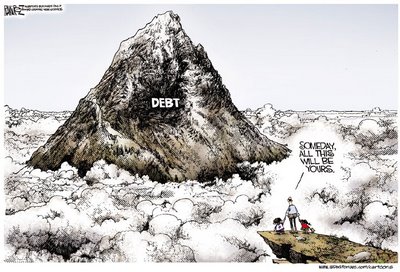
"We've consistently done too little too late, looked too short-term, said the future would take care of itself, we'll deal with that tomorrow," he says. "Well, guess what? You can't keep putting off these problems." To eliminate the fiscal gap, Kotlikoff says, the U.S. would have to have tax increases and spending reductions far beyond what's being negotiated right now in Washington."What you have to do is either immediately and permanently raise taxes by about two-thirds, or immediately and permanently cut every dollar of spending by 40 percent forever. The [Congressional Budget Office's] numbers say we have an absolutely enormous problem facing us." Please read full at NPR
Aug 7, 2011
Bedbugs Found Carrying Drug-Resistant Staph
Some bedbugs have begun carrying a deadly staph virus, researchers report, bringing a dangerous new twist to the resurgence of bedbug infestations ... Infestations have overwhelmed schools, hospitals, apartment buildings, and hotels, particularly in large cities. Adding a new and dangerous twist to the bedbug resurgences, Canadian researchers have discovered bedbugs carrying methicillin-resistant Staphylococcus aureus (MRSA) and vancomycin-resistant Enterococcus faecium (VRE). MRSA is a bacterial infection that is highly resistant to some antibiotics and can become deadly if the infection gets through the skin and into the bloodstream. VRE is a less dangerous form of antibiotic-resistant bacteria. Read more from source
Aug 6, 2011
S&P Downgrades U.S. Credit Rating for First Time
Standard & Poor’s announced Friday night that it has downgraded the United States credit rating for the first time, dealing a huge symbolic blow to the world’s economic superpower in what was a sharply worded critique of the American political system. Washington Post
...if the US credit rating is reduced from AAA many pensions will not be able to hold US Treasury bonds, as their bylaws or rules state that they must hold AAA paper. Unless they find a loophole or change their rules it will be a cascade spiral down.
...if the US credit rating is reduced from AAA many pensions will not be able to hold US Treasury bonds, as their bylaws or rules state that they must hold AAA paper. Unless they find a loophole or change their rules it will be a cascade spiral down.
Aug 5, 2011
U.S. Borrowing Tops 100% of GDP
US gross debt shot up $238 billion to reach 100 percent of gross domestic product after the government’s debt ceiling was lifted, Treasury figures showed.On Tuesday, the Treasury had to add more than $200 billion of commitments immediately after President Barack Obama signed into law an increase in the debt ceiling. The liabilities had been temporarily taken off the federal government’s balance sheet since May 16, when the Treasury reached the $14.29 trillion official cap.It then used extraordinary measures to remain under the legal limit while deeply polarized Republicans and Democrats battled over raising the debt ceiling and reining in the country’s massive deficit. The new borrowing took total public debt to $14.58 trillion, over end-2010 GDP of $14.53 trillion, putting the United States in a league with highly indebted countries like Italy and Belgium. - google AP
Rare Earth Deposit Discovered In US
 "With China having 97% of the market share of rare earth elements, many countries are nervous about being able to get supplies of key elements needed for high tech gear. Quantum Rare Earths Developments Corp. has reported they have discovered a potential huge source of rare earth elements, right in the middle of the U.S. While the USGS reports that the U.S. has an estimated 13 million metric tonnes available for mining (about 1/3 of China's reserves), finding another regular source is crucial to global stability. The potential yield of the deposit, found in Nebraska, could be the world's largest source for Niobium and other rare earth elements. Could this be the next gold rush?"
Aug 4, 2011
Funding for Sustainable Housing and Communities
U.S. Department of Housing and Urban Development (HUD) Secretary Shaun Donovan announced July 28, 2011 in a press release that HUD will be investing $95 million to support stronger, economically competitive communities through their Office of Sustainable Housing and Communities. From the release:
This year's Regional Planning Grant program will encourage grantees to support regional planning efforts that integrate housing, land-use, economic and workforce development, transportation, and infrastructure developments in a manner that empowers regions to consider how all of these factors work together to bring economic competitiveness and revitalization to a community. The program will place a priority on partnerships, including the collaboration of arts and culture, philanthropy, and innovative ideas to the regional planning process. Recognizing that areas are in different stages of sustainability planning. To read the full text of HUD's funding announcement, visit HUD?s official website www.hud.gov/sustainability Source: epa.gov/brownfields
This year's Regional Planning Grant program will encourage grantees to support regional planning efforts that integrate housing, land-use, economic and workforce development, transportation, and infrastructure developments in a manner that empowers regions to consider how all of these factors work together to bring economic competitiveness and revitalization to a community. The program will place a priority on partnerships, including the collaboration of arts and culture, philanthropy, and innovative ideas to the regional planning process. Recognizing that areas are in different stages of sustainability planning. To read the full text of HUD's funding announcement, visit HUD?s official website www.hud.gov/sustainability Source: epa.gov/brownfields
Department of Energy Relaunches Energy.Gov!
 The U.S. Department of Energy announced today the next step of its comprehensive website reform, making energy.gov a cutting-edge, interactive information platform and saving taxpayers more than $10 million annually. Through a complete overhaul of its front-end and back-end design, energy.gov modernizes how consumers and businesses access the information and resources they need to save money and energy while improving Departmental staff's ability to interact with the public and each other. "Our goal is to make energy.gov easier to use, more transparent and more participatory," said Secretary Chu. "This next phase is part of our ongoing commitment to empower consumers and businesses with the information, tools and services they need to save money, create jobs and find opportunities in the new energy economy." Check it out at www.energy.gov and read full story at EERE
Billions Available Energy and Environmental Grants & Funding
Here is a summary of just a few
Clean Fuel Buses and Facilities
The U.S. Department of Transportation requests proposals for the Clean Fuels/Bus and Bus Facilities Program. This program will support: 1) The purchase or leasing of clean fuel buses, including buses that employ a lightweight composite structure, 2) Construction or leasing of clean fuel bus facilities or electrical recharging facilities and related equipment, and 3) Projects relating to clean fuel, biodiesel, hybrid electric, or zero emissions technology buses that exhibit equivalent or superior emissions reductions to existing clean fuel or hybrid electric technologies. $51.5 million expected to be available. Rooftop Solar Challenge
The U.S. Department of Energy requests proposals for the SunShot Initiative: Rooftop Solar Challenge to Induce Market Transformation. Through this initiative, DOE seeks improvements in market conditions for rooftop photovoltaics across the U.S. $12.5 million expected to be available
Water Conservation – Lower Colorado
The U.S. Department of Interior, Bureau of Reclamation, requests proposals for Water Conservation Field Services Program - Phoenix Area Office. This program will support projects to assess the potential for water management improvements and identify specific ways to implement those improvements. $200K expected to be available State Energy Program
The U.S. Department of Energy requests proposals for the State Energy Program. This program provides formula grants to State and Territorial energy offices to design and carry out renewable energy and energy efficiency priorities. $39 million expected to be available.
Innovative Manufacturing
The U.S. Department of Energy requests proposals for the Innovative Manufacturing Initiative. This RFP will support manufacturing processes and materials to advance the clean energy economy. $120 million expected to be availableBrownfield Economic Development
The U.S. Department of Housing & Urban Development requests proposals for the Brownfield Economic Development Initiative. This initiative is designed to help local governments redevelop abandoned, idled, or underutilized real property, including industrial and commercial facilities, where expansion or redevelopment is complicated by the presence or potential presence of environmental contamination. $17.3 million expected to be available Biotechnology, Biochemical, and Biomass Engineering
The National Science Foundation requests proposals for Biotechnology, Biochemical, and Biomass Engineering. This program addresses fundamental problems involved in the processing and manufacturing of products of economic importance by effectively utilizing renewable resources of biological origin and bioinformatics originating from genomic and proteomic information. $8.2 million expected to be available Energy for Sustainability
The National Science Foundation requests proposals for Energy for Sustainability. This program supports fundamental research and education in energy production, conversion, and storage and is focused on energy sources that are environmentally friendly and renewable. Sources of sustainable energy include: Sunlight, Wind/Wave, Biomass, and Geothermal. $9.2 million expected to be available Environmental Sustainability
The National Science Foundation requests proposals for Environmental Sustainability. This program supports engineering research with the goal of promoting sustainable engineered systems that support human well-being and that are also compatible with sustaining natural systems. $5.4 million expected to be available See all annoucemnts here VIA - Laurie Brown (Big Thanks ;-)
Clean Fuel Buses and Facilities
The U.S. Department of Transportation requests proposals for the Clean Fuels/Bus and Bus Facilities Program. This program will support: 1) The purchase or leasing of clean fuel buses, including buses that employ a lightweight composite structure, 2) Construction or leasing of clean fuel bus facilities or electrical recharging facilities and related equipment, and 3) Projects relating to clean fuel, biodiesel, hybrid electric, or zero emissions technology buses that exhibit equivalent or superior emissions reductions to existing clean fuel or hybrid electric technologies. $51.5 million expected to be available. Rooftop Solar Challenge
The U.S. Department of Energy requests proposals for the SunShot Initiative: Rooftop Solar Challenge to Induce Market Transformation. Through this initiative, DOE seeks improvements in market conditions for rooftop photovoltaics across the U.S. $12.5 million expected to be available
Water Conservation – Lower Colorado
The U.S. Department of Interior, Bureau of Reclamation, requests proposals for Water Conservation Field Services Program - Phoenix Area Office. This program will support projects to assess the potential for water management improvements and identify specific ways to implement those improvements. $200K expected to be available State Energy Program
The U.S. Department of Energy requests proposals for the State Energy Program. This program provides formula grants to State and Territorial energy offices to design and carry out renewable energy and energy efficiency priorities. $39 million expected to be available.
Innovative Manufacturing
The U.S. Department of Energy requests proposals for the Innovative Manufacturing Initiative. This RFP will support manufacturing processes and materials to advance the clean energy economy. $120 million expected to be availableBrownfield Economic Development
The U.S. Department of Housing & Urban Development requests proposals for the Brownfield Economic Development Initiative. This initiative is designed to help local governments redevelop abandoned, idled, or underutilized real property, including industrial and commercial facilities, where expansion or redevelopment is complicated by the presence or potential presence of environmental contamination. $17.3 million expected to be available Biotechnology, Biochemical, and Biomass Engineering
The National Science Foundation requests proposals for Biotechnology, Biochemical, and Biomass Engineering. This program addresses fundamental problems involved in the processing and manufacturing of products of economic importance by effectively utilizing renewable resources of biological origin and bioinformatics originating from genomic and proteomic information. $8.2 million expected to be available
Energy for Sustainability The National Science Foundation requests proposals for Energy for Sustainability. This program supports fundamental research and education in energy production, conversion, and storage and is focused on energy sources that are environmentally friendly and renewable. Sources of sustainable energy include: Sunlight, Wind/Wave, Biomass, and Geothermal. $9.2 million expected to be available Environmental Sustainability
The National Science Foundation requests proposals for Environmental Sustainability. This program supports engineering research with the goal of promoting sustainable engineered systems that support human well-being and that are also compatible with sustaining natural systems. $5.4 million expected to be available See all annoucemnts here VIA - Laurie Brown (Big Thanks ;-)
Federal Loan Guarantees for the Construction of Nuclear Power Plants
CBO's analysis examines the main factors that influence the cost to the federal government of providing loan guarantees for the construction of nuclear power plants. It includes illustrative cost estimates using the methodology specified by the Federal Credit Reform Act of 1990, which determines the budgetary cost of the program, and also estimates prepared on a fair-value basis, which provide a more comprehensive measure of cost. CBO found that the expected cost to the federal government of guaranteeing a nuclear construction loan varies greatly depending on a project's characteristics...

CBO relied on a credit-ratings-based approach to evaluate the probability of default rather than on the historical experience of the nuclear industry, for which not enough data exist to draw quantitative inferences. However, historical experience suggests that investing in nuclear generating capacity engenders considerable risk. One study found that of the 117 privately owned plants in the United States that were started in the 1960s and 1970s and for which data were available, 48 were canceled, and almost all of them experienced significant cost overruns. As a consequence, most of the utilities that undertook nuclear projects suffered ratings downgrades—sometimes several downgrades—during the construction phase. However, bondholders experienced losses from defaults in only a few instances. Losses for the most part were borne by the projects' equity holders, the regions' electricity ratepayers, and the government. Supporters of nuclear power argue that newer plant designs and changes in the regulatory environment make nuclear investments less risky now, but recent experience abroad suggests that cost overruns and delays are still common phenomena, and concerns remain about an uncertain regulatory environment and changes in demand for electricity. Read more at CBO
CBO relied on a credit-ratings-based approach to evaluate the probability of default rather than on the historical experience of the nuclear industry, for which not enough data exist to draw quantitative inferences. However, historical experience suggests that investing in nuclear generating capacity engenders considerable risk. One study found that of the 117 privately owned plants in the United States that were started in the 1960s and 1970s and for which data were available, 48 were canceled, and almost all of them experienced significant cost overruns. As a consequence, most of the utilities that undertook nuclear projects suffered ratings downgrades—sometimes several downgrades—during the construction phase. However, bondholders experienced losses from defaults in only a few instances. Losses for the most part were borne by the projects' equity holders, the regions' electricity ratepayers, and the government. Supporters of nuclear power argue that newer plant designs and changes in the regulatory environment make nuclear investments less risky now, but recent experience abroad suggests that cost overruns and delays are still common phenomena, and concerns remain about an uncertain regulatory environment and changes in demand for electricity. Read more at CBO
Federal Loan Guarantees for the Construction of Nuclear Power Plants
CBO's analysis examines the main factors that influence the cost to the federal government of providing loan guarantees for the construction of nuclear power plants. It includes illustrative cost estimates using the methodology specified by the Federal Credit Reform Act of 1990, which determines the budgetary cost of the program, and also estimates prepared on a fair-value basis, which provide a more comprehensive measure of cost. CBO found that the expected cost to the federal government of guaranteeing a nuclear construction loan varies greatly depending on a project's characteristics...
CBO relied on a credit-ratings-based approach to evaluate the probability of default rather than on the historical experience of the nuclear industry, for which not enough data exist to draw quantitative inferences. However, historical experience suggests that investing in nuclear generating capacity engenders considerable risk. One study found that of the 117 privately owned plants in the United States that were started in the 1960s and 1970s and for which data were available, 48 were canceled, and almost all of them experienced significant cost overruns. As a consequence, most of the utilities that undertook nuclear projects suffered ratings downgrades—sometimes several downgrades—during the construction phase. However, bondholders experienced losses from defaults in only a few instances. Losses for the most part were borne by the projects' equity holders, the regions' electricity ratepayers, and the government. Supporters of nuclear power argue that newer plant designs and changes in the regulatory environment make nuclear investments less risky now, but recent experience abroad suggests that cost overruns and delays are still common phenomena, and concerns remain about an uncertain regulatory environment and changes in demand for electricity. Read more at CBO
CBO relied on a credit-ratings-based approach to evaluate the probability of default rather than on the historical experience of the nuclear industry, for which not enough data exist to draw quantitative inferences. However, historical experience suggests that investing in nuclear generating capacity engenders considerable risk. One study found that of the 117 privately owned plants in the United States that were started in the 1960s and 1970s and for which data were available, 48 were canceled, and almost all of them experienced significant cost overruns. As a consequence, most of the utilities that undertook nuclear projects suffered ratings downgrades—sometimes several downgrades—during the construction phase. However, bondholders experienced losses from defaults in only a few instances. Losses for the most part were borne by the projects' equity holders, the regions' electricity ratepayers, and the government. Supporters of nuclear power argue that newer plant designs and changes in the regulatory environment make nuclear investments less risky now, but recent experience abroad suggests that cost overruns and delays are still common phenomena, and concerns remain about an uncertain regulatory environment and changes in demand for electricity. Read more at CBO
Aug 3, 2011
Nuclear waste as fuel for thermoelectric generators
Curiosity will be powered by the heat given off by the natural decay of (Pu-238) non-fissile isotope of plutonium with a half-life of 87.7 years. An alpha emitter, it is easily shielded. The non-fissile isotope of plutonium are essential to a number of spacecraft missions, particularly those bound for the outer solar system. United States currently has limited facilities to produce Pu-238 . Since 1993, all of the Pu-238 the U.S. has used in space probes has been purchased from Russia. 16.5 kilograms in total have been purchased. The US Department of Energy is requesting funding to restart domestic production, but production of substantial amounts could take 5 years - bobpark.org
Energy Foundation Industrial EE Consultant Opening
The Energy Foundation is increasing its work in the industrial energy efficiency (including CHP) realm and is looking for a 50 to 100% time consultant to support this work. If any of you or your colleagues and contacts are interested, please see job announcement link here
Nissan to Use Cars To Power Homes
"Nissan has developed a system that allows a vehicle to supply electricity to power a house during a power outage or shortage. A prototype of the charging system running on a Nissan Leaf electric car was unveiled in Japan on Tuesday. A two-way charging device that would typically convert the household electricity supply to a voltage suitable for charging the car's battery can be reversed to feed power back into the household circuit." - SlashDot
800Mbps Wireless Network Made With LED Light Bulbs
"German scientists working at Berlin's Fraunhofer Institute for Telecommunications have set a new world record for Visible Light Communication technology after they succeeded in using regular red, blue, green and white LED light bulbs as the basis for building a new 800Mbps capable ultrafast Wireless Local Area Network. Dr. Anagnostis Paraskevopoulos explained: 'With the aid of a special component, the modulator, we turn the LEDs off and on in very rapid succession and transfer the information as ones and zeros. The modulation of the light is imperceptible to the human eye. A simple photo diode on the laptop acts as a receiver. The diode catches the light, electronics decode the information and translate it into electrical impulses, meaning the language of the computer.' The solution, which could be installed on ceilings and would cover approximately 10 square meters, would be ideal for HD video streaming and inside Hospitals or Aircraft where traditional Wi-Fi is often banned. However visible light signals can easily be blocked, such as when a hand is passed in front of the transmitter." - SlashDot
Big things from Congressional Budget Office (DBO) this week
- H.R. 2273, Coal Residuals Reuse and Management Act of 2011
- H.R. 2170, Cutting Federal Red Tape to Facilitate Renewable Energy Act
- H.R. 2171, Exploring for Geothermal Energy on Federal Lands Act
- H.R. 2172, Utilizing America's Federal Lands for Wind Energy Act
- H.R. 2173, Advancing Offshore Wind Production Act
- S. 519, Hoover Power Allocation Act of 2011
Aug 2, 2011
NASA's HazMat Clean up begins
NASA and the US Air Force to clean up the areas around the Kennedy Space Center and Cape Canaveral Air Force Station, which have been contaminated with decades worth of carcinogenic chemicals from launching Shuttles, the Apollo moon missions, and other rockets. The KSC cleanup is expected to take 30 years, and will cost an estimated $96 million. "By far, the most common contaminant is a chlorinated solvent called trichloroethylene, or 'trike,' and its breakdown products — substances known to cause birth defects and cancer and reaching concentrations thousands of times higher than federal drinking water standards allow. ... Kennedy's sandy, alkaline soils are thought to neutralize most metals and other contaminants before they become a problem up the food chain. But trike dies hard. And workers kept pouring it into the ground in the early years of the shuttle program, thinking it would evaporate." - SlashDot
NRC Study Lowers Hazard Estimate For Nuke Plants
With the incident at Fukushima causing much renewed concern about the risks of nuclear power this year, the NY Times brings news that the U.S. Nuclear Regulatory Commission has released the preliminary version of a safety report due out in April 2012, based upon new science about the behavior of Cesium-137. The report finds that the public health hazards of nuclear accidents at the types of reactor designs currently in common use are lower than previously thought, based upon a better understanding of the science behind earlier estimates. - SlashDot
S. 512, Nuclear Power 2021 Act for small modular nuclear reactors
S. 512, would direct the Secretary of Energy to enter into cooperative agreements with private-sector entities to develop standard designs for small modular nuclear reactors as well as processes for licensing such reactors with the Nuclear Regulatory Commission (NRC). The bill would authorize DOE to cover up to 50 percent of the cost of developing designs for such reactors and up to 25 percent of the cost to demonstrate licensing processes and would specify a final deadline for all work to be completed by January 1, 2021. CBO estimates that fully funding S. 512 would require appropriations totaling $467 million over the 2012-2016 period. Read full pdf at CBO
Aug 1, 2011
Volunteer Towns Sought to put Nuclear Waste in their backyards
Will financially crippled states be forced to take our nations waste to pay the bills? 
 Also see more on this subject
"Brian Wingfield writes in Bloomberg that the Blue Ribbon Commission on America's Nuclear Future has sent a draft report to Energy Secretary Steven Chu recommending that US communities should be encouraged to vie for becoming a federal nuclear-waste site as a way to end a decades-long dilemma over disposing of spent radioactive fuel and says this 'consent-based' approach will help cut costs and end delays caused when the federal government picks a site over the objections of local residents, 'This means encouraging communities to volunteer (PDF) to be considered to host a new nuclear-waste management facility,' says the commission. Chu named the panelists after Obama canceled plans to build a permanent repository at Nevada's Yucca Mountain after the Yucca site was opposed by politicians from the state. 'The United States has traveled nearly 25 years down the current path only to come to a point where continuing to rely on the same approach seems destined to bring further controversy, litigation, and protracted delay,' says the report. The Blue Ribbon Commission cited as a 'success' the US Waste Isolation Pilot Plant near Carlsbad, New Mexico, which has accepted and disposed of some defense-related nuclear waste for more than a decade demonstrating that that 'nuclear wastes can be transported safely over long distances and placed securely in a deep, mined repository.' With the right incentives, 'there will be a great deal of support' for a waste site near the New Mexico facility, says former Senator Pete Domenici." - SlashDot
US Radioactive nuclear waste piling up.. 138 million pounds and counting
Status of our $30 Billion Nuclear Waste Fund
Billions spent on 'Temporary' home that only lasts decades for nuclear waste
20 years and $10 billion on studies...
Nuke waste now at $96.2 billion Wall Street Journal
Nuclear waste dump is mired in inertia $15 billion Hole to Nowhere.
Innovative wind turbines power factories - 1936
We forget that wind energy was one of the most competitive markets in the early 1900's
Don't worry, someone next week will sell investors on this "new tech"

Read full here at PopSci Books
Don't worry, someone next week will sell investors on this "new tech"
Read full here at PopSci Books
Subscribe to:
Posts (Atom)