Nov 14, 2007

Important news from WasteCap - WI

LEGISLATIVE / REGULATORY UPDATE
Source: John Reindl, Dane County Recycling Manager, reindl@co.dane.wi.us
AB 76 and SB 29 have 7 Senate and 18 Assembly sponsors and increase the recycling fee at landfills to $10 per ton on April 1, 2008. The bill also increases financial assistance to responsible units (RUs) by $48 million in fiscal year 2008−09. Under these bills, in 2009, each local governmental unit receives at least a 75 percent increase in financial assistance, even if the increased amount exceeds the eligible costs of its recycling program. To read the full legislative update, visit www.wastecapwi.org/b_nov07leg

 
State of Wisconsin Division of State Facilities is asking for comments on construction waste management draft specifications.
Comments should be sent to Rex Loker at rex.loker@wisconsin.gov by Nov. 20. To download the draft specifications, visit www.wgba.org/artman/publish/cat_index_5.shtml
Wisconsin Leopold Center earns LEED Platinum
Source: Environmental News Network viawastecapwi
Built in honor of one of the world's most famed conservationists, the Aldo Leopold Legacy Center, located on Leopold's farm near Baraboo, Wisconsin, has earned 61 out of a possible 69 LEED points, the most earned by any LEED-certified building to date and enough to qualify for a Platinum rating. To read the full article, visit www.enn.com/top_stories/article/24260
 
 
For more important WasteCap Wisconsin news please visit or join, www.wastecapwi.org


Nov 13, 2007

Thanks WDNR- I am in love with this website!

Map of contaminated and cleaned up properties available on DNR Web site
MADISON - Local planners, developers, elected officials and private citizens searching for on-line information about contaminated properties in Wisconsin can look to a new and improved interactive ... Read Full Article


Hydropower.....most immediate, cost-effective, and environmentally acceptable means for developing additional electrical power".

Hydropower: As the U.S. Bureau of Reclamation has suggested, "upgrading hydroelectric generator and turbine units at existing power plants is one of the most immediate, cost-effective, and environmentally acceptable means for developing additional electrical power"
  • Hydropower has played an important part in the development of this Nation's electric power industry. Both small and large hydropower developments were instrumental in the early expansion of the electric power industry.
  • Thirty to forty years ago, hydroelectric plants supplied as much as 40 percent of the electric energy produced. Although the amount of energy produced by this means has steadily increased, the amount produced by other types of powerplants has increased at a faster rate.
  • Today, hydropower, including pumped storage, supplies over 10 percent of the electrical generating capacity of the United States. Coal-fired steam generation is the number one source of electricity in the United States. Hydroelectric pumped storage shows up as a negative factor in electricity production as more electricity is used to pump the water to the upper reservoirs than is produced when the pumped-storage units are used to generate electricity. The benefit of pumped-storage is the ability to effectively shift capacity from periods of low energy use to periods of high energy use.
  • Hydropower is the primary contributor of renewable energy in the United States.
  • The costs of generating hydropower are the lowest of all sources of electricity
  • The hydroelectricity currently produced each year in the United States. is equivalent to nearly 500 million barrels of oil. This presently represents a value for existing hydrogeneration of about $9 billion annually.
  • Hydropower generation is not a contributor to atmospheric emissions, which are a growing problem on both national and global levels.
  • Hydropower is presently the most efficient way to produce energy with each kilowatt-hour of hydroelectricity being produced at an efficiency more than twice that of any competing energy resource.
  • Only 3 percent of the around 80,000 existing dams in the United States have hydropower facilities.
  • http://www.usbr.gov/power/data/uprate/uprate.html


    Factoid: U.S. Hydropower Can Be Increased By At Least 50 Percent:

    The complete 68-page study "Feasibility Assessment of the Water Energy
    Resources of the United States for New Low Power and Small Hydro Classes of
    Hydroelectric Plants, January 2006" can be found at:

    http://hydropower.inl.gov/resourceassessment/pdfs/main_report_appendix_a_final.pdf


    Little Green Lies - Green or Greenwashed?

    The sweet notion that making a company environmentally friendly can be not just cost-effective but profitable is going up in smoke.
    ...With rising consumer anxiety over global warming, businesses want to show that they're part of the solution, says Chris Hunter, a former energy manager at Johnson & Johnson (JNJ ) who works for the environmental consulting firm GreenOrder "Ten years ago, companies would call up and say I need a digital strategy.' Now, it's I need a green strategy.'"

    Environmental stewardship has become a centerpiece of corporate image-crafting. General Electric (
    GE ) says it is spending nearly all of its multimillion-dollar corporate advertising budget on "Ecomagination," its collection of environmentally friendly products, even though they make up only 8% of the conglomerate's sales. Yahoo! (YHOO ) and Google (GOOG ) have proclaimed that by 2008 their offices and computer centers will become "carbon neutral." Fueling the public relations frenzy is the notion that preserving the climate is better than cost-effective. But Schendler, who only a few years ago considered himself a leading proponent of this theory, now offers a searing refutation of the belief that green corporate practices beget green of the pecuniary variety.

    Much corporate environmentalism boils down to misleading statistics and hype. To make real progress, genuine accomplishments will have to be sorted out from feel-good gestures. Schendler no longer views business as capable of the dramatic change he thought possible eight years ago, the sort of change that corporations have grown accustomed to boasting about. His own employer is "a perfect example of why this won't work," he says. "We've had a chance to cherry-pick 50 projects and get them done. But even if every ski company could do what we did, we'd still be nowhere."

    Read full in businessweek here

    The hybrid option minimal savings over the life of the vehicle for car owners...

    Diesel, Hybrid Vehicles Can Provide More Societal Benefits Than Gas-powered Autos

    November 12, 2007 — Cars and light trucks powered by advanced diesel technology or hybrid technology can provide larger societal benefits than traditional gasoline-powered automobiles, according to a new ... > full story

    Among the key findings from the consumer perspective:

    • For all three vehicle types, the advanced diesel offers the highest savings over the life of the vehicle among the options considered. These savings increase with the size and fuel use of the vehicle: $460 for the car, $1,249 for the SUV and $2,289 for the large pick-up truck;
    • The hybrid option has smaller but still considerable savings for SUV applications ($1,066), moderate savings for pick-up applications ($505) but minimal savings over the life of the vehicle for car owners ($198);
    • The vehicles operating on E85 cost all three owners more over the vehicle life, with a greater net cost burden for larger vehicles and increased fuel consumption: (-$1,034 for cars, -$1,332 for SUVs, -$1,632 for pick-ups).

    Both the hybrid and diesel vehicles are more fuel efficient than their gasoline-powered counterparts: 25 to 40 percent better for hybrid and 20 to 30 percent for diesel, depending on the vehicle.

    "While it is assumed that the hybrid vehicle will save more fuel than the advanced diesel, the overall advantage goes to the diesel because of its lower technology costs and better performance such as increased torque," Graham said. "For E85, it is the cost of producing the fuel, not vehicular changes, that drives the negative results."


    HAASE - Have they ever read about direct injected hybrid diesels CURRENTLY sold in U.K.? How about CNG?

     The vast majority small cars can get 60 mpg without right NOW.

    45 Mpg is achieveable today in all car classes. Who are we kidding?

    Sustainability requires living within the regenerative capacity of the biosphere.

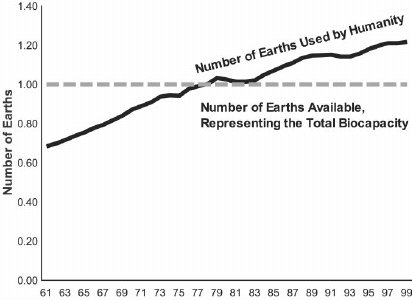
    I thought it was time to step far enough away from the myopia induced by current oil prices and, in so doing, provide sufficient space to review the the sustainability of the way we live. The title is taken from Jeffrey Dukes' 2003 paper Burning Buried Sunshine: Human Consumption of Ancient Solar Energy (pdf). Before moving on to Dukes' results, here is a summary of the findings of Mathis Wackernagel, et. al. Tracking the ecological overshoot of the human economy (pdf).

     
    Sustainability requires living within the regenerative capacity of the biosphere. In an attempt to measure the extent to which humanity satisfies this requirement, we use existing data to translate human demand on the environment into the area required for the production of food and other goods, together with the absorption of wastes. Our accounts indicate that human demand may well have exceeded the biosphere's regenerative capacity since the 1980s. According to this preliminary and exploratory assessment, humanity's load corresponded to 70% of the capacity of the global biosphere in 1961, and grew to 120% in 1999.


    BP: Commercial-Scale Biobutanol May Beat "Economically Sound" Cellulosic Ethanol to Market

    In an interview with the site Ethanol Statistics, BP Biofuels President Philip New said that the company hoped that it may have biobutanol available on a commercial scale before cellulosic ethanol is available on "an economically sound basis."

    I want to avoid setting expectations that are inappropriate on the basis of cutting edge biotech. There could be events that speed up things and set backs. We have our targets, but I hope that we will have butanol available on a commercial scale, before we have cellulosic ethanol on an economically sound basis.

    —Philip New

    In 2006, BP and DuPont formed a partnership to develop, produce and market next-generation biofuels to help meet increasing global demand for renewable transport fuels. The first product from the partnership is to be biobutanol. (Earlier post.)

    Butanol's energy content is closer to gasoline than ethanol's. It is non-corrosive, can be distributed through existing pipelines, and can be—but does not have to be—blended with fossil fuels.

    Biobutanol's low vapor pressure and its tolerance to water contamination in gasoline blends facilitate its use in existing gasoline supply and distribution channels. It has the potential to be blended into gasoline at larger concentrations than existing biofuels without the need to retrofit vehicles and it offers better fuel economy than gasoline-ethanol blends, improving a car's fuel efficiency and mileage.

    Nov 12, 2007

    Highlights of recent additions to the GLRPPR web site

    GLRPPR web site www.glrppr.org

    The web site of the month for November is USGBC Build Green Schools:

    http://www.buildgreenschools.org

    See previous sites of the month at

    http://www.glrppr.org/news/site_of_the_month.cfm

    Volunteer to provide a technical review of new GLRPPR Topic Hubs. GLRPPR
    has developed two new school-related Topic Hubs as part of the P2Rx Topic
    Hub project. See http://www.glrppr.org/hubs/ for more information on the
    project. Before any Topic Hub is published, topical experts review its
    narrative portions for accuracy and completeness. The two new Topic Hubs
    are "Energy Efficient Schools and Students" and "Sustainable School Design."
    See the GLRPPR Blog entry further describing these Topic Hubs and what to do
    if you?re interested in reviewing them at

    http://lib.wmrc.uiuc.edu/glrppr-blog/?p=64

    China: poverty reduction, energy security more important than capping emissions


    China is about to become the world's top greenhouse-gas producer, even though its per capita emissions are still only 35% of the OECD average. However, the People's Republic's stunning economic growth means it will be responsible for the major share in emissions growth over the coming decades, the International Energy Agency said in its World Energy Outlook released earlier this week. The agency projects that in a business as usual scenario, global CO2 emissions will jump from 27 gigatonnes in 2005 to 42 Gt in 2030, with China alone accounting for 42% of the increase. In a high growth scenario, this share will increase to a whopping 49%, more than the rest of the world combined (except India) Image & Ref from BioPact

    'Taking Up Arms' In Regard To Threats To Tap The Great Lakes

    Two Michigan members of Congress fired a stern warning Thursday to colleagues in faster-growing, drought-stricken parts of the nation: Don't even consider using a seemingly harmless bill to study the nation's water usage as cover to begin a process aimed at taking Great Lakes water.

    "I don't think I'm being too alarmist about this," said Rep. Candice Miller, a Harrison Township Republican. "Do not look to the Great Lakes to solve the nation's water problems."

    Her Michigan colleague on the House subcommittee on water resources and environment, Grand Rapids Republican Vern Ehlers [pictured], predicted what might happen if anyone attempted a water grab.

    "I would suspect we'd call up the militia and take up arms," Ehlers said. "We feel that serious about it."

    You have to wonder how welcoming Michigan residents would be to a drought-driven diaspora of 5 to 10 million new residents, given that the Great Lakes states are already suffering for jobs. The meta message is more like this: 'we'll take your jobs and taxbase and maybe some of your best and brightest.'

    Back to the call to arms provocation.

    Their comments came Thursday during a discussion about legislation called the 21st Century Water Commission Act, which would authorize a study of how the nation uses water, where it comes from and how long it will last.

    Apparently, the [Congressional] panel talking about the legislation included speakers from Arizona, Georgia and Texas -- and none from the Great Lakes region - while the commission and a possible national water policy were being proposed by someone representing a drought-stricken area.'

    ViaDetroit Free Press, "Legislators: Hands off our water, Two House members from Michigan demand no diversion of the Great Lakes to other states" Link credit,treehugger.com

    Filed under: waterwars

    Wisconsin farmer turning cheese manufacturing waste into biofuel.

    What will the fuel of the future look like and where will it come from? Anything & Everywhere...
     
    "There is no one silver bullet," Van Groll said in a press release. "The silver bullets are already out there — taking waste streams and turning them into profit centers."

    Prepare for a variety of fuels from many sources, says Wisconsin entrepreneur Joe Van Groll whose start-up renewable energy company produces both ethanol and bio-diesel without a single corn kernel or soybean in sight. The Grand Meadow Energy LLC near Stratford trucks in waste from surrounding cheese plants and raw canola oil from a nearby farm.
    Van Groll bought the Grand Meadow Coop cheese plant when it closed more than three years ago, converted it and with $29,000 from the state's Agricultural Development and Diversification grant program, began testing what is now a trade secret. Today, customers buy a license to use the yeast-based technology he developed with help from the grant.

    As concerns about the environmental and societal impact of corn-based ethanol rise, he lists the advantages of his method. "I don't use energy; I put it back on the grid. I don't slurp up water; I purify and recycle it. I don't push up food costs; I dispose of waste," he said.

    Van Groll is a 13-year veteran of the state's cheese industry, and his process focuses on permeate, a by-product of cheese making. But Van Groll says the technology can be used on a variety of waste streams and he sees no end in sight to its application. His technology now turns what he refers to as "a messy problem" into a profit center for cheese plants. He buys permeate, blends it with a customized yeast culture, and produces pure alcohol ethanol. He does so at about a quarter of the cost of producing corn-based ethanol.

    Two months ago, he began blending the ethanol with raw canola oil to make biodiesel. He uses the biodiesel to power a generator that produces electricity for his plant and plans to sell excess energy back to the power company. Producing two renewable fuels gives him the option of choosing which market is offering the best return. He also sells dried yeast, a byproduct of the process, for livestock feed.
     

    Homeland Security To List Dangerous Chemicals

    "The average chicken farmer does not have enough chemicals to make his farm a terrorist target, but many fertilizer wholesalers and paper mills do -- and they'll have to tell the government about it as part of new anti-terrorism measures. On Friday, the Homeland Security Department plans to release a final list of chemicals that businesses must report to keep dangerous materials out of the hands of terrorists. It's part of new authority Congress gave the department to keep an eye on places where hazardous chemicals are kept. An original list of 344 chemicals -- some with specific weight thresholds -- was proposed in April and caused an uproar among businesses that had assumed they would be exempt from such terror-related reporting laws. If a facility has a chemical on the department's list, it has to fill out an online form that the Homeland Security Department will use to decide whether the chemical poses enough of a terrorist risk that the facility's security measures should be regulated. Many chicken farms, for example, keep more than 7,500 pounds of propane, the threshold on the original list. But a new reporting threshold of 60,000 pounds for propane exempts them." Eileen Sullivan reports for the Associated Press  Read it here: VIA sej.org
     

    "Is a common oil and gas drilling technique making people ill?"

     A House panel Wednesday grappled with concerns that chemicals used in 'hydraulic fracturing,' a process to boost oil and gas production, could pollute nearby drinking water or be released into the air and sicken local residents. 'Oil and gas companies can pump hundreds of thousands of gallons of fluid -- containing any number of toxic chemicals -- into sources of drinking water with little or no accountability,' said Rep. Henry Waxman, D-Calif., chairman of the Oversight and Government Reform Committee. In hydraulic fracturing, a mixture of water, sand and chemicals is injected into a well at high pressure to crack underground rock formations and allow trapped oil or -- more typically -- natural gas to escape. The technique is commonly used in coal bed methane, shale and tight sand fields, where getting to the hydrocarbons can be difficult. Hydraulic fracturing already has been used on more than a million wells nationwide, according to the American Petroleum Institute, a trade group. And industry experts estimate oil-field-services firms will use this technique on up to 80 percent of new gas wells drilled over the next decade. In 2004, the U.S. Environmental Protection Agency examined the use of hydraulic fracturing fluids in coal bed methane wells and concluded they posed a minimal threat to underground sources of drinking water. Since coal bed methane deposits typically lie relatively close to the surface, they were thought to be the most likely to cause a problem for drinking supplies. A critic within the EPA, however, called the study 'scientifically unsound,' Amy Mall, senior policy analyst with the Natural Resources Defense Council, told the panel Wednesday. David Ivanovich reports in the Houston Chronicle Oct. 31, 2007.

    Read it here: http://www.chron.com/disp/story.mpl/headline/biz/5262979.html (VIA sej.org)
     

    Nov 10, 2007

    Climate change denialists winning the race for "Best Science Blog"

    "In the 'Weblog Awards Best Science Blog Contest' a pseudoscience web site denying the effect humans have on global warming is currently in the lead over real science blogs. Apparently conservative political sites have been directing their readers to vote for it, whether they read it or not." Link  (VIA-Boing2)

    NBC's GreenWeek a Bust - We all lose

    NBC's Green Is Universal week;"there was no escaping the green message, and it was ... what's the word? ... artificial and painful and forced.

    Three of the four shows -- My Name Is Earl, 30 Rock, and Scrubs -- took the over-the-topness over the top, having fun at their bosses' expense and doing the movement no favors. Earl was forced to wedge a green message into a school program about prison. David Schwimmer showed up on 30 Rock as an obnoxious, rigid, predictably narrow-minded green superhero who was a hit with the Today show crowd (and yes, that made me wince); Al Gore swooped in to add substance to his message, but promptly disappeared to save the whales. On Scrubs, Janitor turned his life into an eco-crusade, complete with Scout-style badges, only to learn that it's daunting and overwhelming and people don't really listen. Only The Office took a different route, with a bizarre -- but refreshing, given its context -- tale about finding oneself in the woods.

    Throughout the evening, NBC aired mock PSAs featuring stars of the shows giving useless advice about going green. Seizure-inducing "tips" flashed at the bottom of the screen during the shows as well, and earnest ads from corporate giants touted various levels of eco-cred.

    What were we to make of it all? At the end of night, I just felt depressed. All this attention on green issues is amazing, it really is -- when you see a prime time with a woman talking up a CFL bulb, you know things have changed. But is the messaging nothing more than the same old "greens are self-righteous prigs" shtick? Is the backlash against the popularity of green just a reversion to the pre-popularity mindset? I thought the conversation was changing. Now I'm not so sure."


    Like I have said before:" Imagine if the Millions spent on just the publication, circulation and promotion of these shows went towards environmental education a tangible energy programs or current technology?

    ANY environmental or energy engineer would tell you that this kind money diverted to scientific development could have a revolutionary impact in resolving the real problems in our short lifetimes. - Have a good weekend, Chris

    RE: "death of the manmade global warming theory" ? Subhoaxing

    There was a wild scramble on Wednesday about the death of the manmade global warming theory, except the authors didn't exist, nor their institution, nor the journal. It took two minutes to find this out, so what was the purpose? Just a prank?
     
    From the hoax site:
    Carbon dioxide production by benthic bacteria: the death of manmade global warming theory?
    Journal of Geoclimatic Studies (2007) 13:3. 223-231
    www.geoclimaticstudies.info/bent...a.htm
    The hoax text: These findings place us in a difficult position. We feel an obligation to publish, both in the cause of scientific objectivity and to prevent a terrible mistake - with extremely costly implications - from being made by the world's governments. But we recognize that in doing so, we lay our careers on the line. As we have found in seeking to broach this issue gently with colleagues, and in attempting to publish these findings in other peer-reviewed journals, the "consensus" on climate change is enforced not by fact but by fear. We have been warned, collectively and individually, that in bringing our findings to public attention we are not only likely to be deprived of all future sources of funding, but that we also jeopardize the funding of the departments for which we work.

    We believe that academic intimidation of this kind contradicts the spirit of open enquiry in which scientific investigations should be conducted. We deplore the aggressive responses we encountered before our findings were published, and fear the reaction this paper might provoke. But dangerous as these findings are, we feel we have no choice but to publish.


    FULL PAPER at www.geoclimaticstudies.info/bent...a.htm

    Daniel A Klein*, Mandeep J Gupta*, Philip Cooper**, Arne FR Jansson**.
    *Department of Climatology, University of Arizona;
    **Department of Atmospheric Physics, Göteborgs Universitet (University of Gothenburg, Sweden.)
     
    It turns out to be a fraud that was created by a certain David Thorpe in Wales UK (coincidence - where George Monbiot lives...!). He has admitted creating the website and then taking it down.

    bluecrabboulevard.com/2007/11...trating/

    "Subhoaxing for Global Warming: The Journal of Geoclimatic Studies

    The global warming hoax is getting sophisticated enough to spawn subhoaxes intended to discredit the resistance. A site calling itself Journal of Geoclimatic Studies is down now, probably permanently. Slick enough to temporarily trick even Rush Limbaugh, it claimed that global warming is caused by ocean bacteria. The findings were fictional, and the entire site was a hoax, as warned by Blue Crab Boulevard."

    Nov 9, 2007

    Are you being poisoned? 93% of you are.... Update

    Five volunteers tested by Environment Illinois were surprised to find out their bodies contained toxic chemicals — all from using everyday products
        Read full here


    Also 93% of people showed exposure in CDC study -  Government researchers have confirmed widespread exposure to a common chemical found in items such as baby bottles and dental sealants.
    Nearly 93% of more than 2,500 people tested by the Centers for Disease Control and Prevention had bisphenol-A in their urine. 
        Read more here

    EPA to fine CA Over Clean Air

    When I read this week that California Filed Suit Against U.S. Over Clean Air, "and was prepared to "sue again and sue again" ...

    I was besides myself with the lack of progress our own government has made.
    Where does the American public think the money comes from when government sues government?

    Billions of dollars that could be used for Environmental protection gets thrown away every in these federal/state bickering wars...

    When dozens of other states have made REAL gains on environmental protection... California continues to be plague with poor performance and lack of follow through on its VERY own policies (vessel, vehicle emissions, energy, etc...).

    My suggestion to California, lead by example and resolve your own problems first.

    Please take the high road on this, your state examples lead our nation.
    Using all your free geothermal, solar, wind and wave capacity would be a start.
    Map of your potential wind power:
    Map of your potential solar power:
    Data geothermal potential power:
    Other renewable resources CA has in abundance:
    What other state in the U.S. has it as good with prime locations for transport?

    Prove our nation can solve our energy, water and environmental problems by working on solutions together. Not by A suing each other on which hybrid SUV to drive to next lawsuit hearing.

    Seriously, lets stop the war within ourselves and move forward positive progress together.

    I have many friends, family and colleagues in CA. I also think Arnold has made progress, but this is a huge step in the wrong direction.

    Have a better weekend,
    Chris

    WI Governor, "Great Lakes are truly of national and international importance"

    Great Lakes citizens call on the Great Lakes Governors to make Great Lakes protection and restoration a priority -Governor Jim Doyle, Chair of the Council of Great Lakes Governors, today called on each Democratic and Republican presidential candidate to support protecting and restoring the Great Lakes.   
     
    The Great Lakes are truly of national and international importance—both environmentally and economically.  The health of the national economy depends on the
    Great Lakes.  Almost thirty percent of the nation's gross domestic product is produced by Great Lakes States, including approximately sixty percent of all
    U.S. manufacturing. Additionally, more than 35 million Americans benefit from the drinking water, food, recreational opportunities, jobs and transportation that the
    Great Lakes provide.

    "The next President must share our vision of protecting the Great Lakes ," Governor Doyle said. "The Great Lakes are not only our greatest natural resource, but they are also a true national treasure.   We need federal leaders who share our vision – strong partners who recognize that the Great Lakes are critical to our nation's future.  Protecting, preserving, and improving the Great Lakes is not just a Wisconsin issue or a Michigan issue, it must be a national and international priority."


    Also, see additional information on the Great Lakes Governors' efforts to restore and protect the Great Lakes is available at www.cglg.org

    Free Biofuels session by alternative energy expert Dr. Steven Bertman - KALAMAZOO, MI

    Bertman, Western Michigan University professor of chemistry, forgoes the cryptic implications of these issues that are often found in scientific reports and texts for a chance to address the realities of the nation's energy crisis.

    A talk about "What Biofuels are in Your Future?" will be held at 4 p.m. Wednesday, Nov. 14, in Room 1220 of WMU's new Chemistry Building. During this free, public discussion, Bertman will touch on the nation's current and future energy needs, basic properties of biofuels and other alternative energy sources, and the viability and accessibility of resources needed to maintain the modern lifestyle.

    "We are certainly not the world's leader in alternative energy," Bertman says. "We're way behind the game. We should have been where we are now decades ago."


    Nov 8, 2007

    "Ship Emissions Seen Causing 60,000 Deaths a Year"

    Filed under "I Told Ya So..."

    "BEIJING -- Emissions from ocean-going ships are responsible for about 60,000 deaths a year from heart and lung-related cancers, according to research published on Wednesday that calls for tougher fuel standards. Shanghai, Singapore and Hong Kong, three of the world's five busiest ports, were likely to suffer disproportionate impacts from ship-related emissions, said the study, published in Environmental Science and Technology, a journal of the American Chemical Society. 'For a long time there's been this perception that ship emissions are out there in the ocean and they don't really affect anyone on land and I think this study shows that this is clearly false,' said David Marshall, senior counsel at the Boston-based Clean Air Task Force, which co-commissioned the study. ... Scientists said the fact that shipping takes place on the high seas -- away from populations who can readily see impacts of emissions -- was part of the reason the industry's fuel standards lagged those of the auto industry. But sulfur emissions from international shipping represent about 8 percent of sulfur emissions from all fossil fuels, said James Corbett, one of the authors of the study. Most ships run on bunker fuel, which is cheaper than distillate, but also more polluting. Corbett said it was also getting dirtier over time as distillate fuels become cleaner, since the sulfur driven out of distillates ends up in the residuals used by ships." Lindsay Beck reports for Reuters Nov. 7, 2007.

    "Fire Destroys Plastics Manufacturing Plant"

     -- A four-alarm fire gutted one of the largest rotational molding companies in the country. Firefighters from Caldwell, Nampa, Wilder, Star, Middleton and Parma worked together to put out the blaze at the Rotonics Manufacturing Inc. plant in Caldwell on Tuesday. Apparently, an oven used to make the products is the reason it went up in flames. From miles away, you could see thick plumes of smoke billowing into the air. ... 'Because of the smoke and heat and involvement in there, they [firefighters] backed out,' said Richard Davies, Nampa Deputy Fire Chief. Instead, the 40 firefighters poured water into every opening they could find and create. ... Fire officials estimate the damage done to the facility and equipment at $3 million. They believe the whole building will probably have to be replaced. The blaze at the plastics plant almost forced the evacuation of a nearby school. Van Buren Elementary is just two blocks away from Rotonics Manufacturing. Because of the heavy amounts of smoke in the air and toxic chemicals burning, school administrators were concerned about the safety of the nearly 500 students at the school. They decided to take a proactive approach by getting the kids ready to be evacuated to other nearby schools. 'We had 14 buses within five minutes ready to move the children -- teachers and kids ready to go. ...'"
     
    Video link here:  Caldwell Plant Fire
     

    Where's Wisconsin on limiting water exports?

    Jim Rowen asks the right questions. Let's hope a bold Wisconsin Legislature has the answers. (Same for Michigan.)

    Will Wisconsin be the holdout state for the last, best hope for Great Lakes protections?

    Will anyone in the Legislature assume and exercise real leadership on this issue?

    Is there a fearless steward of the Great Lakes in state government, anywhere?

    http://www.madison.com/tct/opinion/column/255517

    WATER WARS 2008 - INDIA HAS VASTLY OVERESTIMATED AVAILABLE WATER

    Did I not mention this in April...

    TIMES OF INDIA - A paper published by researchers from IIT-Delhi and Jamia Milia Islamia has claimed that the government has overestimated the utilizable water resources of the country by up to 88% and had breached its water security levels way back in 1997-98 by overexploiting the resource.

    Published in 'Current Science', 's leading science journal, the study by N K Garg of IIT-Delhi and Q Hassan of Jamia Milia Islamia claimed that the government overestimated water available for use by a whopping 66-88% by double accounting for the resource in their methodology. . .

    Cutting through the reams of data and calculations mentioned in the paper, Garg explained, "During the lean period, the water in rivers that one sees is actually ground water as there is no rain at the time. But when the CWC calculated total utilizable water, it accounted for the water in the rivers at the time as surface water as well as ground water, leading to the inflated figures."

    Filed under: waterwars

    AVERAGE CHILD EXPOSED DAILY TO 27 CHEMICALS NOT FOUND SAFE FOR THEM

    TREE HUGGER - According to an investigation by the Environmental Working Group children are being exposed daily to chemicals via the use of everything from baby shampoo to diaper wipes that have not been assessed for their hazards to children. In an online survey of more than 3,300 parents, the group found that the average child is exposed through body care products to 27 chemicals a day that have not been found safe for them, including some that are associated with brain and nervous system damage, hormone disruption, allergies and cancer. All common ingredients in baby shampoo, lotion, diaper cream, and sunscreen.

    As Dr. Becky Sutton, study's author pointed out, "Just because a shampoo or sunscreen is labeled 'children's' doesn't mean it's been tested and found safe for kids; children are more at risk than adults from many chemical hazards, but we have no special standards to protect them." In conjunction with the release of this report, EWG has also put out a comprehensive parent's buying guide to help determine which products to avoid and which to choose.

    Shell Oil - "we use our waste CO2 to grow flowers."

    Shell Oil has removed ads from Britain's media after the country's Advertising Standards Authority criticized the company's claim to consumers that "we use our waste CO2 to grow flowers." A complaint from activist groups estimated that perhaps 0.325 percent of Shell's emission of poor, misunderstood CO2 emissions are used to grow flowers.

    sources: Associated Press, Reuters

    USW Slams DuPont Over Greenwashing

    dupont_greenwash.jpgThe United Steelworkers says that instead of being a "sustainable" chemical company, DuPont engages in "greenwashing," LOHAS reports.
    A key... Read more from Environmental Leader

    $11 million os your Tax dollars to cleanup San Bernardino, Calif.

    U.S. EPA settles with county of San Bernardino for 11 million for Newmark Superfund site cleanup
    (San Francisco, Calif. -- 11/07/2007) The U.S. Environmental Protection Agency recently settled with the county of San Bernardino, Calif. for $11 million that will be used for cleanup and enforcement activities at the Newmark Groundwater Contamination Superfund Site, located near San Bernardino


    Read more here

    Producing geothermal power from oil and gas wells in the Gulf of Mexico is also being considered.

    http://www.renewableenergyaccess.com/rea/news/ate/story?id=49161

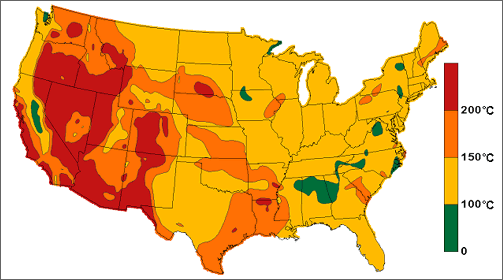
    U.S. Geothermal Resource Map

    The geothermal resources map of the United States below shows the estimated subterranean temperatures at a depth of 6 kilometers. To determine the Earth's internal temperature at any depth below the capabilities of normal well drilling, multiple data sets are synthesized. The data used for this figure are: thermal conductivity, thickness of sedimentary rock, geothermal gradient, heat flow, and surface temperature.

    Geothermal Resource Map of the United States showing the continental United States with estimated subterranean temperatures of 200C plus shown in red, estimated subterranean temperatures of 150°C to 200°C shown in orange, estimated subterranean temperatures of 100°C to 150°C shown in yellow, and estimated subterranean temperatures of 0° to 100°C shown in green. Red areas are located primarily in the western states including Washington, Oregon, California, Idaho, Nevada, Montana, Colorado, Arizona, and New Mexico. Most of the map is colored yellow.

    Also see geothermal resource maps.

    EPA terminates agreement to design cleanup of Waukegan Harbor

    FOR IMMEDIATE RELEASE No. 07 - OPA210 CHICAGO (Nov. 8, 2007) - U.S. Environmental Protection Agency has notified the city of Waukegan that it has terminated the agreement to design a project to clean up Waukegan Harbor using funds provided by the Great Lakes Legacy Act.
     

    Geothermal Simple math - and one more reason to move to AU

     
    The HFR geothermal process is a closed system, with two loops.

    The first loop uses water to extract heat from the buried hot rocks. The simplest hot dry rock power plant comprises one injection well and two production wells. Cold water is pumped under pressure down an injection well where it flows through an underground heat exchanger in the hot granite. It is then returned to the surface through production wells.

    Because this loop operates under pressure, the super heated water remains a liquid, with no steam generated.

    The heated water (> 200oC) returns to the surface under pressure. The high temperatures of the hot water are transferred to the geothermal power station loop via a heat exchanger. This second closed loop uses liquids with a low boiling point (similar to those used in fridges and air conditioners) and this drives a turbine system.

    The cooled geothermal water returns to the underground heat exchanger where it is reheated.

    The twin loop system is known as a binary geothermal power plant.


    3 Well HFR Geothermal Power Station.  The hot granite needs an insulating blanket of sedimentary rocks at least 3km in thickness.


    Schematic diagram of binary geothermal powerplant


    From: http://www.geodynamics.com.au/IRM/content/hfr_hfrexplain_hfrgeothermal.html

    Nov 7, 2007

    GreenOrder, Are they the source or the solution to "greenwashing"?

    Did someone order Green?
    Yesterday I noticed Green Order, Inc. stopped by my blog to track "NBC's green sweeps week." (via Joel's post)
    The question is: Are they the source or the solution to "greenwashing"?
    Promoting a "green" program before it has resulted in measurable, tangible or sustainable impacts is simple greenwashing.
    Reducing, Recycling and Reusing resources to add corporate value and bottom line ROI is just "Lean and Green".
    The key difference to know what side of the GREEN "GreenOrder", will be based on the long term sustainability and impact of these corporate programs.
    Their clients have been some of the largest sources of environmental impact for decades and if GreenOrder succeeds in helping these company's actually reduce resources, energy consumption and environmental impact now and into the distant future... we all win.

    DYK - Biofuels industry will get $ 92 billion

    Biofuels — At What Cost? 2007 Update on the United States

    Download the report: Biofuels—At What Cost? Government Support for Ethanol and Biodiesel in the United States – 2007 Update

    For the original October 2006 report on government support to biofuels in the United States, click here.

    23rd October 2007, Washington D.C. The biofuels industry is witnessing unprecedented growth in the United States, driving agricultural commodities prices to record levels and sparking a host of environmental and economic concerns. This expansion is far from imputable wholly to market forces; rather, federal, state and municipal jurisdictions have been instrumental in driving up both the production and consumption of biofuels through sizeable subsidies and other incentives. A new report by the Global Subsidies Initiative (GSI) and Earth Track, "Biofuels — At What Cost? Government Support for Ethanol and Biodiesel in the United States — 2007 Update", revises an earlier report issued October 2006 and details the extent of current government support to biofuels in the United States. The report also analyzes the potential impact of forthcoming legislation, namely the Energy and Farm Bills, which are poised to expand government support even further.

    Under existing policies, the biofuels industry will, in aggregate, benefit from support worth over $ 92 billion within the 2006–2012 time frame.

    Read more here

    Los Angeles Times editorial, "Killer Cow Emissions,"

    Los Angeles Times editorial, "Killer Cow Emissions,"
     
     
    "…as evidence mounts that cutting back on beef would both improve our health and help stave off global warming, a campaign urging people to do so is clearly in order. It's understandable why political candidates are wary of bashing beef, but less understandable why environmental leaders with nothing to lose are reluctant to raise the issue. They would be more credible in targeting polluters if they were equally assertive in pointing out what all Americans can do to fight global warming, and at the very top of that list... would be eating less red meat."


    Why reduce when you can have third world countries pay for your gluttony.

    U.S. Capitol buys carbon offsets As part of an ongoing greening plan, the U.S. Capitol is buying $89,000 worth of carbon credits to offset the 30,000 tons of greenhouse gases emitted annually by the antiquated coal plant that provides it with power. The Government Accountability Office plans to publish a review of the carbon-offset industry in April; some members of Congress asked House Chief Administrative Officer Daniel Beard, who will cut the offset check to the Chicago Climate Exchange, to hold off until the GAO report is published. Beard chose to go ahead, but also says that shutting down the coal plant is a priority -- although coal-state lawmakers are sure to fight for it to stay. source: The Washington Post (VIA GRIST)